EasyLeadz vs Vulcan7: Which Lead Data Tool Wins in 2026?
EasyLeadz sells mobile numbers for B2B prospecting. Vulcan7 sells expired listings and a power dialer for real estate agents. They rarely compete for the same buyer — here is how to tell which one is actually yours.
TL;DR
- EasyLeadz (via its "Mr. E" extension) is a B2B contact-data tool built to pull direct mobile numbers from LinkedIn profiles, with unusually deep coverage in India and APAC.
- Vulcan7 is a real estate prospecting platform: expired listings, FSBOs, pre-foreclosures, and neighborhood search, bundled with a multi-line power dialer.
- They are not really substitutes. If you sell software, services, or recruiting into companies, Vulcan7 has no data for you. If you're a listing agent chasing expireds at 8am, EasyLeadz has no leads for you.
- Price gap is large: EasyLeadz sits in the tens of dollars per month for modest credit volumes; Vulcan7 commonly lands in the $300–$450/month range once you add dialer lines.
- If your actual need is "find and verify business contact details at scale, by domain and by name," a dedicated finder-plus-verifier stack is cheaper and more accurate than either.
What are EasyLeadz and Vulcan7, exactly?#
They solve different problems that both happen to be called "lead generation."
EasyLeadz is an Indian B2B contact intelligence company. Its best-known product, Mr. E, is a Chrome extension that sits on top of LinkedIn: you open a prospect's profile, click, and it returns a direct dial (and often a work email). It's credit-based — each revealed contact burns a credit — and it also exposes an API and a company database for building lists. The pitch is speed and mobile-number hit rate, particularly for APAC and India-based decision makers where most Western data vendors go thin. You can see their current packaging on easyleadz.com.
Vulcan7 is a US real estate prospecting platform. It scrapes and licenses MLS and public-record data to deliver daily lists of expired listings, for-sale-by-owner (FSBO) sellers, pre-foreclosures, and "neighborhood search" (circle prospecting) contacts — each with phone numbers attached and scrubbed against the national DNC list. On top of that sits a power dialer that runs one, two, or three lines simultaneously so an agent can burn through 200 dials in a morning. Details live at vulcan7.com.
So the honest framing of EasyLeadz vs Vulcan7 isn't "which tool is better." It's "which of these two very different data supply chains matches the list you're trying to build."
How do EasyLeadz and Vulcan7 compare head-to-head?#
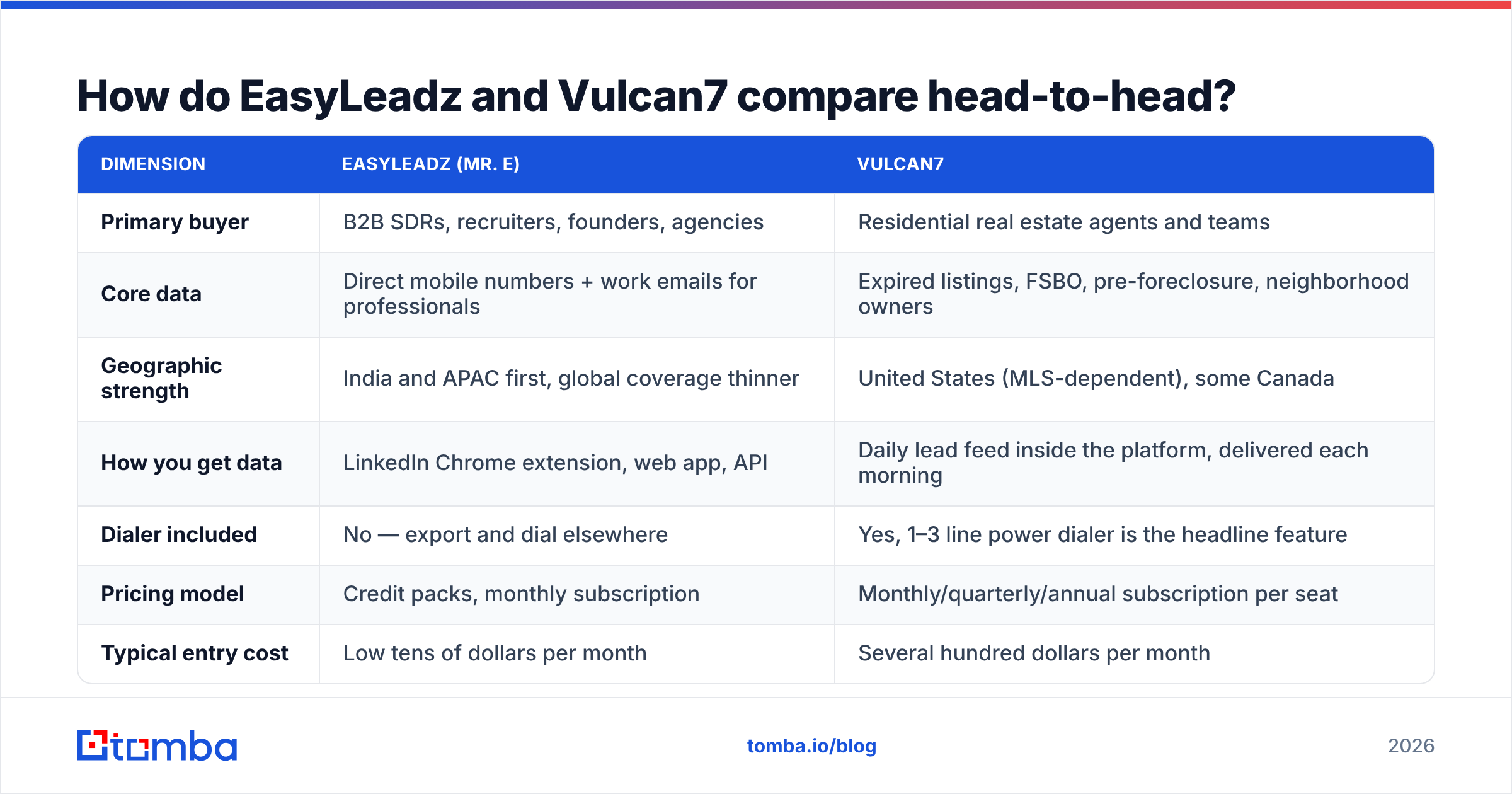
| Dimension | EasyLeadz (Mr. E) | Vulcan7 |
|---|---|---|
| Primary buyer | B2B SDRs, recruiters, founders, agencies | Residential real estate agents and teams |
| Core data | Direct mobile numbers + work emails for professionals | Expired listings, FSBO, pre-foreclosure, neighborhood owners |
| Geographic strength | India and APAC first, global coverage thinner | United States (MLS-dependent), some Canada |
| How you get data | LinkedIn Chrome extension, web app, API | Daily lead feed inside the platform, delivered each morning |
| Dialer included | No — export and dial elsewhere | Yes, 1–3 line power dialer is the headline feature |
| Pricing model | Credit packs, monthly subscription | Monthly/quarterly/annual subscription per seat |
| Typical entry cost | Low tens of dollars per month | Several hundred dollars per month |
| DNC scrubbing | Not a core feature | Built in, central to the value prop |
| CRM fit | Exports to CSV, HubSpot, Salesforce via API/Zapier | Real-estate CRMs, plus its own follow-up tooling |
| Best single use case | "Get me this VP's mobile number now" | "Give me every expired listing in my county by 7am" |
Two things jump out of that table. First, Vulcan7's data is event-driven — a listing expired, a homeowner decided to sell without an agent — which is why agents pay a premium for it. Freshness is the product. Second, EasyLeadz's data is identity-driven — a person exists, works somewhere, and has a phone. Freshness matters but it's a different kind of decay.
What does each one actually cost?#
Both vendors move pricing around and run promotions, so treat these as directional and confirm on their pages before you buy.
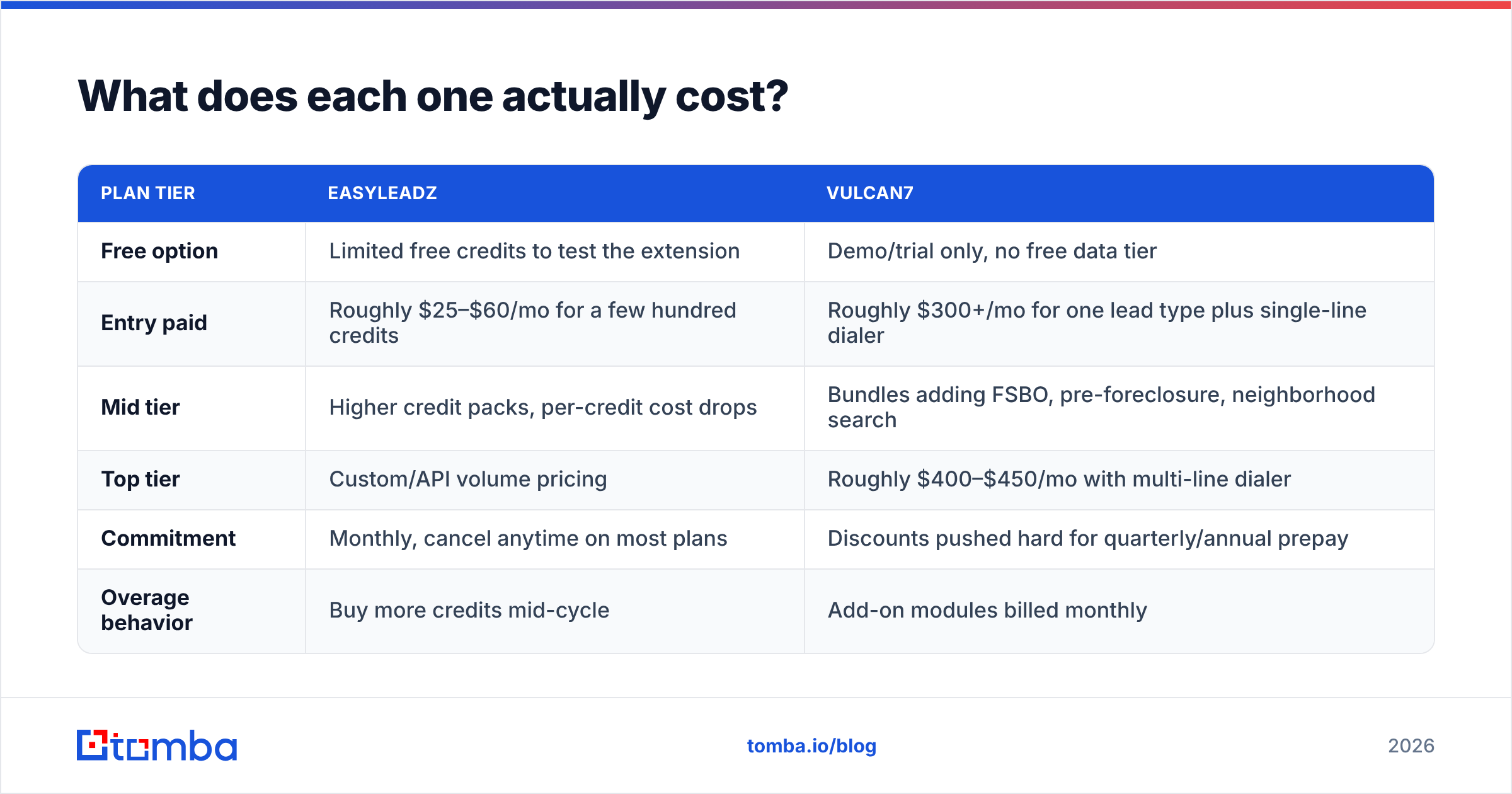
| Plan tier | EasyLeadz | Vulcan7 |
|---|---|---|
| Free option | Limited free credits to test the extension | Demo/trial only, no free data tier |
| Entry paid | Roughly $25–$60/mo for a few hundred credits | Roughly $300+/mo for one lead type plus single-line dialer |
| Mid tier | Higher credit packs, per-credit cost drops | Bundles adding FSBO, pre-foreclosure, neighborhood search |
| Top tier | Custom/API volume pricing | Roughly $400–$450/mo with multi-line dialer |
| Commitment | Monthly, cancel anytime on most plans | Discounts pushed hard for quarterly/annual prepay |
| Overage behavior | Buy more credits mid-cycle | Add-on modules billed monthly |
The commitment row is where people get burned. Vulcan7's most attractive per-month numbers usually assume you prepay for a quarter or a year. That's fine if you're a full-time listing agent with a proven cold-calling habit. It's expensive tuition if you sign up in January, call for three weeks, and quit.

EasyLeadz's credit model has the opposite failure mode: it looks cheap until you actually prospect at volume. Two hundred reveals a month is nothing for a working SDR. At 2,000 reveals, you're negotiating a custom plan and the per-contact math starts mattering a lot — which is exactly the moment to compare it against a general-purpose phone finder or a bulk enrichment run.
Which one has better data accuracy?#
Wrong question — they're measured on different axes.
Vulcan7 accuracy means: is this phone number attached to the right homeowner, and is the listing status current? Agents generally rate its phone match rate as strong for US residential records, and the DNC scrubbing is the piece competitors get dinged for. The weakness is inherited from the source: MLS data quality varies by market, and a homeowner whose listing expired six months ago may have already relisted with someone else.
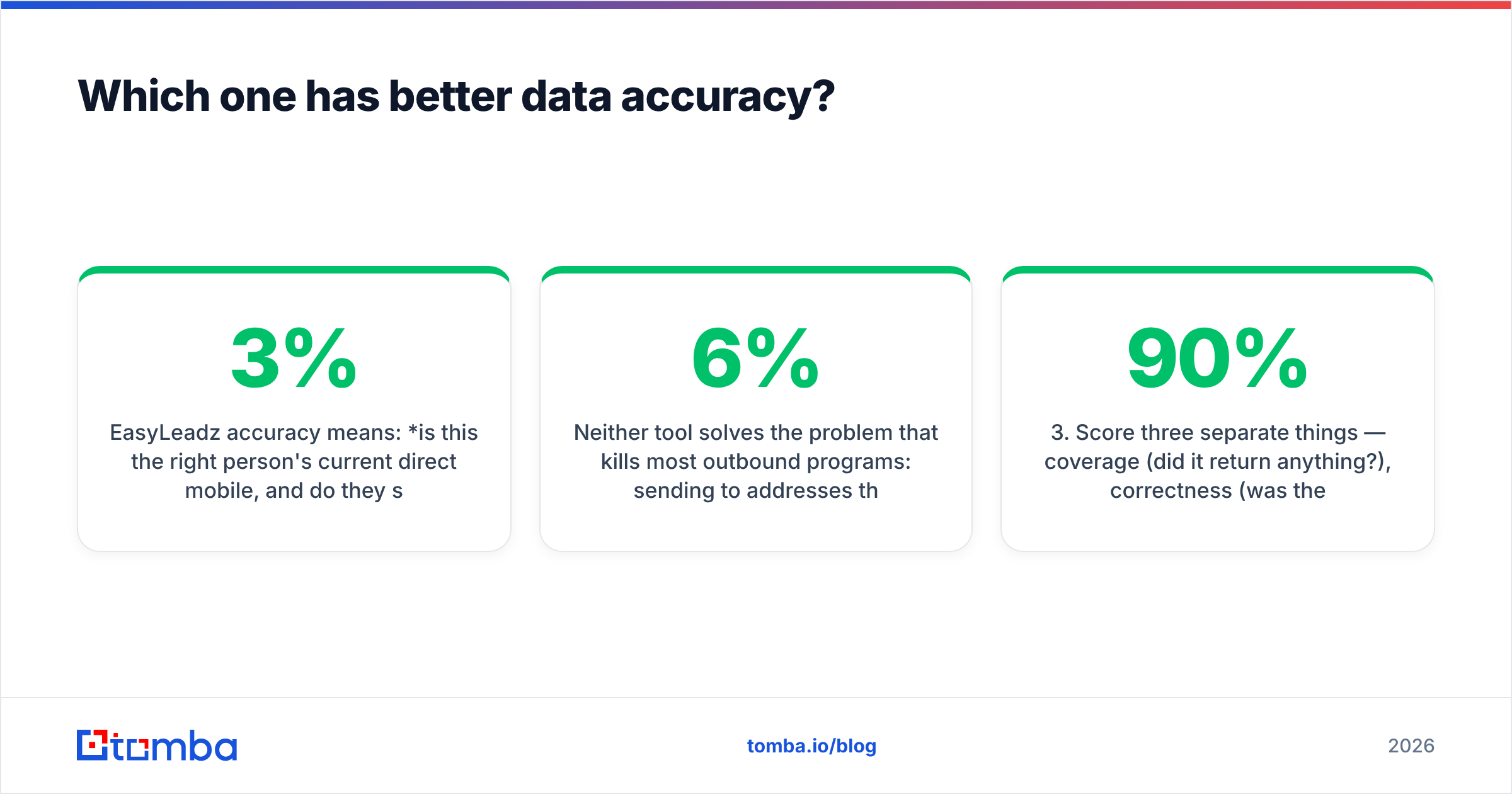
EasyLeadz accuracy means: is this the right person's current direct mobile, and do they still work there? Reviews on G2 tend to praise India and Southeast Asia hit rates and get more mixed on US and Western Europe, where the vendor is competing directly against providers with much deeper local data partnerships. Job-change decay is the silent killer here — B2B contact data goes stale at roughly 2–3% per month, which compounds fast on a list you built last quarter.
Neither tool solves the problem that kills most outbound programs: sending to addresses that bounce. That's a separate job for an email verifier, and it's worth running regardless of which vendor sourced the record. A 6% bounce rate will damage your sender reputation no matter how impressive the source database looked in the demo.
A practical accuracy test before you commit:
- Build a 25-row control list of contacts or properties you already have verified truth for. Real records, not synthetic ones.
- Run both vendors against it blind during their trial or free credits. Don't let a sales engineer drive.
- Score three separate things — coverage (did it return anything?), correctness (was the number right?), and freshness (is the person/listing still current?). A tool with 90% coverage and 60% correctness is worse than one with 60% coverage and 95% correctness.
- Dial or email 10 of them yourself. Connect rate is the only metric that survives contact with reality.
- Recheck the same list in 30 days to measure decay, then decide whether you need enrichment on a schedule rather than a one-time pull.
Who should choose EasyLeadz?#
Pick EasyLeadz when the following describe you:
- You sell B2B and your ICP skews India, Southeast Asia, or the Middle East. This is the clearest reason to choose it over a US-centric provider. Coverage in these regions is its genuine moat.
- You prospect one profile at a time on LinkedIn. The extension workflow is fast and low-friction for reps who live in Sales Navigator.
- You want mobile numbers, not just switchboard lines. Direct dials are the headline output, and connect rates on mobile beat office lines badly in a hybrid-work world.
- Your budget is a few hundred dollars a year, not a few thousand. Credit packs let you start genuinely small.
- You need an API for a light enrichment job. It's straightforward to wire into a CRM workflow without a data-engineering project.
Where it disappoints: bulk list building at scale, European coverage, and anything that requires deep firmographic filtering. It's a reveal tool more than a database.
Who should choose Vulcan7?#
Pick Vulcan7 when:
- You're a residential listing agent or run a team. Everything in the product assumes this. If you're not, nothing here applies to you.
- Expired listings and FSBOs are your lead strategy. These are motivated, time-sensitive sellers, and getting the list at 7am instead of 9am genuinely matters.
- You will actually make 100+ dials a day. The multi-line dialer is where the money goes. If you dial 20 times a week, you're paying for a Ferrari to drive to the mailbox.
- You need DNC compliance handled. TCPA exposure is real, and outsourcing scrubbing to a vendor whose entire business depends on it is a reasonable risk trade.
- You want the coaching layer. The training content and community around real estate dialers is part of what you're buying, and it's not nothing for a newer agent.
Where it disappoints: any B2B use case, any non-US market, and anyone who wants to own the data outside the platform.

What are the biggest limitations of each?#
EasyLeadz limitations
Credit burn on failed lookups is the complaint that shows up most in reviews — policies differ by plan, so read the fine print on what happens when a search returns nothing. Western coverage is inconsistent enough that a US-only SDR team will likely find gaps. And there's no dialer, no sequencing, no sales automation layer — it's a data faucet, and you supply the plumbing.
Vulcan7 limitations
Price is the obvious one, especially since the dialer lines that make it worth the money are what push the total up. It's also a walled garden: you're buying access to a feed, not building a portable asset. Cancel and the leads stop. And market coverage depends on MLS relationships, so agents in some counties report thinner expired-listing volume than the demo suggested. Ask specifically about your county before signing.
Is there a third option if neither fits?#
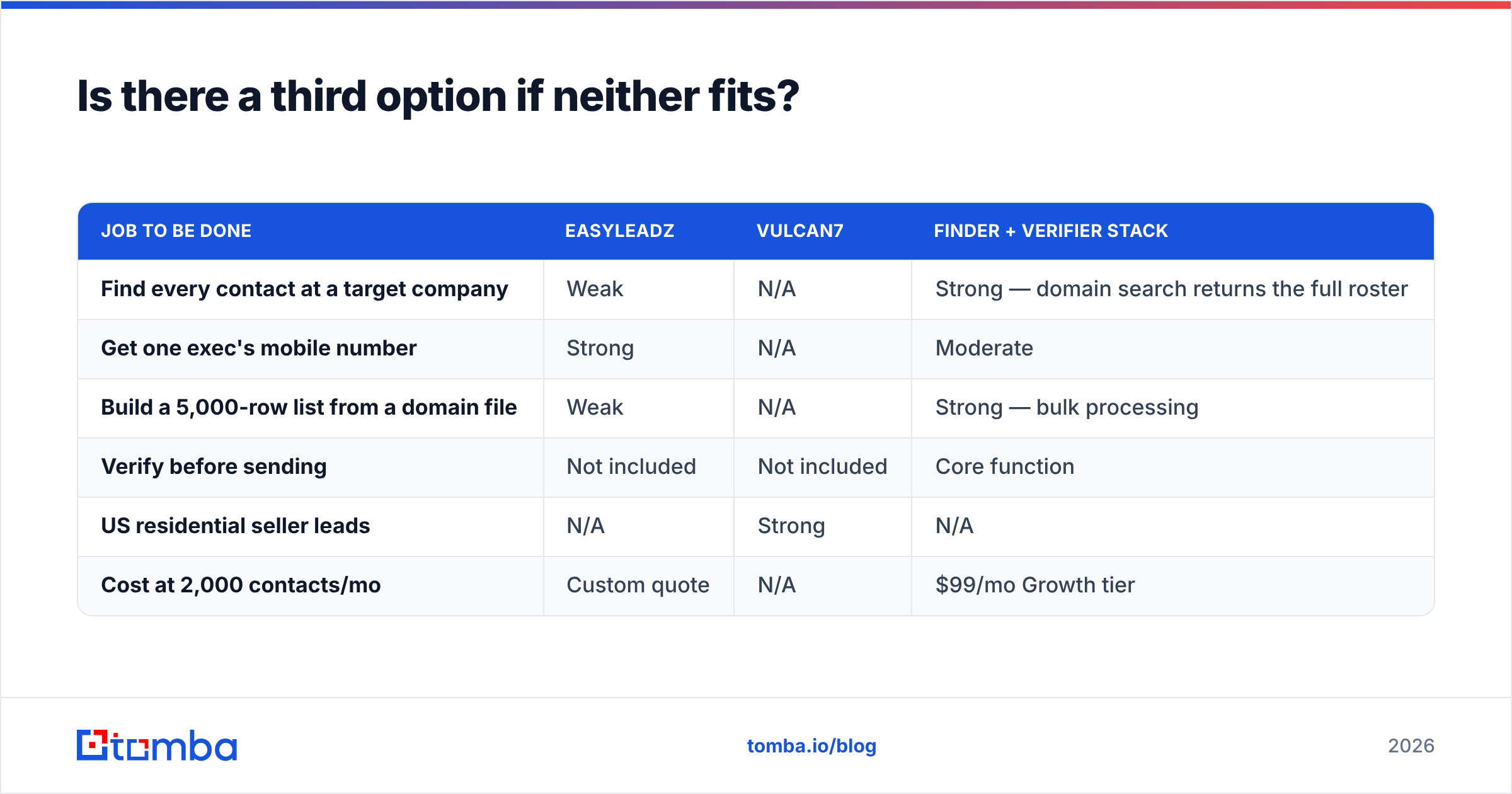
Yes, and for most B2B teams reading a comparison like this, it's the actual answer.
If you're not a real estate agent, Vulcan7 is off the table entirely. That reduces the decision to "is EasyLeadz the right B2B data source for me?" — and the honest answer depends on geography. For India-heavy pipelines, it's competitive. For everything else, you're better served by a stack built around domain-level discovery and verification rather than profile-by-profile reveals.
| Job to be done | EasyLeadz | Vulcan7 | Finder + verifier stack |
|---|---|---|---|
| Find every contact at a target company | Weak | N/A | Strong — domain search returns the full roster |
| Get one exec's mobile number | Strong | N/A | Moderate |
| Build a 5,000-row list from a domain file | Weak | N/A | Strong — bulk processing |
| Verify before sending | Not included | Not included | Core function |
| US residential seller leads | N/A | Strong | N/A |
| Cost at 2,000 contacts/mo | Custom quote | N/A | $99/mo Growth tier |
The pattern that works for outbound B2B teams in 2026 is boring: start from accounts, expand to people, verify, enrich, then sequence. Tools that start from a LinkedIn profile you already found invert that order and cap your volume at how fast a human can click.
What's the verdict on EasyLeadz vs Vulcan7?#
They don't compete, and choosing between them is really choosing your market.
Vulcan7 wins for US residential real estate agents who dial daily and need expired/FSBO data with compliance built in. Nothing EasyLeadz sells will help you list a house. Pay the $350, or don't buy either.
EasyLeadz wins for B2B reps whose prospects sit in India and APAC and who want direct mobiles fast, cheaply, from a LinkedIn workflow. It's a good tool with a specific edge, and it's priced like a tool rather than a platform.
For everyone in the middle — B2B teams selling into North America and Europe who need volume, coverage, and deliverability rather than one-off reveals — neither is the right center of gravity. You want a finder that works from domains and names, a verifier that catches bounces before they happen, and pricing that doesn't punish you for scaling. Compare the Tomba pricing tiers against a per-credit reveal model at your real monthly volume and the gap usually shows up fast: Free covers 25 searches to test, Starter is $49/mo, Growth $99/mo, Pro $249/mo.
Start with the Tomba Email Finder — run your existing target-account list through it, verify the results, and measure bounce rate and reply rate against whatever you're using now. That side-by-side takes an afternoon and settles the argument better than any comparison post, including this one.
Related guides#
Ready to find emails that actually work?
Join 150,000+ professionals who stopped guessing and started sending. Free credits on signup — no credit card required.
Get the Tomba newsletter
Practical outbound tactics and product updates — once every two weeks.
About the author