EasyLeadz vs Webbula: Which B2B Data Tool Wins in 2026?
EasyLeadz sells direct dials. Webbula sells hygiene and audience data. They barely overlap — and picking the wrong one wastes your whole data budget. Here's the honest breakdown.
EasyLeadz vs Webbula is an odd matchup. One tool finds phone numbers. The other cleans email lists. Here is the short version.
TL;DR
- EasyLeadz and Webbula are not competitors. EasyLeadz is a contact-discovery tool built around mobile direct dials. Its Chrome extension "Mr. E" is the main draw. Webbula is an email hygiene and audience-data provider. It cleans and enriches lists you already own.
- Pick EasyLeadz if your SDRs cold call and you need phone numbers attached to LinkedIn profiles, especially in India and APAC.
- Pick Webbula if you're a marketer sending to a large owned database. Your problem is bounces, spam traps, and bad segments — not finding new contacts.
- Neither is a full prospecting stack. Most teams pair a discovery tool with a verification layer. That is where a combined finder + verifier like Tomba changes the math.
- Pricing transparency differs sharply: EasyLeadz publishes credit packs starting around $59/month. Webbula quotes custom, volume-based pricing and rarely publishes numbers.
What Does EasyLeadz Actually Do?#
EasyLeadz is an India-based B2B contact-intelligence company. It is best known for Mr. E, a browser extension that pulls direct mobile numbers from LinkedIn profiles. You browse a prospect's profile and click the extension. It returns a phone number, and often a work email, from the EasyLeadz contact database.
The product is built for one motion: outbound calling. That is a narrower use case than the "all-in-one revenue platform" category, and EasyLeadz does not pretend otherwise. Its edge is mobile-number depth in regions where US-centric providers are thin — India, Southeast Asia, and parts of the Middle East.
What you get:
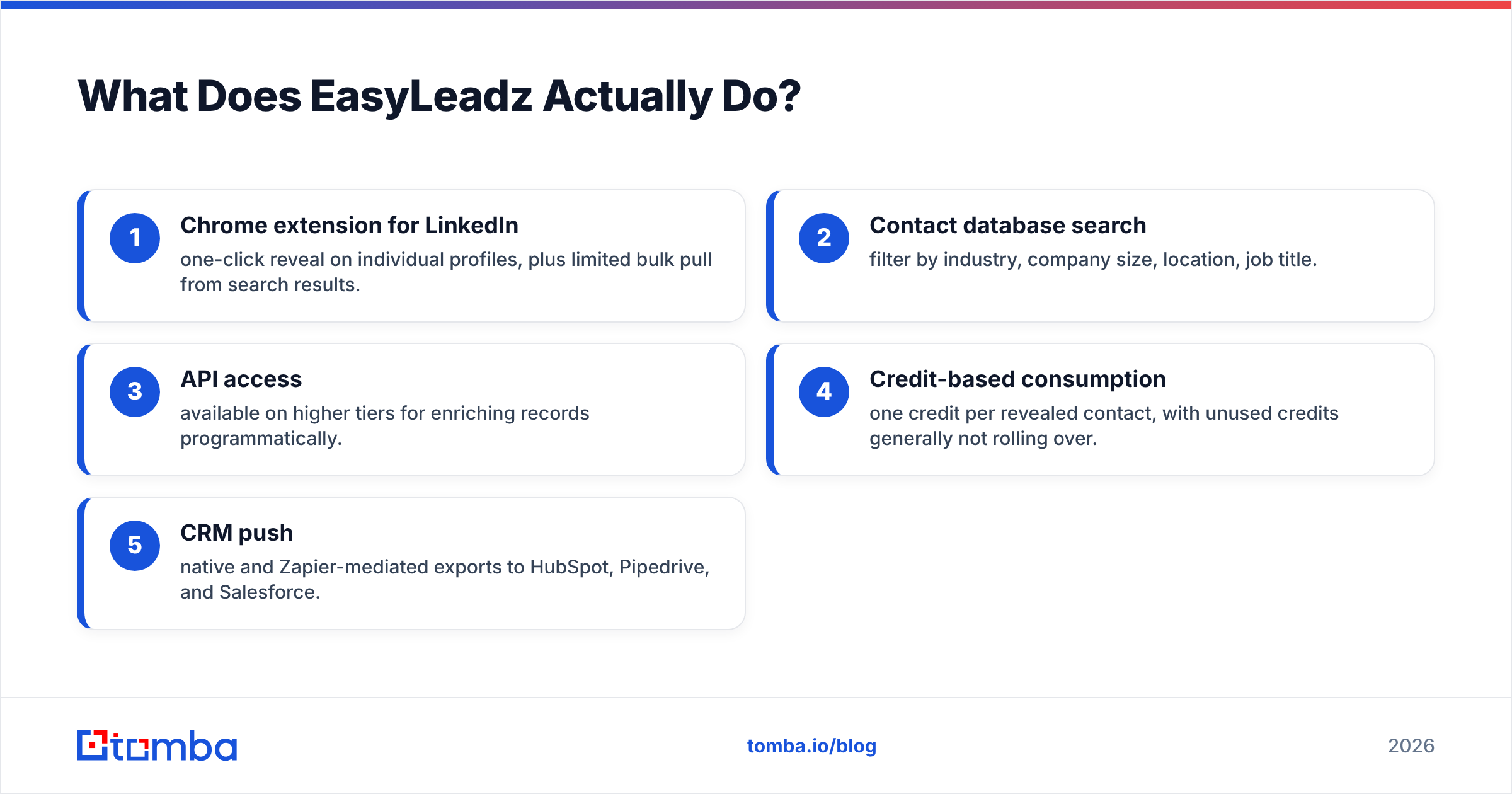
- Chrome extension for LinkedIn — one-click reveal on individual profiles, plus limited bulk pull from search results.
- Contact database search — filter by industry, company size, location, job title.
- API access — available on higher tiers for enriching records programmatically.
- Credit-based consumption — one credit per revealed contact. Unused credits generally do not roll over.
- CRM push — native and Zapier-mediated exports to HubSpot, Pipedrive, and Salesforce.
What you don't get: email verification at any serious depth, deliverability tooling, sequencing, or list-hygiene reporting. EasyLeadz finds contacts. It does not tell you whether the 40,000 emails already sitting in your marketing automation platform are safe to mail.

What Does Webbula Actually Do?#
Webbula sits at the other end of the data lifecycle. It is a US-based data-quality and audience company. Its core offerings are email hygiene (the "cloudHygiene" product), data enrichment, and audience/intent segments sold to marketers and ad platforms.
The hygiene product is the flagship. You upload a list, and Webbula scores each record against a large taxonomy of threat and quality categories. That taxonomy covers spam traps, honeypots, known complainers, bots, disposable domains, role accounts, deceased records, and moved-away consumers. It goes deeper than a standard syntax-plus-SMTP check. It is aimed at senders whose reputation is already at risk.
The enrichment and audience side serves a different buyer again. Agencies and brands buy demographic, firmographic, and behavioral segments for targeting. That is an adtech motion, not an SDR motion.
The practical framing: EasyLeadz gives you contacts you didn't have. Webbula tells you which contacts you already have are dangerous.
EasyLeadz vs Webbula: How Do They Compare?#
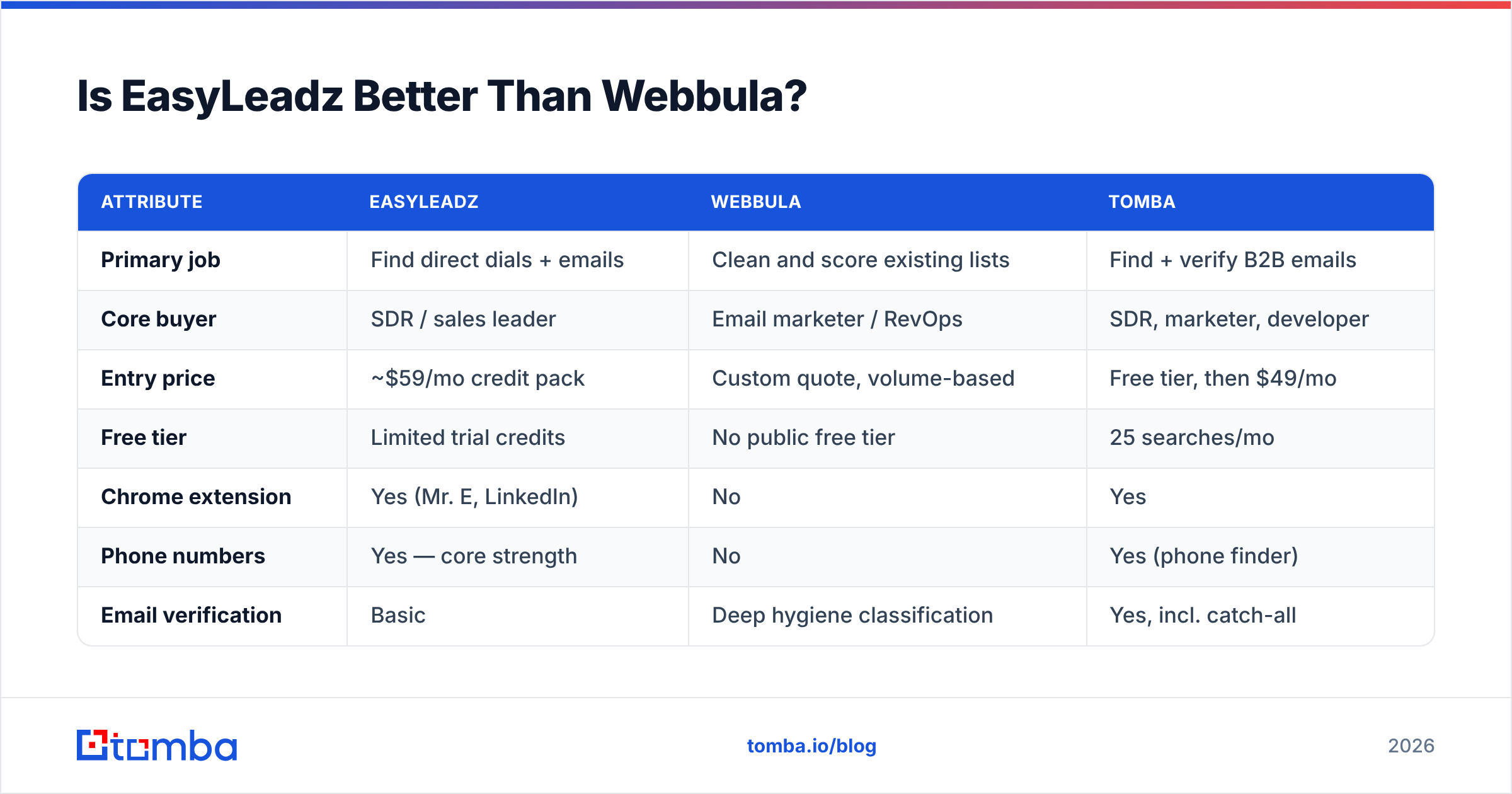
That question only makes sense once you name the job. Here is how the two tools compare on the attributes that actually drive a purchase decision.
| Attribute | EasyLeadz | Webbula | Tomba |
|---|---|---|---|
| Primary job | Find direct dials + emails | Clean and score existing lists | Find + verify B2B emails |
| Core buyer | SDR / sales leader | Email marketer / RevOps | SDR, marketer, developer |
| Entry price | ~$59/mo credit pack | Custom quote, volume-based | Free tier, then $49/mo |
| Free tier | Limited trial credits | No public free tier | 25 searches/mo |
| Chrome extension | Yes (Mr. E, LinkedIn) | No | Yes |
| Phone numbers | Yes — core strength | No | Yes (phone finder) |
| Email verification | Basic | Deep hygiene classification | Yes, incl. catch-all |
| Bulk list processing | Limited | Yes — core strength | Yes |
| Public API | On higher tiers | Yes | Yes, all paid tiers |
| Geographic strength | India, APAC | North America | Global |
| Pricing transparency | Published | Quote-only | Published |
Three things fall out of that table.
First, the price signal. EasyLeadz publishes numbers and Webbula generally does not. Quote-only pricing is not a red flag on its own, since enterprise data contracts are genuinely volume-dependent. But it does mean a longer sales cycle and a harder time comparing unit economics. If you need a decision this week with a company card, EasyLeadz is the faster path.
Second, the credit model bites differently. EasyLeadz charges per revealed contact, useful or not. Webbula charges per record processed. If you run 500 targeted reveals a month, credits are cheap. If you hygiene-check a 2M-record database quarterly, per-record pricing at scale is the number that matters.
Third, coverage is regional, not universal. EasyLeadz's India and APAC mobile coverage is genuinely strong, and it is the reason the tool has a loyal base. Run the same queries against German or Nordic mid-market companies and hit rates drop noticeably. Check reviews on G2 for your own geography before you commit to an annual plan. The aggregate score hides enormous regional variance.
Which One Fits Your Actual Workflow?#
Map the tool to the motion rather than to the feature list. The EasyLeadz vs Webbula call is really a choice between two different jobs.
- You're an SDR team dialing 60 times a day. EasyLeadz is the closer fit. Direct dials are the constraint, and a hygiene vendor does not produce a single new number. Pair it with a phone validator so you are not burning dial time on disconnected lines.
- You're a lifecycle marketer with a 500K-record database and a 4% bounce rate. Webbula. You do not need more contacts. You need to know which of the ones you have will torch your sender reputation.
The remaining cases point somewhere else:
- You're building outbound from zero. Neither, alone. You need discovery and verification in the same loop. Unverified new contacts create the exact bounce problem hygiene vendors get hired to fix later. That is the case for a combined email finder and email verifier. You catch the bad record before it ever enters your CRM.
- You're an agency buying audience segments. Webbula's audience side is the relevant product. EasyLeadz has no equivalent.
- You're a developer wiring enrichment into a product. Both have APIs, but check rate limits and per-call pricing carefully. A published, self-serve email finder API removes the procurement step entirely.
How Accurate Is Each One, Really?#
Vendor-published accuracy figures are marketing artifacts. EasyLeadz cites high match confidence on mobile numbers. Webbula cites deep threat-classification coverage. Both claims are defensible in their own domain. Neither is verifiable from the outside.
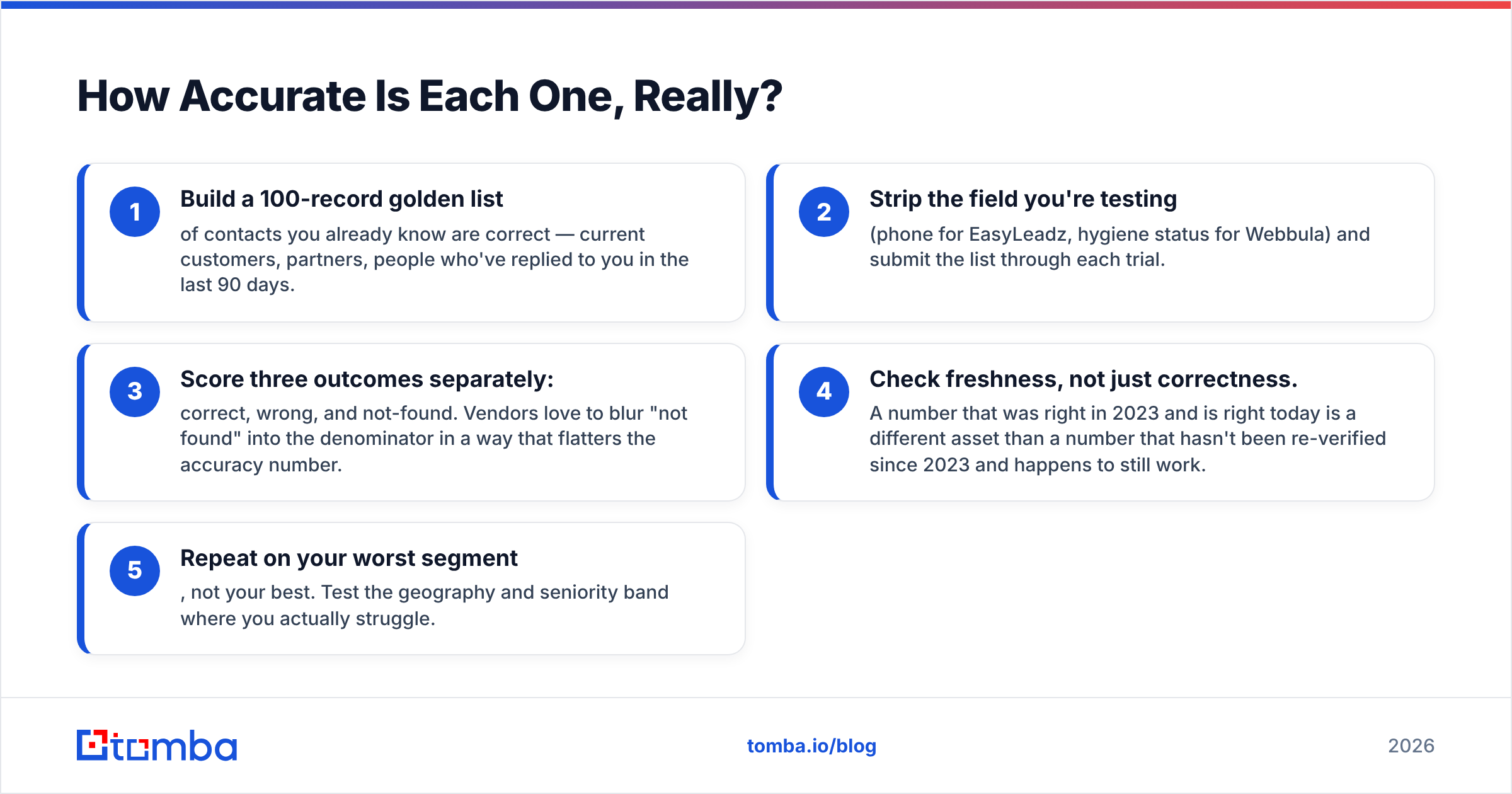
What you can do is run a controlled test before you sign anything:
- Build a 100-record golden list of contacts you already know are correct — current customers, partners, and people who replied to you in the last 90 days.
- Strip the field you're testing (phone for EasyLeadz, hygiene status for Webbula) and submit the list through each trial.
- Score three outcomes separately: correct, wrong, and not-found. Vendors love to blur "not found" into the denominator in a way that flatters the accuracy number.
- Check freshness, not just correctness. A number re-verified this quarter is a different asset than one that has not been touched since 2023 and happens to still work.
- Repeat on your worst segment, not your best. Test the geography and seniority band where you actually struggle.
That five-step test takes an afternoon. It routinely contradicts the deck. Run it.
What Are the Real Downsides of Each?#
EasyLeadz limitations to plan for:
- Credits expire monthly on most plans. Seasonal outbound teams overpay in slow months.
- Coverage outside India and APAC is inconsistent, especially for European mid-market.
- Email verification is shallow. You will still want a dedicated verification pass before sending. Catch-all domains are the worst case, because a naive SMTP check returns a false positive there. A dedicated catch-all verifier is the standard fix.
- The extension-first workflow is fast for single reveals and clumsy for building a 5,000-contact list.
Webbula limitations to plan for:
- No self-serve entry point. Expect a sales conversation, a scoping call, and a quote.
- It is a diagnostic, not a source. Webbula can tell you 22% of your list is unmailable. It cannot replace those records.
- Consumer and adtech DNA means B2B firmographic depth is not its strongest axis compared to dedicated B2B databases.
- Compliance posture matters more here than with a pure finder. If you operate under GDPR, get clarity on the lawful basis for every enriched attribute before you process EU records. The GDPR text itself is worth ten minutes of your legal team's time.
Is There a Middle Path That Covers Both Jobs?#
Yes, and most teams land on it after a year of vendor sprawl. Run one tool that finds and validates. Then add a specialist only where a genuine gap remains.
The logic is simple. Lists rot because unverified contacts enter the system in the first place. Hygiene vendors are downstream cleanup for an upstream problem. If discovery and verification happen in the same call, the cleanup contract gets much smaller — or unnecessary.
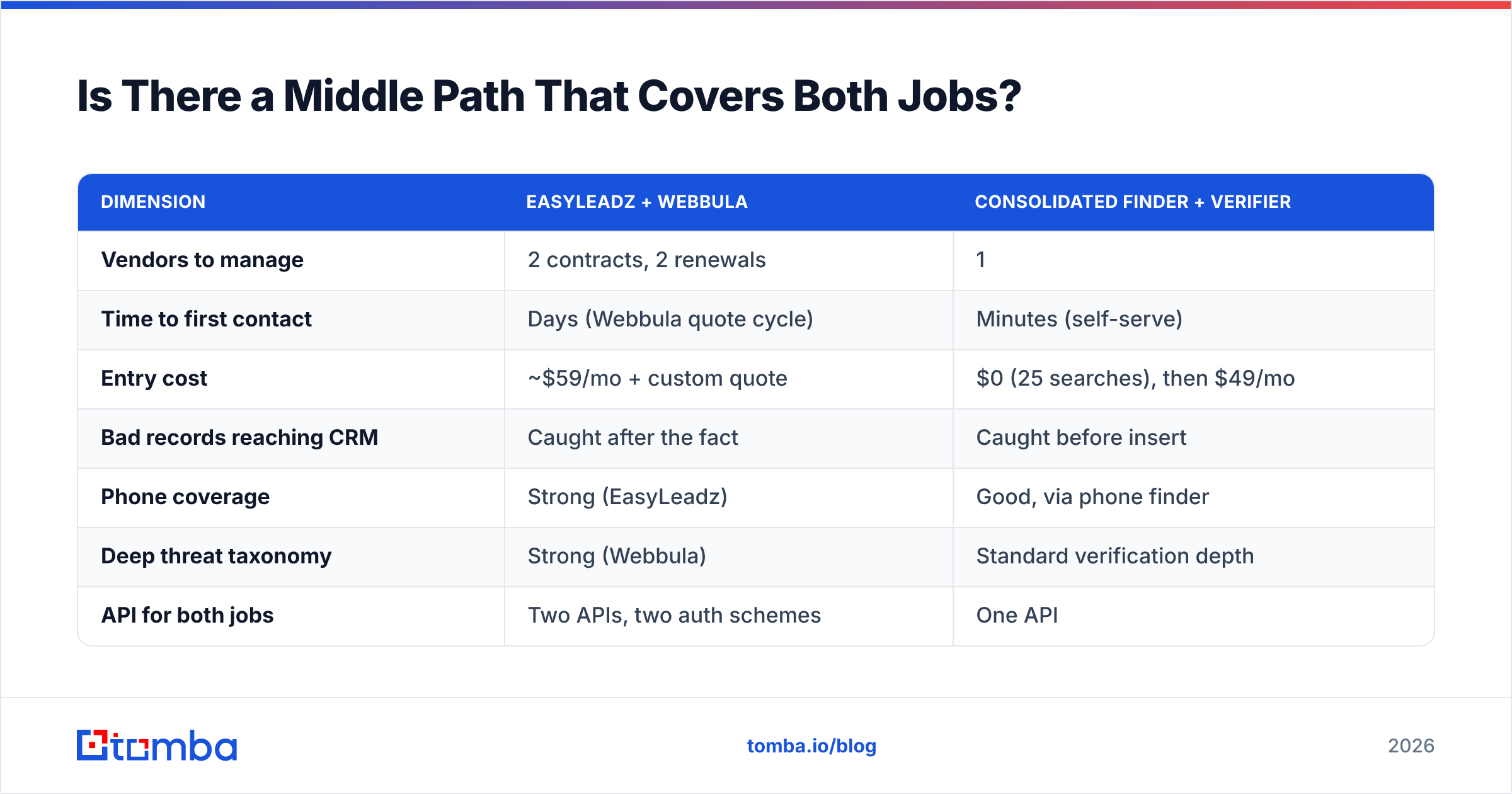
Here's how a consolidated approach compares to running both specialists:
| Dimension | EasyLeadz + Webbula | Consolidated finder + verifier |
|---|---|---|
| Vendors to manage | 2 contracts, 2 renewals | 1 |
| Time to first contact | Days (Webbula quote cycle) | Minutes (self-serve) |
| Entry cost | ~$59/mo + custom quote | $0 (25 searches), then $49/mo |
| Bad records reaching CRM | Caught after the fact | Caught before insert |
| Phone coverage | Strong (EasyLeadz) | Good, via phone finder |
| Deep threat taxonomy | Strong (Webbula) | Standard verification depth |
| API for both jobs | Two APIs, two auth schemes | One API |
Be honest about the trade. If spam traps and honeypots are already in your database, Webbula's classification depth is a real capability. A standard verifier does not fully replicate it. Buy it for that. Just do not buy it as a substitute for building clean data in the first place.
For most teams doing outbound in 2026, the sequence that works is simple: find the contact, verify it in the same step, enrich what you need, then push to CRM. Tomba pricing starts free at 25 searches a month. Paid plans run $49/mo Starter, $99/mo Growth, and $249/mo Pro. All of them include API access, bulk verify, and data enrichment rather than selling them as separate line items.
How Should You Run the Evaluation?#
Give yourself two weeks and a structure. Week 1 is scoping:
- Days 1–2: Define the job. Write one sentence: "Our constraint is _____." If the blank is "we can't reach enough people," you are shopping discovery. If it is "our emails bounce," you are shopping hygiene. If you cannot fill the blank, you are not ready to buy.
- Days 3–5: Build the 100-record golden list described above. This is the single highest-leverage hour in the process.
Week 2 is testing:
- Days 1–3: Run trials in parallel — same list, same day. Sequential trials introduce data-freshness drift and make the comparison meaningless.
- Days 4–5: Score correct, wrong, and not-found separately. Then compute cost per usable record, not cost per credit. That number is often 2–4x the sticker rate, and it is the only one that belongs in the business case.
- Before signing: Ask for month-to-month terms on the first term. Any vendor confident in their data will take that deal.
Teams that skip step 2 almost always over-buy. The golden-list test converts a vendor deck into a number you can defend.
Which Should You Choose?#
The EasyLeadz vs Webbula decision answers itself once you name the constraint. If you call prospects in India or APAC and direct dials are your bottleneck, EasyLeadz earns its place. It is focused, transparently priced, and strong where it is strong. If your owned database is actively damaging your sender reputation, Webbula does forensic-grade classification that few vendors match. That is worth the quote cycle.
But maybe the honest answer is "we need clean, reachable B2B contacts, and we would rather not run two contracts to get them." Then start upstream. The Tomba Email Finder finds professional email addresses by domain, name, or company. It verifies them in the same request. You get a record that does not need cleaning six months later. Start on the free tier at 25 searches a month, run the golden-list test against your own data, and let the numbers pick the winner instead of the deck.
Related guides#
Ready to find emails that actually work?
Join 150,000+ professionals who stopped guessing and started sending. Free credits on signup — no credit card required.
Get the Tomba newsletter
Practical outbound tactics and product updates — once every two weeks.
About the author