EasyLeadz vs Xverum: Which B2B Data Provider Wins in 2026?
EasyLeadz sells verified direct dials one contact at a time. Xverum sells bulk B2B datasets by the million. They barely compete — and picking the wrong one wastes a full quarter of budget.
TL;DR
- EasyLeadz vs Xverum is not a fair fight — the two solve different problems. EasyLeadz is a contact-level tool for reps who need a direct mobile number right now. Xverum is a bulk data supplier that ships millions of company and people records into your warehouse.
- EasyLeadz wins on India and APAC mobile coverage. Its Mr. E extension is one of the few tools that reliably returns direct dials for Indian companies.
- Xverum wins on volume and freshness pipelines. Need 100M+ records refreshed on a schedule and dropped into S3 as JSON or CSV? EasyLeadz is not built for that.
- Neither is a strong email-first tool. If your main motion is cold email, both leave gaps. You fill them with a dedicated email finder and verifier.
- Pricing models are opposite. EasyLeadz is credit-based and starts small. Xverum is contract-based and starts at enterprise numbers.
Most people searching EasyLeadz vs Xverum expect a close race. It isn't one. The two vendors show up in the same search result, yet they sell almost nothing in common. That mix-up is the biggest reason teams overpay in this category. Let's fix it.
What is EasyLeadz?#
EasyLeadz is an India-headquartered B2B contact data provider, best known for Mr. E, its Chrome extension. You open a LinkedIn profile and click the extension. It returns a direct phone number for that person, and often an email too.
The core pitch is direct dials, not emails. EasyLeadz built its name on one thing: mobile numbers in places where US-first providers come up empty. Think India, Southeast Asia, and the Middle East. For an SDR working an APAC patch, that edge is real.
The product surface is small, and deliberately so:
- Chrome extension (Mr. E) — profile-by-profile lookups while you prospect on LinkedIn.
- Web app search — filter by company, industry, headcount, location.
- API — programmatic lookups for teams that enrich inside their own systems.
- CRM push — send contacts to HubSpot, Salesforce, Pipedrive and similar.
Credits are consumed per successful reveal. That's the whole model. You can read the vendor's own framing at easyleadz.com and cross-check real user reports on G2.
What is Xverum?#
Xverum is a data-as-a-service provider. It doesn't really compete for the SDR-clicking-a-Chrome-extension use case at all. Xverum sells structured B2B datasets in bulk: company profiles, employee profiles, job postings, and web-scraped firmographic data.
Delivery is the giveaway. Xverum ships to S3, Google Cloud Storage, Azure, SFTP, or an API. Formats are JSON, CSV, or Parquet. The refresh schedule is agreed up front. That's a data-engineering deliverable, not a sales tool. The company advertises hundreds of millions of profiles and company records. Check the current figures at xverum.com, because dataset sizes in this category change every quarter.
Typical Xverum buyers:
- Data / RevOps teams building an internal TAM model or account graph
- AI and ML teams training models on firmographic or employment data
- Investment and market-research firms tracking hiring signals and company growth
- Platform companies embedding B2B data into their own product
If none of those describe you, Xverum is the wrong tool. That holds no matter how well it scores on a feature checklist.
EasyLeadz vs Xverum: how do they actually compare?#
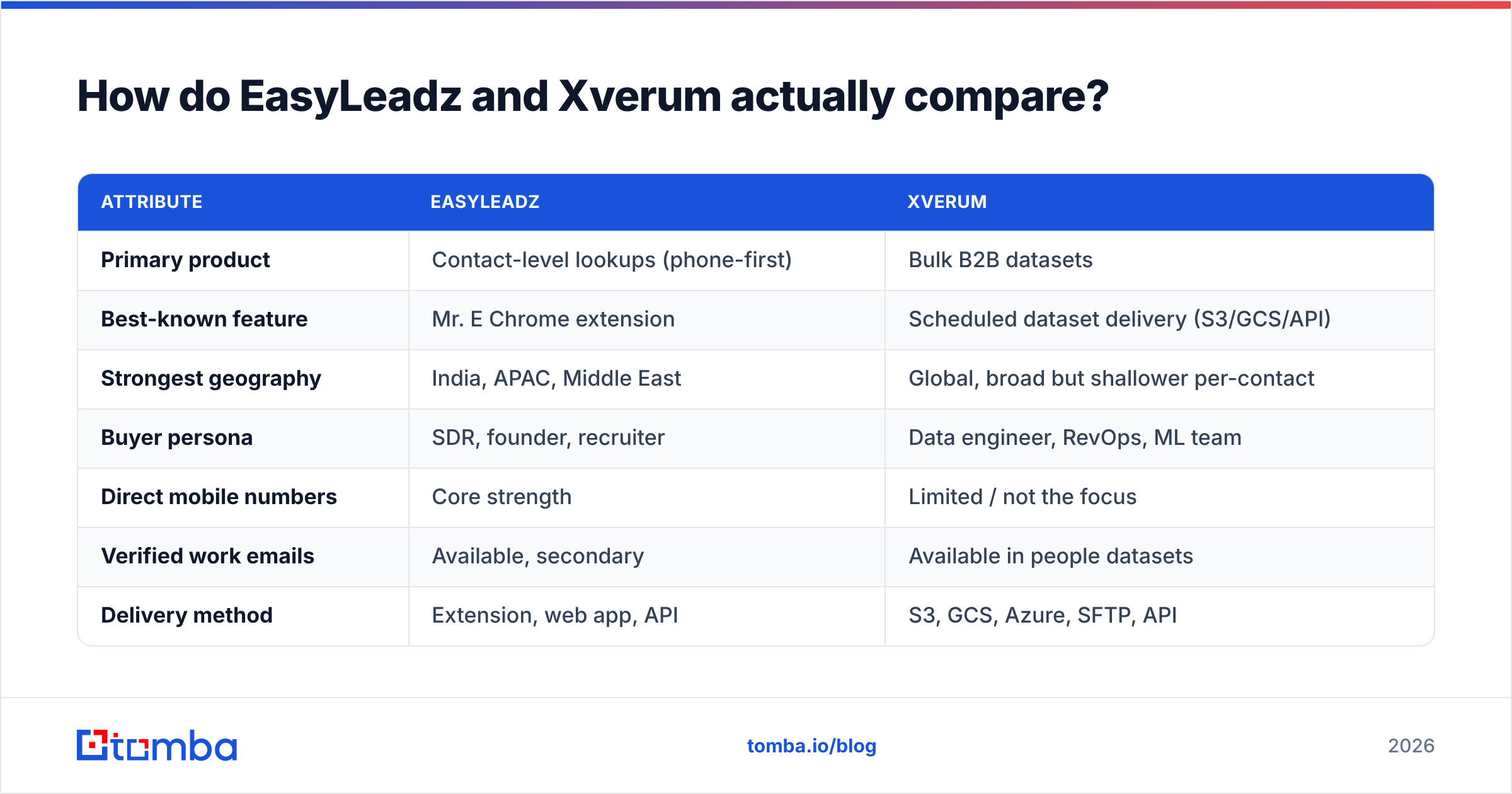
Here's the head-to-head on the attributes that change a buying decision.
| Attribute | EasyLeadz | Xverum |
|---|---|---|
| Primary product | Contact-level lookups (phone-first) | Bulk B2B datasets |
| Best-known feature | Mr. E Chrome extension | Scheduled dataset delivery (S3/GCS/API) |
| Strongest geography | India, APAC, Middle East | Global, broad but shallower per-contact |
| Buyer persona | SDR, founder, recruiter | Data engineer, RevOps, ML team |
| Direct mobile numbers | Core strength | Limited / not the focus |
| Verified work emails | Available, secondary | Available in people datasets |
| Delivery method | Extension, web app, API | S3, GCS, Azure, SFTP, API |
| Data formats | Web UI, CSV export, JSON API | JSON, CSV, Parquet, NDJSON |
| Refresh model | On-demand per lookup | Scheduled bulk refresh |
| Pricing model | Credit packs, monthly | Subscription / annual contract |
| Entry cost | Low (tens of dollars) | High (enterprise range) |
| Self-serve signup | Yes | Sales-led |
| Compliance posture | GDPR-aware, opt-out on request | GDPR/CCPA-aligned, public-web sourced |
Read that table once and the "vs" mostly dissolves. These are complements, not rivals. A large team could buy both. Xverum builds the account universe. EasyLeadz gets the mobile number for the one VP who never answers email.

Which one has better data coverage?#
Coverage is the wrong single question. Break it into three.
1. Breadth (how many records exist). Xverum wins outright. Bulk providers index the public web at a scale no lookup tool matches. Say your requirement is "every SaaS company in DACH with 50–500 employees." Xverum is built for exactly that.
2. Depth (how much is known about one person). EasyLeadz wins for phone. A row with a name, title, and company URL is not the same as a mobile number that connects on the first ring. EasyLeadz's hit rate on Indian mobiles is the reason the product exists.
3. Freshness (how recently it was true). Both get uncomfortable here. A bulk dataset is only as fresh as the last crawl. A profile pulled 60 days ago may describe someone who has already changed jobs. Per-lookup tools like EasyLeadz look better in theory, since you query close to request time. They still draw on cached sources.
The practical answer: verify at the point of use, whichever you buy. B2B contact data decays 25–30% a year. Job-change churn spiked after the 2023 tech layoffs. So run records through an email verifier before a send. It's the cheapest insurance in the whole stack. It costs a fraction of a credit, and it guards your sender reputation, which is far harder to rebuild than to keep.
How much do EasyLeadz and Xverum cost?#
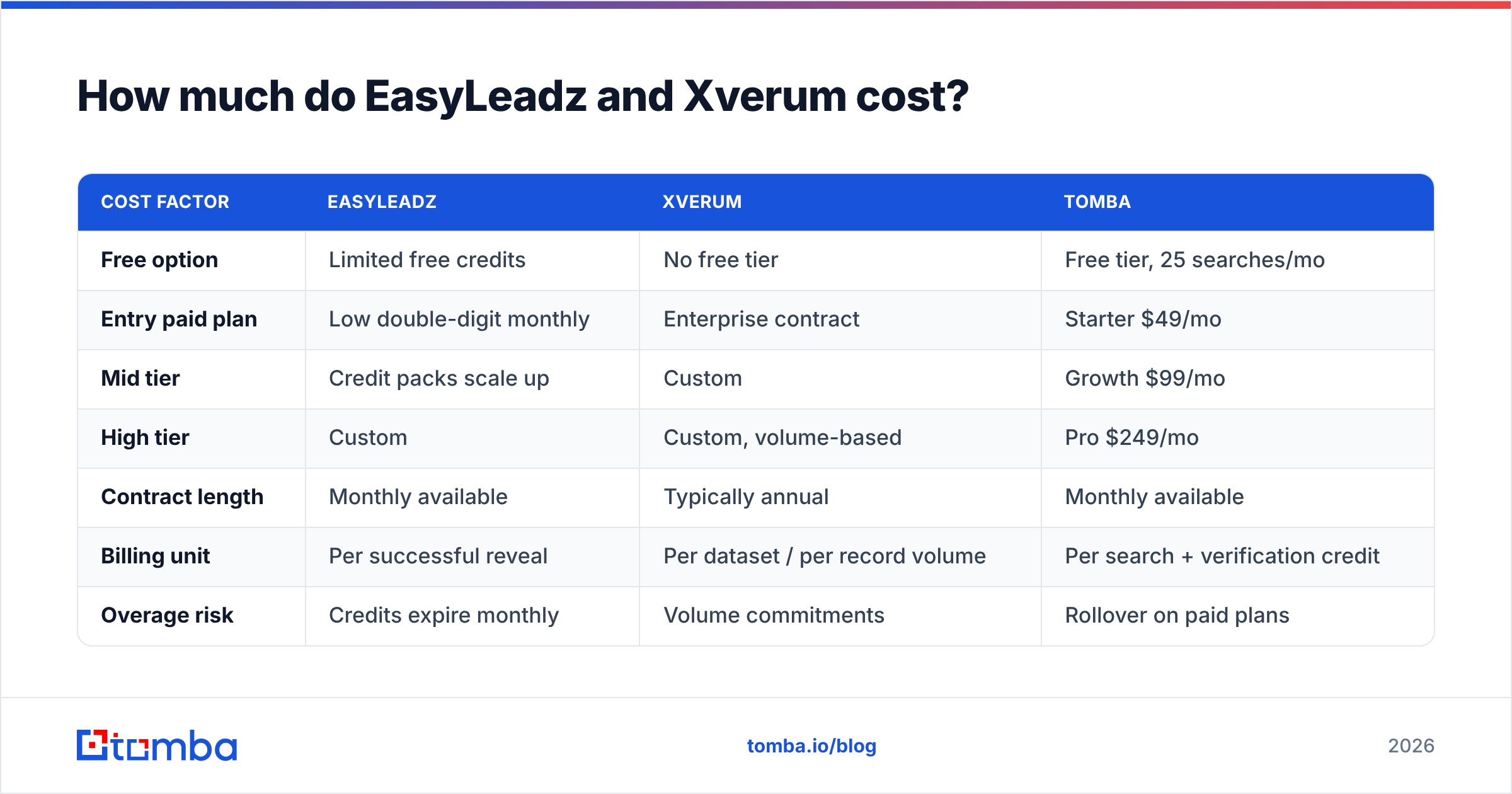
Pricing is where the two split hardest. It's also where most buyers make the wrong call.
| Cost factor | EasyLeadz | Xverum | Tomba |
|---|---|---|---|
| Free option | Limited free credits | No free tier | Free tier, 25 searches/mo |
| Entry paid plan | Low double-digit monthly | Enterprise contract | Starter $49/mo |
| Mid tier | Credit packs scale up | Custom | Growth $99/mo |
| High tier | Custom | Custom, volume-based | Pro $249/mo |
| Contract length | Monthly available | Typically annual | Monthly available |
| Billing unit | Per successful reveal | Per dataset / per record volume | Per search + verification credit |
| Overage risk | Credits expire monthly | Volume commitments | Rollover on paid plans |
| Sales call required | No | Yes | No |
Two things to flag honestly:
- Vendor pricing changes. EasyLeadz has repriced its credit packs more than once. Xverum quotes per engagement. Treat any number in a comparison post, this one included, as directional. Confirm on the vendor site before you commit budget.
- The cheap option isn't always cheaper. A $30/month credit pack that works 40% of the time costs more per usable contact than a $99/month plan that works 80% of the time. Count cost per verified, reachable contact, not cost per credit.
For reference, Tomba pricing is public: a free tier at 25 searches a month, Starter at $49/mo, Growth at $99/mo, and Pro at $249/mo. No sales call needed to see it.
Is EasyLeadz the right pick for outbound SDRs?#
Yes, with one condition. Your motion has to be phone-heavy, and your territory has to sit inside EasyLeadz's coverage sweet spot.
Where EasyLeadz genuinely earns its place:
- Cold calling into India, UAE, Singapore, or Southeast Asia. Very few Western providers match it here.
- Recruiting. Recruiters live on direct dials, and the extension workflow is fast.
- Founder-led sales at small scale. Low entry cost, no procurement, working in ten minutes.
Where it disappoints:
- Email-first outbound in North America and Western Europe. Coverage and verification depth trail the specialists.
- High-volume list building. Per-reveal credit pricing punishes you at scale.
- Complex enrichment. Need technographics, funding rounds, or intent? You're stacking another vendor on top anyway.
Is your outbound really email-led? Then pair a dedicated email finder with a phone finder for the accounts worth a call. One phone-first tool will not cover both jobs well.
Is Xverum the right pick for RevOps and data teams?#
Also yes, with a much bigger condition: you need people who can work with the data.
Xverum hands you files. Nobody there builds your ICP model, dedupes against your CRM, or picks which of 400M profiles matter. Without a data engineer or a RevOps operator who writes SQL, a bulk subscription turns into a very expensive folder in cloud storage.
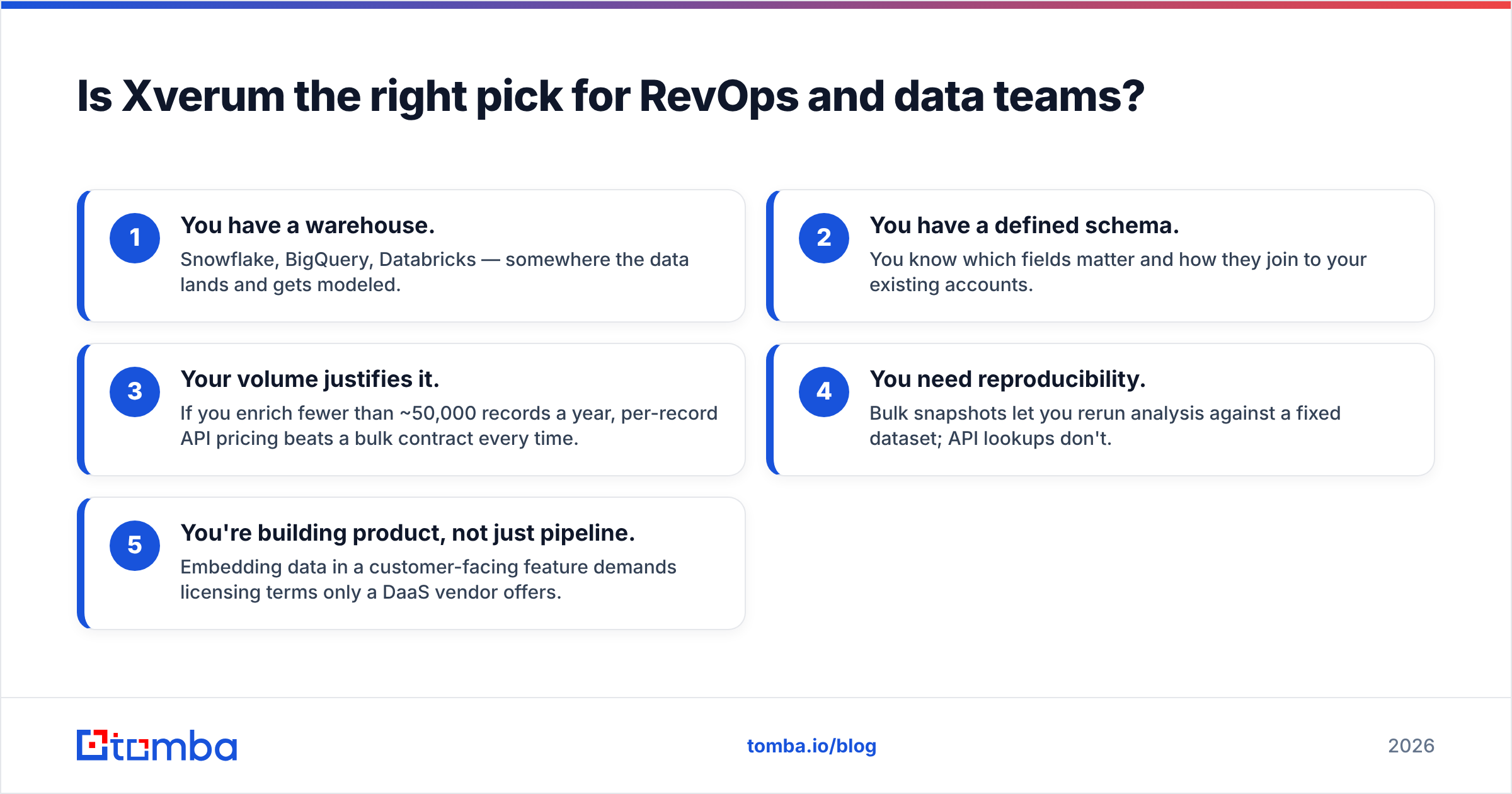
Signs you're ready for Xverum:
- You have a warehouse. Snowflake, BigQuery, Databricks — somewhere the data lands and gets modeled.
- You have a defined schema. You know which fields matter and how they join to your accounts.
- Your volume justifies it. Enrich fewer than ~50,000 records a year and per-record API pricing wins every time.
- You need reproducibility. Bulk snapshots let you rerun analysis against a fixed dataset. API lookups don't.
- You're building product, not just pipeline. Data inside a customer-facing feature needs licensing terms only a DaaS vendor offers.
Miss two or more of those, and you should buy API-based data enrichment instead. Same outcome, a fraction of the commitment.

What alternatives should you consider?#
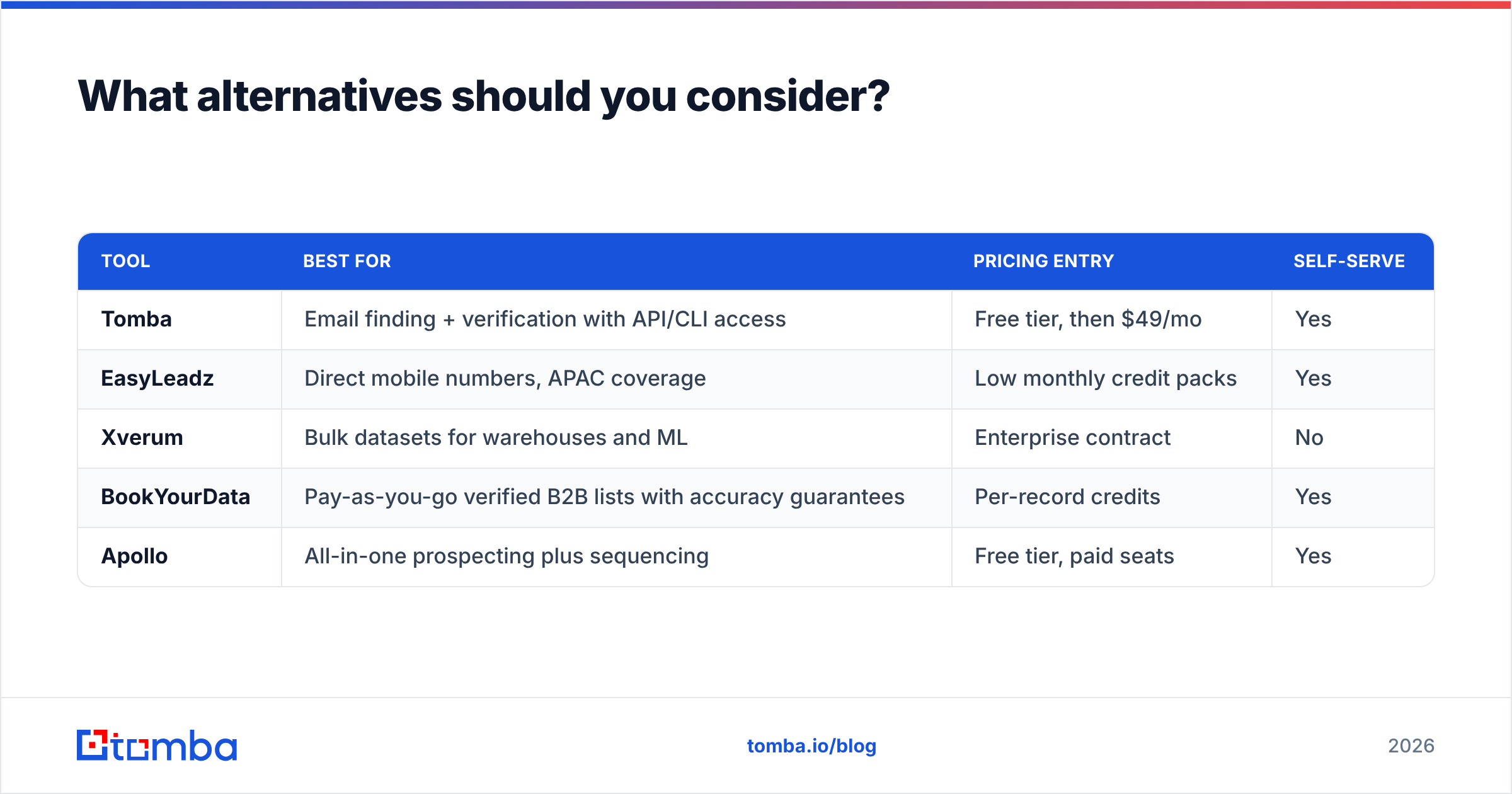
EasyLeadz and Xverum sit at opposite ends of the market. Most buyers weighing both need something in the middle: accurate contact data, self-serve, API-ready, priced per use.
| Tool | Best for | Pricing entry | Self-serve |
|---|---|---|---|
| Tomba | Email finding + verification with API/CLI access | Free tier, then $49/mo | Yes |
| EasyLeadz | Direct mobile numbers, APAC coverage | Low monthly credit packs | Yes |
| Xverum | Bulk datasets for warehouses and ML | Enterprise contract | No |
| BookYourData | Pay-as-you-go verified B2B lists with accuracy guarantees | Per-record credits | Yes |
| Apollo | All-in-one prospecting plus sequencing | Free tier, paid seats | Yes |
BookYourData deserves a look if you want a clean, targeted list without a subscription. Its pay-as-you-go model and accuracy guarantee suit teams that buy lists in bursts, not continuously. It's a different shape of purchase from both vendors here, and often a better fit than either.
Tomba fits when your bottleneck is finding and validating work emails at a predictable cost. The email finder resolves an address from a name and domain. Domain search pulls every discoverable address at a company. The catch-all verifier handles the domains that break most validation tools. The Tomba API puts all of it behind a single endpoint. Where the data comes from is documented on the data sources page. Demand that level of openness from any vendor in this category.
So which should you choose?#
Choose EasyLeadz if: you're a rep or recruiter who needs mobile numbers, you sell into India or APAC, and you want to be productive today without a procurement cycle.
Choose Xverum if: you're a data or RevOps team with warehouse infrastructure, you need millions of records on a refresh schedule, and you have budget signed off at the annual-contract level.
Choose neither if: your real problem is cold email at moderate volume. That covers most readers who land on this comparison. Both tools force an awkward fit there. One is too narrow on channel. The other is too heavy on infrastructure.
One test settles the EasyLeadz vs Xverum question. Write down the last ten contacts you tried to reach, and how you tried. Mostly calls into APAC? EasyLeadz. Can't answer, because your work happens at the list level rather than the contact level? Xverum. Mostly emails, and half bounced or went dark? Neither vendor is your fix. Verification is.
Ready to fix the email side?#
If your outbound depends on reaching people by email, start where the leverage is highest. Tomba Email Finder returns verified professional addresses from a name and domain. It flags risky and catch-all results before you send. Everything runs through an API, CLI, Chrome extension, and Google Sheets add-on. The free tier gives you 25 searches a month, enough to benchmark hit rate against your current tool before you sign anything.
Run 100 of your hardest contacts through it. Compare the verified-deliverable count against your current provider. Let the numbers decide instead of the comparison table.
Related guides#
Ready to find emails that actually work?
Join 150,000+ professionals who stopped guessing and started sending. Free credits on signup — no credit card required.
Get the Tomba newsletter
Practical outbound tactics and product updates — once every two weeks.
About the author