Effective Sales Messages: The 2026 Framework That Gets Replies
Most sales messages fail in the first eight words. Here's the structure, length, and data quality behind messages that actually earn replies in 2026 — with templates and benchmarks you can copy.
TL;DR
- Effective sales messages are short, specific, and built around one observable fact about the buyer — not around your product.
- The winning structure is five parts: trigger, relevance line, problem framing, proof, and a low-friction ask. Skip any of them and reply rates drop.
- 50–125 words beats 200+ words in almost every benchmark. Longer messages only work when the trigger is genuinely unusual.
- Frameworks (AIDA, PAS, BAB, 9-word email) are tools, not religion — pick by intent stage, not by preference.
- Message quality is capped by data quality. A perfect message sent to a bounced or wrong-role address scores zero.
What makes a sales message effective in 2026?#
An effective sales message earns a reply from someone who did not ask to hear from you. That is the entire job. Not brand awareness, not "touches," not pipeline theater — a reply.
The bar moved. Buyers now receive more outbound than ever, and most of it is AI-generated with the same three hollow openers. The messages that still work share four traits:
- They reference something the buyer can verify. A hiring post, a funding round, a product changelog, a conference talk, a job title change. Anything the recipient can look at and confirm you actually noticed.
- They name a problem before they name a product. The buyer needs to recognize themselves in your second sentence, not in your fourth paragraph.
- They ask for something small. A yes/no question or a redirect request converts far better than a 30-minute calendar block.
- They land in the inbox. Deliverability is not a copywriting concern until it is — a message that hits spam has a 0% reply rate regardless of how good the writing is.
That last point is why message strategy and data strategy cannot be separated. You can A/B test subject lines for a quarter and never beat the lift you get from cleaning your list once.
What are the five parts of an effective sales message?#
Every high-performing outbound message — email, LinkedIn DM, or SMS follow-up — decomposes into the same five parts. Treat this as your editing checklist, not a paint-by-numbers script.
- The trigger (1 sentence). Why this person, why now. "Saw you're hiring three SDRs in Berlin" or "Noticed your pricing page moved to usage-based last month." No trigger means no reason for the message to exist.
- The relevance bridge (1 sentence). Connect the trigger to a problem the buyer already feels. "Teams that scale SDR headcount that fast usually hit a data bottleneck before month two."
- The problem frame (1–2 sentences). State the cost of the status quo in their language — wasted rep hours, bounced sends, missed quota — not in your feature language.
- The proof (1 sentence, optional but powerful). One number from one comparable company. "Cut their bounce rate from 14% to 2% in six weeks" beats a paragraph of adjectives.
- The ask (1 sentence). One question, answerable in under ten words. "Worth a look, or is this handled?" outperforms "Do you have 15 minutes Thursday at 2?" because it removes calendar friction.
Notice what is missing: no company boilerplate, no "I hope this email finds you well," no three-bullet feature list, no attachment. Every sentence you delete that does not serve one of those five jobs raises your reply rate.
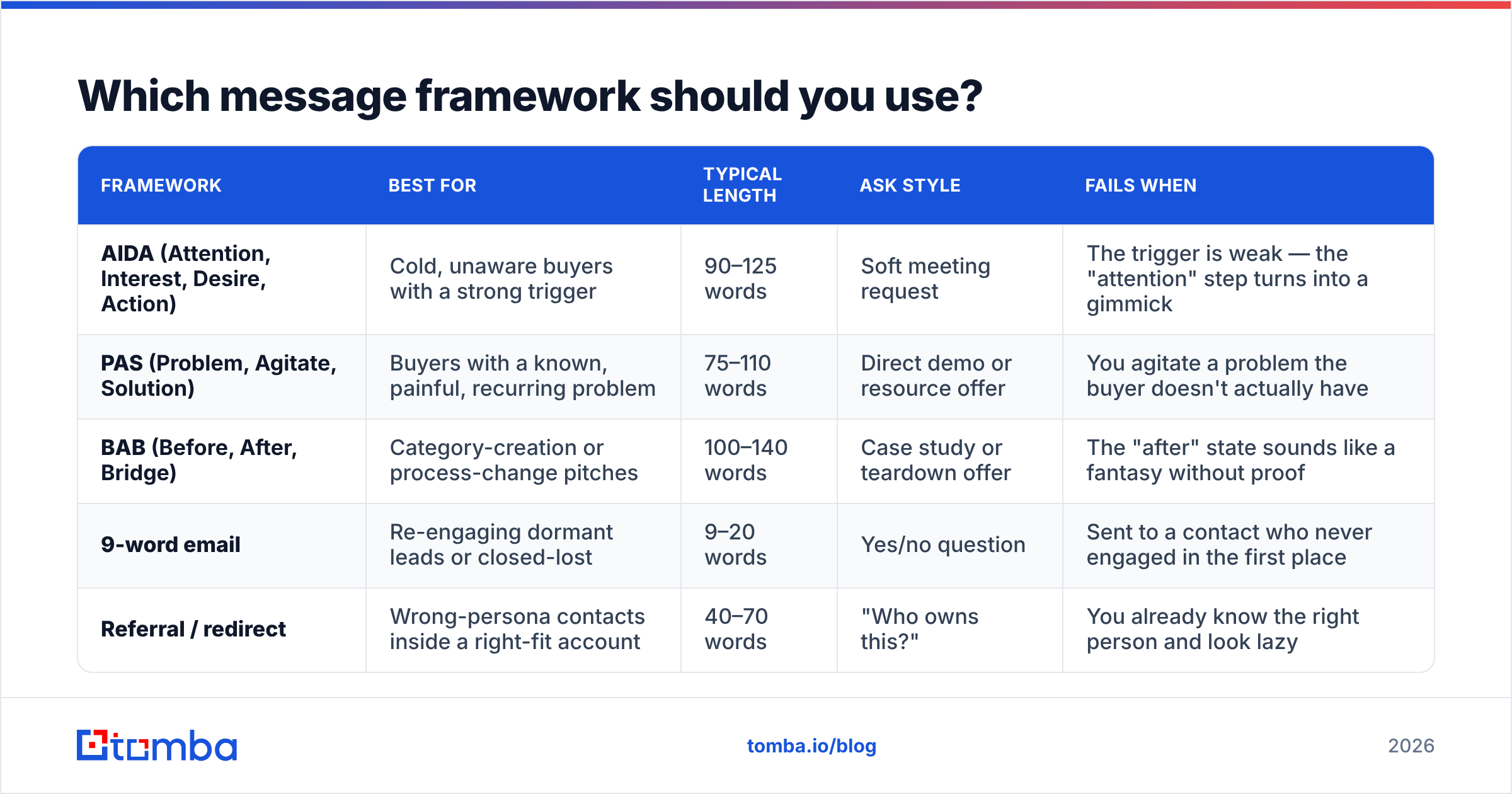
Which message framework should you use?#
Frameworks are shortcuts for the five parts above. The mistake is picking one and forcing every message into it. Match the framework to where the buyer sits.
| Framework | Best for | Typical length | Ask style | Fails when |
|---|---|---|---|---|
| AIDA (Attention, Interest, Desire, Action) | Cold, unaware buyers with a strong trigger | 90–125 words | Soft meeting request | The trigger is weak — the "attention" step turns into a gimmick |
| PAS (Problem, Agitate, Solution) | Buyers with a known, painful, recurring problem | 75–110 words | Direct demo or resource offer | You agitate a problem the buyer doesn't actually have |
| BAB (Before, After, Bridge) | Category-creation or process-change pitches | 100–140 words | Case study or teardown offer | The "after" state sounds like a fantasy without proof |
| 9-word email | Re-engaging dormant leads or closed-lost | 9–20 words | Yes/no question | Sent to a contact who never engaged in the first place |
| Referral / redirect | Wrong-persona contacts inside a right-fit account | 40–70 words | "Who owns this?" | You already know the right person and look lazy |
The 9-word email deserves special mention because it is the highest ROI message most teams never send. "Are you still looking to fix your bounce rate?" — sent to a contact who went dark four months ago — routinely outperforms elaborate multi-paragraph sequences, because it costs nothing to read and nothing to answer.
How long should effective sales messages be?#
Short, with one exception. Across published outbound benchmarks and internal tests, reply rate rises as word count falls until you cross under roughly 50 words, at which point the message stops carrying enough context to be credible.
| Length | Typical reply rate band | When to use |
|---|---|---|
| Under 50 words | Moderate | Re-engagement, referral asks, follow-ups 3+ |
| 50–125 words | Highest | Standard cold first touch with a real trigger |
| 125–200 words | Declining | Complex or technical sale with strong proof |
| Over 200 words | Lowest | Almost never — move it to a linked doc instead |
Two practical rules follow from this. First, mobile matters: a majority of B2B email is now opened on a phone, so anything past roughly five short lines requires a scroll and a decision to keep reading. Second, subject lines follow the same physics — three to five words, lowercase, no punctuation gimmicks. Run candidates through a subject line tester before you commit a whole sequence to one.
What does an effective sales message actually look like?#
Three annotated examples. Steal the structure, not the words.
1. Hiring-trigger cold email (PAS, 84 words)
Subject: three SDRs in Berlin
Hi Marta — saw the three SDR roles you posted for the Berlin team last week.
Most teams ramping that fast hit the same wall: reps burn their first two weeks building lists by hand instead of selling, and the lists still bounce at 10–15%.
Fintech client of ours cut list-build time per rep from six hours a week to under one, and bounce rate to 2%.
Worth a look before the new reps start, or is list-building already solved?
2. Product-change trigger (AIDA, 96 words)
Subject: your usage-based switch
Hi Dan — noticed the pricing page moved to usage-based billing in June.
That usually breaks the old lead-scoring model, because the accounts that convert best under seat pricing aren't the ones that expand under usage pricing.
The teams that handled this well rebuilt scoring around firmographic + product-usage signals in the same quarter as the pricing change, not the one after.
I put together a one-page breakdown of how three companies re-scored their pipeline post-switch. Want me to send it over?
3. Re-engagement (9-word, 12 words)
Subject: still relevant?
Hi Priya — are you still trying to fix the bounce rate issue?
Message three takes eleven seconds to write and consistently beats sequences that took an hour. The reason is structural: it presumes a prior context, asks a closed question, and gives the recipient a socially easy way to say no — which is exactly why they say yes.
Why do most sales messages fail?#
The failure modes are boringly consistent. In order of how much damage they do:
- Bad data. The address bounces, the person left the company, or the title is three levels off. This is the single largest source of zero-reply outreach and it is invisible in your copy dashboard — a bounced send looks like a "no reply," so teams blame the message and rewrite it.
- Fake personalization. "I loved your post about [topic]" where the topic is scraped from a three-year-old article. Buyers detect this instantly now, and it costs you more credibility than a plain generic message would.
- Product-first opening. Any message whose first sentence contains your company name is starting from a deficit.
- Multiple asks. "Book a call, or download this, or reply with a good time" is three decisions. Ship one.
- Volume masking quality. Sending 5,000 mediocre messages to hit the same reply count as 500 good ones works right up until your domain reputation collapses. Then neither works.
- No follow-up discipline. The bulk of replies arrive on touches two through four. Sending once and moving on discards most of your yield.
How do you measure whether your sales messages work?#
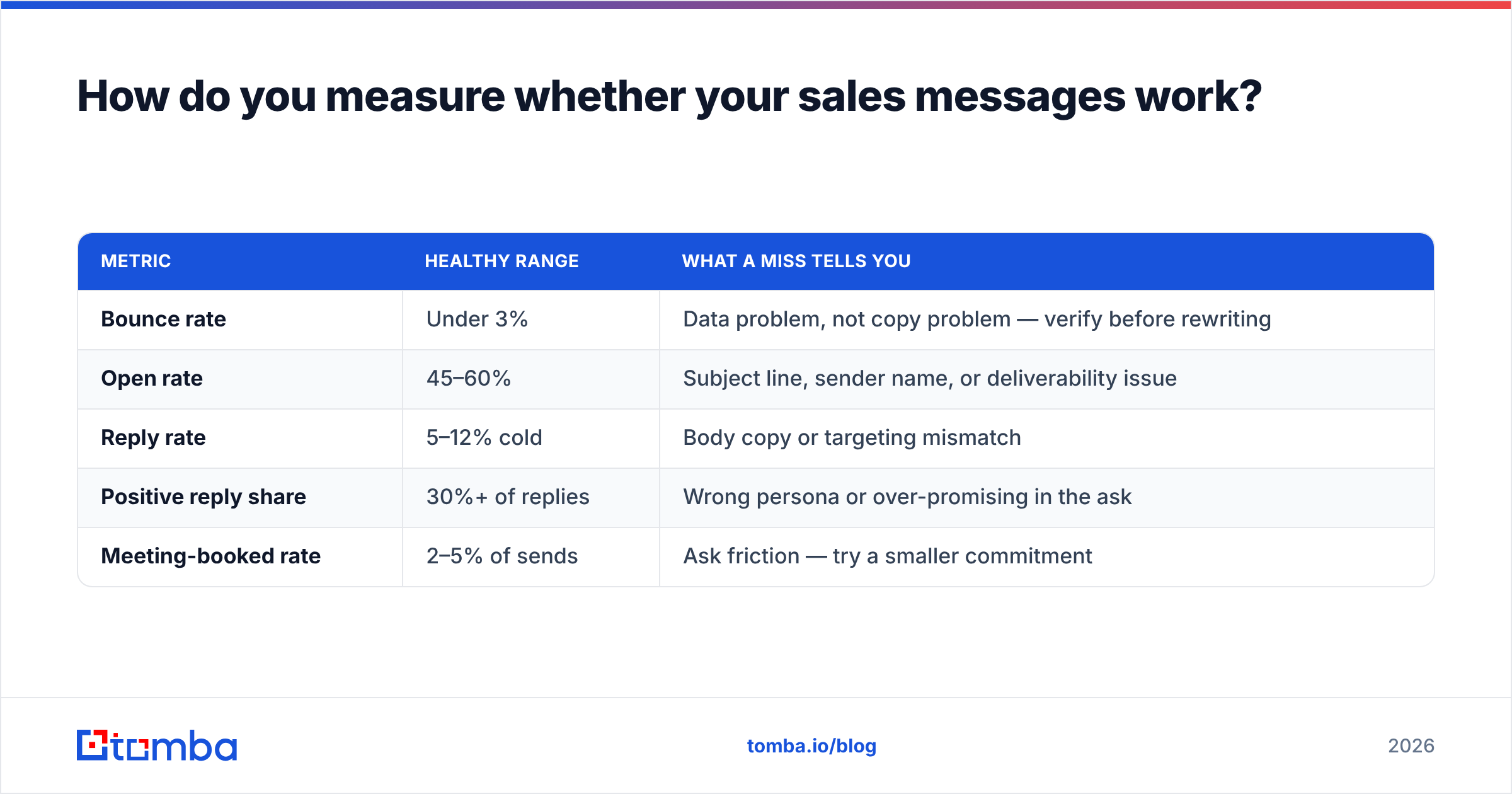
Reply rate is the headline metric, but it hides too much on its own. Track five numbers per sequence and diagnose by where the drop happens.
| Metric | Healthy range | What a miss tells you |
|---|---|---|
| Bounce rate | Under 3% | Data problem, not copy problem — verify before rewriting |
| Open rate | 45–60% | Subject line, sender name, or deliverability issue |
| Reply rate | 5–12% cold | Body copy or targeting mismatch |
| Positive reply share | 30%+ of replies | Wrong persona or over-promising in the ask |
| Meeting-booked rate | 2–5% of sends | Ask friction — try a smaller commitment |
Diagnose top-down. If bounces are above 3%, nothing below that line is trustworthy, because your denominators are wrong. Fix the list, re-baseline, then test copy. Teams that skip this step spend months optimizing a variable that was never the constraint. If you want the definitional groundwork, our response rate entry breaks down how the ratios interact.
For external benchmarks, Gong's research team publishes analysis on what language patterns correlate with deal progression, and HubSpot's sales blog maintains regularly updated outreach statistics. Treat both as directional — your ICP's numbers will differ.
How does data quality change message performance?#
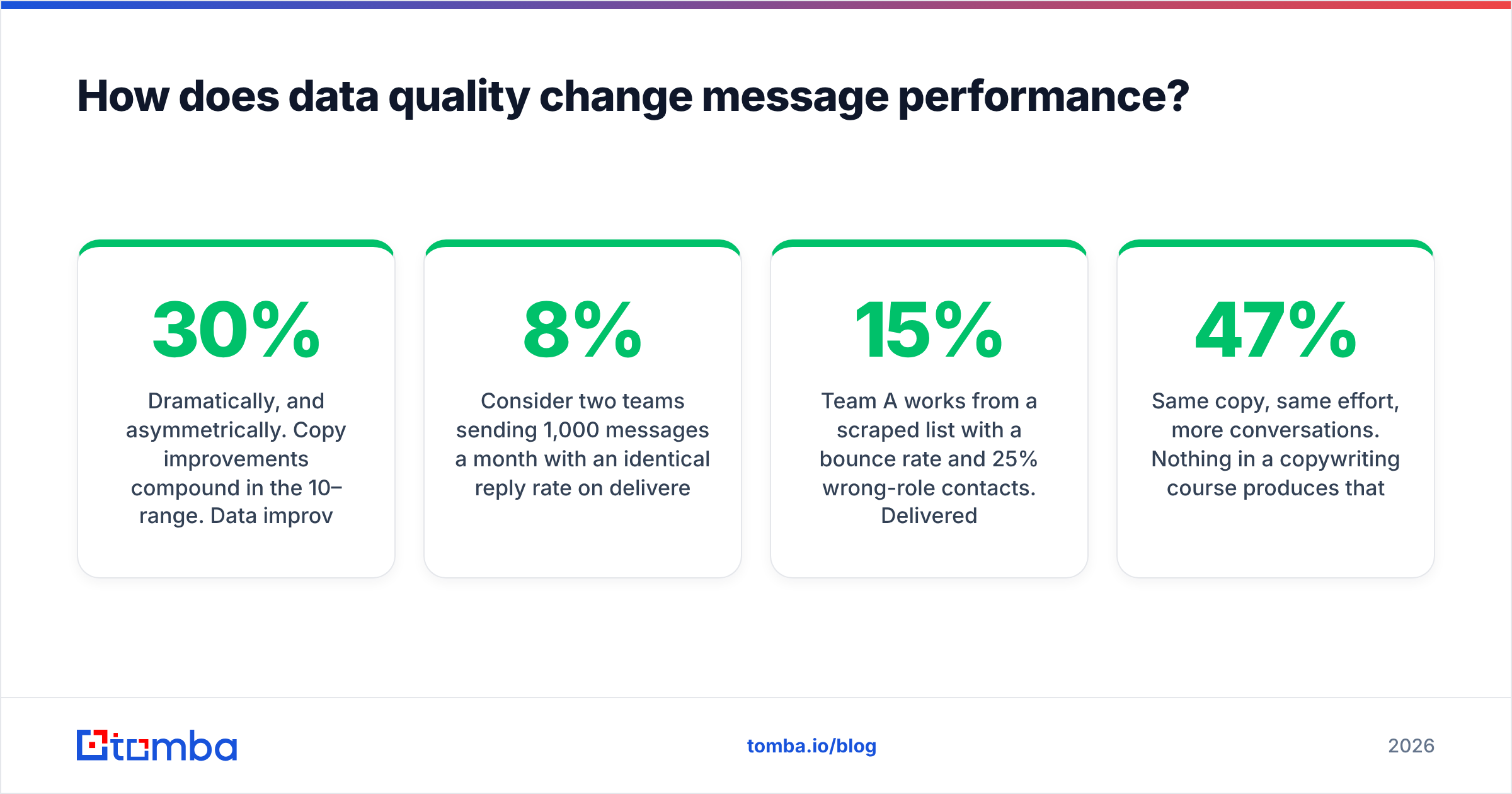
Dramatically, and asymmetrically. Copy improvements compound in the 10–30% range. Data improvements can double or triple effective output, because they fix the denominator instead of the numerator.
Consider two teams sending 1,000 messages a month with an identical 8% reply rate on delivered mail:
- Team A works from a scraped list with a 15% bounce rate and 25% wrong-role contacts. Delivered to the right person: 638 messages. Replies: 51.
- Team B verifies addresses and confirms role before sending. Delivered to the right person: 940 messages. Replies: 75.
Same copy, same effort, 47% more conversations. Nothing in a copywriting course produces that lift.
Practically, that means three things sit upstream of your message work. Use an email finder to source addresses tied to a named person and domain rather than guessing patterns. Run the list through an email verifier before it touches your sending tool, so soft and hard bounces never reach your sender reputation. And use contact enrichment to confirm the title, seniority, and company size actually match your ICP — a great message to a wrong-fit buyer is still a wrong-fit conversation.
The frameworks in this guide are only as good as the inbox they land in. If you want a fast diagnostic: pull 100 addresses from your current active sequence, verify them, and see what percentage come back invalid or catch-all. If it is over 5%, your message is not your problem yet. Plans and volumes are listed on the Tomba pricing page, including a free tier if you just want to run that diagnostic.
What should you do next?#
Pick one sequence you already run. Cut every message to under 125 words. Replace the opener with one verifiable trigger. Reduce the ask to a single closed question. Then verify the list before the next send and re-baseline your numbers after two weeks.
That sequence of changes — in that order — reliably outperforms rewriting from scratch, because it isolates the variables instead of changing everything at once.
When you are ready to fix the data layer underneath your messaging, start with the Tomba Email Finder. Find verified professional addresses by name, company, or domain, confirm they are deliverable before you send, and stop attributing data failures to copy. The free tier includes 25 searches a month, which is enough to audit a live sequence and see whether your messages were ever the bottleneck.
Related guides#
Ready to find emails that actually work?
Join 150,000+ professionals who stopped guessing and started sending. Free credits on signup — no credit card required.
Get the Tomba newsletter
Practical outbound tactics and product updates — once every two weeks.
About the author