eGrabber vs ZoomInfo (2026): Which B2B Data Tool Wins?
One is a desktop scraper you buy once a year. The other is an enterprise database with a five-figure contract. Here is how eGrabber and ZoomInfo actually compare on data, pricing, and workflow fit in 2026.
TL;DR
- eGrabber (LeadGrabber Pro, Email Finder) is Windows desktop software you license annually. It scrapes lists you already found — LinkedIn results, directories, conference pages — and appends emails and phones locally. Roughly $1,500–$3,500/year depending on the module.
- ZoomInfo is a hosted B2B database with intent data, org charts, technographics, and CRM sync. Contracts commonly land in the $15,000–$40,000/year range with seat minimums and annual lock-in.
- They are not really the same product. eGrabber solves "turn this list into contacts." ZoomInfo solves "tell me who to target and when."
- Both stumble on the same thing: email accuracy on non-US, SMB, and recently-changed-job contacts. Neither replaces a dedicated verification step.
- If your actual need is finding and verifying work emails at a known set of companies, a per-credit API tool like Tomba does that job for a fraction of either price.
What is eGrabber and who actually uses it?#
eGrabber is a Silicon Valley company that has been shipping desktop lead-capture software since the 1990s. Its two relevant products are LeadGrabber Pro (extract lists from web pages and LinkedIn results, then append business emails and phone numbers) and eGrabber Email Finder (bulk append emails to an existing spreadsheet of names + companies).
The defining trait is that it runs on your Windows machine, using your browser session and your IP. That has two consequences:
- You control the source. If you can see a list on screen — a chamber of commerce directory, an association member page, a conference speaker roster, a LinkedIn Sales Navigator search — LeadGrabber can usually structure it into rows.
- You inherit the risk. Scraping LinkedIn from your own logged-in account is against LinkedIn's user agreement, and account restrictions are a real outcome for aggressive use. eGrabber throttles, but the exposure sits with you, not a vendor's proxy fleet.
Typical eGrabber buyers are staffing and recruiting firms, small agencies, and one-to-five-person sales teams who work from niche lists that no database indexes well. Local trade associations, regional manufacturers, and franchise operators are the sweet spot.
What is ZoomInfo and what does it actually sell?#
ZoomInfo is the opposite architecture: a hosted database of hundreds of millions of business contacts, refreshed by a mix of contributory network data, public web crawling, machine learning inference, and a research team. You do not bring a list. You filter one out of the platform using firmographics, technographics, job changes, funding events, and buying-intent signals.
The platform now sells mostly as ZoomInfo Copilot — the same data with an AI layer on top that surfaces accounts showing intent, drafts outreach, and pushes everything into Salesforce or HubSpot. Add-ons include Engage (sequencer), Chat, Enrich, and Operations (data hygiene for RevOps teams).
ZoomInfo's real product is not "emails." It is coverage plus signal. You are paying for the ability to say "show me every 200–1,000 employee SaaS company in North America using Snowflake that just hired a VP of Data" and get a workable list in ninety seconds. eGrabber cannot do that at all, because it has no database to query.
How do eGrabber and ZoomInfo compare head-to-head?#
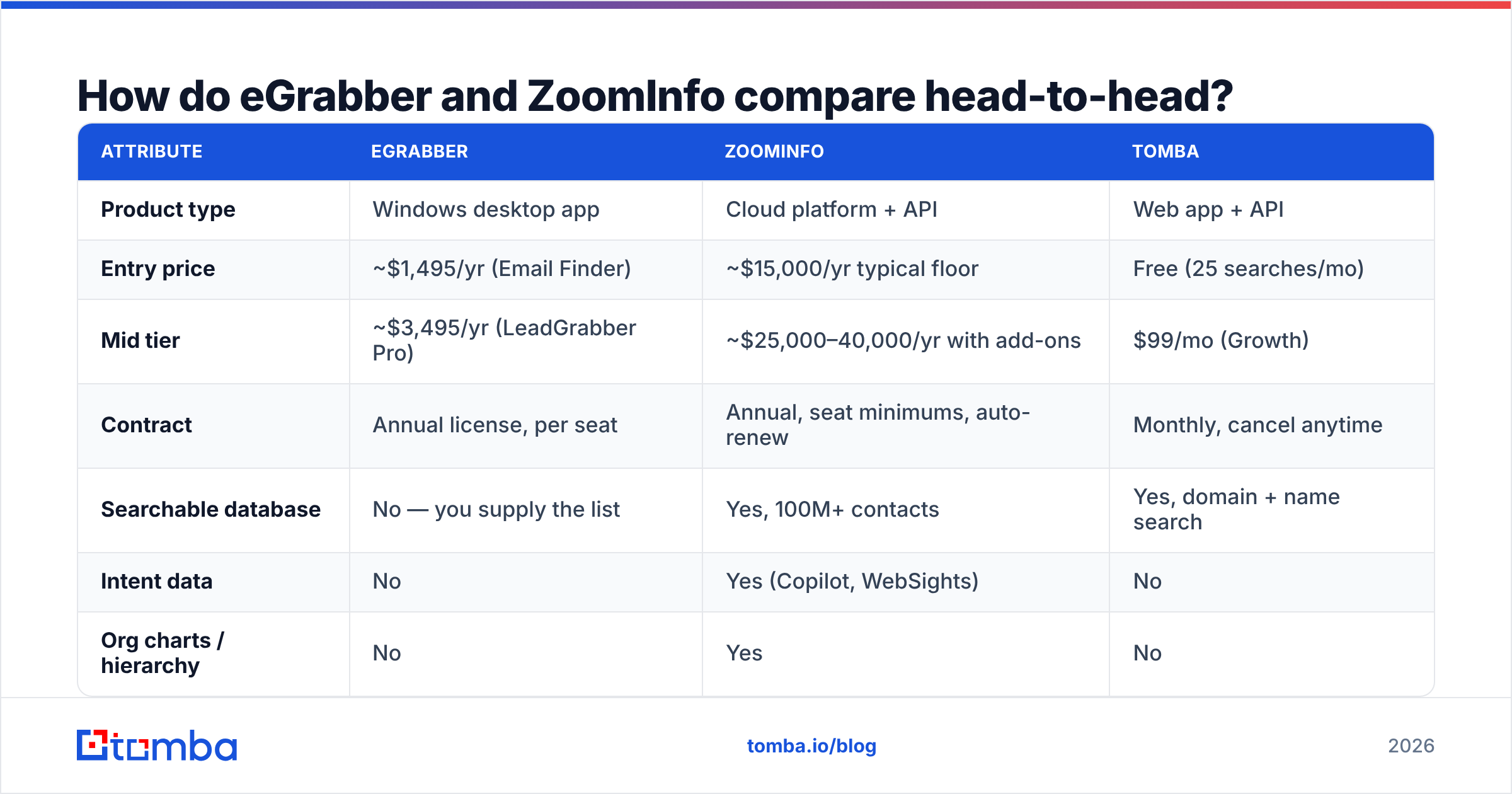
Here is the practical comparison. Pricing reflects publicly reported list prices and reseller quotes as of early 2026 — both vendors negotiate, and ZoomInfo in particular rarely publishes numbers.
| Attribute | eGrabber | ZoomInfo | Tomba |
|---|---|---|---|
| Product type | Windows desktop app | Cloud platform + API | Web app + API |
| Entry price | ~$1,495/yr (Email Finder) | ~$15,000/yr typical floor | Free (25 searches/mo) |
| Mid tier | ~$3,495/yr (LeadGrabber Pro) | ~$25,000–40,000/yr with add-ons | $99/mo (Growth) |
| Contract | Annual license, per seat | Annual, seat minimums, auto-renew | Monthly, cancel anytime |
| Searchable database | No — you supply the list | Yes, 100M+ contacts | Yes, domain + name search |
| Intent data | No | Yes (Copilot, WebSights) | No |
| Org charts / hierarchy | No | Yes | No |
| Direct dials | Yes, appended | Yes, large inventory | Yes, via phone finder |
| Email verification built in | Basic pattern check | Basic, plus "last verified" date | Dedicated verifier + catch-all logic |
| Runs on Mac / Linux | No | Yes (browser) | Yes (browser) |
| Free trial | Limited-credit trial | Demo-gated, sales call required | Free tier, no card |
| Best for | Niche list building from the open web | Enterprise ABM and territory planning | Targeted email finding and verification at scale |

The table makes the real distinction visible: eGrabber is a tool, ZoomInfo is a data subscription. A tool with no data is useless without a source. A subscription with great data is expensive when you only need a slice of it.
Which one has better email accuracy?#
Neither vendor publishes an independently audited accuracy figure, so treat any single number with suspicion — including the ones in their own marketing.
What holds up across G2 reviews and practitioner testing is a consistent pattern:
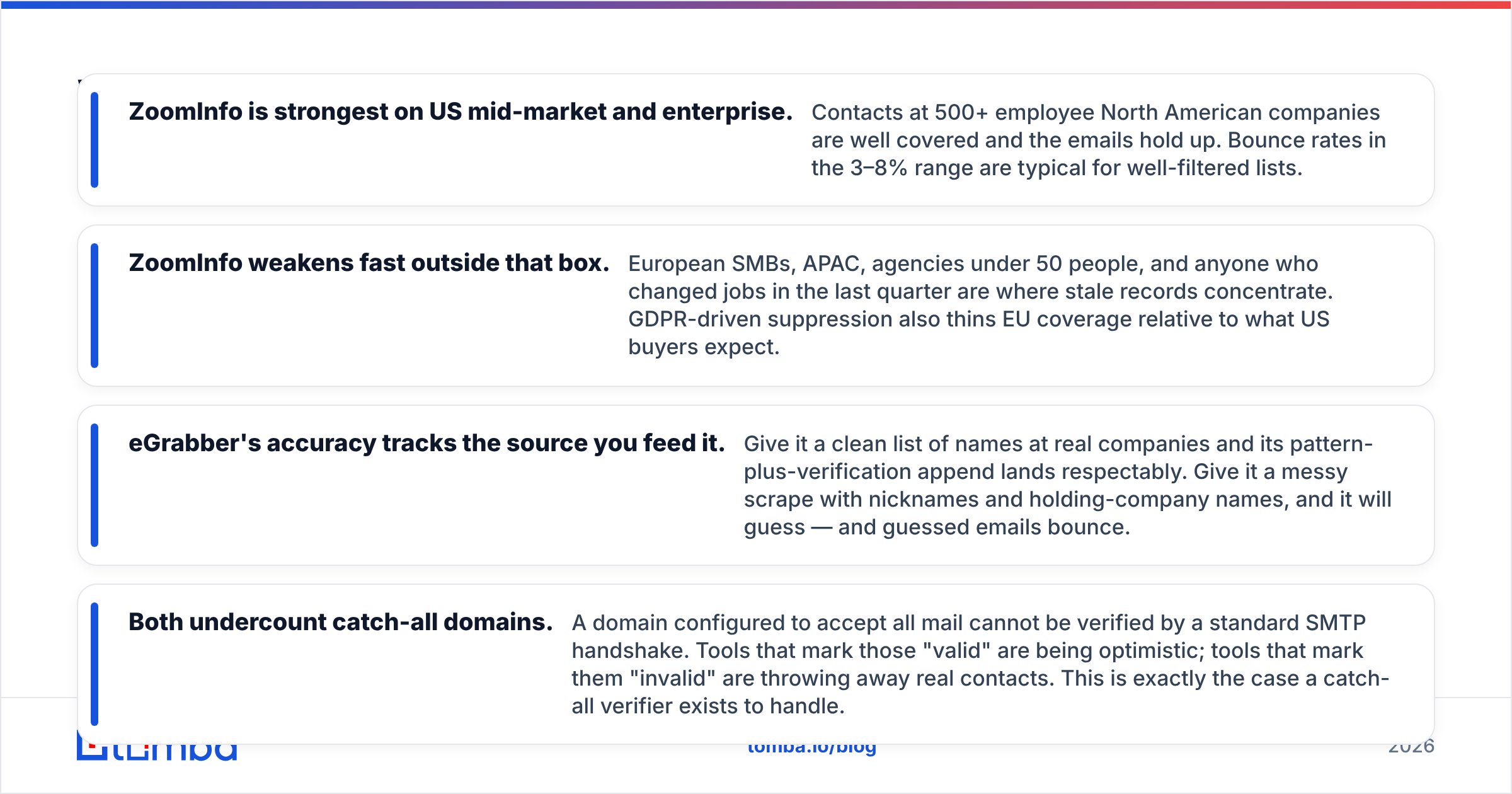
- ZoomInfo is strongest on US mid-market and enterprise. Contacts at 500+ employee North American companies are well covered and the emails hold up. Bounce rates in the 3–8% range are typical for well-filtered lists.
- ZoomInfo weakens fast outside that box. European SMBs, APAC, agencies under 50 people, and anyone who changed jobs in the last quarter are where stale records concentrate. GDPR-driven suppression also thins EU coverage relative to what US buyers expect.
- eGrabber's accuracy tracks the source you feed it. Give it a clean list of names at real companies and its pattern-plus-verification append lands respectably. Give it a messy scrape with nicknames and holding-company names, and it will guess — and guessed emails bounce.
- Both undercount catch-all domains. A domain configured to accept all mail cannot be verified by a standard SMTP handshake. Tools that mark those "valid" are being optimistic; tools that mark them "invalid" are throwing away real contacts. This is exactly the case a catch-all verifier exists to handle.

The operational takeaway: verify before you send, regardless of source. Neither eGrabber nor ZoomInfo is a verification product. Running exported lists through a dedicated email verifier typically strips 8–20% of records that would otherwise have bounced — which matters far more to your sender reputation than which vendor sourced the list.
What does each one really cost you?#
Sticker price is the smaller half of the story. Here is the full picture for each:
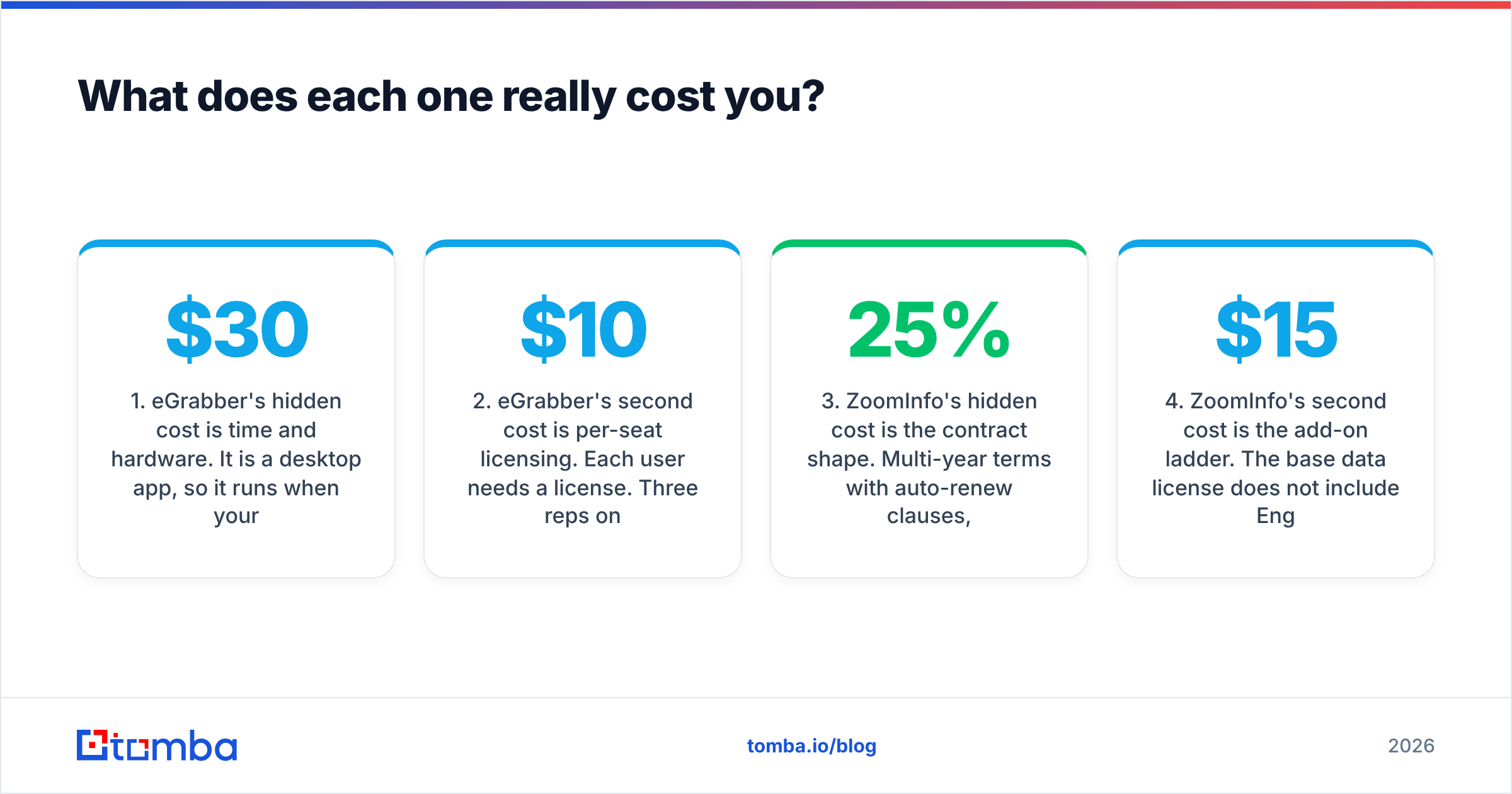
eGrabber's hidden cost is time and hardware. It is a desktop app, so it runs when your machine runs. Big append jobs occupy a Windows box for hours. Teams that run it seriously end up dedicating a spare laptop or a cloud VM — add $30–80/month if you go the VM route. There is no Mac version; Parallels is the common workaround and it is not pleasant.
eGrabber's second cost is per-seat licensing. Each user needs a license. Three reps on LeadGrabber Pro is roughly $10,000/year, and there is no shared credit pool to smooth out uneven usage.
ZoomInfo's hidden cost is the contract shape. Multi-year terms with auto-renew clauses, seat minimums that often start at three to five, and credit blocks that expire annually rather than rolling over. Renewal quotes commonly step up 10–25%. Buyers who tried to downgrade mid-term generally could not.
ZoomInfo's second cost is the add-on ladder. The base data license does not include Engage, Chat, WebSights, or Operations. Most quotes that start near $15,000 end near $30,000 once the features the demo showed you are actually included.
The shared hidden cost is credit waste. Both models charge you for pulls you never email. If your ICP is 2,000 accounts, you do not need a 100-million-record subscription — you need 2,000 accurate contacts. Per-credit pricing aligns with that; annual platform licensing does not.

When should you choose eGrabber over ZoomInfo?#
Pick eGrabber when:
- Your best lists live on the open web, not in a database. Trade associations, local directories, event rosters, alumni pages, government registries.
- You are one to three people and a five-figure annual contract is not survivable.
- Your ICP is genuinely long-tail — regional trades, franchises, small clinics, independent contractors — where ZoomInfo's coverage thins out anyway.
- You are a recruiter working candidate lists rather than company lists.
Pick ZoomInfo when:
- You need to discover accounts, not just enrich known ones. Territory planning, ABM tiering, and TAM sizing all require a queryable database.
- Intent and job-change signals drive your timing, and you have the headcount to act on them within days.
- You need org charts to map a buying committee at a 5,000-person enterprise.
- Procurement will actually fund it and RevOps will actually operationalize it. An unused ZoomInfo seat is the most expensive object in a sales org.
Pick neither when your job is narrower than both: you know the companies, you know the roles, and you need verified work emails. That is a domain search and email finder problem, and paying database prices for it is overspending by an order of magnitude.
How do you build a stack that costs less than either?#
Most teams that ditch a five-figure data contract do not replace it with one thing. They replace it with three cheap things:
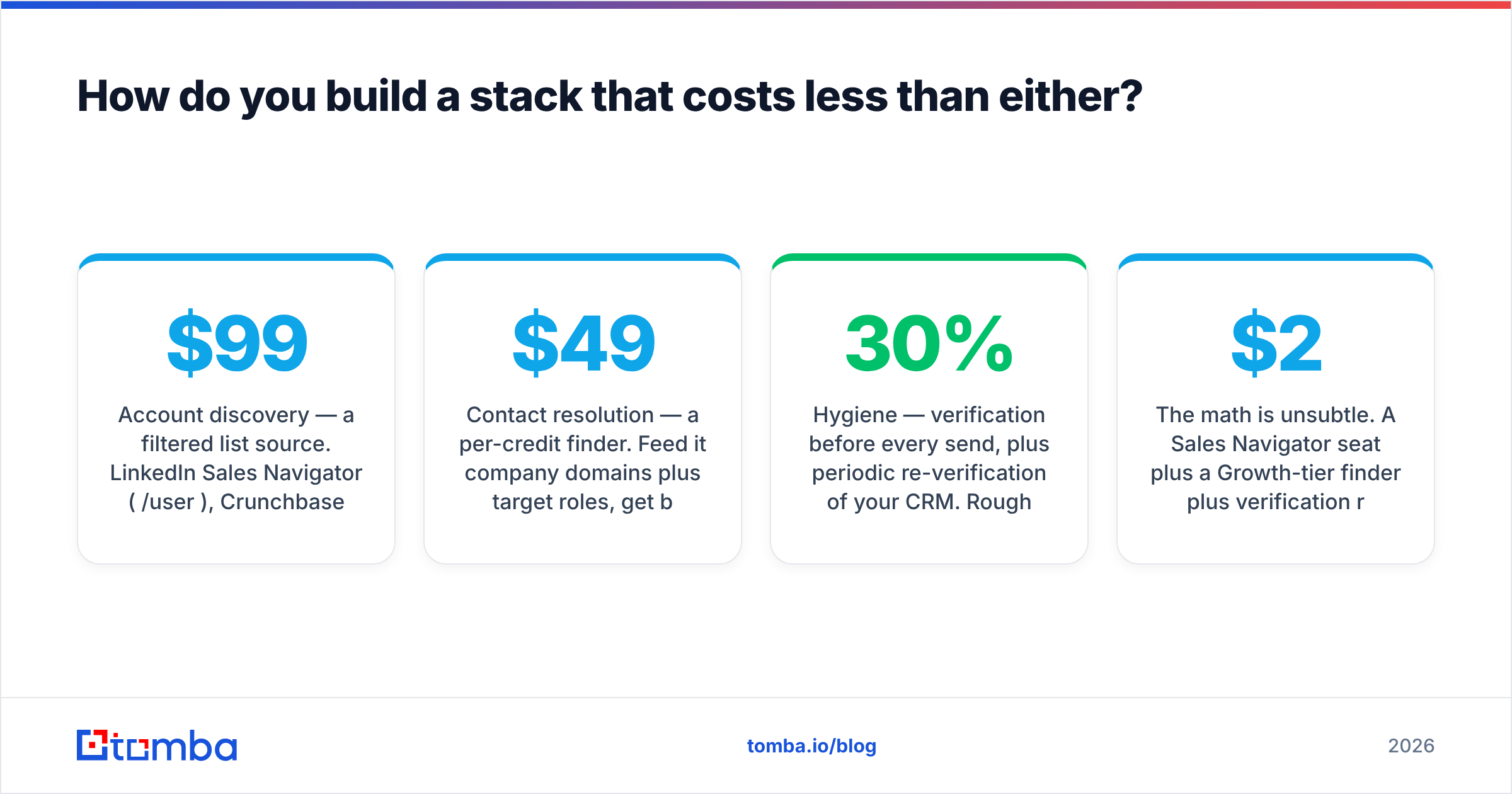
- Account discovery — a filtered list source. LinkedIn Sales Navigator ($99/user/mo), Crunchbase, or a vertical directory. You are buying the list of companies, not the contacts.
- Contact resolution — a per-credit finder. Feed it company domains plus target roles, get back emails and phones. Tomba's bulk email finder and Tomba API cover this, with Tomba pricing starting free at 25 searches/month, $49/mo Starter, $99/mo Growth, and $249/mo Pro.
- Hygiene — verification before every send, plus periodic re-verification of your CRM. Roughly 25–30% of B2B contact data decays annually, so a static list bought once is a bouncing list by month nine.
The math is unsubtle. A Sales Navigator seat plus a Growth-tier finder plus verification runs under $2,500/year. A ZoomInfo contract with the features you saw in the demo runs ten to fifteen times that. The database is worth the premium only if intent signals and org charts change what you do — not just what you know.
If your team already runs HubSpot or Salesforce, wire enrichment in at the record level and skip the bulk-export-and-import ritual entirely. Enriching on demand, per record, is both cheaper and fresher than refreshing a 50,000-row static list quarterly.
What is the verdict on eGrabber vs ZoomInfo?#
ZoomInfo wins on data breadth and buying signal. eGrabber wins on cost and on lists nobody has indexed. Neither wins on email accuracy, and neither is the cheapest way to solve the specific problem most teams actually have.
Be honest about which problem you are solving. If you cannot name your target accounts, you have a discovery problem and ZoomInfo — or a cheaper database — is the answer. If you can name them and just need to reach the right humans there, you have a resolution problem, and paying enterprise database prices for it is the most common budget leak in outbound.
Start with the resolution layer, because it is cheap to test. Run 25 free searches through the Tomba Email Finder against companies you already know you want, verify the results, and send. If your reply rate holds, you never needed the five-figure contract. If you run out of accounts to target, that is your signal — and only then — to go shopping for a database.
Related guides#
Ready to find emails that actually work?
Join 150,000+ professionals who stopped guessing and started sending. Free credits on signup — no credit card required.
Get the Tomba newsletter
Practical outbound tactics and product updates — once every two weeks.
About the author