Elevator Pitch Examples and Formulas That Win in 2026
Most elevator pitch advice is stuck in 2010: memorize 30 seconds, recite it at anyone. Here is what actually works across cold calls, email, LinkedIn, and events — with formulas, scored examples, and a 20-minute build process.
TL;DR
- An elevator pitch is not a speech. It is a 20-40 second answer to "why should I keep listening?" that ends in a question, not a period.
- The formula that survives contact with real buyers: trigger → problem → proof → ask. Feature lists and mission statements lose.
- Pitch length and structure must change by channel. A cold call pitch (15 seconds) and a conference pitch (40 seconds) are different assets, not the same script delivered faster.
- Score every pitch on four things: specificity of the buyer, specificity of the pain, a number you can defend, and a low-friction ask.
- The pitch is only half the equation. A perfect pitch delivered to the wrong contact — or a bounced email address — still returns zero.
What is an elevator pitch, really?#
An elevator pitch is a short, self-contained explanation of what you do, who it helps, and why that matters — short enough to deliver in the time a lift takes to reach the top floor. That is the origin of the name, and the term has been in business use since the 1980s.
But the 1980s definition has aged badly. Back then the pitch was a monologue: you had a captive listener, no competing tabs, and no way for them to Google you mid-sentence. In 2026 your listener has already made a decision about you within about five seconds — from your subject line, your opening question, or your LinkedIn headline — long before you reach your value proposition.
So the modern working definition is narrower and more useful:
An elevator pitch is the shortest sequence of words that earns you permission to ask your next question.
That reframe changes everything about how you write one. You stop optimizing for "explains my company completely" and start optimizing for "makes a specific person want to reply." Completeness is the enemy. Relevance is the whole game.
Three things a good elevator pitch is not:
- A mission statement. "We're on a mission to democratize revenue intelligence" tells a buyer nothing they can act on.
- A feature tour. Nobody buys the fourth bullet on your integrations page during a first conversation.
- A monologue. If there is no handoff at the end, you have written a commercial, not a pitch.
Why do most elevator pitches fail?#
They fail for boringly consistent reasons. After reviewing hundreds of cold call openers, LinkedIn intros, and first-touch emails, the same five failure modes come up again and again.
- The pitch describes the seller, not the buyer. Any pitch where the first eight words are about your company is already losing. Buyers filter for self-relevance first; they cannot hear your differentiation until they have decided the topic applies to them.
- The pain is generic. "Struggling with pipeline?" applies to every B2B company on earth, which is exactly why it lands on nobody. "Your SDRs are rebuilding the same account list every quarter because your CRM has 40% missing contact data" lands on someone.
- There is no defensible number. Claims without magnitude are noise. "Save time" is noise. "Cut list-building from six hours a week to forty minutes" is a claim someone can argue with — and arguing is engagement.
- The ask is too big. Ending with "can we book 45 minutes next week?" after 25 seconds of context is a mismatch. The ask should cost the buyer roughly what your pitch cost them: seconds, not a calendar slot.
- It never changes. The same 30 seconds gets used on a CFO, a RevOps manager, and a founder. One of those three might care. The other two churn out of the conversation politely.

The fix is not "be more charismatic." It is structural. Rewrite the pitch so the buyer appears in the first clause, the pain is narrow enough to be wrong, the proof carries a number, and the ask is small.
What does the anatomy of a working elevator pitch look like?#
Every pitch that consistently converts has the same four moving parts, in the same order. Think of it like a doctor's opening: they name the symptom you came in with before they explain their credentials. Trust flows from recognition, not résumé.
- The trigger (3-6 seconds). Why you are talking to this person now. A hiring signal, a funding round, a tech-stack change, a post they published, a competitor they just lost to. This is the single highest-leverage sentence in the whole pitch, and it is the one most reps skip.
- The problem (6-10 seconds). One named pain, phrased in the buyer's language, specific enough that a wrong guess is obvious. Narrow beats safe. If the prospect thinks "that's not us," you have saved both of you ten minutes.
- The proof (6-12 seconds). A number, a named peer, or a mechanism. "Three of the four seed-stage sales teams we work with in your city cut their bounce rate below 2%" is proof. "We're the leading platform for..." is not.
- The ask (3-5 seconds). A question that costs almost nothing to answer. "Is that a problem you're actively working on, or already solved?" gives the buyer a socially acceptable exit — which is exactly why they answer honestly.
Optional fifth element for live settings: the hook back. After they answer, you get one follow-up. Prepare that follow-up in advance for each of the two likely answers. Most reps prepare the pitch and improvise the response, which is precisely backwards — the response is where deals actually start.
Which elevator pitch format fits which channel?#
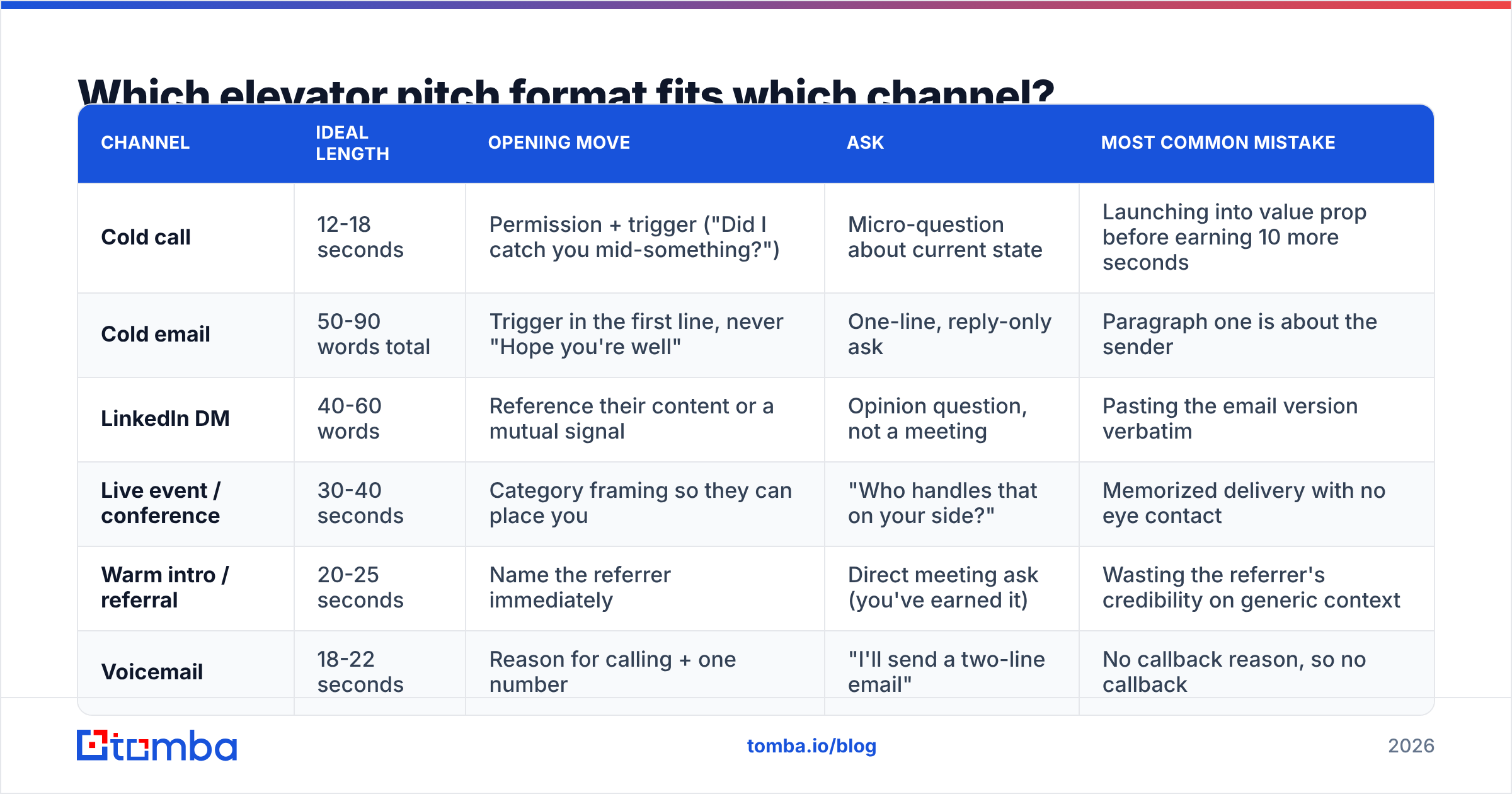
This is the part most guides skip. A pitch is not channel-agnostic. The same core message needs four different packagings, because attention budget, interruption cost, and social norms differ wildly.
| Channel | Ideal length | Opening move | Ask | Most common mistake |
|---|---|---|---|---|
| Cold call | 12-18 seconds | Permission + trigger ("Did I catch you mid-something?") | Micro-question about current state | Launching into value prop before earning 10 more seconds |
| Cold email | 50-90 words total | Trigger in the first line, never "Hope you're well" | One-line, reply-only ask | Paragraph one is about the sender |
| LinkedIn DM | 40-60 words | Reference their content or a mutual signal | Opinion question, not a meeting | Pasting the email version verbatim |
| Live event / conference | 30-40 seconds | Category framing so they can place you | "Who handles that on your side?" | Memorized delivery with no eye contact |
| Warm intro / referral | 20-25 seconds | Name the referrer immediately | Direct meeting ask (you've earned it) | Wasting the referrer's credibility on generic context |
| Voicemail | 18-22 seconds | Reason for calling + one number | "I'll send a two-line email" | No callback reason, so no callback |
A useful discipline: write the email version first, because writing forces precision. Then compress to the DM, then compress again to the call. Anything that survives three compressions is your actual message. Anything that drops out was decoration.
What do strong elevator pitch examples look like in 2026?#
Generic examples are useless, so here are four written for specific roles, with the structure annotated.
For a RevOps lead (cold email, 62 words):
Saw your team posted two SDR roles in Austin this month. When headcount doubles, the usual first crack is contact data — new reps burn their first three weeks rebuilding lists that already exist somewhere in the CRM. We cut that ramp for a 12-rep team down to four days by deduping and enriching before onboarding. Is list-building currently on your ramp plan, or handled already?
Trigger (hiring), problem (ramp waste), proof (12-rep team, four days), ask (binary, low cost).
For a founder at a seed-stage startup (LinkedIn DM, 48 words):
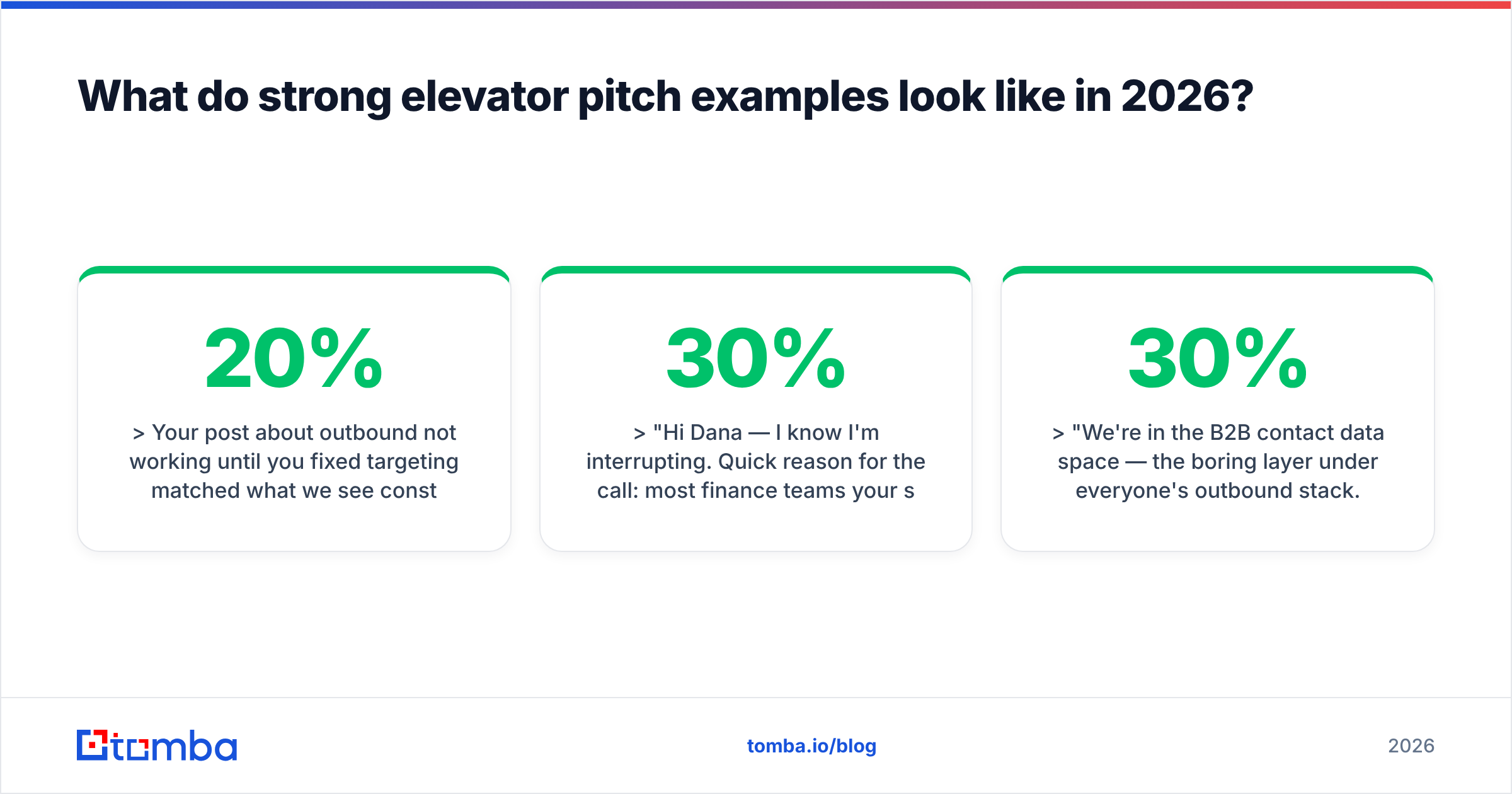
Your post about outbound not working until you fixed targeting matched what we see constantly — the message gets blamed when the list was the problem. Most of the seed teams we work with had a 14-20% bounce rate before cleanup. Curious what your current bounce rate looks like?
The ask here is an opinion question with a number attached. It is answerable in six words and it qualifies the prospect for you.
For a CFO (cold call, 16 seconds):
"Hi Dana — I know I'm interrupting. Quick reason for the call: most finance teams your size are paying for three overlapping data tools and using maybe 30% of the credits. That's usually 40-60k a year in shelfware. Is data tooling something you've already consolidated?"
Note that the pain is financial, not operational. Same product, different pain, because the buyer changed.
For an event conversation (35 seconds):
"We're in the B2B contact data space — the boring layer under everyone's outbound stack. The problem we keep running into is that teams buy a huge database, then discover 30% of it doesn't deliver, and their domain reputation takes the hit. So we built verification-first instead of volume-first. How does your team handle verification today — separate tool, or bundled?"
Category framing first ("the boring layer") gives the listener a mental slot to put you in. Without that slot, everything after it is unfilable.

How do you write your own elevator pitch in 20 minutes?#
Set a timer. Perfectionism is the reason most reps never finish this exercise.
Minutes 0-5: pick one segment. Not "B2B SaaS." Pick "Series A SaaS companies with 5-15 SDRs in North America." If you serve three segments, you need three pitches. This is not optional; it is the whole reason your current pitch feels flat.
Minutes 5-10: write the pain in their words. Open five recent call recordings or support tickets from that segment. Steal actual phrases. If your customers say "our data is a mess," do not translate it to "data hygiene challenges."
Minutes 10-15: find one number you can defend. A real customer result, a benchmark from your own aggregate data, or a cost-of-inaction figure. Write down where it came from. If you cannot cite it internally, you will hedge when you say it out loud, and buyers hear hedging.
Minutes 15-18: write the ask as a question a busy person answers in five words. Test: could they reply "already solved, thanks" without feeling rude? If not, the ask is too heavy.
Minutes 18-20: read it aloud and cut 20% of the words. Written English and spoken English diverge. Anything you stumble over gets deleted, not fixed.
Then run it live twenty times before you judge it. Twenty is the minimum sample; anything below that is superstition. If you want structural help drafting variants, pre-built cold email templates are a faster starting point than a blank page, and a subject line generator covers the part of the email that decides whether the pitch gets read at all.
How do you score whether an elevator pitch is actually working?#
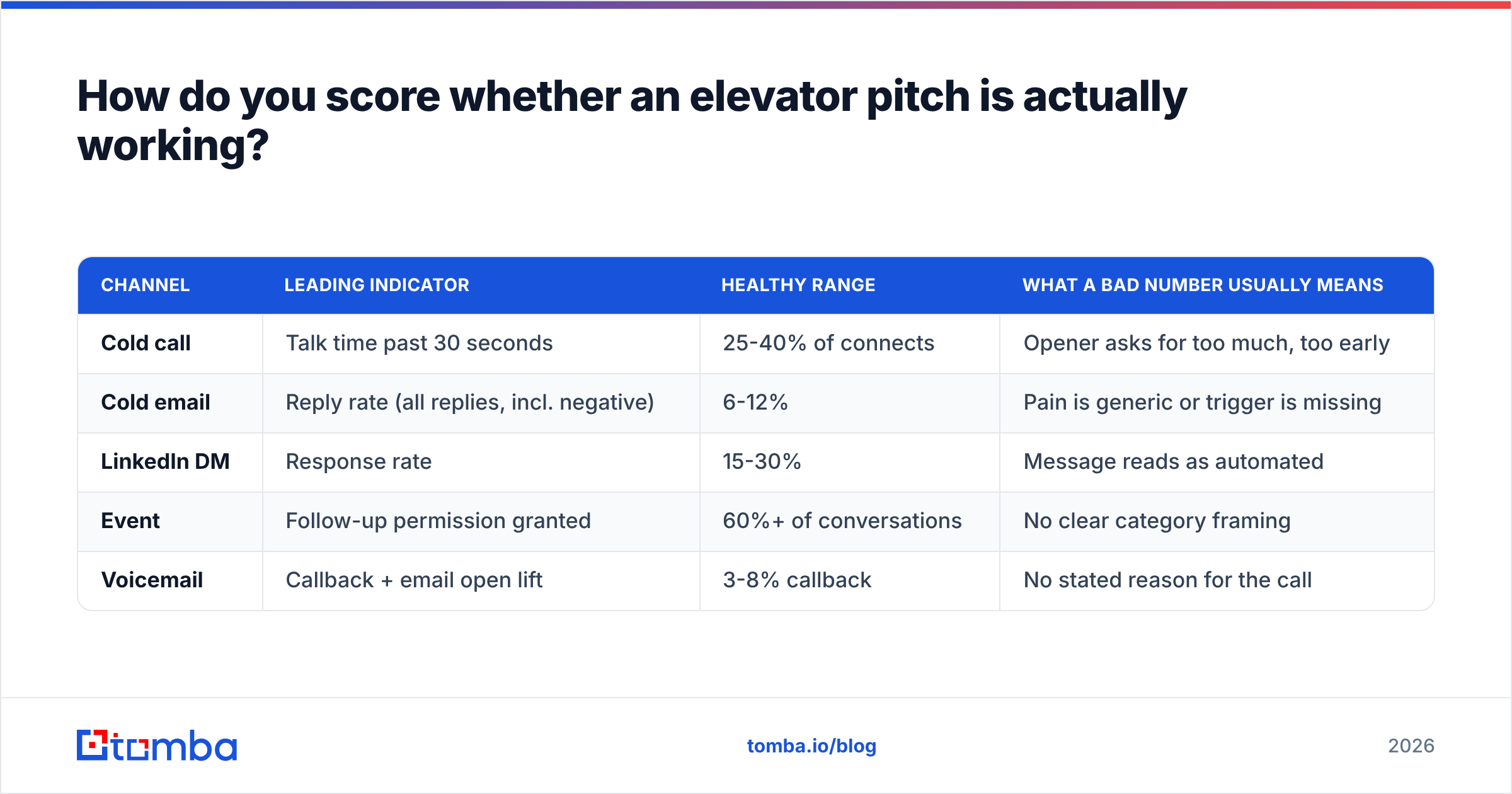
Do not judge a pitch on how good it feels. Judge it on which specific signal moved. Different channels give you different leading indicators, and mixing them up is how teams "optimize" for months with nothing to show.
| Channel | Leading indicator | Healthy range | What a bad number usually means |
|---|---|---|---|
| Cold call | Talk time past 30 seconds | 25-40% of connects | Opener asks for too much, too early |
| Cold email | Reply rate (all replies, incl. negative) | 6-12% | Pain is generic or trigger is missing |
| LinkedIn DM | Response rate | 15-30% | Message reads as automated |
| Event | Follow-up permission granted | 60%+ of conversations | No clear category framing |
| Voicemail | Callback + email open lift | 3-8% callback | No stated reason for the call |
One caveat that matters more than the pitch itself: negative replies are good data. A pitch generating 10% replies where most are "not now" is far healthier than one generating 2% replies that are all positive — the second is usually just a tiny, over-warmed list. Track your overall response rate, not only the flattering slice of it.
For the broader discipline behind this — qualification frameworks, discovery structure, and what happens after the pitch lands — HubSpot's sales resources and Salesforce's sales guidance are both solid, vendor-neutral-enough starting points. For peer reviews of the tooling underneath, G2's sales software categories will tell you more than any vendor's own comparison page.
Does the pitch matter more than the list?#
No. And this is the uncomfortable part of every elevator pitch article, including this one.
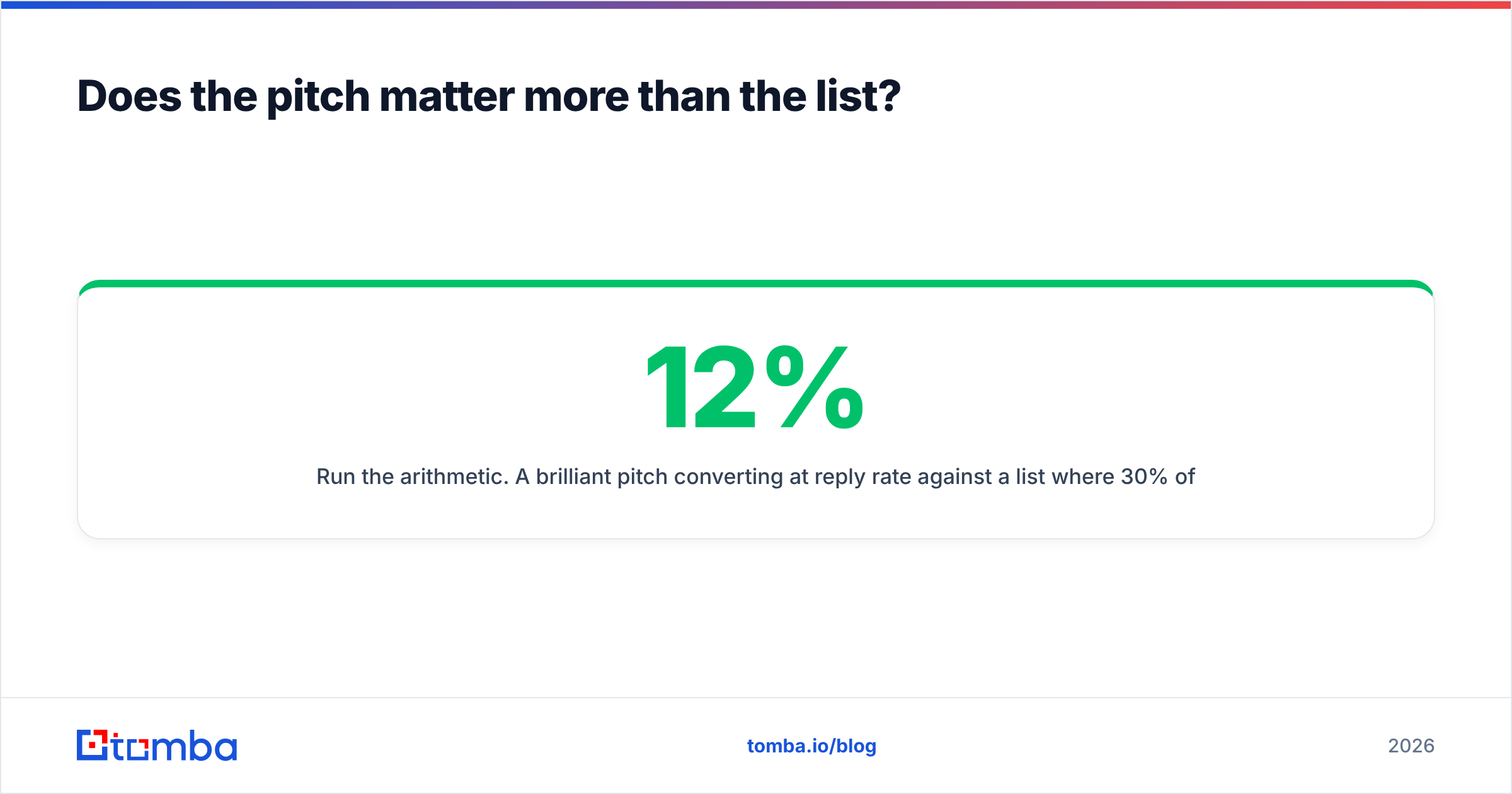
Run the arithmetic. A brilliant pitch converting at 12% reply rate against a list where 30% of addresses bounce and 40% of contacts hold the wrong role produces fewer conversations than a mediocre pitch at 6% against a clean, correctly-targeted list. Pitch quality is a multiplier. List quality is the base number. Multipliers on a base of near-zero stay near-zero.
Worse, bad data actively damages the channel. High bounce rates hit your sender reputation, which suppresses deliverability for the good addresses too — meaning your best-written pitch never reaches the people it was written for. That is a pitch problem you cannot fix by rewriting the pitch.
So the honest order of operations is:
- Get the right accounts. Segment tightly enough that one pitch can be genuinely relevant.
- Get the right people at those accounts. Role-correct contacts, current title, current company.
- Get deliverable addresses. Verify before you send, every time, not once a quarter.
- Then invest in the pitch — because now the multiplier has something to multiply.
Most teams do this in reverse: months of message iteration on top of a list nobody validated. If you are enriching accounts before you write, contact enrichment closes the role and seniority gaps that make a pitch land on the wrong desk, and verification before send is what keeps the reputation cost of experimentation near zero.
What should you do next?#
Pick one segment. Write one pitch using trigger → problem → proof → ask. Deliver it twenty times. Log which of the four elements caused the drop-off when it failed — you will find it is almost always the trigger or the ask, rarely the middle.
Then fix the base number. A pitch can only convert people who actually receive it, which means the list under your outreach matters more than the words on top of it. Tomba Email Finder gets you role-correct, verified contact data by domain, name, or company, so the pitch you just spent an afternoon sharpening reaches an inbox instead of a bounce log. The free tier includes 25 searches a month if you just want to test your segment before committing, and paid plans start at $49/mo — full Tomba pricing is public, no sales call required to see it.
Write the pitch. Then make sure someone real is on the other end of it.
Related guides#
Ready to find emails that actually work?
Join 150,000+ professionals who stopped guessing and started sending. Free credits on signup — no credit card required.
Get the Tomba newsletter
Practical outbound tactics and product updates — once every two weeks.
About the author