Elevator Pitch Template: 7 Frameworks That Actually Work
Most elevator pitches fail because they describe the seller, not the buyer's problem. Here are seven tested elevator pitch templates, filled-in examples by role, and a channel-by-channel adaptation guide.
TL;DR
- A working elevator pitch template has four moving parts: who you help, the specific pain, the mechanism, and a proof point. Everything else is decoration.
- Thirty seconds is the ceiling for spoken pitches. For cold email, the same structure compresses to roughly 50 words.
- Seven frameworks cover almost every situation — PAS, the Wolf pitch, the "so that" formula, the Category Design pitch, the Before/After/Bridge, the Hook-Story-Offer, and the one-line positioning statement.
- The pitch is the cheap part. The expensive part is being in front of the right person, with the right contact details, at the right moment.
- Rewrite your pitch quarterly against real objections. A pitch that has never been tested on a live prospect is a writing exercise, not a sales asset.
What is an elevator pitch, and why do most of them fail?#
An elevator pitch is a compressed explanation of what you do, delivered in the time it takes to ride an elevator — roughly 30 seconds, or 75 to 100 spoken words. The term itself dates back to Hollywood screenwriters, not sales, which explains a lot about why so many of them read like movie loglines instead of business conversations.
Here is the failure mode, and it is nearly universal: most pitches describe the seller. "We're a cloud-native revenue intelligence platform that leverages AI to unify go-to-market data." That sentence contains zero information a buyer can act on. It does not name a person, a problem, or a consequence.
The fix is structural, not stylistic. A good pitch leads with the listener's situation and only mentions your product as the mechanism that resolves it. You are not describing a category. You are describing a specific bad Tuesday that a specific person has, and how it stops.

The second failure mode is length. Buyers decide whether to keep listening in about the first eight seconds. If your first sentence is a company description, you have spent your entire budget on throat-clearing.
What goes into an elevator pitch template that works?#
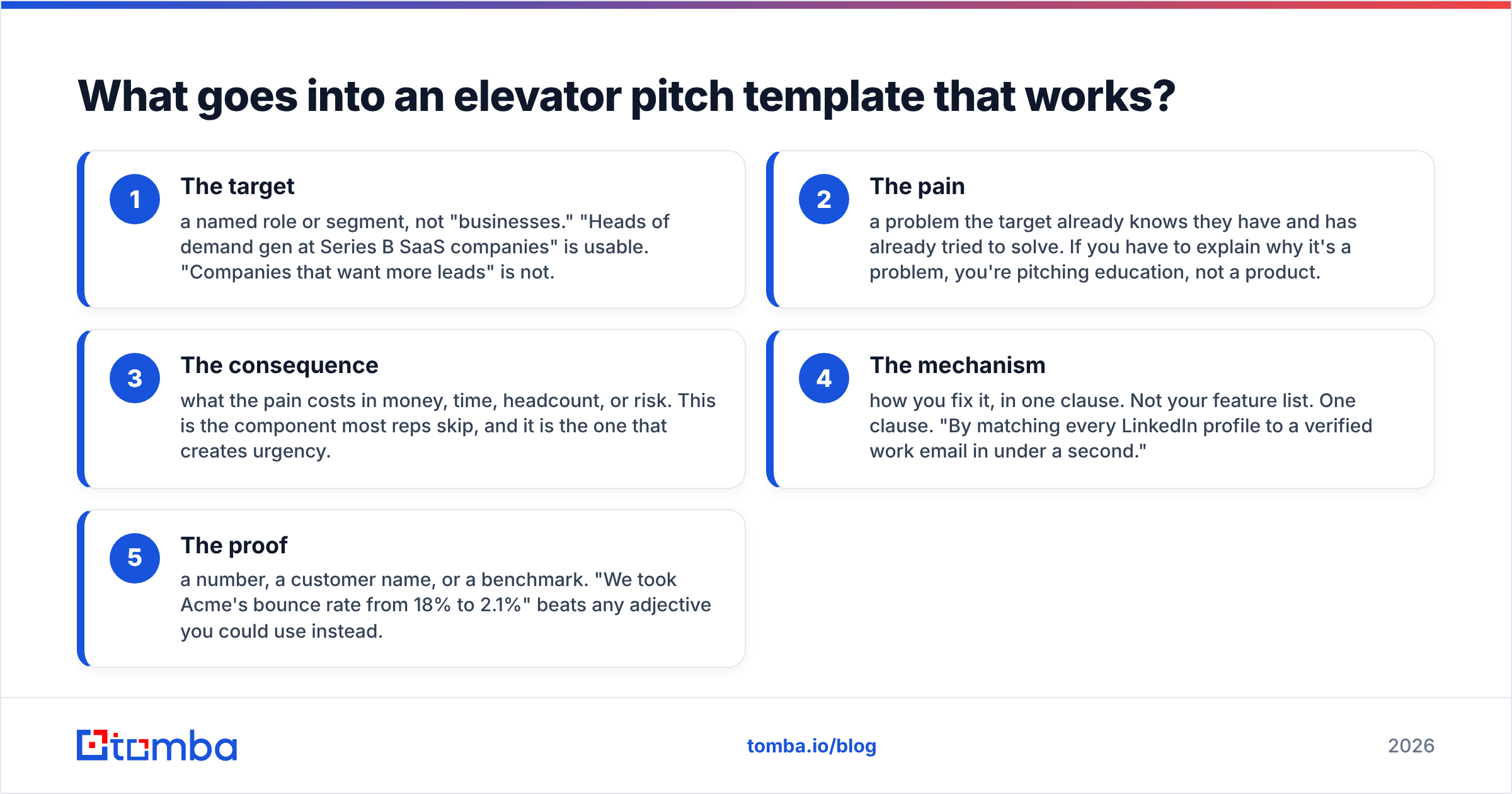
Every durable framework is a rearrangement of the same five components. Learn the components and you can build a pitch on the spot without a script.
- The target — a named role or segment, not "businesses." "Heads of demand gen at Series B SaaS companies" is usable. "Companies that want more leads" is not.
- The pain — a problem the target already knows they have and has already tried to solve. If you have to explain why it's a problem, you're pitching education, not a product.
- The consequence — what the pain costs in money, time, headcount, or risk. This is the component most reps skip, and it is the one that creates urgency.
- The mechanism — how you fix it, in one clause. Not your feature list. One clause. "By matching every LinkedIn profile to a verified work email in under a second."
- The proof — a number, a customer name, or a benchmark. "We took Acme's bounce rate from 18% to 2.1%" beats any adjective you could use instead.
Assemble them in that order and you have a default template:
"I work with [target] who struggle with [pain], which usually costs them [consequence]. We solve it by [mechanism] — for example, [proof]."
That is the skeleton. The seven frameworks below are variations that shift emphasis depending on how much the listener already knows.
Which elevator pitch framework should you use?#
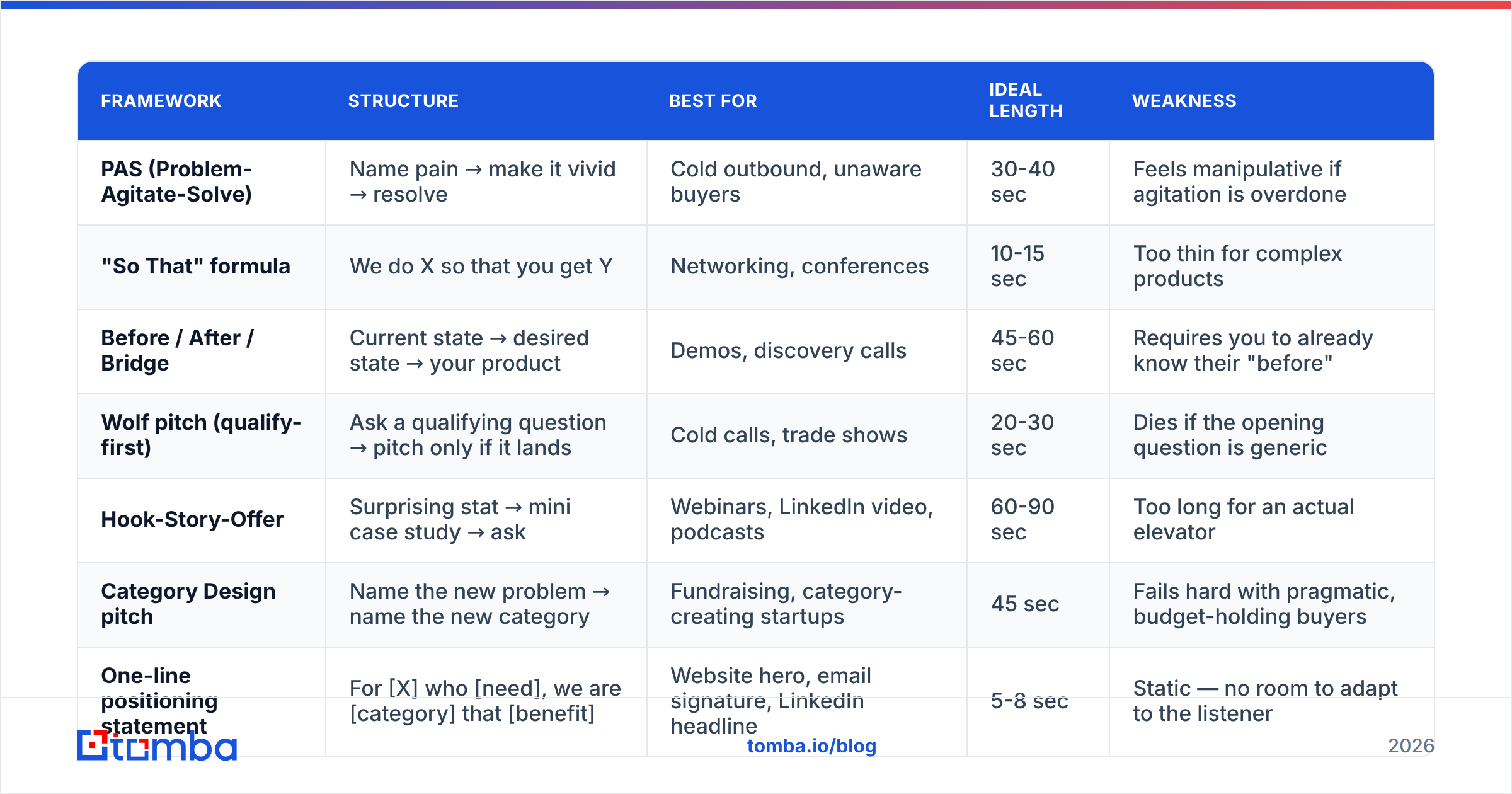
Not all pitches face the same audience. A cold prospect who has never heard of your category needs different scaffolding than an investor who evaluates twelve companies a week. Here is how the main frameworks compare.
| Framework | Structure | Best for | Ideal length | Weakness |
|---|---|---|---|---|
| PAS (Problem-Agitate-Solve) | Name pain → make it vivid → resolve | Cold outbound, unaware buyers | 30-40 sec | Feels manipulative if agitation is overdone |
| "So That" formula | We do X so that you get Y | Networking, conferences | 10-15 sec | Too thin for complex products |
| Before / After / Bridge | Current state → desired state → your product | Demos, discovery calls | 45-60 sec | Requires you to already know their "before" |
| Wolf pitch (qualify-first) | Ask a qualifying question → pitch only if it lands | Cold calls, trade shows | 20-30 sec | Dies if the opening question is generic |
| Hook-Story-Offer | Surprising stat → mini case study → ask | Webinars, LinkedIn video, podcasts | 60-90 sec | Too long for an actual elevator |
| Category Design pitch | Name the new problem → name the new category | Fundraising, category-creating startups | 45 sec | Fails hard with pragmatic, budget-holding buyers |
| One-line positioning statement | For [X] who [need], we are [category] that [benefit] | Website hero, email signature, LinkedIn headline | 5-8 sec | Static — no room to adapt to the listener |
A practical rule: the less your listener knows about the problem, the more structure you need. Cold prospects get PAS. Warm inbound gets Before/After/Bridge. People who already asked "what do you do?" at a conference get the "so that" formula and nothing more, because they asked a small question and deserve a small answer.
What does a filled-in elevator pitch template look like?#
Templates are useless in the abstract. Here are five worked examples across common roles.
SDR cold-calling a VP of Sales (Wolf / qualify-first):
"Quick question — when your reps build a prospect list, how much of it comes back as bounced or wrong-person? Most teams I talk to are at 15 to 20 percent, and it's quietly burning their domain reputation. We fix the list quality at the source, before the first send. Worth ten minutes?"
Founder pitching at a conference ("so that" formula):
"We find and verify work email addresses so that outbound teams stop sending to dead inboxes. About 40 percent of a B2B list decays every year — we keep yours current."
Agency owner talking to a prospective client (Before/After/Bridge):
"Right now you're getting maybe eight replies per thousand emails and you can't tell whether it's the copy or the data. After we work together, you'll know — because we split it: we clean and verify the list first, then we test copy against a stable baseline. The bridge is a two-week audit where we rebuild one segment and run it head-to-head against your current process."
Job seeker at a networking event (one-line positioning):
"I'm a RevOps analyst. I take messy CRM data and turn it into forecasts leadership actually trusts — last role, I cut pipeline reporting time from three days to about four hours."
Account executive following up on a demo (PAS, compressed):
"The thing you mentioned — reps spending the first hour of every day hunting for contact details — that doesn't get better as you hire. It scales linearly with headcount. Automating the lookup step gave one of our customers back roughly 90 rep-hours a month. That's the whole pitch."
Notice that none of these open with a company name. The company name is the least interesting fact in the sentence and it can always wait.
How do you adapt the pitch to the channel?#
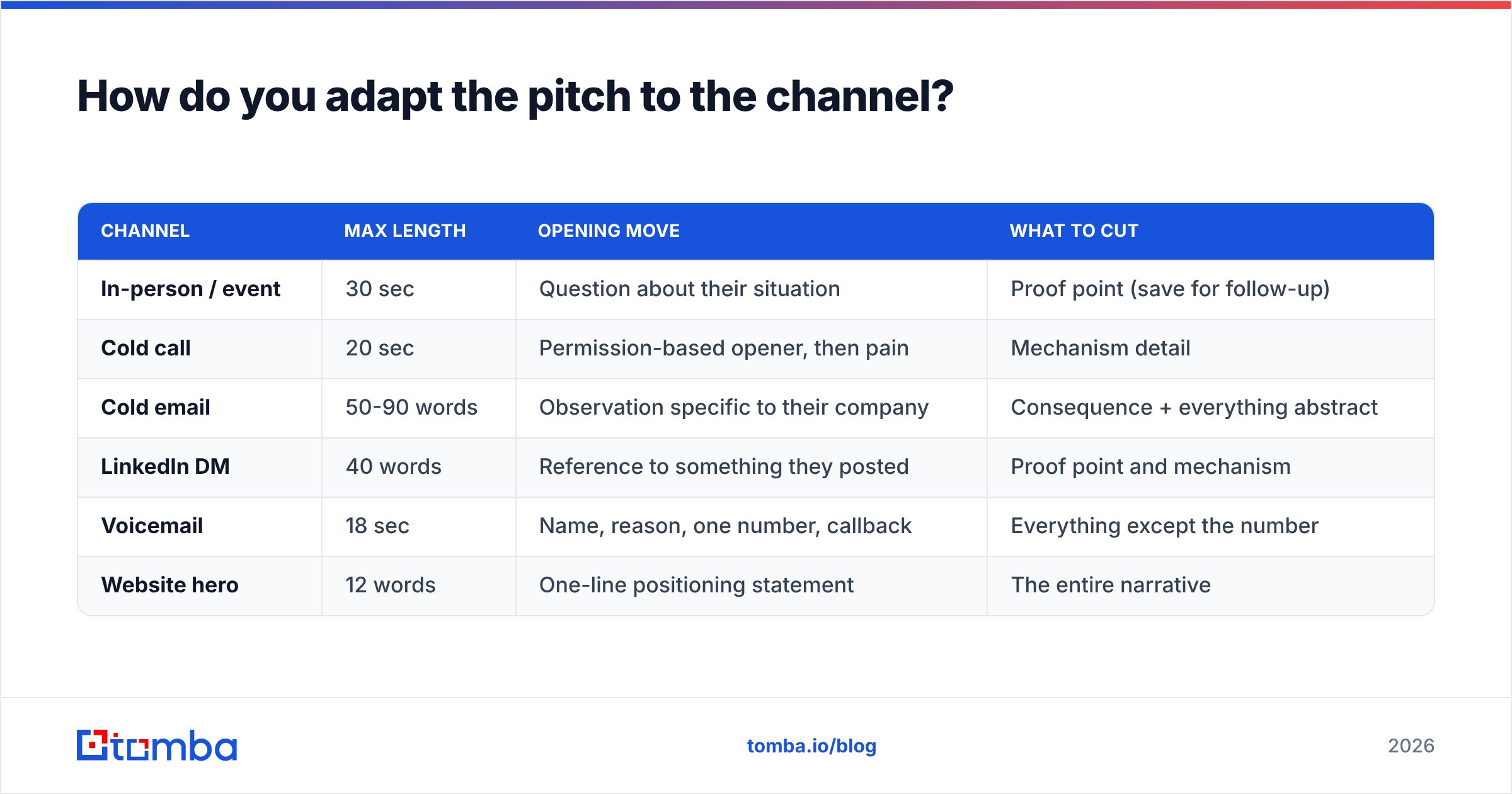
The same core template flexes across channels, but length and opening move change dramatically. Written pitches lose tone of voice, so they need to be shorter and more concrete than spoken ones.
| Channel | Max length | Opening move | What to cut |
|---|---|---|---|
| In-person / event | 30 sec | Question about their situation | Proof point (save for follow-up) |
| Cold call | 20 sec | Permission-based opener, then pain | Mechanism detail |
| Cold email | 50-90 words | Observation specific to their company | Consequence + everything abstract |
| LinkedIn DM | 40 words | Reference to something they posted | Proof point and mechanism |
| Voicemail | 18 sec | Name, reason, one number, callback | Everything except the number |
| Website hero | 12 words | One-line positioning statement | The entire narrative |
For cold email specifically, the structure inverts: you lead with the observation, not the pain, because a stranger's inbox is not a place to assert what someone's problems are. If you want reusable starting points, our library of cold email templates maps most of these frameworks to written form, and the subject line generator handles the part of the email most people write last and should write first.

How long should an elevator pitch actually be?#
Thirty seconds is the number everyone repeats, and it is roughly right for a reason: it's about the limit of a stranger's uninterrupted attention when they didn't ask for the conversation.
But length is downstream of permission. If someone asks "what do you do?" you have earned about ten seconds. If they follow up with "how does that work?" you've earned another thirty. Treating a polite question as an invitation to deliver 90 seconds of positioning is the single fastest way to end a conversation.
Practical guidance from HubSpot's sales research and most enterprise sales methodologies converges on the same shape: open short, expand only on invitation. Gartner's B2B buying research has repeatedly found that buyers spend the majority of their purchase journey independent of any vendor — which means your pitch is not the moment of decision. It is the moment they decide whether to grant you a second conversation. Optimize for that, not for completeness.
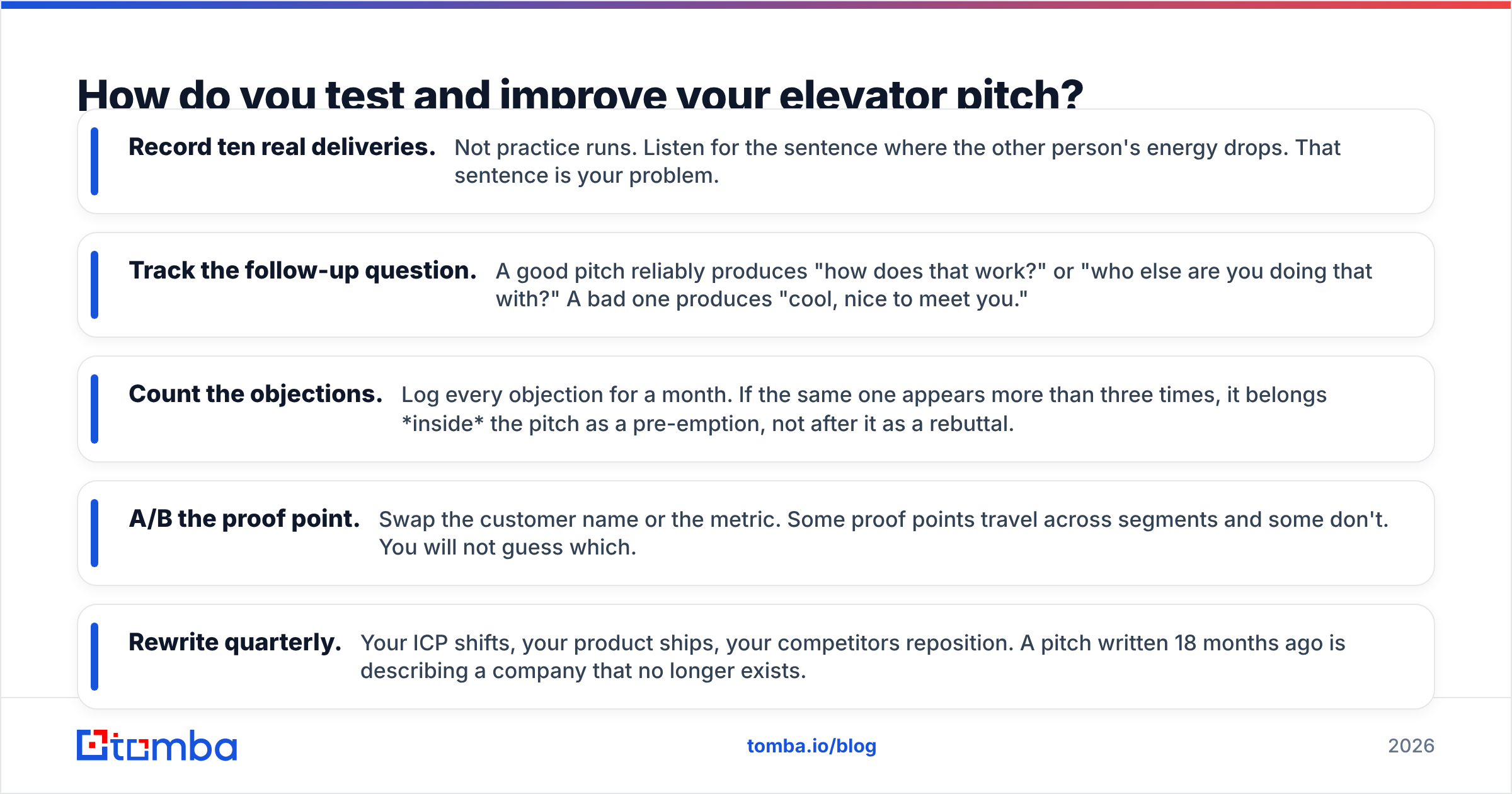
How do you test and improve your elevator pitch?#
Treat the pitch like ad copy: version it, ship it, measure it.
- Record ten real deliveries. Not practice runs. Listen for the sentence where the other person's energy drops. That sentence is your problem.
- Track the follow-up question. A good pitch reliably produces "how does that work?" or "who else are you doing that with?" A bad one produces "cool, nice to meet you."
- Count the objections. Log every objection for a month. If the same one appears more than three times, it belongs inside the pitch as a pre-emption, not after it as a rebuttal.
- A/B the proof point. Swap the customer name or the metric. Some proof points travel across segments and some don't. You will not guess which.
- Rewrite quarterly. Your ICP shifts, your product ships, your competitors reposition. A pitch written 18 months ago is describing a company that no longer exists.
Measure the downstream number too, not just the vibe in the room. If your pitch is working, response rate on follow-ups should move. If it doesn't, the pitch wasn't the constraint.
What mistakes kill an elevator pitch fastest?#
Leading with the company. "We're Acme, founded in 2019..." Nobody has ever bought anything because of a founding date.
Jargon that only makes sense internally. "Unified GTM data layer" means something to your product team and nothing to a VP of Sales who is trying to hit a number this quarter.
Superlatives without numbers. "Best-in-class accuracy" is unfalsifiable and therefore worthless. "94% deliverable on verified results" is a claim someone can check — which is exactly why it lands.
Pitching a feature as a benefit. "Real-time verification" is a feature. "You stop burning your sending domain on dead addresses" is a benefit. The buyer only cares about the second one.
No ask. A pitch that ends without a next step is a monologue. End with something small and specific: fifteen minutes, a sample file, a single question answered by email.
Pitching the wrong person entirely. This is the one nobody counts as a pitch failure, but it accounts for more dead outbound than bad copy ever will. If your message goes to a manager who has no budget authority and no ownership of the problem, the world's best framework changes nothing. Getting the right name, the right title, and a deliverable address is upstream of everything on this page — which is why serious outbound teams spend more time on list construction than on script writing.
Where should you start?#
Pick one framework from the table, write the five components for your single best-fit segment, and deliver it live five times this week. Not to your manager — to actual prospects. Then cut whatever sentence made people look away.
And before you invest another hour polishing the words, make sure the words are reaching someone who can act on them. Tomba's email finder turns a name and a company domain into a verified work email, so the pitch you just rewrote lands in a real inbox instead of a bounce log. The free tier covers 25 searches a month, Starter is $49/mo, and Growth is $99/mo — see full Tomba pricing for team-scale plans. A great pitch delivered to the wrong address is still a zero.
Related guides#
Ready to find emails that actually work?
Join 150,000+ professionals who stopped guessing and started sending. Free credits on signup — no credit card required.
Get the Tomba newsletter
Practical outbound tactics and product updates — once every two weeks.
About the author