Email After a Networking Event: Templates That Get Replies
You met 40 people and got 6 replies. The gap is almost never charisma — it's the follow-up email. Here's the timing, structure, and templates that turn a badge scan into a booked call.
TL;DR
- Send within 24 hours. The single biggest predictor of a reply is not how clever your copy is — it's whether the person still remembers your face.
- Lead with a specific detail from the conversation ("the Snowflake migration you're dreading in Q3"), not "it was great meeting you."
- One ask, one sentence, low friction. "Worth 15 minutes next week?" beats "let me know if you'd like to explore synergies."
- No email address? Don't guess. Use a verified email finder on their name + company domain, then verify before you send.
- Two follow-ups, spaced 4 and 10 days out, then stop. Most replies land on message one or two; message four just annoys people.
Why does the email after a networking event matter more than the conversation?#
Because the conversation is worth nothing until it's written down somewhere both of you can find.
Think of a networking event like a farmers market at closing time. Everyone is friendly, everyone swaps a few words, and by the time you get home you cannot remember which stall had the good tomatoes. Your prospect is in the same state. They spoke to 25 people, collected 11 business cards, and by Monday morning the memory has collapsed into "that conference." The follow-up email is what re-attaches your name to a specific, useful memory before it dissolves entirely.
That's why the mechanics matter more than the prose. A plain, slightly awkward email sent 6 hours after you shook hands will outperform a beautifully written one sent nine days later — every time. Business networking only compounds when there's a follow-up mechanism behind it, and email is still the highest-intent one for B2B.
The second reason: an in-person meeting gives you the one thing cold outbound never has — legitimate permission. You are not interrupting a stranger. You are continuing a conversation they consented to. That single fact changes your subject line, your opener, your ask, and your acceptable follow-up count.
When should you send an email after a networking event?#
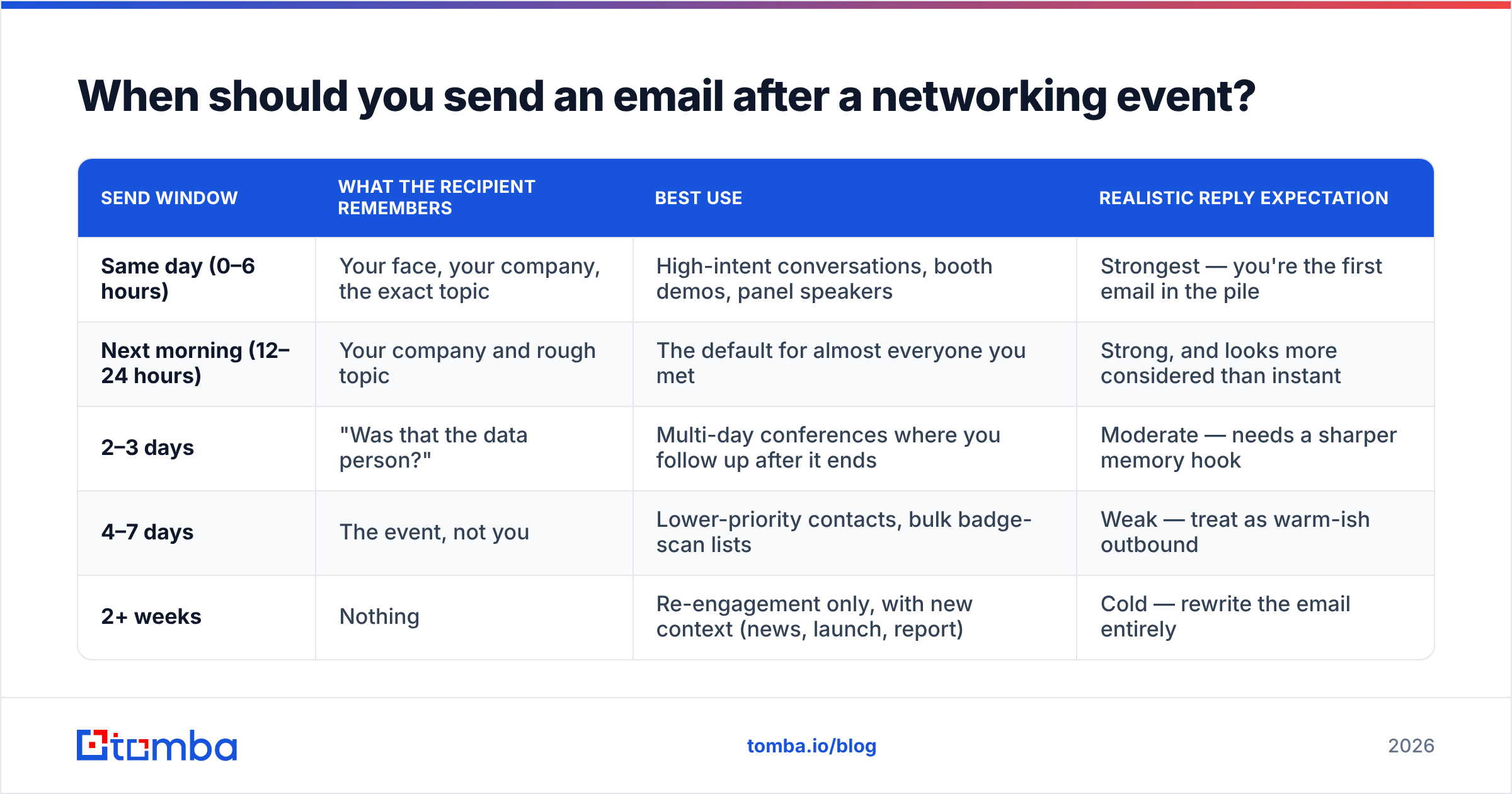
Within 24 hours, and ideally the same evening. Here's how the windows actually behave in practice:
| Send window | What the recipient remembers | Best use | Realistic reply expectation |
|---|---|---|---|
| Same day (0–6 hours) | Your face, your company, the exact topic | High-intent conversations, booth demos, panel speakers | Strongest — you're the first email in the pile |
| Next morning (12–24 hours) | Your company and rough topic | The default for almost everyone you met | Strong, and looks more considered than instant |
| 2–3 days | "Was that the data person?" | Multi-day conferences where you follow up after it ends | Moderate — needs a sharper memory hook |
| 4–7 days | The event, not you | Lower-priority contacts, bulk badge-scan lists | Weak — treat as warm-ish outbound |
| 2+ weeks | Nothing | Re-engagement only, with new context (news, launch, report) | Cold — rewrite the email entirely |
Two nuances that trip people up:
Multi-day conferences change the math. If you meet someone on day one of a three-day event, emailing that night is fine, but a short in-person "let's grab coffee tomorrow" beats any email. Save the written follow-up for the flight home.
Time zones and Friday afternoons matter less than you think. Send when you write it. A follow-up email is not a cold sequence — nobody has ever declined a meeting because a post-event note arrived at 9:40 p.m.
What makes a networking follow-up email actually work?#
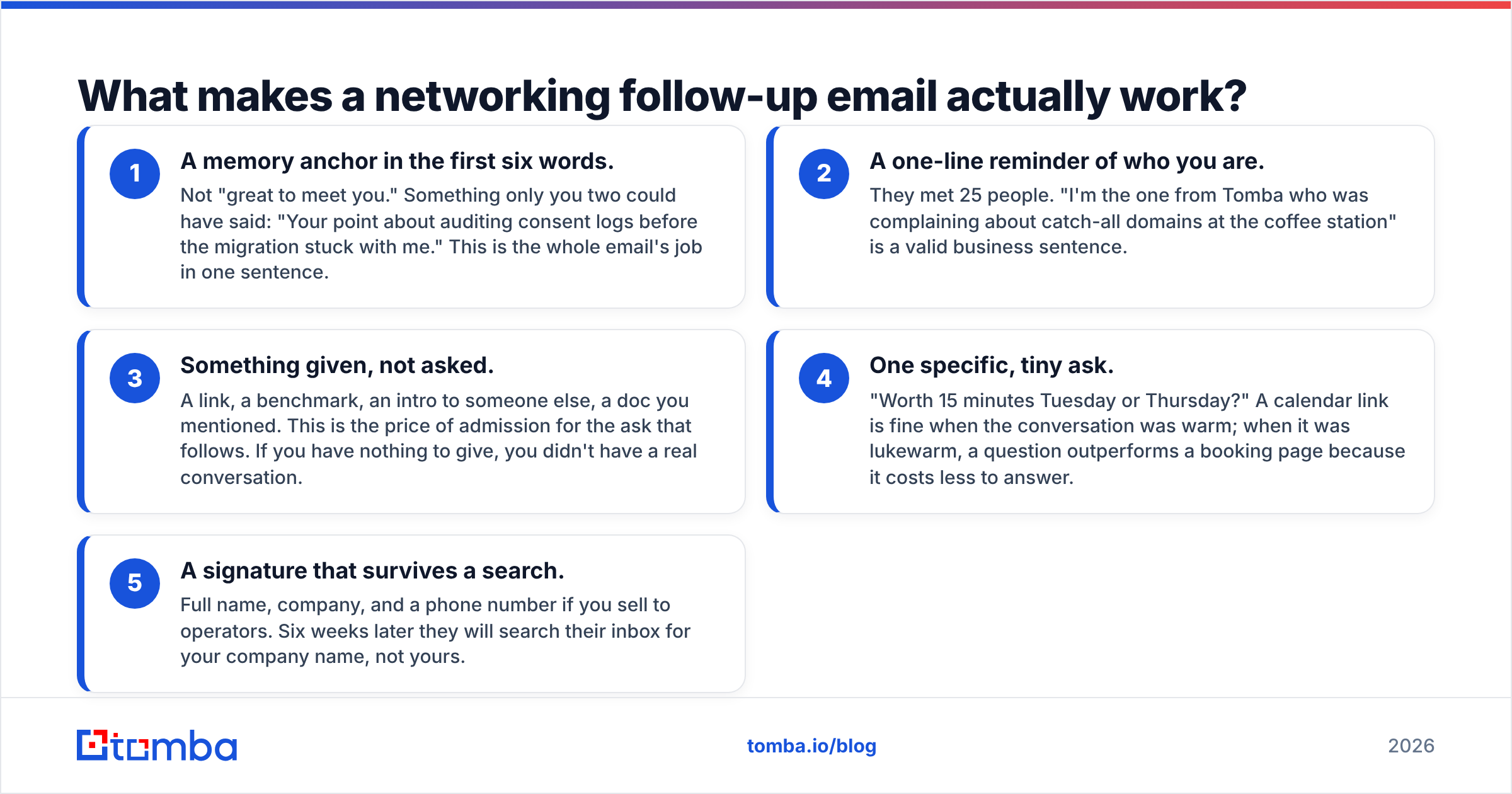
Five components, in this order. Skip any of them and reply rates drop measurably.
- A memory anchor in the first six words. Not "great to meet you." Something only you two could have said: "Your point about auditing consent logs before the migration stuck with me." This is the whole email's job in one sentence.
- A one-line reminder of who you are. They met 25 people. "I'm the one from Tomba who was complaining about catch-all domains at the coffee station" is a valid business sentence.
- Something given, not asked. A link, a benchmark, an intro to someone else, a doc you mentioned. This is the price of admission for the ask that follows. If you have nothing to give, you didn't have a real conversation.
- One specific, tiny ask. "Worth 15 minutes Tuesday or Thursday?" A calendar link is fine when the conversation was warm; when it was lukewarm, a question outperforms a booking page because it costs less to answer.
- A signature that survives a search. Full name, company, and a phone number if you sell to operators. Six weeks later they will search their inbox for your company name, not yours.
What to cut: the paragraph about your company's mission, the attached deck, the phrase "I wanted to reach out," and any sentence containing "synergy," "circle back," or "touch base." HubSpot's own sales follow-up guidance has said the same thing for a decade and it's still ignored daily.
Keep the whole thing under 120 words. If you met someone in person, your job is to be easy, not impressive.
Which templates work for which situation?#
Five situations cover roughly everything. Adapt the specifics — the structure is the reusable part.
1. The strong conversation (send same night)
Subject: Your Q3 migration + the audit doc I mentioned
Hi Dana — great talking at the RevOps track today. You mentioned the Snowflake cutover is happening before Q3 close and that consent logs are the part nobody owns. Here's the audit checklist I said I'd send: [link].
If it's useful, I'm happy to walk through how three other teams sequenced it — 15 minutes, Tuesday or Thursday?
— Sam, Tomba
2. The booth or demo visitor
Subject: The catch-all question you asked at booth 214
Hi Marcus — you asked whether catch-all domains can be verified at all, and I gave you the two-minute version. Here's the longer answer: [link].
If you want to test it against your own list, I can set up a sandbox with 500 records so you can see the hit rate on your data, not ours. Want me to?
— Sam
3. The speaker or panelist you had 90 seconds with
Subject: Your slide 14 (the churn cohort chart)
Hi Priya — I was the one who asked about the 90-day cohort after your panel. Slide 14 reframed how I think about onboarding drag, so thank you.
One thing you might find interesting: we see the same curve in outbound data decay, roughly 2% per month. Happy to share the raw numbers if it's useful for the next version of that talk.
No ask — just wanted to say it landed.
4. The person you never actually spoke to
Be honest about it. Pretending you talked is the fastest way to get marked as spam.
Subject: We both sat through the 8 a.m. deliverability panel
Hi Ken — we didn't get to speak at SaaStock, but we were both in the deliverability session and you asked the question about shared IP pools that everyone in the room needed answered.
We publish a monthly teardown on exactly that. Want me to send the last one?
5. The two-week-late follow-up
Don't apologize. Add new information instead.
Subject: Following up from SaaStock — with the numbers this time
Hi Jules — we spoke about pipeline attribution at SaaStock and I said I'd find comparable data. Took longer than promised because I wanted real numbers, not vendor ones: [link].
Still worth 15 minutes? If the project got deprioritized, just say "later" and I'll check back in Q4.

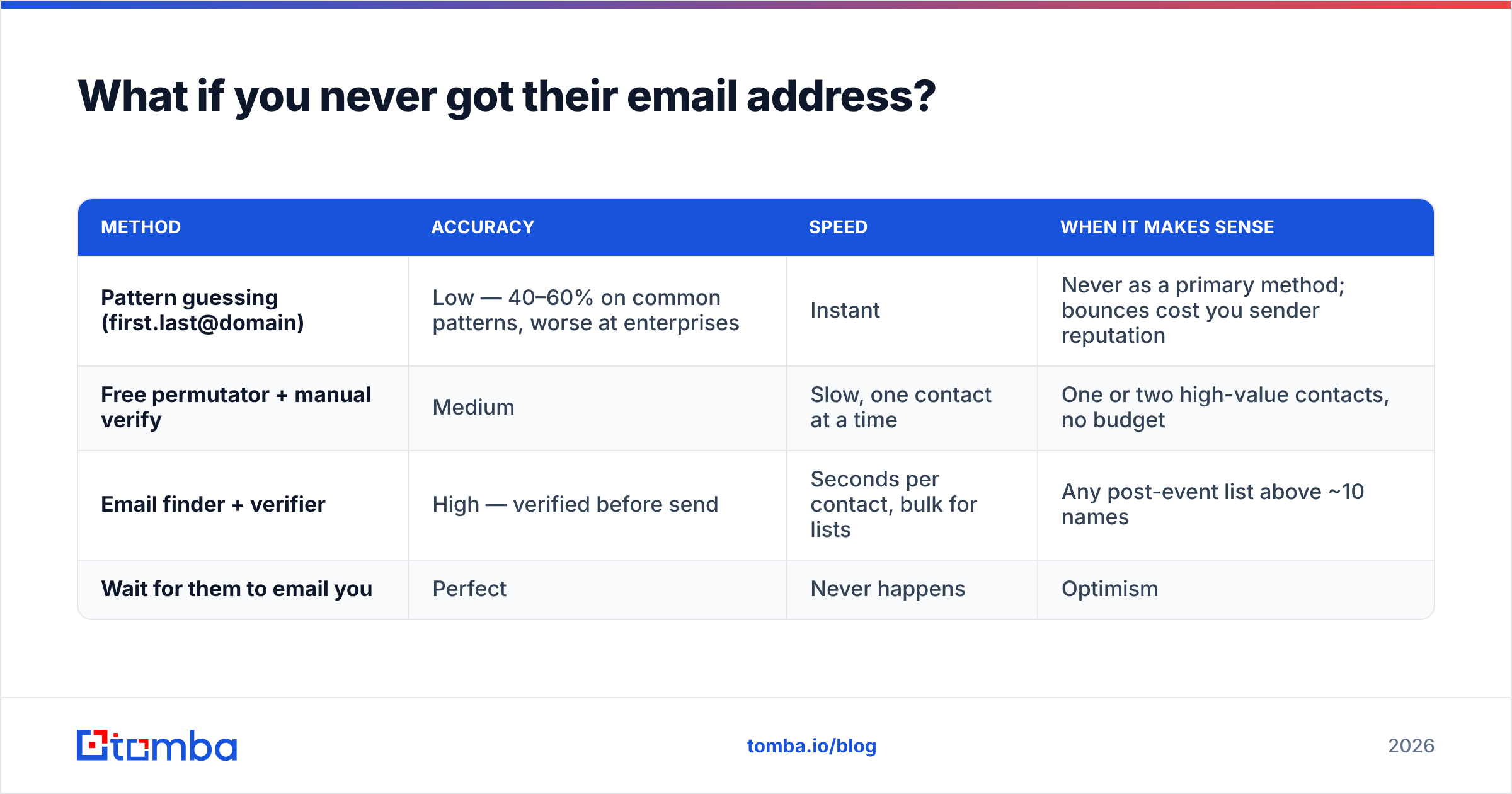
What if you never got their email address?#
This is the actual failure point for most people. You have a first name, a company, and a blurry LinkedIn memory — and no address.
Three options, in order of reliability:
| Method | Accuracy | Speed | When it makes sense |
|---|---|---|---|
| Pattern guessing (first.last@domain) | Low — 40–60% on common patterns, worse at enterprises | Instant | Never as a primary method; bounces cost you sender reputation |
| Free permutator + manual verify | Medium | Slow, one contact at a time | One or two high-value contacts, no budget |
| Email finder + verifier | High — verified before send | Seconds per contact, bulk for lists | Any post-event list above ~10 names |
| Wait for them to email you | Perfect | Never happens | Optimism |
The practical workflow: run their name and company domain through an email finder, check the result with an email verifier, and only then send. If you scanned badges and have a spreadsheet of 200 names, use a bulk email finder instead of doing it one row at a time. If all you kept was a LinkedIn connection, a LinkedIn finder closes that gap.
Why verify before sending post-event emails at all? Because event lists are unusually dirty — badge scanners mangle characters, people give personal addresses, and job changes cluster around conference season. A 12% bounce rate on a 200-person list is enough to dent sender reputation for weeks, which then hurts the sequences you actually care about.
Should you follow up by email, LinkedIn, or phone?#
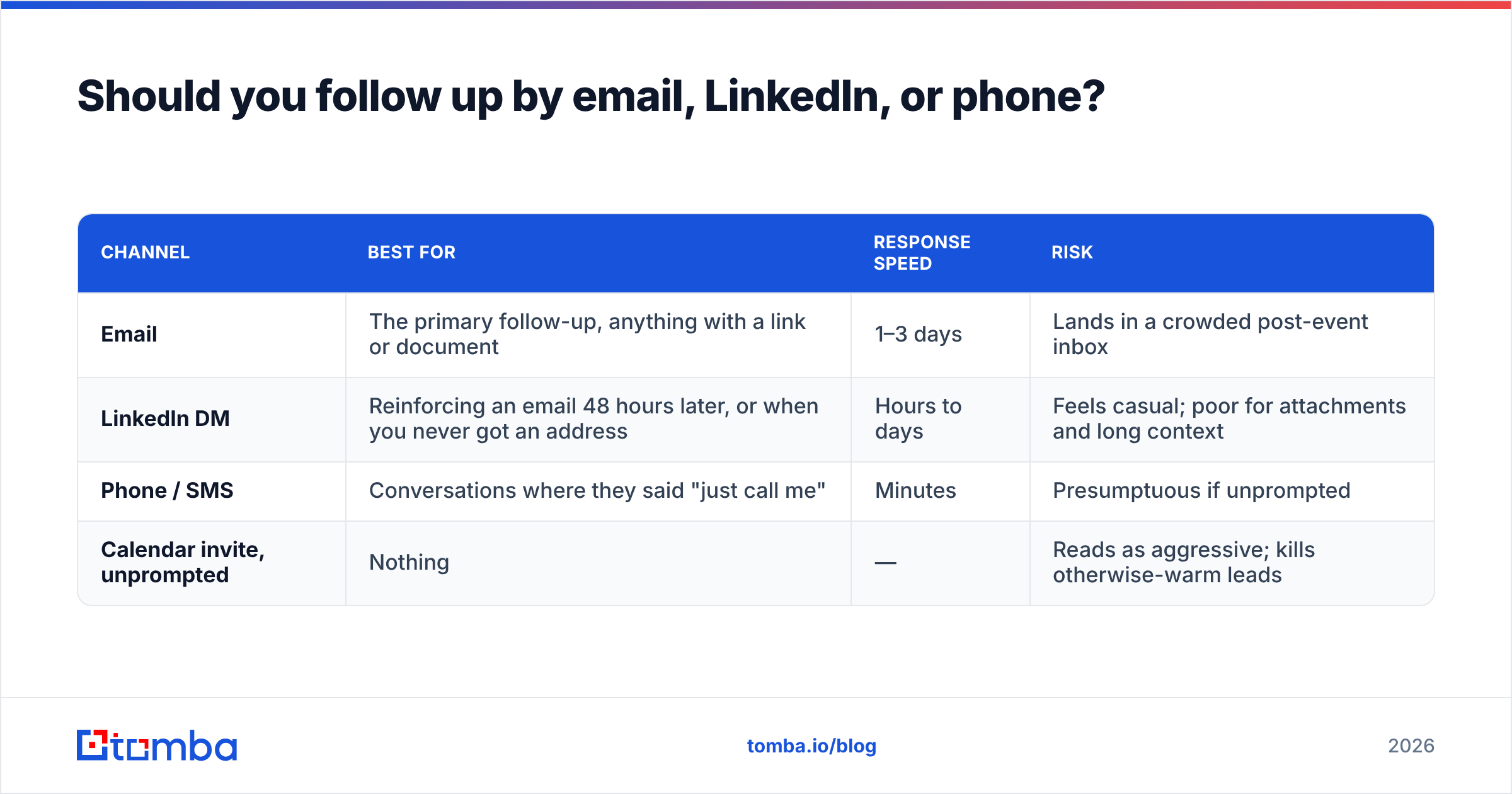
Email first, LinkedIn as reinforcement, phone only if they invited it.
| Channel | Best for | Response speed | Risk |
|---|---|---|---|
| The primary follow-up, anything with a link or document | 1–3 days | Lands in a crowded post-event inbox | |
| LinkedIn DM | Reinforcing an email 48 hours later, or when you never got an address | Hours to days | Feels casual; poor for attachments and long context |
| Phone / SMS | Conversations where they said "just call me" | Minutes | Presumptuous if unprompted |
| Calendar invite, unprompted | Nothing | — | Reads as aggressive; kills otherwise-warm leads |
The combination that works: email same day, LinkedIn connection request 48 hours later referencing the email, then one final email 7–10 days out. That's it. Three touches across two channels, then move on. Reviews across lead intelligence tools on G2 tend to converge on the same pattern — coverage beats frequency.
How many follow-ups before you stop?#
Two after the first email. Cadence: day 0, day 4, day 10.
The reason is simple. Someone who met you in person and doesn't reply to three emails is not being coy — they're busy, or it's not a priority, or they were being polite at the event. A fourth and fifth email converts almost nobody and costs you the relationship for the next event, where you will likely meet them again.
Close the last one with an explicit door: "I'll stop here — if this comes back around, my line's open." That sentence pulls more replies than any pressure tactic, because it removes the obligation to negotiate.
Track response rate by event, not just by campaign. Some conferences produce 30% reply rates and some produce 4%, and knowing which is which is the difference between a sponsorship you renew and one you quietly drop.
What mistakes kill the post-event email?#
- Sending a template with no anchor. If your email would make sense to anyone at the event, it means nothing to the person who got it.
- Attaching a deck. Nobody opens a 14MB PDF from someone they met once. Link to one page instead.
- Batching 200 names into a generic blast. Personalize the first line at minimum, even if the rest is templated.
- Waiting for the "right moment." There isn't one. Day 9 has no advantage over day 1.
- Skipping verification. Guessed addresses bounce, and post-event bounce spikes are the fastest way to teach mailbox providers that your domain sends to bad data.
- Asking for 30 minutes. Ask for 15. You can always run long.
Where should you put the follow-up list?#
Wherever your team already looks — CRM, spreadsheet, or sequencing tool — but enrich it before it lands there. A row that reads "Dana, VP Ops, ProductCo" is a to-do. A row with a verified email, a phone number, and the topic you discussed is a workable lead. Pushing the enriched version straight into HubSpot or a sheet the day you get home is the difference between a list you work and a list you find in six months.
Turn badge scans into verified contacts#
The hardest part of the email after a networking event isn't the writing — it's that half your list has no usable address. Run your post-event names and company domains through Tomba Email Finder, verify the results before you hit send, and start with the free tier (25 searches/month) to see the hit rate on your own list. Paid plans start at $49/month for Starter and $99/month for Growth if you're processing full conference lists; see Tomba pricing for the breakdown. Write the email tonight — the memory window closes faster than you think.
Related guides#
Ready to find emails that actually work?
Join 150,000+ professionals who stopped guessing and started sending. Free credits on signup — no credit card required.
Get the Tomba newsletter
Practical outbound tactics and product updates — once every two weeks.
About the author