Email Asking For a Meeting: Templates That Get Replies
Most meeting request emails fail before the first sentence lands. Here are the structures, timing rules, and 7 copy-paste templates that actually book calendar time in 2026.
TL;DR
- The meeting is not the ask. The reason is the ask — a request with no specific, recipient-side reason to talk gets ignored regardless of how polite the wording is.
- Short beats clever: 50–125 words, one paragraph of context, one question, one CTA. Anything longer reads as a pitch deck in plain text.
- Give a specific time window ("Tuesday or Thursday, 15 minutes") instead of an open "let me know what works." Open asks push the scheduling work onto a stranger.
- Verified contact data matters more than copy. A perfect meeting email to a bounced address is a 0% reply rate with extra steps.
- Follow-ups book more meetings than first sends. Two to three spaced follow-ups typically double total reply volume — but only if each one adds something new.
You can write a technically flawless email asking for a meeting and still get nothing back. That happens because the recipient's decision isn't "is this well written?" — it's "is 30 minutes of my week worth what this person is offering?" Everything below is built around answering that question in under 125 words.
What makes an email asking for a meeting actually work?#
A meeting request has four jobs, in order: prove you know who they are, name a reason that matters to them, make the time commitment feel small, and remove every decision except "yes" or "no."
Most requests fail on job two. "I'd love to connect and learn about your business" is a reason that matters to you. "You just opened a second warehouse in Rotterdam and I've seen how that breaks quote-to-cash for three similar 3PLs" is a reason that matters to them.
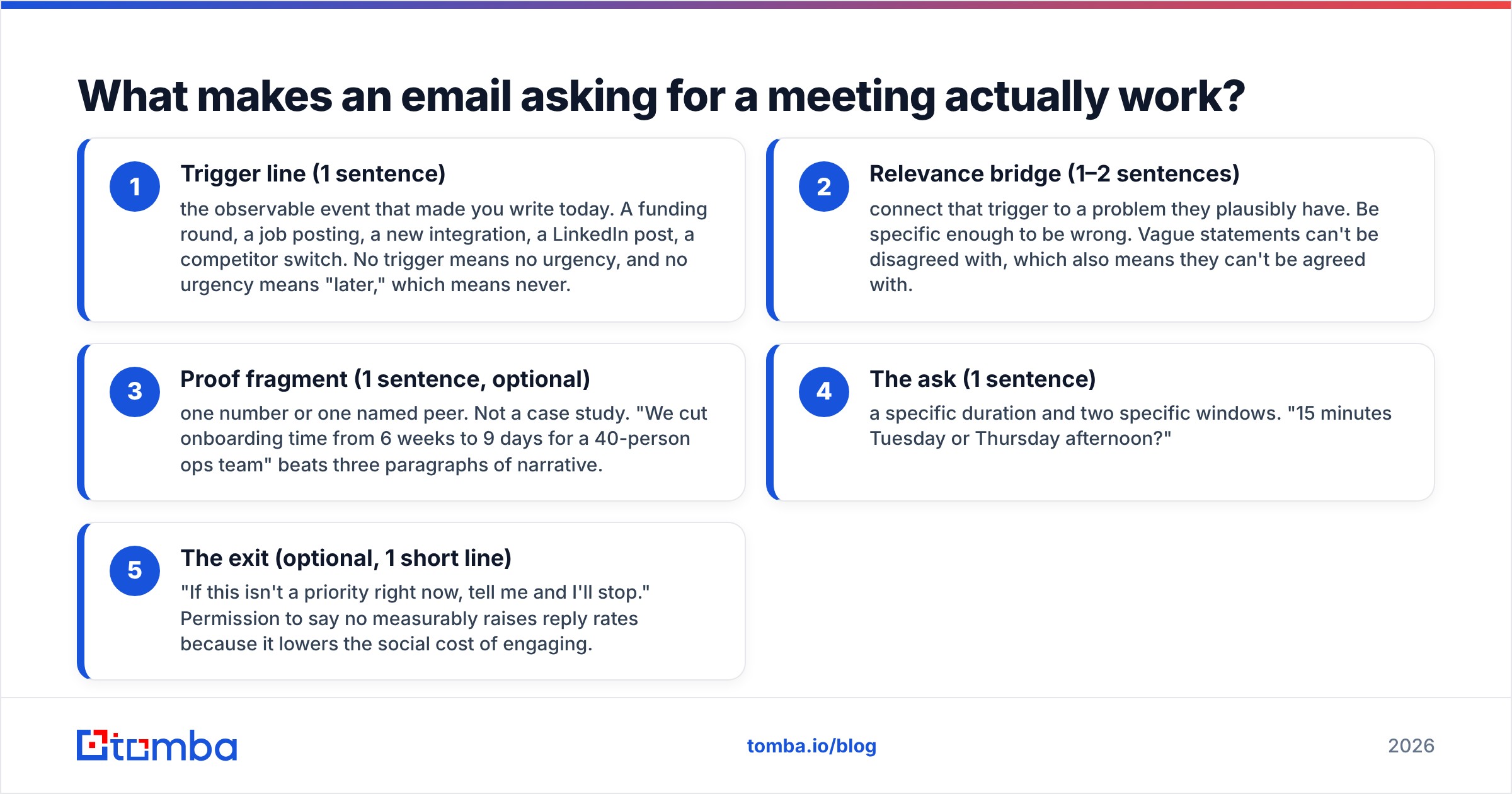
Here's the anatomy that consistently books time:
- Trigger line (1 sentence) — the observable event that made you write today. A funding round, a job posting, a new integration, a LinkedIn post, a competitor switch. No trigger means no urgency, and no urgency means "later," which means never.
- Relevance bridge (1–2 sentences) — connect that trigger to a problem they plausibly have. Be specific enough to be wrong. Vague statements can't be disagreed with, which also means they can't be agreed with.
- Proof fragment (1 sentence, optional) — one number or one named peer. Not a case study. "We cut onboarding time from 6 weeks to 9 days for a 40-person ops team" beats three paragraphs of narrative.
- The ask (1 sentence) — a specific duration and two specific windows. "15 minutes Tuesday or Thursday afternoon?"
- The exit (optional, 1 short line) — "If this isn't a priority right now, tell me and I'll stop." Permission to say no measurably raises reply rates because it lowers the social cost of engaging.
That's five lines. If your draft is longer than that, you're writing a proposal, not a meeting request.
How long should a meeting request email be?#
Between 50 and 125 words in the body. That's roughly what fits on a phone screen without scrolling — and most B2B email is opened on mobile first, previewed, then either archived or reopened later at a desk.
Length interacts with the ask. A 15-minute request can be short because the commitment is small. A 60-minute discovery call needs more justification, which means more words, which means lower reply rates. This is why "15 minutes" outperforms "a quick call" — the former is priced, the latter is open-ended and therefore expensive.
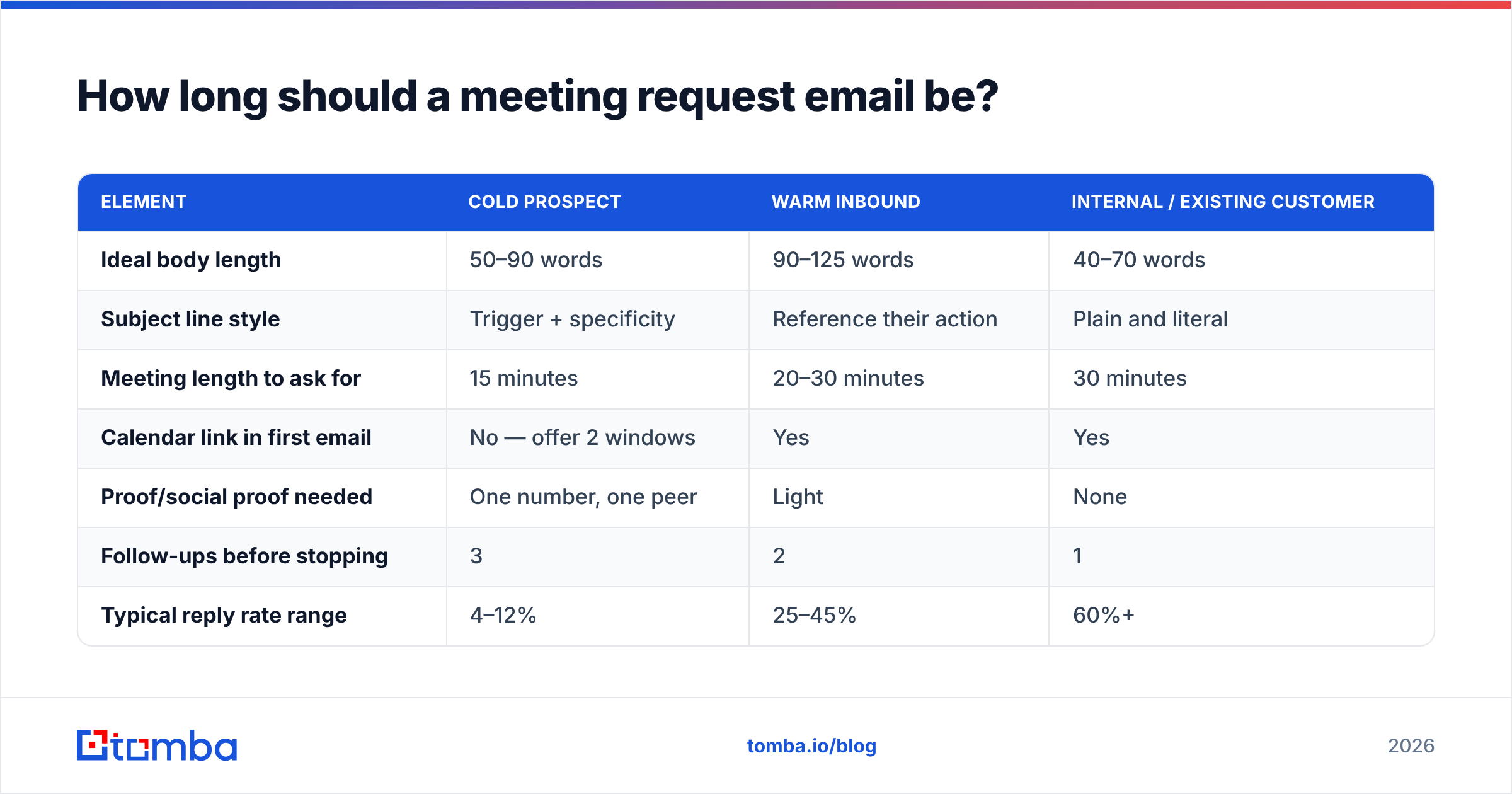
| Element | Cold prospect | Warm inbound | Internal / existing customer |
|---|---|---|---|
| Ideal body length | 50–90 words | 90–125 words | 40–70 words |
| Subject line style | Trigger + specificity | Reference their action | Plain and literal |
| Meeting length to ask for | 15 minutes | 20–30 minutes | 30 minutes |
| Calendar link in first email | No — offer 2 windows | Yes | Yes |
| Proof/social proof needed | One number, one peer | Light | None |
| Follow-ups before stopping | 3 | 2 | 1 |
| Typical reply rate range | 4–12% | 25–45% | 60%+ |
Two rows deserve explanation. Calendar link in the first cold email is usually a mistake — it asks a stranger to do administrative work before they've agreed the conversation is worth having, and it signals "I've automated this." Offer two windows first; send the link after they say yes.
Three follow-ups on cold, one internally. Persistence reads as diligence when there's no relationship and as nagging when there is.
What subject line should you use for a meeting request?#
Lowercase, 3–7 words, and descriptive rather than clever. Clever subject lines get opened and then punished — the body has to justify the tease, and it usually can't.
Patterns that hold up:
- The trigger reference — "your Rotterdam warehouse" / "the Series B post"
- The literal ask — "15 min next week?" (works better than it should, because it's honest)
- The mutual name — "Sarah Chen suggested I reach out" (only if true; this one is verifiable and burns you if not)
- The question — "how are you handling EU VAT now?"
- The one-word — "timing?" (high open, high risk, use sparingly and never at scale)
Avoid: anything with "quick," "touching base," "circling back," "synergy," or an emoji. Avoid RE: and FW: prefixes on a first send — that's deception, and modern filters plus modern buyers both flag it. If you're unsure, run drafts through a subject line tester before sending at volume.
Do you need a calendar link or should you propose times?#
Propose times for cold. Send a link for warm.
The underlying rule: whoever wants the meeting more should absorb the scheduling friction. In cold outreach, you want it more — so you do the work of proposing. Once they've replied "sure, send some times," the power balance flipped and a link is a courtesy, not an imposition.
There's a middle path that works well: propose two windows and include the link as a fallback in the signature area, not the body. "Tuesday 2–4pm or Thursday morning work — or grab whatever's easiest here [link]." You've made the decision easy without outsourcing it.
Which meeting request templates actually get replies?#
Seven templates below. Each is a skeleton, not a script — swap in real specifics or the whole thing collapses into the same generic mush everyone else sends.
1. The trigger-event ask (cold, highest performing)
Subject: your Rotterdam opening
Hi Marta —
Saw the second Rotterdam facility went live last month. Congrats.
When 3PLs add a second node, quote-to-cash usually breaks in the same place: rate cards drift between sites and finance finds out at month-end. We fixed that for Kuehne's mid-market unit in about three weeks.
Worth 15 minutes Tuesday or Thursday afternoon to see if you're hitting it too?
If it's not a priority, say so and I'll leave it alone.
2. The referral ask
Subject: Sarah Chen suggested I reach out
Hi David —
Sarah Chen mentioned you're rebuilding the outbound motion at Northwind and that lead data quality is the current bottleneck.
That's the exact problem we work on — Sarah's team went from a 14% bounce rate to under 2% in a quarter.
15 minutes next week to compare notes? Wednesday or Friday morning both work on my end.
3. The post-content ask (warm inbound)
Subject: your comment on the attribution thread
Hi Priya —
You wrote that multi-touch attribution "mostly launders the assumptions you already had." Strongest thing I've read on it this year.
We've been rebuilding how we model this and I think you'd tear a hole in our approach, productively. Would you take 20 minutes? Here's my calendar: [link]
4. The re-engagement ask (dormant deal)
Subject: picking this back up?
Hi Tom —
We talked in March about consolidating the enrichment stack. You said revisit after the fiscal year turned.
It turned. Two things changed since we spoke: our API now handles catch-all domains natively, and pricing dropped for the volume tier you were sizing.
20 minutes to see if the math works now? Or tell me the timing's still wrong and I'll check back in Q4.
5. The mutual-value ask (peer-to-peer, no selling)
Subject: comparing notes on RevOps headcount
Hi Elena —
We're both running RevOps at ~200-person B2B companies and I suspect we've solved opposite halves of the same problem. We've got routing and SLA enforcement nailed and forecasting is a mess. Your Q2 talk suggested the reverse.
Trade 30 minutes? No pitch, I don't sell anything you'd buy.
6. The executive ask (short, no fluff)
Subject: 15 min on pipeline coverage
Hi Ken —
Your Q1 letter flagged pipeline coverage as the constraint for FY26.
We take that from a manual quarterly exercise to a live number. Three of your named competitors already run it this way.
15 minutes with me or my VP of Sales — whichever is less useless to you. Tuesday?
7. The last-attempt ask (breakup)
Subject: closing the loop
Hi Ana —
I've written three times about the routing problem and haven't landed. That's my read being wrong, not you being rude.
I'll stop here. If it becomes relevant in six months, reply to this thread and I'll pick it straight back up.
Anything you'd want me to send over in the meantime?
Template seven books a surprising number of meetings — not because breakup emails are magic, but because they're the first message in the sequence that doesn't ask for anything, which makes replying cheap.
How many follow-ups should you send?#
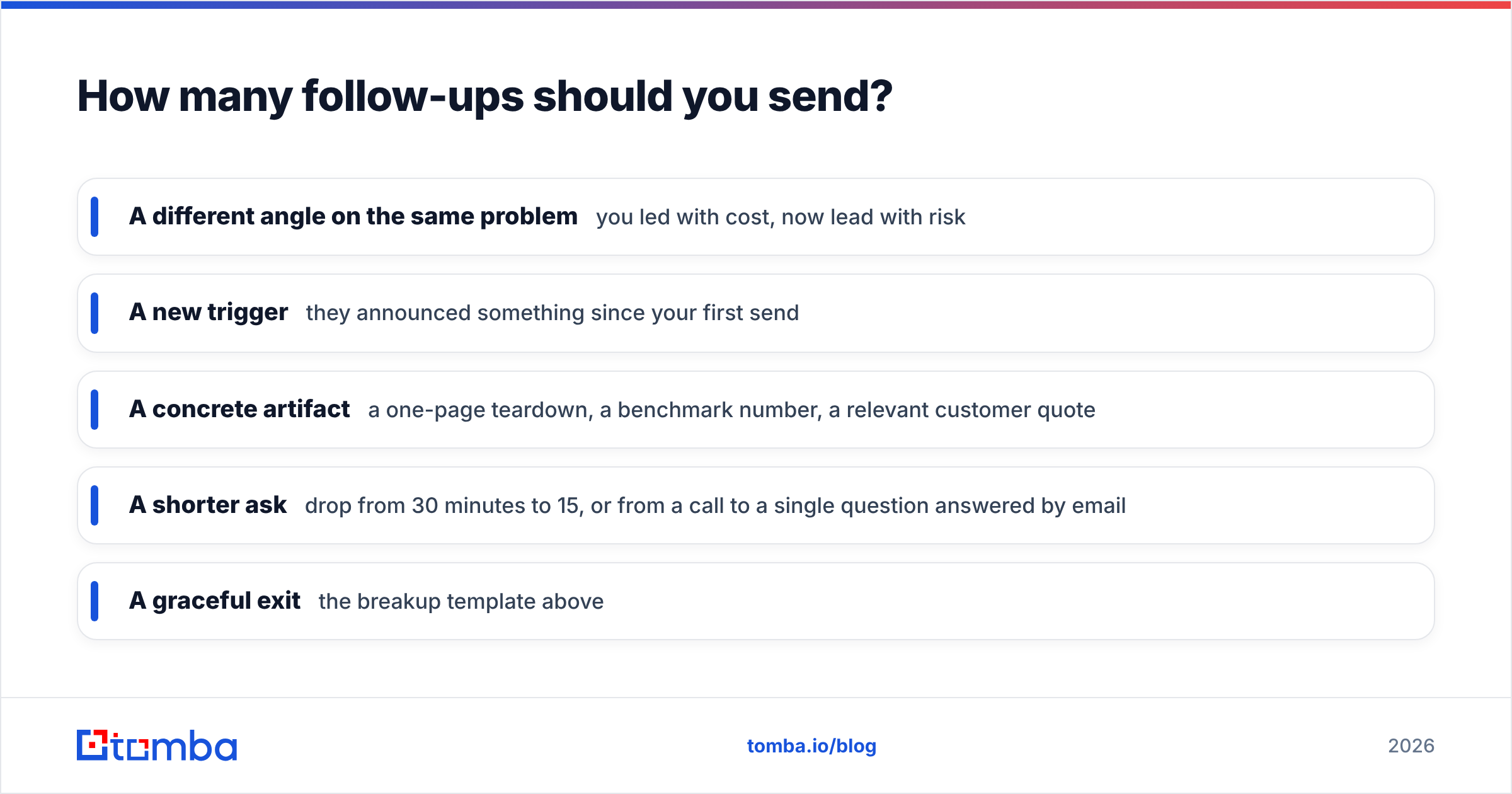
Three after the first email, spaced 3, 5, and 8 days out — and each one must carry new information. A follow-up that says "just bumping this to the top of your inbox" adds nothing and trains people to ignore your name.
What counts as new information:
- A different angle on the same problem — you led with cost, now lead with risk
- A new trigger — they announced something since your first send
- A concrete artifact — a one-page teardown, a benchmark number, a relevant customer quote
- A shorter ask — drop from 30 minutes to 15, or from a call to a single question answered by email
- A graceful exit — the breakup template above
Spacing matters as much as content. Same-day and next-day follow-ups read as anxious. Ten-plus-day gaps lose the thread entirely. Three, five, eight is a workable default; adjust upward for enterprise buyers and executive titles, downward for founder-to-founder and SMB.
Does the email even reach them?#
This is the part most template roundups skip, and it's the part that determines whether any of the above matters.
Three failure points sit between your draft and their attention:
- The address is wrong. Guessed patterns like
first.last@company.comare right maybe 60–70% of the time depending on the industry. Every wrong guess is a hard bounce, and hard bounces compound into domain reputation damage. Use an email finder that returns a confidence score rather than a pattern generator that returns a guess. - The address is stale. B2B contact data decays at roughly 25–30% per year through job changes alone. A list built eight months ago is meaningfully worse than one built last week. Re-run email verification before any send at volume, not once at list-build time.
- The domain isn't trusted. SPF, DKIM, and DMARC all have to be aligned, and Google and Microsoft both tightened bulk-sender enforcement in the last two years. Google's own sender guidelines are the authoritative reference here — read them rather than a summary. Weak email deliverability turns a good meeting request into an invisible one.
Catch-all domains deserve a note. A large share of enterprise domains accept mail to any address, so a standard verifier returns "unknown" rather than valid or invalid. Skipping every unknown drops real prospects; sending to all of them raises bounce risk. A dedicated catch-all verifier resolves the middle ground rather than forcing an all-or-nothing call.
What should you never put in a meeting request email?#
A short list, all of it earned through bounced, ignored, or actively resented sends:
- Attachments on a first send. Filters hate them, and so do people.
- "I hope this email finds you well." It signals template. Delete it and start with the trigger.
- More than one question. Two questions means the recipient has to think about which to answer, which means neither gets answered.
- A pitch of your entire product. The meeting is where you do that. The email's only job is to earn the meeting.
- Fake urgency. "Closing out my quarter" is your problem, not theirs, and everyone can read it.
- Images or heavy HTML in cold outreach. Plain text lands better and looks like a person wrote it.
- A 30-minute ask when 15 would do. You can always run long once you're on the call.
For structural writing help — grammar, tone, length — a grammar checker catches the mechanical errors, but no tool fixes an email whose reason for existing is weak. Fix the reason first.
How do you scale this without sounding automated?#
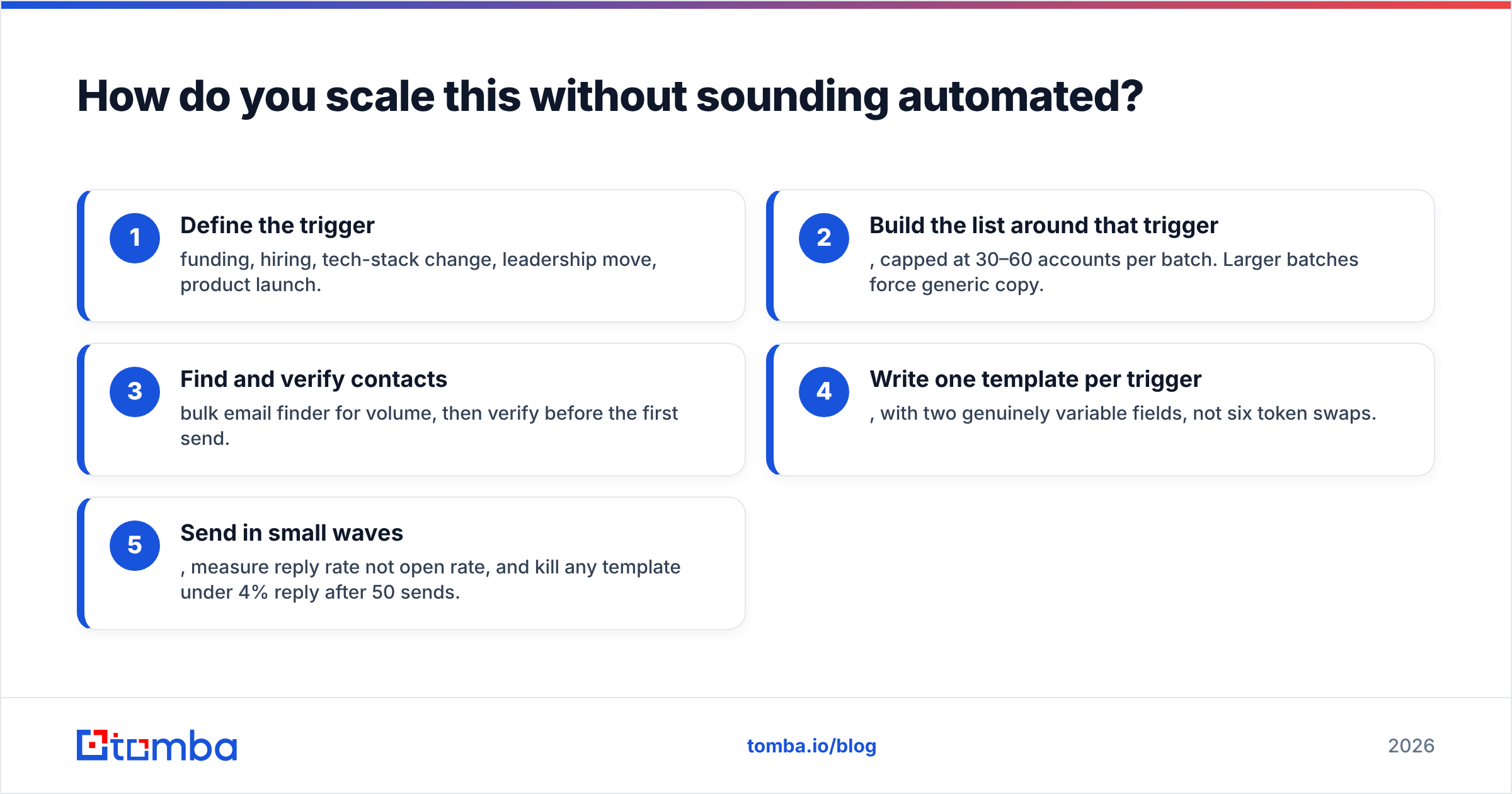
Segment by trigger, not by title. A list of 500 VPs of Sales gets one generic email. A list of 40 companies that all posted a RevOps job opening last month gets one specific email that works for all 40 — because the trigger is genuinely shared.
The workflow that holds up:
- Define the trigger — funding, hiring, tech-stack change, leadership move, product launch.
- Build the list around that trigger, capped at 30–60 accounts per batch. Larger batches force generic copy.
- Find and verify contacts — bulk email finder for volume, then verify before the first send.
- Write one template per trigger, with two genuinely variable fields, not six token swaps.
- Send in small waves, measure reply rate not open rate, and kill any template under 4% reply after 50 sends.
Open rates are increasingly unreliable as a metric — Apple Mail Privacy Protection and similar features inflate them badly. Response rate and meetings booked are the only numbers worth optimizing against. If you want a broader benchmark on what's normal in your segment, G2's sales-engagement category reviews are a reasonable sanity check on what teams actually report.
Start with contacts that exist#
Every template on this page assumes one thing: the email address is real, current, and belongs to the person you researched. That assumption is where most outbound quietly fails, long before copy has a chance to matter.
Tomba's Email Finder returns verified professional addresses with a confidence score, sourced by domain, name, or company, so your meeting request lands in a real inbox instead of a bounce log. The free tier covers 25 searches a month if you just want to check your existing list, and paid plans start at $49/mo — full Tomba pricing is public, no sales call required to see it. Write the better email. Then make sure it arrives.
Related guides#
Ready to find emails that actually work?
Join 150,000+ professionals who stopped guessing and started sending. Free credits on signup — no credit card required.
Get the Tomba newsletter
Practical outbound tactics and product updates — once every two weeks.
About the author