Email Astra Pricing 2026: Reviews, Pros, Cons and Costs
A neutral breakdown of Email Astra pricing, what reviewers actually praise and complain about, where the credit math bites, and which alternatives cost less per usable lead in 2026.

TL;DR
- Email Astra sells itself on price: low entry cost, credit-based packs, and a bundled finder + verifier. That combination is genuinely attractive if your list volume is small and predictable.
- The number that matters is not the monthly fee — it's cost per verified, deliverable email. A $19 plan that returns 55% usable addresses is more expensive than a $49 plan returning 90%.
- Reviewers consistently praise the price and the simple UI, and consistently flag thin coverage outside the US/UK, weak catch-all handling, and support latency.
- Verify the vendor's current tiers on its own site before you buy. Credit-based pricing on smaller tools changes often, and any figure in a blog post (including this one) is a snapshot.
- If you need API access, bulk enrichment, and catch-all verification in one place, Tomba pricing starts at $49/mo with a free tier of 25 searches — a useful benchmark for judging whether Email Astra's cheaper sticker actually saves you money.
What is Email Astra?#
Email Astra is a B2B email-finding and verification tool. The pitch is the same one every tool in this category makes: give it a name and a company domain, and it returns a work email address with a confidence score. Most tools in the tier also bundle a domain search (all public emails at a company), a bulk CSV mode, and an SMTP-level verifier.
What separates tools in this bracket is not the feature list — it's three things:
- Coverage. How much of your target list returns anything at all. This is a function of the vendor's data sources and crawl footprint.
- Accuracy. Of the addresses returned, how many actually accept mail. Vendors quote 95%+ almost universally; independent testing rarely agrees.
- Credit accounting. Whether you're charged for failed lookups, whether unused credits roll over, and whether verification consumes a separate credit from the find.
Email Astra competes on point three more than one or two. Its positioning is "cheaper per credit than the incumbents," which is a legitimate strategy — and also the reason you need to read the fine print carefully.
How does Email Astra pricing work in 2026?#
Email Astra uses credit-based tiers rather than seat-based licensing. That's the norm for tools in this segment, and it means your real cost scales with list volume, not headcount.
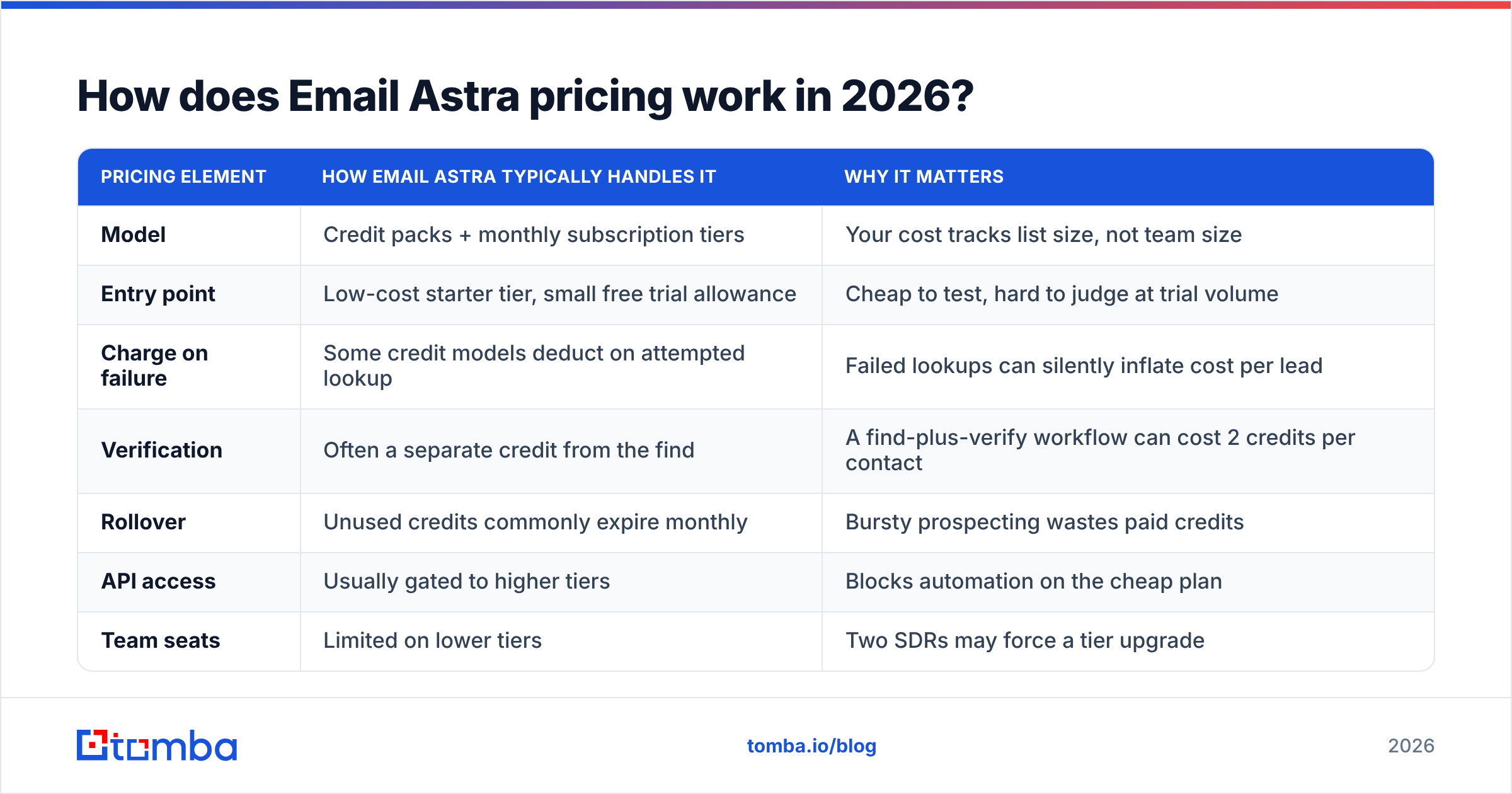
Here is how the pricing model breaks down structurally. Treat the dollar figures as indicative — check the vendor's live pricing page before you commit, because credit packs in this tier get repriced regularly.
| Pricing element | How Email Astra typically handles it | Why it matters |
|---|---|---|
| Model | Credit packs + monthly subscription tiers | Your cost tracks list size, not team size |
| Entry point | Low-cost starter tier, small free trial allowance | Cheap to test, hard to judge at trial volume |
| Charge on failure | Some credit models deduct on attempted lookup | Failed lookups can silently inflate cost per lead |
| Verification | Often a separate credit from the find | A find-plus-verify workflow can cost 2 credits per contact |
| Rollover | Unused credits commonly expire monthly | Bursty prospecting wastes paid credits |
| API access | Usually gated to higher tiers | Blocks automation on the cheap plan |
| Team seats | Limited on lower tiers | Two SDRs may force a tier upgrade |
The structural question to ask any credit-based vendor before you pay: do I get charged when you find nothing? If the answer is yes, the advertised per-credit price is fiction. A 60% hit rate at $0.02/credit is $0.033 per usable email — worse than a $0.03/credit tool with a 90% hit rate.

Image direction note for editors: replace with a screenshot of the Email Astra pricing page showing the credit tiers and the "credits expire monthly" fine print.
Where do the hidden costs show up?#
Sticker price is the easy part. These five line items are where teams get surprised, in rough order of how often they bite:
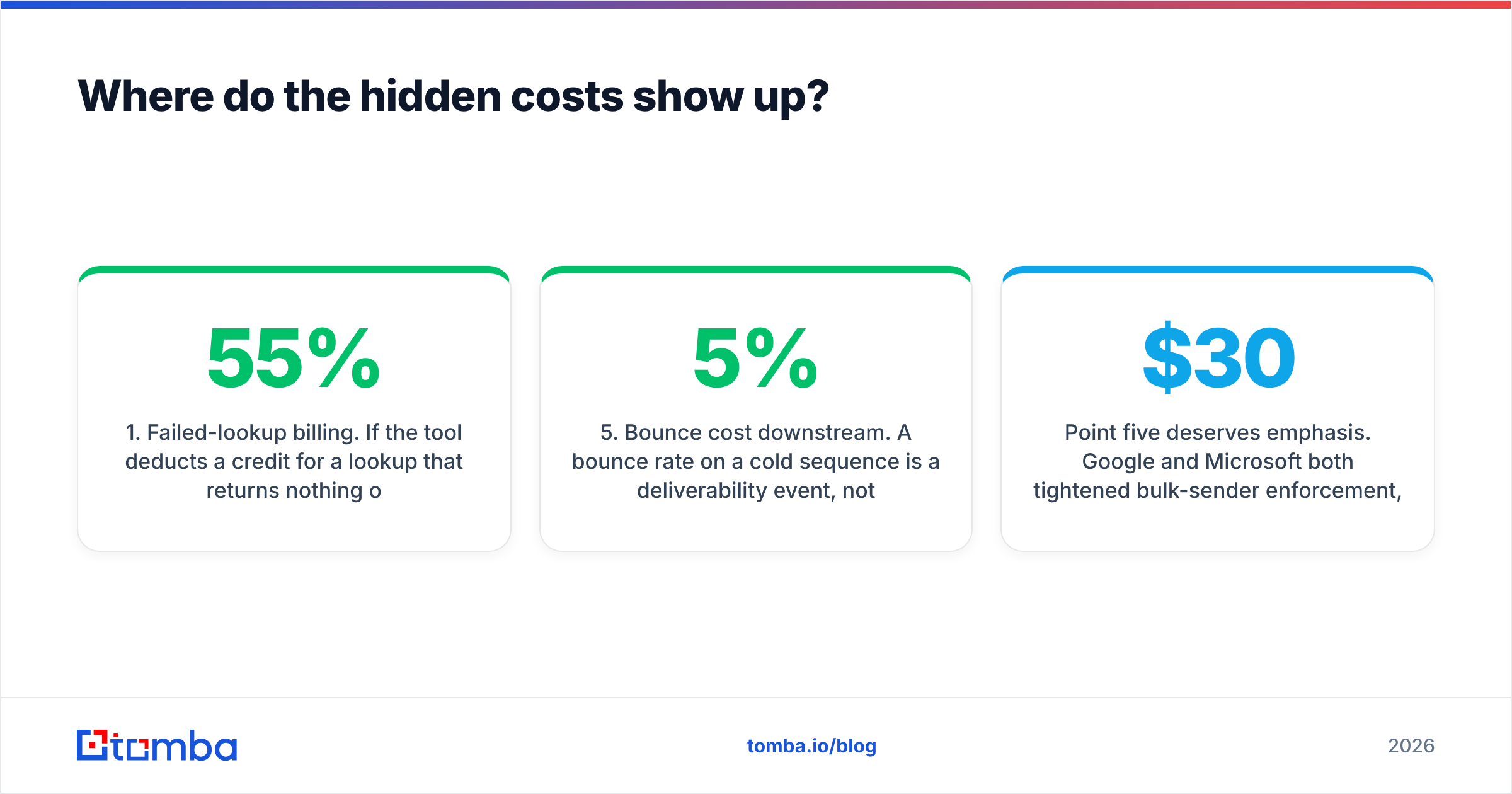
- Failed-lookup billing. If the tool deducts a credit for a lookup that returns nothing or returns "unknown," your effective cost per delivered address rises by 1/(hit rate). On a 55% hit rate, that's an 82% markup on the advertised credit price.
- Double-charging find plus verify. Finding an address without verifying it is not a finished job. If verification consumes a second credit, budget for 2x. Some vendors bundle verification into the find; that bundling is worth real money at volume.
- Catch-all domains. Roughly a fifth of B2B domains are configured to accept all mail, which makes standard SMTP verification useless. Cheaper tools tend to return "accept-all — unknown" and still charge you. If your ICP skews enterprise, you need a dedicated catch-all verifier or you're guessing on a large slice of your list.
- API gating. If the API sits on a higher tier, the cheap plan is a manual-work plan. Any workflow involving a CRM sync, a Clay table, or a scraper needs programmatic access — otherwise you're paying a person to copy-paste.
- Bounce cost downstream. A 5% bounce rate on a cold sequence is a deliverability event, not a data event. Damage to sender reputation costs far more than the credits you saved, and it takes weeks to repair. This is the single most expensive hidden cost of cheap data.
Point five deserves emphasis. Google and Microsoft both tightened bulk-sender enforcement, and a domain that starts bouncing at scale gets throttled quickly. The math almost never favors saving $30/month on data if it costs you a sending domain.
What do Email Astra reviews actually say?#
Review coverage for smaller tools in this bracket is thinner than for Apollo or ZoomInfo, so weight what you read accordingly — a tool with 40 reviews has a much noisier average than one with 4,000. Check current listings on G2 and Capterra rather than trusting any single roundup, including this one.
The recurring themes in reviews of budget email finders — Email Astra included — cluster tightly:
What reviewers praise:
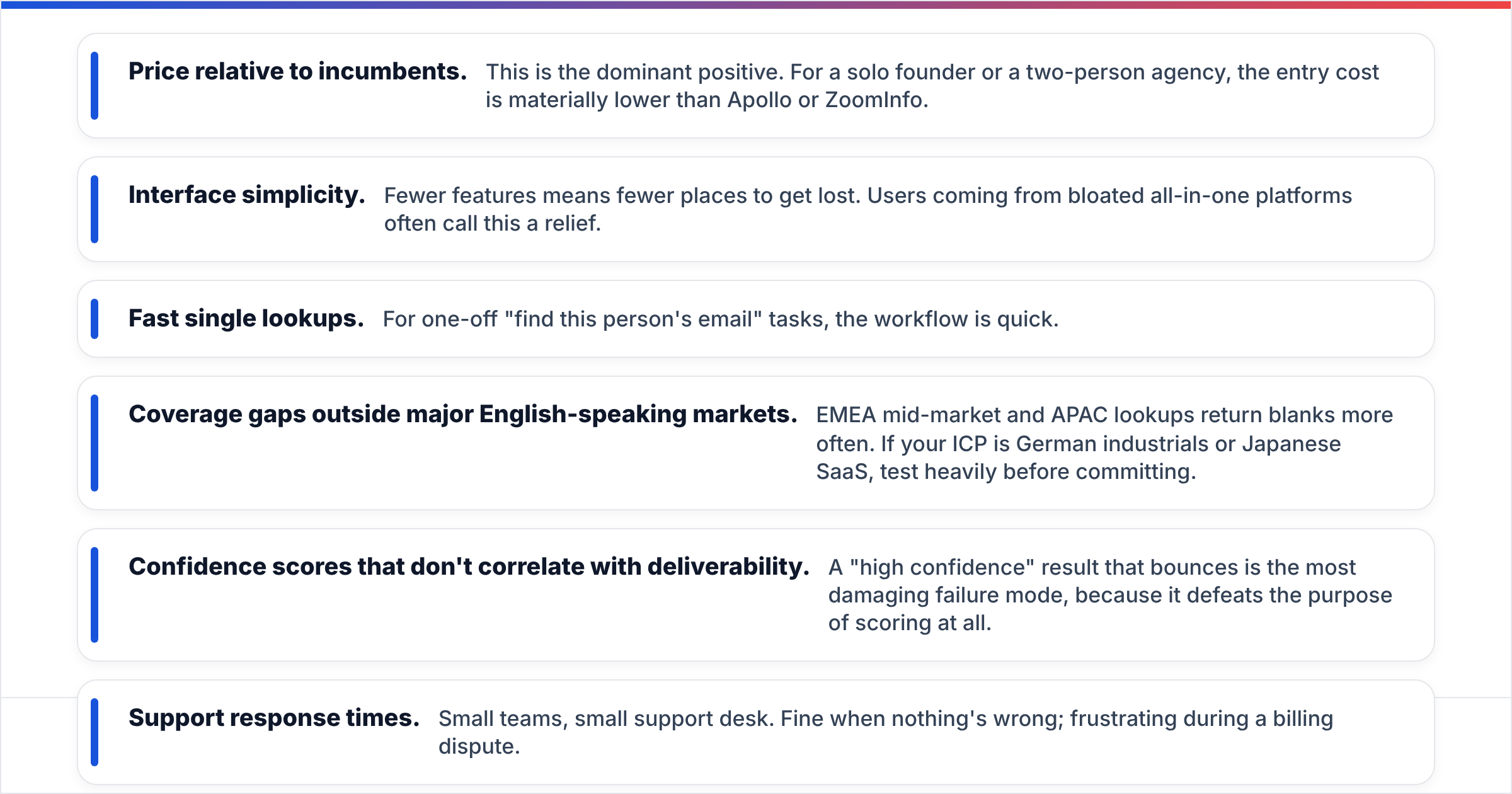
- Price relative to incumbents. This is the dominant positive. For a solo founder or a two-person agency, the entry cost is materially lower than Apollo or ZoomInfo.
- Interface simplicity. Fewer features means fewer places to get lost. Users coming from bloated all-in-one platforms often call this a relief.
- Fast single lookups. For one-off "find this person's email" tasks, the workflow is quick.
What reviewers complain about:
- Coverage gaps outside major English-speaking markets. EMEA mid-market and APAC lookups return blanks more often. If your ICP is German industrials or Japanese SaaS, test heavily before committing.
- Confidence scores that don't correlate with deliverability. A "high confidence" result that bounces is the most damaging failure mode, because it defeats the purpose of scoring at all.
- Support response times. Small teams, small support desk. Fine when nothing's wrong; frustrating during a billing dispute.
- Credit expiry. Prospecting is bursty. Monthly expiry punishes teams that build lists in sprints.
How accurate is Email Astra compared to other email finders?#
Accuracy is the axis where cheap tools most often lose the value argument, and it's the hardest thing to evaluate from a marketing page. Every vendor in the category claims 95%+ accuracy. The claims are not comparable because the denominators differ: some vendors measure accuracy only on addresses they chose to return, quietly excluding the lookups that failed.

The only test that means anything is your own. Run this before you buy anything:
- Take 100 real contacts from your actual ICP — not a demo list, not a Fortune 500 sample.
- Run them through each tool's trial. Record coverage (how many returned an address) and accuracy (how many passed independent verification).
- Verify the results with a different tool than the one that found them. A vendor grading its own homework is not evidence. A standalone email verifier works well as the neutral referee.
- Compute cost per verified email: (credits consumed x credit price) / verified addresses returned.
That last number is the only one worth putting in a budget request. It routinely reorders the leaderboard relative to sticker price.
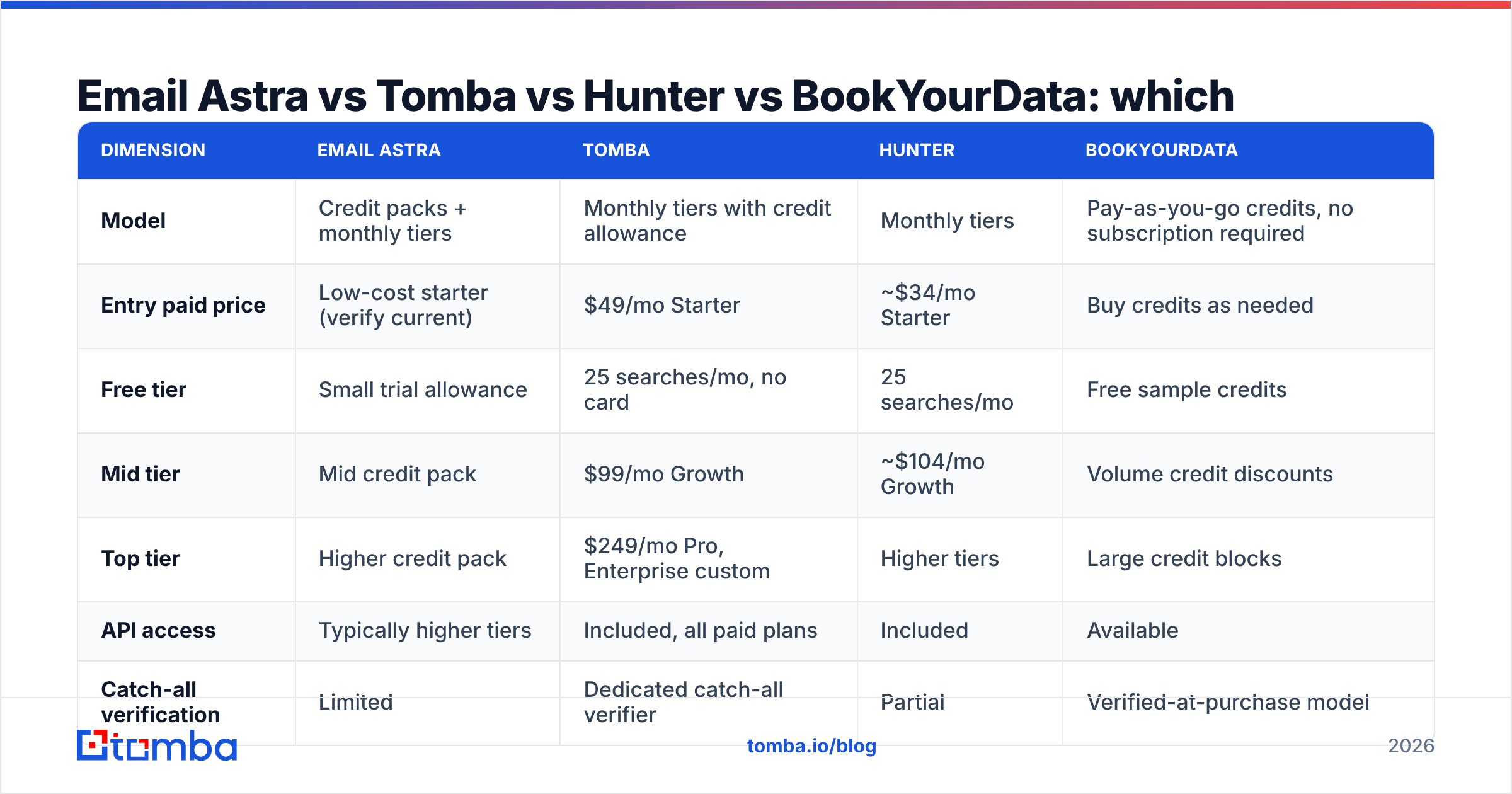
Email Astra vs Tomba vs Hunter vs BookYourData: which costs less per lead?#
Here's how the options compare on the dimensions that drive total cost. Pricing reflects publicly listed figures at the time of writing; verify current tiers on each vendor's site.

| Dimension | Email Astra | Tomba | Hunter | BookYourData |
|---|---|---|---|---|
| Model | Credit packs + monthly tiers | Monthly tiers with credit allowance | Monthly tiers | Pay-as-you-go credits, no subscription required |
| Entry paid price | Low-cost starter (verify current) | $49/mo Starter | ~$34/mo Starter | Buy credits as needed |
| Free tier | Small trial allowance | 25 searches/mo, no card | 25 searches/mo | Free sample credits |
| Mid tier | Mid credit pack | $99/mo Growth | ~$104/mo Growth | Volume credit discounts |
| Top tier | Higher credit pack | $249/mo Pro, Enterprise custom | Higher tiers | Large credit blocks |
| API access | Typically higher tiers | Included, all paid plans | Included | Available |
| Catch-all verification | Limited | Dedicated catch-all verifier | Partial | Verified-at-purchase model |
| Bulk CSV | Yes | Yes, bulk find + verify | Yes | Native — list building is the core product |
| Best for | Solo users with small, US-centric lists | Teams needing find + verify + API in one subscription | Users who want domain search with a mature brand | Buyers who want a filtered, pre-verified list without a subscription |
The honest read: these four tools are not really competing for the same buyer.
BookYourData is the cleanest fit if what you actually want is a list, not a lookup engine. Its pay-as-you-go model means no subscription overhead, and buying pre-verified contacts by filter beats hand-finding them one at a time when you need 2,000 contacts in a defined segment. If your workflow is "define ICP, buy list, load into sequencer," that's the shortest path.
Hunter is the incumbent brand with strong domain-search UX. You pay a premium for maturity.
Tomba is the option to look at when a single subscription needs to cover finding, verifying, catch-all checking, enrichment, and API automation. The $49/mo Starter includes API access, which is where cheaper credit-pack tools typically force an upgrade, and bulk email finder handles CSV workflows without per-seat charges.
Email Astra wins on one axis — entry price — and that axis genuinely matters when your monthly volume is a few hundred lookups against US companies.
Who should buy Email Astra, and who shouldn't?#
Buy it if:
- Your volume is under a few hundred lookups a month and your ICP is US or UK.
- You need manual, one-at-a-time lookups and have no automation requirements.
- Your budget ceiling is genuinely hard and the alternative is doing nothing.
Skip it if:
- You need API access on the cheapest tier. Check this before you pay — it's the most common reason teams churn out of budget tools within 60 days.
- Your ICP is outside major English-speaking markets. Coverage gaps will eat the savings in wasted SDR hours.
- A meaningful share of your target domains are catch-all. Guessing at scale damages deliverability.
- You need audit-grade data lineage for compliance. Ask any vendor where its data comes from; Tomba's data sources page is the kind of documentation to expect.
Frequently asked questions#
Is Email Astra a legitimate tool or a wrapper? Many low-cost finders in this bracket resell or aggregate upstream data. That's not inherently bad — most of the category does some aggregation — but it does mean accuracy tracks the upstream provider, and pricing can shift when upstream costs shift. Ask directly.
Does Email Astra offer a lifetime deal? Budget tools in this segment frequently run lifetime or AppSumo-style promotions. Treat them cautiously: credit-based tools with lifetime pricing have a structural incentive to reduce per-credit generosity over time. Check the terms on refresh allowances.
Can I use Email Astra output directly in a cold sequence? Not without independent verification. Run any finder's output through a separate verifier before sending — including output that came back marked "high confidence." One bad send week costs more than a year of verification credits.
What's the cheapest safe stack? A free-tier finder for discovery plus a paid verifier for the gate, then upgrade the finder once you've measured your real hit rate. Test with a free email checker before you commit budget anywhere.
The bottom line#
Email Astra's low entry price is real, and for a small, US-focused list it can be the right call. But the metric that decides whether it's cheap is cost per verified email, not cost per credit — and that number depends on coverage, failed-lookup billing, and whether verification costs extra. Run the 100-contact test. It takes an afternoon and it usually changes the answer.
If your list spans more than one region, or you need API access and catch-all verification inside one subscription rather than bolted on, start with the Tomba Email Finder. The free tier gives you 25 searches with no card, which is enough to run the coverage test against your own ICP before you spend anything — and paid plans start at $49/mo with the API included, so you're not upgrading three months in just to automate.
Related guides#
Ready to find emails that actually work?
Join 150,000+ professionals who stopped guessing and started sending. Free credits on signup — no credit card required.
Get the Tomba newsletter
Practical outbound tactics and product updates — once every two weeks.
About the author