Email Checkernet vs Lead411: Which B2B Email Tool Wins?
One tool cleans lists. The other sells you a contact database with intent data. Comparing Email Checkernet vs Lead411 on accuracy, pricing, and real outbound use cases — plus when neither is the right pick.
TL;DR
- They are not the same category. Email Checkernet (the way people usually search for email-checker.net) is a list-cleaning verifier. Lead411 is a B2B sales intelligence database with contacts, direct dials, and intent signals. Comparing them head-to-head only makes sense if you are trying to decide where your budget goes first.
- If you already have a list, a verifier is the cheaper fix. If you have no list at all, a verifier does nothing for you.
- Lead411 costs roughly 10-20x more per seat than a pay-as-you-go verifier, because you are buying data coverage and intent, not a syntax-and-SMTP check.
- Neither one closes the loop cleanly. Verifiers do not find emails; databases usually verify their own data with their own standards and rarely let you audit it.
- The practical answer for most teams is a finder + verifier that shares one credit pool and one API — which is where Tomba at $49/mo lands against a $99/user/mo intelligence platform.
What is Email Checkernet, exactly?#
"Email Checkernet" is how the tool at email-checker.net gets typed into search bars — one word, no dot. It is a straightforward email verification service: you paste an address (or upload a CSV), and it runs a chain of checks to tell you whether that mailbox is likely to accept mail.
The check chain is standard across the verification industry:
- Syntax validation — is the string a legal RFC-compliant address? Catches typos like
john@gmail..com. - Domain and MX lookup — does the domain resolve, and does it publish mail exchanger records? A domain with no MX record cannot receive email, full stop.
- Disposable and role detection — flags
mailinator.comthrowaways and role accounts likeinfo@,sales@,support@that tank reply rates and inflate complaint risk. - SMTP handshake — opens a conversation with the receiving server and asks whether the mailbox exists, without actually delivering a message.
- Catch-all detection — flags domains that accept mail for every address, which means the SMTP check returns "valid" for
asdfgh@company.comtoo.
That last one is where most verifiers, including this one, hand you a shrug. A catch-all domain is not a verdict; it is an unknown. Roughly a fifth to a quarter of corporate domains are configured this way, and how a tool handles them is the single biggest differentiator between verification products. If you want a deeper breakdown of the mechanics, the catch-all verifier approach explains why "accept-all" needs a separate resolution path rather than a blanket "risky" label.
What Email Checkernet does not do: find addresses. It has no company database, no name-to-email inference, no LinkedIn layer. You bring the list.
What is Lead411, exactly?#
Lead411 sits at the opposite end. It is a B2B sales intelligence platform in the same competitive set as ZoomInfo, Apollo, and Cognism. You search by title, industry, headcount, tech stack, or location, and it returns contact records — verified business emails, direct dial phone numbers, company firmographics.
Its differentiators, as the vendor positions them:
- Bombora intent data — third-party signals showing which companies are researching topics relevant to your product right now.
- Growth intent triggers — funding rounds, hiring spikes, leadership changes, new office openings.
- Direct dials — mobile and desk numbers, which is the expensive part of any B2B dataset and the reason enterprise data costs what it does.
- Unlimited-view pricing — its headline pitch against ZoomInfo's credit metering, though export volumes are still capped.
Lead411 is a prospecting tool with verification bolted on, not a verification tool. Its verification is internal and non-auditable: you get records marked as verified, but you cannot run your own list through it the way you can with a standalone checker.
How do Email Checkernet and Lead411 compare side by side?#
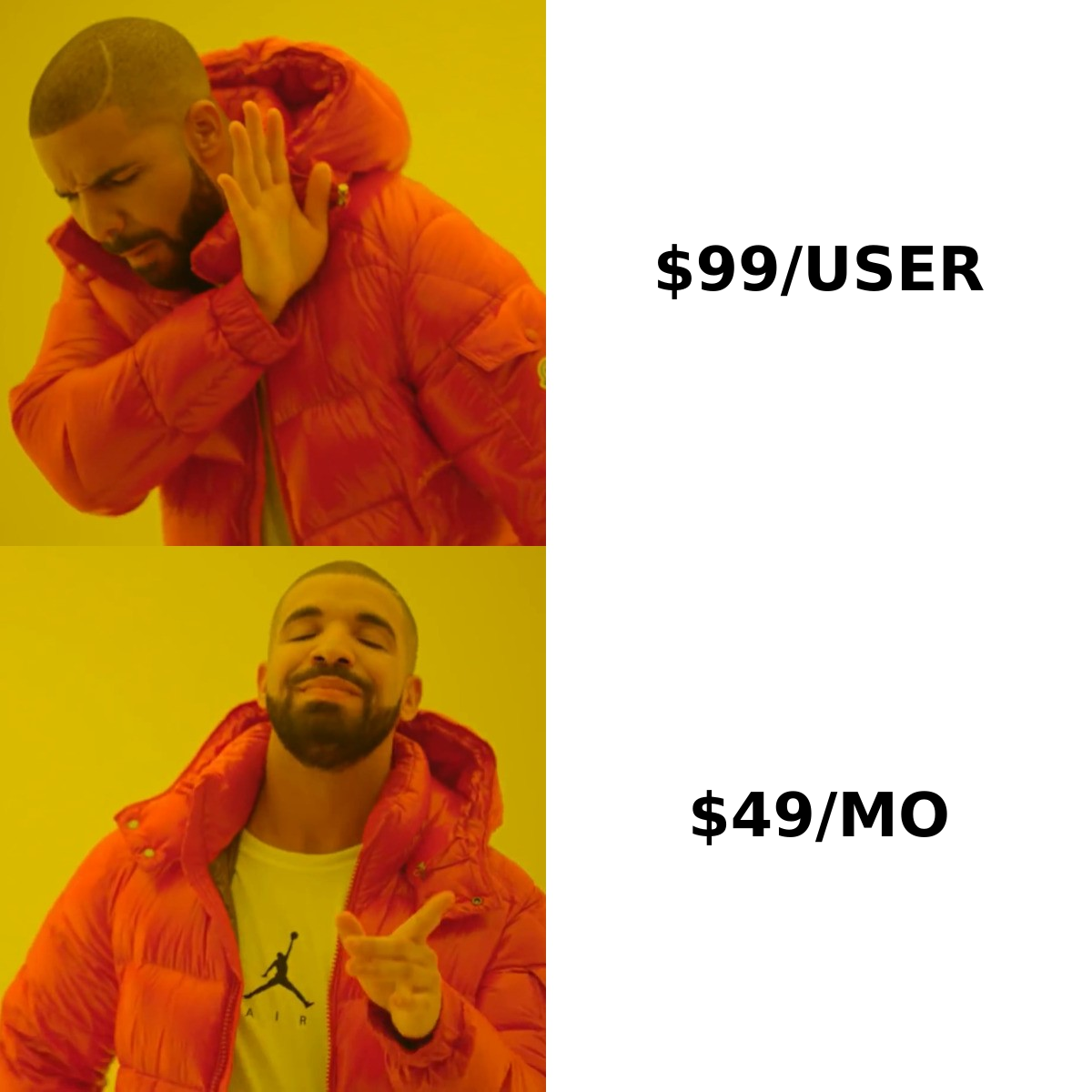
Here is the honest structural comparison. Note how few rows actually overlap — that is the point.
| Attribute | Email Checkernet | Lead411 | Tomba |
|---|---|---|---|
| Primary job | Verify a list you already own | Build a list from a database | Find + verify in one stack |
| Contact database | None | 450M+ contacts (vendor claim) | Domain + pattern + web index |
| Finds emails from a name | No | Yes | Yes |
| Direct dial phone numbers | No | Yes (core selling point) | Yes, via phone finder |
| Intent data | No | Yes (Bombora + growth triggers) | No |
| Catch-all handling | Flagged as unknown | Not exposed to the user | Dedicated catch-all resolution |
| Bulk CSV processing | Yes | Export-capped | Yes, via bulk email finder |
| Public API | Limited | Yes, on higher tiers | Yes, on every paid tier |
| Free tier | Free single checks | Trial only | 25 searches/mo |
| Entry price | Pay-as-you-go credits | ~$99/user/mo annual | $49/mo flat |
| Contract | None | Annual commitment typical | Monthly, no contract |
Two things jump out.
First, the "vs" framing is mostly false. These tools solve sequential problems, not competing ones. A verifier is the QA step; a database is the sourcing step. Teams that buy one thinking it covers the other end up disappointed in whichever they bought.
Second, the price gap is not arbitrary. Verification is a commodity — the SMTP protocol is public, the logic is well understood, and the marginal cost per check is fractions of a cent. Contact data is not a commodity; maintaining 450M records against ~30% annual B2B job churn is genuinely expensive. Lead411 charges more because it does something structurally harder.
Which one is more accurate?#
Wrong question, but here is the useful version of it: accurate at what?

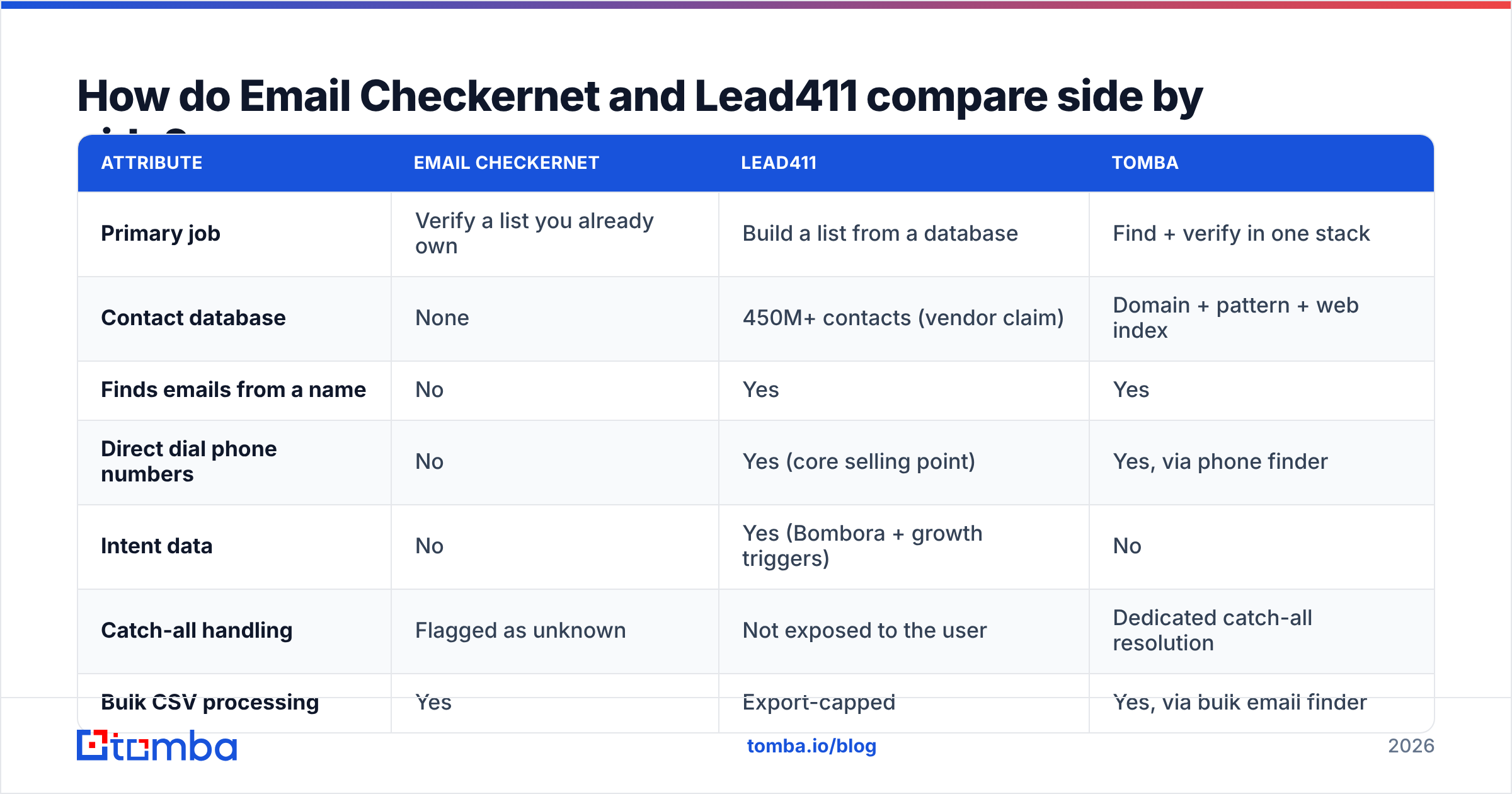
Verification accuracy and discovery accuracy are measured differently and fail differently.
Verification accuracy is measured against actual delivery. You verify 10,000 addresses, send to the ones marked valid, and compare the bounce rate to the tool's implied prediction. A good verifier keeps hard bounces under 2%. Where verifiers diverge is the false negative rate — addresses marked invalid that would actually have delivered. Aggressive SMTP probing against servers with greylisting or tarpitting produces a lot of these, and you never notice, because you never sent to them. You just quietly threw away good leads.
Discovery accuracy is measured as coverage times correctness. If Lead411 returns a contact for 60% of your target list and 85% of those are deliverable, your effective yield is 51%. A tool with 45% coverage at 95% correctness yields 43%. The headline "95% accurate" claim on any vendor site is almost always the correctness number with the coverage number omitted, which is how two tools with wildly different real-world yields both advertise 95%.
This matters for the comparison because Email Checkernet can only ever improve the second number, never the first. It cannot expand your coverage. If your list is 2,000 contacts and 700 are stale, verification hands you 1,300 usable records. It does not hand you 2,000.
Lead411 improves coverage but gives you no independent quality check. Its records are verified by Lead411, to Lead411's standard, and you find out how good that standard is when your bounce report comes back. Most experienced outbound teams re-verify purchased data through a third-party email verifier before it touches a sending domain — not because vendors lie, but because verification decays. A record verified in March is a different asset in July.
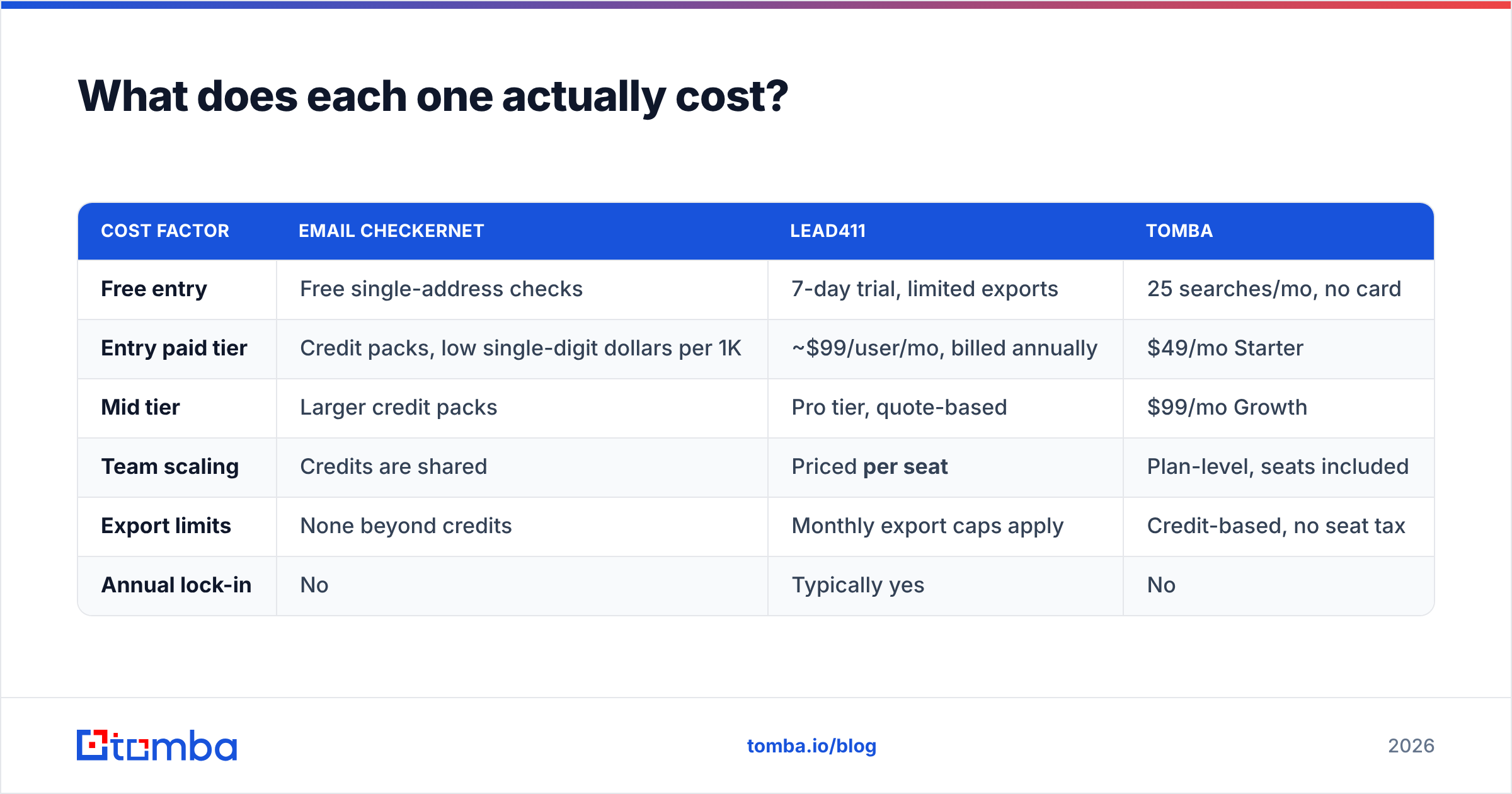
What does each one actually cost?#
Pricing on both sides changes; treat these as directional and check the vendor pages before you commit budget.
| Cost factor | Email Checkernet | Lead411 | Tomba |
|---|---|---|---|
| Free entry | Free single-address checks | 7-day trial, limited exports | 25 searches/mo, no card |
| Entry paid tier | Credit packs, low single-digit dollars per 1K | ~$99/user/mo, billed annually | $49/mo Starter |
| Mid tier | Larger credit packs | Pro tier, quote-based | $99/mo Growth |
| Team scaling | Credits are shared | Priced per seat | Plan-level, seats included |
| Export limits | None beyond credits | Monthly export caps apply | Credit-based, no seat tax |
| Annual lock-in | No | Typically yes | No |
The per-seat detail is the one that bites. A five-person SDR team on Lead411's entry tier is roughly $500/mo before you negotiate — against $99/mo on a plan-level tool where all five reps draw from one credit pool. That is not an argument that Lead411 is overpriced; intent data genuinely costs money to license from Bombora. It is an argument that you should only pay for intent if you will actually build plays around it. Most teams that buy intent data never operationalize it, and they are paying a large premium for a dashboard nobody opens. Compare the structure against Tomba pricing before you sign anything annual.
Who should use Email Checkernet?#
Pick a standalone verifier when:
- You already have the list. Conference attendee exports, webinar registrations, a CRM you inherited, a partner's shared list — data you own but do not trust.
- You are doing a one-time cleanup. Pay-as-you-go credits with no subscription beat a monthly seat you will cancel in six weeks.
- Your bounce rate crossed 3%. That is the point where mailbox providers start throttling. Cleaning is faster and cheaper than repairing sender reputation after the fact.
- You have zero prospecting need. Inbound-led businesses with plenty of form fills often need hygiene, not sourcing.
Skip it when your actual constraint is "I don't have enough contacts." No verifier solves that.
Who should use Lead411?#
Pick a full intelligence platform when:
- You are building lists from scratch, at volume, across accounts you have not identified yet.
- Phone matters as much as email. Direct dials are the strongest argument for paying enterprise data prices; they are hard to source any other way.
- You have a real intent play. Someone owns the workflow: intent spike triggers a sequence, a rep works it within 48 hours, and you measure lift. If nobody owns that, you are buying a feature you will not use.
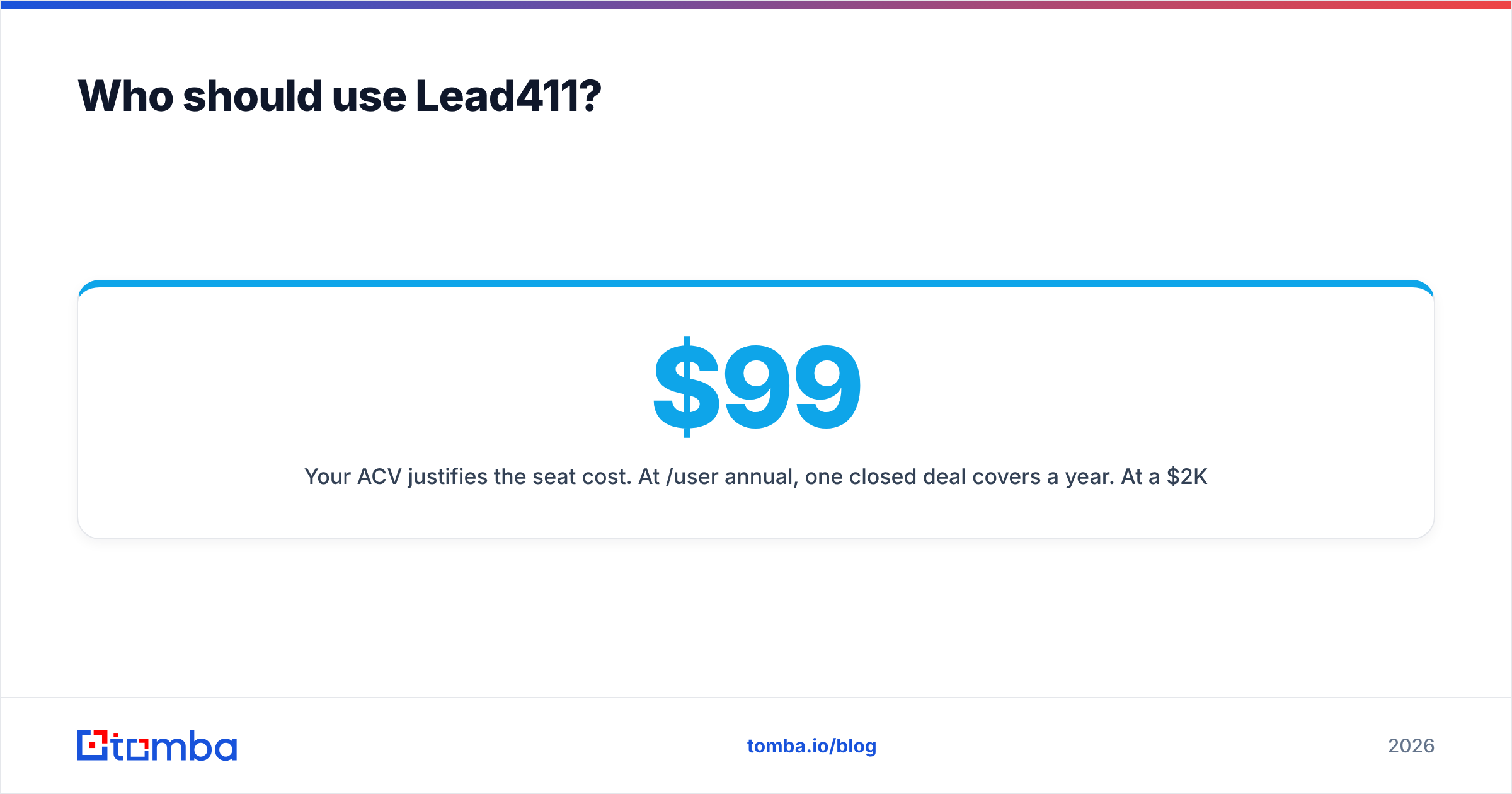
- Your ACV justifies the seat cost. At $99/user/mo annual, one closed deal covers a year. At a $2K ACV with a 3% reply rate, the math is much tighter.
Check current user sentiment on G2 before committing to an annual contract — data vendors' coverage varies enormously by geography and industry vertical, and a tool that is excellent for US mid-market SaaS may be thin for European manufacturing.

Is there a tool that covers both jobs?#
Yes, and this is the practical middle path most teams land on: a finder-plus-verifier that shares one credit pool, one API, and one dashboard — without the intent-data premium.

The functional difference between that and a Lead411-class platform comes down to four things:
- Sourcing model. A database sells you pre-scraped records; a finder resolves addresses live from domain patterns, public web signals, and verification at query time. Live resolution means fresher data on the records it does return; a database means broader coverage on records it already holds.
- Intent data. You do not get Bombora topic surges from a finder. If intent is central to your motion, that is a real gap and you should pay for the platform.
- Phone coverage. Databases generally win on direct dials at the top of the market, though a phone finder covers the common B2B cases at a fraction of the cost.
- Pricing shape. Plan-level credits versus per-seat licensing. The gap widens with every rep you add.
If your outbound motion is "identify a company, find the right person, verify the address, send," you do not need an intelligence platform. You need domain search to map who works there, a finder to resolve the address, and verification on the way out — which is one workflow, not three vendors.
How should you actually structure the stack?#
Five steps, in order. Skipping any of them is where deliverability goes wrong.
- Define the account list first, tool second. Firmographic filters are cheap; buying a database and then figuring out your ICP is how teams burn 200 export credits on garbage.
- Source contacts with a finder or database, depending on whether your bottleneck is coverage or cost.
- Verify everything through an independent checker, including records that arrived pre-verified. Vendor-verified is a claim, not an audit.
- Resolve catch-alls separately rather than dumping them or sending blind. A catch-all verifier recovers a meaningful chunk of a list that most tools write off as "risky."
- Re-verify anything older than 90 days. B2B contact data decays at roughly 2-3% per month. Last quarter's clean list is this quarter's bounce problem.
What is the verdict on Email Checkernet vs Lead411?#
Email Checkernet wins on cost and simplicity for list hygiene. If you have a list and want fewer bounces, it does that job for pocket change, with no contract. It will never help you find a single new contact.
Lead411 wins on coverage and signal. If your bottleneck is "who do I even call," and phone plus intent are part of the plan, the seat cost is defensible. Just be honest about whether you will operationalize intent, because that is what you are paying the premium for.
Neither is the efficient answer for a small outbound team that needs both jobs done. Paying per seat for intelligence you do not use, or paying for verification without any sourcing, both leave money on the table.
If your motion is find-then-verify at reasonable volume, start with the Tomba Email Finder. The free tier gives you 25 searches a month with no card — enough to run your real target accounts through it and compare the hit rate against whatever you are using now. Paid plans start at $49/mo with verification, domain search, and API access included in the same credit pool, no per-seat tax, no annual lock-in. Run the comparison on your own list before you sign a contract with anyone.
Related guides#
Ready to find emails that actually work?
Join 150,000+ professionals who stopped guessing and started sending. Free credits on signup — no credit card required.
Get the Tomba newsletter
Practical outbound tactics and product updates — once every two weeks.
About the author