Email Checkernet vs ZoomInfo: Which Data Tool Wins in 2026?
One is a lightweight email validation utility. The other is a six-figure GTM data platform. Here's an honest breakdown of where each actually earns its cost — and where a middle option beats both.
TL;DR
- Email Checkernet and ZoomInfo are not really competitors — one is a cheap email validation utility, the other is an enterprise GTM data platform with contact records, intent signals, and CRM workflows.
- If your only problem is "this list of 40,000 addresses might be dirty," a validator solves it for double-digit dollars. ZoomInfo would be a $15,000–$40,000/year answer to a $60 question.
- If your problem is "I don't have a list at all," a validator is useless. You need sourcing — either ZoomInfo, or a cheaper finder-plus-verifier stack.
- ZoomInfo's real costs are annual contracts, seat minimums, credit caps, and add-on modules (Intent, Engage, Copilot) that rarely appear in the headline quote.
- Most teams under 50 reps land better with a combined finder + verifier like Tomba at $49–$249/month than with either extreme.
What is Email Checkernet and what does it actually do?#
Email Checkernet is a bulk email verification utility. You upload a CSV, it runs each address through a validation chain, and it returns a cleaned file with per-address statuses — valid, invalid, catch-all/accept-all, role-based, disposable, unknown.
That chain is fairly standardized across the category, and it's worth knowing because it explains both the price and the limits:
- Syntax check — is the address RFC-compliant? Catches typos like
john@@acme.com. Costs nothing, catches maybe 2% of junk. - Domain and MX record lookup — does the domain exist and does it publish mail exchanger records? Kills dead domains and parked pages.
- Disposable and role detection — flags
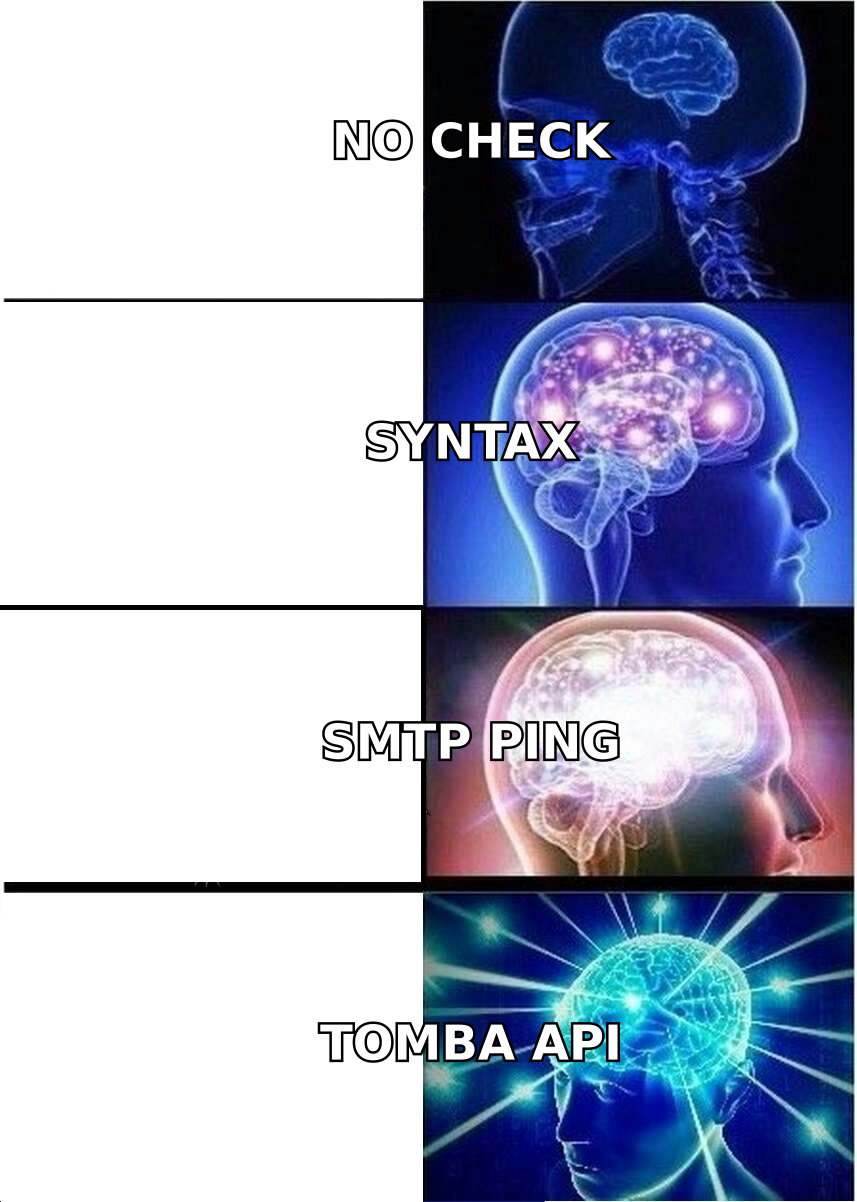
mailinator.comthrowaways andinfo@,sales@,support@aliases that tank reply rates. - SMTP handshake — opens a connection to the receiving mail server and asks whether the mailbox exists, without sending mail. This is the expensive part and the one that actually determines accuracy.
- Catch-all classification — some domains accept every address at the server level, so the SMTP ping returns "yes" for everything. Good validators mark these separately instead of calling them valid.
What Email Checkernet does not do is give you addresses. It has no contact database, no company firmographics, no org charts, no intent data, no CRM sync worth the name. It cleans what you already have. That's a legitimate job — bounce rates above 3% start visibly damaging email deliverability — but it's one job.

What is ZoomInfo and why does it cost so much more?#
ZoomInfo is a go-to-market data platform. Its core asset is a contact and company database — hundreds of millions of professional profiles with job titles, direct dials, corporate emails, technographics, funding events, and hierarchy mapping. Around that sits a product suite: SalesOS for prospecting, MarketingOS for ABM audiences, Intent for buyer-signal scoring, Engage for sequencing, and Copilot for AI account prioritization.
The pitch is consolidation. Instead of a finder, a verifier, an intent vendor, and a sequencer, you buy one contract. For a 100-rep organization with a mature revenue operations function, that consolidation is genuinely valuable — one data model, one admin, one enrichment pipe into Salesforce.
The price reflects it. ZoomInfo does not publish rates publicly; reported deals on G2 and Capterra cluster around $15,000–$40,000 annually for mid-market teams, with enterprise deployments running well past $100,000. Contracts are annual, usually with auto-renewal clauses, per-seat licensing, and credit caps on bulk exports. The features buyers most want — Intent, Engage, Copilot — are typically add-ons priced separately from the base seat.
Two things make ZoomInfo hard to evaluate against a $30 validator:
- The units don't match. Validation is priced per address checked. ZoomInfo is priced per seat per year with credit allowances layered on top.
- The failure modes don't match. A validator fails by returning "unknown" on catch-all domains. ZoomInfo fails by returning a contact who left the company nine months ago — with a confident-looking record attached.
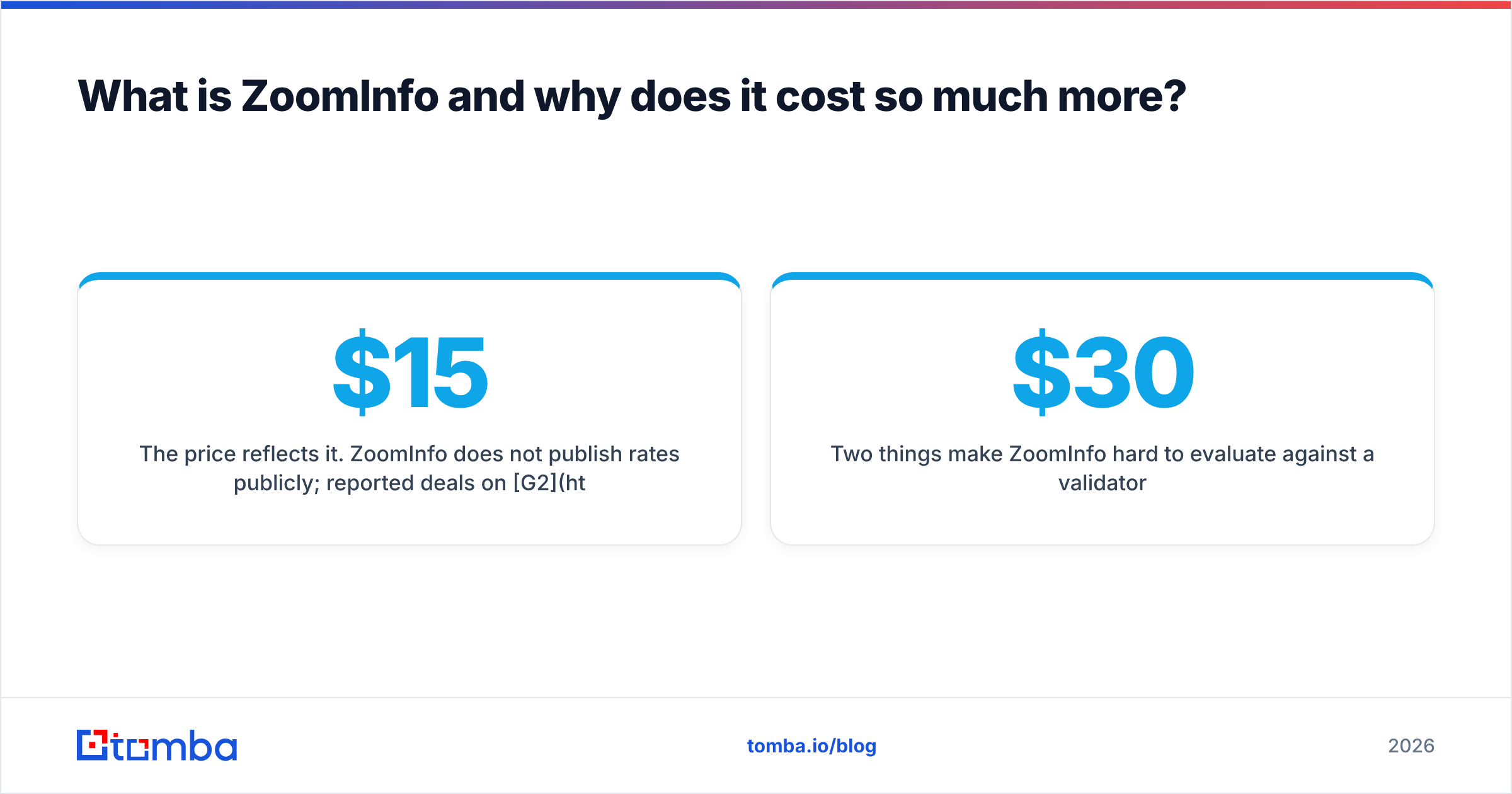
How do Email Checkernet and ZoomInfo compare head to head?#
| Dimension | Email Checkernet | ZoomInfo | Tomba |
|---|---|---|---|
| Primary job | Verify existing lists | Source contacts + GTM intelligence | Find + verify emails |
| Contact database | None | 260M+ profiles (vendor claim) | 400M+ indexed contacts |
| Email verification | Yes — core product | Bundled, secondary | Yes — dedicated verifier |
| Catch-all handling | Flagged as risky/unknown | Not surfaced clearly | Dedicated catch-all verifier |
| Direct dials / phone | No | Yes — a headline feature | Phone finder module |
| Intent data | No | Yes (paid add-on) | No |
| CRM enrichment | Export CSV only | Native Salesforce/HubSpot sync | HubSpot, Pipedrive, Salesforce, Zapier |
| API access | Limited | Enterprise tier only | All paid plans |
| Entry price | Pay-as-you-go, ~$10–$40 per batch | ~$15K/yr, annual contract | Free tier, then $49/mo |
| Contract term | None | 12 months, auto-renew common | Monthly, cancel anytime |
| Best for | Cleaning a list you already own | 50+ rep orgs with RevOps staff | Teams of 1–50 building lists |
The table makes the real decision obvious: you're not picking between two versions of the same product. You're deciding whether your bottleneck is data quality or data supply.
Which one should you buy for your situation?#
Work through these in order — the first one that matches is your answer.
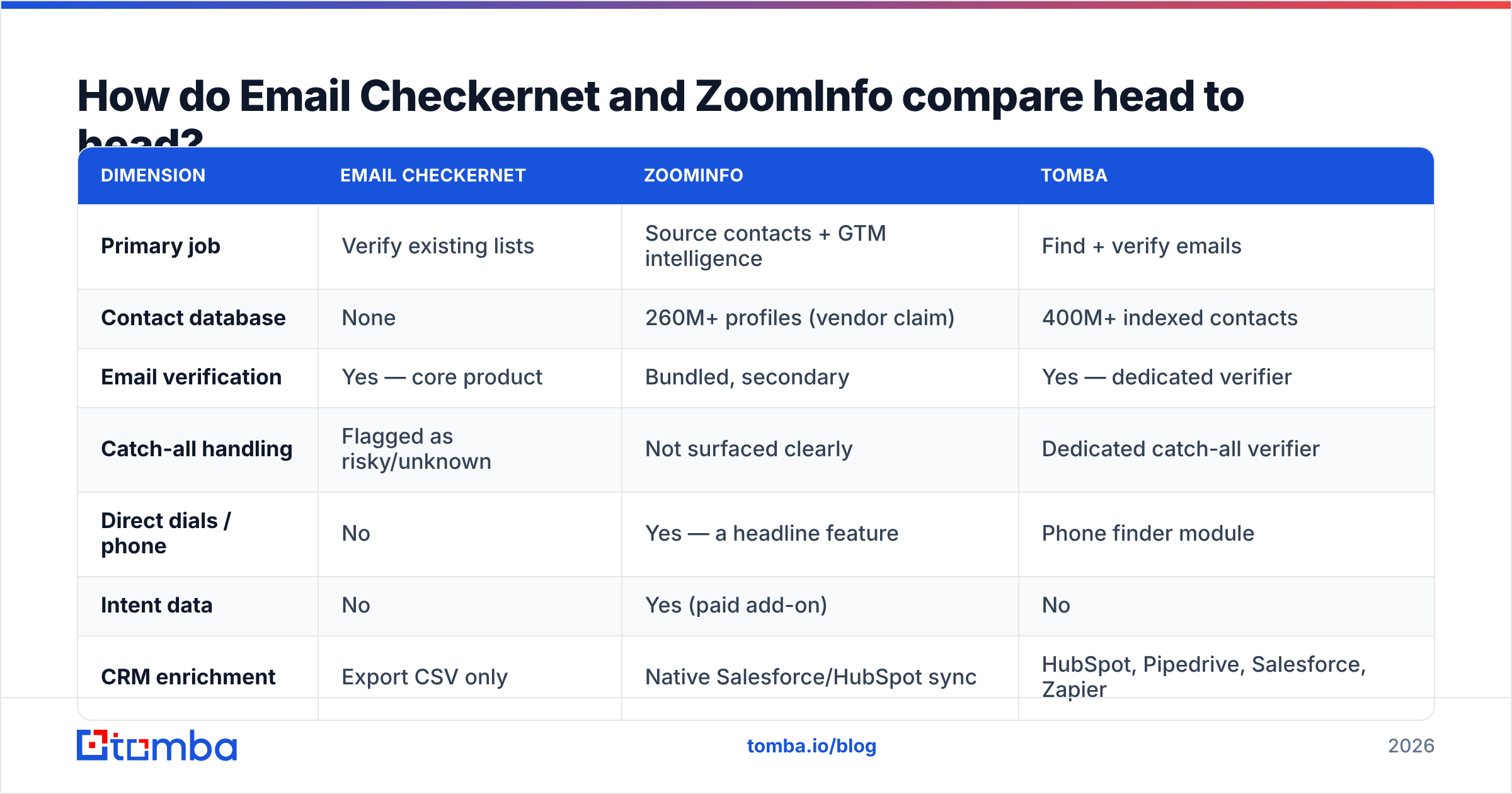
- You have a list and it's bouncing. Buy a verifier. Email Checkernet, or any competent alternative, will get bounce rates under 2% for the cost of a lunch. ZoomInfo is the wrong tool and the wrong price. Run the list through an email verifier and move on.
- You have company names but no contacts. You need sourcing, not validation. A domain search returns every discoverable address at a domain plus the pattern the company uses. This is where a validator hits its ceiling entirely.
- You need direct dials and org charts for enterprise ABM. ZoomInfo is genuinely strong here and few tools match its phone coverage. Budget accordingly, and negotiate — first quotes are rarely final.
- You need buyer intent signals tied to accounts. ZoomInfo, 6sense, or Demandbase. No email tool of any kind replaces this.
- You're a team of 1–50 doing outbound and want one bill. A finder + verifier combo covers 90% of the workflow at roughly 3% of the enterprise price. This is the largest segment of buyers and the one most often oversold.
- You're validating catch-all domains at scale. Most validators return "unknown" and leave you guessing. A catch-all verifier that actually resolves them changes your usable list size by 15–30% on B2B data.
Is ZoomInfo's accuracy worth the premium over a validator?#
Partly — and the distinction matters more than the marketing on either side admits.
Sourced data decays. Reported B2B contact churn sits around 25–30% per year as people change jobs, companies rebrand, and domains consolidate. That decay is why "verified" databases still produce bounces: the record was accurate when it was collected, and stale by the time you exported it. ZoomInfo's community-contribution model and refresh cadence slow the decay, but nothing stops it.
This is why the two tools are complements more than substitutes. A common enterprise pattern is exporting from ZoomInfo, then running the export through a third-party verifier before it touches a sending domain — because the platform's internal validation is a bundled feature, not a specialized one. If you're paying five figures and still buying a validator, that's a signal about where the value actually sits.
For teams building lists from scratch, the more honest accuracy question is about the discovery method. Pattern-based finding (deduce first.last@domain.com from a known format, then SMTP-verify it) reaches high confidence on most corporate domains without licensing a database at all. Vendors like Tomba publish their data sourcing openly, which is a reasonable thing to demand from any provider before you sign.
What are the hidden costs buyers miss?#
With ZoomInfo:
- Annual commitment. You cannot pilot for a month. Most contracts are 12 months minimum with auto-renewal windows that require written notice 30–60 days out.
- Seat minimums. Pricing assumes multiple seats. A two-person team pays close to what a five-person team pays.
- Credit caps. Bulk exports draw down a credit pool. Blow through it mid-quarter and you're negotiating an overage mid-contract, from a weak position.
- Add-on stacking. Intent, Engage, Copilot, and Data-as-a-Service are separate lines. The demo shows all of them; the base quote includes few.
- Implementation time. CRM mapping, dedupe rules, and admin training are real weeks of RevOps effort.
With a standalone validator:
- The re-verification treadmill. A list cleaned in January is dirty by June. Budget for repeat runs, not one.
- Catch-all blind spots. If 25% of your list comes back "unknown," you paid to verify data you still can't confidently use.
- No sourcing means another tool anyway. The verifier is never the whole stack. You'll add a finder, and now you're managing two vendors and two bills.
Peers in the space handle this bundling differently. BookYourData, for instance, sells pre-verified contact lists with a bounce guarantee, which suits teams that want data delivered rather than assembled — a reasonable third model alongside "source it yourself" and "license the whole platform."
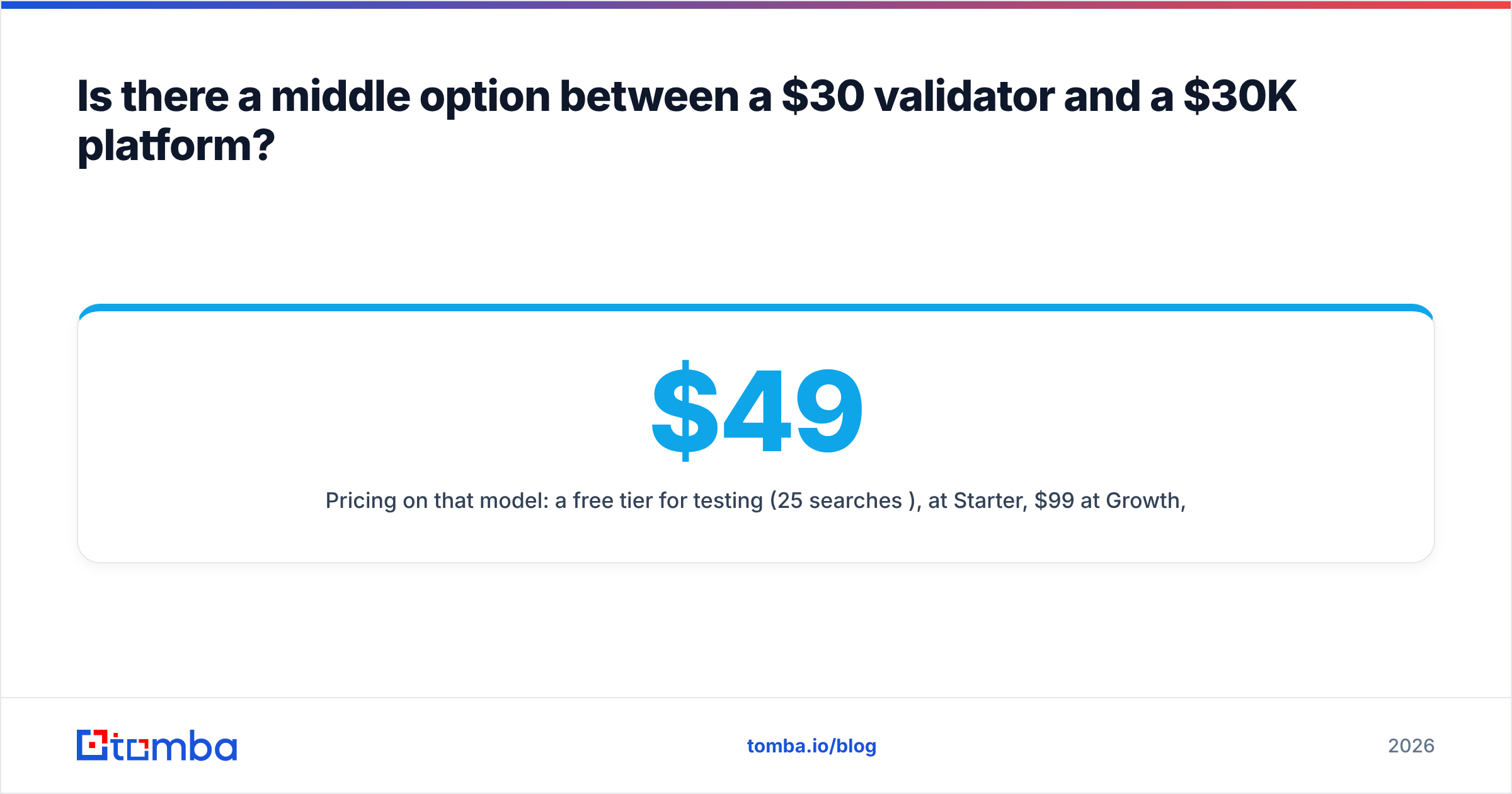
Is there a middle option between a $30 validator and a $30K platform?#
Yes, and for most teams it's the correct answer.
The gap between these two products is where combined finder-verifier tools live. They source addresses (by domain, by name, by LinkedIn profile, by article byline), validate them in the same pass, and expose the whole thing through an API so it can run inside your existing workflow instead of as a CSV round trip.
Concretely, that stack looks like:
- Find — domain search for every address at a target company, or an email finder for a specific person you already identified.
- Verify — SMTP-level validation on every result before it enters your sequencer, with catch-all domains resolved rather than shrugged off.
- Enrich — job title, company size, social profiles, and phone appended so your CRM has something to segment on.
- Automate — the Tomba API or a Zapier/HubSpot connector so enrichment happens on lead creation, not in a monthly batch job.
Pricing on that model: a free tier for testing (25 searches/month), $49/month at Starter, $99/month at Growth, $249/month at Pro, custom above that. Compare that to a ZoomInfo contract and the math is roughly 30:1 — while covering the same two jobs most outbound teams actually run every week.
You lose things at that price, and it's worth being explicit about what: no intent data, no org-chart visualization, no Copilot-style account prioritization, thinner direct-dial coverage. If those drive your pipeline, pay for the platform. If they don't — and for most sub-50-rep teams they don't — you're funding features that never make it into a sequence. See the full Tomba pricing breakdown before assuming the cheap option can't carry the load.
How should you run a fair evaluation?#
Don't compare feature lists. Run the same test against both.
- Take 200 real target contacts from your ICP — not a vendor-provided sample. Vendor samples are curated.
- Measure hit rate, meaning what percentage returned a usable address, not what percentage returned a record. A record with a blank email is a miss.
- Send to a small segment and measure the actual bounce rate. This is the only number that matters. Vendor-claimed accuracy is measured against their own validation, which is circular.
- Time the workflow. Count minutes from "I know the company" to "the contact is in my sequencer." A tool that's 5% more accurate but requires three CSV exports loses.
- Price per usable contact, not per credit. Divide the annual cost by the number of contacts that survived your bounce test. This single calculation flips more decisions than any feature grid.
Most teams that run this test find their real gap isn't accuracy — it's that they're paying platform prices for utility usage, or utility prices while their sourcing problem goes unsolved.
The bottom line#
Email Checkernet and ZoomInfo answer different questions. Buy a validator when you have data and don't trust it. Buy ZoomInfo when you have RevOps headcount, an ABM motion, and a budget that treats $30K as a line item rather than a decision. Most teams sit between those poles and overpay on one side or under-serve themselves on the other.
If you're building lists rather than licensing them, start with the Tomba Email Finder. The free tier gives you 25 searches to test hit rate on your own ICP before you spend anything, and every paid plan includes API access, bulk processing, and verification in the same workflow — so you're not stitching a finder to a validator and hoping the handoff holds. Run your 200-contact test against it and let the bounce rate decide.
Related guides#
Ready to find emails that actually work?
Join 150,000+ professionals who stopped guessing and started sending. Free credits on signup — no credit card required.
Get the Tomba newsletter
Practical outbound tactics and product updates — once every two weeks.
About the author