Email Finder UK: How to Find British B2B Emails in 2026
UK B2B email data breaks in ways US-first tools never warn you about — .co.uk domains, GDPR under UK law, and Companies House. Here's what actually works in 2026.
TL;DR
- Any email finder UK shortlist has to handle data that works differently from US data:
.co.ukand.ukdomains, a long tail of sub-500-employee firms, and fewer public professional profiles. Tools built on US-first crawls under-perform here. - Expect real hit rates of 55–75% on UK SME domains. The 95%+ numbers on pricing pages do not hold up. Verify before you send.
- UK GDPR and PECR allow B2B email to a limited company or LLP under legitimate interests. Sole traders and partnerships count as individuals, which raises the bar.
- Catch-all domains are common on UK SMEs running Microsoft 365. A catch-all check matters more here than in US outbound.
- Best setup: a domain-first finder for coverage, a verifier for accuracy, and Companies House data for the firmographic filtering US databases do not carry.
Why is finding UK email addresses harder than US email addresses?#
Most B2B contact databases were built by crawling American web properties first. Every email finder UK buyer hits the same wall: the UK long tail never made it into the index.
Think of a phone book put together by someone who only ever walked the high streets of Manhattan. Ask them for a plumber in Leeds and they will guess. That guess is what a low-confidence email result really is.
Three structural differences make UK data behave differently:
- Domain sprawl. One UK company may run
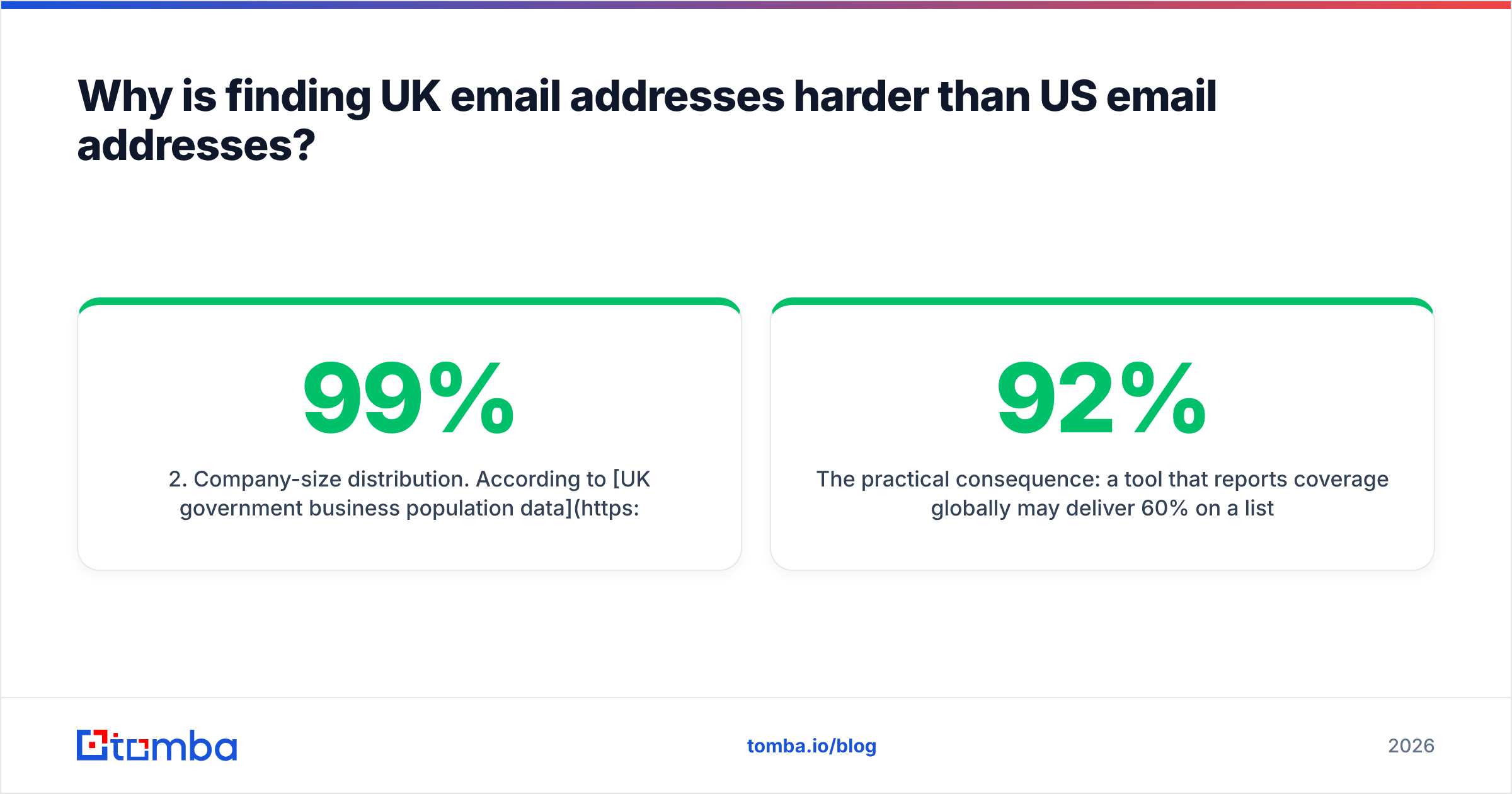
acme.co.uk,acme.uk, andacme.comat once, but route mail through only one. Guessfirstname@acme.comwhen the MX records live onacme.co.ukand you get a bounce. It looks like a bad pattern. It is really a bad domain. - Company-size distribution. Over 99% of UK private-sector businesses are SMEs, and most have fewer than 10 staff, according to UK government business population data. Small firms publish fewer staff pages, press releases, and conference bios. Those are the exact sources contact databases harvest.
- Lower profile density. LinkedIn use is high among UK professionals. But UK users share a work email far less often than US users, and scraped-profile providers depend on that.
So a tool that reports 92% coverage globally may deliver 60% on a list of Birmingham manufacturers. Test on your own ICP, not on a demo list of FTSE 100 domains.
What does a UK-focused email finder actually need to do?#
Five capabilities separate a tool that works on British data from one that merely accepts a .co.uk string.
- Multi-TLD domain resolution — given "Halfords", return the live trading domain, not the first
.commatch. A proper domain search checks every associated domain for live MX records. - Pattern inference from small samples — UK SMEs may publish only two or three addresses. The finder has to infer
f.lastname@orfirstinitial.lastname@from that thin sample without over-fitting. - Catch-all detection — catch-all routing is common on UK Microsoft 365 tenants. Without a catch-all verifier, every guess looks valid until your bounce rate says otherwise.
- Companies House cross-reference — UK filings expose registered address, SIC code, incorporation date, and directors via Companies House. No US-built database carries this natively, yet it is the best firmographic filter for UK targeting.
- UK GDPR compliance posture — a documented lawful basis, named data sources, and a working deletion flow. UK enterprise procurement will ask.
If a vendor cannot answer points 1, 3, and 5 on a sales call, its UK numbers are marketing.
How do the main email finder UK tools compare?#
Below are the providers most often shortlisted for UK B2B prospecting. Pricing is the published entry tier as of early 2026. Always confirm on the vendor's own page, since tiers shift.
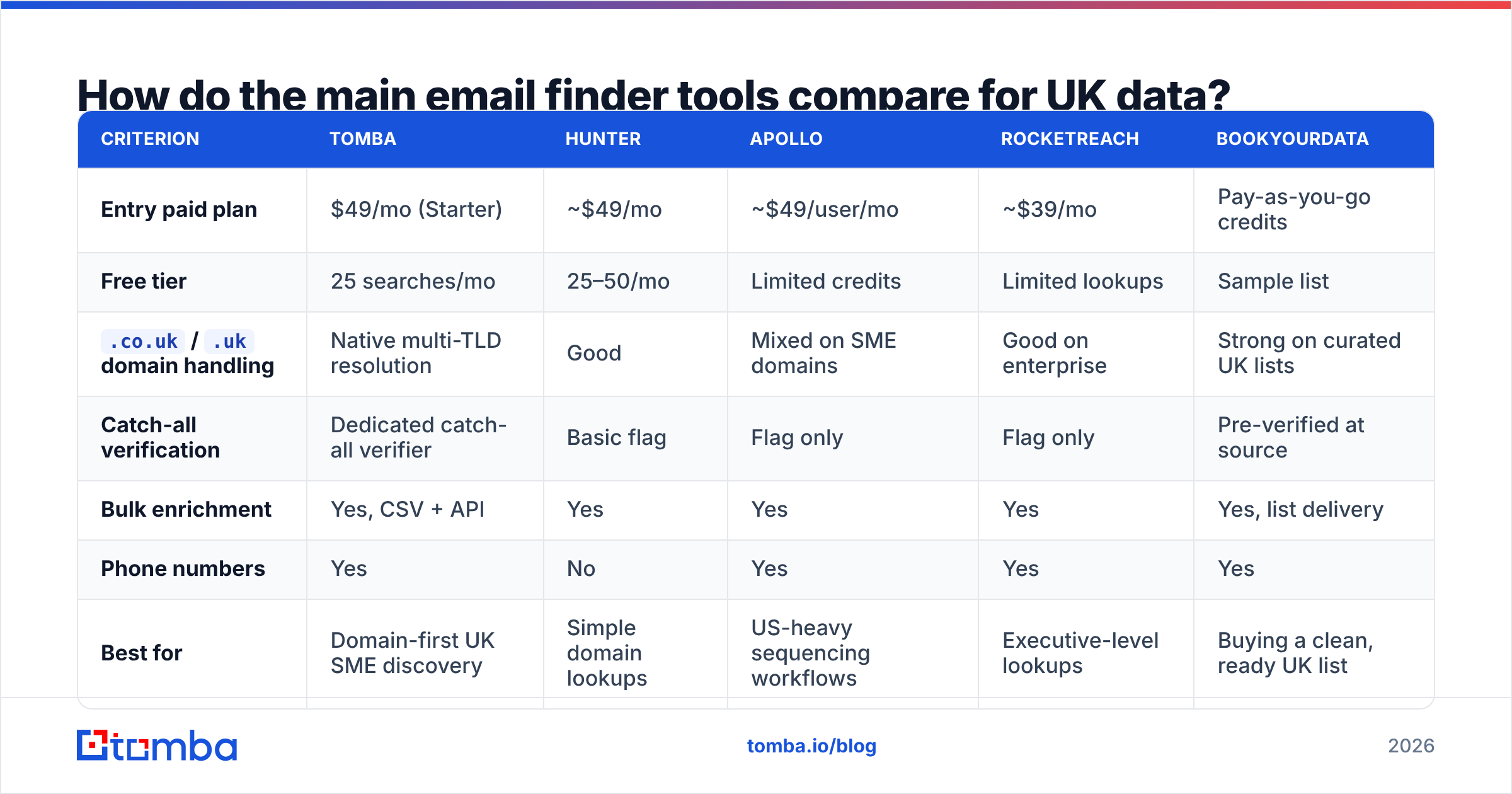
| Criterion | Tomba | Hunter | Apollo | RocketReach | BookYourData |
|---|---|---|---|---|---|
| Entry paid plan | $49/mo (Starter) | ~$49/mo | ~$49/user/mo | ~$39/mo | Pay-as-you-go credits |
| Free tier | 25 searches/mo | 25–50/mo | Limited credits | Limited lookups | Sample list |
.co.uk / .uk domain handling |
Native multi-TLD resolution | Good | Mixed on SME domains | Good on enterprise | Strong on curated UK lists |
| Catch-all verification | Dedicated catch-all verifier | Basic flag | Flag only | Flag only | Pre-verified at source |
| Bulk enrichment | Yes, CSV + API | Yes | Yes | Yes | Yes, list delivery |
| Phone numbers | Yes | No | Yes | Yes | Yes |
| Best for | Domain-first UK SME discovery | Simple domain lookups | US-heavy sequencing workflows | Executive-level lookups | Buying a clean, ready UK list |
| Weak spot | Smaller brand recall than incumbents | Thin on phone data | UK SME coverage gaps | Credit costs at volume | Less useful for ad-hoc single lookups |
Two honest notes on this table. First, BookYourData plays a different game. It sells pre-verified lists rather than a live lookup engine, which is often the faster route if you need 2,000 UK contacts in a named SIC code by Friday. Second, Apollo's UK gaps sit in sub-50-employee firms. On UK enterprise accounts it performs well.

Accuracy claims deserve scrutiny. A "98% accurate" badge usually means 98% of returned results were deliverable. It says nothing about how many searches returned nothing at all. Coverage and accuracy are separate metrics, and vendors quote whichever one flatters them.

Is cold email to UK contacts legal under UK GDPR?#
Short answer: yes, for corporate subscribers, if you use legitimate interests properly and honour opt-outs. The nuance is where people get caught.
The UK kept GDPR after leaving the EU, as UK GDPR. It sits alongside the Privacy and Electronic Communications Regulations (PECR). PECR governs electronic marketing, and it splits the world into corporate subscribers and individual subscribers.
- Corporate subscribers — limited companies, LLPs, PLCs, government bodies, and Scottish partnerships. Unsolicited B2B email is allowed without prior consent, as long as you identify yourself and offer an opt-out.
- Individual subscribers — sole traders and, in England, Wales, and Northern Ireland, non-limited partnerships. These are treated like consumers, and the consent bar is far higher.
That line is why Companies House filtering matters commercially, not just for firmographics. It tells you which side of it a prospect sits on. A list of @gmail.com addresses held by sole-trader consultants is a different legal object from a list of @ltd.co.uk addresses at incorporated firms.
You still need a lawful basis for the personal data itself. A named person's work email is personal data. Legitimate interests is the standard basis for B2B outreach. It requires a documented Legitimate Interests Assessment (LIA), a privacy notice the recipient can reach, and a working deletion path. Read the ICO's direct marketing guidance rather than a vendor's summary of it.
Three practical rules keep UK campaigns clean:
- Put your registered company name and address in every send. PECR requires sender identification.
- Honour unsubscribes within days, not "the next list refresh."
- Keep a source record per contact. If the ICO or a prospect asks where you got the address, "our data provider" is a weaker answer than a logged source URL and date.
What hit rate should you actually expect on UK domains?#
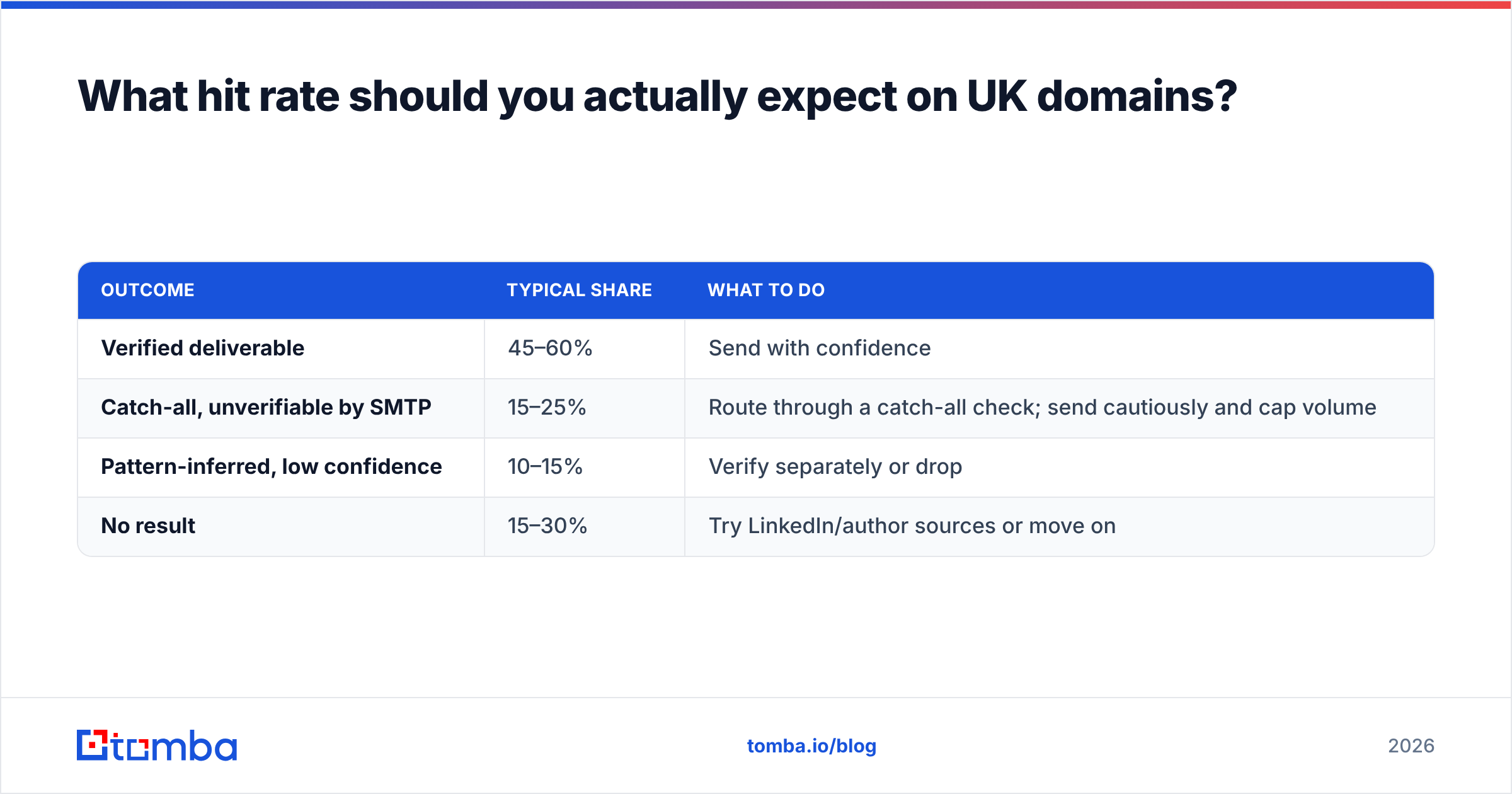
Plan for 55–75% on SME domains and 80–90% on enterprise domains. Anything higher on a real SME list is luck, or a catch-all domain lying to you.
Here is what typically happens to 1,000 UK SME domain lookups:
| Outcome | Typical share | What to do |
|---|---|---|
| Verified deliverable | 45–60% | Send with confidence |
| Catch-all, unverifiable by SMTP | 15–25% | Route through a catch-all check; send cautiously and cap volume |
| Pattern-inferred, low confidence | 10–15% | Verify separately or drop |
| No result | 15–30% | Try LinkedIn/author sources or move on |
The middle two rows are where campaigns die. Send to catch-all and low-confidence addresses without a second pass, and your bounce rate climbs past the 2–3% threshold mailbox providers tolerate. Your email deliverability then degrades across every domain you send from, including the good addresses.
Run every list through an email verifier before it touches your sending tool. The credit cost is trivial next to a burned sending domain.

What's the most efficient UK prospecting workflow in 2026?#
A five-step sequence beats buying one big list.
- Define the segment in Companies House terms first. SIC code, incorporation year, registered region, and accounts-filing size band. That gives you a clean universe of limited companies, and it drops sole traders before they become a PECR problem.
- Resolve domains, not company names. Map each company to its live trading domain. Most UK list-building fails here, silently.
- Run domain search per company. Pull every published address plus the inferred pattern. For 20 domains, use the UI. For 2,000, use bulk email finder or the API.
- Verify, then split by confidence. Deliverable addresses go to your main sequence. Catch-all addresses go to a slower sequence on a secondary domain, so bounce damage stays contained.
- Enrich before writing. Company size, tech stack, and recent filings give you the opening line that earns a reply. Data enrichment is cheaper than rewriting a failed campaign.
Teams working from a spreadsheet rather than a CRM can use the Google Sheets add-on for steps 3 and 4. It removes the CSV round-trip that eats an afternoon.
When should you buy a UK list instead of building one?#
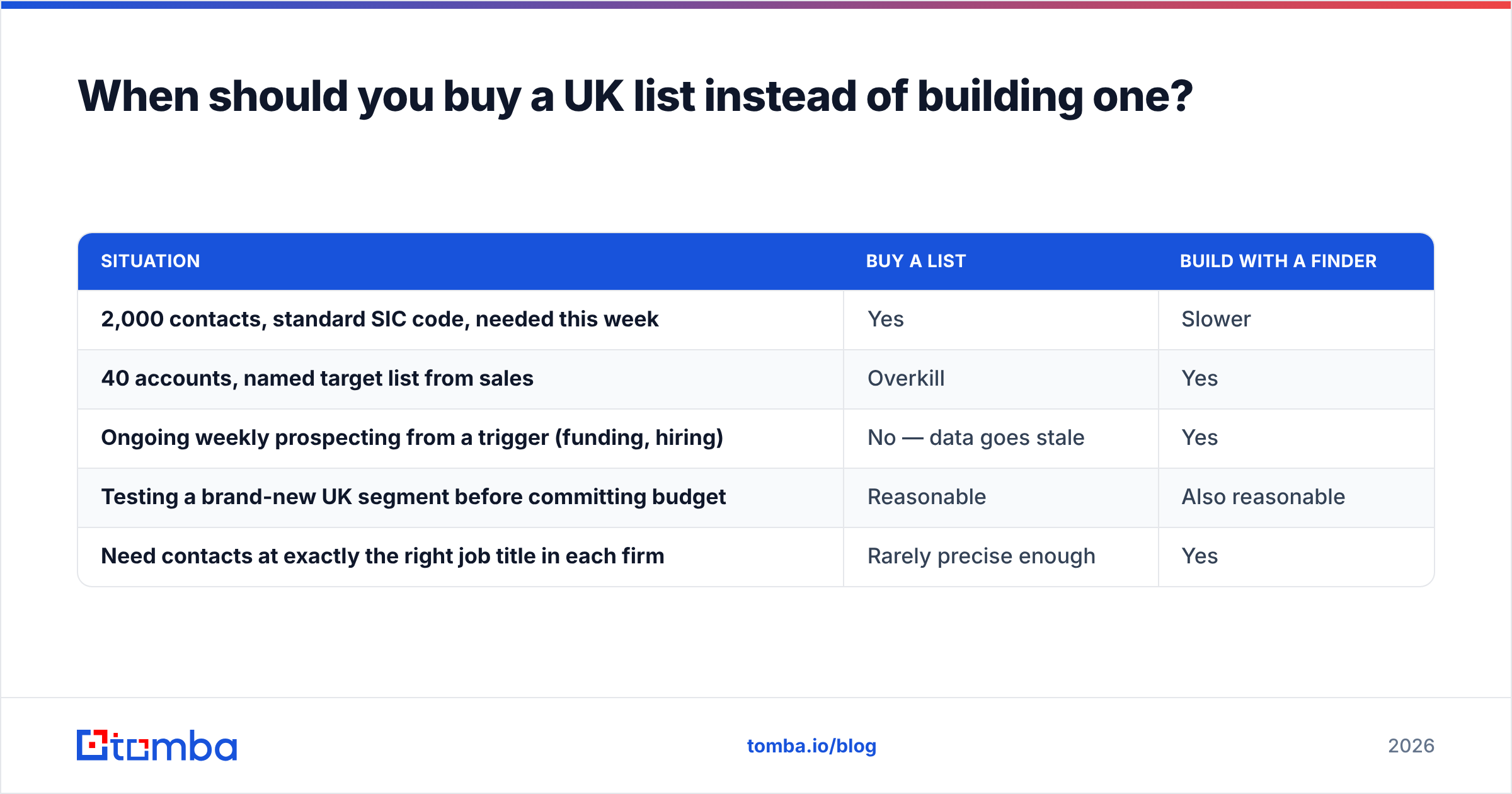
Buy when the segment is well defined and stable. Build when it is narrow, unusual, or changes weekly.
| Situation | Buy a list | Build with a finder |
|---|---|---|
| 2,000 contacts, standard SIC code, needed this week | Yes | Slower |
| 40 accounts, named target list from sales | Overkill | Yes |
| Ongoing weekly prospecting from a trigger (funding, hiring) | No — data goes stale | Yes |
| Testing a brand-new UK segment before committing budget | Reasonable | Also reasonable |
| Need contacts at exactly the right job title in each firm | Rarely precise enough | Yes |
Purchased lists have one persistent problem: decay. B2B contact data goes stale at roughly 20–30% a year through job changes alone. A list built nine months ago is not the list advertised. If you buy, re-verify on arrival, whatever the seller promises. Reputable UK list vendors, BookYourData among them, expect this and will not object.
How do you check a UK provider's real coverage before paying?#
Run a blind test on 50 domains from your own pipeline. Not their sample data — yours.
- Pick 50 UK domains where you already have verified addresses, from closed deals or inbound leads.
- Run them through each tool's free tier. Tomba gives 25 searches a month and Hunter is similar, which covers a two-tool comparison over two months.
- Score three things: coverage (did it return anything?), accuracy (does it match the address you know is right?), and calibration (when it says 95%, is it right 95% of the time?).
- Weight coverage heavily. A tool that returns nothing on 40% of your ICP is expensive at any price.
Calibration is the underrated metric. A provider that returns fewer results but scores them honestly beats one that labels everything "high confidence", because you can act on the score. Check the vendor's data sources documentation to see what confidence actually reflects.
For a full breakdown of each tier, the Tomba pricing page lists search volumes per plan: Free at 25 searches a month, Starter at $49/mo, Growth at $99/mo, and Pro at $249/mo, with Enterprise negotiated. Compare on searches per dollar at your real monthly volume, not on the headline price. The tiers cross over at different points depending on whether you run 500 or 5,000 lookups.
What are the most common UK email-finding mistakes?#
- Assuming
.comwhen the company routes.co.uk. Check MX records, not the website URL. Many UK firms host a.commarketing site but receive mail on.co.uk. - Ignoring the sole-trader distinction. Emailing
dave@davesplumbing.co.uk, where Dave trades as an individual, is a different legal position from emailing a limited company. Filter on entity type. - Treating catch-all as verified. A catch-all domain accepts everything at the SMTP layer. It tells you nothing about whether the mailbox exists.
- Skipping regional context in the message. UK prospects notice American spelling, dollar pricing, and Q4 fiscal years that do not match a March or April UK year-end. Localise the copy, not just the list.
- Sending everything from one domain. Split verified and catch-all traffic across separate sending domains, so a bad batch cannot damage your primary sender reputation.
Getting started#
Start with the domain, not the person. Pull every published and inferred address for the domains on your target account list. Verify what comes back. Split by confidence before a single message goes out. That order — resolve, find, verify, segment — turns a 60% coverage rate into a campaign that still lands after 5,000 sends.
The Tomba Email Finder covers the first three steps in one place. It resolves .co.uk and .uk domains natively, runs a dedicated catch-all verifier for the Microsoft 365 tenants that dominate UK SMEs, and gives 25 free searches a month. That is enough to run the 50-domain blind test above before you spend anything. Test any email finder UK tool against your own pipeline data, score coverage honestly, and let the numbers pick the winner.
Related guides#
Ready to find emails that actually work?
Join 150,000+ professionals who stopped guessing and started sending. Free credits on signup — no credit card required.
Get the Tomba newsletter
Practical outbound tactics and product updates — once every two weeks.
About the author