Email Hippo vs FindThatLead (2026): Which One Should You Pick?
One tool verifies emails you already have. The other finds new ones. Here's an honest breakdown of accuracy, pricing, and workflow fit — plus what to do if you need both jobs done.
TL;DR
- Email Hippo and FindThatLead are not really competitors. Email Hippo is a verification-first platform; FindThatLead is a prospecting-first platform that bundles a sender. Picking between them is mostly a question of which half of the pipeline is broken.
- If your list already exists (CRM export, event scan, purchased data) and bounces are killing you, Email Hippo is the stronger technical fit — deep SMTP checks, risk scoring, and a decent API.
- If you have no list at all and need to build one from domains, LinkedIn, or company filters, FindThatLead does the job Email Hippo simply doesn't do.
- Buying both stacks up fast. Two subscriptions, two credit systems, two CSV round-trips before a single email goes out.
- A combined find-and-verify platform — Tomba's Free tier starts at 25 searches/month, Starter at $49/mo — usually beats running two point tools unless you have a genuinely specialized need.
What are Email Hippo and FindThatLead?#
Short version: Email Hippo checks whether an email address is real. FindThatLead guesses email addresses for people you haven't met yet. They sit at opposite ends of the same pipeline.
Email Hippo is a UK-based email verification company that's been around since the mid-2010s. Its products are split by job: a real-time single-address API for signup forms, a bulk file checker for list hygiene, and a risk-assessment layer that scores an address on things like disposable-domain usage and mailbox age signals. The pitch is depth over breadth — it does one thing and exposes a lot of detail about how it reached its verdict.
FindThatLead is a Spanish prospecting suite. Its core is an email finder (give it a name plus domain, get a likely address), plus a domain-level search, a "Prospector" that builds lists from filters like industry and location, a Chrome extension for LinkedIn, and a built-in cold email sender. Verification exists inside it, but it's a supporting feature rather than the product.
That distinction matters more than any feature checklist. Asking "email hippo vs findthatlead" is a bit like asking whether you need a smoke detector or a fire extinguisher. Different stage of the same problem.

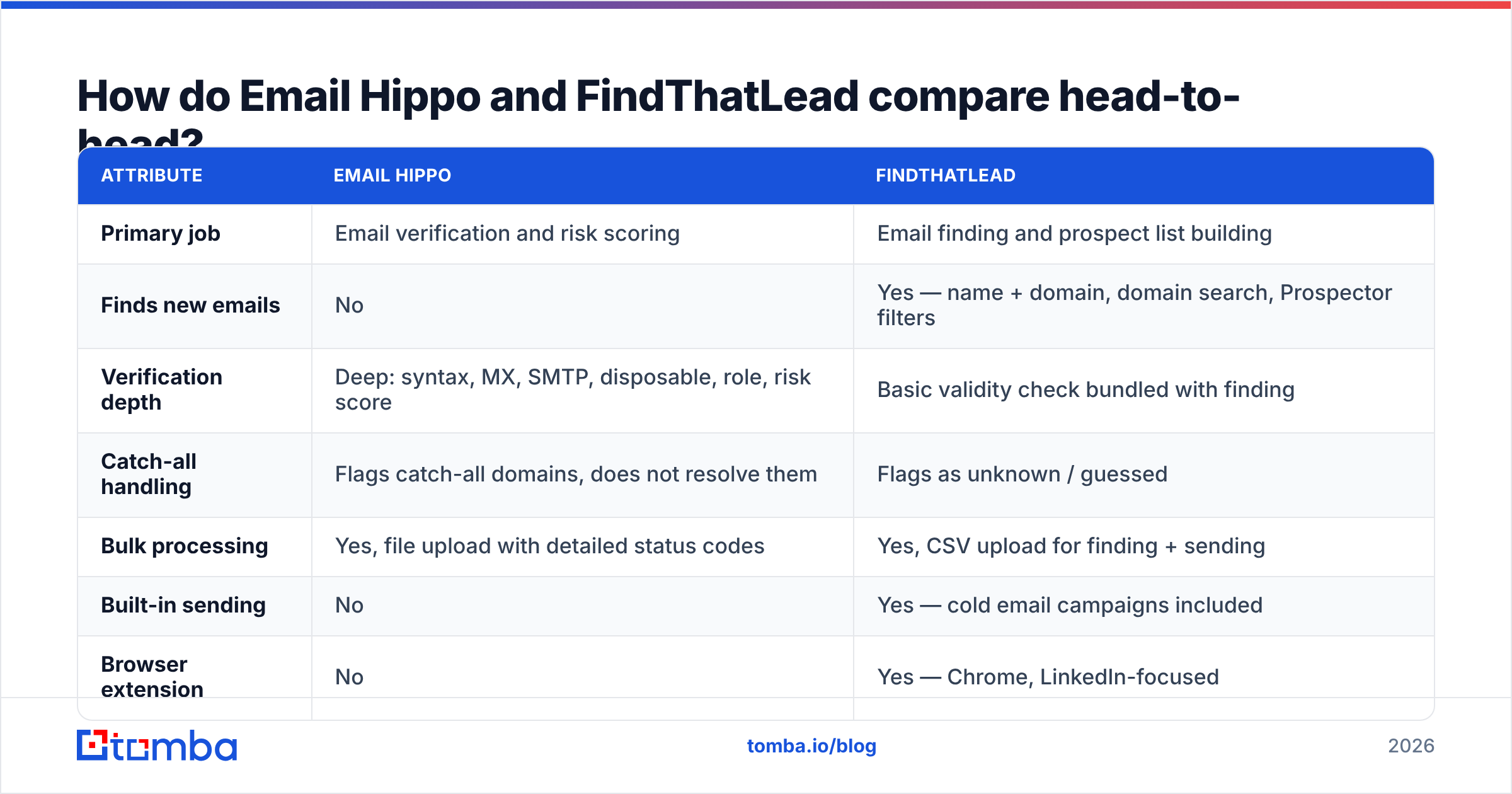
How do Email Hippo and FindThatLead compare head-to-head?#
| Attribute | Email Hippo | FindThatLead |
|---|---|---|
| Primary job | Email verification and risk scoring | Email finding and prospect list building |
| Finds new emails | No | Yes — name + domain, domain search, Prospector filters |
| Verification depth | Deep: syntax, MX, SMTP, disposable, role, risk score | Basic validity check bundled with finding |
| Catch-all handling | Flags catch-all domains, does not resolve them | Flags as unknown / guessed |
| Bulk processing | Yes, file upload with detailed status codes | Yes, CSV upload for finding + sending |
| Built-in sending | No | Yes — cold email campaigns included |
| Browser extension | No | Yes — Chrome, LinkedIn-focused |
| API | Yes, well documented, single and bulk | Yes, narrower surface area |
| Free access | Limited free verifications to trial the service | Limited free credits on signup |
| Best for | Marketers protecting sender reputation | SDRs building lists from scratch |
Read that table as a shopping list rather than a scoreboard. There's no row where both tools are competing on the same job and one clearly wins — the rows where Email Hippo scores high are rows FindThatLead barely plays in, and vice versa.
How accurate is each tool?#
Accuracy means two different things here, and vendors exploit the ambiguity.
For Email Hippo, accuracy means: when it says "deliverable," does the message land? That's a verification-accuracy question, and it's measurable. You take a list of known-good and known-dead addresses, run it, and count how often the verdict matches reality. Email Hippo tends to do well on this because it invests in the hard parts — SMTP conversation handling, greylisting retries, disposable-domain databases, and honest "unknown" verdicts instead of guessing. A verifier that returns "unknown" on a catch-all domain is being truthful, not lazy.
For FindThatLead, accuracy means: when it hands you an address for a person, is that actually their address? That's a discovery-accuracy question, and it's much harder to measure because the tool is often pattern-guessing from a known company format. Finders that lean heavily on permutation logic produce plausible-looking addresses that fail on delivery. Finders that lean on verified sources produce fewer results but survive contact with a real mail server.

The practical consequence: a high hit rate from any finder is meaningless without a verification pass behind it. If you run FindThatLead alone and blast the output, you inherit every pattern guess it made. If you run Email Hippo alone, you have nothing to check because you never sourced anything.
This is exactly why a single platform that does both — find, then verify emails in the same pass — removes a category of error instead of just moving it downstream.
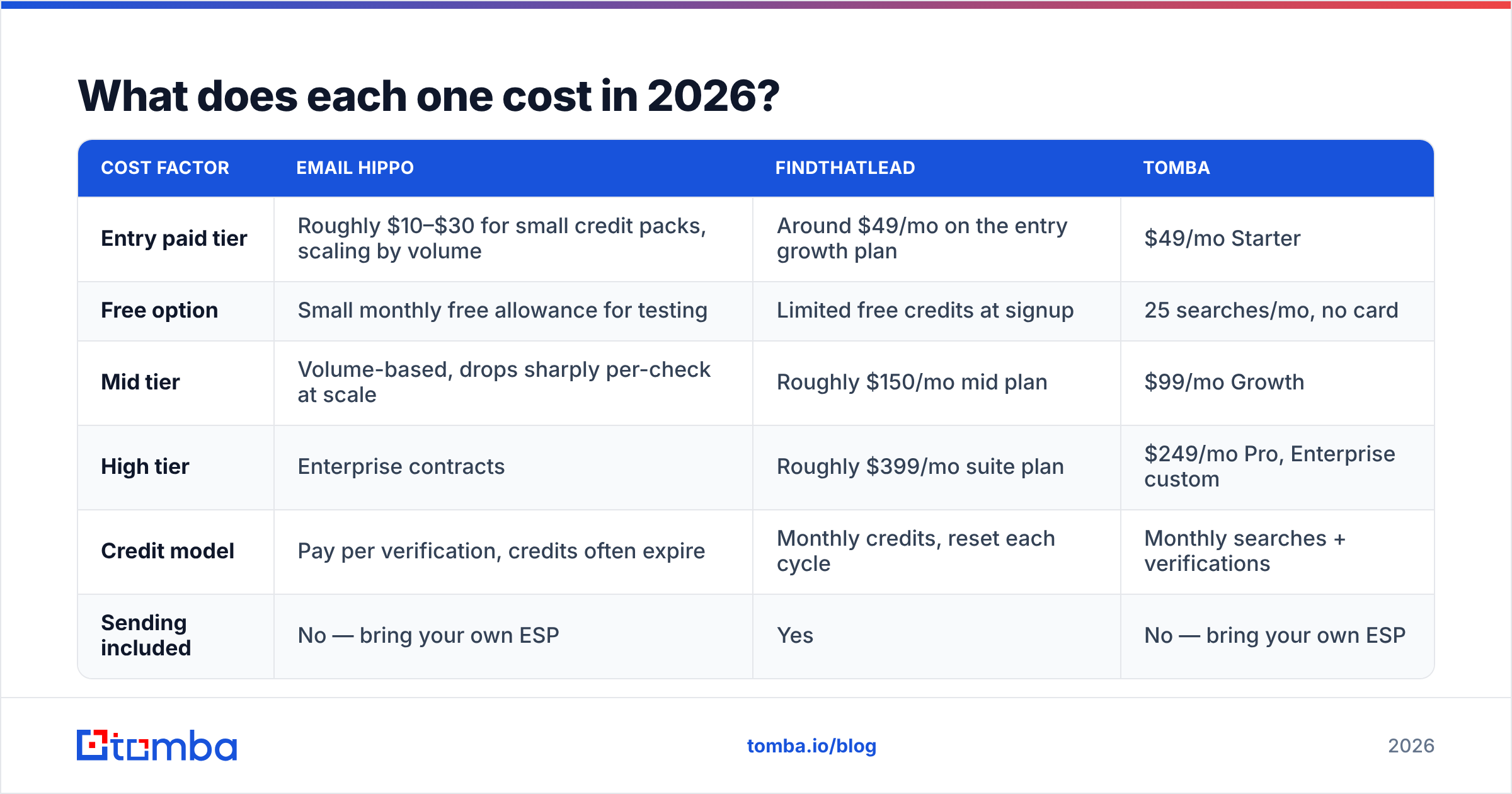
What does each one cost in 2026?#
Pricing on both platforms shifts, and both publish current numbers on their own sites, so treat the shape below as directional and confirm before you buy.
| Cost factor | Email Hippo | FindThatLead | Tomba |
|---|---|---|---|
| Entry paid tier | Roughly $10–$30 for small credit packs, scaling by volume | Around $49/mo on the entry growth plan | $49/mo Starter |
| Free option | Small monthly free allowance for testing | Limited free credits at signup | 25 searches/mo, no card |
| Mid tier | Volume-based, drops sharply per-check at scale | Roughly $150/mo mid plan | $99/mo Growth |
| High tier | Enterprise contracts | Roughly $399/mo suite plan | $249/mo Pro, Enterprise custom |
| Credit model | Pay per verification, credits often expire | Monthly credits, reset each cycle | Monthly searches + verifications |
| Sending included | No — bring your own ESP | Yes | No — bring your own ESP |
The real cost question isn't the sticker price on either plan. It's what happens when you need both jobs. Running FindThatLead for discovery plus Email Hippo for verification means two bills, two credit pools that never line up, and an export-import step in the middle where somebody on your team hand-maps CSV columns every week. Compare that against consolidated Tomba pricing where finding and verifying draw from one plan.
Also watch credit expiry. Pay-as-you-go verification credits that expire after a fixed window are a quiet tax on teams with lumpy list volume — you buy for your biggest month and eat the waste in the quiet ones.
Which tool fits your workflow?#
Pick by the job you actually have in front of you, not by feature count.
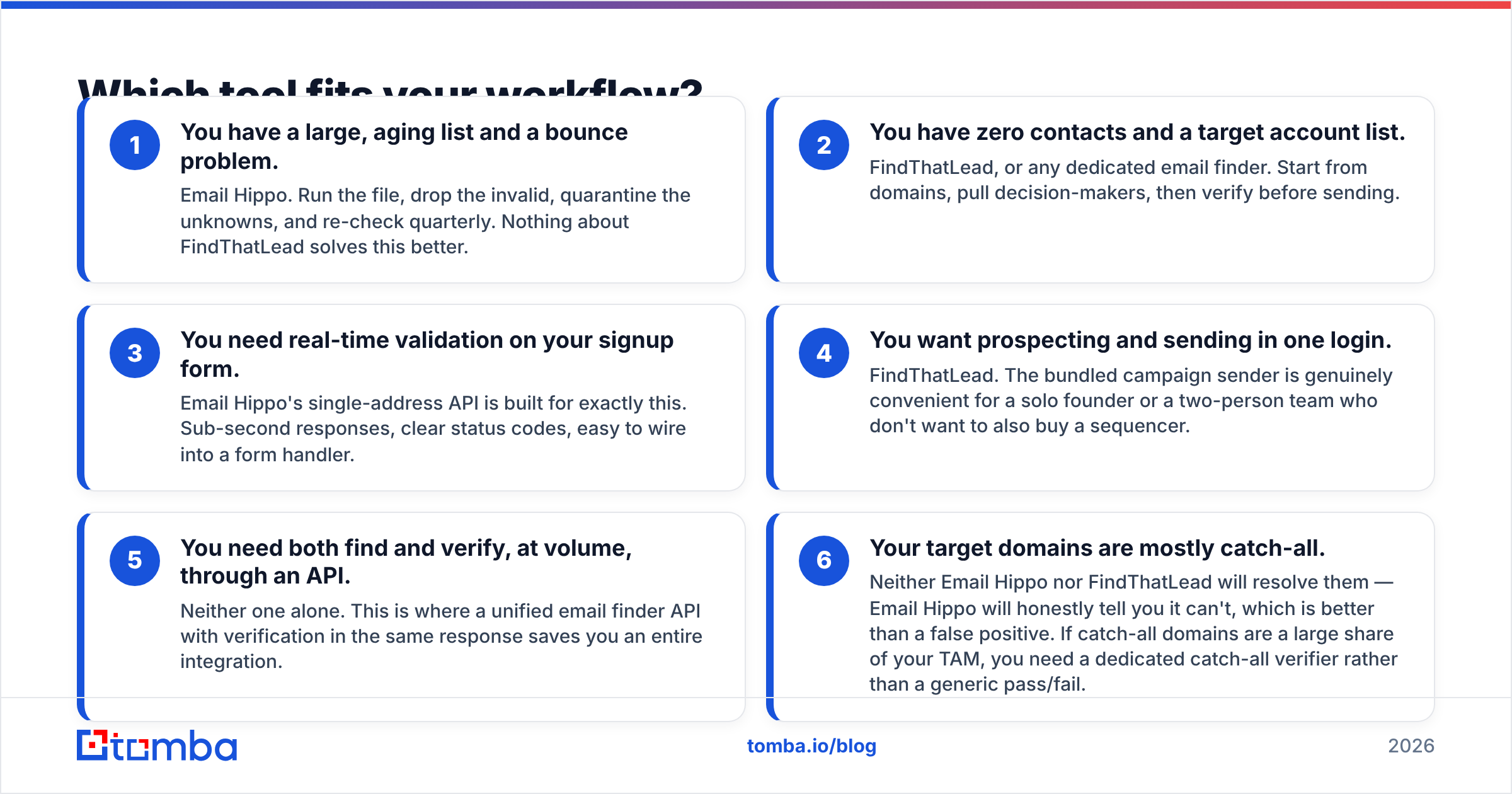
You have a large, aging list and a bounce problem. Email Hippo. Run the file, drop the invalid, quarantine the unknowns, and re-check quarterly. Nothing about FindThatLead solves this better.
You have zero contacts and a target account list. FindThatLead, or any dedicated email finder. Start from domains, pull decision-makers, then verify before sending.
You need real-time validation on your signup form. Email Hippo's single-address API is built for exactly this. Sub-second responses, clear status codes, easy to wire into a form handler.
You want prospecting and sending in one login. FindThatLead. The bundled campaign sender is genuinely convenient for a solo founder or a two-person team who don't want to also buy a sequencer.
You need both find and verify, at volume, through an API. Neither one alone. This is where a unified email finder API with verification in the same response saves you an entire integration.
Your target domains are mostly catch-all. Neither Email Hippo nor FindThatLead will resolve them — Email Hippo will honestly tell you it can't, which is better than a false positive. If catch-all domains are a large share of your TAM, you need a dedicated catch-all verifier rather than a generic pass/fail.
Where does each tool fall short?#
Email Hippo's limits. It doesn't source contacts. It doesn't enrich. It doesn't tell you the CFO's name at a target account. Every workflow built on it assumes a list already arrived from somewhere else, which means Email Hippo is always the second tool in your stack, never the first. The credit-pack model can also feel awkward if your verification volume is spiky rather than steady, and the "unknown" verdicts on catch-all domains — while honest — still leave you with a decision to make and no tooling to make it.
FindThatLead's limits. Its verification is a checkbox, not a discipline. Independent reviews on G2 consistently flag credit consumption and hit-rate variability across regions — European mid-market tends to be its strength, and coverage thins out elsewhere. The bundled sender is convenient but not competitive with dedicated sequencers on deliverability tooling: no serious warmup layer, limited inbox rotation, thinner analytics. If you outgrow it, you're migrating campaigns mid-flight.
What both share. Neither gives you a full contact record. If you need direct dials alongside email, you're adding a third vendor for B2B phone numbers or a data enrichment layer. Neither is a CRM, and both expect you to own the orchestration between steps.
Is there a tool that does both jobs properly?#
Yes — and this is the honest resolution to the email hippo vs findthatlead question for most teams: you probably don't want either as a standalone purchase.

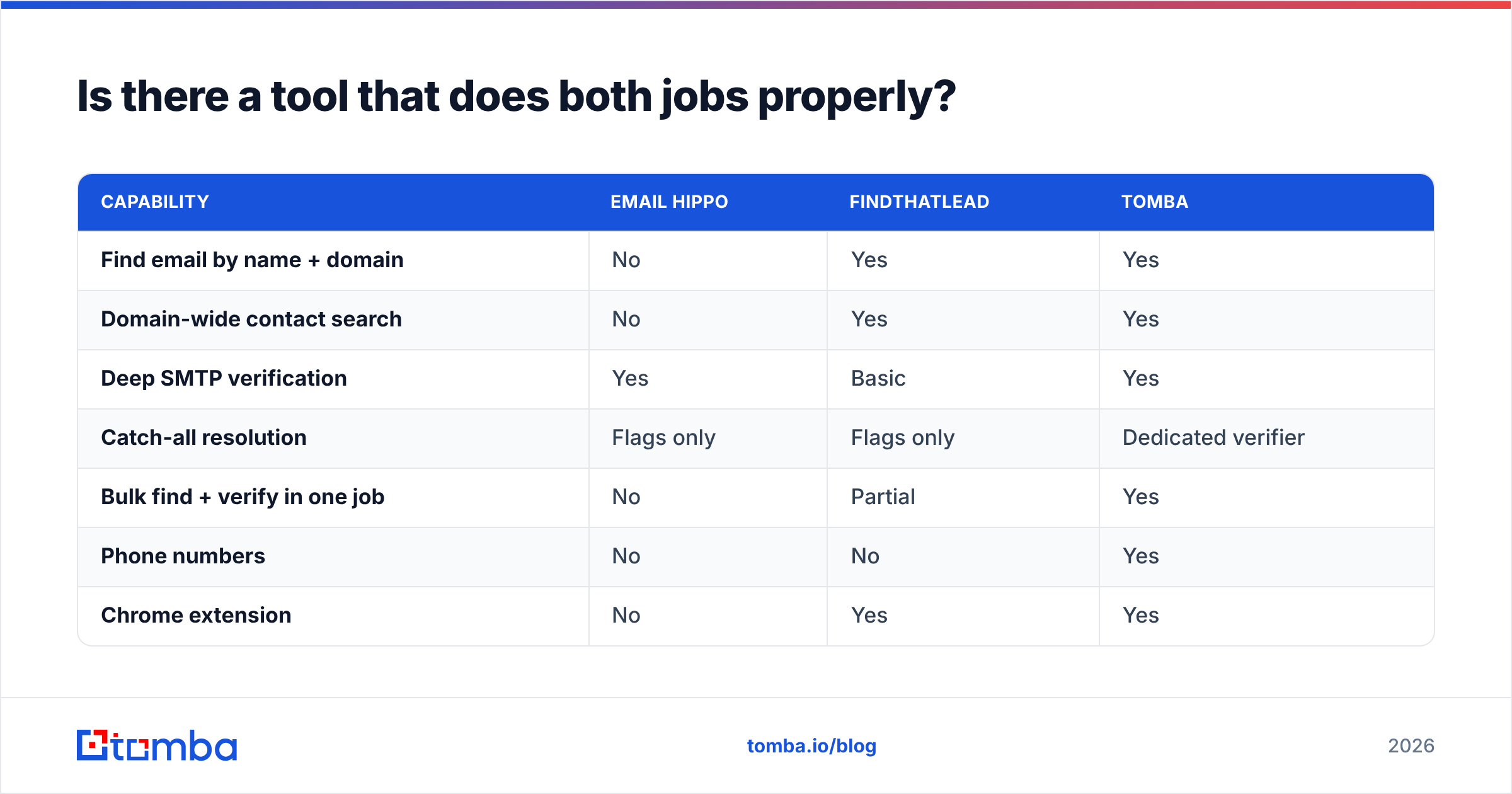
| Capability | Email Hippo | FindThatLead | Tomba |
|---|---|---|---|
| Find email by name + domain | No | Yes | Yes |
| Domain-wide contact search | No | Yes | Yes |
| Deep SMTP verification | Yes | Basic | Yes |
| Catch-all resolution | Flags only | Flags only | Dedicated verifier |
| Bulk find + verify in one job | No | Partial | Yes |
| Phone numbers | No | No | Yes |
| Chrome extension | No | Yes | Yes |
| Sheets / Excel / Airtable add-ons | No | Limited | Yes |
| MCP + CLI access | No | No | Yes |
| Free tier | Small trial allowance | Trial credits | 25 searches/mo |
The consolidation argument is operational, not ideological. Every handoff between tools is a place where a column gets mismapped, a dedupe gets skipped, or a batch gets sent twice. Running discovery and verification through one bulk email finder job removes the handoff entirely, and it means the verification verdict is attached to the address at the moment it's found rather than three days later after it sat in a spreadsheet.
There's also a genuine argument for staying specialized. If you verify tens of millions of addresses a year and nothing else — a large ESP, a marketplace, a data broker — Email Hippo's depth and volume pricing will beat a general-purpose platform. Specialized needs deserve specialized tools. Most sales teams don't have that need.
What should you check before you commit?#
Run the same test on any candidate, including Tomba. Vendors' published hit rates are marketing; your own list is evidence.
- Build a 100-row control set. Fifty addresses you know are live (colleagues, existing customers who reply, your own aliases) and fifty you know are dead (offboarded staff, defunct domains).
- Run it through every tool's free tier. Email Hippo, FindThatLead, and Tomba all give you enough free volume to do this without a card.
- Count false positives, not hit rate. A tool that says "valid" on a dead address costs you sender reputation. A tool that says "unknown" costs you nothing but a decision.
- Test your actual ICP domains. Coverage varies wildly by region and company size. A tool that's excellent on US SaaS can be mediocre on German manufacturing.
- Check the export path. How does the output get into your CRM? If the answer involves a manual CSV every week, price that time into the subscription.
For the discovery half, the same discipline applies. Take twenty target companies, run a domain search on each, and count how many contacts survive verification — not how many the tool returned.
FAQ#
Is Email Hippo better than FindThatLead? For verification, yes, clearly. For finding new contacts, it doesn't compete at all. The comparison only makes sense if you've decided which half of the pipeline you're solving.
Can I use FindThatLead as my only tool? You can, but verify its output before sending. Its bundled validity check is not equivalent to a dedicated verification pass, and pattern-guessed addresses will bounce.
Do I need both? If you're building lists and sending cold, you need both jobs done — which doesn't mean you need both vendors. A combined platform covers the same ground on one bill.
What about catch-all domains? Neither tool resolves them. Both will flag them. If catch-alls are more than a small slice of your target list, budget for a dedicated catch-all solution.
The bottom line#
Stop framing this as Email Hippo vs FindThatLead and start framing it as: which step in my pipeline is leaking? If it's bounces on lists you already own, buy verification depth. If it's an empty pipeline, buy discovery. If it's both — and for most outbound teams it is both — a single platform that finds and verifies in one pass is cheaper and less fragile than stitching two point tools together with a spreadsheet.
Test it against your own control list before you decide. The Tomba Email Finder gives you 25 searches a month free with no card, so you can run your fifty-good/fifty-dead set through it in an afternoon and see how it stacks against whatever you're using now. If it wins on your data, Starter is $49/mo with verification included in the same plan — no second subscription, no CSV round-trip.
Related guides#
Ready to find emails that actually work?
Join 150,000+ professionals who stopped guessing and started sending. Free credits on signup — no credit card required.
Get the Tomba newsletter
Practical outbound tactics and product updates — once every two weeks.
About the author