Email Hippo vs Listkit (2026): Which One Should You Buy?
Email Hippo verifies addresses you already have. Listkit sells you addresses you don't. Here's an honest breakdown of pricing, accuracy, and which one actually belongs in your outbound stack in 2026.
TL;DR
- Email Hippo and Listkit solve different problems. Email Hippo is a verification engine that grades addresses you already own. Listkit is a lead database that hands you contacts you don't own yet.
- If your bounce rate is the problem, Email Hippo (or any dedicated verifier) is the fix. If your list is empty, a verifier does nothing for you.
- Listkit's appeal is speed: filter, export, load into a sequencer. The trade-off is that you inherit whatever the underlying database believes about a person, and B2B data decays roughly 25-30% per year.
- Most teams that run both end up paying twice for overlapping coverage. A single provider that finds and verifies (Tomba's email finder plus email verifier, starting at $49/mo) usually costs less than the two-tool stack.
- Verdict: buy Email Hippo if verification depth is your bottleneck, buy Listkit if you need volume lists fast, and buy neither if what you actually need is targeted, on-demand email discovery.
What is Email Hippo and what does it actually do?#
Email Hippo is a UK-based email verification company. Its whole business is answering one question: will this address accept mail? It does that through syntax checks, DNS and MX record lookups, disposable-domain detection, role-account flagging, and SMTP-level mailbox probing, then returns a status plus a confidence score.
The product line splits into a few pieces. There's a free single-address checker for one-off lookups, a bulk uploader for CSV lists, and a real-time API for validating addresses at the point of capture — signup forms, checkout flows, CRM entry. That last use case is where verifiers earn their keep, because catching a typo at the form beats cleaning it out of a database six months later.
What Email Hippo does not do is give you contacts. It has no prospecting database, no company filters, no "show me every VP of Marketing at Series B SaaS companies." You bring the list. It tells you which parts of the list are garbage. You can see the current scope on emailhippo.com.
What is Listkit and who is it built for?#
Listkit came out of the agency-led cold email world and is built for people who send a lot of email. It's a B2B contact database: you filter by industry, headcount, job title, technology, location, and revenue, then export a list of contacts with emails and, on higher tiers, phone numbers. Its marketing leans hard on "triple-verified" data, meaning contacts are run through verification before they reach your export.
The pitch is workflow compression. Instead of building a list in one tool, enriching in a second, verifying in a third, and sequencing in a fourth, you do the first three in one place. Recent versions have added sequencing and AI-assisted persona targeting, pushing it closer to an all-in-one outbound platform. Details are on listkit.io, and user reviews across both tools are worth skimming on G2 before you commit to an annual plan.
The buyer profile is different from Email Hippo's. Listkit sells to founders, agencies, and SDR teams who need net-new contacts weekly. Email Hippo sells to marketing ops, RevOps, and developers who need list hygiene and form-level validation.
How do Email Hippo and Listkit compare head-to-head?#
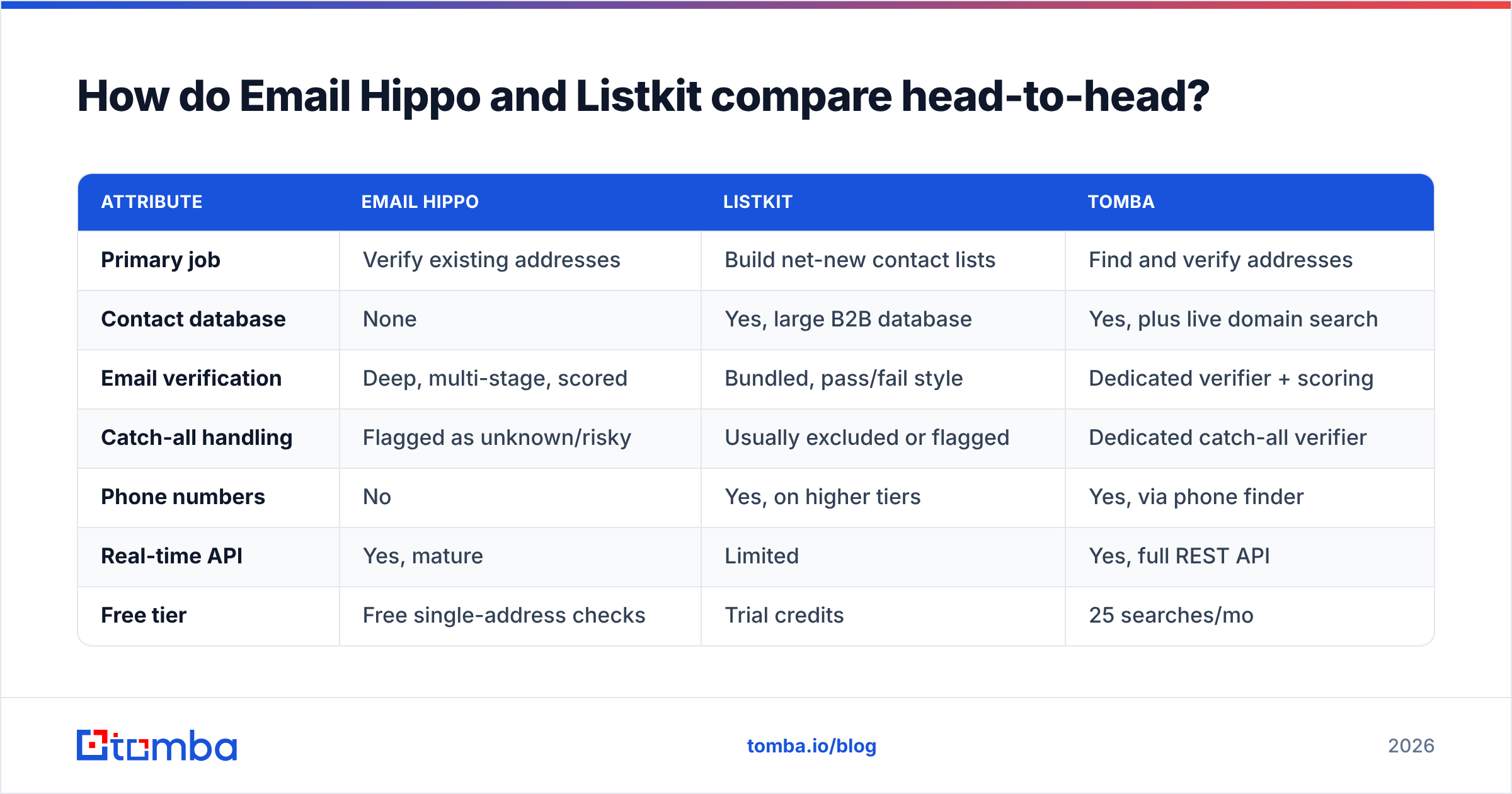
Here's the honest structural comparison. Note how little overlap there actually is:
| Attribute | Email Hippo | Listkit | Tomba |
|---|---|---|---|
| Primary job | Verify existing addresses | Build net-new contact lists | Find and verify addresses |
| Contact database | None | Yes, large B2B database | Yes, plus live domain search |
| Email verification | Deep, multi-stage, scored | Bundled, pass/fail style | Dedicated verifier + scoring |
| Catch-all handling | Flagged as unknown/risky | Usually excluded or flagged | Dedicated catch-all verifier |
| Phone numbers | No | Yes, on higher tiers | Yes, via phone finder |
| Real-time API | Yes, mature | Limited | Yes, full REST API |
| Free tier | Free single-address checks | Trial credits | 25 searches/mo |
| Entry price | Roughly $89 per bulk credit pack | Roughly $97/mo | $49/mo Starter |
| Best for | Form validation, list hygiene | Volume list building | Targeted finding + hygiene |

Pricing on both platforms shifts, and credit definitions differ (Email Hippo charges per verification, Listkit charges per exported contact). Always confirm against the vendor's live pricing page before budgeting. The numbers above are directional, not contractual.
Which one gives you better data accuracy?#
They're measuring different things, so "accuracy" means two different things here.
For Email Hippo, accuracy means: when it says deliverable, is it deliverable? Dedicated verifiers built on SMTP probing typically land in the 95-98% range on standard business domains. The failure mode isn't false positives — it's the "unknown" bucket. Catch-all domains, greylisting servers, and aggressive spam filters all return ambiguous responses, and a verifier that refuses to guess will hand you a large unknown pile you still have to make a judgment call on.
For Listkit, accuracy means: is this the right person, at the right company, at the right address, today? That's a harder problem, and it degrades with time. Contact records go stale as people change jobs. Any database-first tool — Listkit, Apollo, Lusha, ZoomInfo, or the well-regarded BookYourData, which sells verified lists with a bounce guarantee — is fighting the same decay curve. The difference between vendors is how aggressively they re-verify.

The practical implication: a database export that was verified 90 days ago is not the same as an address verified this morning. If you're buying on the "triple-verified" claim, ask when the last verification pass ran, not just how many passes there were.

What does each one actually cost in 2026?#
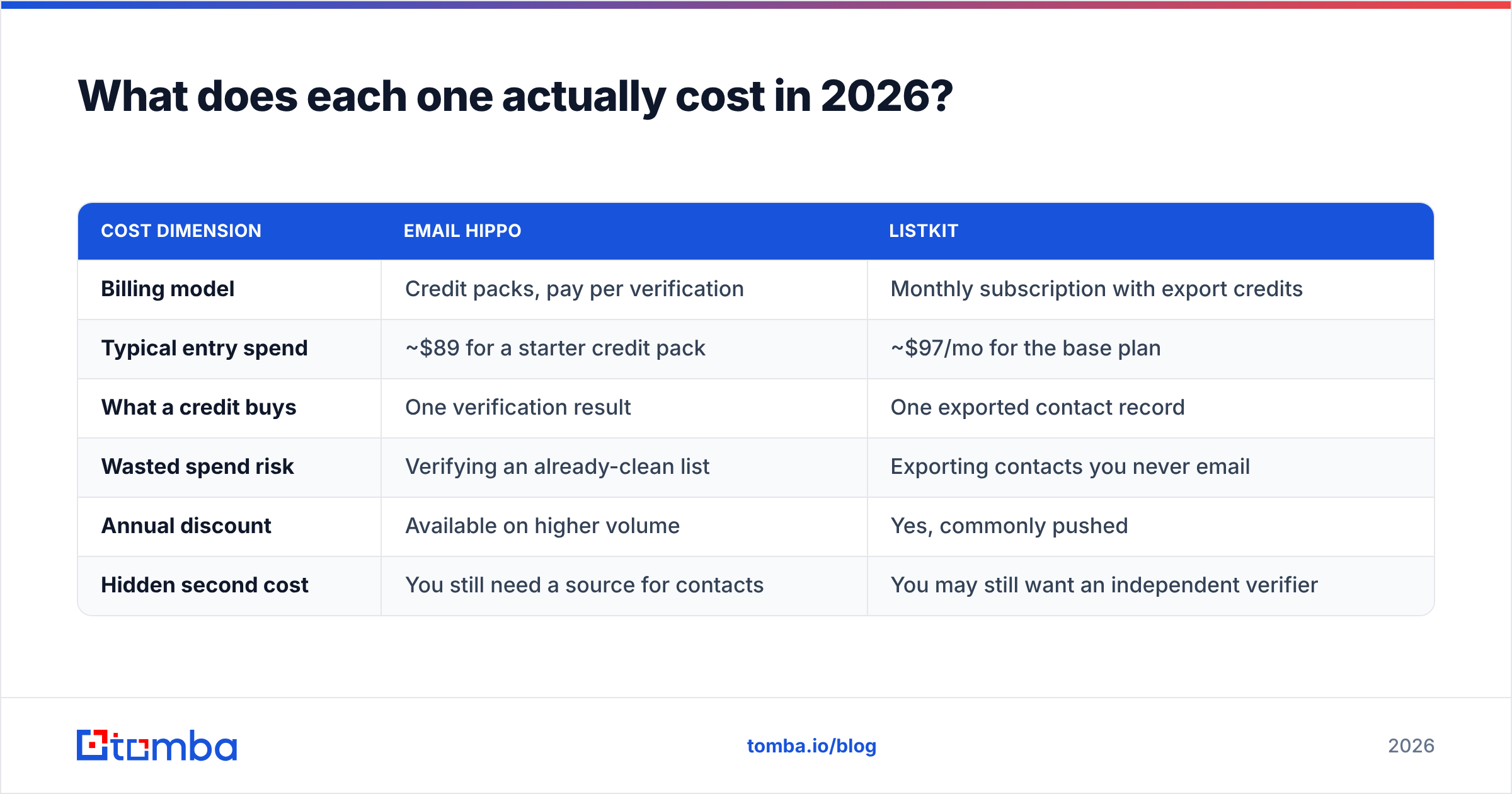
Cost comparisons between these two are apples-to-oranges unless you normalize on outcome: dollars per usable, sent-to contact.
| Cost dimension | Email Hippo | Listkit |
|---|---|---|
| Billing model | Credit packs, pay per verification | Monthly subscription with export credits |
| Typical entry spend | ~$89 for a starter credit pack | ~$97/mo for the base plan |
| What a credit buys | One verification result | One exported contact record |
| Wasted spend risk | Verifying an already-clean list | Exporting contacts you never email |
| Annual discount | Available on higher volume | Yes, commonly pushed |
| Hidden second cost | You still need a source for contacts | You may still want an independent verifier |
That last row is the whole story. Email Hippo customers usually also pay a prospecting tool. Listkit customers who care about deliverability usually also pay a verifier, because trusting a single vendor's self-reported hygiene is how you end up on a blocklist. Either path ends in a two-line invoice.
For comparison, Tomba pricing runs Free (25 searches/mo), Starter $49/mo, Growth $99/mo, Pro $249/mo, and Enterprise custom — with finding, verification, catch-all verification, and enrichment on the same credit pool. That single-pool model is the main structural argument against buying two specialists.
Where does each tool fit in a real outbound stack?#
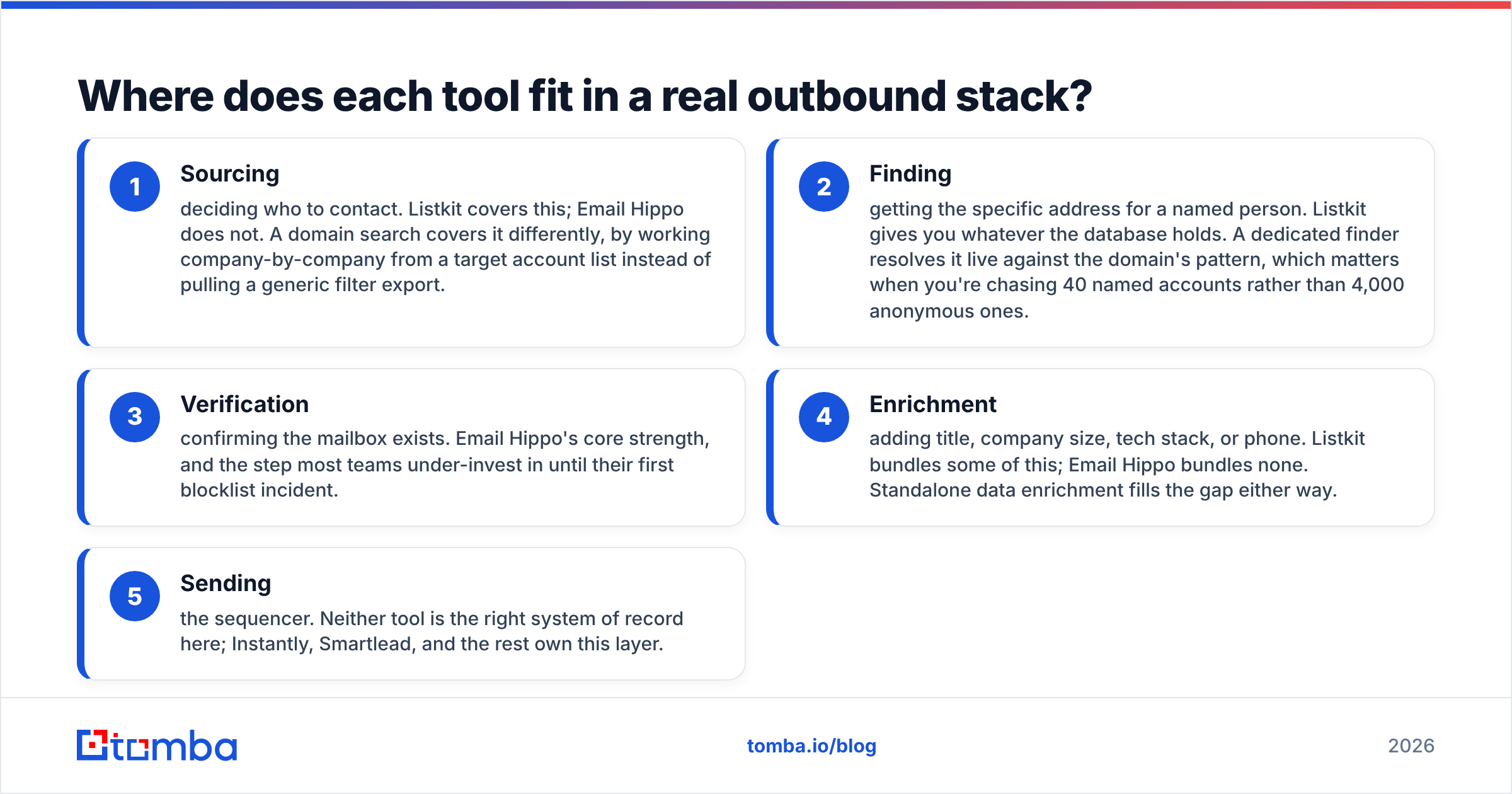
Think of it like building a kitchen. Email Hippo is a very good thermometer. Listkit is a grocery delivery service. Neither one cooks. Here's how the pieces line up:
- Sourcing — deciding who to contact. Listkit covers this; Email Hippo does not. A domain search covers it differently, by working company-by-company from a target account list instead of pulling a generic filter export.
- Finding — getting the specific address for a named person. Listkit gives you whatever the database holds. A dedicated finder resolves it live against the domain's pattern, which matters when you're chasing 40 named accounts rather than 4,000 anonymous ones.
- Verification — confirming the mailbox exists. Email Hippo's core strength, and the step most teams under-invest in until their first blocklist incident.
- Enrichment — adding title, company size, tech stack, or phone. Listkit bundles some of this; Email Hippo bundles none. Standalone data enrichment fills the gap either way.
- Sending — the sequencer. Neither tool is the right system of record here; Instantly, Smartlead, and the rest own this layer.
Map your actual bottleneck to that list before you buy. Teams routinely buy a verifier when their real problem is that they have no target account list, or buy a database when their real problem is that their existing 40,000-row CRM has never been cleaned.
Is a database export better than live email finding?#
Depends entirely on how you sell.
Volume outbound — you're sending thousands of emails a month to a broad ICP, and the cost of a wrong contact is near zero. A database export wins. Filter, export, send, iterate on the segment that replies.
Targeted outbound — you have a named account list of 50-500 companies, deal sizes justify research, and contacting the wrong person burns the account. Live finding wins. You want the address for that VP at that company, resolved and verified right now, not whatever the database captured last quarter.
Most teams claim to be the second and behave like the first. Be honest about which you are, because the tooling answer flips completely.
There's also a middle path that people under-use: build the target list manually or from an export, then run every address through a bulk email finder and verifier before it ever touches your sequencer. That way, database freshness stops being your problem — you re-resolve everything at send time.

How should you handle catch-all domains?#
This is where both tools get uncomfortable, and it's worth its own section because catch-all domains are now a meaningful share of B2B mail servers.
A catch-all domain accepts mail to any address, valid or not. SMTP verification can't distinguish a real mailbox from a made-up one, so a strict verifier returns "unknown" and a permissive database quietly ships the address as verified. Both behaviors are wrong for different reasons.
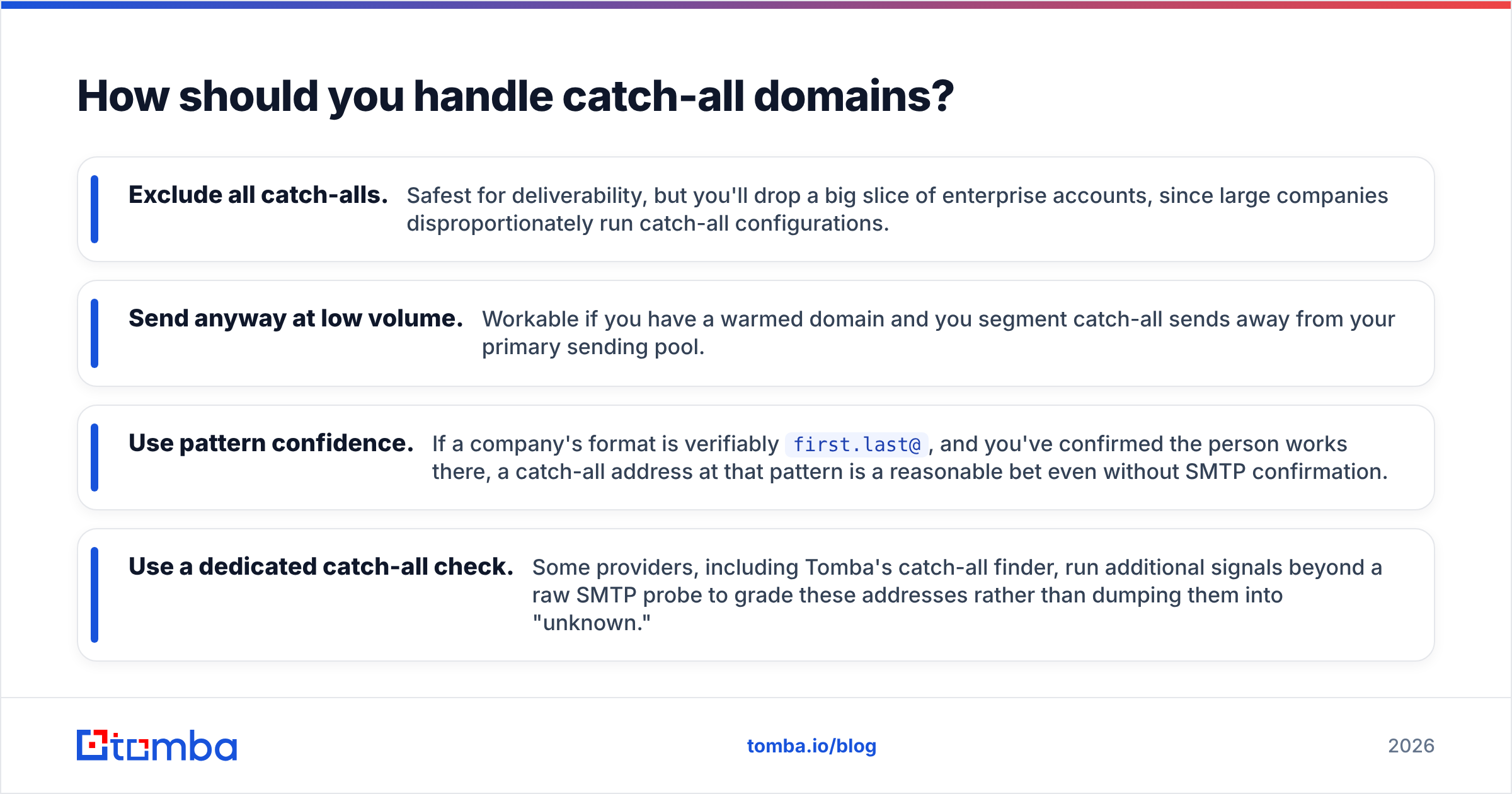
Your options:
- Exclude all catch-alls. Safest for deliverability, but you'll drop a big slice of enterprise accounts, since large companies disproportionately run catch-all configurations.
- Send anyway at low volume. Workable if you have a warmed domain and you segment catch-all sends away from your primary sending pool.
- Use pattern confidence. If a company's format is verifiably
first.last@, and you've confirmed the person works there, a catch-all address at that pattern is a reasonable bet even without SMTP confirmation. - Use a dedicated catch-all check. Some providers, including Tomba's catch-all finder, run additional signals beyond a raw SMTP probe to grade these addresses rather than dumping them into "unknown."
Whatever you choose, decide it deliberately. The default behavior of your tool is making this call for you right now, and you probably don't know which way it's ruling.
Is Email Hippo or Listkit better for deliverability?#
Email Hippo, straightforwardly — but with a caveat that matters.
Verification protects deliverability by removing hard bounces, which are the fastest way to torch sender reputation. A dedicated verifier with a mature scoring model and an "unknown" category you can act on gives you more control than a bundled pass/fail flag.
The caveat: verification is necessary, not sufficient. A perfectly clean list sent from an unauthenticated domain with a bad SPF record and no warmup still lands in spam. Verification removes one failure mode. Authentication, warmup, volume ramping, and content quality handle the rest. If your reply rate is bad but your bounce rate is already under 2%, buying a verifier will not fix anything.
Which should you actually buy?#
Short answers, by situation:
- You have a big, aging CRM or marketing list. Buy verification. Email Hippo is a solid, mature choice, and any competent verifier will get you most of the way there for less.
- You have no list and need pipeline this quarter. Buy the database. Listkit is fast and priced for small teams, and it will get contacts into your sequencer today.
- You have a named target account list. Buy neither. You need on-demand finding against specific domains, not a bulk filter export or a hygiene tool.
- You're stacking both and the invoice hurts. Consolidate. Two specialists at ~$90-100 each is $190+/mo for capabilities that overlap by design.
- You're a developer wiring this into a product. Buy on API quality. Email Hippo's real-time API is genuinely good for form validation. If you also need finding, you want a single API surface for both.
The uncomfortable truth is that the "Email Hippo vs Listkit" framing is a false choice for most buyers. They're complements, not competitors, and the real decision is whether you want to run a two-vendor stack or a single provider that covers finding, verification, catch-all grading, and enrichment on one credit pool and one API key.
Ready to stop paying two vendors for one workflow?#
If your bottleneck is finding the right address for the right person, then knowing it's real, start with the Tomba Email Finder. It resolves addresses live against a company's actual email pattern, runs verification on the same credits, grades catch-all domains instead of shrugging at them, and plugs into your CRM, Sheets, or codebase through one API. The free tier gives you 25 searches a month to test against your own target accounts — run 20 contacts through it and through whatever you're paying for now, then compare bounce rates before you renew anything.
Related guides#
Ready to find emails that actually work?
Join 150,000+ professionals who stopped guessing and started sending. Free credits on signup — no credit card required.
Get the Tomba newsletter
Practical outbound tactics and product updates — once every two weeks.
About the author