Email Hippo vs RocketReach (2026): Which One Should You Pick?
One verifies emails you already have. The other finds contacts you don't. Here's how Email Hippo and RocketReach actually compare on accuracy, pricing, and coverage in 2026 — and when neither is the right buy.
Email Hippo vs RocketReach is an odd matchup. One tool checks emails you already have. The other finds emails you don't. This guide compares both on accuracy, real pricing, and coverage — and says when neither one is worth buying.
TL;DR
- Email Hippo vs RocketReach is not a fair fight, because the two tools do different jobs. Email Hippo is a verification engine: will this address bounce? RocketReach is a discovery engine: who works here, and what is their email?
- Got a list already — CRM exports, form fills, bought data? Email Hippo is the cheaper, tighter buy. You pay per credit. There are no seat licences.
- Need to build lists from scratch? RocketReach has 700M+ profiles and a Chrome extension. But you pay per seat, and annual deals hurt small teams.
- Buy both and you run two vendors, two credit systems, and two accuracy problems. One find-and-verify platform usually costs less than the pair.
- Both vendors grade their own homework. Test 200 of your own contacts first. Then sign nothing longer than a month.
Email Hippo vs RocketReach: what does each tool do?#
They solve two halves of the same problem. That split drives every other point in this post.
Email Hippo is a UK email verification specialist. You give it an address. It checks the syntax, looks up DNS and MX records, opens an SMTP handshake, spots throwaway domains, and flags role accounts like info@. Then it hands back a status and a confidence score.
It sells two things. One is a bulk uploader for one-off list cleaning. The other is a live API called MORE, which teams drop into signup forms and CRMs. There is no contact database. It cannot tell you who runs marketing at a company.
RocketReach is the mirror image. It runs a huge people database — the company claims around 700 million profiles and 35 million companies. You search by name, title, company, location, or skill.
You get work emails, personal emails, and phone numbers. A browser extension pulls the same data while you sit on a LinkedIn profile. RocketReach does check the addresses it returns. But checking is a side feature here, not the product.
So the honest framing of Email Hippo vs RocketReach is one question. Are you cleaning data you own, or buying data you don't?

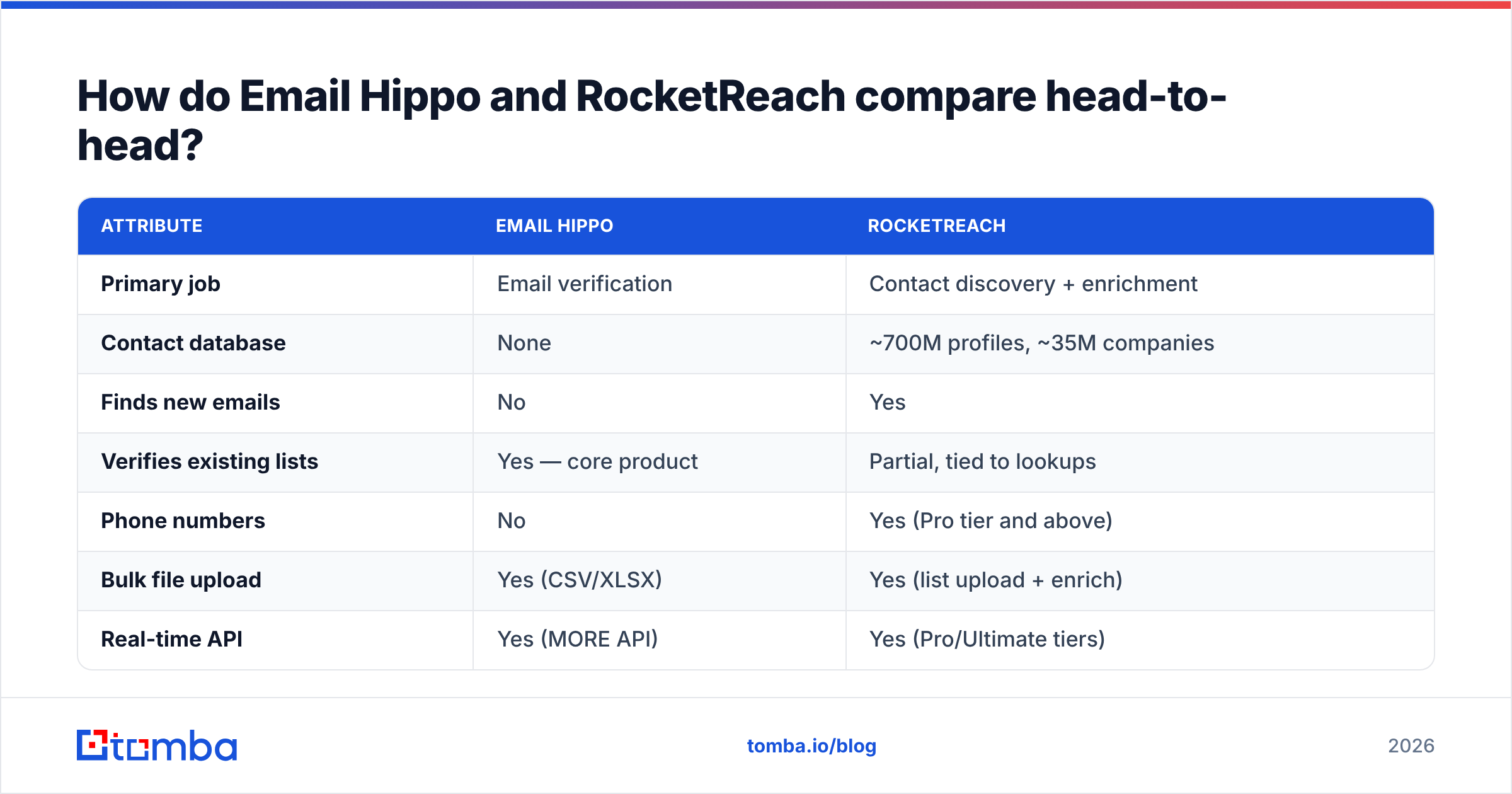
Email Hippo vs RocketReach: the head-to-head table#
| Attribute | Email Hippo | RocketReach |
|---|---|---|
| Primary job | Email verification | Contact discovery + enrichment |
| Contact database | None | ~700M profiles, ~35M companies |
| Finds new emails | No | Yes |
| Verifies existing lists | Yes — core product | Partial, tied to lookups |
| Phone numbers | No | Yes (Pro tier and above) |
| Bulk file upload | Yes (CSV/XLSX) | Yes (list upload + enrich) |
| Real-time API | Yes (MORE API) | Yes (Pro/Ultimate tiers) |
| Chrome extension | No | Yes |
| Pricing model | Credit packs / pay-as-you-go | Per-seat subscription, annual discount |
| Free option | Small trial allotment | Limited free lookups per month |
| Best for | Data hygiene, signup-form gating | SDRs and recruiters building lists |
| Weak spot | Cannot source anything | Cost scales badly with headcount |
Read that table twice before you compare price tags. A verification credit and a lookup credit are not the same unit of value. That is why "which is cheaper" is the wrong opening question.
Email Hippo vs RocketReach: which one is more accurate?#
Accuracy means different things here. Judge each tool on the metric that matches its job.
For Email Hippo, accuracy means bounce prediction. Of the addresses it marks "ok", how many actually land? Email Hippo posts a high pass rate. Like most verifiers, it does well on normal company domains, where the mail server answers straight.
Catch-all domains are the weak spot — for Email Hippo and for every rival. They accept every address at the SMTP layer and give nothing away. Email Hippo returns those as "unverifiable" instead of guessing. That is honest. It is also annoying, because you end up with a pile of maybes and no decision.
For RocketReach, accuracy means something else. Is this the right person's real email? The failure mode is not a hard bounce. It is a clean-looking address for someone who left the job 18 months ago.
Big databases go stale fast. Roughly 2-3% of records rot each month as people change roles. A profile that has not been re-checked in a year is a coin flip. RocketReach reviews praise the coverage and knock the stale records. Check the current review distribution on G2 rather than any vendor's own number, including the ones quoted here.

Here is the practical point. A finder's stated accuracy and a verifier's stated accuracy are not the same measure. Run RocketReach output through an independent email verifier. If 12% comes back invalid, that is the number your sender reputation cares about. The homepage claim is not.
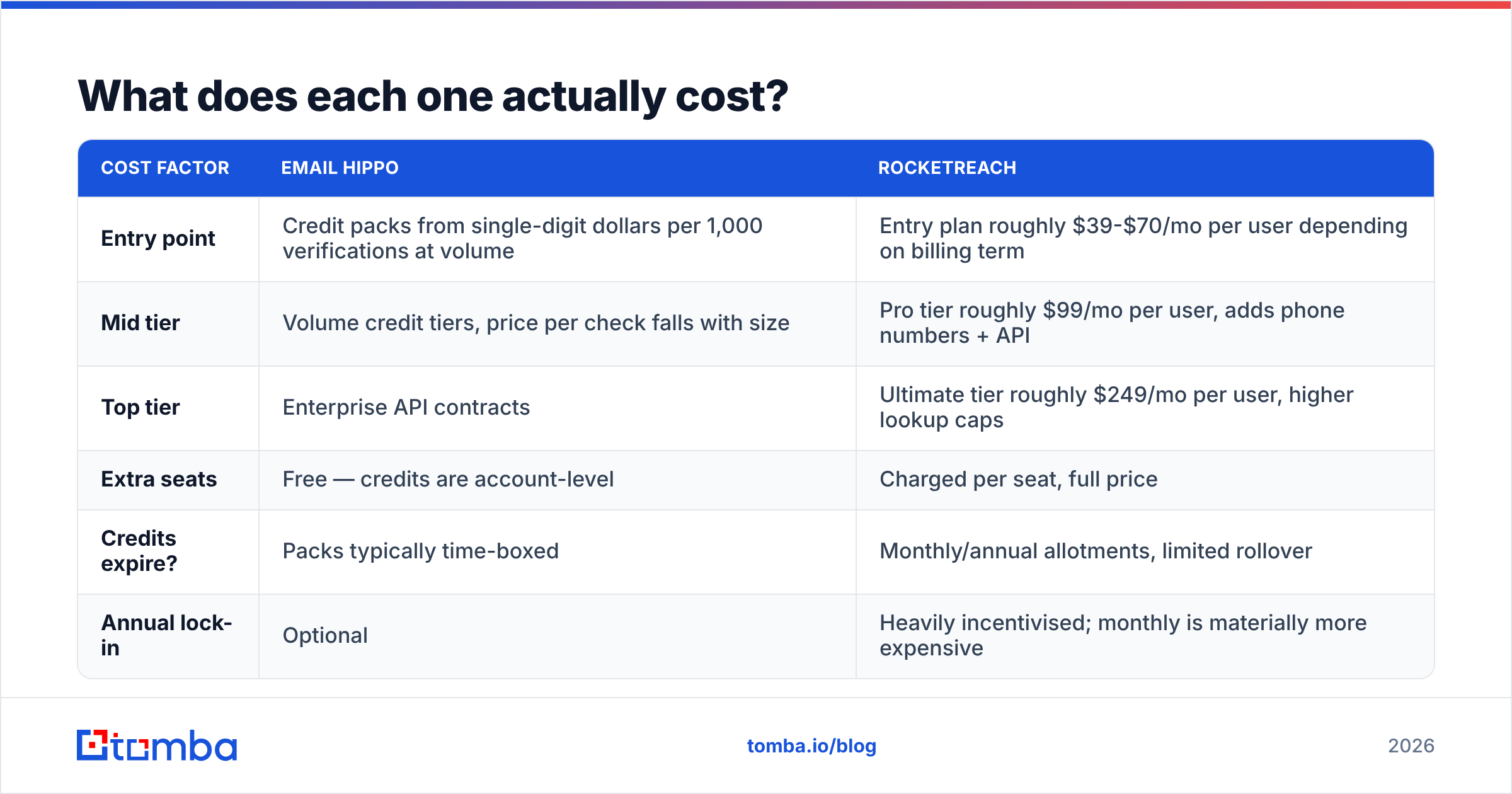
Email Hippo vs RocketReach pricing: what does each one cost?#
Both vendors change prices often. Treat these figures as directional and confirm before you buy.
| Cost factor | Email Hippo | RocketReach |
|---|---|---|
| Entry point | Credit packs from single-digit dollars per 1,000 verifications at volume | Entry plan roughly $39-$70/mo per user depending on billing term |
| Mid tier | Volume credit tiers, price per check falls with size | Pro tier roughly $99/mo per user, adds phone numbers + API |
| Top tier | Enterprise API contracts | Ultimate tier roughly $249/mo per user, higher lookup caps |
| Extra seats | Free — credits are account-level | Charged per seat, full price |
| Credits expire? | Packs typically time-boxed | Monthly/annual allotments, limited rollover |
| Annual lock-in | Optional | Heavily incentivised; monthly costs a lot more |
Here is where teams get burned. RocketReach's headline price is per user. A four-person SDR pod on the Pro tier is not $99 a month. It is closer to $400. And the cheap number on the pricing page assumes a twelve-month commitment.
Email Hippo works the other way. Credits sit in one pool. Seats do not matter. A team of one pays the same rate per check as a team of twenty. If your usage is spiky — a big list clean in January, nothing in February — the credit model wins outright.
So the Email Hippo vs RocketReach price question is about shape, not size. Steady daily prospecting favours seats. Occasional bulk work favours credits.
Compare both against Tomba pricing. Starter is a flat $49/mo, Growth is $99/mo, and Pro is $249/mo. The free tier gives 25 searches a month. Finding and verifying share one credit pool, so you get one invoice instead of two.
Which tool fits which job?#
Pick by workflow, not by feature count. Most of the Email Hippo vs RocketReach debate ends right here.
- Cleaning an inherited CRM of 80,000 contacts — Email Hippo. Upload the file, pay per check, close the account when you are done. Nobody needs a seat licence for a one-week job.
- Gating signup forms in real time — Email Hippo's MORE API. It answers in under a second, blocks throwaway domains, and returns a score you can threshold on. RocketReach is not built for this.
- Building a list of 300 heads of RevOps in fintech — RocketReach. Search by title and industry, export, done. Email Hippo has nothing to search.
- Recruiting: personal emails and mobile numbers — RocketReach. Personal contact coverage is one of its strongest areas. Few verify-only vendors touch it.
- Domain-level prospecting ("everyone at these 40 companies") — Neither one alone. A domain search returns every address at a domain, already verified, and folds two steps into one.
- API-first automation inside your own product — Both offer APIs. Check rate limits and per-call prices closely. RocketReach puts API access behind higher tiers, which changes the real cost of adding enrichment.

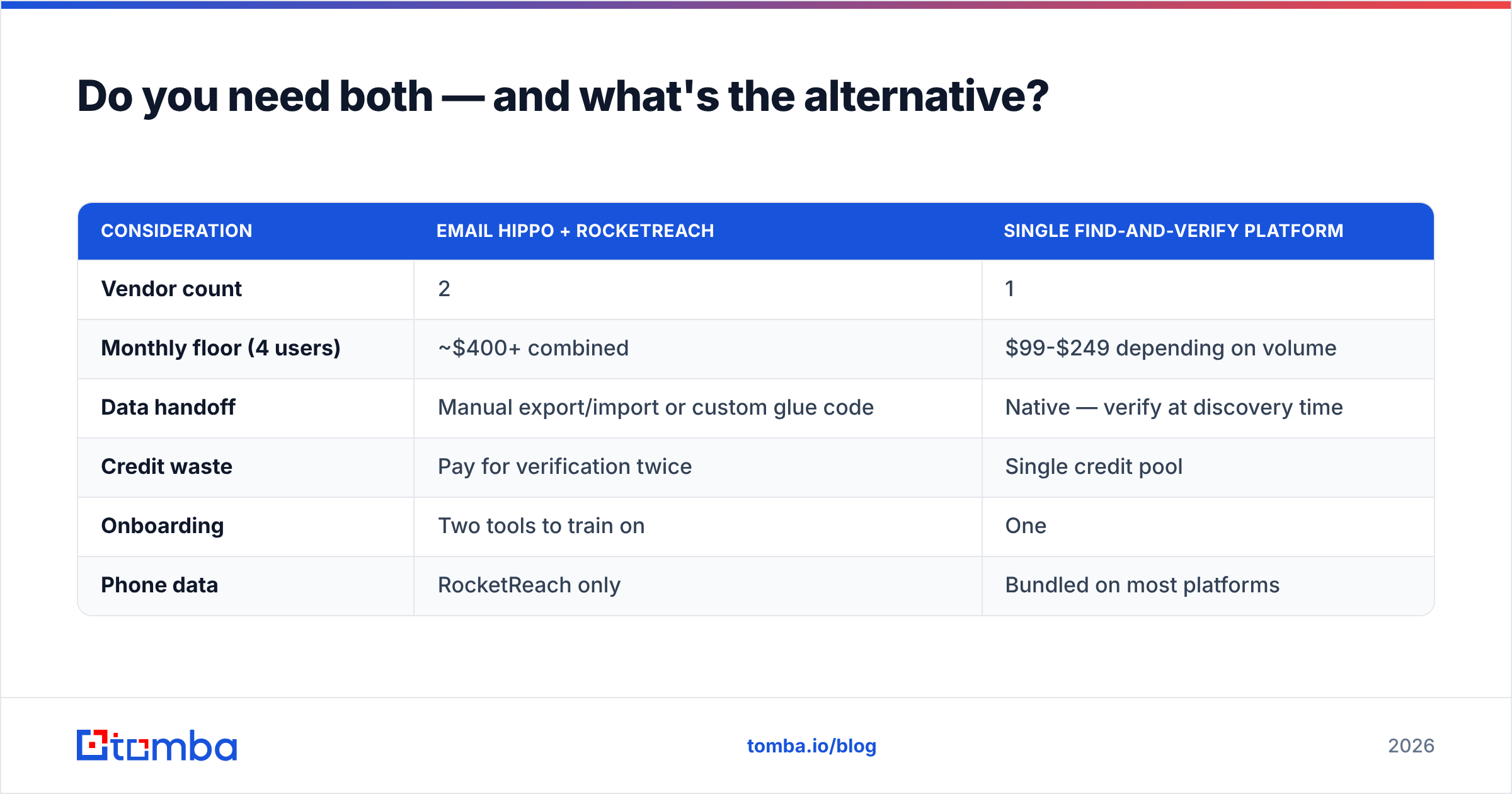
Do you need both — and what's the alternative?#
The real answer to Email Hippo vs RocketReach may be neither. To run outbound well you need what both tools do. Discovery without checking creates bounces. Checking without discovery gives you a very clean list of nobody.
Running both means two contracts, two credit currencies, and two support queues. It also means a manual export-import step that someone will forget. And you pay twice for the same work, because RocketReach validates on the way out and Email Hippo validates on the way in.
The other route is one platform that finds and verifies in a single pass. Tomba, Hunter, Findymail, Apollo, and BookYourData all sit in that space, each with a different centre of gravity. BookYourData is worth a look if you would rather buy a filtered, pre-verified list outright. That is a different purchase model, and it suits teams who want data delivered rather than discovered.

| Consideration | Email Hippo + RocketReach | Single find-and-verify platform |
|---|---|---|
| Vendor count | 2 | 1 |
| Monthly floor (4 users) | ~$400+ combined | $99-$249 depending on volume |
| Data handoff | Manual export/import or custom glue code | Native — verify at discovery time |
| Credit waste | Pay for verification twice | Single credit pool |
| Onboarding | Two tools to train on | One |
| Phone data | RocketReach only | Bundled on most platforms |
Catch-all addresses are the biggest hole in Email Hippo's output. A dedicated catch-all verifier clears a good share of the addresses a plain SMTP check gives up on. The rest stop landing in an "unknown" bucket you never open again.
What should you check before you commit?#
Run this five-point test before any annual contract. It takes an afternoon.
- Sample your own data, not theirs. Take 200 contacts you already know the truth about. Feed them to both tools. Count real hits, not confidence scores.
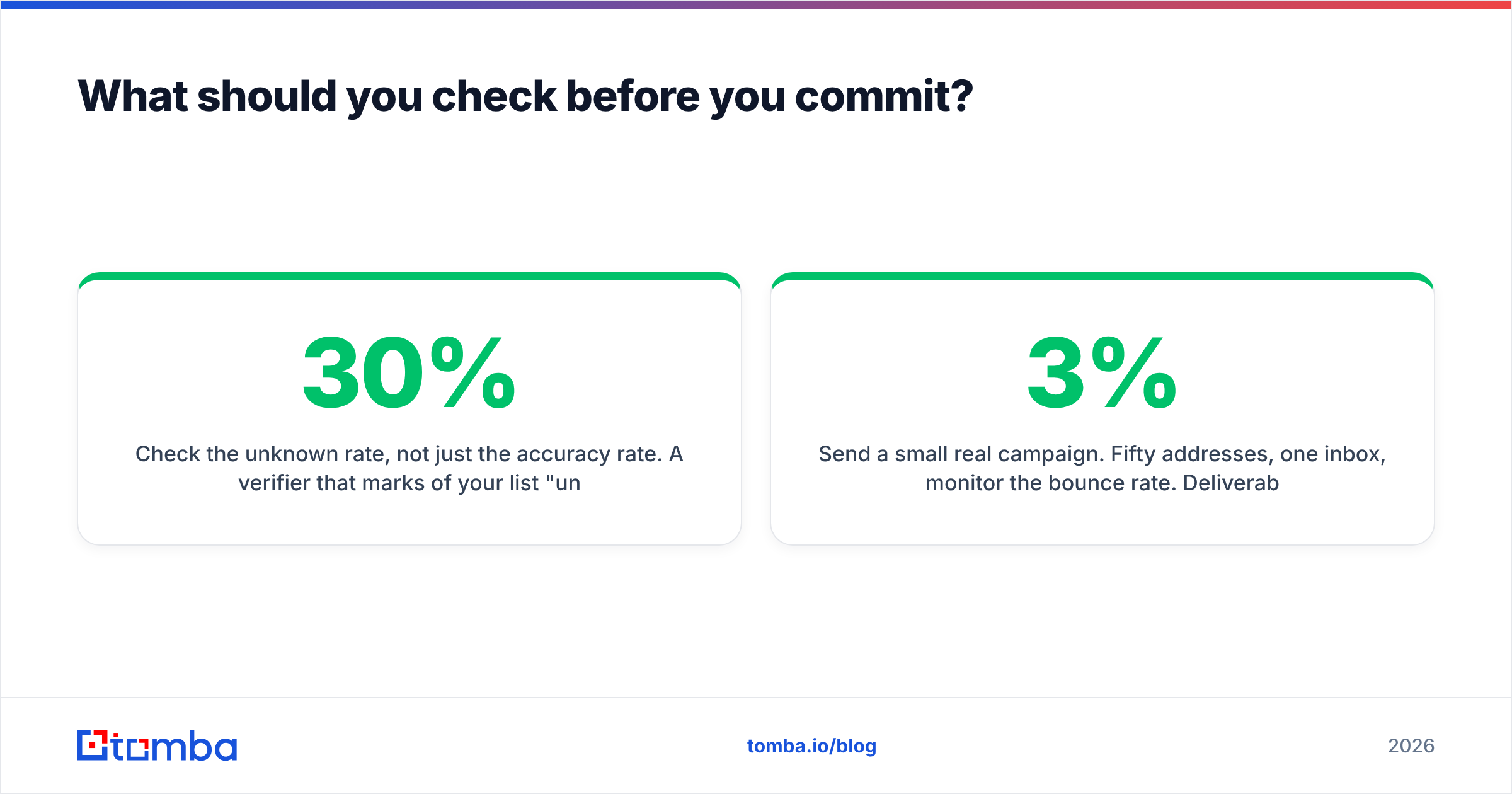
- Watch the unknown rate, not just the accuracy rate. A verifier that marks 30% of your list "unverifiable" and is 99% right on the rest has done 70% of the job.
- Send one small real campaign. Fifty addresses, one inbox, watch the bounces. Anything above 3% hard bounces starts to hurt your sender reputation.
- Price the seat you will add in month four. Not the seat you have today. Per-seat plans punish growth.
- Read the credit expiry terms. Credits that vanish at month-end are a discount that is not a discount.
Email Hippo vs RocketReach: which one wins?#
There is no single winner. They are not playing the same sport. But there are clear verdicts by scenario.
Choose Email Hippo if your problem is list hygiene. You have the contacts. You don't trust them. You want a focused, credit-based tool with no seat licences. The API is solid, the scoring is clear, and it refuses to guess on catch-alls — a feature if you value precision over volume.
Choose RocketReach if your problem is sourcing. It shines for recruiting, and when personal emails and mobile numbers matter. Coverage is broad, and the extension fits LinkedIn work. Budget for seats, and re-check anything older than a few months.
Choose neither if you are a small outbound team that needs both halves. Two subscriptions for one workflow is how tool sprawl starts. The combined bill usually beats a single platform that finds and verifies in the same call.
If the Email Hippo vs RocketReach choice feels like buying half a solution twice, start with the Tomba Email Finder. Search by domain, name, or company. Verification comes in the same request, not bolted on later. Test it on 25 free searches a month before you spend a cent. Starter is $49/mo with pooled credits — no per-seat maths, no second invoice, and no manual export between the tool that finds and the tool that checks.
Related guides#
Ready to find emails that actually work?
Join 150,000+ professionals who stopped guessing and started sending. Free credits on signup — no credit card required.
Get the Tomba newsletter
Practical outbound tactics and product updates — once every two weeks.
About the author