Email Hippo vs Warpleads (2026): Which One Should You Buy?
One verifies emails you already have. The other sells you emails in bulk. Here is the honest breakdown of Email Hippo vs Warpleads — pricing, accuracy, data freshness, and when you need neither.
TL;DR
- Email Hippo and Warpleads are not competitors. Email Hippo validates email addresses you already own; Warpleads sells you addresses in bulk. Comparing them head-to-head only makes sense because both end up as line items on the same outbound budget.
- Pick Email Hippo if your problem is bounce rate: you have a list, an ESP screaming at you, and you need a defensible verification layer with an API.
- Pick Warpleads if your problem is volume: you need thousands of exportable B2B contacts per month and you are comfortable doing your own verification pass afterward.
- Buying both is the common outcome — and it is usually more expensive than one platform that finds, enriches, and verifies in a single credit pool.
- Neither tool solves the hard case: catch-all domains, which are roughly a third of B2B mail servers and where most "verified" lists quietly rot.
What are Email Hippo and Warpleads?#
Email Hippo is a UK-based email verification company that has been around since the early 2010s. Its products split into two lanes: real-time API verification (used at signup forms and inside apps) and bulk list cleaning (upload a CSV, get a scored file back). It does not find email addresses. It tells you whether the ones you have will bounce.
Warpleads is a much newer B2B lead-data platform built around one loud promise: unlimited exports. Instead of metering you per contact, its headline plans let you pull large volumes of B2B leads out of a database and drop them into your sequencer. It is a supply-side tool — the pitch is quantity and export freedom, not forensic validation.
So the real question is not "which is better." It is: is your bottleneck data quality or data quantity? Answer that and the choice makes itself.
How do Email Hippo and Warpleads compare on paper?#
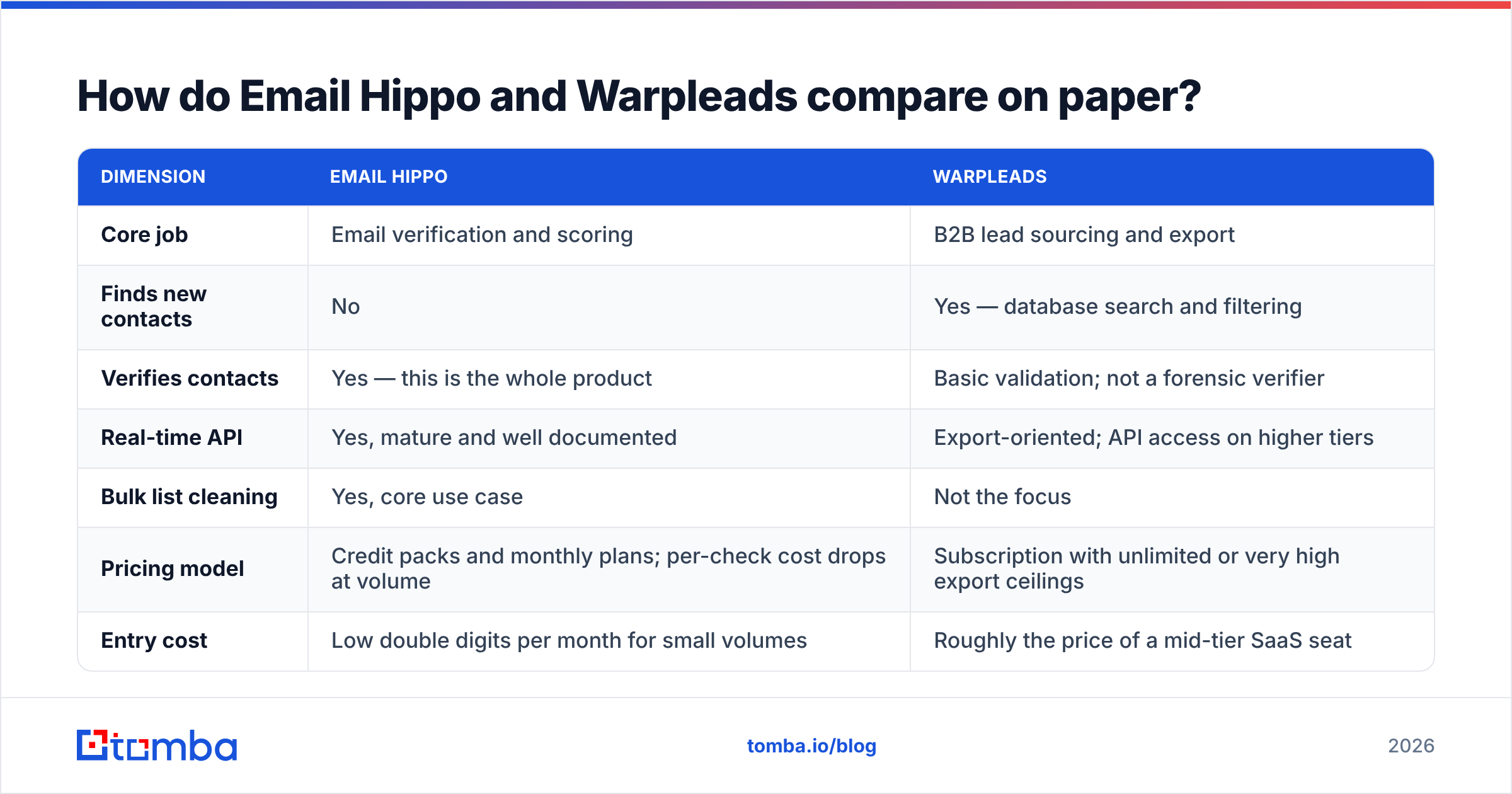
Here is the structural comparison. Note that vendor pricing shifts frequently — treat the figures as directional and confirm on each vendor's own pricing page before you buy.
| Dimension | Email Hippo | Warpleads |
|---|---|---|
| Core job | Email verification and scoring | B2B lead sourcing and export |
| Finds new contacts | No | Yes — database search and filtering |
| Verifies contacts | Yes — this is the whole product | Basic validation; not a forensic verifier |
| Real-time API | Yes, mature and well documented | Export-oriented; API access on higher tiers |
| Bulk list cleaning | Yes, core use case | Not the focus |
| Pricing model | Credit packs and monthly plans; per-check cost drops at volume | Subscription with unlimited or very high export ceilings |
| Entry cost | Low double digits per month for small volumes | Roughly the price of a mid-tier SaaS seat |
| Best fit | Teams with a list and a bounce problem | Teams with budget and a volume problem |
| Weakest point | Gives you nothing new to email | Data freshness varies; verification still your job |
Read that table again and the overlap is almost zero. The only place they meet is your outbound spreadsheet — one fills the rows, the other cleans them.
Which one is more accurate, and what does accuracy even mean here?#
"Accuracy" means two different things depending on which vendor is saying it, and this is where most buyers get burned.
For a verifier like Email Hippo, accuracy means: of the addresses we marked as deliverable, what percentage actually delivered? That is a measurable, falsifiable claim. Good verifiers land in the mid-to-high 90s on non-catch-all domains.
For a lead database like Warpleads, accuracy means: of the contacts in our export, what percentage are real, current, and reachable? That number is a function of how recently the record was refreshed — and job-change churn in B2B runs roughly 20–30% annually depending on the role. A database record that was perfect eighteen months ago is now a bounce.

The practical implication: verifying a stale export tells you the mailbox exists. It does not tell you the person still works there. You can pass an address as "valid" and still send a pitch to someone who left the company last spring — the mailbox is a catch-all or a shared alias, the mail delivers, and nobody replies. That is why raw deliverability scores flatter every vendor in this category.
If reply rate matters more to you than bounce rate, prioritise freshness of sourcing over depth of validation. If your domain reputation is already damaged, invert that.
What does each tool actually cost you per usable contact?#
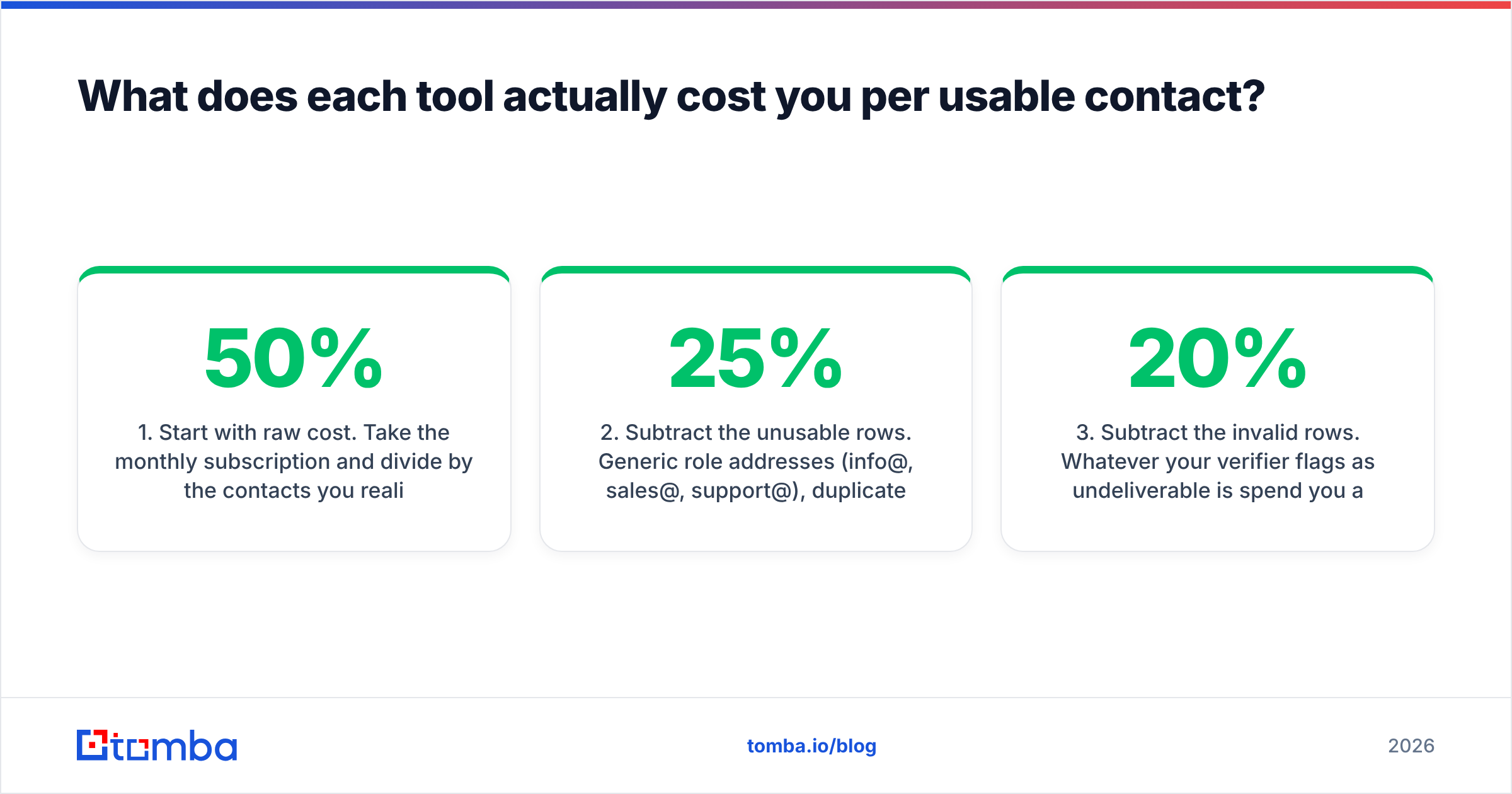
Sticker price is misleading. What matters is cost per contact you can safely email. Work it out in four steps:
- Start with raw cost. Take the monthly subscription and divide by the contacts you realistically pull or clean in a month — not the plan ceiling. Most teams use 30–50% of an "unlimited" allowance.
- Subtract the unusable rows. Generic role addresses (info@, sales@, support@), duplicates, and out-of-ICP records routinely eat 15–25% of a bulk export. Deduplicate before you count — a remove duplicates pass takes thirty seconds and changes the arithmetic.
- Subtract the invalid rows. Whatever your verifier flags as undeliverable is spend you already made and cannot use. On a cold third-party list this is often 8–20%.
- Add the second tool. If you bought a database and a verifier, both subscriptions divide into the same surviving row count. This is the step buyers forget, and it is usually where a two-vendor stack loses to a single platform.
Run those four steps honestly and a "cheap" unlimited-export plan plus a per-check verifier frequently lands north of what a single find-and-verify platform charges — before anyone has sent an email.
When should you choose Email Hippo?#
Email Hippo earns its place in a specific set of situations:
- You have a large in-house list going stale. Years of webinar signups, trial users, and CRM records that nobody has touched. A bulk clean before you re-engage is straightforward risk reduction.
- You need form-level validation. Blocking disposable and malformed addresses at signup is a real-time API job, and this is the kind of workload the product was built for.
- You are in a compliance-sensitive market. A UK/EU-based vendor with documented processing is easier to defend to a security reviewer than a lead broker with vague sourcing.
- Your bounce rate is already over 3%. At that point your problem is not more leads. It is email deliverability, and you fix that before you scale sends.
Where it disappoints: it will never hand you a new prospect. It is a filter, not a faucet. Teams that buy verification hoping it will fix a weak pipeline are solving the wrong half of the equation.
When should you choose Warpleads?#
- You run high-volume outbound and your sequencer is starving. If you burn through 10,000+ contacts a month, per-credit pricing punishes you and export-unlimited pricing looks rational.
- Your ICP is broad. Wide filters over a large database work well. Narrow, technical, or non-US ICPs are where generic databases thin out fast.
- You already own a verification step. Warpleads assumes you will clean what you export. If you do not have that step, you are effectively sending unverified third-party data — the fastest way to torch a sending domain.
- You value predictable billing. A flat monthly fee with a huge ceiling is easier to forecast than variable credits, even if the effective per-contact cost is not actually lower.
Where it disappoints: verification depth and the catch-all problem. Which brings us to the part neither vendor likes to discuss.
Why do catch-all domains break both tools?#
A catch-all domain accepts mail to every address at that domain, real or invented. Send to notarealperson@company.com and the server says yes. Roughly a third of business domains are configured this way, and the share is higher among enterprises.
For a verifier, catch-alls return "unknown" or "accept-all" — a shrug. For a database, catch-alls mean pattern-guessed addresses look valid when they were never real. Both tools return a green light on a record that may not exist.
The only reliable handling is a dedicated resolution layer that goes beyond SMTP handshake — cross-referencing the pattern against known-good records for that domain, checking whether the specific mailbox appears in verified sources, and scoring confidence rather than returning a binary. Tomba's catch-all verifier exists specifically because the SMTP-only approach cannot answer this, and pretending otherwise is how "98% verified" lists still bounce at 9%.
Ask any vendor you are evaluating one question: what do you return on an accept-all domain, and how do you score it? The answer separates serious data platforms from wrappers around an SMTP check.
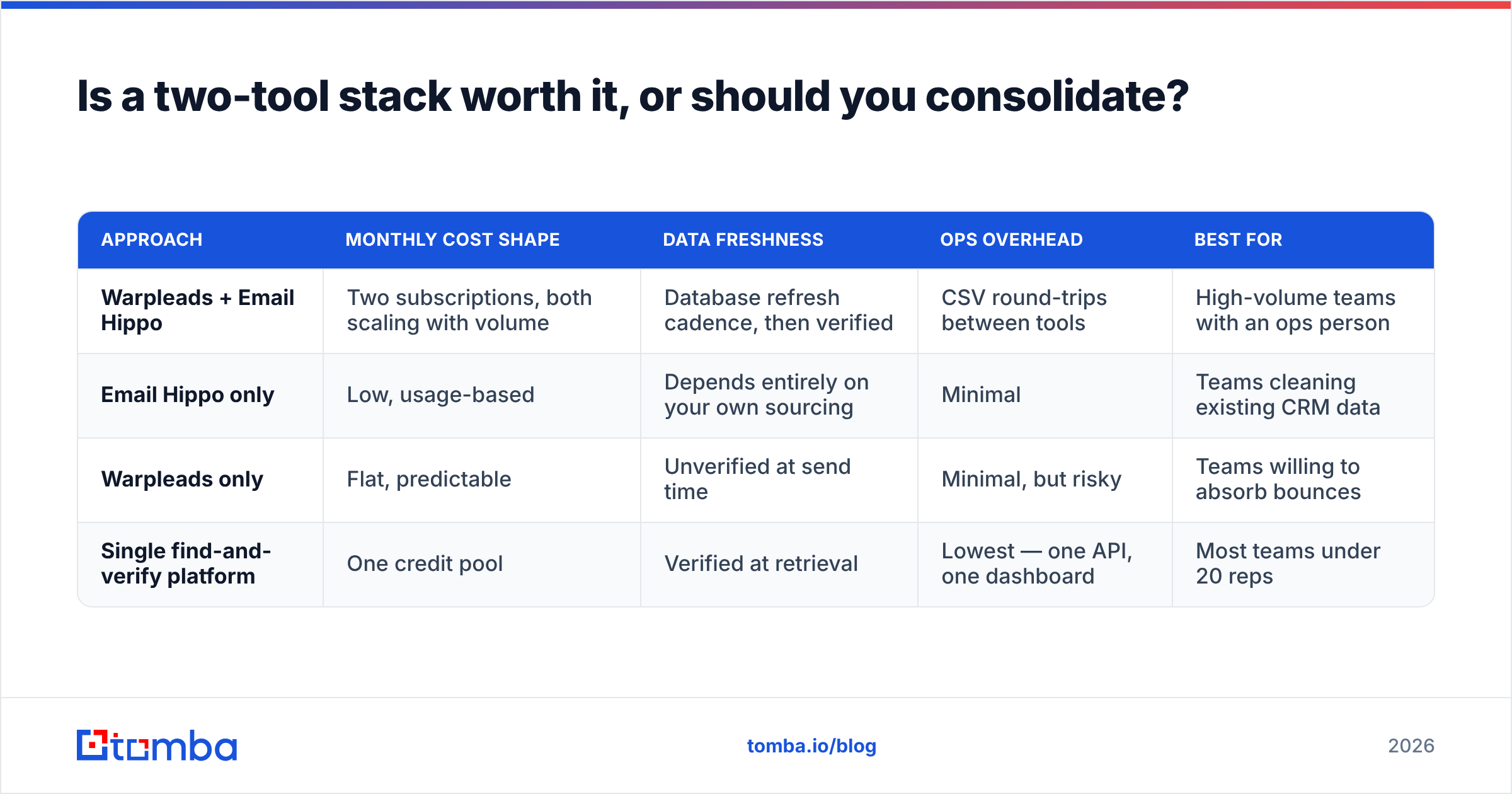
Is a two-tool stack worth it, or should you consolidate?#

Here is the honest version of the consolidation argument, with the trade-offs included.
| Approach | Monthly cost shape | Data freshness | Ops overhead | Best for |
|---|---|---|---|---|
| Warpleads + Email Hippo | Two subscriptions, both scaling with volume | Database refresh cadence, then verified | CSV round-trips between tools | High-volume teams with an ops person |
| Email Hippo only | Low, usage-based | Depends entirely on your own sourcing | Minimal | Teams cleaning existing CRM data |
| Warpleads only | Flat, predictable | Unverified at send time | Minimal, but risky | Teams willing to absorb bounces |
| Single find-and-verify platform | One credit pool | Verified at retrieval | Lowest — one API, one dashboard | Most teams under 20 reps |

The two-tool stack is genuinely correct in one scenario: you have engineering resources, you are running a real-time signup validation flow and a separate high-volume outbound motion, and those workloads have different reliability requirements. Then specialised vendors make sense.
For everyone else — which is most B2B teams under about twenty reps — the CSV shuttle between a database and a verifier is unpaid labour. You export, upload, wait, download, re-import, and reconcile. Do that weekly and you have invented a part-time job.
Where does Tomba fit in this comparison?#
Straightforwardly: Tomba covers both jobs from one credit pool, and it is stronger on the sourcing-plus-verification loop than on standalone form validation.
The email finder resolves a name and domain to a work address and verifies it at retrieval, so the "is this deliverable" question is answered before the contact reaches your sequencer. Domain search pulls every discoverable address at a company with department and seniority filters — closer to the Warpleads use case, though Tomba indexes for precision rather than raw export volume. The standalone email verifier handles the Email Hippo use case for lists you already own, including bulk uploads.
Where Tomba is not the better answer: if you need tens of thousands of unfiltered contacts a month and genuinely do not care about per-record confidence, a flat-fee unlimited-export vendor will be cheaper per row. That is a real trade-off, and volume-first teams should take it seriously.
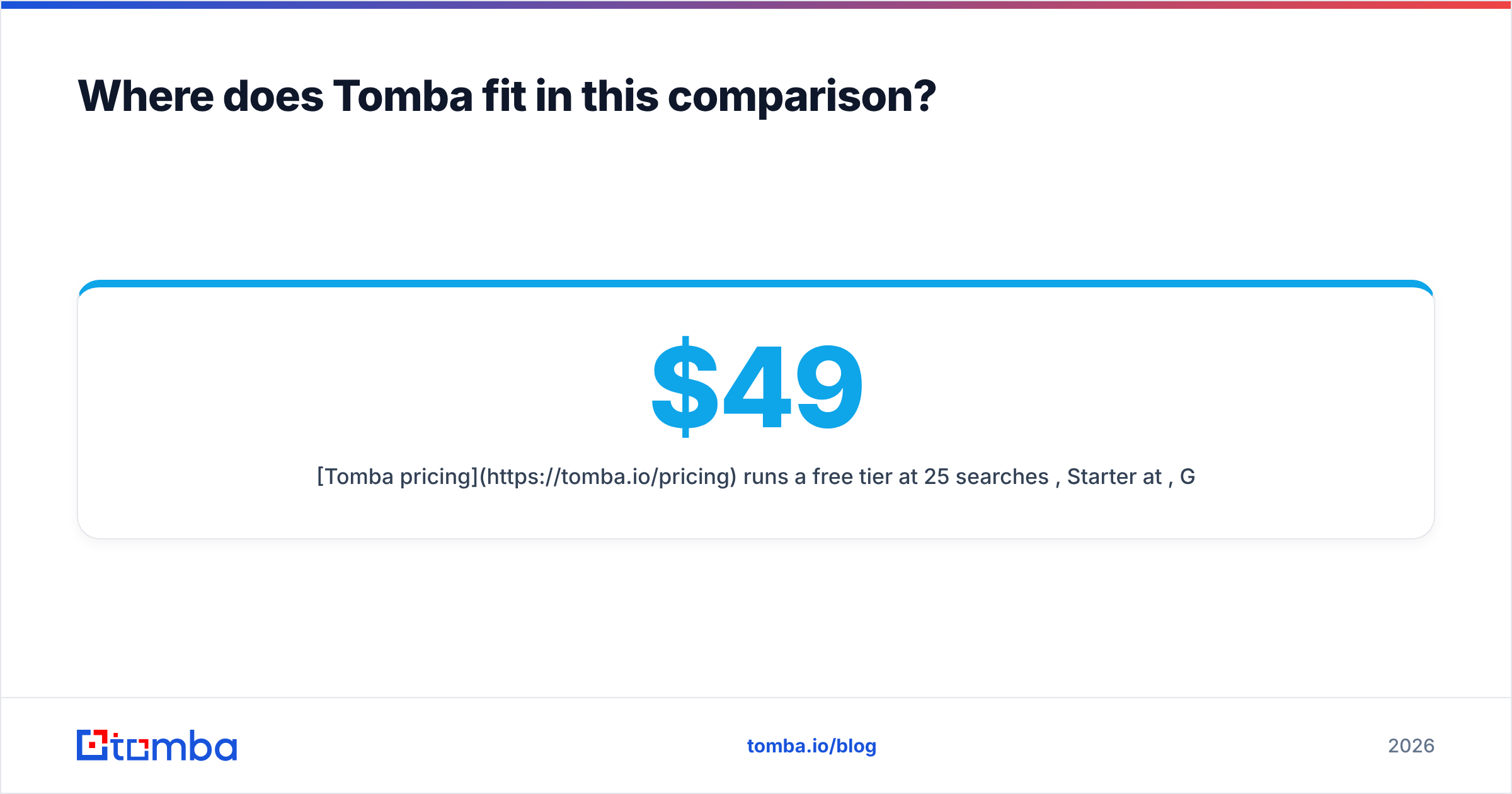
Tomba pricing runs a free tier at 25 searches per month, Starter at $49/mo, Growth at $99/mo, Pro at $249/mo, and custom Enterprise. Finding and verifying draw on the same balance, so you are not reconciling two invoices against one workflow.
How should you actually run the evaluation?#
Do not trust anyone's published accuracy figure, including the ones above. Run this test instead:
- Build a 100-row control set from companies in your ICP where you can independently confirm the contact — LinkedIn presence, a recent press mention, a conference speaker list.
- Run the same 100 rows through each tool. Note coverage (how many addresses returned) separately from accuracy (how many were correct).
- Send a genuine, low-volume campaign to each set from a warmed domain. Measure hard bounces at 48 hours.
- Count catch-all handling explicitly. Tag which domains were accept-all and check whether each vendor's confidence score predicted the outcome.
- Divide total spend by confirmed-deliverable contacts. That single number is your real cost, and it will not match any pricing page.
Two afternoons of work will tell you more than every comparison article on the internet, this one included. Vendors optimise for the metrics they publish; your ICP is the only benchmark that pays your salary.
The verdict#
Email Hippo and Warpleads answer different questions, so the winner depends entirely on which question you are asking. If your list is dirty, Email Hippo is a sound, well-established choice. If your list is empty, Warpleads gets you volume fast — provided you add verification yourself and accept that freshness will vary.
If you are asking both questions at once, buying both tools is the expensive answer. Start with a platform that finds verified contacts in one step, measure your bounce and reply rates for a month, and only add a specialist vendor when you can point to a specific gap it closes.
Ready to test the consolidated approach? Run your next 25 target accounts through the Tomba Email Finder on the free tier, send to them, and compare your bounce rate against whatever your current stack produces. No credit card, no CSV round-trip, and the result is a number you can defend in a pipeline review.
Related guides#
Ready to find emails that actually work?
Join 150,000+ professionals who stopped guessing and started sending. Free credits on signup — no credit card required.
Get the Tomba newsletter
Practical outbound tactics and product updates — once every two weeks.
About the author