Email Lookup Free: How to Find Any Email Without Paying
Free email lookup tools all promise the same thing and deliver wildly different results. Here's what each free tier actually gives you in 2026, where the hidden limits bite, and when paying is cheaper than staying free.
TL;DR
- "Free email lookup" almost always means a small monthly credit allowance (10–50 lookups), not unlimited access. The tools that advertise unlimited free results are usually pattern guessers with no verification behind them.
- The two numbers that matter are coverage (does the tool return anything at all?) and accuracy (is what it returns deliverable?). Free tiers usually keep coverage and quietly degrade verification.
- Free is genuinely enough for three jobs: one-off lookups, testing a vendor's accuracy on domains you already know, and enriching under ~30 contacts a month.
- Free stops being free the moment bounces hit your sending domain. At a 5% bounce rate on a 1,000-email campaign, you're spending reputation to save about $49.
- Best practical setup in 2026: stack two or three free tiers for ad-hoc work, and move to a paid plan once you need bulk processing, an API, or catch-all handling.
What does "email lookup free" actually mean in 2026?#
It means one of four very different things, and vendors deliberately blur the lines.
1. A permanent free tier with monthly credits. You create an account and get a fixed number of searches that reset every month — typically 10 to 50. This is the most common and most honest model. Tomba's free tier gives 25 searches per month; Hunter's gives 25 as well; Snov.io hands out a larger recurring allowance but spends those credits across finding and verifying.
2. A free trial. You get a bigger allowance once — 50, 100, sometimes 500 lookups — and then the tap closes. Useful for a one-time list build, useless as an ongoing workflow.
3. A free public tool with no account. Email permutators, format checkers, MX lookups, and syntax validators. These don't have a contact database behind them. They generate or test possibilities; they don't know anything.
4. "Free" as a lead magnet for a data purchase. You get a sample of records, then a sales conversation. Common in the bulk-database category.
The distinction matters because the word "free" in a Google result is doing a lot of work. A tool offering "unlimited free email lookup" is almost certainly category 3 — permutation plus a shallow SMTP ping — while a tool offering "25 free searches" is category 1 and is giving you real database access, just not much of it.
How does a free email lookup actually find an address?#
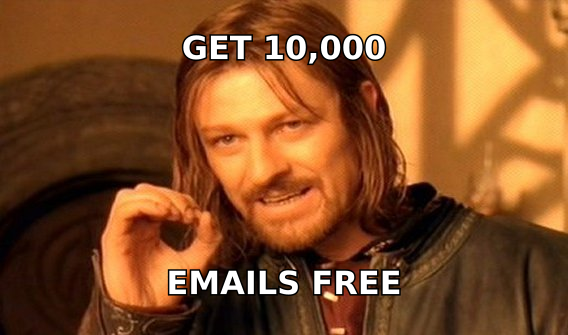
Under the hood, every finder runs some version of the same pipeline. Knowing the steps tells you exactly where free tiers cut corners.
- Pattern detection. The tool looks up the company domain and determines its dominant email format —
first.last@,flast@,first@, and so on. This comes from previously observed addresses at that domain. A tool with a thin database guesses the pattern; a tool with a deep one knows it. - Candidate generation. It builds the likely address from the person's name and the detected pattern. This is the part that free permutator tools do — and the only part they do. You can run it yourself with an email permutator in about ten seconds.
- Source corroboration. The candidate is checked against addresses actually seen in public sources — company sites, press releases, technical documentation, author bylines, public repositories. This is what separates a real finder from a guesser, and it's the expensive part.
- Syntax and DNS checks. Is the address well-formed? Does the domain have valid MX records? Cheap, fast, and where most "free checkers" stop.
- SMTP validation. The tool opens a conversation with the receiving mail server and asks whether the mailbox exists, without sending a message. The SMTP protocol allows this, but many providers now respond ambiguously to reduce enumeration.
- Confidence scoring. The output gets a score — usually 0–100 — combining pattern strength, number of corroborating sources, and validation result.
Free tiers almost never skip steps 1–2. They frequently limit steps 3 and 5, because those are the ones that cost the vendor money per request. That's why a free lookup often returns a plausible address with a mediocre confidence score, while the same query on a paid plan returns the same address with sources attached and a hard verification verdict.

Accuracy varies far more between vendors than most buyers expect — and free tiers typically sit at the lower end of their own vendor's range.
Which free email lookup tools are worth using?#
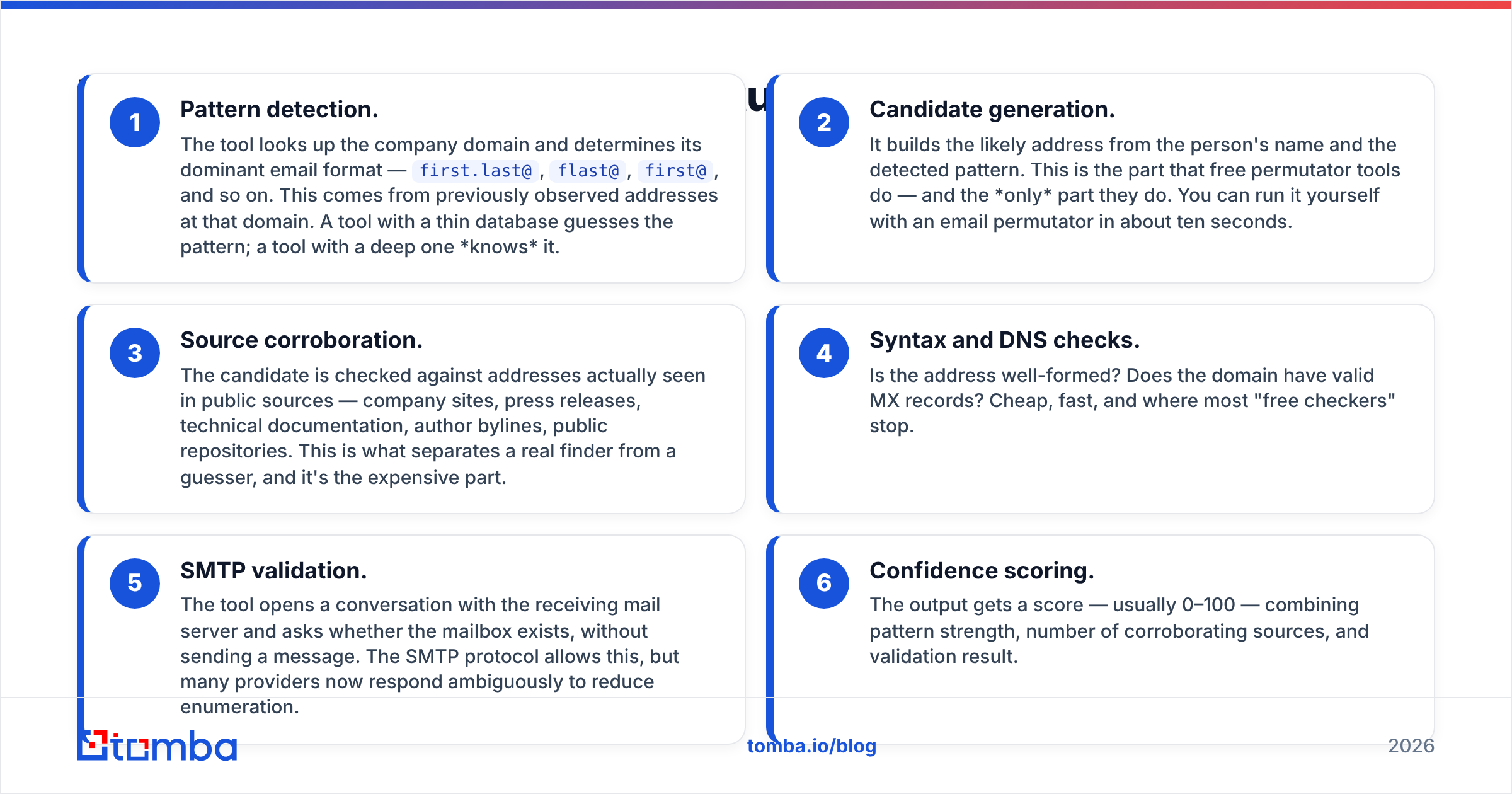
Here's the honest comparison. Free allowances change often — always check the vendor's current pricing page before committing a workflow to one.
| Tool | Free allowance | Verification included free? | Bulk on free tier | Entry paid plan | Best free-tier use case |
|---|---|---|---|---|---|
| Tomba | 25 searches/mo, recurring | Yes, verifier included | No | $49/mo (Starter) | Testing accuracy on domains you can verify yourself |
| Hunter | 25 searches/mo, recurring | Limited | No | ~$34/mo | Quick domain format lookups |
| Snov.io | ~50 credits/mo | Credits shared with finder | Small batches | ~$39/mo | Combined find + verify on tiny lists |
| Skrapp | 100 credits/mo | No | No | ~$49/mo | LinkedIn-adjacent single lookups |
| VoilaNorbert | 50 lookups, trial only | No | No | ~$49/mo | One-off list build, not ongoing |
| BookYourData | Sample records on request | Verified database records | Pay-as-you-go | Credit packs | Buying a clean list without a subscription |
| Free permutators | Unlimited | No | Manual | n/a | Generating candidates you'll verify elsewhere |
Two things jump out of that table.
First, "free" clusters tightly at 25–50 lookups per month. That's not coincidence — it's roughly the point where a vendor's data cost per user stays under their expected conversion value. Anyone advertising dramatically more free volume is either running a trial, selling your data, or not doing real lookups.
Second, verification is the real dividing line. Skrapp's 100 free credits sound generous until you notice they're finder-only. Tomba's 25 include access to the email verifier, which means each result is actually usable. Twenty-five verified addresses beat a hundred unverified guesses every time.

BookYourData deserves a separate note because it plays a different game: rather than a monthly credit drip, it sells verified records on a pay-as-you-go basis with a bounce guarantee. If your need is "I want 2,000 clean contacts once and I don't want a subscription," that model can be cheaper than any finder's paid tier. If your need is "look up this one person right now," a finder's free tier wins.
Is a free email lookup accurate enough for cold outreach?#
For fewer than about 30 contacts a month, yes — if you verify every result before sending. Past that, no.
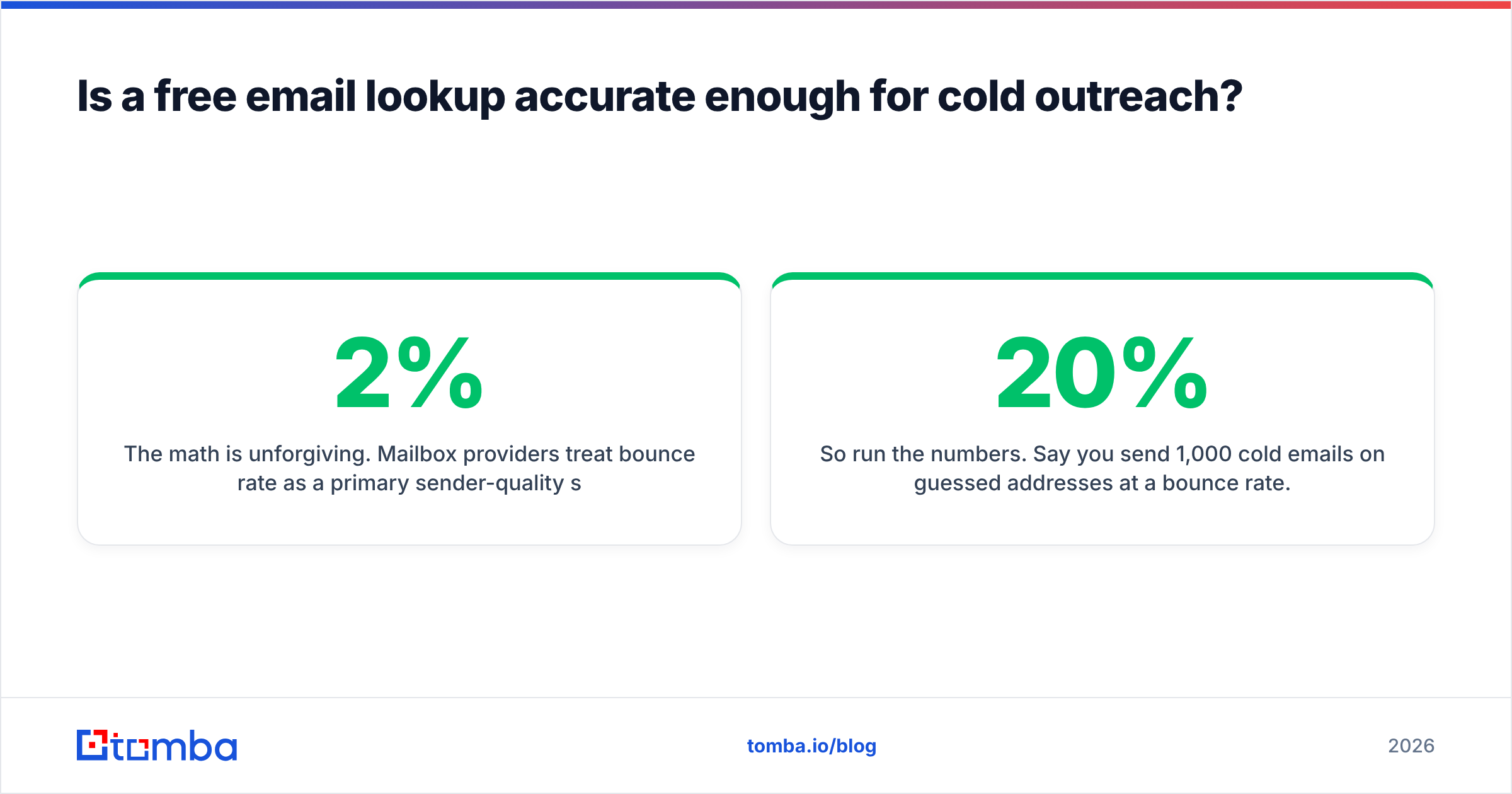
The math is unforgiving. Mailbox providers treat bounce rate as a primary sender-quality signal. Google and Microsoft both tightened bulk-sender requirements in 2024, and the practical ceiling most deliverability practitioners now use is 2% hard bounces, with real trouble starting above 5%. Unverified pattern-guessed addresses routinely bounce at 15–30% on domains the tool has never seen before.
So run the numbers. Say you send 1,000 cold emails on guessed addresses at a 20% bounce rate. That's 200 hard bounces, which is roughly ten times the threshold where filtering starts to bite. The cost of that isn't the 200 wasted sends — it's that the other 800 land in spam for the next several weeks, and your domain's sender reputation takes months to recover. A $49/mo plan would have prevented it.
The other place free tiers hurt is catch-all domains. A catch-all server accepts mail to any address at the domain, so SMTP validation returns "accepted" for asdfgh@company.com just as happily as for a real mailbox. Roughly a fifth of B2B domains are configured this way. Free tiers generally return these as "unknown" or, worse, as "valid" — and a catch-all resolution engine is exactly the kind of expensive infrastructure that sits behind a paywall. If your target market is enterprise, where catch-alls concentrate, free-tier accuracy drops hardest precisely where you need it most.

How do you get the most out of free tiers without paying?#
If your volume genuinely is small, here's the workflow that squeezes the most out of $0.
Stack tiers, don't exhaust one. Create accounts on two or three finders with recurring monthly credits. You get 75–100 real lookups a month across them, and — more importantly — you get a second opinion. When two independent databases return the same address, confidence goes way up. When they disagree, you've learned something free.
Start with the domain, not the person. Running a domain search on a company returns every known address at that domain plus the dominant pattern, usually for a single credit. Once you know the company uses first.last@, you can construct addresses for ten more people at that company without spending another credit — then verify only the ones you'll actually email.
Verify last, not first. Generate candidates for free with a permutator, then spend your scarce paid-quality credits on verification only. This inverts the usual order and roughly triples your effective free volume.
Use free public tools for the cheap checks. Syntax validation, MX record lookups, and disposable-domain detection cost the vendor almost nothing and are widely available without an account. A free email checker will catch typos and dead domains before you burn a real credit on them.
Track your own hit rate. Keep a simple sheet: address, source tool, confidence score, and outcome (delivered / bounced / replied). After 100 sends you'll know empirically which free tier is accurate for your target segment, which is far more useful than any vendor's published accuracy claim or any aggregated G2 rating.
When should you stop using free and pay?#
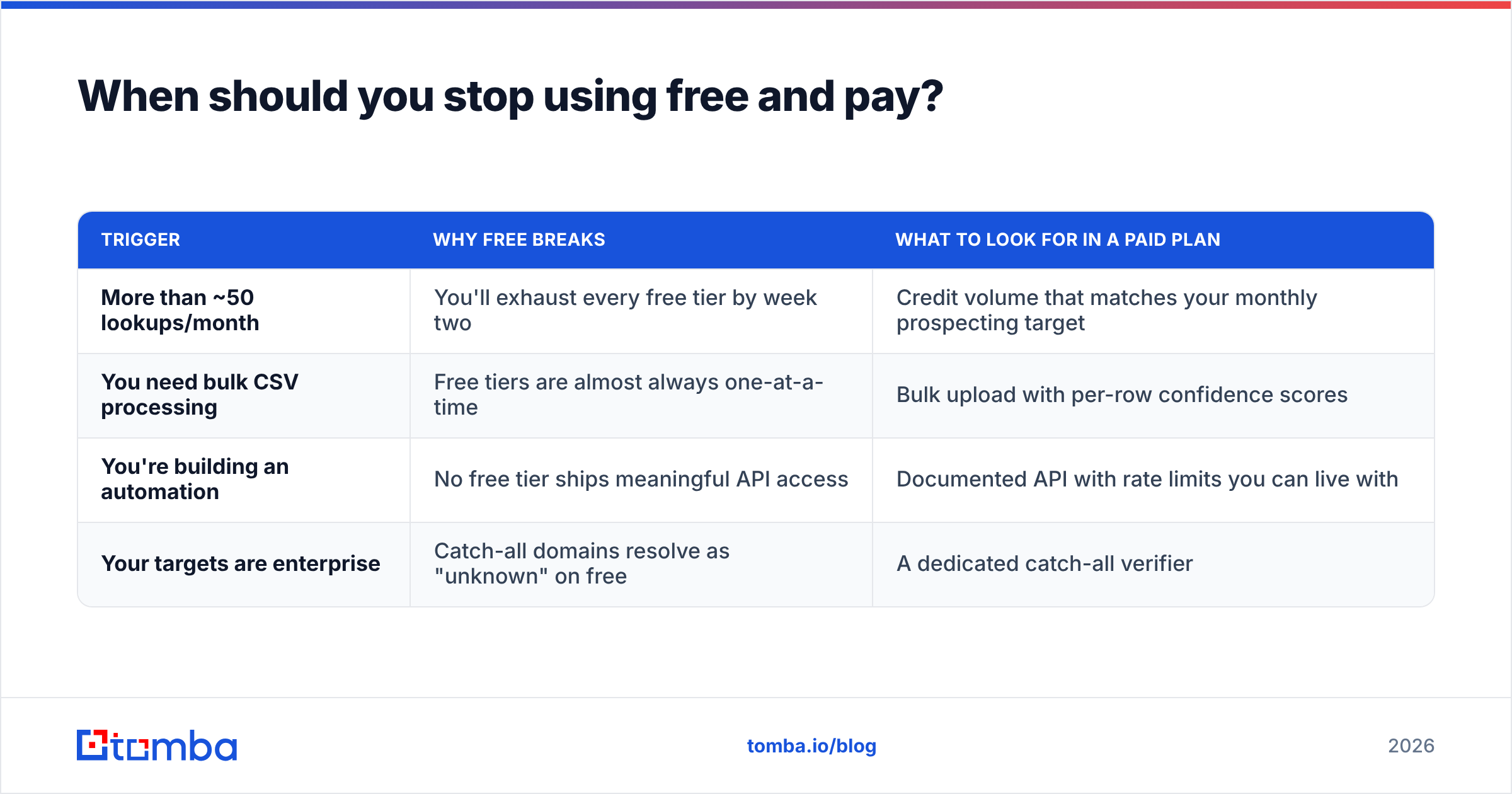
Four clear triggers. If any one applies, free tiers are costing you more than they save.
| Trigger | Why free breaks | What to look for in a paid plan |
|---|---|---|
| More than ~50 lookups/month | You'll exhaust every free tier by week two | Credit volume that matches your monthly prospecting target |
| You need bulk CSV processing | Free tiers are almost always one-at-a-time | Bulk upload with per-row confidence scores |
| You're building an automation | No free tier ships meaningful API access | Documented API with rate limits you can live with |
| Your targets are enterprise | Catch-all domains resolve as "unknown" on free | A dedicated catch-all verifier |
On price, the market has converged: most entry plans land between $34 and $50/mo. Tomba's Starter plan is $49/mo, Growth is $99/mo, and Pro is $249/mo, with the API included from Starter up. What varies more than headline price is what a "credit" buys — some vendors charge separately for finding and verifying the same contact, which effectively doubles the cost per usable address. Read that detail before comparing sticker prices.
One more consideration: pay-as-you-go options exist for people who spike. If you build one big list a quarter and do nothing in between, a credit pack from a database vendor like BookYourData, or a bulk run on a month-to-month plan you cancel afterward, beats paying for twelve months of capacity you won't use.
What's the honest verdict on free email lookup?#
Free email lookup is real, useful, and deliberately small. Twenty-five to fifty verified addresses a month is a genuine product, not a bait-and-switch — it's just sized for individuals doing occasional research, not for anyone running outbound at volume.
The failure mode isn't using free tools. It's using free tools as if they were paid ones — skipping verification, trusting pattern guesses, and sending at volume on data that was never validated. That's how a $49 saving turns into a burnt sending domain.
Use free for what it's good at: one-off lookups, vendor testing, and low-volume enrichment. Verify everything before it touches a send. And the moment your workflow needs bulk, API access, or catch-all handling, switch — because at that point the paid plan is the cheaper option, not the expensive one.
Try it on your own data first. Tomba's Email Finder includes 25 free searches a month with verification built in — enough to test accuracy against domains you already know before you commit a cent. Run twenty contacts you can independently confirm, check the hit rate, and let the numbers decide whether free is enough for your pipeline.
Related guides#
Ready to find emails that actually work?
Join 150,000+ professionals who stopped guessing and started sending. Free credits on signup — no credit card required.
Get the Tomba newsletter
Practical outbound tactics and product updates — once every two weeks.
About the author