Email Opening Best Practices: How to Start Cold Emails in 2026
Your first line decides whether the rest of the email gets read. Here are the email opening best practices that still earn replies in 2026 — the formulas, the failures, and a test plan you can run this week.
TL;DR
- Your opening line is read in the inbox preview, before the email is opened. Treat it as an extension of the subject line, not as a greeting.
- The three openers that consistently beat everything else are the observed trigger, the specific compliment with a consequence, and the direct problem statement. All three earn their first sentence.
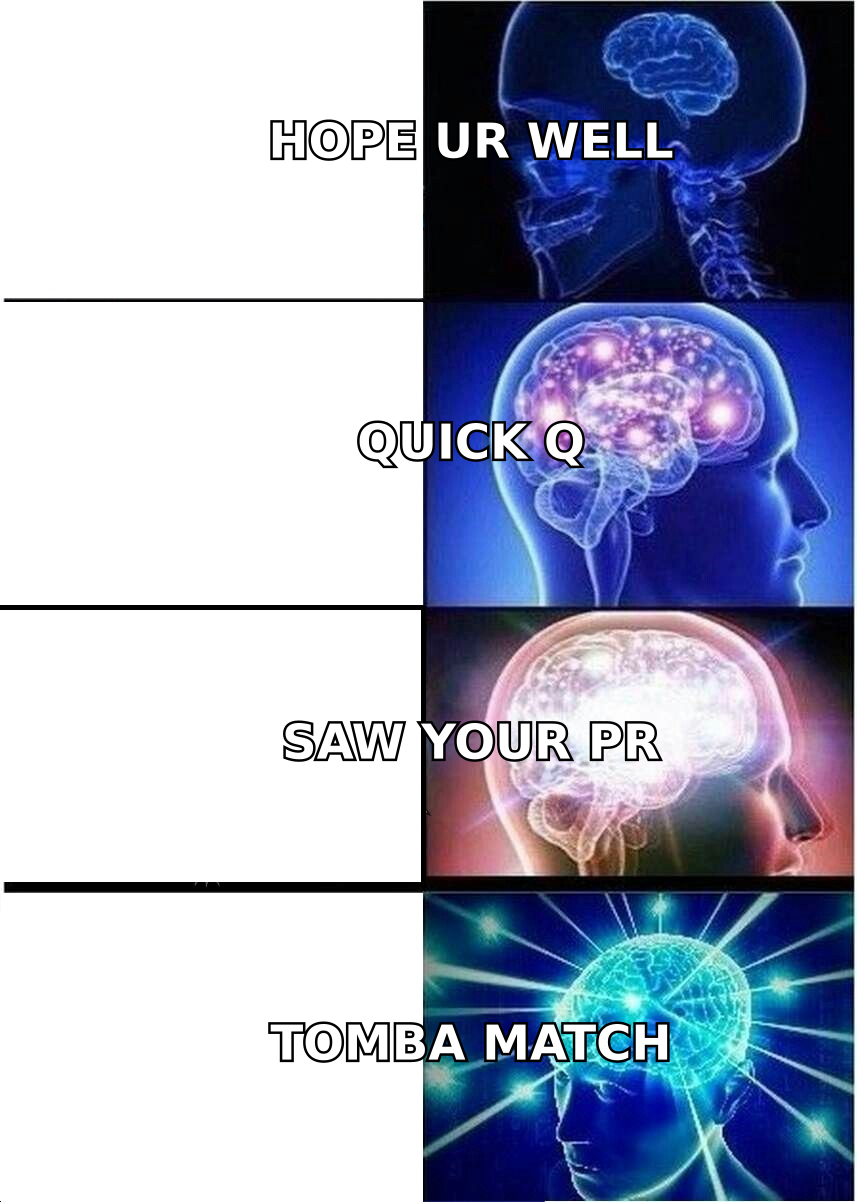
- Delete "I hope this email finds you well," "My name is X and I work at Y," and any sentence whose first word is "I." They cost you the preview pane and say nothing.
- Personalization only pays when it is relevant, not just accurate. Naming someone's city is accurate; naming the job they just posted is relevant.
- Test openers separately from subject lines. Same subject, two openers, 200 sends per arm — otherwise you cannot attribute the lift.
What counts as an "email opening" — and why does it decide the whole email?#
Your email opening is the first 8–12 words of body copy, and it does two jobs at once.
Job one: it appears in the inbox preview text next to your subject line in Gmail, Outlook, and Apple Mail. Before anyone opens anything, they read Subject — first line of body. That means your opening competes for the open, not just for the read.
Job two: once opened, it answers the only question the reader is actually asking — why is this in front of me? If sentence one does not answer that, sentence two never gets read.
Think of it like a stranger tapping you on the shoulder in a busy airport. "Excuse me, I noticed your bag is unzipped" gets your full attention. "Hi, I hope you're having a wonderful day, my name is Daniel and I represent…" gets you walking faster. Same person, same intent, completely different first four seconds.
That is why openings matter more than any other line in a cold email, and why most sales teams still get them wrong: they write the opening last, as connective tissue between the greeting and the pitch, instead of writing it first as the thing that buys attention for everything after it.
What do the numbers say about email openings in 2026?#
Three shifts have changed what works, and none of them are subtle.
Preview text got longer, not shorter. Mobile clients now surface 40–90 characters of body copy. A wasted first line is a wasted second impression.
Generic AI personalization got detected. Buyers have now received thousands of "I loved your recent post about {{topic}}" emails. The pattern is burned. Anything that smells like a merge field in a compliment slot reads as automated, and once a reader tags you as automated, the rest of the email is skimmed at best.
Volume filters got stricter. Google and Yahoo's bulk-sender requirements pushed complaint rates into hard-fail territory. A weak opener does not just lose a reply — it raises the odds someone hits "report spam," which damages your email deliverability for every future send. The opening line is now a deliverability control, not just a copy choice.
The practical takeaway: your first sentence has to prove, in under 15 words, that a human chose to send this to this person. Not that a human wrote it — that a human targeted it.
Which email opening formulas actually work?#
Here are the six that hold up across industries, ordered roughly by how much research each requires.
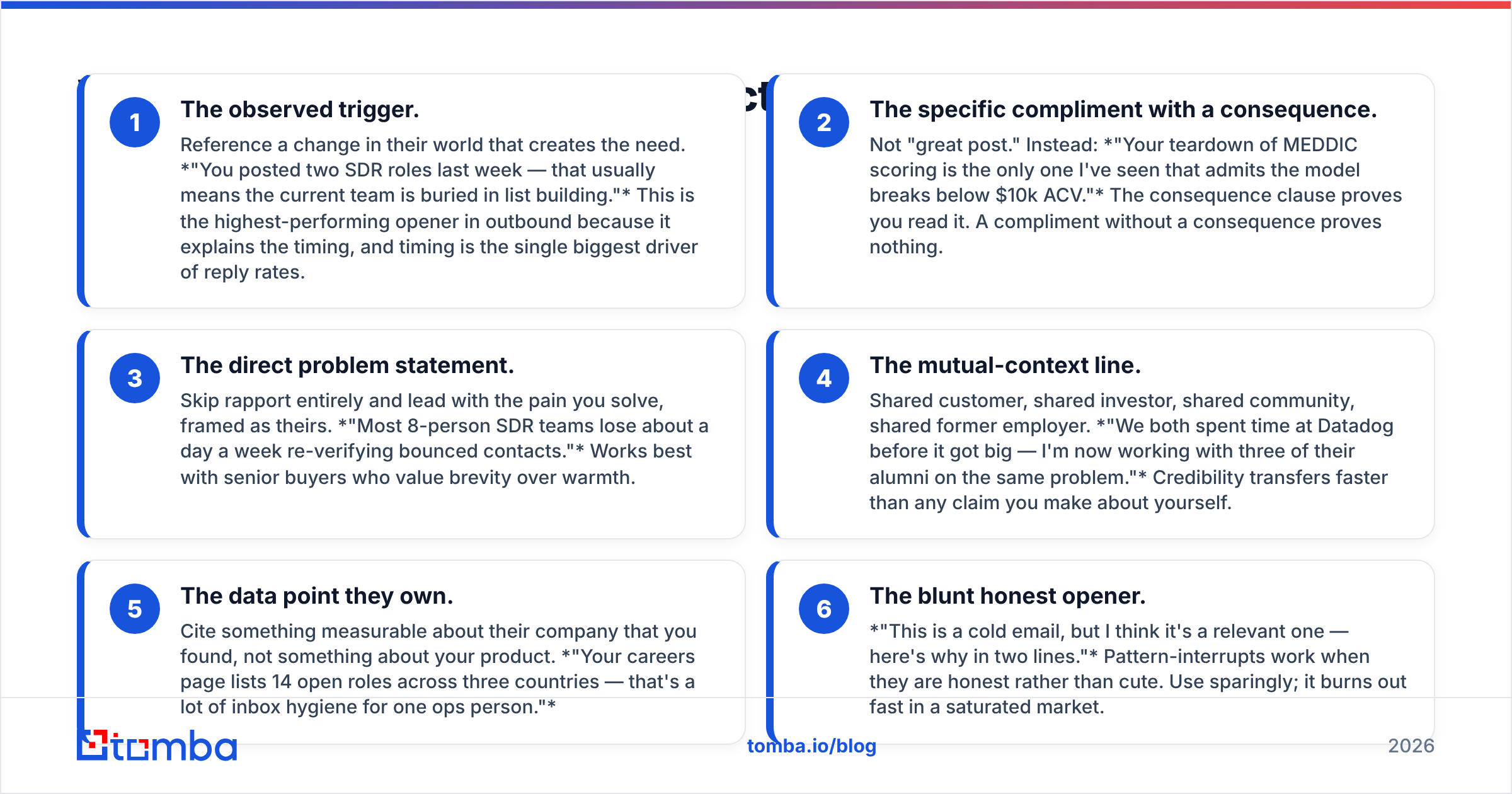
- The observed trigger. Reference a change in their world that creates the need. "You posted two SDR roles last week — that usually means the current team is buried in list building." This is the highest-performing opener in outbound because it explains the timing, and timing is the single biggest driver of reply rates.
- The specific compliment with a consequence. Not "great post." Instead: "Your teardown of MEDDIC scoring is the only one I've seen that admits the model breaks below $10k ACV." The consequence clause proves you read it. A compliment without a consequence proves nothing.
- The direct problem statement. Skip rapport entirely and lead with the pain you solve, framed as theirs. "Most 8-person SDR teams lose about a day a week re-verifying bounced contacts." Works best with senior buyers who value brevity over warmth.
- The mutual-context line. Shared customer, shared investor, shared community, shared former employer. "We both spent time at Datadog before it got big — I'm now working with three of their alumni on the same problem." Credibility transfers faster than any claim you make about yourself.
- The data point they own. Cite something measurable about their company that you found, not something about your product. "Your careers page lists 14 open roles across three countries — that's a lot of inbox hygiene for one ops person."
- The blunt honest opener. "This is a cold email, but I think it's a relevant one — here's why in two lines." Pattern-interrupts work when they are honest rather than cute. Use sparingly; it burns out fast in a saturated market.
Notice that none of these mention the sender. Your name, your company, and your role belong in sentence two or three, or in your signature. The reader will look you up if sentence one earns it.
Which openers should you delete on sight?#
| Opener | Why it fails | Replace with |
|---|---|---|
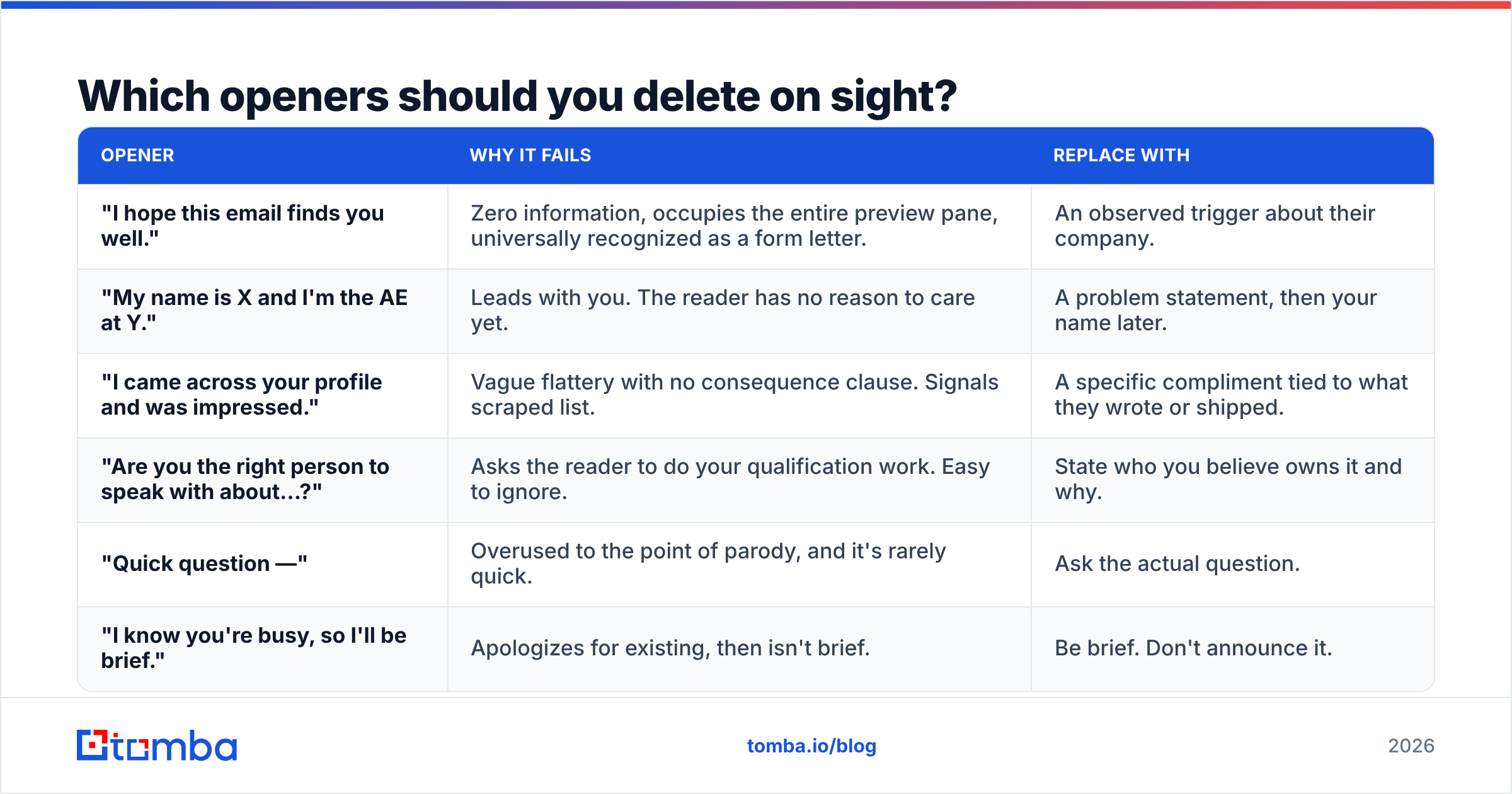
| "I hope this email finds you well." | Zero information, occupies the entire preview pane, universally recognized as a form letter. | An observed trigger about their company. |
| "My name is X and I'm the AE at Y." | Leads with you. The reader has no reason to care yet. | A problem statement, then your name later. |
| "I came across your profile and was impressed." | Vague flattery with no consequence clause. Signals scraped list. | A specific compliment tied to what they wrote or shipped. |
| "Are you the right person to speak with about…?" | Asks the reader to do your qualification work. Easy to ignore. | State who you believe owns it and why. |
| "Quick question —" | Overused to the point of parody, and it's rarely quick. | Ask the actual question. |
| "I know you're busy, so I'll be brief." | Apologizes for existing, then isn't brief. | Be brief. Don't announce it. |
The pattern behind every failure in that table is the same: the sentence is about the sender's process rather than the recipient's situation. Any opener you could paste into a thousand emails unchanged is an opener that earns nothing.
How should openings change by channel and audience?#
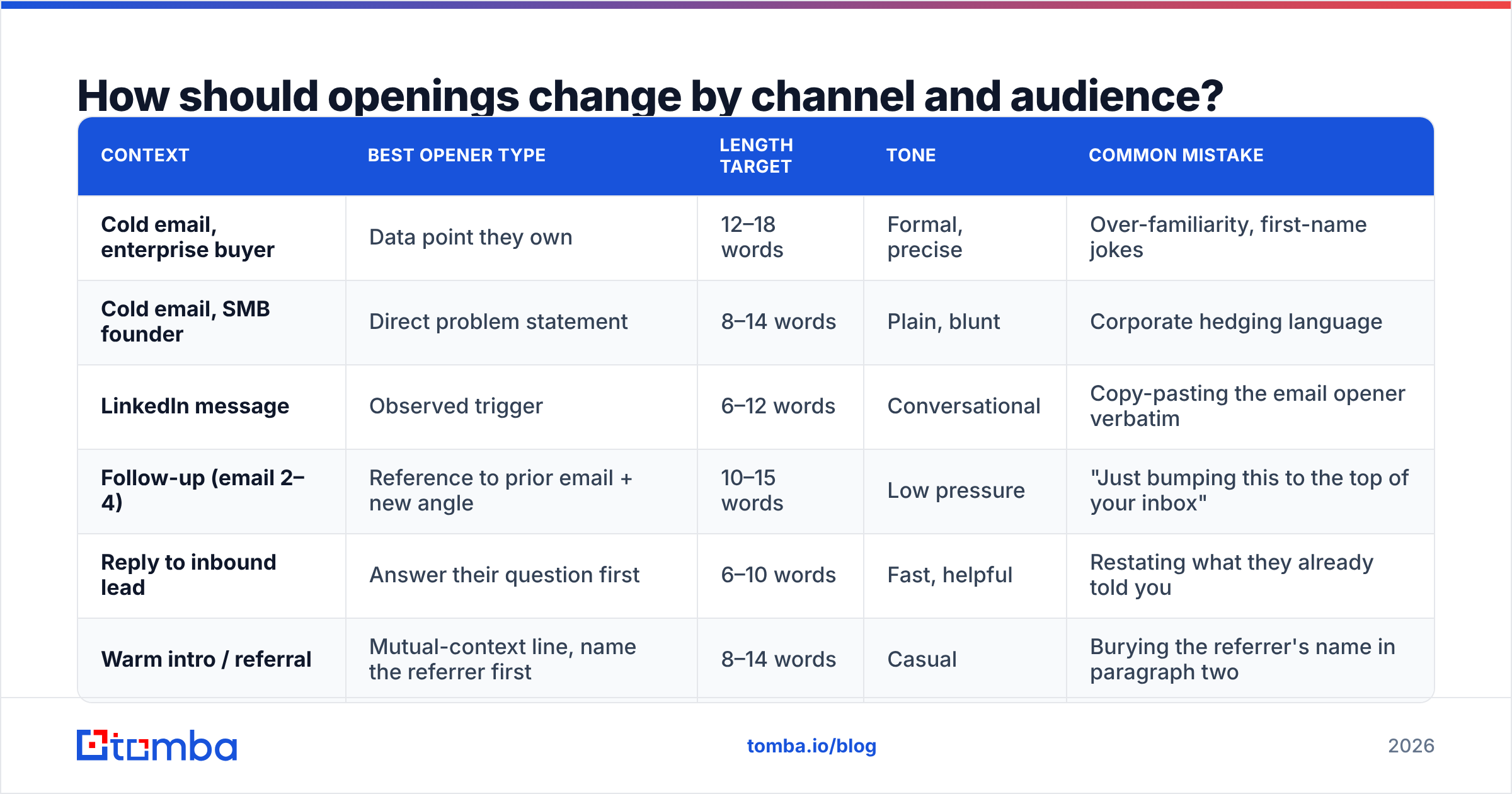
The formula that works for a VP of Engineering at a 2,000-person company will flop on a founder running a 12-person agency. Match the opener to the reading context.
| Context | Best opener type | Length target | Tone | Common mistake |
|---|---|---|---|---|
| Cold email, enterprise buyer | Data point they own | 12–18 words | Formal, precise | Over-familiarity, first-name jokes |
| Cold email, SMB founder | Direct problem statement | 8–14 words | Plain, blunt | Corporate hedging language |
| LinkedIn message | Observed trigger | 6–12 words | Conversational | Copy-pasting the email opener verbatim |
| Follow-up (email 2–4) | Reference to prior email + new angle | 10–15 words | Low pressure | "Just bumping this to the top of your inbox" |
| Reply to inbound lead | Answer their question first | 6–10 words | Fast, helpful | Restating what they already told you |
| Warm intro / referral | Mutual-context line, name the referrer first | 8–14 words | Casual | Burying the referrer's name in paragraph two |
One rule cuts across all six rows: the opener should be shorter than you think. Every word before the point costs you attention you have not earned yet. If you can cut the first three words of your draft and the sentence still works, they were throat-clearing.
How do you personalize openings at scale without sounding like a bot?#
The failure mode is not automation. It is shallow automation — merge fields dressed up as insight.
Build your personalization in layers, and be honest about which layer a given prospect deserves:
- Layer 1 — Segment-level (works at 500+ sends). One opener per persona and trigger type. No per-prospect research. "Series B ops leaders usually inherit three overlapping data tools." Fast, honest, and better than fake personalization.
- Layer 2 — Account-level (works at 100–500 sends). One researched fact per company, reused across every contact there. Hiring signals, funding, product launches, tech-stack changes.
- Layer 3 — Person-level (reserve for your top 50). Something only that individual said or shipped. Podcast quote, conference talk, GitHub commit, LinkedIn comment.
Most teams try Layer 3 on everyone, run out of time by Tuesday, and ship half-researched Layer 2 with Layer 3 phrasing — which is exactly what reads as robotic. Pick the layer you can sustain.
The second half of scale is data quality. A perfect opener sent to a stale address never gets scored. Before you obsess over word choice, make sure the contact resolves: use an email verifier on every list, and run ambiguous domains through a catch-all verifier so you know which sends are actually landing. Copy tests on a list with a 12% bounce rate produce noise, not learning.
How do you test and measure your email openings?#
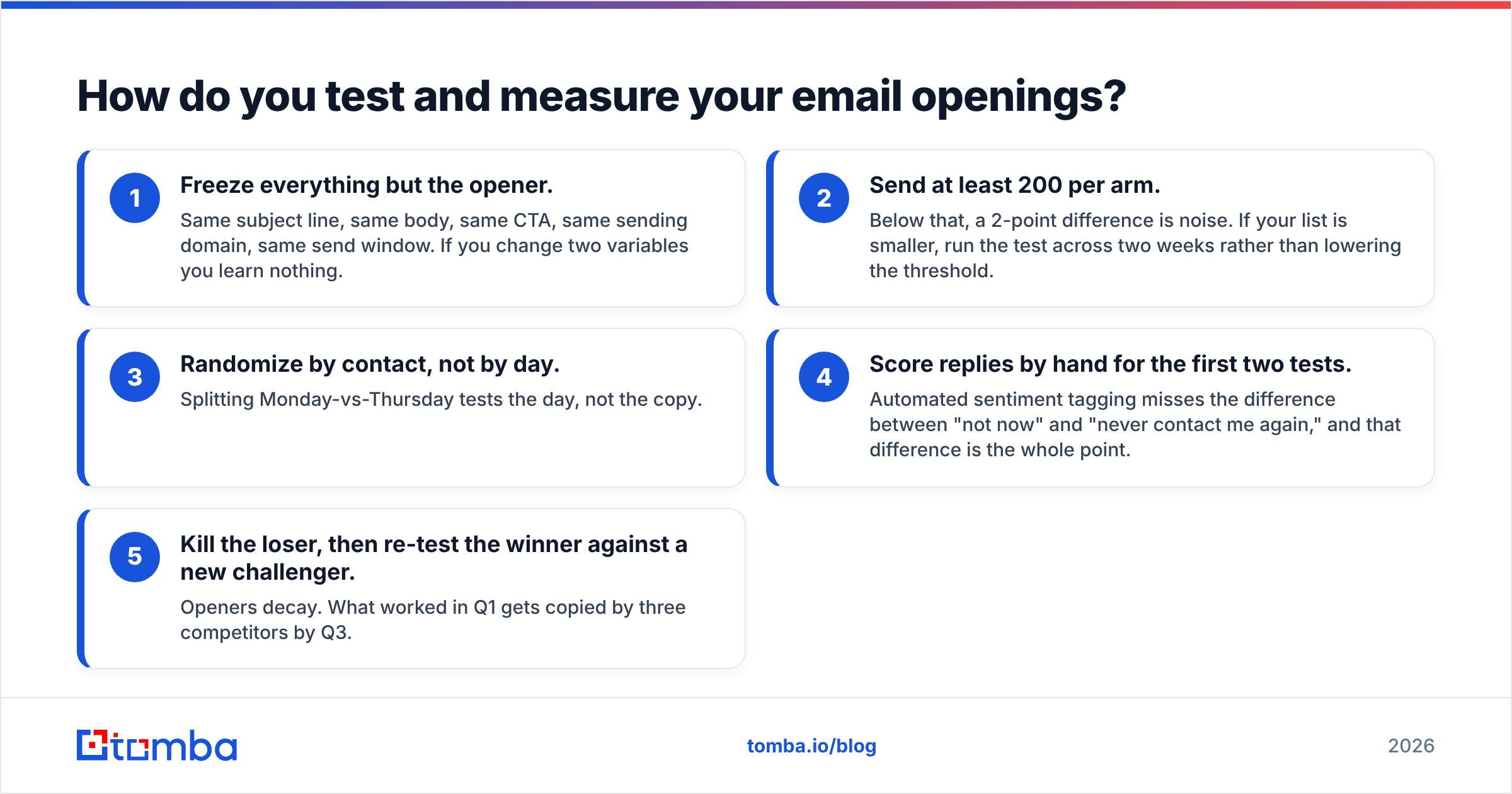
Reply rate is the only metric that matters here, and open rate will lie to you. Apple Mail Privacy Protection and similar proxies inflate opens; treat them as directional at best. Measure positive reply rate (replies excluding "unsubscribe" and "wrong person") against sends.
A test protocol you can actually run:
- Freeze everything but the opener. Same subject line, same body, same CTA, same sending domain, same send window. If you change two variables you learn nothing.
- Send at least 200 per arm. Below that, a 2-point difference is noise. If your list is smaller, run the test across two weeks rather than lowering the threshold.
- Randomize by contact, not by day. Splitting Monday-vs-Thursday tests the day, not the copy.
- Score replies by hand for the first two tests. Automated sentiment tagging misses the difference between "not now" and "never contact me again," and that difference is the whole point.
- Kill the loser, then re-test the winner against a new challenger. Openers decay. What worked in Q1 gets copied by three competitors by Q3.
Run subject-line testing on a separate cycle with tools like a subject line tester so the two experiments do not contaminate each other. And track your baseline response rate before you start — you cannot claim a lift you never measured.
For benchmarks outside your own data, HubSpot's sales blog publishes reply-rate ranges by industry, and peer reviews on G2 are a reasonable sanity check on which sequencing tools actually report reply data honestly rather than burying it behind open rates. If you want the psychology underneath why an unfinished, specific observation pulls harder than a complete generic one, the Zeigarnik effect is the mechanism.
What does a strong opening look like end to end?#
Three rewrites, before and after:
Before: "Hi Sarah, I hope this email finds you well! My name is Marcus and I'm a rep at DataCo, we help companies with their data enrichment." After: "Sarah — you're hiring two RevOps analysts while running Clearbit and ZoomInfo side by side. That overlap usually shows up as duplicate records first."
Before: "I came across your company and was really impressed with what you're building." After: "Your changelog shipped 14 releases in March. Support volume usually spikes about six weeks after that pace."
Before: "Quick question — are you the right person to talk to about email deliverability?" After: "You moved 40 seats to Google Workspace in January. Domains that migrate that fast usually take a reputation hit in month two."
Each rewrite does the same three things: it names something verifiably true about them, it draws a consequence from it, and it stops. No pitch in sentence one. No credentials in sentence one. Just proof that this email was aimed.
Where should you start this week?#
Pick one sequence, rewrite the opening lines of every email in it using the observed-trigger and problem-statement formulas, and leave everything else untouched. Run 400 sends. Compare positive reply rate against your last 400. That single change moves the needle more than a full sequence rewrite, and it takes an afternoon.
The prerequisite is contacts worth writing to. A researched, specific, well-timed opening line is wasted on a guessed address that bounces — and bounces are what quietly sink the domain you send everything else from. Use Tomba Email Finder to build the list from verified company data first, then spend your energy on the first twelve words. The free tier covers 25 searches a month if you want to test the workflow before committing; Tomba pricing starts at $49/mo for Starter when you're ready to run real volume.
Write the opener last in the draft, but treat it first in the edit. It is the only sentence guaranteed to be read.
Related guides#
Ready to find emails that actually work?
Join 150,000+ professionals who stopped guessing and started sending. Free credits on signup — no credit card required.
Get the Tomba newsletter
Practical outbound tactics and product updates — once every two weeks.
About the author