Email to CEO Sample: 9 Templates That Get Real Replies
Nine field-tested email to CEO samples, plus the 5-part structure, subject lines, and verification steps that separate a reply from a silent delete.
TL;DR
- A CEO reads email in 6-second bursts between meetings. Your entire message needs to survive a mobile preview pane: subject line, first sentence, one ask.
- The structure that works is always the same — relevance trigger, one-line credibility, one specific ask, easy exit. Everything else is decoration.
- Templates below cover nine real scenarios: cold pitch, partnership, job inquiry, investor intro, customer escalation, press request, referral, board intro, and re-engagement.
- Length beats cleverness. Every sample here is 50–125 words, because messages under 125 words consistently outperform longer ones in reply-rate studies.
- None of it matters if the address bounces. Verify the CEO's email before you send — a bounce on your first attempt burns the domain reputation you need for attempt two.
Why is emailing a CEO different from emailing anyone else?#
Because you are competing with the board, the CFO, three investors, and a legal thread — not with other salespeople.
A VP of Marketing might read a 300-word pitch on a Tuesday afternoon. A CEO triages. They scan the sender name, the subject line, and roughly the first eight words of the preview text, then make a binary decision. Research from HubSpot's sales data and similar vendor studies consistently shows that shorter emails get more replies, and the effect is strongest at the executive level.
Three practical consequences:
- Your subject line is 70% of the work. It gets read whether or not the body does.
- The first sentence must not be about you. "I'm reaching out because" is a delete trigger. Lead with something true about their company.
- You get exactly one ask. Two asks means the CEO has to make two decisions, and a busy person defers double decisions indefinitely.
There is also a structural reality nobody mentions: many CEOs do not read their own inbox. An executive assistant filters it. So your email is often being judged by someone whose entire job is deciding what is worth the CEO's attention. Write for that reader too — clarity and specificity read as "legitimate," while vagueness and flattery read as "spam."
What does a good email to a CEO actually look like?#
Every effective email to a CEO sample follows the same five-part skeleton. Learn the skeleton and you can write your own instead of copy-pasting.
- Relevance trigger (1 sentence). A funding round, a new hire, a product launch, a podcast appearance, a job posting, a shift in their public strategy. Something dated within the last 90 days. This proves you are not mail-merging.
- Credibility compression (1 sentence). Who you are, in the fewest words that make you worth answering. "We run fraud detection for three of the top-10 EU neobanks" beats a paragraph about your mission.
- The specific claim (1–2 sentences). What you believe is true about their situation, and what changes if they are right. Use a number. Numbers are the cheapest credibility signal in existence.
- One low-friction ask (1 sentence). Not "a 30-minute call to explore synergies." Ask a yes/no question, or ask for a redirect: "Is this worth pointing at whoever owns onboarding?"
- The exit ramp (optional, 1 short line). "If it's not a priority this quarter, no problem — I'll leave it there." This raises reply rates because it removes the fear of a pursuit sequence.
Total length: 50 to 125 words. If you cannot say it in 125 words, you do not understand your own ask well enough yet.
What are the best email to CEO samples by scenario?#
Nine templates. Replace the bracketed parts, delete anything that isn't literally true, and keep the length.
1. Cold outbound (product pitch)#
Subject: your Series B hiring plan
[Name] — saw you're opening 14 SDR roles after the Series B. That's the point where most teams' CRM data quality falls off a cliff.
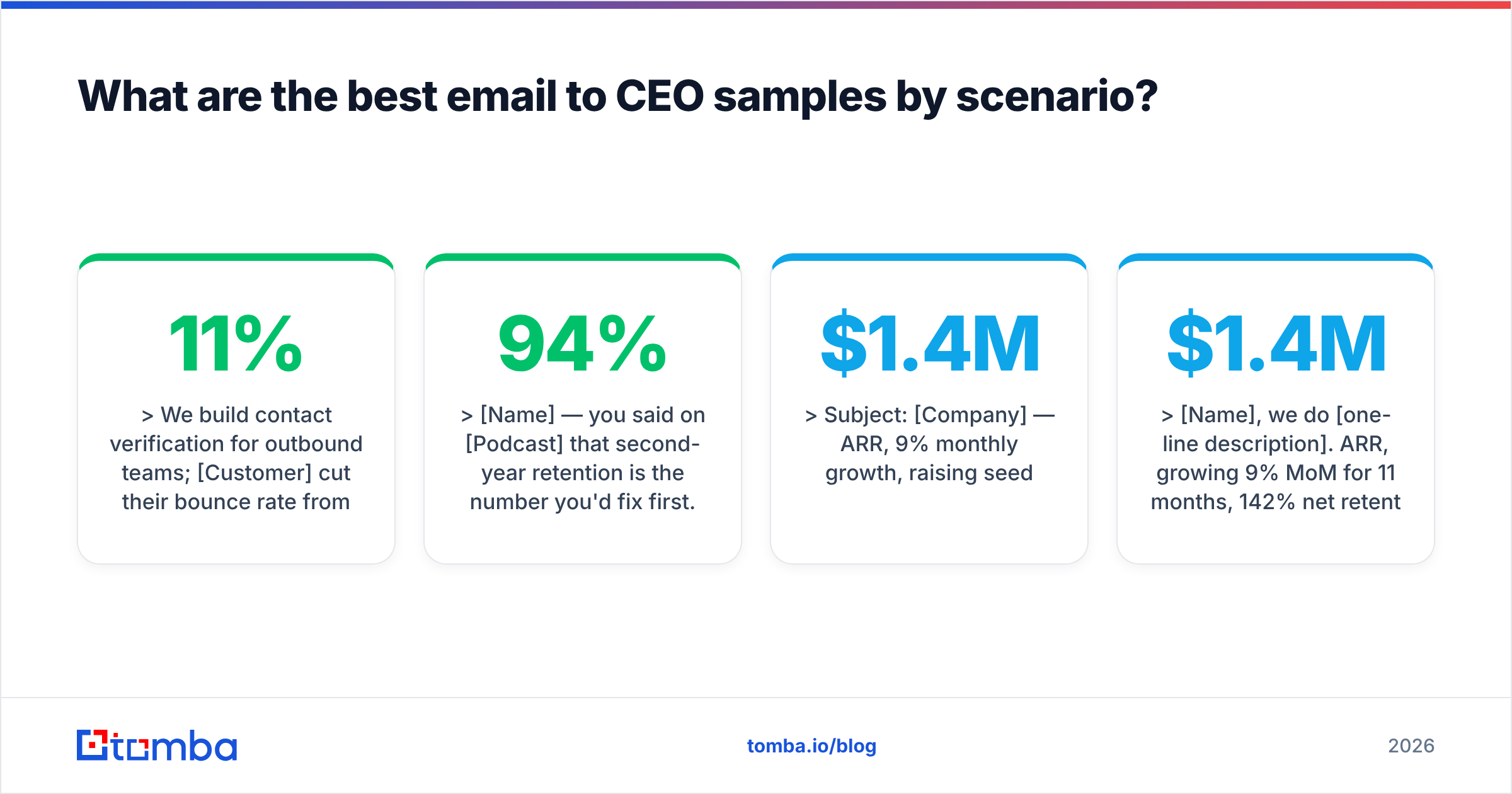
We build contact verification for outbound teams; [Customer] cut their bounce rate from 11% to under 2% in six weeks after a similar ramp.
Worth a 10-minute look, or should I send this to whoever owns RevOps?
— [You]
2. Partnership proposal#
Subject: [Their Company] + [Your Company] — shared customer overlap
[Name], we share 40+ customers with [Their Company], including [Named Account] and [Named Account].
We've had two of them ask whether our platforms integrate. They don't yet.
Would it be useful to have our teams scope a native integration? Happy to send a one-page outline first.
3. Job inquiry (no posting exists)#
Subject: the churn problem you mentioned on [Podcast]
[Name] — you said on [Podcast] that second-year retention is the number you'd fix first. I spent three years doing exactly that at [Company], taking net revenue retention from 94% to 118%.
I'm not applying to a posting; I'm asking whether that problem is still open. If so I'll send a two-page plan, not a résumé.
4. Investor intro (founder → VC)#
Subject: [Company] — $1.4M ARR, 9% monthly growth, raising seed
[Name], we do [one-line description]. $1.4M ARR, growing 9% MoM for 11 months, 142% net retention, two engineers.
You led [Portfolio Company]'s seed, which is the closest comp to what we're building.
Raising $4M. Deck attached — worth 20 minutes?
5. Customer escalation#
Subject: ticket #48212 — 9 days open, contract renews Feb 3
[Name], I'm escalating because normal channels haven't moved. We've been down on [feature] for nine days, ticket #48212, three support replies, no resolution owner named.
Our renewal is Feb 3. I'd rather renew than switch. Can someone be assigned today?
6. Press / interview request#
Subject: 15 min on [specific topic] for [Publication]
[Name] — I'm writing a piece for [Publication] on [narrow topic]. Your comments on [specific thing they said] are the strongest counterargument to the prevailing view, and I want it represented properly.
15 minutes this week or next? Questions in advance if that's easier.
7. Warm referral (name-drop first)#
Subject: [Referrer] suggested I reach out
[Name] — [Referrer] mentioned you're rebuilding the data stack this year and said we should talk.
We handle [specific thing] for [Similar Company] and [Similar Company]. One sentence on the fit: [sentence].
Worth 15 minutes, or is there someone closer to the project I should talk to?
8. Board / advisor introduction#
Subject: advisory conversation — [specific expertise]
[Name], I'm building [Company] in [market]. You scaled [Their Company] through the exact transition we're hitting: [specific transition].
Not asking for a commitment — one 30-minute conversation, and if it's useful for both of us we can talk about what an advisory role would look like.
9. Re-engagement after silence#
Subject: closing the loop
[Name] — I sent a note in March about [topic] and never heard back, which usually means it wasn't a priority. Fair enough.
One thing changed since: [new, concrete development]. If that changes the math, reply and I'll send details. If not, I'll close the file.
Which subject lines get CEOs to open?#
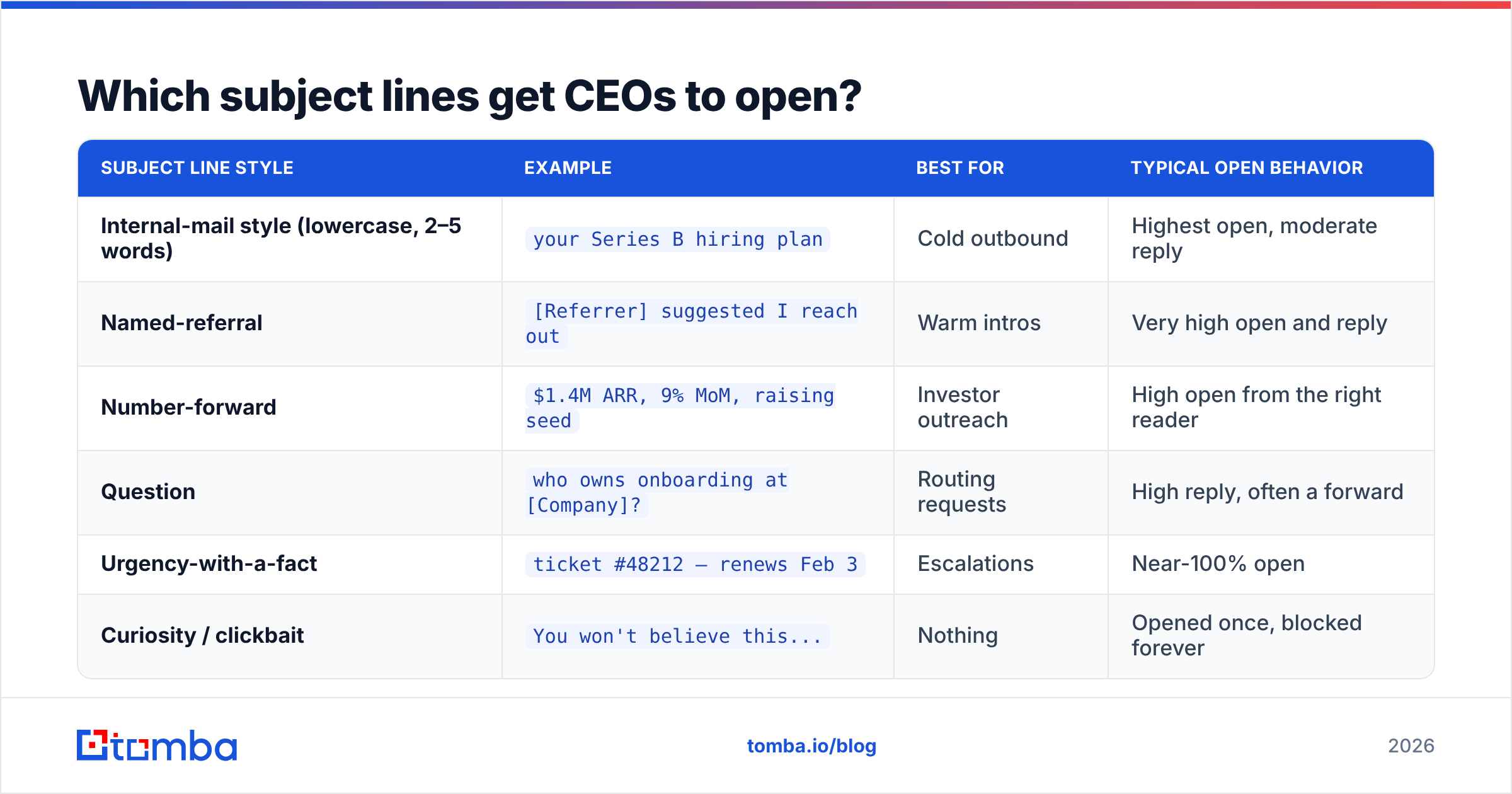
Lowercase, short, and specific — subject lines that look like internal mail rather than marketing.
| Subject line style | Example | Best for | Typical open behavior |
|---|---|---|---|
| Internal-mail style (lowercase, 2–5 words) | your Series B hiring plan |
Cold outbound | Highest open, moderate reply |
| Named-referral | [Referrer] suggested I reach out |
Warm intros | Very high open and reply |
| Number-forward | $1.4M ARR, 9% MoM, raising seed |
Investor outreach | High open from the right reader |
| Question | who owns onboarding at [Company]? |
Routing requests | High reply, often a forward |
| Urgency-with-a-fact | ticket #48212 — renews Feb 3 |
Escalations | Near-100% open |
| Curiosity / clickbait | You won't believe this... |
Nothing | Opened once, blocked forever |
Two rules that hold across all six: keep it under 45 characters so it survives a mobile preview, and never use a subject line that promises something the body does not deliver. Executives punish that permanently.
If you're testing variants at scale, run them through a subject line tester before the send rather than after, and keep a swipe file of the ones that actually produced meetings.
How do you find and verify a CEO's email address?#
You find the pattern, apply it to the name, then verify before sending. Guessing without verification is how domains get burned.
The workflow that scales:
- Step 1 — Get the company's email pattern. Most companies use one of six formats (
first.last@,flast@,first@, etc.). A domain search returns the dominant pattern plus known addresses at that domain in one lookup. - Step 2 — Apply the pattern to the CEO's exact legal-ish name. "Mike" is often "michael" in the mail system. Check LinkedIn, SEC filings, and press releases for the formal spelling.
- Step 3 — Verify before sending. Run the candidate through an email verifier so you know whether the mailbox exists. On catch-all domains — very common at companies with under 200 employees — a standard SMTP check returns "accept all" and tells you nothing, which is where a catch-all verifier earns its keep.
- Step 4 — Have a fallback route. If the CEO's address is genuinely unreachable, the chief of staff, the EA, or a VP who reports directly is a better target than a generic
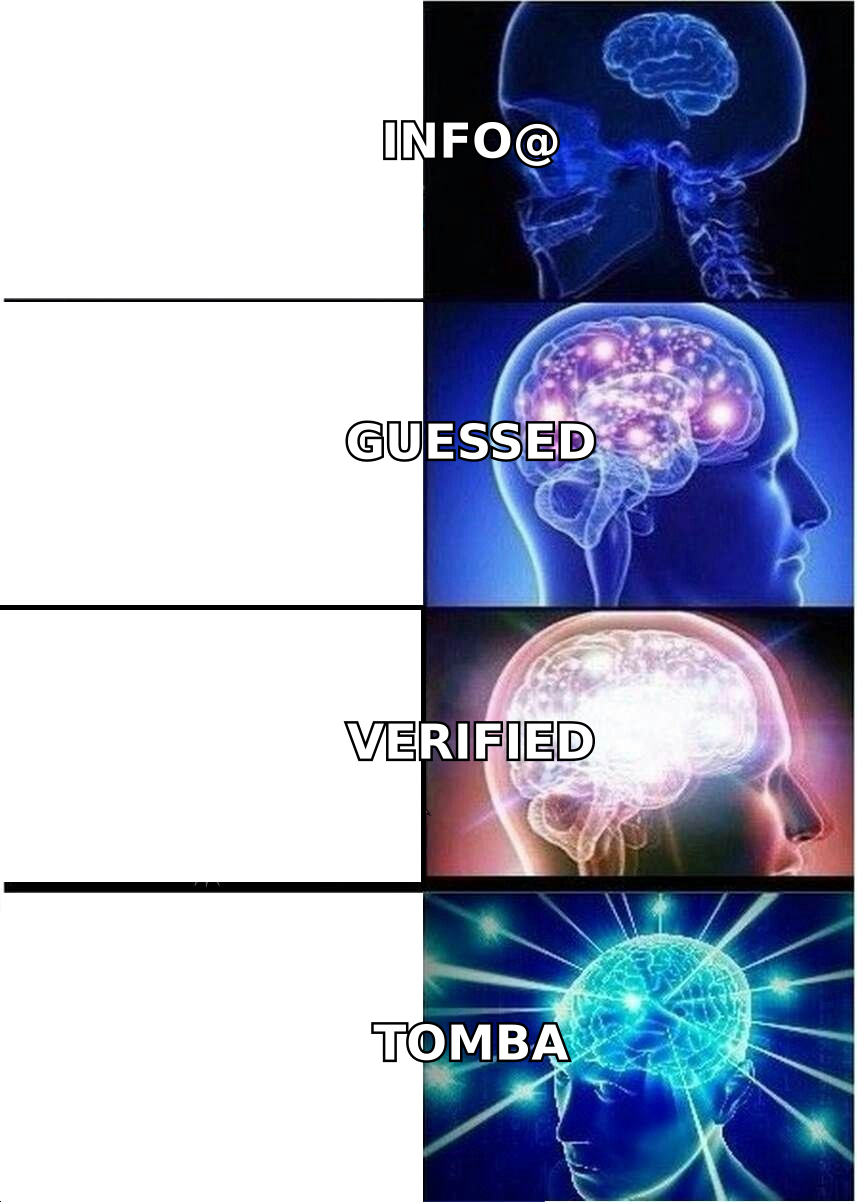
info@inbox. Nobody has ever gotten a meeting frominfo@.

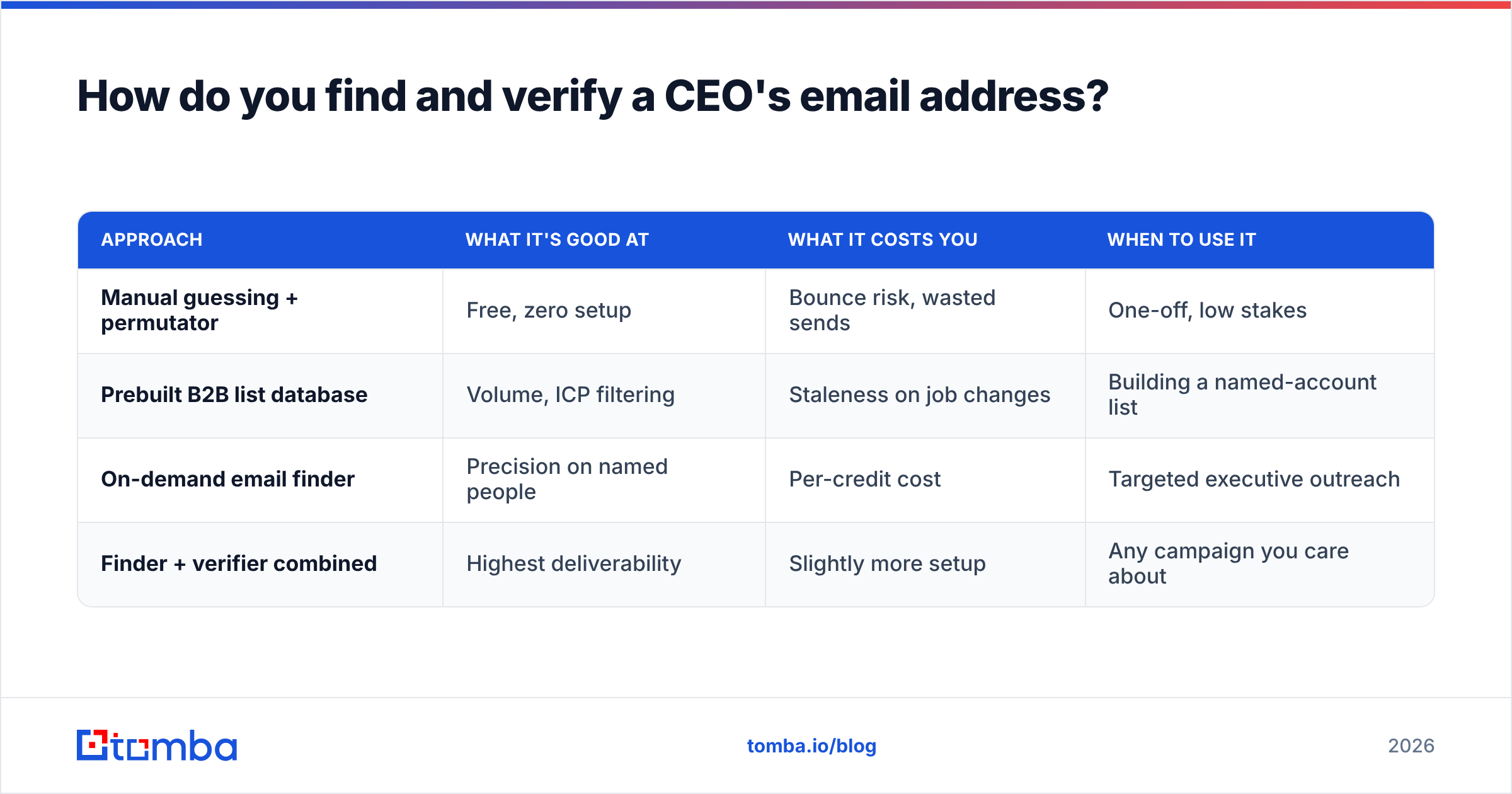
A note on tools: the market splits between broad B2B databases and focused finders. Platforms like BookYourData sell pre-built, filterable executive lists — genuinely useful when you want volume in a defined ICP without building the list yourself. Finder-first tools resolve a specific person at a specific domain on demand, which is what you want when you already know exactly which nine CEOs you need. Most serious teams end up using both: a database for coverage, a finder plus verification for precision. G2's category listings are a reasonable place to compare current options.
| Approach | What it's good at | What it costs you | When to use it |
|---|---|---|---|
| Manual guessing + permutator | Free, zero setup | Bounce risk, wasted sends | One-off, low stakes |
| Prebuilt B2B list database | Volume, ICP filtering | Staleness on job changes | Building a named-account list |
| On-demand email finder | Precision on named people | Per-credit cost | Targeted executive outreach |
| Finder + verifier combined | Highest deliverability | Slightly more setup | Any campaign you care about |
What mistakes kill an email to a CEO?#
- Flattery openers. "I'm a huge admirer of your work" signals that you have nothing substantive.
- The two-ask email. A call and a document and an intro. Pick one.
- Attachments in cold email. They trip spam filters and nobody opens them from an unknown sender. Link instead.
- Merge-tag tells.
Hi {FirstName}in production, or a "personalized" line that could apply to any company in the sector. - Sending from a cold domain. If your sending domain has no history, even a perfect email lands in spam. Check sender reputation and your SPF/DKIM setup before a high-stakes send.
- The 400-word context dump. If your email needs paragraph three, it needed a different first paragraph.
- Following up four times in eight days. Executives read that as desperation and block.
The deeper failure is treating a CEO email as a numbers game. Gartner's B2B buying research is consistent on this point: enterprise buying groups are large and slow, and executive attention is the scarcest input in the process. A hundred generic emails to a hundred CEOs will produce fewer meetings than nine researched ones.
How should you follow up without becoming annoying?#
Two follow-ups, spaced wide, each carrying new information.
- Follow-up 1 (day 4–5): Add one new fact — a case study, a benchmark, a relevant competitor move. Do not say "just bumping this."
- Follow-up 2 (day 12–14): The permission-to-close email. "Assuming this isn't a priority — should I close the file or check back in Q3?" This gets replies from people who ignored both earlier messages, because it costs them one word to answer.
- Then stop. Move to a different channel (LinkedIn, a mutual contact, an event) or re-enter in six months with a genuinely new trigger.
Track reply behavior, not open rates. Open tracking is increasingly unreliable thanks to privacy proxies, while response rate is the only number that maps to pipeline. Salesforce's own sales guidance makes the same point: the metric that matters is the conversation started, not the pixel fired.
Ready to send emails that actually reach the CEO?#
The best email to CEO sample in the world fails if the address is wrong. Start with the address, then write the 90 words.
Use the Tomba Email Finder to resolve a named executive at a specific domain, confirm the mailbox with the built-in verifier, and check the catch-all status before you hit send. The free tier includes 25 searches a month — enough to build your first nine-CEO target list — and Tomba pricing starts at $49/mo on Starter when you need volume, with Growth at $99/mo and Pro at $249/mo for teams running continuous outbound.
Find the person. Verify the address. Then send the shortest email you can write.
Related guides#
Ready to find emails that actually work?
Join 150,000+ professionals who stopped guessing and started sending. Free credits on signup — no credit card required.
Get the Tomba newsletter
Practical outbound tactics and product updates — once every two weeks.
About the author