Email to Phone Number: How to Find a Prospect's Cell in 2026
There is no magic switch that turns an email address into a mobile number. Here is how email-to-phone lookup actually works, what match rates to expect, what it costs, and where the legal line sits.
TL;DR
- There is no algorithm that converts an email string into a phone number. Every "email to phone number" tool works by matching the email to a person record in a database that already contains a phone.
- Realistic match rates are 25-55% for direct dials and mobiles on US B2B contacts, and materially lower in the EU. Anyone promising 90% is measuring something else.
- Mobile numbers cost 3-10x more per record than emails because they decay faster and are harder to source.
- Validate before you dial. A HLR/line-type check strips disconnected and landline-only records and protects your connect rate.
- The legal constraint is not "can I find it" but "can I call it" — TCPA, DNC scrubbing, and GDPR legitimate interest all apply the moment you pick up the phone.
What does "email to phone number" actually mean?#
It means reverse identity resolution, not conversion. Think of it like a coat check: the email address is the ticket stub, not the coat. Handing the stub to the attendant only works if the coat was checked in the first place — and if the attendant's rack is the same rack you used.
Technically, the flow is:
- Normalize the email. Strip plus-addressing, lowercase the local part, resolve the domain to a canonical company record.
- Resolve to a person. Match
sarah.chen@acme.comagainst a contact graph built from public profiles, company sites, opt-in submissions, licensed data co-ops, and user-contributed records. - Pull attached phone attributes. A resolved person record may carry a company switchboard, a direct dial (DID), a mobile, or nothing at all.
- Score and rank. Good providers return a confidence score plus a line type, not just a string of digits.
- Validate the number. An HLR lookup or carrier query confirms the line is live and tells you whether it is mobile, landline, or VoIP.
Step 3 is where most of the disappointment lives. If nobody ever published, submitted, or contributed that person's mobile, no vendor can produce it — they can only guess, and guessing is how you end up dialing a stranger.
Why can't a tool just derive the number from the email?#
Because emails are deterministic and phone numbers are not.
Email addresses follow patterns. Roughly 70% of B2B domains use one of five formats — first.last@, flast@, first@, firstl@, f.last@. That is why an email finder can generate candidates and then verify them at the SMTP layer with high confidence. You can test a hypothesis cheaply.
Phone numbers have no such structure tied to identity. A mobile number is assigned by a carrier from a pool, portable across carriers, and unrelated to the person's employer or name. There is no pattern to permute and no cheap "does this exist for this person" test — dialing to check is both expensive and rude. So every phone result is a retrieved fact, never a derived one.
Two consequences follow. First, coverage is a hard ceiling set by the vendor's data sources, not by the cleverness of their software. Second, phone data decays faster than you think: people change jobs roughly every 2-4 years, and while a work email dies loudly (it bounces), a mobile number quietly follows the person to their new employer or gets recycled. That is why a phone validator step matters more for phones than verification does for email.
What match rates should you actually expect?#
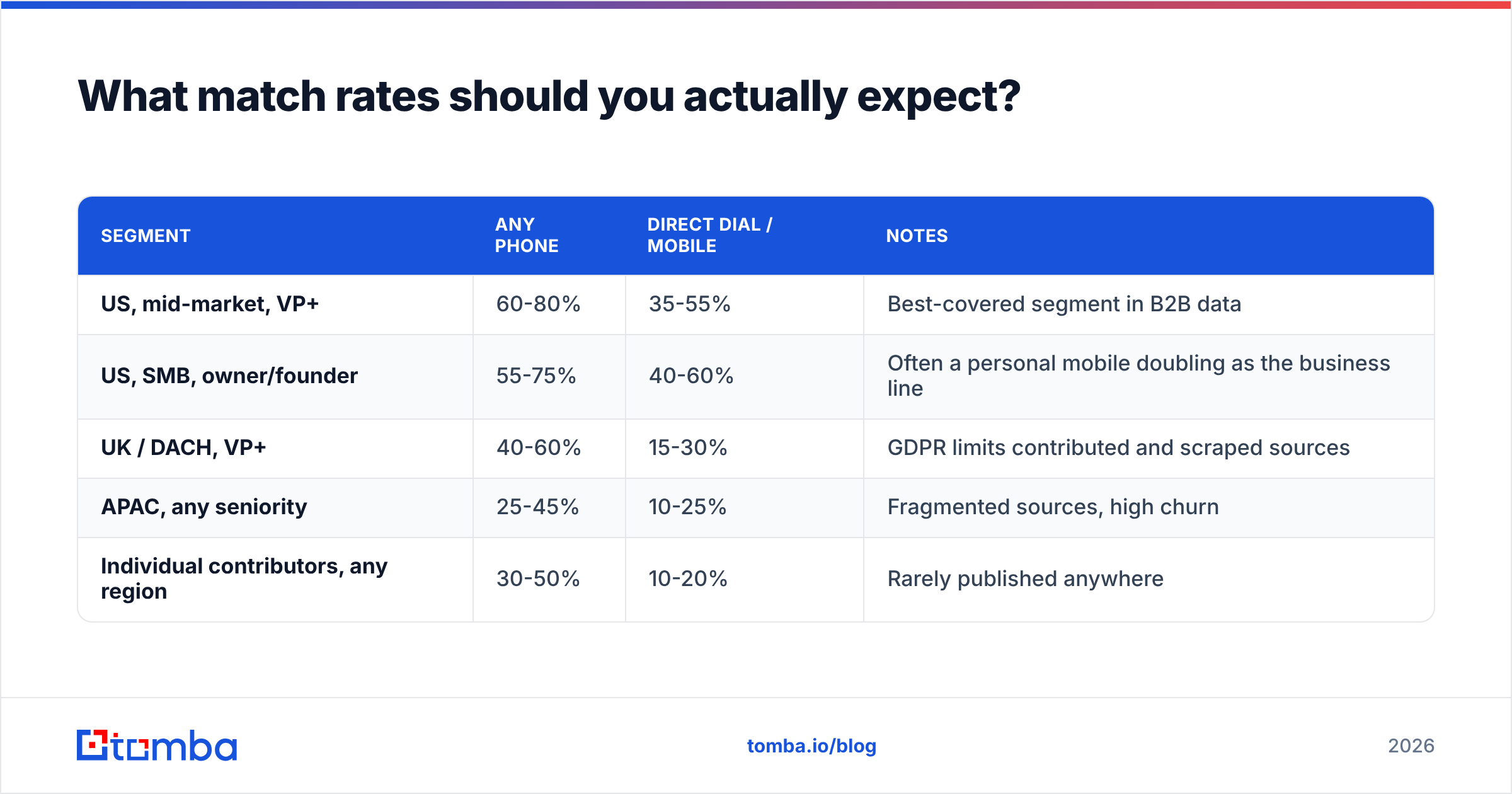
Set expectations by geography and seniority before you sign anything.
| Segment | Any phone | Direct dial / mobile | Notes |
|---|---|---|---|
| US, mid-market, VP+ | 60-80% | 35-55% | Best-covered segment in B2B data |
| US, SMB, owner/founder | 55-75% | 40-60% | Often a personal mobile doubling as the business line |
| UK / DACH, VP+ | 40-60% | 15-30% | GDPR limits contributed and scraped sources |
| APAC, any seniority | 25-45% | 10-25% | Fragmented sources, high churn |
| Individual contributors, any region | 30-50% | 10-20% | Rarely published anywhere |
Two things distort vendor-published numbers. Vendors quote database coverage ("we have 200M phone records") rather than match rate on your list, and they count switchboard numbers as "phone data". A switchboard number plus a gatekeeper is not a direct dial. When you run a trial, measure exactly one thing: of 500 emails you actually care about, how many returned a mobile or DID that a validator marked live?
Budget for decay too. Assume 15-25% annual rot on mobile records. A list you enriched 18 months ago is roughly a coin flip today.
How do the main email-to-phone tools compare?#
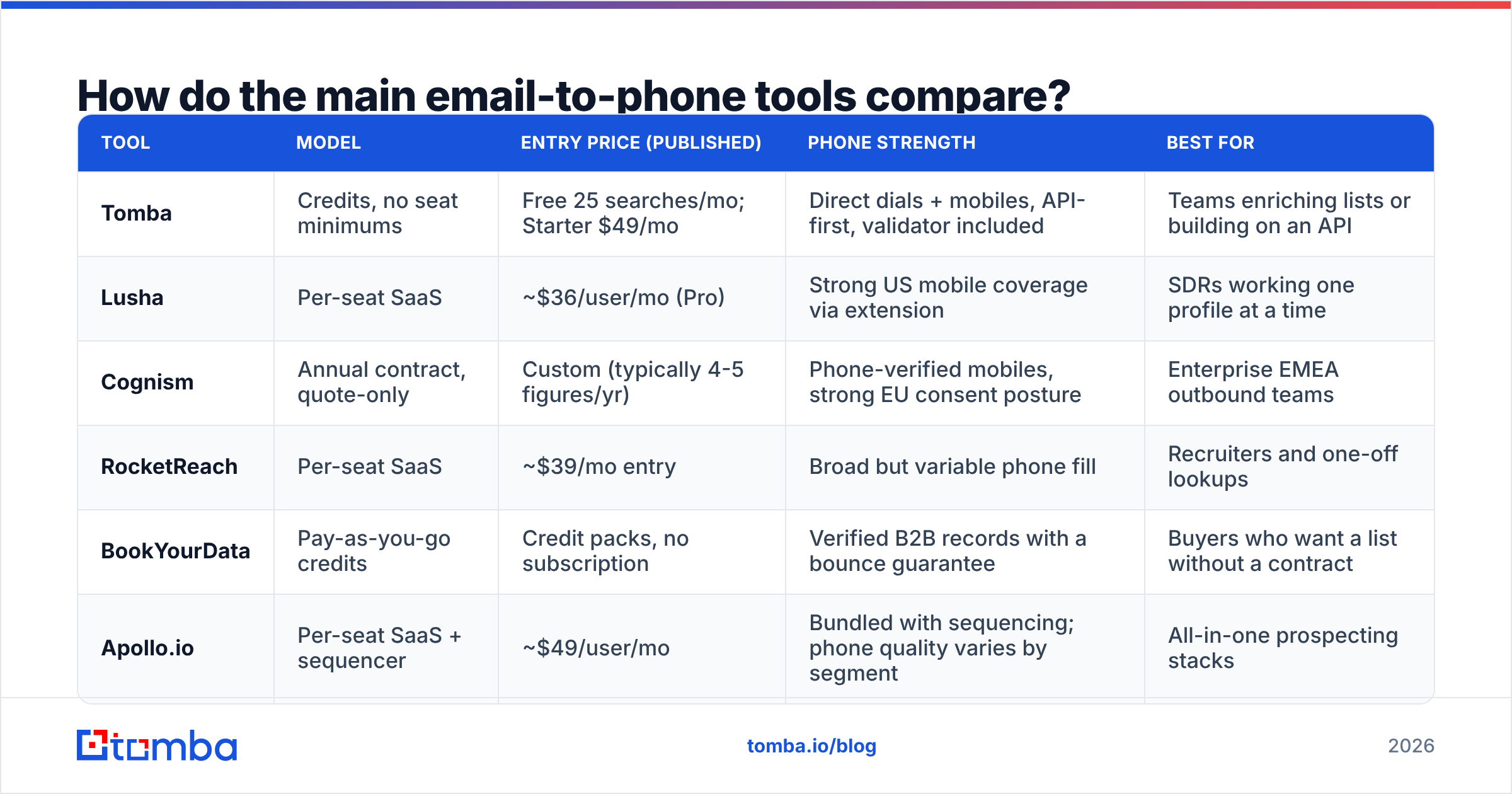
The market splits into three shapes: contact databases you subscribe to, enrichment APIs you call programmatically, and pay-as-you-go credit shops. Pick the shape first, the brand second.
| Tool | Model | Entry price (published) | Phone strength | Best for |
|---|---|---|---|---|
| Tomba | Credits, no seat minimums | Free 25 searches/mo; Starter $49/mo | Direct dials + mobiles, API-first, validator included | Teams enriching lists or building on an API |
| Lusha | Per-seat SaaS | ~$36/user/mo (Pro) | Strong US mobile coverage via extension | SDRs working one profile at a time |
| Cognism | Annual contract, quote-only | Custom (typically 4-5 figures/yr) | Phone-verified mobiles, strong EU consent posture | Enterprise EMEA outbound teams |
| RocketReach | Per-seat SaaS | ~$39/mo entry | Broad but variable phone fill | Recruiters and one-off lookups |
| BookYourData | Pay-as-you-go credits | Credit packs, no subscription | Verified B2B records with a bounce guarantee | Buyers who want a list without a contract |
| Apollo.io | Per-seat SaaS + sequencer | ~$49/user/mo | Bundled with sequencing; phone quality varies by segment | All-in-one prospecting stacks |
Prices are the vendors' published entry tiers at time of writing — check each vendor's own pricing page before you commit, since credit allowances change more often than headline prices do. Independent review volume on G2's sales intelligence category is a useful sanity check on coverage claims, because reviewers tend to describe the segments where a tool actually delivered.
Two honest observations. If you work EMEA-heavy enterprise deals, Cognism's consent-checked, DNC-scrubbed mobile file is genuinely differentiated and worth the contract. If you dial fewer than 200 net-new people a month, a per-seat subscription is usually the wrong shape — pay-as-you-go credits from a provider like BookYourData or a credit-based API like Tomba will cost less per connected call.
Where Tomba fits: it is built API-first and priced on credits rather than seats, so enrichment runs in your pipeline instead of in someone's browser tab. Tomba pricing runs Free (25 searches/mo), Starter $49/mo, Growth $99/mo, Pro $249/mo, and Enterprise custom, and the phone finder shares the same credit pool as email finding, verification, and enrichment. For RevOps teams that would rather not reconcile three vendor invoices, that consolidation is the practical argument.
How do you run an email-to-phone enrichment properly?#
Order matters. Enriching phones before you clean emails wastes credits on records you were never going to keep.
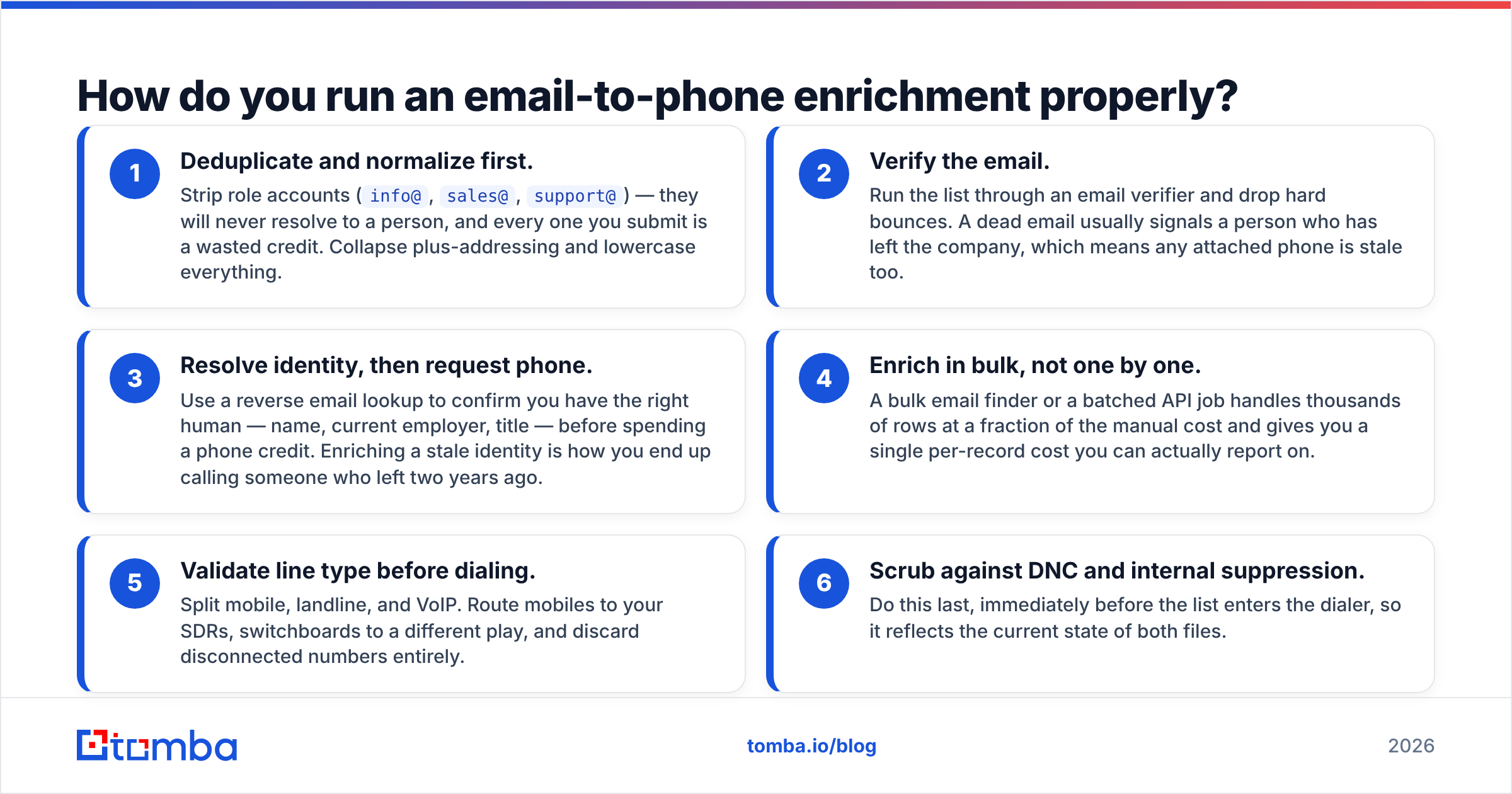
- Deduplicate and normalize first. Strip role accounts (
info@,sales@,support@) — they will never resolve to a person, and every one you submit is a wasted credit. Collapse plus-addressing and lowercase everything. - Verify the email. Run the list through an email verifier and drop hard bounces. A dead email usually signals a person who has left the company, which means any attached phone is stale too.
- Resolve identity, then request phone. Use a reverse email lookup to confirm you have the right human — name, current employer, title — before spending a phone credit. Enriching a stale identity is how you end up calling someone who left two years ago.
- Enrich in bulk, not one by one. A bulk email finder or a batched API job handles thousands of rows at a fraction of the manual cost and gives you a single per-record cost you can actually report on.
- Validate line type before dialing. Split mobile, landline, and VoIP. Route mobiles to your SDRs, switchboards to a different play, and discard disconnected numbers entirely.
- Scrub against DNC and internal suppression. Do this last, immediately before the list enters the dialer, so it reflects the current state of both files.
Skipping step 5 is the most common and most expensive mistake. Connect rates on unvalidated lists routinely sit in the 3-6% range; validated, line-typed lists commonly double that, because your reps stop burning half their dials on dead numbers and switchboards.

Is email-to-phone lookup legal?#
Finding is generally lawful. Calling is regulated. Keep those two questions separate in your head, because compliance teams do.
In the US, the constraint is the Telephone Consumer Protection Act and the National Do Not Call Registry. Manual, non-automated B2B calls to business numbers have historically had more room than B2C, but the moment an autodialer or prerecorded message touches a wireless number, the exposure changes sharply — and mobiles you sourced from a database are exactly the numbers most likely to be wireless. The FCC's telemarketing rules are the primary source; the TCPA overview on Wikipedia is a decent orientation before you talk to counsel. State-level mini-TCPA statutes (Florida, Oklahoma, Maryland among them) add stricter rules and are where most recent litigation volume has come from.
In the EU and UK, GDPR treats a personal mobile as personal data regardless of how you obtained it. Legitimate interest can support B2B outreach, but it requires a documented balancing test, a clear privacy notice, a working opt-out, and a source you can name on request. "We bought it from a vendor" is not a source. Ask any provider for their lawful-basis documentation and their notification process before you import a single EU record.
Practical guardrails that cost you nothing:
- Keep provenance on every record — which vendor, which date, which source type.
- Honor opt-outs across channels, not just the one where they were raised.
- Suppress consumer-looking numbers unless you have a specific reason to believe they are business lines.
- Re-scrub monthly, not per campaign. DNC files move.
When should you skip the phone entirely?#
When the math does not work. Phone credits cost multiples of email credits, so run the comparison for your own funnel before you buy.
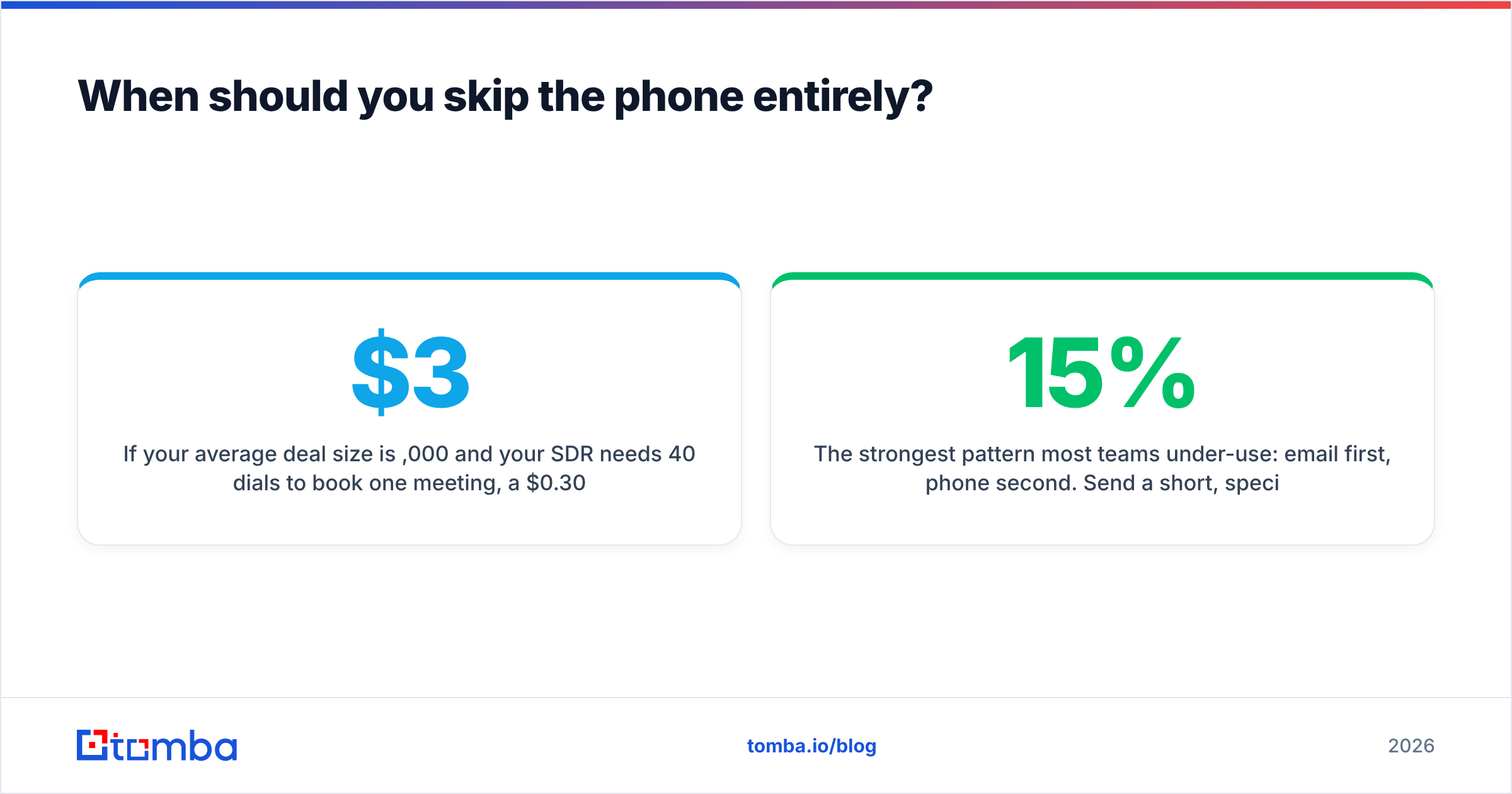
If your average deal size is $3,000 and your SDR needs 40 dials to book one meeting, a $0.30 phone credit plus rep time may cost more than the meeting is worth. If you sell $80,000 enterprise contracts to a 400-account list, a mobile number that shortens the cycle by three weeks pays for itself several times over.
Cheaper alternatives worth exhausting first: domain search to map the entire buying committee at an account and find the person who does answer email, data enrichment to add firmographics and trigger events that make an email land without a call, and LinkedIn voice notes, which reach the same person at zero data cost.
The strongest pattern most teams under-use: email first, phone second. Send a short, specific email. If it opens twice and gets no reply, then spend the phone credit. You have already qualified the interest, so the connect converts at a far higher rate — and you buy phones only for the 10-15% of the list showing signal.
Where should you start?#
Start with a list of 200 emails you genuinely want to reach, not a vendor demo. Run them through verification, then request phones, then validate line type, then count how many mobiles survived. That single number — verified mobiles per 200 real targets, divided by what you paid — is the only benchmark that matters, and it is the one no vendor will quote you.
If you want to run that test without a seat commitment or an annual contract, start with the Tomba Email Finder. The free tier gives you 25 searches a month to check whether your target segment is covered at all, email finding, verification, phone lookup, and enrichment share a single credit pool, and the Tomba API lets you wire the whole sequence into your CRM so enrichment happens on record creation instead of in a spreadsheet someone forgets to update. Test your own list, measure your own match rate, and buy on evidence rather than on a coverage claim.
Related guides#
Ready to find emails that actually work?
Join 150,000+ professionals who stopped guessing and started sending. Free credits on signup — no credit card required.
Get the Tomba newsletter
Practical outbound tactics and product updates — once every two weeks.
About the author