Email Tracking GDPR Rules: What's Legal in 2026 (Guide)
Open pixels, click redirects, and read receipts all process personal data. Here is what GDPR and ePrivacy actually require in 2026, what regulators have fined, and how to run tracking that survives a complaint.
Email tracking GDPR rules come down to one question: did the reader agree to be measured? Here is what the law says in 2026, and what to change today.
TL;DR
- Open pixels and click-redirect links process personal data. In most EU states they also trigger the ePrivacy consent rule — the same one that covers cookies.
- Legitimate interest can cover sending a B2B cold email in several countries. It rarely covers invisible tracking of the open. These are two separate questions.
- Regulators have been clear since 2023: silent pixels in marketing mail need prior opt-in consent. France's CNIL and Germany's DSK both say so in writing.
- Apple Mail Privacy Protection and Gmail image proxies already inflate open rates. So the legal risk buys you a number you cannot trust.
- The safer 2026 stack: drop open pixels, keep consented click tracking, and spend the time on better contact data.
This is a practitioner's guide, not legal advice. If you send at volume into the EU, run your final setup past counsel.
What do email tracking GDPR rules actually say?#
Nothing, directly. GDPR never names pixels, beacons, or read receipts. It sets rules for processing personal data. Email tracking is one more processing activity.
Think of a shop camera pointed at the door. The camera is not illegal. What matters is whether you told people about it, why you film, and how long you keep the tape. A tracking pixel is that camera. It is invisible, and it sits inside a message the reader let into their inbox.
Three parts of the regulation do the heavy lifting:
- Article 6 — lawful basis. Every processing operation needs one of six bases. For tracking, the real options are consent (6(1)(a)) or legitimate interests (6(1)(f)).
- Articles 13 and 14 — transparency. The reader must be able to learn that tracking happens, who does it, and why. A privacy policy that never says "we record when you open our emails" fails this test.
- Article 5(1)(c) — data minimisation. Logging IP, device, location, and a timestamp for every open, forever, is hard to defend. The stated purpose is only "measure campaign performance".
You can read the full text of Article 6 on gdpr-info.eu if you want the exact wording.
Is an open-tracking pixel personal data?#
Yes, in almost every real setup.
A tracking pixel is a 1×1 transparent image. Its URL holds a unique ID tied to one recipient. When the mail client loads the image, your server logs the request. That request carries an IP address, a user-agent string, and the ID that points back to a named person in your CRM.
The ID alone is enough. Recital 26 treats data as personal when a person can be singled out, directly or indirectly. A pixel URL like track.example.com/o/8f3c2a is a textbook online identifier. The law lists that category next to cookies and device IDs.
Click tracking is the same story in a different wrapper. Replacing https://yoursite.com/pricing with https://track.example.com/c/8f3c2a?u=... records who clicked what and when, tied to an identity.
So the question is never "is this personal data". It is "what is my basis, and did I tell anyone".
Do email tracking GDPR rules require consent?#
Usually yes — and the reason surprises people. GDPR is not what forces the issue. ePrivacy is.
Article 5(3) of the ePrivacy Directive covers storing or reading information on a user's device. Both need prior informed consent. That is the cookie rule. Regulators have held again and again that it also covers pixels, beacons, and any trick that makes a device fetch a remote file for measurement.
So even a strong legitimate-interest assessment is not enough. In most member states, ePrivacy consent sits on top of it. You clear one hurdle and the next one is still there.
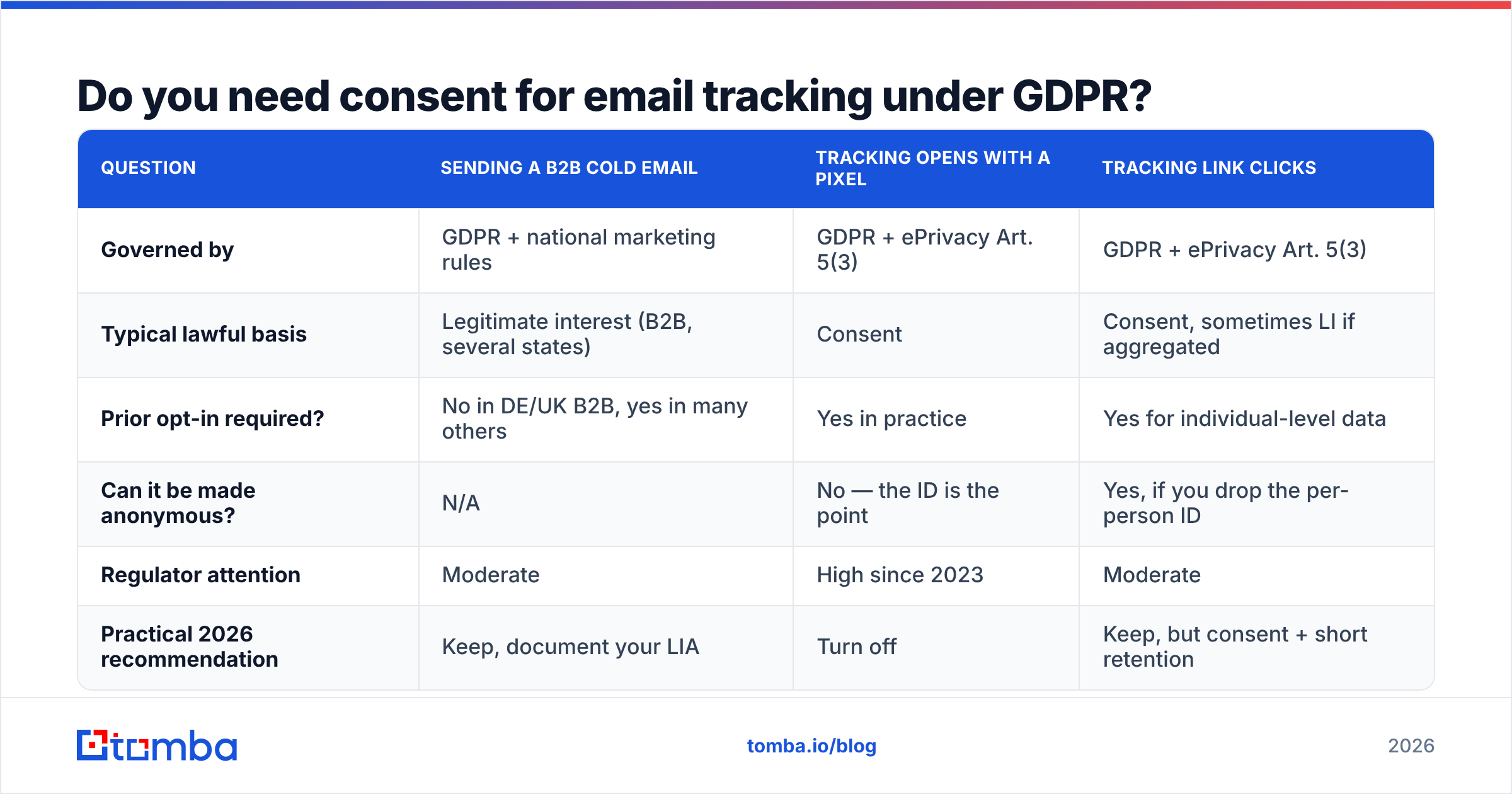
| Question | Sending a B2B cold email | Tracking opens with a pixel | Tracking link clicks |
|---|---|---|---|
| Governed by | GDPR + national marketing rules | GDPR + ePrivacy Art. 5(3) | GDPR + ePrivacy Art. 5(3) |
| Typical lawful basis | Legitimate interest (B2B, several states) | Consent | Consent, sometimes LI if aggregated |
| Prior opt-in required? | No in DE/UK B2B, yes in many others | Yes in practice | Yes for individual-level data |
| Can it be made anonymous? | N/A | No — the ID is the point | Yes, if you drop the per-person ID |
| Regulator attention | Moderate | High since 2023 | Moderate |
| Practical 2026 recommendation | Keep, document your LIA | Turn off | Keep, but consent + short retention |
Two national positions set the tone for everyone else:
- France (CNIL). The regulator says tracking pixels in marketing email fall under the same consent rules as cookies. It has also run sweeps on email trackers. Its cookies and trackers guidance is the reference document.
- The EDPB. Its guidelines on the technical scope of Article 5(3) pull pixels and tracked URLs inside the consent perimeter. That closes the "it's not a cookie" argument. The EDPB guidelines library is worth a bookmark.
What is the difference between GDPR consent and "we mentioned it in the footer"?#
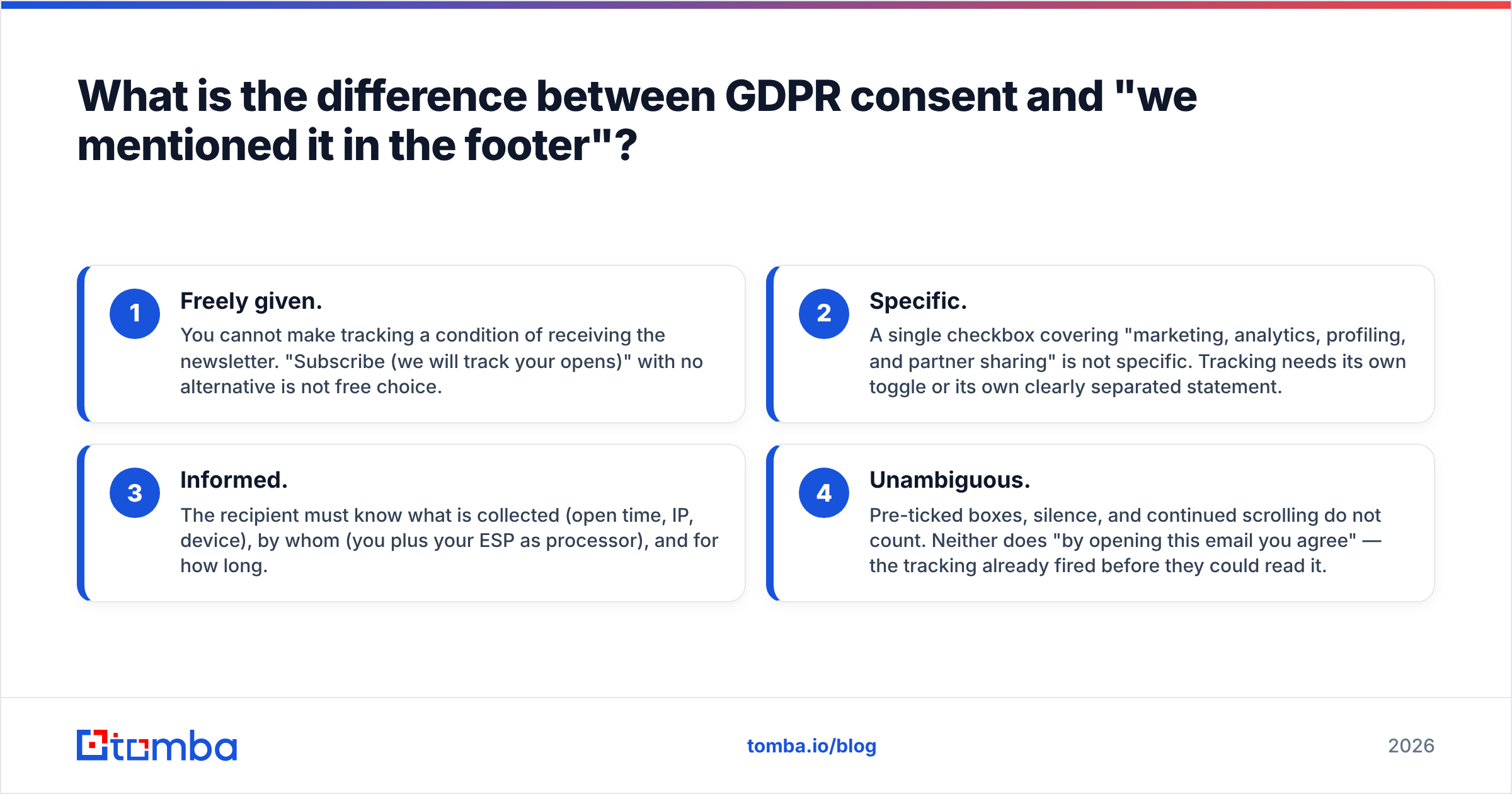
Consent under Article 4(11) has four properties. Most email programs fail at least two.
- Freely given. You cannot make tracking a condition of receiving the newsletter. "Subscribe (we will track your opens)" with no alternative is not free choice.
- Specific. A single checkbox covering "marketing, analytics, profiling, and partner sharing" is not specific. Tracking needs its own toggle, or its own clearly separated statement.
- Informed. The reader must know what is collected (open time, IP, device), by whom (you plus your ESP as processor), and for how long.
- Unambiguous. Pre-ticked boxes, silence, and continued scrolling do not count. Neither does "by opening this email you agree" — the tracking already fired before they could read it.
Two operational rules get forgotten. Consent must be as easy to withdraw as to give. And you must be able to prove it later. That means a timestamped consent log tied to the contact record, not a memory that the form had a checkbox in 2024.
A workable pattern looks like this:
- Signup form carries a separate, unticked "Allow us to measure engagement with our emails" option with a one-line explanation.
- Preference centre lets the contact flip that toggle at any time, and the change reaches the ESP within minutes, not at the next quarterly sync.
- Suppression logic in the sending platform strips pixels and rewrites links to plain URLs for anyone who has not consented — per message, not per campaign.
- Retention job deletes raw event rows after 90 days and keeps only aggregate counts.
- Privacy notice names the tracking, the processor, and the retention window in plain language.
If your ESP cannot suppress pixels per recipient, that is a real limit on your compliance. Put it in your vendor review.
Can legitimate interest cover email tracking in B2B?#
Sometimes for the send. Rarely for the pixel.
The test has three steps. Name the interest. Show the processing is needed for it. Then check that it does not override the reader's rights and expectations. Recital 47 names direct marketing as a possible legitimate interest. That is why B2B cold outreach to a work address holds up in Germany, the UK, and other states — as long as the offer fits that person's job.
Invisible tracking fails the balancing step for a simple reason: the reader does not expect it, and cannot see it. Silent watching inside a private inbox weighs against you. And the ePrivacy consent rule applies either way.
Where legitimate interest holds up better:
- Aggregate click counts with no per-person identifier — you know 12% of the send clicked, not who.
- Bounce and delivery telemetry, which is necessary to operate the service at all.
- Reply handling, because the recipient initiated it.
Where it collapses:
- Per-person open logs used to score or prioritise leads.
- Geolocation derived from pixel IPs.
- Retargeting audiences built from email engagement.
First, the list itself has to be lawful. Scraped consumer addresses and guessed personal Gmail accounts fail at step one, whatever your tracking settings. Start from verified, role-based business contacts with a documented source. A clean email verifier pass and a clear view of where the data came from help your file more than any tracking toggle.
What are the real penalties, and who has been fined?#
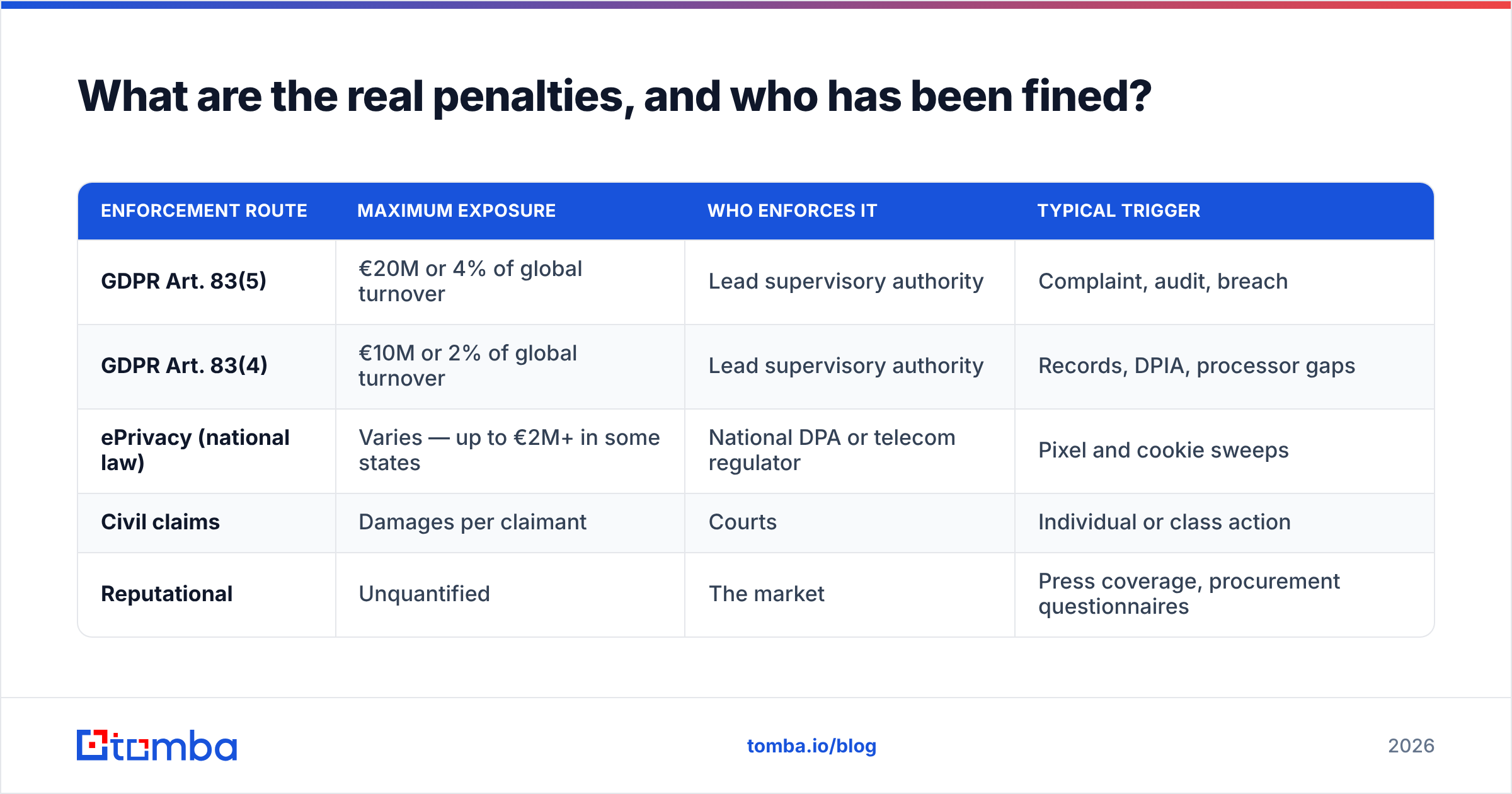
Two enforcement tracks matter here, and they carry different numbers.
| Enforcement route | Maximum exposure | Who enforces it | Typical trigger |
|---|---|---|---|
| GDPR Art. 83(5) | €20M or 4% of global turnover | Lead supervisory authority | Complaint, audit, breach |
| GDPR Art. 83(4) | €10M or 2% of global turnover | Lead supervisory authority | Records, DPIA, processor gaps |
| ePrivacy (national law) | Varies — up to €2M+ in some states | National DPA or telecom regulator | Pixel and cookie sweeps |
| Civil claims | Damages per claimant | Courts | Individual or class action |
| Reputational | Unquantified | The market | Press coverage, procurement questionnaires |
The headline nine-figure fines went to ad-tech at platform scale, not to mid-market email programs. A normal B2B sender gets something smaller: a subject access request from an annoyed prospect. If the answer is thin, a complaint follows. That complaint is cheap for them and costly for you. You must show the data you hold on that person, name your lawful basis, and produce your consent record. A tracking log full of IPs and open times with no consent trail is the worst thing to hand over.
There is a sales cost too. Enterprise buyers now ask in their security forms whether you track opens, and on what basis. "Yes, silently, everyone" is an answer that stalls deals.

Is open tracking even worth the risk in 2026?#
Technically, it stopped working years ago.
Apple Mail Privacy Protection pre-fetches images whether or not the person opened the mail. Gmail proxies images through Google servers. Security gateways click every URL in an inbound message to scan for malware. That looks like an open, and sometimes a click.
So your open rate blends three things: real people, privacy proxies, and security bots. You cannot split them apart later. Teams often see open rates jump 20 points with no change in replies. The metric moved. The business did not.
So the trade in 2026 is simple. You take on real legal risk for a number you cannot trust or compare year over year.
Better signals, ranked by how much they actually predict revenue:
- Replies, including negative ones. A "not now, ask me in Q3" is worth a hundred phantom opens.
- Consented click-throughs to a specific asset, which show what the person wanted, not that a proxy fetched an image.
- Website visits from known companies, which you can capture with visitor identification without touching the recipient's inbox at all.
- Meeting bookings — the only metric that survives every privacy change so far.
- Deliverability health: bounce rate, spam complaints, and authentication status. Fix email deliverability before you fix attribution.
What does a compliant email tracking GDPR setup look like?#
Here is the configuration most EU-facing B2B teams are converging on:
- Open pixels: off by default. Enable only for contacts with a logged, specific consent event. Many teams simply turn them off globally and stop maintaining the exception logic.
- Click tracking: on, with consent, short retention. Keep 90 days of per-person events, then collapse to aggregates. Document the retention rule in your privacy notice.
- Link domains: your own subdomain, authenticated. A shared tracking domain hurts deliverability and makes your data-flow documentation harder to write.
- One-click unsubscribe on every message, including cold outreach. Required by the major mailbox providers for bulk senders and expected by every regulator.
- Processor agreements with your ESP and any enrichment vendor, listing sub-processors and transfer mechanisms.
- A records-of-processing entry that names email engagement tracking as its own activity, not a footnote under "marketing".
Then move the effort from open-rate dashboards to list quality. Fewer, better-aimed messages to verified addresses beat measuring how a proxy behaved. Start from a verified B2B database, not a scraped export, and check each address before it enters a sequence.
How do you audit your current tracking in an afternoon?#
Run these five checks. Each takes minutes, and each maps to a question a regulator would ask.
- Send yourself a real campaign and inspect the raw HTML source. Count every remote image and every rewritten link. Anything you cannot explain is a finding.
- Grep your privacy notice for the words "open", "pixel", "beacon", or "engagement". If none appear, your transparency duty is unmet today.
- Pull one contact record and try to produce everything you hold on them in under an hour. That is the subject access request drill.
- Check your consent log for a timestamp, a source, and the exact wording shown at the time. "TRUE" in a spreadsheet column is not a record.
- Ask your ESP whether pixel injection can be switched off per recipient. Get the answer in writing.
Most teams find the same two gaps: no per-recipient suppression, and no retention limit on event data. Both are fixable in a sprint.
Where should you spend the effort instead?#
Compliance work and pipeline work point in the same direction: send less, to better-chosen people, with data you can defend.
That starts with knowing the address is real and tied to a business role you can justify contacting. Tomba's email finder finds work addresses from a domain or a name and verifies them before they enter a sequence. Each record comes with a documented source. That is what you need in the "where did you get my data" conversation. The free tier covers 25 searches a month. Starter is $49/mo, Growth $99/mo, and Pro $249/mo; see full Tomba pricing on the site.
Turn off the pixel. Keep the consent log. Spend the difference on accuracy.
Related guides#
Ready to find emails that actually work?
Join 150,000+ professionals who stopped guessing and started sending. Free credits on signup — no credit card required.
Get the Tomba newsletter
Practical outbound tactics and product updates — once every two weeks.
About the author