Emailable vs Zintlr in 2026: Which Tool Should You Pick
Emailable verifies email lists. Zintlr finds contacts and profiles them. Comparing them head-to-head only makes sense once you know which half of the outbound problem you actually have — here is the honest breakdown.
Emailable vs Zintlr is a strange match-up. One tool cleans a list you already own. The other builds a list from scratch. This guide shows which gap each one fills.
TL;DR
- Emailable is a dedicated email verification service. Zintlr is a B2B contact database with a browser extension and a personality layer. They overlap on maybe 20% of their features.
- Bounce rate at 6% and Google throttling you? Emailable fits. No list at all? Zintlr fits.
- Emailable wins on check depth, SMTP probes, and a mature API. Zintlr wins on breadth: emails, phone numbers, company data, and prospect insight in one seat.
- Neither tool is a great single answer if you need both jobs. So teams often pay twice, or move to one platform that does both.
- Quick pick in the Emailable vs Zintlr debate: cleaning work goes to Emailable. List building goes to Zintlr. Both jobs on one bill goes to a finder plus verifier stack.
What are Emailable and Zintlr, exactly?#
They solve different halves of the same funnel. That is why most Emailable vs Zintlr write-ups read like nonsense.
Emailable is an email verification specialist. You feed it a list by CSV, API, or integration. It returns a verdict per address: deliverable, undeliverable, risky, or unknown. It runs syntax checks, DNS and MX lookups, and disposable-domain checks. It flags role accounts and probes the mailbox at the SMTP layer. It also sells a live API for forms, so junk never reaches your CRM.
Zintlr is a prospecting data platform. It pairs a B2B contact database with a Chrome extension called Zint. The extension surfaces emails, direct dials, and company data while you browse LinkedIn. Its stand-out feature is Personax. Personax reads public signals and guesses personality traits, so you can match your tone. Verification exists here, but it is a side feature.
Here is the simple way to hold the Emailable vs Zintlr split in your head:
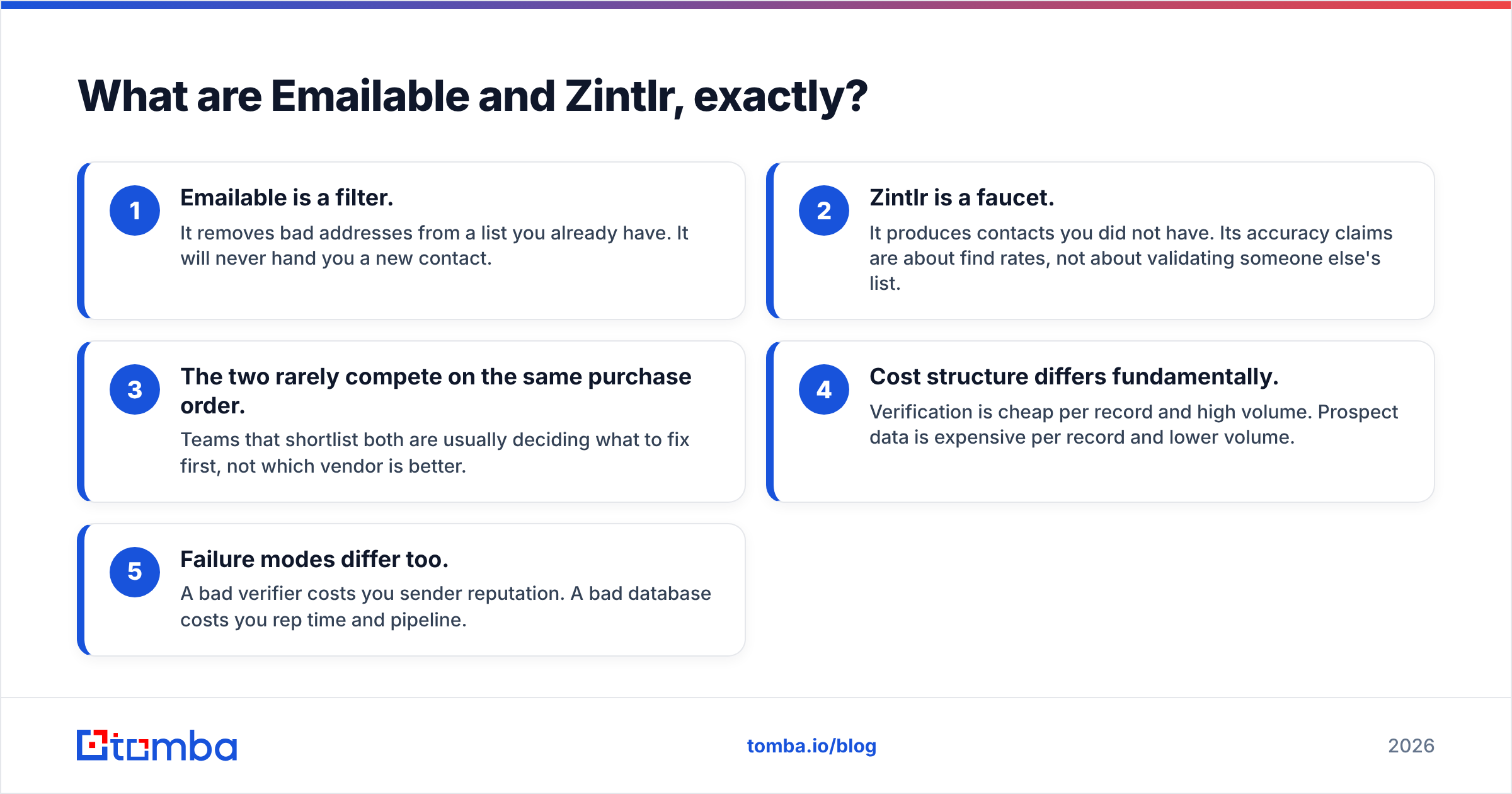
- Emailable is a filter. It strips bad addresses from a list you own. It will never hand you a new contact.
- Zintlr is a faucet. It produces contacts you did not have. Its accuracy claims cover find rates, not someone else's list.
- The two rarely compete on one purchase order. Teams that shortlist both are choosing what to fix first.
- Cost works differently. Verification is cheap per record and high volume. Prospect data costs far more per record.
- Failure modes differ too. A weak verifier costs you sender reputation. A weak database costs you rep time.

Emailable vs Zintlr: how do they compare head-to-head?#
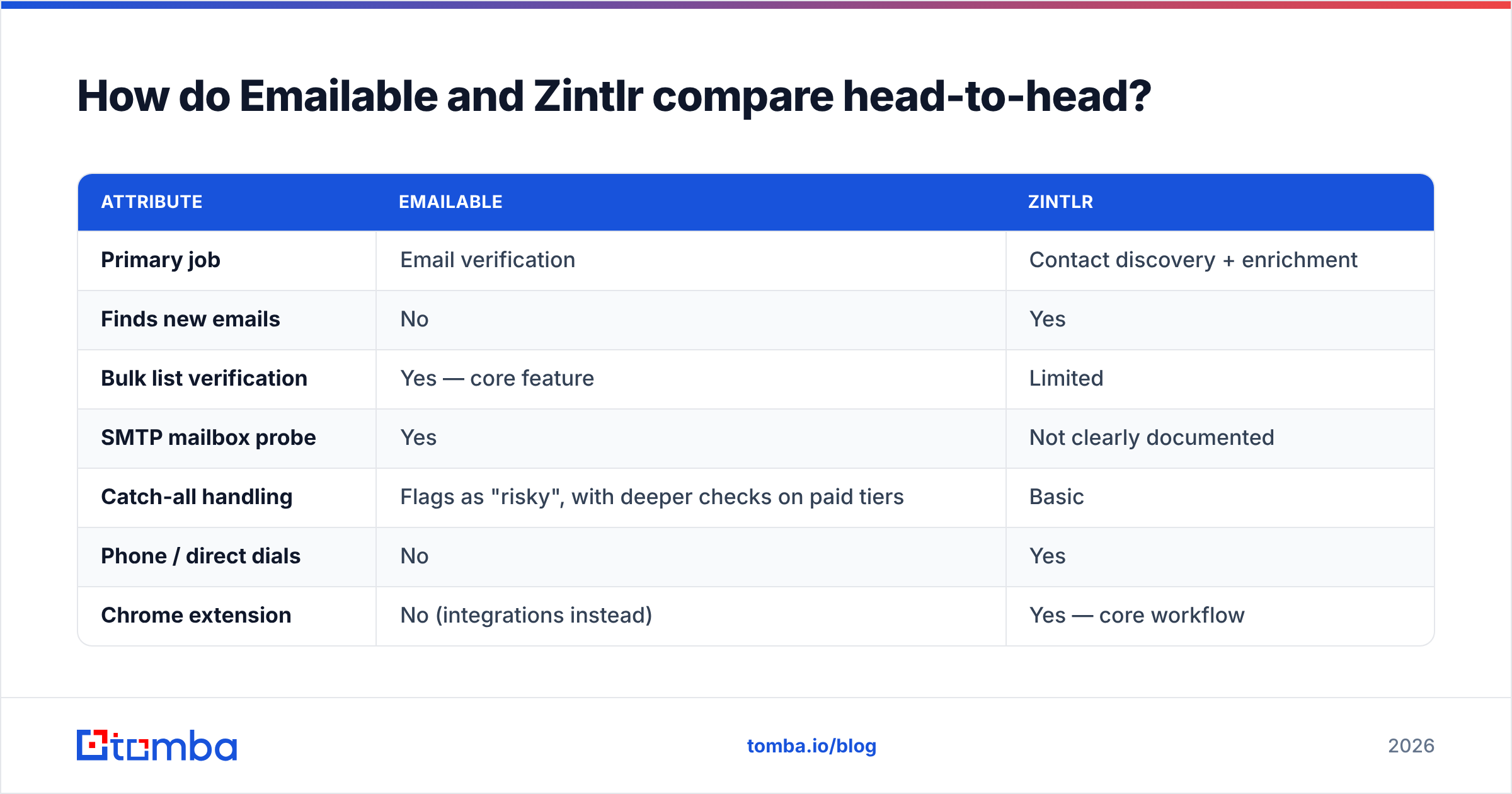
| Attribute | Emailable | Zintlr |
|---|---|---|
| Primary job | Email verification | Contact discovery + enrichment |
| Finds new emails | No | Yes |
| Bulk list verification | Yes — core feature | Limited |
| SMTP mailbox probe | Yes | Not clearly documented |
| Catch-all handling | Flags as risky, with deeper checks on paid tiers | Basic |
| Phone / direct dials | No | Yes |
| Chrome extension | No (integrations instead) | Yes — core workflow |
| Personality / intent data | No | Yes (Personax) |
| Public API | Mature, well documented | Available, thinner docs |
| Free entry point | 250 free credits | Limited free trial credits |
| Best for | Deliverability teams, RevOps, form validation | SDRs building lists from scratch |
| Weak spot | Zero list building | Verification depth |

The table makes the verdict obvious. This is not a feature race. It is a category mismatch. Emailable goes deeper on the one job it owns. Zintlr goes wider but shallower.
One nuance matters. Zintlr coverage skews toward India and the wider APAC region. That helps a lot if you sell there. It hurts if you sell only into North America or Western Europe. Check coverage on your own ICP first. Pull 50 target accounts, run a trial, and count the hits. Published find rates are averages across a whole database, not across your niche.
Which tool is more accurate, and how would you know?#
Accuracy means two different things here. Vendors lean on that gap.
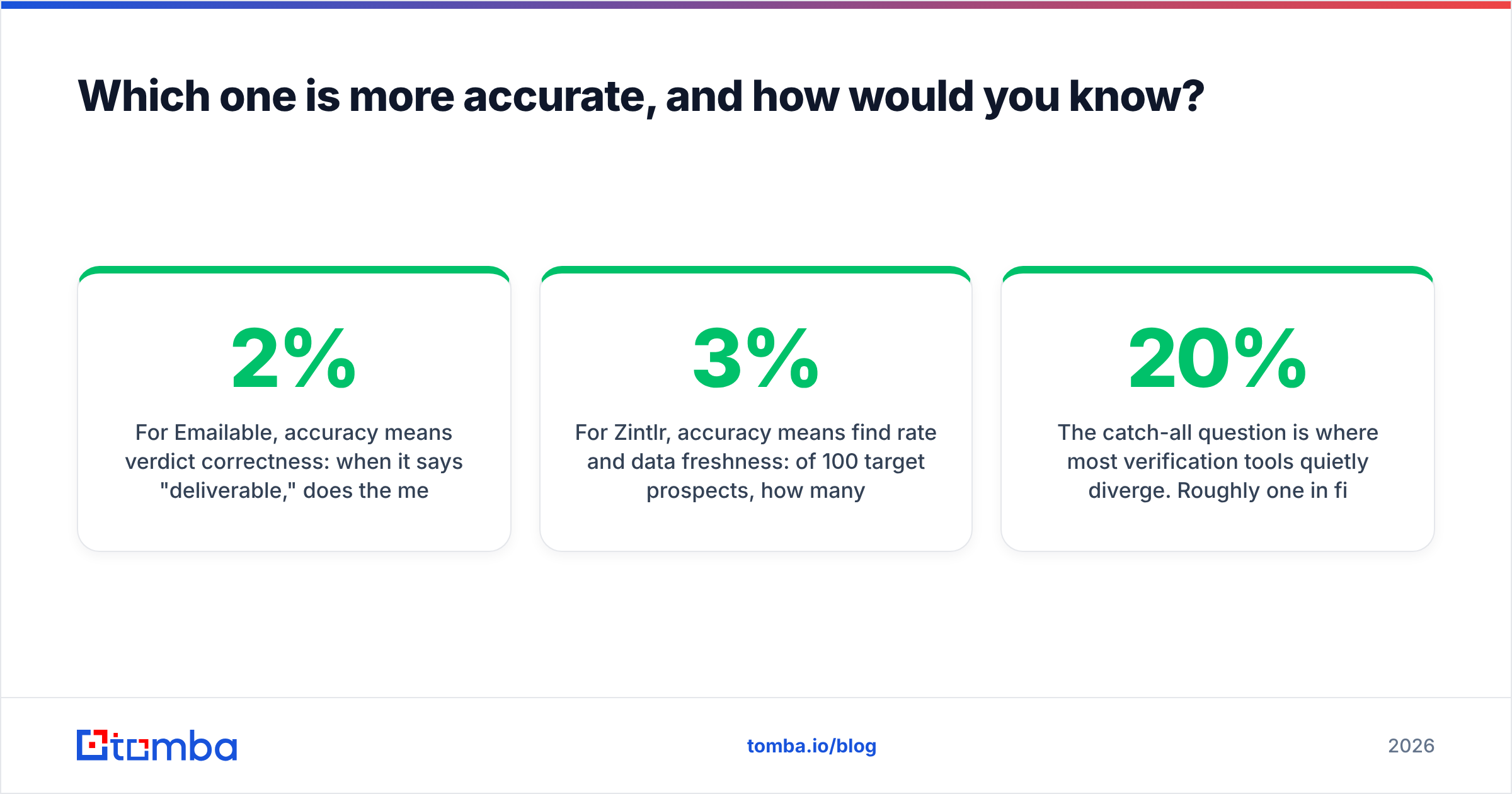
For Emailable, accuracy means verdict correctness. When it says deliverable, does the message land? Emailable publishes figures in the high 90s. Serious verifiers all claim numbers in that range. The number that matters is your own bounce rate after a send. Under 2% means the tool is working. Near 4% means you have a catch-all problem it cannot solve.
For Zintlr, accuracy means find rate and freshness. Of 100 target prospects, how many emails come back? And how many still work six months later? B2B contact data decays about 2-3% per month as people change jobs. A database that shone in 2024 can be average in 2026.
Run this test before you settle the Emailable vs Zintlr question with money:
- Build a 100-row control set from your real ICP. Use named people at named companies.
- Run it through both trials. Emailable gets addresses you hold. Zintlr gets names and domains.
- Count coverage, not confidence. Unknown and risky results are misses when you plan.
- Send a small warm-up batch to the deliverable group. Log hard bounces within 48 hours.
- Repeat in 90 days with the same list to measure decay.
The test costs you an afternoon. It settles the argument better than any review site. Cross-check both vendors on G2 before you sign an annual deal. Weight recent reviews far above old ones.
Catch-all domains are where verifiers quietly split. Roughly one in five B2B domains accepts every address at the SMTP layer. A standard probe tells you nothing there. Emailable flags these as risky and adds extra checks. Zintlr does less. If many of your contacts sit on catch-all domains, add a dedicated catch-all verifier. That holds true whichever side of Emailable vs Zintlr you land on.

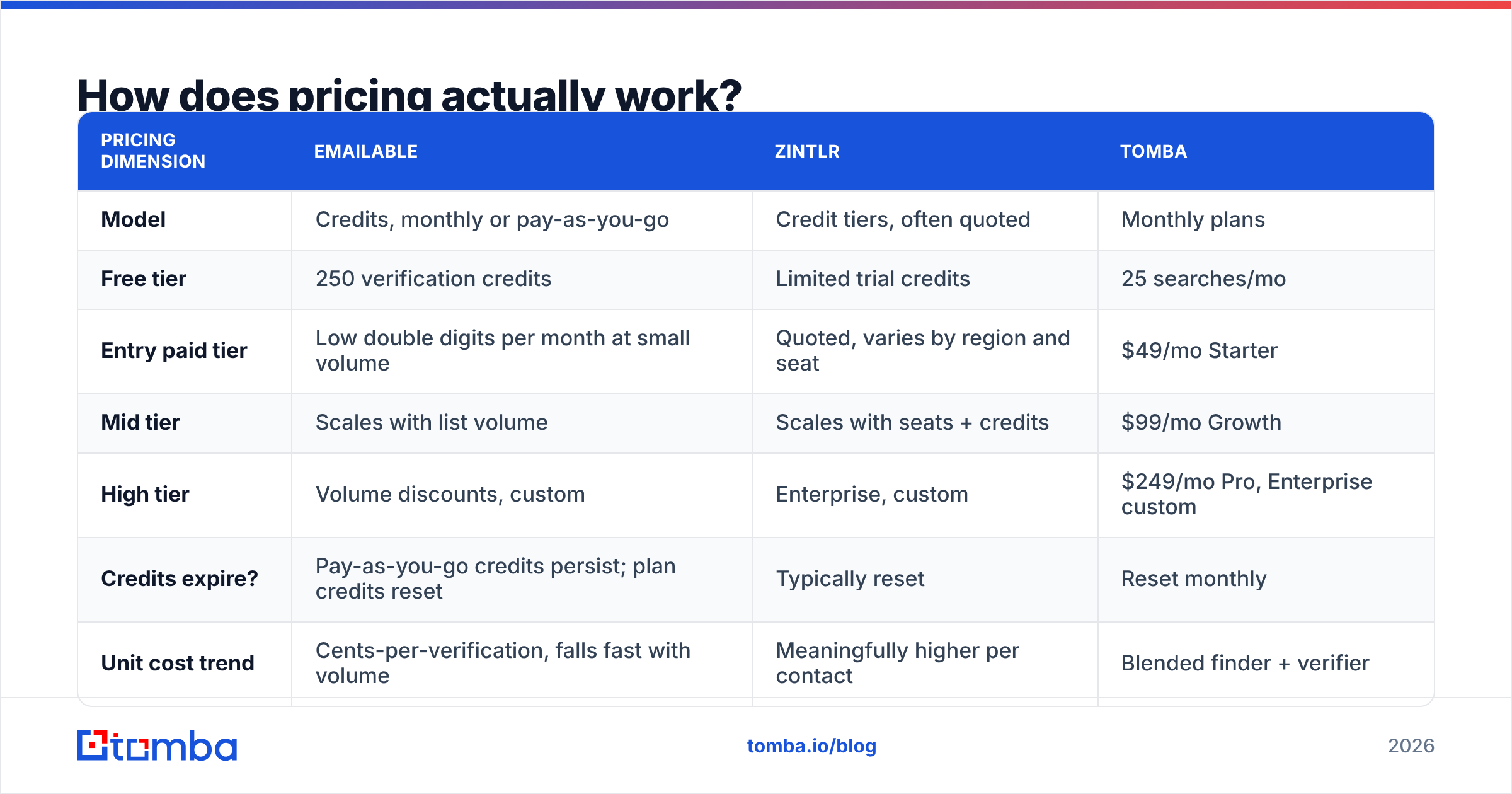
How does Emailable vs Zintlr pricing actually work?#
Both sell credits. The credit math is not comparable.
| Pricing dimension | Emailable | Zintlr | Tomba |
|---|---|---|---|
| Model | Credits, monthly or pay-as-you-go | Credit tiers, often quoted | Monthly plans |
| Free tier | 250 verification credits | Limited trial credits | 25 searches/mo |
| Entry paid tier | Low double digits per month at small volume | Quoted, varies by region and seat | $49/mo Starter |
| Mid tier | Scales with list volume | Scales with seats + credits | $99/mo Growth |
| High tier | Volume discounts, custom | Enterprise, custom | $249/mo Pro, Enterprise custom |
| Credits expire? | Pay-as-you-go credits persist; plan credits reset | Typically reset | Reset monthly |
| Unit cost trend | Cents-per-verification, falls fast with volume | Meaningfully higher per contact | Blended finder + verifier |
Two things to watch. First, verification credits and discovery credits are not the same currency. One verified address is worth a fraction of one sourced contact. So a cheaper-per-credit headline can mislead you either way. Second, check whether unused credits roll over. A plan that resets each month is use-it-or-lose-it. Teams with lumpy campaigns burn real money there.
Confirm prices on each vendor site before you budget. Both firms have changed tiers more than once. Any number in a blog post has a shelf life, including this one. For reference, Tomba pricing is public and flat: Free at 25 searches a month, Starter $49, Growth $99, Pro $249, Enterprise custom.
Is Emailable better than Zintlr for cold email?#
For the delivery half, yes. For the list-building half, no. Here is the split by job.
Choose Emailable when:
- You bought or inherited a list and need it clean before you send.
- Bounce rates sit above 3% and you must protect sender reputation now.
- You want live API checks on signup and demo forms.
- Your work is high volume and low touch: tens of thousands of addresses a month.
- You already like your data source and only need the filter.
Choose Zintlr when:
- You start from zero: a persona and target accounts, but no contacts.
- Your reps live in LinkedIn and want one-click grabs, not batch jobs.
- You need direct dials next to emails for multi-channel outreach.
- Your ICP sits in regions where Zintlr coverage is strongest.
- The personality layer really changes how your team writes.
Choose neither when you need both jobs done well and cannot justify two bills plus the CSV shuffle between them. That is the usual spot for a sales team of two to ten people. A combined stack wins there on total cost, not on any single feature.
Where does each tool fall short?#
The Emailable limit is structural, not a defect. It is a filter with no faucet. Run out of prospects and it cannot help. You still need an email finder or a database upstream. Its integrations are solid, but they assume a source system exists. And like every verifier, it cannot settle catch-all domains for sure. It can only rank the odds.
The Zintlr limits are the usual database limits. Coverage is uneven by region and by seniority. You will find VPs at mid-market SaaS firms more often than plant managers at factories. Verification is not deep enough to be your last gate before a send. So you will likely pair it with a verifier anyway. Personax is a real differentiator, but it infers traits from public signals. Treat it as a tie-breaker on tone, not as a forecast input.
Both share one flaw worth naming: you cannot audit their data. Ask each vendor where the data comes from and how often it refreshes. Any provider that dodges the question should lose points. Tomba publishes its data sources for that reason. Hold every vendor to the same bar, including us.
Do you need a third option instead?#
Often, yes. This is also where our bias shows, so weigh it as you like.
Maybe your real need reads like this: find verified B2B emails at target companies, in bulk, through an API your engineers do not hate. That describes a combined finder and verifier. Neither side of Emailable vs Zintlr covers it alone. That category includes Tomba, Hunter, Findymail, and others. Judge them on six points:
- Find rate on your ICP. Measure it on your own control list, not a vendor benchmark.
- Verification inside the same credit. You should not pay twice per contact.
- Bulk and API parity. A UI-only tool caps out the moment you automate.
- A clear catch-all policy. Explicit handling beats a silent risky label.
- Flat, public pricing. Quote-only pricing usually scales badly for you.
- Native destinations. CRM, sheets, and sequencer links without middleware.
A combined platform usually beats a two-tool stack under about 20 reps. Above that, specialists pay off again. Big delivery programs gain from a dedicated verifier like Emailable as a final gate. Big SDR floors gain from a dedicated discovery layer. Team size should drive that call, not a feature checklist. BookYourData also belongs on a serious shortlist. It sells ready-made, pre-verified lists. That is a different buying motion, but a fair one on a deadline.
Emailable vs Zintlr: which should you choose in 2026?#
Verdict: pick Emailable if you have a list and need it clean. Pick Zintlr if you need the list itself and sell into its strong regions. Pick neither if you need both jobs and one invoice.
The classic mistake is buying a discovery tool to fix a delivery problem, or the reverse. Diagnose first. Pull your last 5,000 sends. Compare hard bounce rate against coverage rate. High bounces point to a verification gap. Clean sends at low volume point to a sourcing gap. Each tool fixes only one of those.
Whatever you pick, keep verification as its own gate. Do not trust a database to have done it. Run every list through an email verifier before it touches your sending domain. Cap daily volume per mailbox. Check email deliverability every week. The habit matters more than the tool.
Want to test the combined route first? Start with the Tomba Email Finder. The free tier gives you 25 searches a month with verification included. That is enough to run the 100-row control test on your real ICP. If coverage beats Zintlr and the verdicts hold up like Emailable does, you have merged two line items into one. If not, you learned it from data rather than from a comparison post. Either way, the Emailable vs Zintlr choice stops being a guess.
Related guides#
Ready to find emails that actually work?
Join 150,000+ professionals who stopped guessing and started sending. Free credits on signup — no credit card required.
Get the Tomba newsletter
Practical outbound tactics and product updates — once every two weeks.
About the author