Emailchaser vs UpLead 2026: Which Outbound Tool Wins?
Emailchaser sends cold email. UpLead sells verified contact data. They get compared constantly but solve different halves of outbound — here's which one you actually need in 2026, and what neither gives you.
TL;DR
- They are not the same category. Emailchaser is cold email sending software (sequences, inbox rotation, reply detection). UpLead is a B2B contact database you buy records from. Comparing them head-to-head is like comparing a delivery van to a warehouse.
- Pick Emailchaser if you already have a list and need to send, track, and follow up without paying enterprise sequencer prices.
- Pick UpLead if your bottleneck is who to email — you need filtered, firmographic-rich records with a verify-before-you-spend-a-credit model.
- Most teams end up needing both halves, which is where the real cost problem shows up: two subscriptions, two credit systems, two places for data to rot.
- The cheaper middle path is a dedicated finder/verifier layer feeding a sending tool you already pay for. That's the recommendation at the end, and it's not a coincidence it costs less than either full stack.
What are Emailchaser and UpLead, actually?#
Start here, because the entire comparison collapses if you get this wrong.
Emailchaser is a cold email outreach platform. You connect mailboxes, upload or find contacts, build a multi-step sequence, and it handles the sending cadence, the automatic follow-ups, and — critically — stopping the sequence when someone replies. It positions itself as the no-nonsense, no-per-seat-tax alternative to the big sequencers. Its email-finding feature exists, but it's a convenience layer, not the product's center of gravity.
UpLead is a B2B prospecting database. You filter a catalog of tens of millions of contacts by industry, headcount, technology used, job title, revenue band, and location, then reveal contacts by spending credits. Its headline differentiator is real-time verification: UpLead checks the address at the moment you reveal it and, per its own policy, doesn't charge you a credit for a record it can't verify. It does not send your email for you.
So the honest framing of Emailchaser vs UpLead is: one is the mouth, the other is the food. People compare them because both show up in the same "cold outreach tools" listicles on G2, not because they overlap functionally.
Where they do overlap: both touch contact data, both charge on credits, and both will happily let you build a bad list and burn a domain with it.
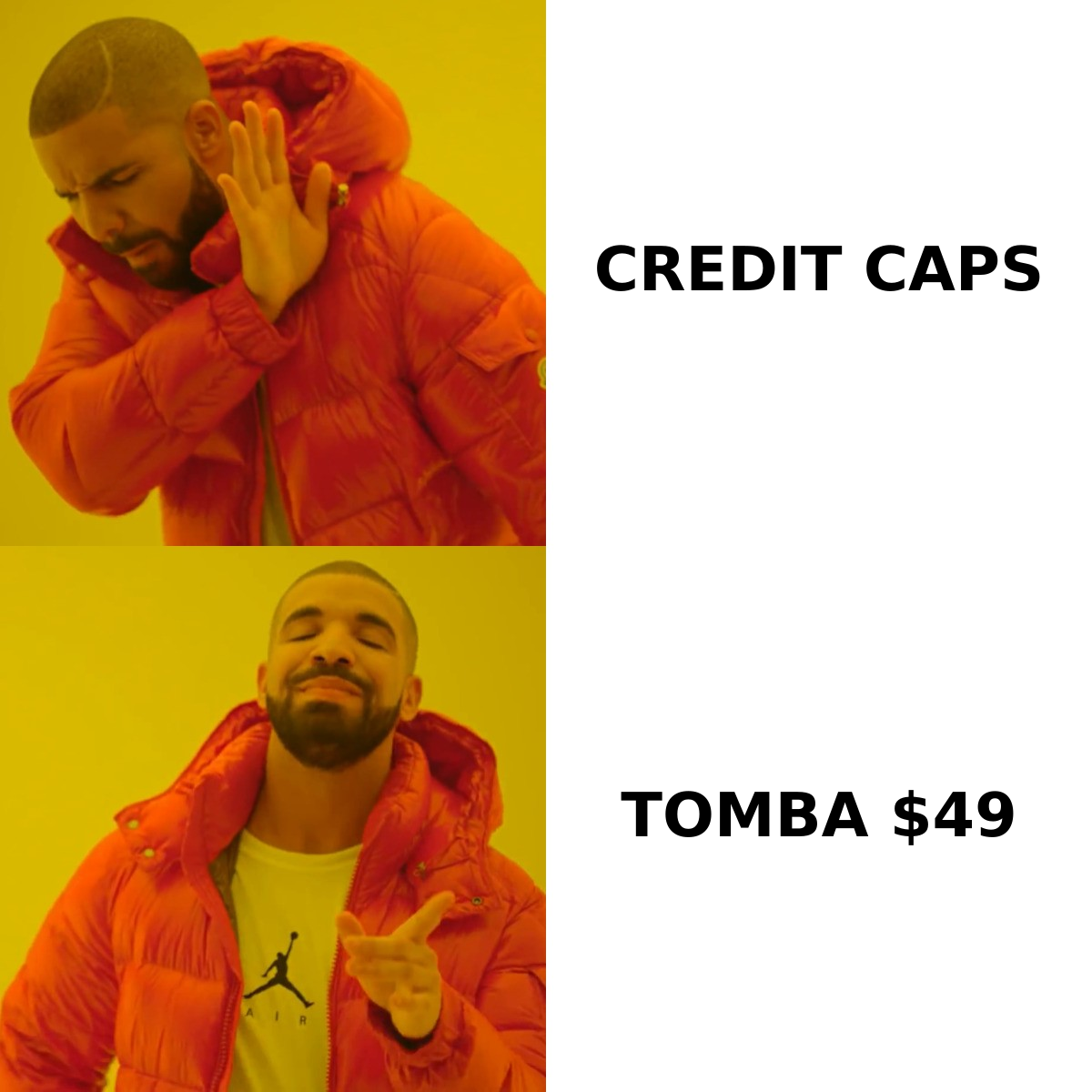
How do Emailchaser and UpLead compare head to head?#
| Dimension | Emailchaser | UpLead |
|---|---|---|
| Primary job | Send + follow up on cold email | Source + verify B2B contacts |
| Core asset | Sending infrastructure, sequences | Contact database (~100M+ records claimed) |
| Email finding | Secondary feature | Core feature |
| Email verification | Basic list hygiene | Real-time, credit refunded on unverifiable |
| Firmographic filters | Minimal | Extensive (industry, tech stack, revenue, headcount) |
| Intent data | No | Available on higher tiers |
| Sequencing / auto follow-up | Yes — the whole point | No |
| Inbox rotation | Yes | N/A |
| Reply detection | Yes | N/A |
| CRM push | Yes | Yes (HubSpot, Salesforce, Pipedrive, Outreach) |
| Per-seat pricing | No seat tax on most plans | Seats limited by tier |
| Typical entry cost | Low double-digit to ~$50/mo range | ~$99/mo published entry tier |
| Who it's for | Founders, agencies, lean SDR teams | Sales teams that need list-building at volume |
| What it does NOT do | Give you a filtered prospect universe | Send a single email |
Two things jump out of that table.
First, there is no row where they compete directly except email finding, and neither one wins that row convincingly — UpLead is stronger on breadth, Emailchaser is stronger on "it's already in the tool I'm sending from."
Second, the pricing comparison is misleading if you read it flat. Emailchaser looks dramatically cheaper. It is — for what it does. Add a data source on top and the gap narrows fast.
Is UpLead's data accuracy claim real?#
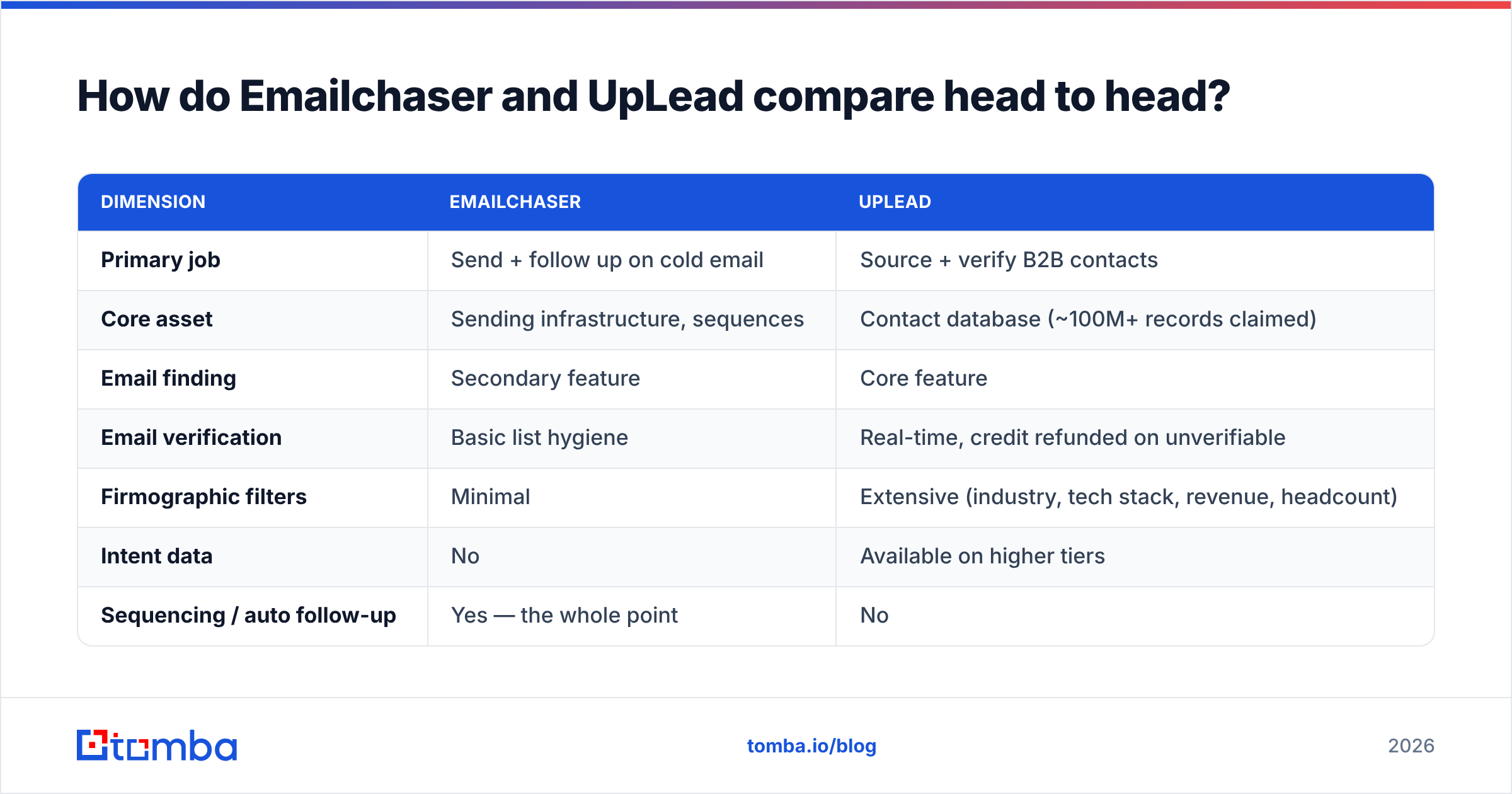
UpLead markets a 95% data accuracy guarantee, and its real-time verification-on-reveal model is genuinely one of the better credit policies in the category. When you reveal a contact, it runs an SMTP-level check right then. If the mailbox doesn't validate, you're not charged.
That's a meaningful protection, and it's more honest than vendors who sell you a static CSV and shrug at your bounce report.
But read the guarantee precisely. A 95% accuracy claim is a statement about the deliverability of the mailbox at reveal time, not about:
- Whether the person still works there. Job-change churn in B2B runs roughly 20–30% annually depending on segment. A perfectly valid mailbox belonging to someone who left in March is a verified dead end.
- Whether the record is the right contact. Verified
info@at the target company is technically valid and practically worthless. - Catch-all domains. Roughly a fifth of B2B domains accept everything at the SMTP layer. "Verified" against a catch-all means "the server didn't say no," which is not the same as "a human reads this." This is exactly why a dedicated catch-all verifier exists as a separate discipline.
- Age of the underlying record. Verification checks the mailbox; it doesn't re-check the title, the seniority, or the company headcount that you filtered on three tiers up.
None of this makes UpLead bad. It makes UpLead normal. Any database vendor faces the same physics. What it means practically: budget for a second verification pass before you send at volume, especially on records older than 90 days, and especially on catch-all domains. Running your export through an independent email verifier before it hits a sequencer is cheap insurance against the one thing you cannot buy back — sender reputation.
Emailchaser, for its part, doesn't make a big data-accuracy claim, because data isn't what it sells. If you bring a dirty list, Emailchaser will send it. That's on you.
What does Emailchaser get right that bigger sequencers don't?#
Three things, and they're worth naming because they're the real reason people shortlist it.
- No per-seat extortion. Most outbound platforms scale price by seat, which punishes agencies and small teams that need five logins and don't need five times the sending. Emailchaser's flat-ish model removes that.
- Inbox rotation is standard, not a premium unlock. Spreading volume across multiple connected mailboxes is table stakes for staying deliverable in 2026 post-Google/Yahoo bulk-sender enforcement. Charging extra for it is a tax on doing outbound correctly.
- Reply detection that actually stops the sequence. Sounds basic. Isn't. The number of prospects who reply "not interested" and then receive follow-up #3 four days later is the single most common self-inflicted brand wound in cold email.
What it doesn't get right: discovery. Emailchaser gives you a place to put a list, not a way to build one from a hypothesis like "Series B fintechs in DACH with 50–200 headcount running Segment." That's an UpLead-shaped job.
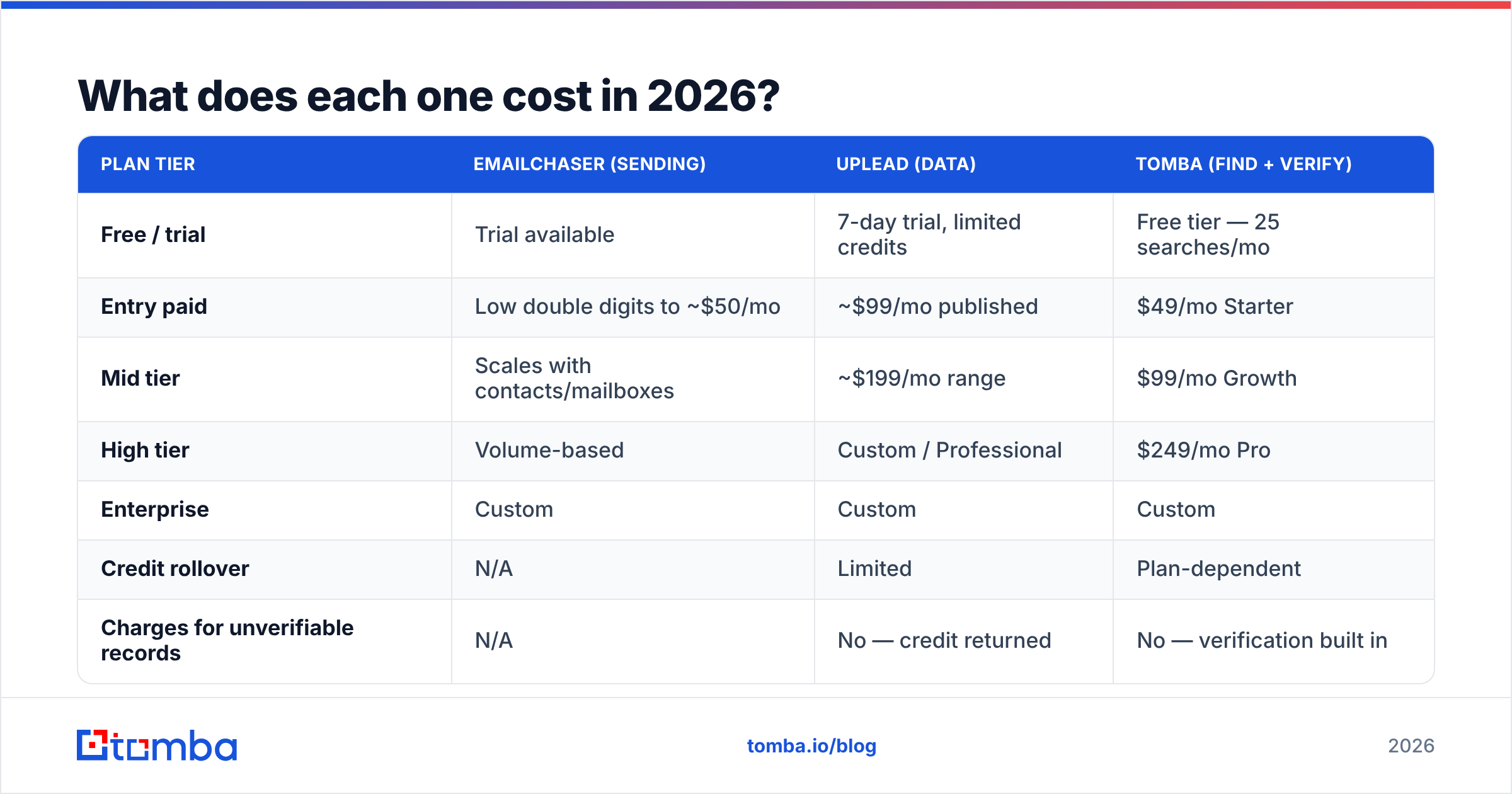
What does each one cost in 2026?#
Prices move. Check both vendors' pricing pages before you commit — the shape of the model matters more than the exact number.
| Plan tier | Emailchaser (sending) | UpLead (data) | Tomba (find + verify) |
|---|---|---|---|
| Free / trial | Trial available | 7-day trial, limited credits | Free tier — 25 searches/mo |
| Entry paid | Low double digits to ~$50/mo | ~$99/mo published | $49/mo Starter |
| Mid tier | Scales with contacts/mailboxes | ~$199/mo range | $99/mo Growth |
| High tier | Volume-based | Custom / Professional | $249/mo Pro |
| Enterprise | Custom | Custom | Custom |
| Credit rollover | N/A | Limited | Plan-dependent |
| Charges for unverifiable records | N/A | No — credit returned | No — verification built in |
| API access | Limited | Yes, higher tiers | Yes, all paid tiers |
The number that matters isn't the sticker price on either — it's cost per usable contact that actually gets emailed. Run that math:
- Buy 1,000 UpLead credits. Assume ~90% resolve to a usable, still-employed, non-generic contact after your own filtering. That's 900.
- Push those into a sender. Assume a further 3–5% bounce because the record aged between reveal and send.
- You're paying database-tier pricing for roughly 860 live sends.
Now compare that against a dedicated finder at $49/mo Starter feeding the same sequencer. The finder doesn't give you the firmographic filtering — you bring the target account list from LinkedIn, a conference attendee page, or a funding announcement — but the per-contact cost drops sharply, and verification is part of the lookup rather than a separate purchase.
That trade is the whole decision: are you paying for discovery, or for resolution?
Which one should you pick?#
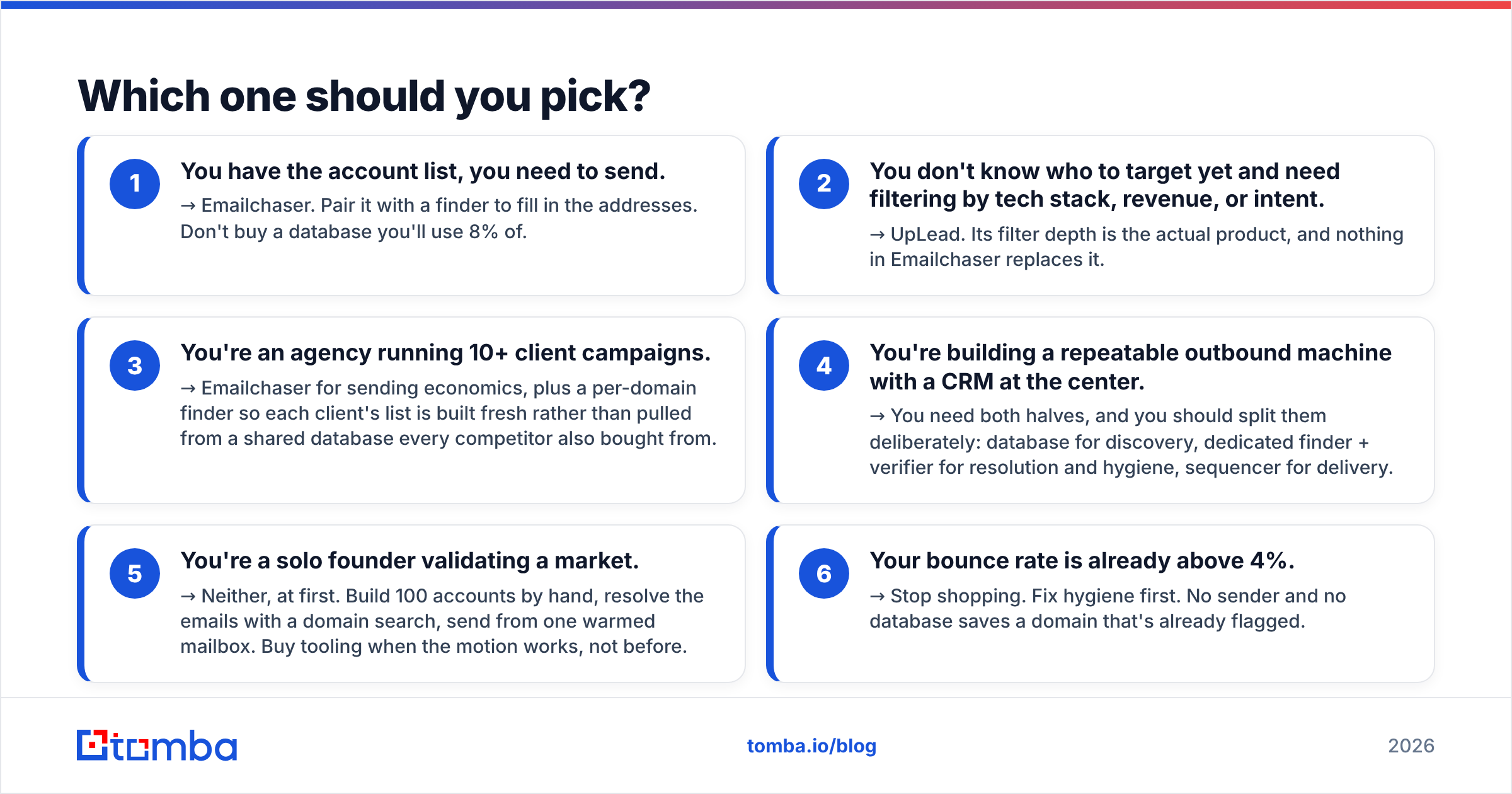
Use this as a decision tree, not a scoreboard.
- You have the account list, you need to send. → Emailchaser. Pair it with a finder to fill in the addresses. Don't buy a database you'll use 8% of.
- You don't know who to target yet and need filtering by tech stack, revenue, or intent. → UpLead. Its filter depth is the actual product, and nothing in Emailchaser replaces it.
- You're an agency running 10+ client campaigns. → Emailchaser for sending economics, plus a per-domain finder so each client's list is built fresh rather than pulled from a shared database every competitor also bought from.
- You're building a repeatable outbound machine with a CRM at the center. → You need both halves, and you should split them deliberately: database for discovery, dedicated finder + verifier for resolution and hygiene, sequencer for delivery.
- You're a solo founder validating a market. → Neither, at first. Build 100 accounts by hand, resolve the emails with a domain search, send from one warmed mailbox. Buy tooling when the motion works, not before.
- Your bounce rate is already above 4%. → Stop shopping. Fix hygiene first. No sender and no database saves a domain that's already flagged.

What do both tools leave you missing?#
The gap is the same in both directions, and it's the reason so many stacks end up with three subscriptions.
Emailchaser's gap is data resolution at scale. You can find an address here and there. You cannot reliably take 500 company domains and 500 names and get back verified, deduplicated, catch-all-flagged addresses with a confidence score on each. That's a specialized job. A bulk email finder exists as a product category precisely because sequencers are bad at it.
UpLead's gap is everything after the export. The moment a CSV leaves the platform, it starts decaying, and UpLead has no opinion about how you send it, whether your SPF and DKIM are aligned, or whether your follow-up cadence looks robotic. Deliverability lives entirely on your side of the wall.
Both share a third gap: freshness at send time. Verified-at-reveal is not verified-at-send. If there's a two-week lag between building a list and launching a campaign — and there almost always is — you want a re-verification pass in between. That's a 20-minute job with an email finder that includes verification and an API, and it's the single highest-ROI habit in cold outreach.
How do you actually assemble the stack?#
Here's the configuration that holds up under audit, in order:
- Define the account list — from a database like UpLead if you need filtering, or manually from funding news, job boards, review sites, and conference rosters if your ICP is narrow enough to hand-build.
- Resolve contacts — run domain + name through a dedicated finder. Score each result. Discard anything below your confidence floor rather than "trying it anyway."
- Verify immediately before send — not at list-build time. Separate catch-all domains into their own segment and send to them at lower volume from a secondary mailbox.
- Enrich for personalization — title, seniority, tech stack, recent trigger. A verified address with nothing to say to it is still a bounce, just a human one.
- Send and sequence — Emailchaser or whatever sequencer you already pay for. Rotate inboxes, cap daily volume per mailbox, stop on reply.
- Feed results back — bounced and hard-negative records go back into your suppression list, not into next quarter's campaign.
Steps 2 and 3 are where teams overpay, because they assume the database subscription covers them. It covers them once, at reveal time, for the records that database happens to hold. It doesn't cover the account you found on Product Hunt yesterday.
The bottom line#
Emailchaser vs UpLead isn't a winner-take-all comparison — it's a diagnosis question. If your problem is "I don't know who to email," UpLead is the better spend and Emailchaser won't help. If your problem is "I have the list and my follow-ups are manual," Emailchaser is the better spend and UpLead is an expensive way to solve a problem you don't have.
What neither solves cheaply is the middle: turning a name and a domain into a verified, current, sendable address, at volume, on demand, without buying a database subscription sized for a 20-person SDR org.
That's the job the Tomba Email Finder is built for. Free tier gives you 25 searches a month to test the accuracy against a list you already know the answers to — which is exactly how you should evaluate any data vendor, including this one. Starter is $49/mo with verification included, an API on every paid plan, and no per-seat charge. Run it alongside whichever sender you land on, and you stop paying database prices for a lookup problem.
Related guides#
Ready to find emails that actually work?
Join 150,000+ professionals who stopped guessing and started sending. Free credits on signup — no credit card required.
Get the Tomba newsletter
Practical outbound tactics and product updates — once every two weeks.
About the author