EmailListVerify vs LeadGenius: Which One Do You Actually Need?
One cleans the list you already have. The other builds a list you don't. Here's an honest breakdown of EmailListVerify vs LeadGenius on pricing, data quality, and which outbound stack each one belongs in.
EmailListVerify vs LeadGenius is a choice between two different jobs, not two rival tools. One cleans the list you already own. The other builds a list you do not have yet.
TL;DR
- EmailListVerify and LeadGenius solve different problems. EmailListVerify is a bulk email verification engine that cleans lists you already own. LeadGenius is a managed data service. Its researchers build custom contact datasets for you.
- The price gap is huge. EmailListVerify runs on pay-as-you-go credits — tens of dollars for tens of thousands of checks. LeadGenius is an annual enterprise contract, usually five figures.
- Is your bounce rate the problem? Buy verification. Is the list itself the problem — no contacts, wrong personas, missing custom fields? Then verification will not save you.
- Most mid-market teams need neither extreme. A self-serve finder plus verifier (Tomba, for example) covers discovery and hygiene in one workflow, at a fraction of managed-data cost.
- Both mistakes cost real money. You can pay $30k for data you could self-serve. You can also pay $30 to clean a list that was never worth sending to.
EmailListVerify vs LeadGenius: what does each one actually do?#
They get compared because both show up in "B2B data" searches. That is about where the overlap ends.
EmailListVerify is an email validation service. You upload a CSV of addresses — from a webinar, a CRM export, a scraped list, an old newsletter. It then runs syntax checks, MX record lookups, and SMTP handshakes. It also flags disposable domains, role accounts, and catch-all servers. Each address comes back in one of four buckets: valid, invalid, unknown, or catch-all. It does not find new contacts. It has no opinion about whether the person fits your ICP.
LeadGenius sits at the other end. It is a human-in-the-loop data provider. A global research team, backed by automation, builds datasets to your spec. You write the brief. For example: "VP Ops at DTC brands in EMEA running Shopify Plus, with headcount up 20% year over year." They deliver contacts with fields no standard database carries: tech signals, hiring signals, custom firmographics. It sells as a subscription with onboarding, a CSM, and usually a one-year commitment.
So the honest way to frame EmailListVerify vs LeadGenius is not "which one is better." Ask this instead: is your bottleneck list quality, or list existence?

EmailListVerify vs LeadGenius: the head-to-head comparison#
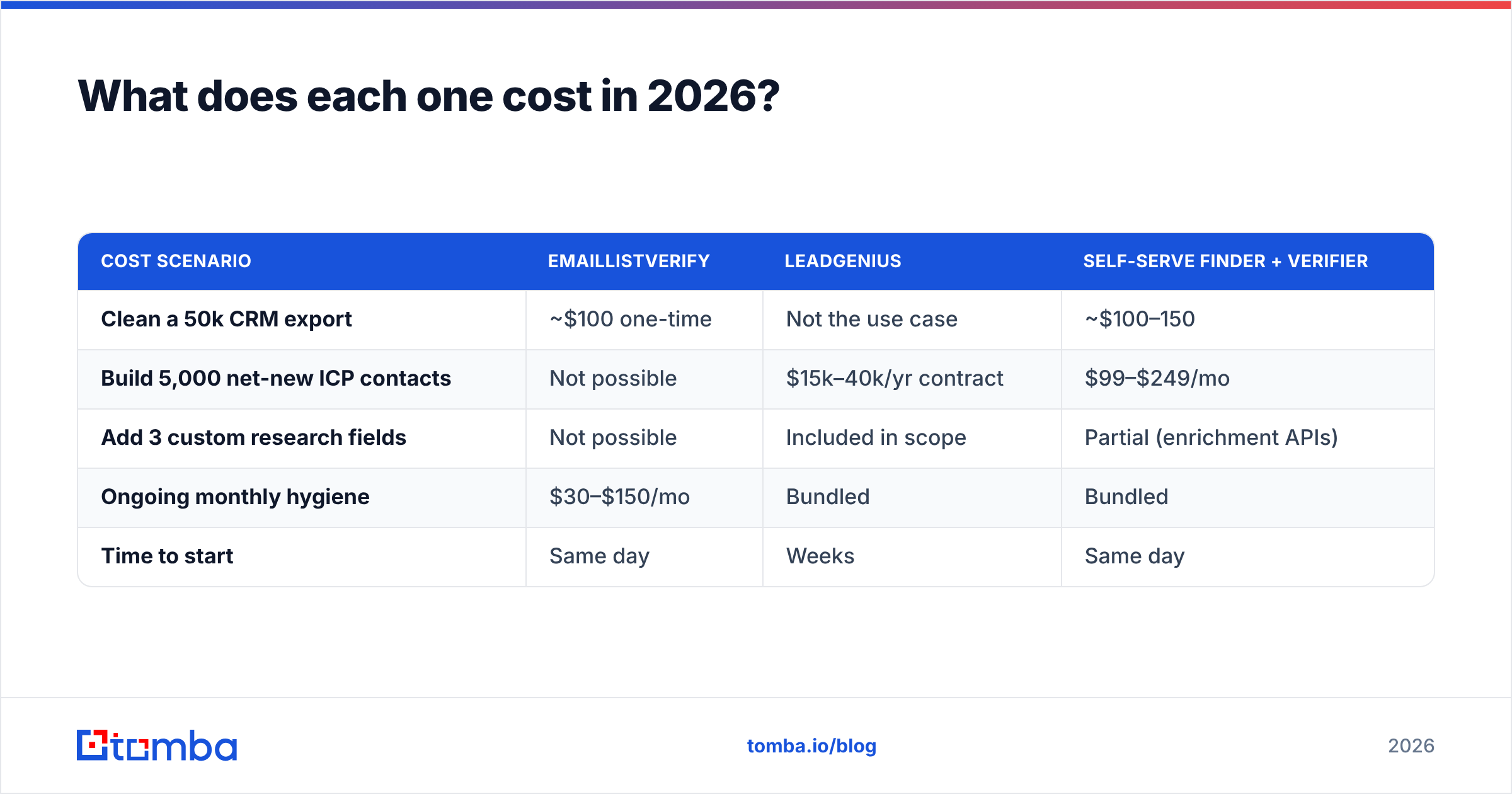
| Dimension | EmailListVerify | LeadGenius |
|---|---|---|
| Primary job | Validate existing email lists | Build custom contact datasets |
| Delivery model | Self-serve web app + API | Managed service with research team |
| Finds new contacts | No | Yes — core offering |
| Custom data fields | No | Yes — the main differentiator |
| Time to first value | Minutes | 2–6 weeks (scoping + delivery) |
| Pricing model | Pay-as-you-go credits or monthly | Annual contract, custom quote |
| Typical annual spend | $50–$2,000 | $20,000–$100,000+ |
| Best fit team size | Solo founder → enterprise ops | Mid-market → enterprise RevOps |
| Contract required | No | Usually yes |
| API access | Yes | Yes (plus CRM sync) |
| Handles catch-all domains | Flags them, partial resolution | N/A — supplies verified contacts |
| Human QA on data | No | Yes |
Read that table as a fork in the road, not a scorecard. A three-person sales team that buys LeadGenius will overpay for capacity it cannot use. An enterprise ABM program that buys only EmailListVerify still has no accounts to work.
EmailListVerify vs LeadGenius pricing: what does each one cost in 2026?#
Pricing is the clearest dividing line in EmailListVerify vs LeadGenius. It is also where most teams decide without admitting it.
EmailListVerify sells credits. Public pricing has sat near $24 for 10,000 verifications. The per-check price drops toward a fraction of a cent at higher volumes. Monthly plans exist for teams that verify all the time. On pay-as-you-go plans, credits do not expire. Check the site for today's numbers, because verification vendors reprice often.
LeadGenius does not publish pricing. Every deal is quoted against scope: how many records, how many custom fields, how often they refresh, and how much human research each record needs. Buyers on G2 and in procurement forums report entry points in the low five figures per year. Multi-region programs run well past that. Expect an onboarding period before any data arrives.
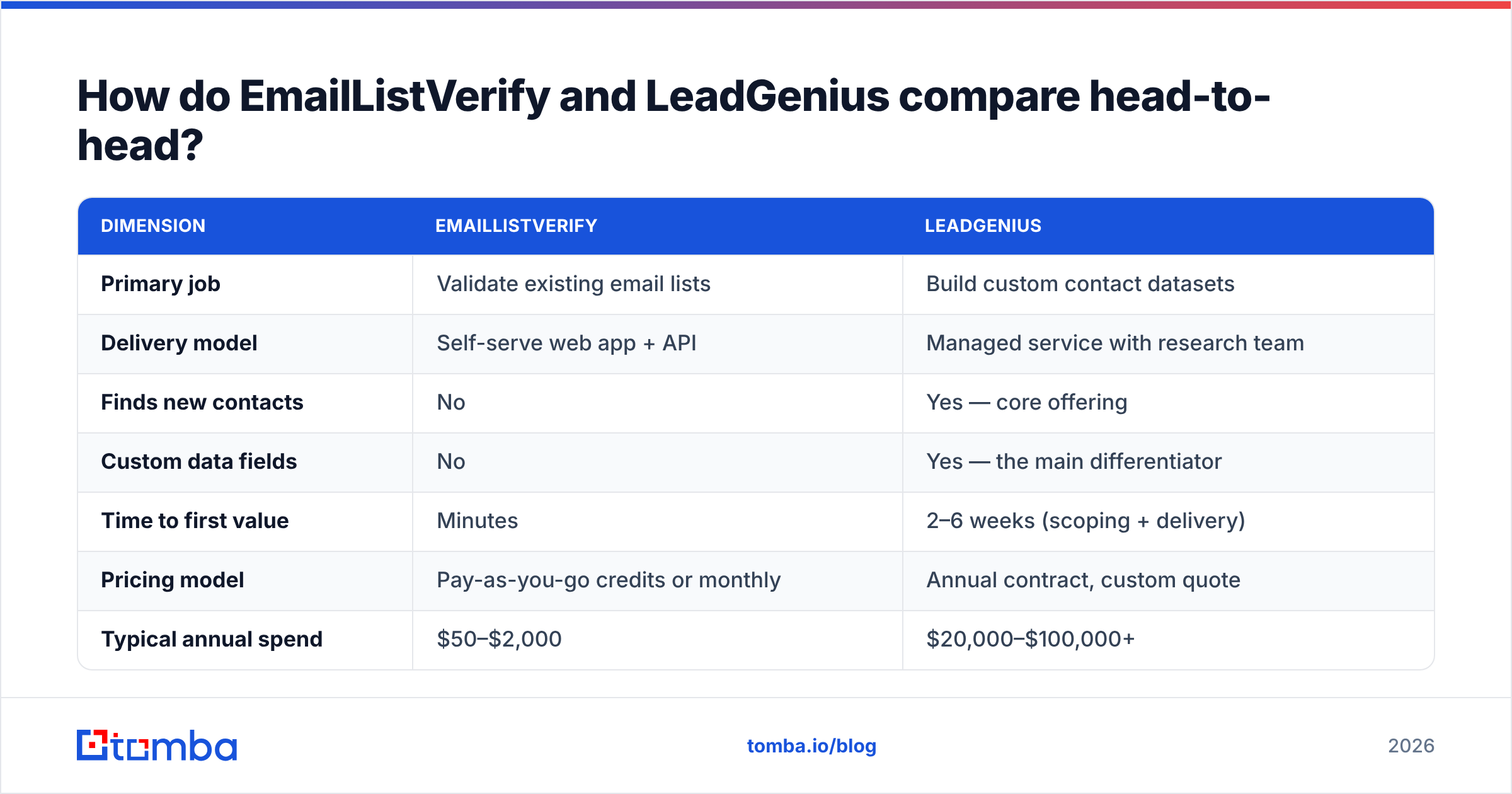
| Cost scenario | EmailListVerify | LeadGenius | Self-serve finder + verifier |
|---|---|---|---|
| Clean a 50k CRM export | ~$100 one-time | Not the use case | ~$100–150 |
| Build 5,000 net-new ICP contacts | Not possible | $15k–40k/yr contract | $99–$249/mo |
| Add 3 custom research fields | Not possible | Included in scope | Partial (enrichment APIs) |
| Ongoing monthly hygiene | $30–$150/mo | Bundled | Bundled |
| Time to start | Same day | Weeks | Same day |
That middle column earns its price only when the custom fields are truly unbuyable elsewhere. If your "custom" fields are job title, company size, and industry, you are paying managed-service rates for commodity data.
EmailListVerify vs LeadGenius: which one has more accurate data?#
Wrong question. EmailListVerify vs LeadGenius measure accuracy on different objects.
EmailListVerify measures deliverability. Did the address it called "valid" actually accept mail? Independent tests put the serious verifiers between 95% and 99% on clean test sets. The real gap shows up on catch-all domains, and on hosts like Microsoft 365 that refuse to reveal recipient status over SMTP. Any vendor claiming 99%+ on catch-alls is dressing up a guess.
LeadGenius measures fit and freshness. Is this really the VP of Ops? Is she still there? Does the company run the tech you asked about? People checking data by hand beat scraped databases here, and that is what you pay for. It is also slower, and it does not scale in a straight line.
Three practical notes matter more than either vendor's marketing:
- Catch-all domains are the honest test. Roughly 15–20% of B2B domains accept mail sent to any address. A verifier that returns "unknown" on all of them has punted. Tools with a dedicated catch-all verifier use pattern confidence and other signals instead of shrugging.
- Verification decays. A list cleaned in January is 8–12% stale by July. People change jobs. One-time cleaning is a snapshot, not a system.
- Accuracy comes before copy. No subject line rescues a 22% bounce rate. Your sending domain gets flagged before anyone reads the pitch. Treat email deliverability as the gate you clear first.
When should you pick EmailListVerify?#
For most buyers, EmailListVerify vs LeadGenius comes down to one question: do you already have the contacts? If you do, pick EmailListVerify when all of these are true:
- You already have the contacts. CRM exports, event lists, inbound signups, or a database you licensed elsewhere. You have volume. You do not have trust.
- Your bounce rate is above 3%. Past that line, mailbox providers start throttling you. Cleaning pays for itself in a single send.
- You want zero sales process. Card in, credits out, CSV back in twenty minutes.
- You need an API for a pipeline. Verifying every address as it enters your CRM is a boring, high-return integration.
Where it falls short: it will not tell you a contact is a bad fit. It will not fill a missing field. And it cannot help if your list is 400 rows and you need 4,000.
When should you pick LeadGenius?#
Pick it when all of these are true:
- Standard filters cannot reach your ICP. "Companies that just opened a second warehouse" is not a dropdown in any database.
- You have budget authority and a 12-month horizon. Managed data is an operating expense with onboarding, not a tool you trial on Friday.
- You need custom fields piped into your CRM continuously, not a one-time list drop.
- Your team's time is the scarce resource. Handing research to a managed team is a real trade. It just costs real money.
Where it falls short: procurement cycles, minimum commitments, and a delivery lag that kills fast experiments. If you cannot yet write a precise brief, you will pay a research team consulting rates to discover your ICP for you.
Is there a middle option in EmailListVerify vs LeadGenius?#
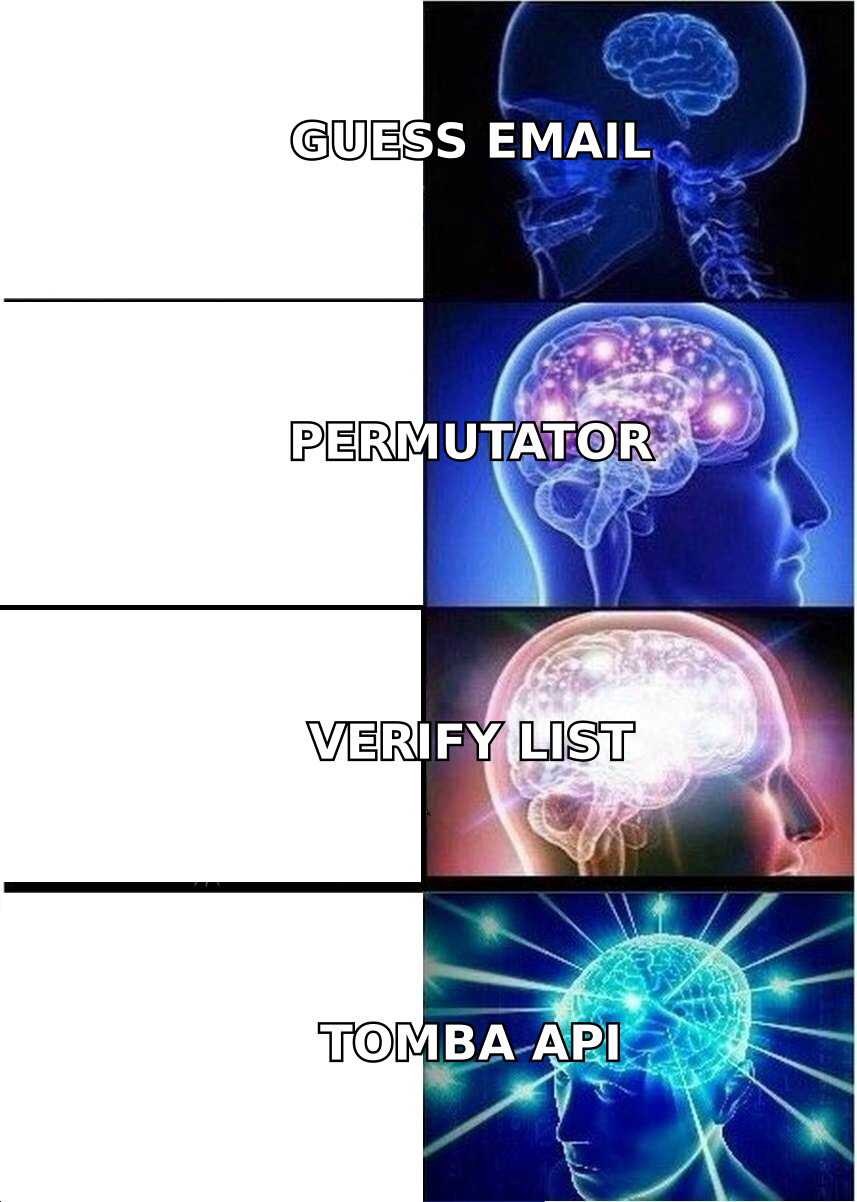
Yes. It is where most teams between 5 and 200 people actually land: a self-serve platform that both finds and verifies, with no managed-service contract.
The workflow looks like this:
- Define the account list. Pull target domains from your CRM, a funding database, LinkedIn Sales Navigator, or a conference roster. This part is cheap, and you should own it.
- Find contacts per domain. A domain search returns the people and email patterns at each company, so you are not guessing at address formats. Filter by department and seniority.
- Verify before export. Run every address through an email verifier that handles catch-alls, and drop anything that does not clear. This is the EmailListVerify job, bundled.
- Enrich the survivors. Add phone numbers, LinkedIn URLs, and company details so reps are not tab-hopping mid-call.
- Automate the refresh. Re-verify every quarter through the API, so decay never surprises you.
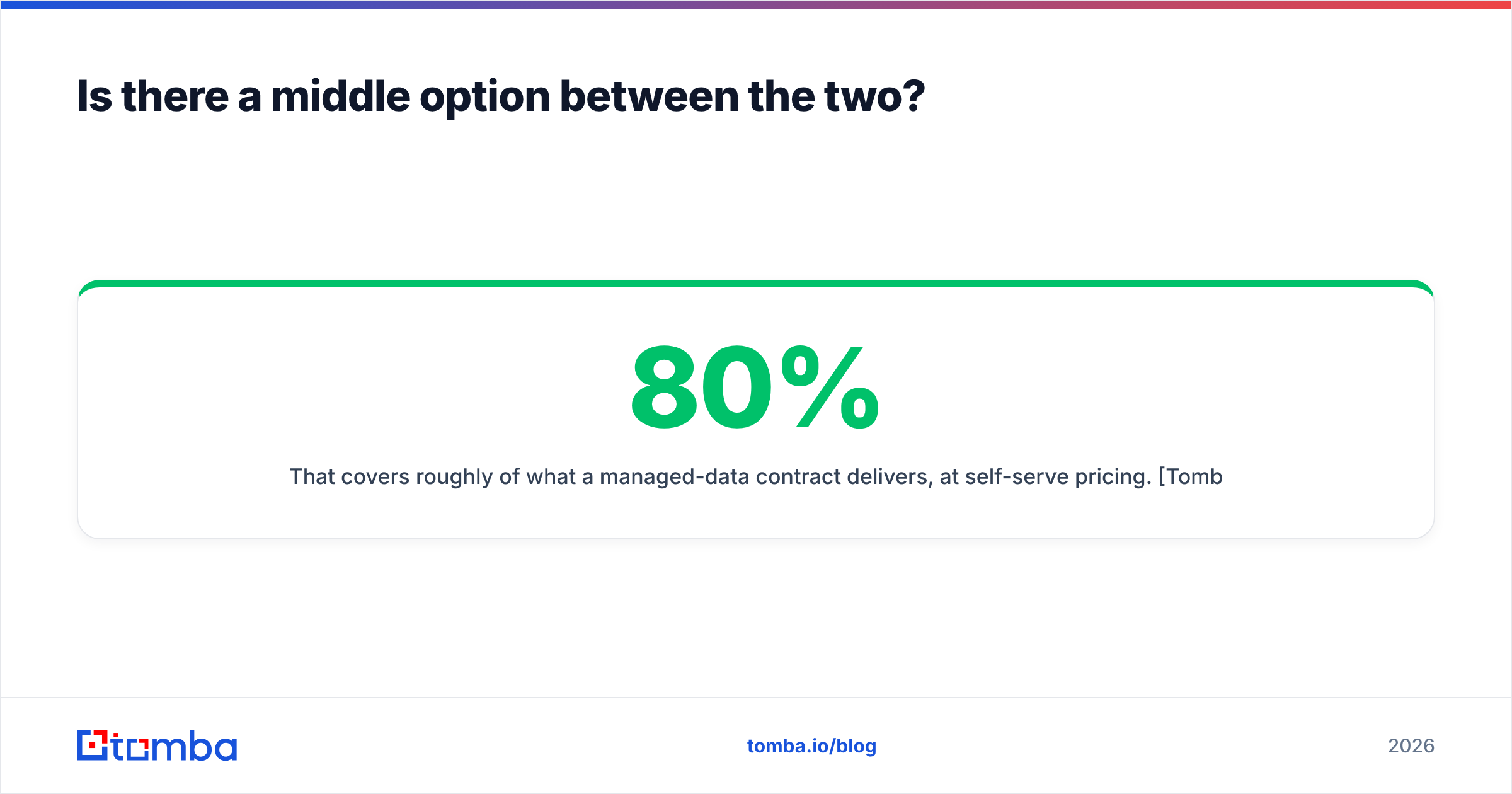
That covers roughly 80% of what a managed-data contract delivers, at self-serve prices. Tomba pricing starts free at 25 searches per month, then $49/mo Starter, $99/mo Growth, and $249/mo Pro. A full year of Growth costs less than one month of most managed-data agreements. If you want out of a verification-only tool, the EmailListVerify alternative breakdown covers the migration path.
One honest caveat. Some data needs a human to read a company's job postings and infer a buying signal. No self-serve tool replaces that. LeadGenius exists because that work is real. Just be sure it is your requirement before you sign.
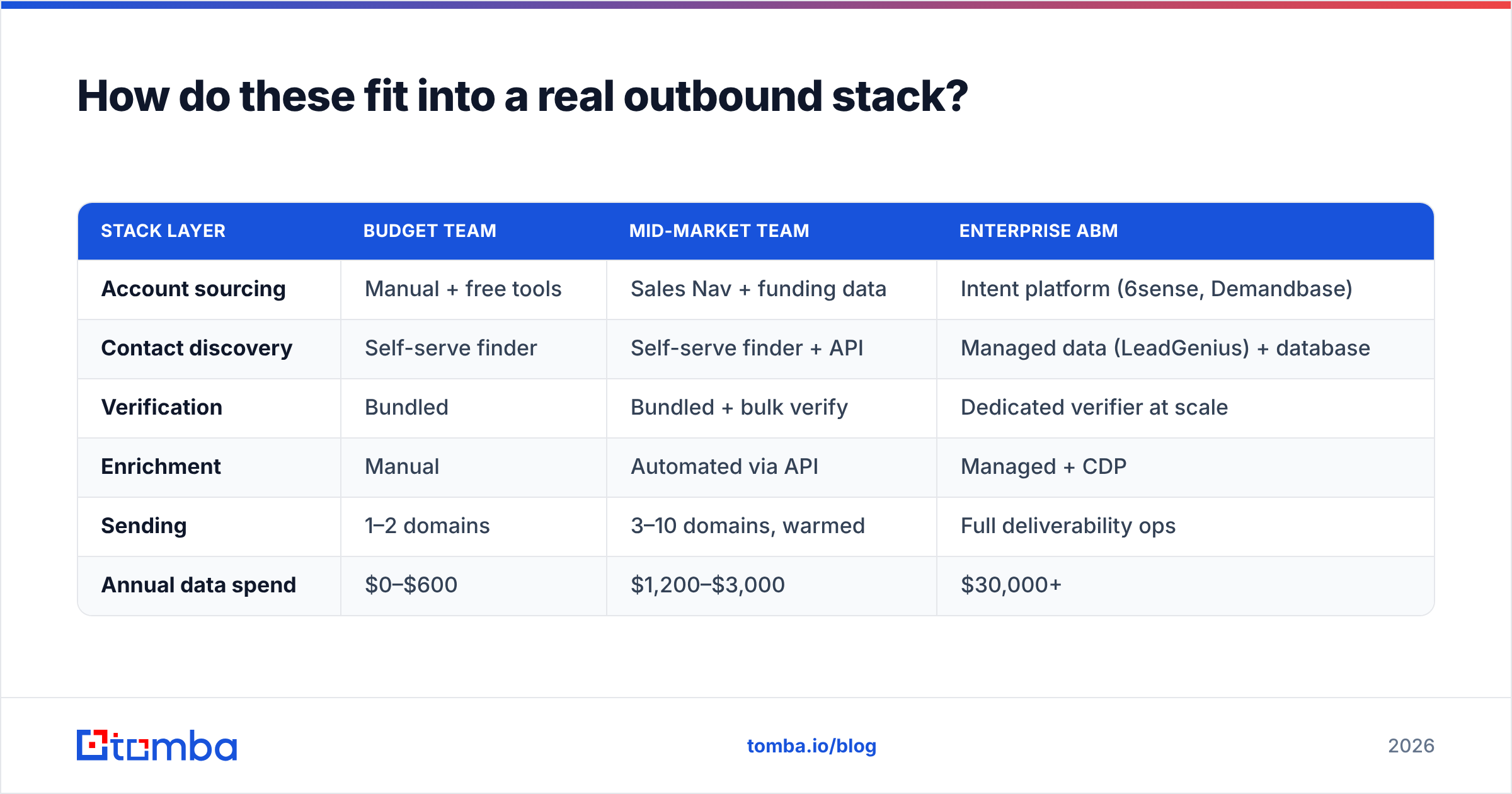
EmailListVerify vs LeadGenius in a real outbound stack#
| Stack layer | Budget team | Mid-market team | Enterprise ABM |
|---|---|---|---|
| Account sourcing | Manual + free tools | Sales Nav + funding data | Intent platform (6sense, Demandbase) |
| Contact discovery | Self-serve finder | Self-serve finder + API | Managed data (LeadGenius) + database |
| Verification | Bundled | Bundled + bulk verify | Dedicated verifier at scale |
| Enrichment | Manual | Automated via API | Managed + CDP |
| Sending | 1–2 domains | 3–10 domains, warmed | Full deliverability ops |
| Annual data spend | $0–$600 | $1,200–$3,000 | $30,000+ |
Notice that verification shows up in every column. That is the point. Hygiene is non-optional at every budget level. Managed research is a luxury that only pays back at enterprise scale, with enterprise deal sizes. A $2,000 ACV product cannot cover a $40,000 data contract without huge volume.
One more path is worth naming. You can buy a curated list from a reputable database vendor. Providers like BookYourData sell pre-verified B2B contacts per record. That lands between self-serve finding and full managed research, and it works when you want vetted data without a research engagement.
The verdict on EmailListVerify vs LeadGenius#
They are not competitors. Picking "the winner" is a category error.
- Choose EmailListVerify if you have a list and a bounce problem. It is cheap, fast, self-serve, and does one thing well.
- Choose LeadGenius if you have budget, an unusual ICP, and a need for custom research fields no database sells. Expect a contract and a ramp.
- Choose neither if you are a growing team that needs to find and verify contacts on a monthly budget. That is a self-serve finder's job. Paying two vendors for it is overspend.
Here is the failure mode to avoid. You buy verification because it is cheap. You then find your list is too small. So you buy managed data, because it is the only other thing you have heard of. Map the bottleneck first. If you cannot say whether your problem is quality or quantity, you are not ready to buy either one.
Start with the layer that is actually missing. Maybe you need net-new contacts and clean deliverability in one workflow, with no sales call and no annual commitment. The Tomba Email Finder covers discovery, verification, and enrichment from one dashboard and one API key. The free tier gives you 25 searches a month, so you can test the data against a list you already trust. If the match rate holds, scale up from there. Bring your own domains, verify before you send, and keep the $30k contract for the day your ICP genuinely cannot be filtered.
Related guides#
Ready to find emails that actually work?
Join 150,000+ professionals who stopped guessing and started sending. Free credits on signup — no credit card required.
Get the Tomba newsletter
Practical outbound tactics and product updates — once every two weeks.
About the author