EmailListVerify vs Warpleads: Which Tool Wins in 2026?
One is a list-cleaning specialist, the other is an unlimited-export lead database. Here is how EmailListVerify and Warpleads actually compare on data quality, pricing, and where each one breaks down in a real outbound stack.
TL;DR
- EmailListVerify and Warpleads are not really competitors. EmailListVerify cleans lists you already have; Warpleads sells you the list in the first place.
- If your bounce rate is the problem, EmailListVerify is the cheaper, more direct fix — pay-as-you-go credits, no subscription required.
- If your problem is "I have no leads," Warpleads' unlimited-export model is attractive on paper, but exported volume is not the same as verified volume.
- Buying leads and then verifying them is two invoices for one job. A finder that verifies at source removes a step.
- Most teams that run both end up paying twice for the same contact. Decide which half of the problem you actually have before you buy either.
What are EmailListVerify and Warpleads?#
EmailListVerify is a bulk email verification service. You upload a CSV, it runs syntax checks, MX lookups, SMTP handshakes, disposable-domain detection, and role-account flagging, then hands back a scored file. It has been around since 2016 and sells credits rather than seats, which makes it popular with agencies that clean other people's lists.
Warpleads sits at the other end of the pipeline. It is a B2B lead database that leans hard on one pitch: unlimited exports. Instead of metering every contact, it sells monthly access and lets you pull large volumes of B2B contacts filtered by industry, title, geography, and company size. It also offers on-demand lead sourcing for niches the static database does not cover well.
So the comparison people actually mean when they search "EmailListVerify vs Warpleads" is usually one of two questions:
- "I have a list — which of these fixes my bounce rate?" That is EmailListVerify's job, not Warpleads'.
- "I need leads — should I buy volume from Warpleads and clean it with EmailListVerify?" That is a legitimate stack, and it is the one worth pricing out.
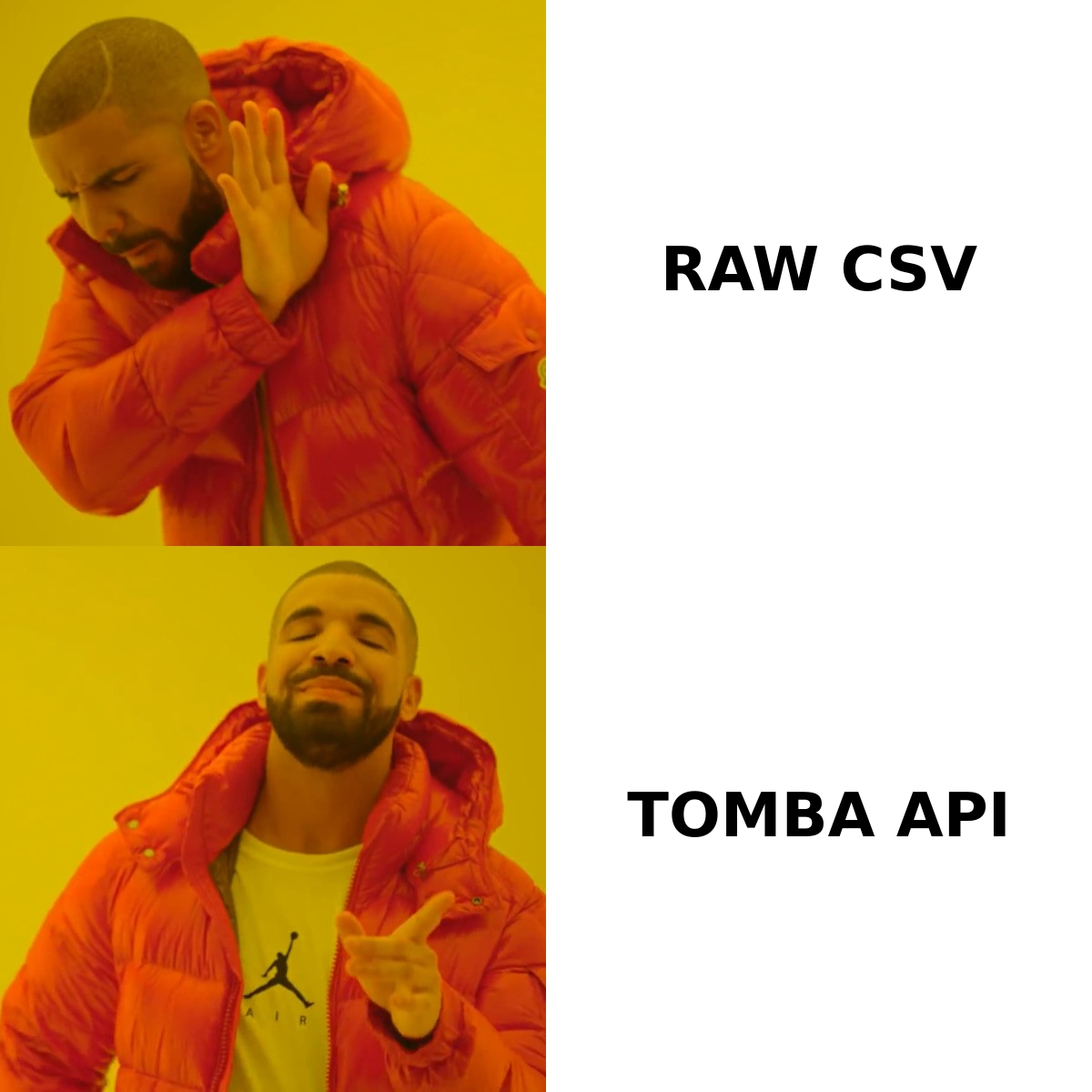
How do EmailListVerify and Warpleads differ in practice?#
| Attribute | EmailListVerify | Warpleads | Tomba |
|---|---|---|---|
| Primary job | Verify lists you already own | Source B2B leads at volume | Find + verify emails at source |
| Data source | None — it validates what you upload | Static B2B database + on-demand sourcing | Crawled public web, patterns, live SMTP checks |
| Pricing model | Pay-as-you-go credits or subscription | Monthly unlimited-export plans | Free tier, then $49 / $99 / $249 per month |
| Free option | Small free credit batch on signup | Trial / limited free leads | 25 searches per month, no card |
| Bulk workflow | CSV upload, scored file back | Filter, export, download CSV | Bulk finder, verifier, and API |
| Catch-all handling | Flags as "unknown" / risky | Not its job — exports as-is | Dedicated catch-all verifier |
| API | Verification API | Export/enrichment API | Full REST API, CLI, MCP, Sheets, Excel |
| Best for | Agencies and ESP hygiene | Volume-first outbound teams | Teams that want one verified source |
The row that matters most is the first one. EmailListVerify never tells you who to email. Warpleads never really tells you whether the address will land. Neither product is bad at its job; they are just answering different halves of the same question.
Which one actually protects your deliverability?#
EmailListVerify, and it is not close — because Warpleads does not claim that job.
Bounce rate is the metric that decides whether your domain survives a campaign. Google and Microsoft both treat a spike in hard bounces as a signal that you are sending to a purchased, unmaintained list. Google's own bulk sender guidelines put spam complaint rate and invalid recipients near the top of the list of things that get you filtered.
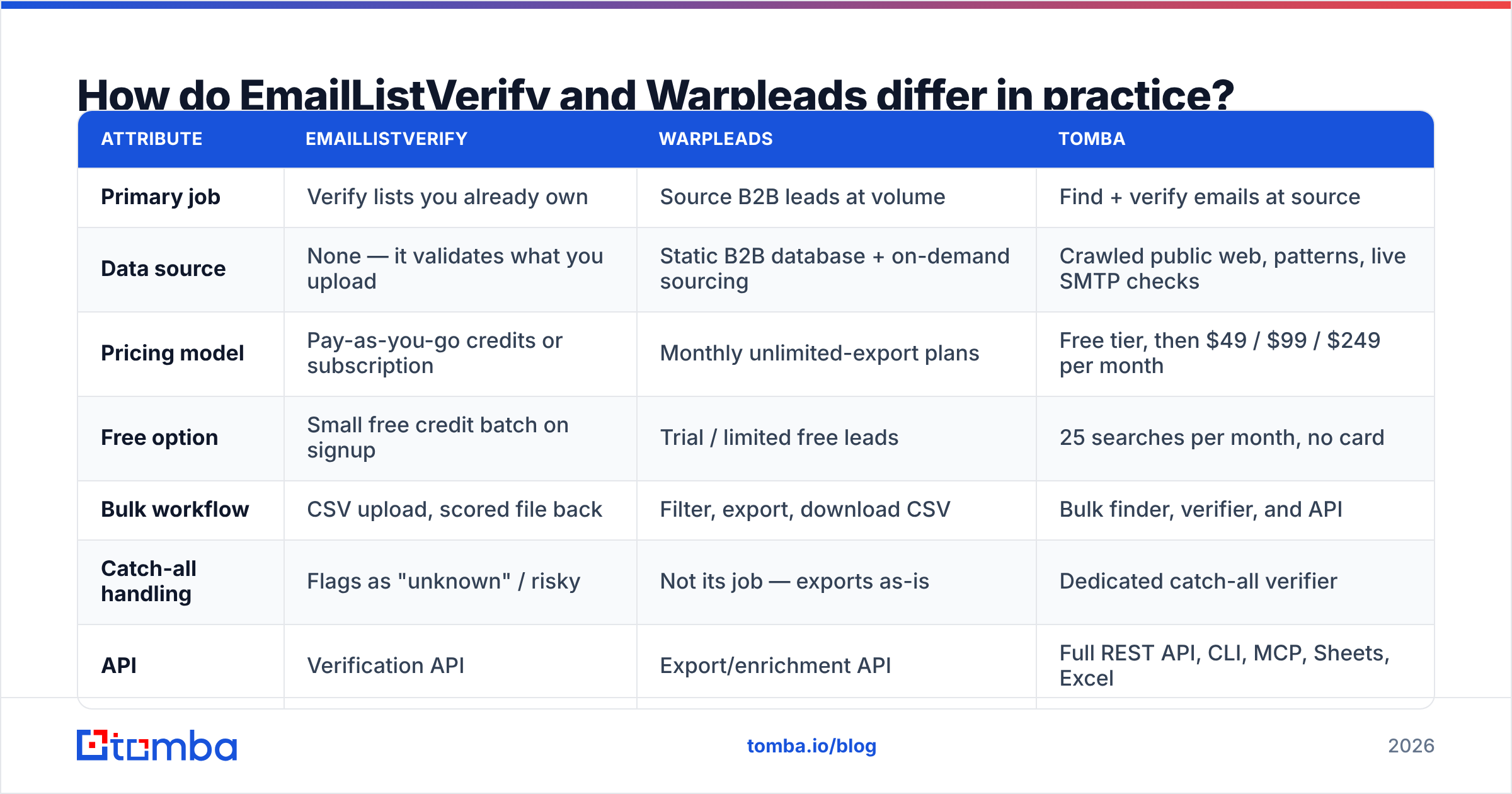
That means the order of operations is fixed:
- Source the contact — from a database, a scrape, or a finder.
- Verify the mailbox — syntax, domain, MX record, SMTP response.
- Segment the risky ones — catch-all domains, role accounts (info@, sales@), and anything scored "unknown".
- Send to the clean tier first — and warm up before you touch the risky tier.
- Re-verify anything older than 90 days — B2B data decays at roughly 2–2.5% per month as people change jobs.
EmailListVerify covers steps 2 and 3 well. Warpleads covers step 1. If you run Warpleads exports straight into a sequencer without step 2, you are gambling your sending domain on someone else's refresh cadence. Run the export through an email verifier first, every time.

How accurate is the data from each tool?#
This is where the two products get judged on different scales, and it trips people up.
EmailListVerify accuracy means verdict accuracy: when it says "valid," is the mailbox really there? Independent tests and G2 reviews generally place the mainstream verifiers — EmailListVerify, ZeroBounce, Bouncer, Debounce — within a few points of each other on clean B2B lists, typically in the 95–98% band. The differences show up on hard cases: catch-all domains, greylisting servers, and providers that accept every RCPT TO. No verifier can definitively resolve a true catch-all with SMTP alone, which is why the honest ones return "unknown" instead of guessing. Read any vendor's stated accuracy number as a claim about their best-case dataset, not yours.
Warpleads accuracy means record freshness: does this person still hold this title at this company, and is the email pattern current? Static databases age. A contact record that was correct in March can be wrong by September because the person moved. Unlimited-export plans make this worse in a subtle way — when volume is free, there is no cost pressure to be selective, so teams export 50,000 records and email all of them. The 15% that are stale still count against your sender reputation.
A practical test before you commit to either: take 200 known-good contacts from your CRM, run them through EmailListVerify, and count the false invalids. Then pull 200 records from Warpleads in your exact ICP and manually check 20 of them on LinkedIn or the company site. Both tests take under an hour and tell you more than any vendor benchmark page.
If you want to compare the underlying finder layer rather than the verifier layer, the data sources page explains what a crawl-plus-verification pipeline looks like versus a static licensed database.
What do EmailListVerify and Warpleads cost?#
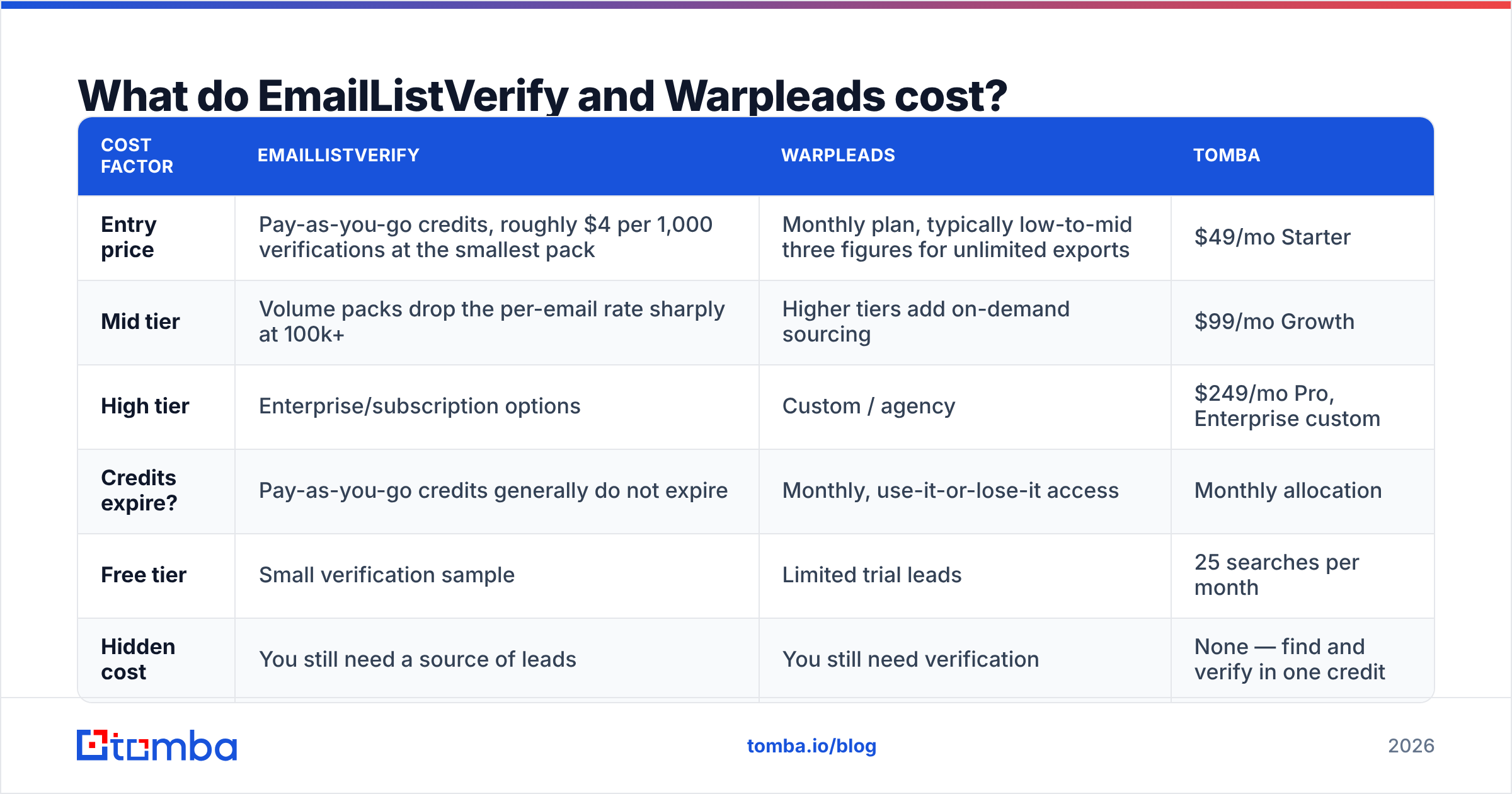
Pricing on both moves, so treat these as shapes rather than quotes — check the vendor pages before you buy.
| Cost factor | EmailListVerify | Warpleads | Tomba |
|---|---|---|---|
| Entry price | Pay-as-you-go credits, roughly $4 per 1,000 verifications at the smallest pack | Monthly plan, typically low-to-mid three figures for unlimited exports | $49/mo Starter |
| Mid tier | Volume packs drop the per-email rate sharply at 100k+ | Higher tiers add on-demand sourcing | $99/mo Growth |
| High tier | Enterprise/subscription options | Custom / agency | $249/mo Pro, Enterprise custom |
| Credits expire? | Pay-as-you-go credits generally do not expire | Monthly, use-it-or-lose-it access | Monthly allocation |
| Free tier | Small verification sample | Limited trial leads | 25 searches per month |
| Hidden cost | You still need a source of leads | You still need verification | None — find and verify in one credit |
The hidden-cost row is the whole argument. A Warpleads-plus-EmailListVerify stack means you pay for a contact once to obtain it and again to confirm it is real. At 50,000 records a month that second invoice is not rounding error. Compare that to Tomba pricing, where verification is part of the find rather than a separate purchase order.

Is "unlimited exports" actually a good deal?#
Sometimes. It depends entirely on whether your bottleneck is volume or precision.
Unlimited export pricing is genuinely good when:
- Your ICP is broad. If you sell to any SMB with 10–200 employees in three countries, volume is your friend and per-credit pricing punishes you.
- You have infrastructure to absorb it. Multiple warmed domains, a real sequencer, and someone who segments before sending.
- You verify downstream anyway. The unlimited plan becomes a raw-material contract and you own quality control.
It is a bad deal when:
- Your ICP is narrow. If there are 4,000 qualifying companies on earth, unlimited access to 100 million records is worth exactly the value of those 4,000 rows.
- You send from one domain. Volume you cannot safely send is not an asset.
- You count "leads exported" as a KPI. This is the trap. Exported rows feel like progress and cost nothing marginal, so teams optimise for the wrong number.
Run the math on cost-per-meeting, not cost-per-record. A stack that produces 300 verified, well-targeted contacts often beats one that produces 30,000 unverified ones, and it certainly beats it on domain reputation.

Which should you choose — EmailListVerify or Warpleads?#
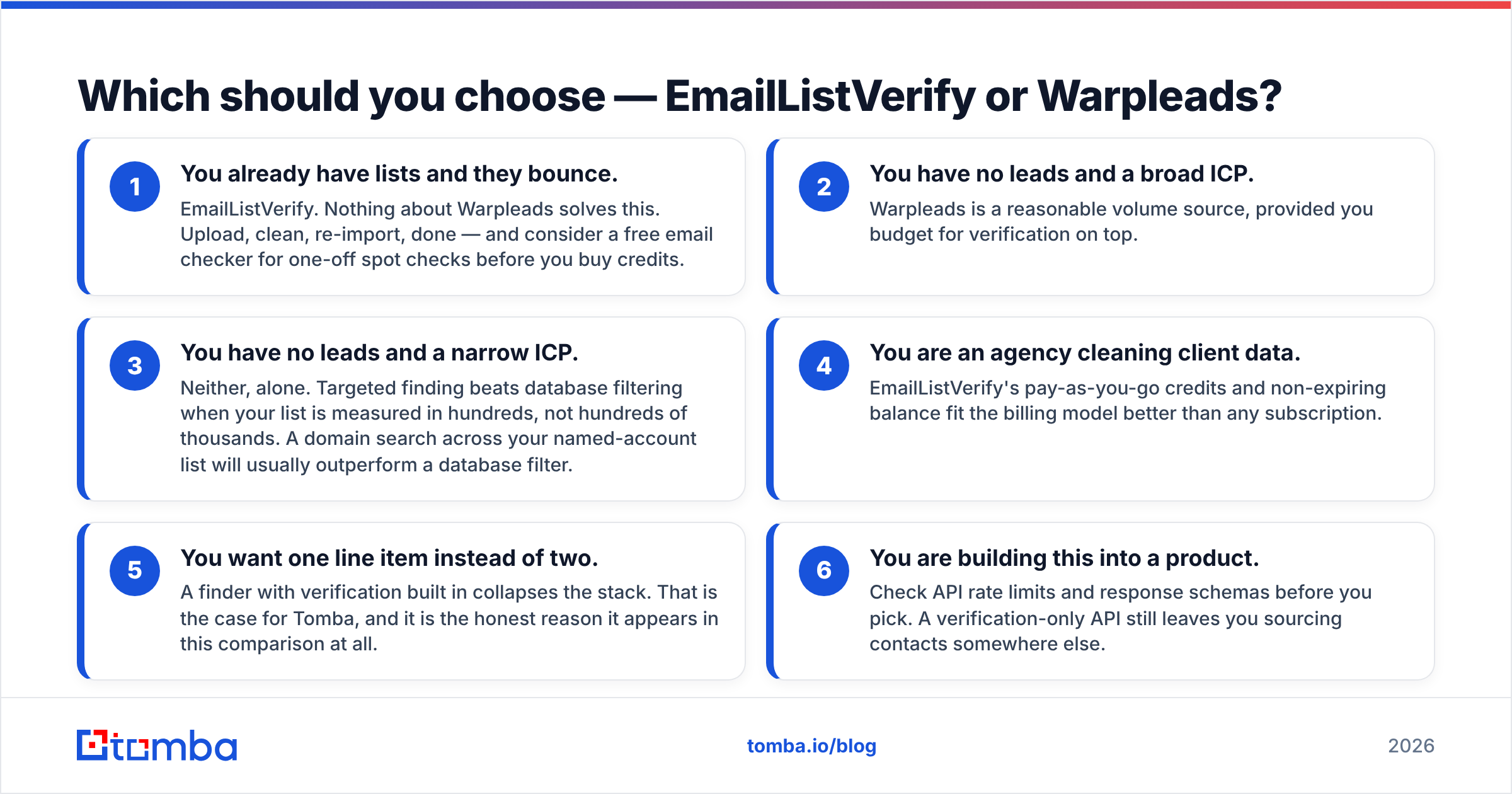
Pick by the problem you actually have:
- You already have lists and they bounce. EmailListVerify. Nothing about Warpleads solves this. Upload, clean, re-import, done — and consider a free email checker for one-off spot checks before you buy credits.
- You have no leads and a broad ICP. Warpleads is a reasonable volume source, provided you budget for verification on top.
- You have no leads and a narrow ICP. Neither, alone. Targeted finding beats database filtering when your list is measured in hundreds, not hundreds of thousands. A domain search across your named-account list will usually outperform a database filter.
- You are an agency cleaning client data. EmailListVerify's pay-as-you-go credits and non-expiring balance fit the billing model better than any subscription.
- You want one line item instead of two. A finder with verification built in collapses the stack. That is the case for Tomba, and it is the honest reason it appears in this comparison at all.
- You are building this into a product. Check API rate limits and response schemas before you pick. A verification-only API still leaves you sourcing contacts somewhere else.
Are there alternatives worth testing alongside these?#
Yes, and it is worth running a 200-record bake-off before committing budget.
On the verification side, ZeroBounce, Bouncer, Debounce, and Clearout all compete directly with EmailListVerify and score similarly on G2. Differences come down to price at your specific volume, catch-all handling, and API ergonomics rather than raw accuracy.
On the data side, Apollo, Cognism, and BookYourData all sell B2B contact data with different trade-offs. BookYourData in particular is worth a look if you want verified, region-filtered lists with a pay-as-you-go structure rather than a subscription — a different shape of deal than unlimited exports, and a better fit for teams that buy in bursts. Apollo bundles sequencing, which matters if you want fewer tools; Cognism leans on compliance and phone-verified data for EU/UK outbound.
And if your list is stale rather than missing, data enrichment is often cheaper than re-buying contacts you already have.
What is the verdict?#
EmailListVerify wins if the question is "will this email land." It is a focused, fairly priced verifier with a credit model that suits irregular usage. It will not find you a single new contact.
Warpleads wins if the question is "where do I get 20,000 contacts this month." The unlimited-export model removes per-record anxiety, which genuinely changes how a volume-first team operates. It will not tell you which of those 20,000 addresses is dead.
Neither wins if you want one tool. That is the structural gap: you are buying half a pipeline from each vendor, at two prices, with two data-quality standards to reconcile.
If that reconciliation is the part you want to skip, start with the Tomba Email Finder. You get find-and-verify in a single credit, a catch-all verifier for the domains other tools mark "unknown," bulk processing, and an API that drops into the same script you would have used to call two vendors. The free tier gives you 25 searches a month with no card, which is enough to run the 200-record test above and see whether one line item can replace two.
Related guides#
Ready to find emails that actually work?
Join 150,000+ professionals who stopped guessing and started sending. Free credits on signup — no credit card required.
Get the Tomba newsletter
Practical outbound tactics and product updates — once every two weeks.
About the author