EmailValidation.io vs Salesbot: Email Data Tools Compared
One is a verification API that cleans lists you already have. The other is an AI bot that builds lists for you. Here is where each one wins, where each one breaks, and which fits your outbound stack.
EmailValidation.io vs Salesbot is a strange matchup. One tool cleans the list you already have. The other tries to build the list for you. Here is where each one wins, where each one breaks, and which one your outbound stack actually needs.
TL;DR
- EmailValidation.io vs Salesbot is not a fair fight. EmailValidation.io is a verification API that grades emails you already have. Salesbot is an AI prospecting layer that tries to build the list.
- If your bounce rate is 9% and your domain is throttled, you want a verifier. If you have no list, a verifier will not help at all.
- AI tools build a list fast. You still need a separate verification pass before you send. Never trust an AI-assembled list unverified.
- Buying both means two vendors, two credit pools, two failure points. A combined finder-plus-verifier stack (Tomba, Hunter, and similar) usually costs less than the two-tool split.
- Verification is priced per email. Prospecting is priced per credit. Those units are not comparable, so the table below normalizes them.
What is EmailValidation.io?#
EmailValidation.io is a single-purpose email verification service delivered mostly as an API. You send it an address, it runs syntax checks, MX record lookups, disposable-domain detection, role-account detection, and an SMTP handshake, then hands back a verdict: deliverable, undeliverable, risky, or unknown.
Think of it like a bouncer checking IDs at the door. It does not go out and recruit people to the party. It only tells you whether the person standing in front of it is real.
That narrow scope is the product's strength. There is no CRM, no sequencer, no dashboard bloat. You get an endpoint, a JSON response, and a per-email price. Developers integrating a signup-form check or cleaning a database before import tend to like this shape. Marketers who wanted a full prospecting suite tend to be confused by it.
Typical fields in the response include the format check, the MX check, the SMTP check, whether the domain is a catch-all, whether the mailbox is free (Gmail, Outlook), whether it is a role account (info@, sales@), and a quality score. That last one matters more than people think — a binary valid/invalid flag is nearly useless on catch-all domains, which is where most B2B addresses live.
What is Salesbot?#
Salesbot sits at the other end of the pipeline. It is an AI-assisted lead generation tool: you describe an ideal customer profile, it assembles a list of matching companies and contacts, and it attempts to attach a work email to each one. Some versions of the product also generate outreach copy and push contacts into a sequence.
The pitch is compression. Instead of scraping LinkedIn, exporting to a sheet, running a finder, then running a verifier, you describe the target and get contacts back. When it works, it removes three tools from your Monday morning.
The catch is the one every AI-sourcing tool shares: the model is confident whether or not it is correct. An LLM can produce first.last@company.com for a company that actually uses flast@company.com, and it will produce it with the same tone of certainty either way. That guessed address does not become real because a bot generated it. It becomes a bounce.
So the honest framing is: Salesbot is a list builder with an inline email guess. EmailValidation.io is a truth check with no list building. Those are complementary jobs, not competing ones — which is exactly why comparing them is worth doing carefully.
EmailValidation.io vs Salesbot: how do they compare head-to-head?#
Here is the practical breakdown. I have included Tomba as a third column because a large share of people searching this exact comparison are actually trying to figure out whether they need two tools or one.
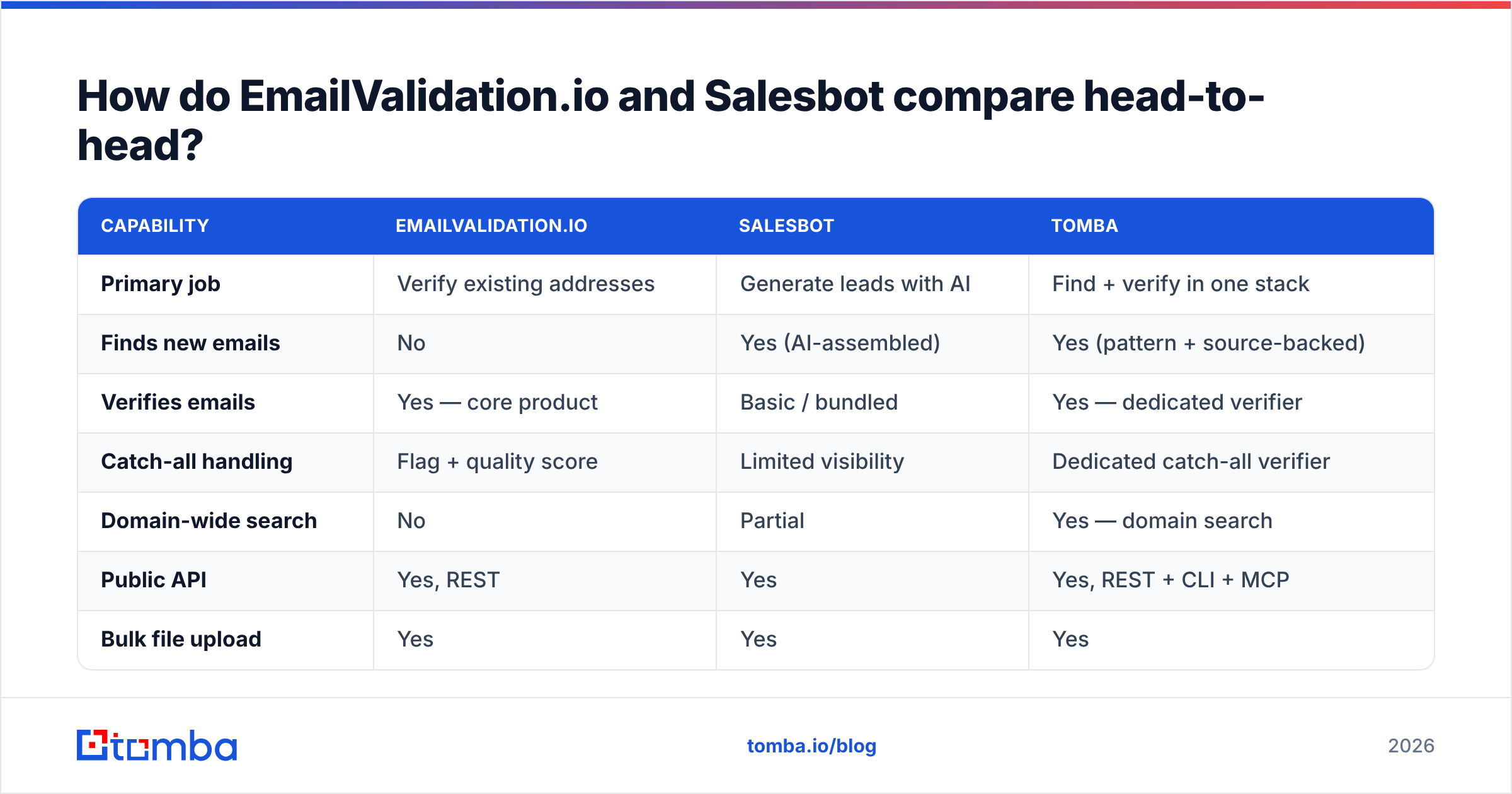
| Capability | EmailValidation.io | Salesbot | Tomba |
|---|---|---|---|
| Primary job | Verify existing addresses | Generate leads with AI | Find + verify in one stack |
| Finds new emails | No | Yes (AI-assembled) | Yes (pattern + source-backed) |
| Verifies emails | Yes — core product | Basic / bundled | Yes — dedicated verifier |
| Catch-all handling | Flag + quality score | Limited visibility | Dedicated catch-all verifier |
| Domain-wide search | No | Partial | Yes — domain search |
| Public API | Yes, REST | Yes | Yes, REST + CLI + MCP |
| Bulk file upload | Yes | Yes | Yes |
| Free tier | Small monthly quota | Trial credits | 25 searches/month |
| Entry paid tier | Low double digits/month | Credit bundles | $49/month |
| Best for | Devs cleaning lists | Founders with no list | Teams doing both |

A note on the pricing row: published plans change often and both vendors adjust tiers without much announcement. Treat the ranges above as directional and confirm on each vendor's own pricing page before you buy. Tomba's numbers are exact — Tomba pricing runs Free (25 searches/month), Starter $49/month, Growth $99/month, Pro $249/month, and custom Enterprise.
Which one is more accurate?#
Wrong question, and it is the question most comparison posts get wrong. These tools report accuracy on different things.
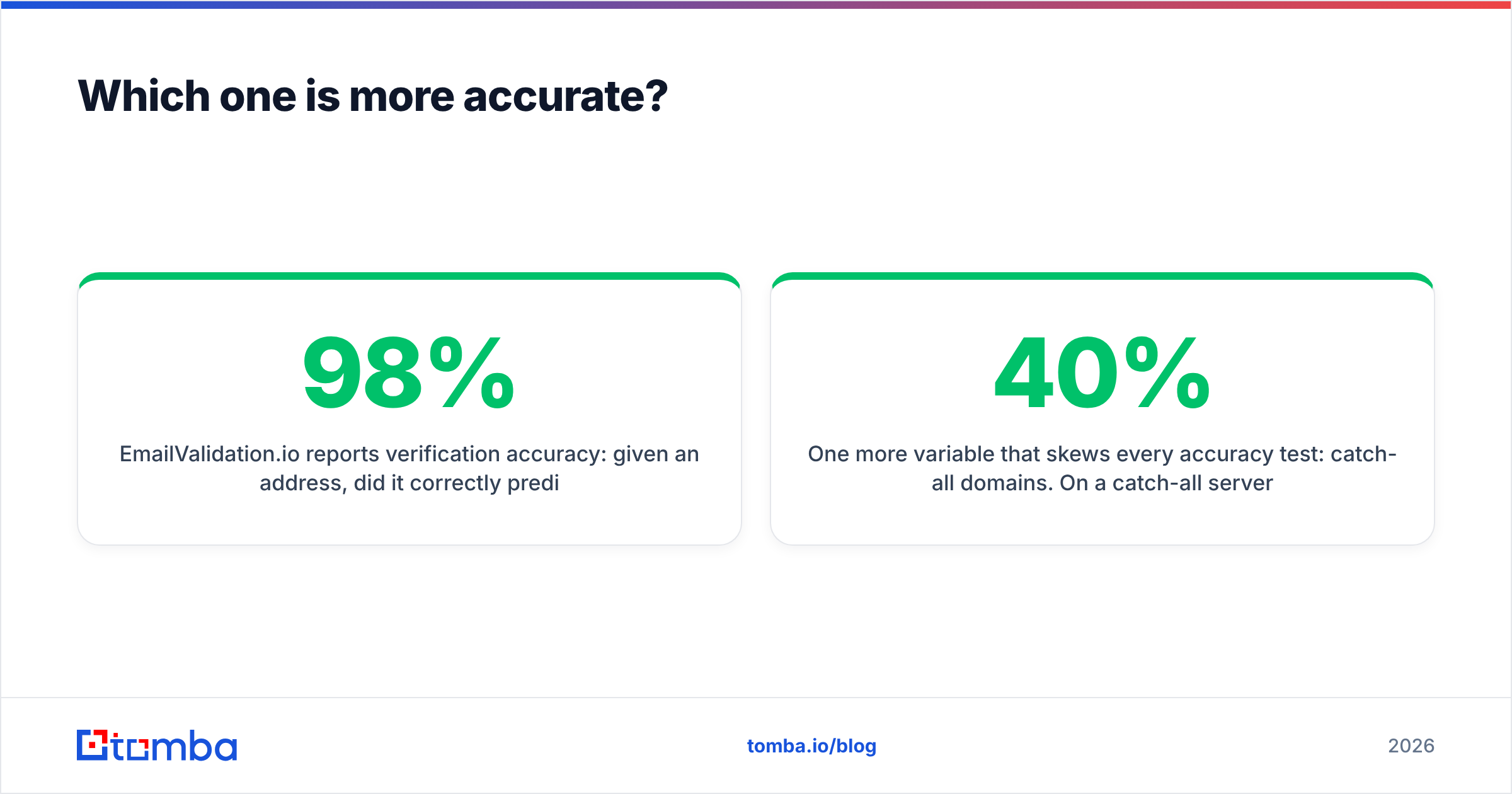
EmailValidation.io reports verification accuracy: given an address, did it correctly predict whether a send would land? Salesbot reports something closer to discovery accuracy: of the contacts it produced, how many had a usable email? A verifier with 98% accuracy and a finder with 98% coverage are not the same claim, and vendors know that the ambiguity flatters them.

Here is how to test both honestly, using a control list:
- Build a 200-address ground-truth set. Use addresses you have personally emailed and received replies from in the last 90 days. These are known-good.
- Add 50 known-dead addresses. People who left the company, domains that lapsed. These are known-bad.
- Run the mixed list through the verifier. Count false negatives — good addresses flagged as risky or invalid. This is the expensive error, because you delete real prospects.
- Feed the same 200 companies to the prospecting tool. Compare the emails it returns against your ground truth. Character-for-character matches only.
- Send a 300-address cold batch through each path and record the actual bounce rate from your ESP, not the tool's dashboard.
Step 5 is the one that settles arguments. Vendor dashboards report what the vendor predicted. Your ESP reports what actually happened. When they disagree, the ESP is right.
One more variable skews every accuracy test: catch-all domains. On a catch-all server, the mail host accepts everything at the SMTP handshake, so a plain verifier cannot tell a real mailbox from a typo. Depending on your industry, 20–40% of B2B domains are catch-all. If a tool has no specific handling for them, its headline accuracy number was measured on the easy 60%. Tools with a dedicated catch-all verifier apply extra signals — historical engagement, pattern confidence, source corroboration — instead of shrugging and returning "unknown."
What does each tool actually do well?#
Rather than a winner-takes-all verdict, here is where each earns its money.
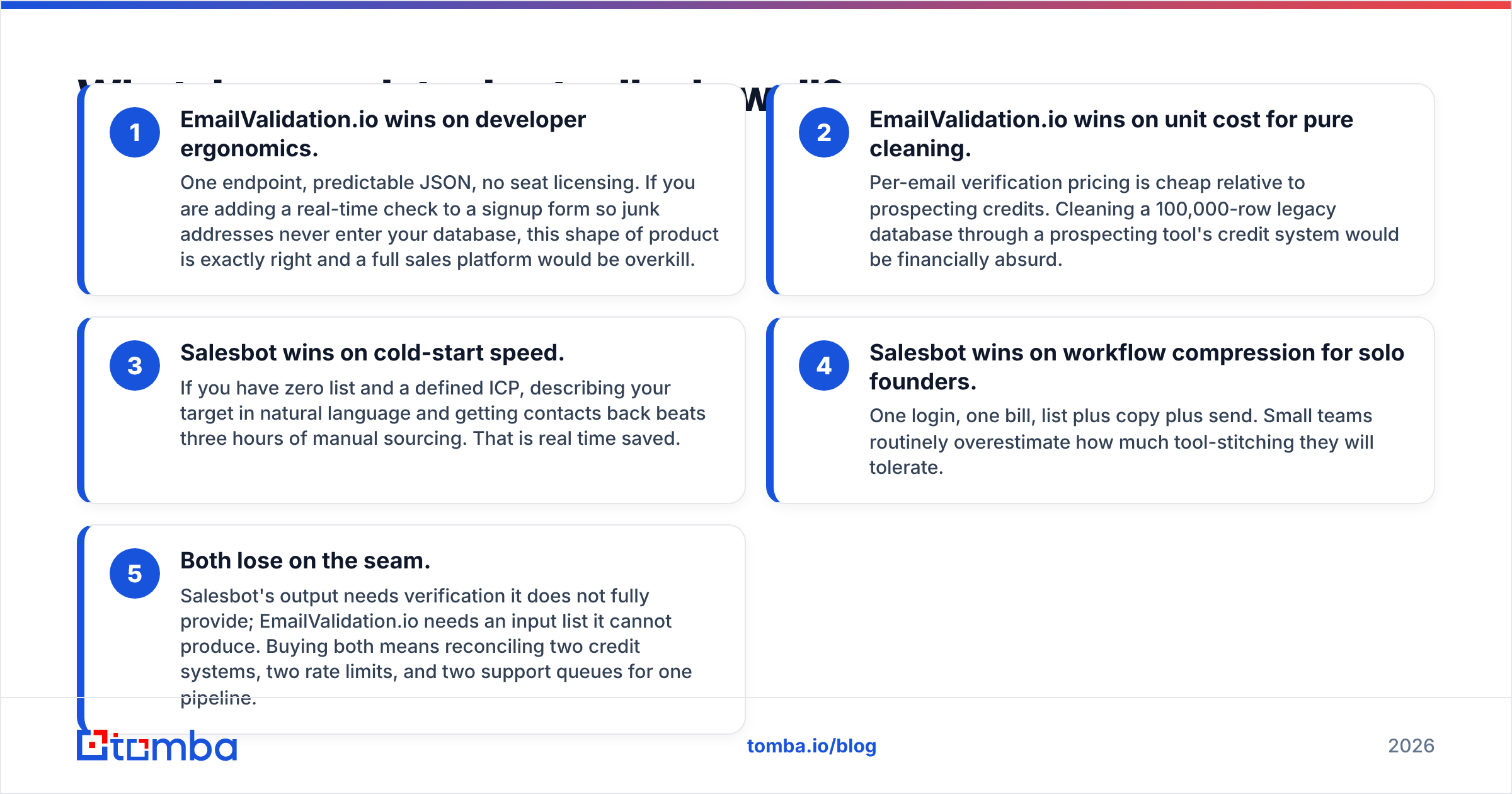
- EmailValidation.io wins on developer ergonomics. One endpoint, predictable JSON, no seat licensing. Adding a real-time check to a signup form? This shape of product is exactly right, and a full sales platform would be overkill.
- EmailValidation.io wins on unit cost for pure cleaning. Per-email verification pricing is cheap relative to prospecting credits. Cleaning a 100,000-row legacy database through a prospecting tool's credit system would be financially absurd.
- Salesbot wins on cold-start speed. If you have zero list and a defined ICP, describing your target in natural language and getting contacts back beats three hours of manual sourcing. That is real time saved.
- Salesbot wins on workflow compression for solo founders. One login, one bill, list plus copy plus send. Small teams routinely overestimate how much tool-stitching they will tolerate.
Both tools lose on the seam. Salesbot's output needs verification it does not fully provide. EmailValidation.io needs an input list it cannot produce. Buying both means reconciling two credit systems, two rate limits, and two support queues for one pipeline.
That seam is the actual decision. You are not choosing between two products — you are choosing whether to run a two-vendor pipeline or a single stack.
Is a combined finder plus verifier cheaper than running both?#
Usually, yes, and the reason is waste rather than list price.
Run the two-vendor math on a realistic month. Say you need 3,000 new contacts. The prospecting tool burns credits on every lookup, including the ones that return nothing usable — a miss still costs you. Then the verifier charges again on all 3,000 returned addresses, including the ones the prospecting tool already guessed wrong. You are paying twice to discover that 600 of them were never real.
A combined stack collapses that. When the finder and verifier share the same source data, a low-confidence pattern guess gets filtered before it becomes a billable verification. That is the core argument for using one vendor for both jobs: fewer round trips, one credit pool, one confidence score.

Practically, a single-stack setup looks like this:
- Domain search to enumerate contacts at a target company — find emails by domain returns the roster plus the company's dominant email pattern, which is more useful than any individual address.
- Email finder for named prospects you already identified on LinkedIn or in a conference list.
- Bulk processing for the list you exported from your CRM last quarter — bulk verify handles CSV in and CSV out without you writing a loop.
- API for anything recurring, so enrichment happens on record creation instead of in a monthly cleanup panic. The email verification API covers both directions.
Other credible options in this space are worth knowing: ZeroBounce and Bouncer for pure verification depth, BookYourData if you want a purchased-database model with verification built in rather than a search-based one, and Hunter for the classic finder-plus-verifier pairing. Check current reviews on G2 before you commit to an annual plan — this category churns.
Which should you choose for your use case?#
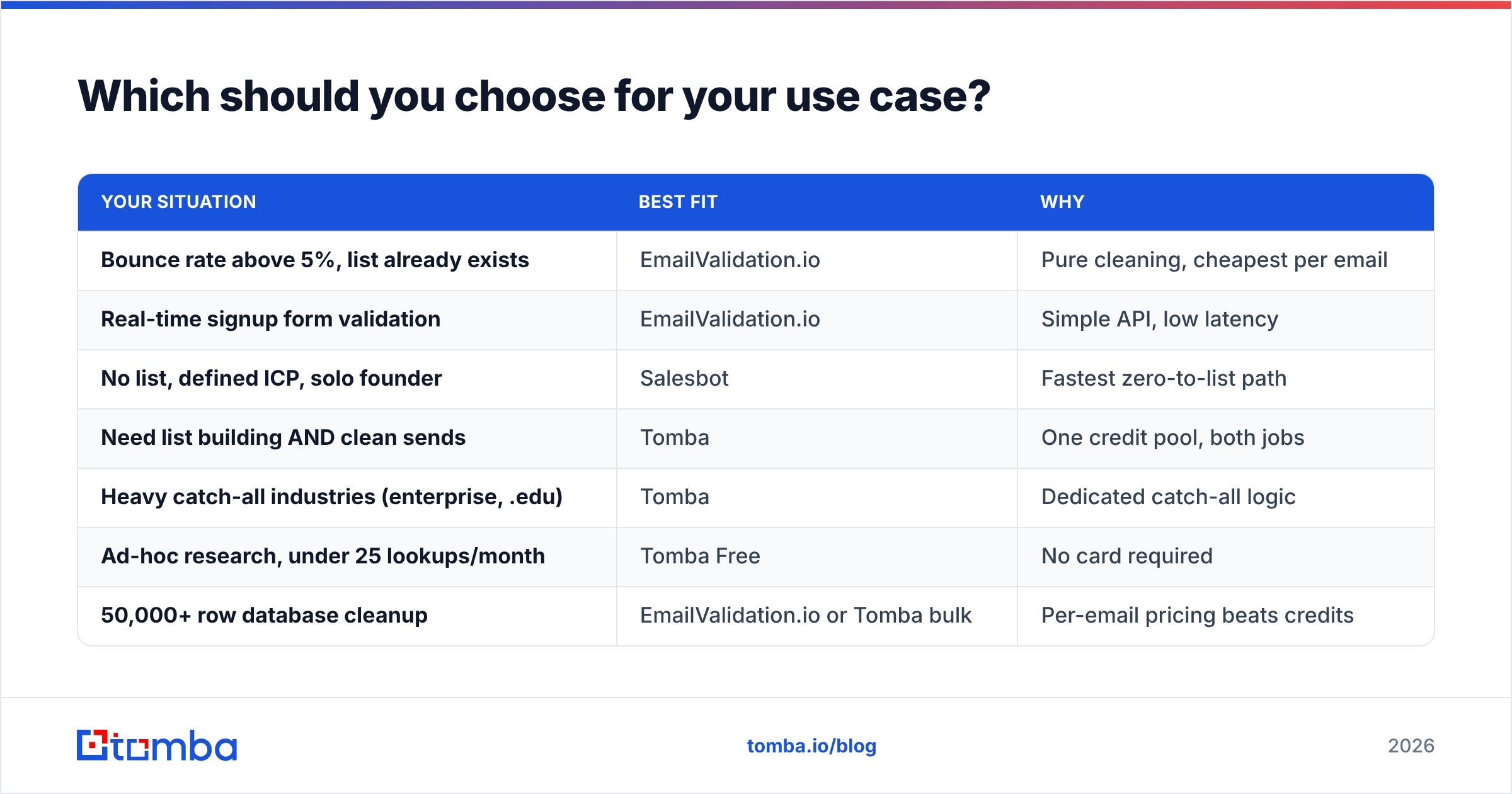
Match the tool to the actual bottleneck.
| Your situation | Best fit | Why |
|---|---|---|
| Bounce rate above 5%, list already exists | EmailValidation.io | Pure cleaning, cheapest per email |
| Real-time signup form validation | EmailValidation.io | Simple API, low latency |
| No list, defined ICP, solo founder | Salesbot | Fastest zero-to-list path |
| Need list building AND clean sends | Tomba | One credit pool, both jobs |
| Heavy catch-all industries (enterprise, .edu) | Tomba | Dedicated catch-all logic |
| Ad-hoc research, under 25 lookups/month | Tomba Free | No card required |
| 50,000+ row database cleanup | EmailValidation.io or Tomba bulk | Per-email pricing beats credits |
If you are still torn, apply this test: which side of the pipeline is currently costing you money? If prospects exist in your CRM but your sends bounce, buy verification. If your sequences are half-empty because nobody sourced anyone this week, buy discovery. Do not buy the tool that solves the problem you had last quarter.
What should you check before you sign up?#
Five things, in order of how often they burn people:
- Credit rollover and expiry. Unused credits that vanish monthly change your effective price meaningfully. Ask, in writing.
- How "unknown" results are billed. Some verifiers charge for inconclusive results, some do not. On catch-all-heavy lists, this can be 30% of your volume.
- Rate limits on the API. A 10-requests-per-second cap turns a 50,000-row cleanup into a multi-hour job. Fine if you planned for it, painful if you did not.
- Data provenance and compliance. Ask where the contact data comes from and how GDPR deletion requests are handled. Vendors that are vague here are a liability, not a bargain. Tomba publishes its data sources for exactly this reason.
- Export freedom. Can you get your enriched contacts out as CSV without an upgrade? If the answer is "on the higher tier," price the higher tier.
The bottom line#
EmailValidation.io vs Salesbot is really an architecture choice, not a feature checklist: two specialist vendors, or one stack that covers discovery and verification with a shared confidence signal.
If you run outbound at any real volume, the two-vendor split costs more than the pricing pages suggest. You pay for misses twice, and you burn engineering time reconciling two sets of credits and rate limits. Start with the Tomba Email Finder on the free tier (25 searches per month, no card) and run it against a company you know well. Check the returned pattern against addresses you have actually emailed. If the match holds on your own data, it will hold on your prospects', and you will have replaced two subscriptions with one.
Related guides#
Ready to find emails that actually work?
Join 150,000+ professionals who stopped guessing and started sending. Free credits on signup — no credit card required.
Get the Tomba newsletter
Practical outbound tactics and product updates — once every two weeks.
About the author