EmailValidation.io vs Zintlr: Full 2026 Comparison Guide
One cleans lists, the other builds them. A neutral 2026 breakdown of EmailValidation.io vs Zintlr — coverage, accuracy, pricing, API depth, and which one actually belongs in your outbound stack.
TL;DR
- They are not the same category. EmailValidation.io is a verification API that tells you whether an address is deliverable. Zintlr is a B2B prospecting and intelligence platform that gives you contacts in the first place.
- Pick EmailValidation.io if you already have lists (signup forms, CRM exports, purchased data) and need a cheap, fast, developer-friendly cleaning layer.
- Pick Zintlr if you need net-new contacts, firmographic filters, and personality/intent context for your SDR team — and you're comfortable with per-seat pricing.
- Most teams need both jobs done, which is why a combined finder + verifier (Tomba's Free tier through $249/mo Pro) usually beats stitching two single-purpose vendors together.
- Accuracy claims from any vendor are marketing until you test them. Run the same 500-row sample through both and measure bounce rate on a real send.
What is EmailValidation.io?#
EmailValidation.io is a single-purpose email verification API. You send it an address, it returns a structured verdict: syntax valid, MX records present, SMTP reachable, disposable domain, role-based address (info@, sales@), free provider, and a deliverability score.
That's the whole product. There's a dashboard, a bulk upload, and a REST endpoint — but the center of gravity is the API. It's built for developers who want a GET request in a signup flow, not for SDRs who want a UI to browse companies in.
What that buys you:
- Latency you can put in a form. Sub-second responses mean you can block typo'd addresses at registration instead of discovering them at send time.
- Predictable request-based pricing. You pay per check, not per seat, so cost scales with volume rather than headcount.
- A thin integration surface. One endpoint, one API key, JSON in and out. Most engineers wire it up in an afternoon.
- No data-sourcing baggage. It never claims to know who works where — it only judges the address you hand it.
What it explicitly does not do: find anyone. If your list is empty, EmailValidation.io leaves it empty.
What is Zintlr?#
Zintlr sits at the opposite end of the funnel. It's a B2B database and sales-intelligence platform — company and contact search, filters by industry, headcount, geography, and tech stack, plus a Chrome extension for pulling contacts while you browse LinkedIn or a company site.
Its distinguishing pitch is personality intelligence: alongside the contact record, Zintlr surfaces inferred behavioral traits meant to help reps tailor tone and opener. Whether that materially lifts reply rates is unproven at industry level, but it's a real differentiator versus a plain contact database.
Zintlr's practical profile:
- Contact discovery first. Search, filter, export, push to CRM.
- Per-seat commercial model. Cost tracks the size of your sales team, and credits are typically bundled per user.
- Strongest coverage in APAC and India-headquartered accounts, with thinner depth than the largest US-centric databases in some Western mid-market segments. Test your own ICP before committing.
- Verification is a feature, not the product. You get some validity signal on exported contacts, but it isn't a standalone verification API you'd embed in a signup form.
Are EmailValidation.io and Zintlr even competitors?#
Mostly no — and that's the single most useful thing to understand before you compare price tags.
Think of it like a restaurant kitchen. Zintlr is the supplier that delivers ingredients. EmailValidation.io is the quality check at the back door that rejects the spoiled ones. Comparing "which is better" is like asking whether the vegetable supplier beats the food inspector. You need both functions; the question is whether you buy them from one vendor or two.
Teams end up comparing these two for three reasons:
- They're both mid-priced tools that show up in the same "B2B data" G2 categories.
- Both promise "clean data," which papers over the finder/verifier distinction.
- Budget owners want to consolidate and assume one can absorb the other's job. Usually it can't.
The overlap is real but narrow: Zintlr does some validity checking on the contacts it returns, and EmailValidation.io does return metadata (role, free, disposable) that helps you segment a list. Neither substitutes for the other.
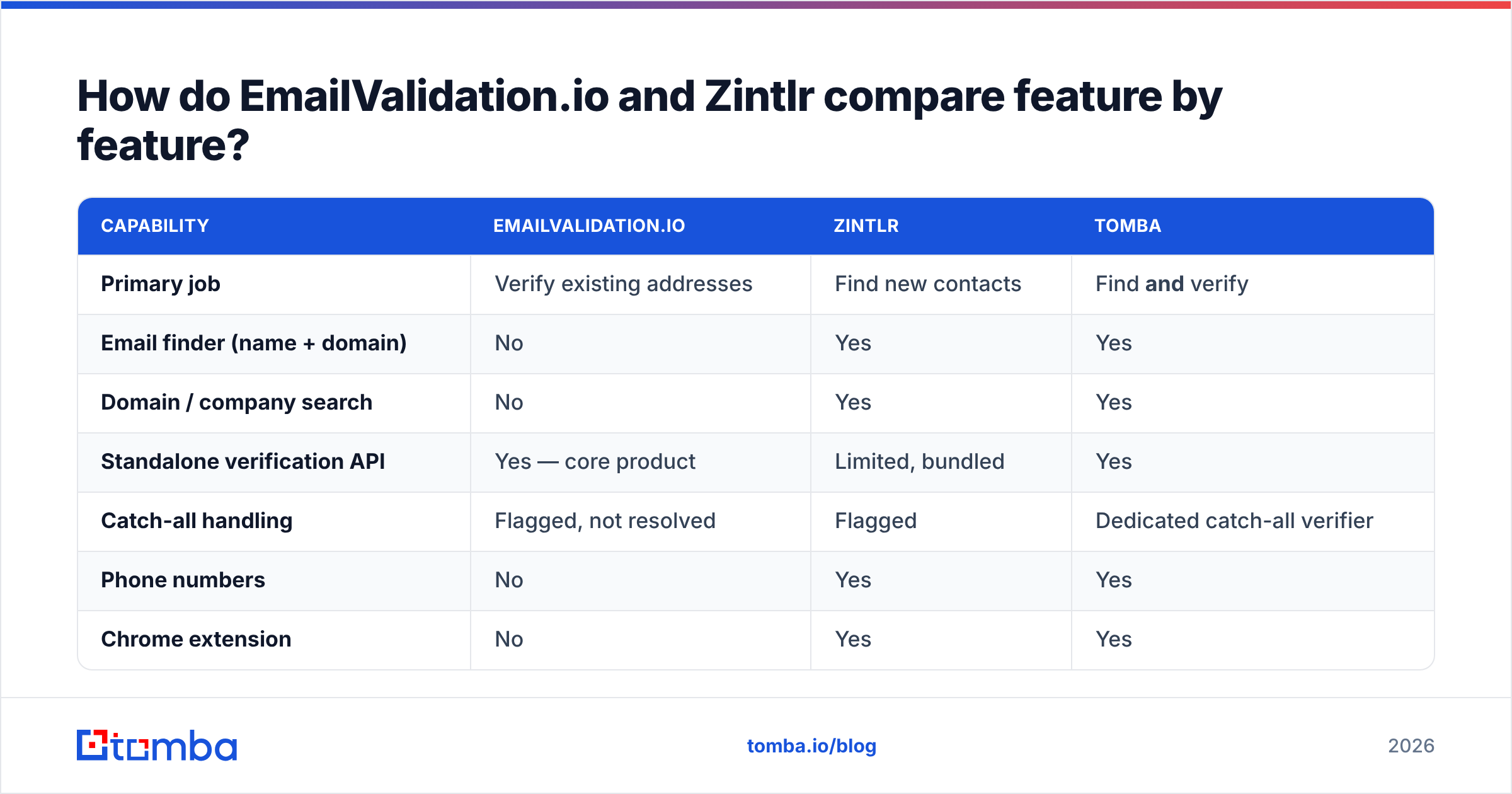
How do EmailValidation.io and Zintlr compare feature by feature?#
| Capability | EmailValidation.io | Zintlr | Tomba |
|---|---|---|---|
| Primary job | Verify existing addresses | Find new contacts | Find and verify |
| Email finder (name + domain) | No | Yes | Yes |
| Domain / company search | No | Yes | Yes |
| Standalone verification API | Yes — core product | Limited, bundled | Yes |
| Catch-all handling | Flagged, not resolved | Flagged | Dedicated catch-all verifier |
| Phone numbers | No | Yes | Yes |
| Chrome extension | No | Yes | Yes |
| Personality / behavioral intel | No | Yes — differentiator | No |
| Pricing model | Per request | Per seat + credits | Per credit, flat tiers |
| Free tier | Yes, small monthly quota | Trial / limited free | 25 searches/mo |
| Best-fit buyer | Engineers, growth teams | SDR teams, APAC-focused GTM | Both, plus API-first teams |
Two things jump out of that table. First, the feature sets barely intersect — the "vs" framing is mostly a search-query artifact. Second, if you actually need both columns filled, you're looking at two contracts, two integrations, and two support queues.
How accurate is each tool, and how do you test it?#
Accuracy means different things on each side of this comparison, so measure them differently.
For EmailValidation.io, accuracy = correct verdicts. The metrics that matter:
- False valid rate — addresses marked deliverable that bounce. This is the expensive error; it burns your sender reputation.
- False invalid rate — good addresses marked bad. Silent revenue loss, and much harder to notice.
- Unknown rate — how often it shrugs. Catch-all domains inflate this for every verifier on the market, which is why a dedicated catch-all verifier matters if a big share of your ICP runs catch-all MX.
For Zintlr, accuracy = data freshness and coverage. Job changes are the killer: roughly a fifth of B2B contact records decay annually as people switch roles, so a database that looked great in a demo can degrade quietly. Measure hit rate (percentage of target accounts where you get a usable contact) separately from validity (percentage of returned emails that survive verification).

The honest test takes an afternoon:
- Build a 500-row sample from your real ICP — not a vendor-supplied list.
- Run it through each tool with default settings.
- Verify every returned address with a neutral third verifier so you're not grading a vendor's homework with its own marking scheme.
- Send a real, low-volume campaign to the survivors and record the actual bounce rate.
- Compare cost per usable contact, not cost per credit.
Vendor-published accuracy percentages — including everyone's — are measured on lists the vendor chose. Treat them as directional at best. Independent review aggregation on G2 is a useful sanity check on support quality and billing surprises, but it won't tell you bounce rates either.
What does each one cost in 2026?#
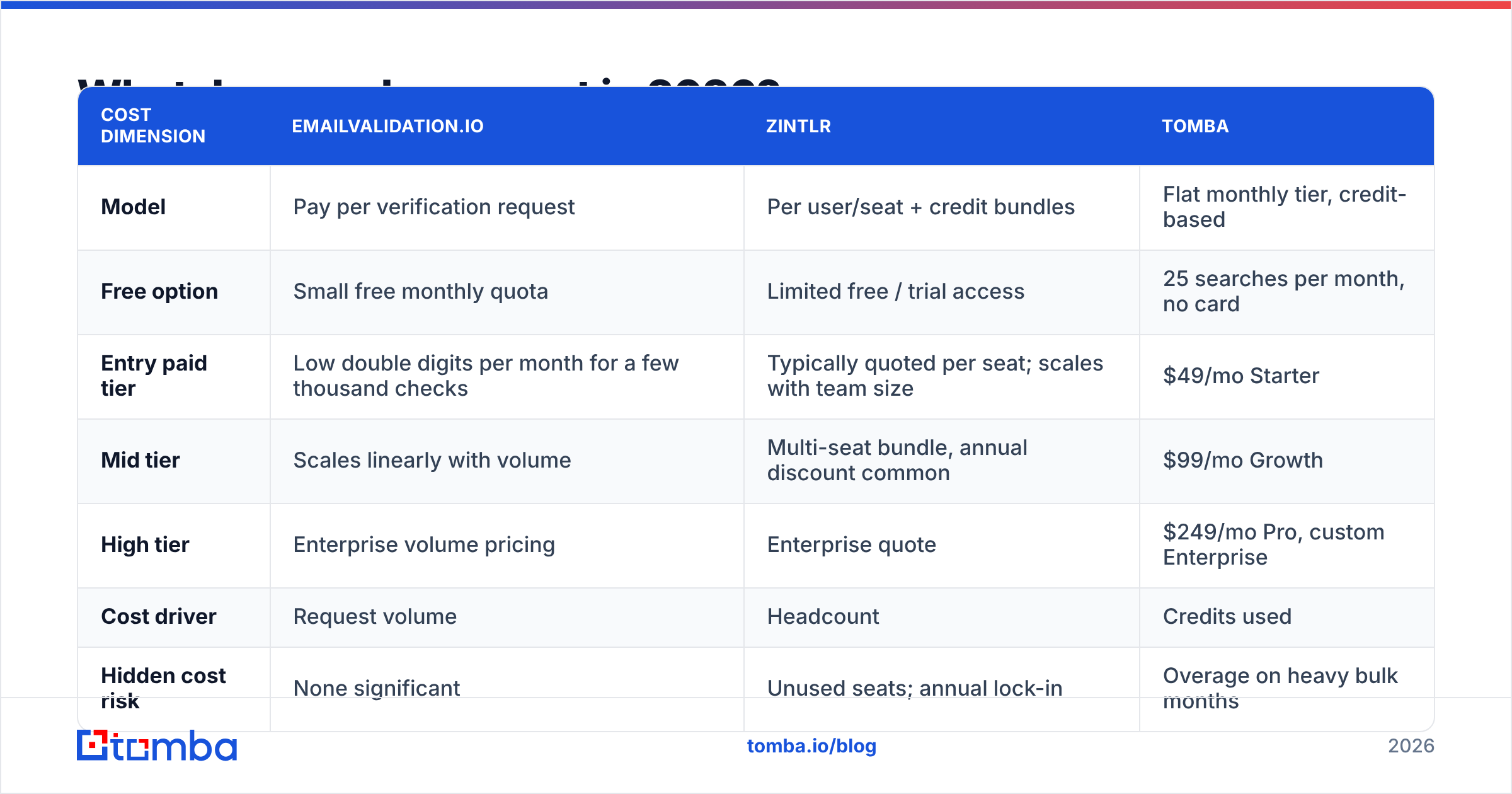
Pricing on both platforms moves, and Zintlr in particular quotes per team. Treat the shape of the model as the durable fact and confirm current numbers on the vendor pages.
| Cost dimension | EmailValidation.io | Zintlr | Tomba |
|---|---|---|---|
| Model | Pay per verification request | Per user/seat + credit bundles | Flat monthly tier, credit-based |
| Free option | Small free monthly quota | Limited free / trial access | 25 searches per month, no card |
| Entry paid tier | Low double digits per month for a few thousand checks | Typically quoted per seat; scales with team size | $49/mo Starter |
| Mid tier | Scales linearly with volume | Multi-seat bundle, annual discount common | $99/mo Growth |
| High tier | Enterprise volume pricing | Enterprise quote | $249/mo Pro, custom Enterprise |
| Cost driver | Request volume | Headcount | Credits used |
| Hidden cost risk | None significant | Unused seats; annual lock-in | Overage on heavy bulk months |
The structural difference matters more than the sticker price. Request-based pricing punishes volume; seat-based pricing punishes growth. A three-person team verifying two million addresses a year will find EmailValidation.io's model brutal. A twelve-person SDR team pulling 400 contacts a month each will find seat pricing expensive relative to actual data consumed.
Flat-tier credit pricing — the model behind Tomba pricing — sits between them: you buy capacity, not chairs, and everyone on the team shares it.

Which one should you pick for your use case?#
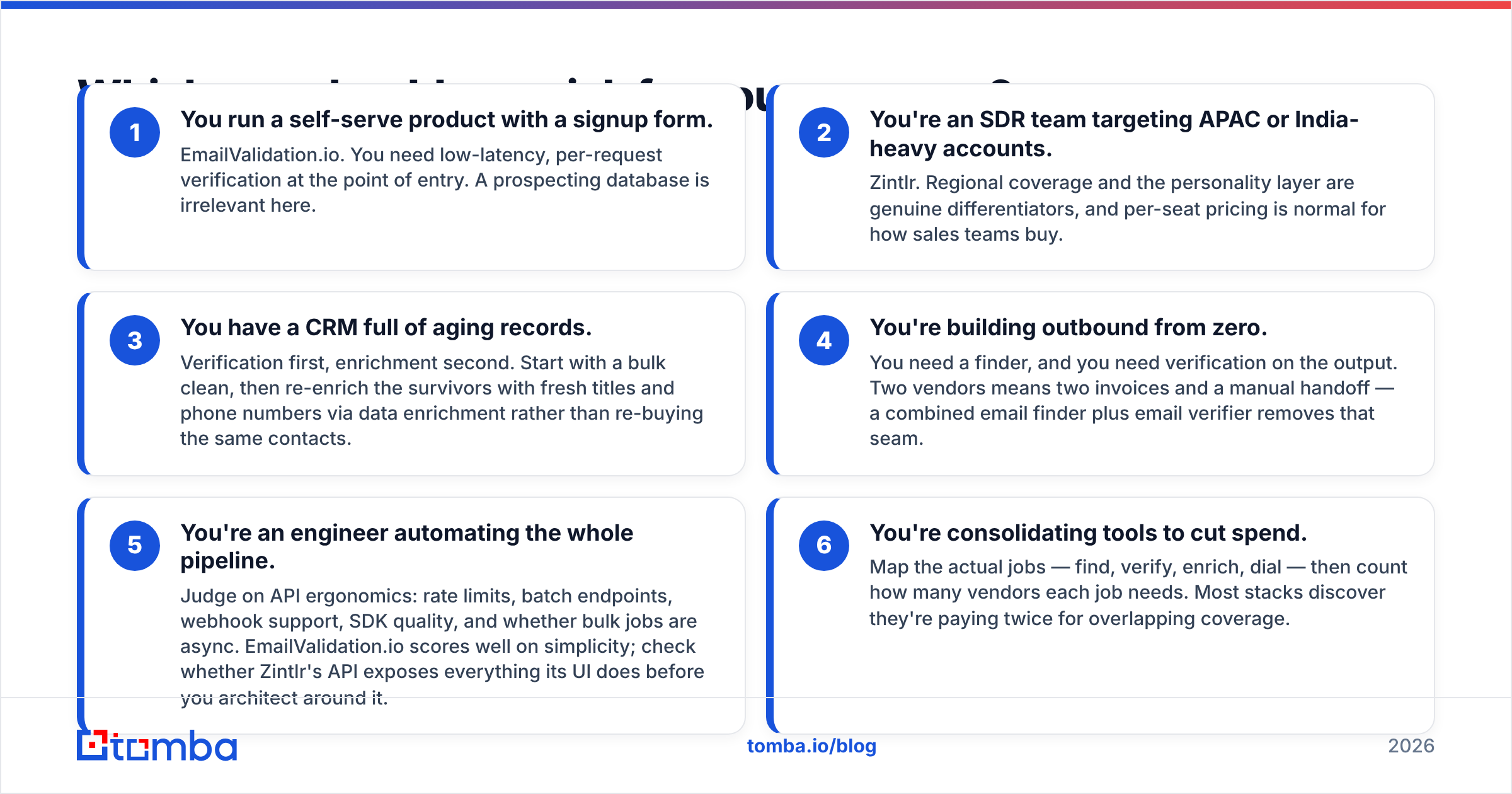
- You run a self-serve product with a signup form. EmailValidation.io. You need low-latency, per-request verification at the point of entry. A prospecting database is irrelevant here.
- You're an SDR team targeting APAC or India-heavy accounts. Zintlr. Regional coverage and the personality layer are genuine differentiators, and per-seat pricing is normal for how sales teams buy.
- You have a CRM full of aging records. Verification first, enrichment second. Start with a bulk clean, then re-enrich the survivors with fresh titles and phone numbers via data enrichment rather than re-buying the same contacts.
- You're building outbound from zero. You need a finder, and you need verification on the output. Two vendors means two invoices and a manual handoff — a combined email finder plus email verifier removes that seam.
- You're an engineer automating the whole pipeline. Judge on API ergonomics: rate limits, batch endpoints, webhook support, SDK quality, and whether bulk jobs are async. EmailValidation.io scores well on simplicity; check whether Zintlr's API exposes everything its UI does before you architect around it.
- You're consolidating tools to cut spend. Map the actual jobs — find, verify, enrich, dial — then count how many vendors each job needs. Most stacks discover they're paying twice for overlapping coverage.
Where does Tomba fit in this comparison?#
Tomba is relevant here precisely because this comparison exposes a gap: neither tool does the other's job well.
Tomba's core product is the email finder, with the verifier, domain search, catch-all verifier, phone finder, and enrichment sitting alongside it on the same credit pool. Practically, that means:
- One API key covers find + verify instead of chaining two vendors, which matters when you're scripting a pipeline and don't want a failed second call to orphan a first-call credit.
- Flat tiers, shared credits. $49/mo Starter, $99/mo Growth, $249/mo Pro, custom Enterprise, and a Free tier at 25 searches per month for evaluation. Nobody pays for an idle seat.
- Catch-all is treated as a first-class problem, not just a flag on the response — which is where most verification comparisons quietly fall apart.
- Coverage is Western-leaning. If your ICP is concentrated in India or Southeast Asia, run the sample test above before assuming any US/EU-centric database beats a regional specialist like Zintlr. That's an honest limitation, not a footnote.
Tomba is not a sales-intelligence suite. There's no personality inference, no sequencer, no dialer. If your team wants an all-in-one SDR cockpit, Zintlr and the larger platforms are a closer shape. If you want accurate contact data through an API you can call from anywhere, that's the narrower bet Tomba takes.

What's the verdict on EmailValidation.io vs Zintlr?#
There is no single winner, because they answer different questions.
Choose EmailValidation.io when your bottleneck is list hygiene and your integration point is code. It's cheap, narrow, and good at the one thing it does. It will never fill an empty pipeline.
Choose Zintlr when your bottleneck is finding people, your team sells into its coverage strengths, and per-seat pricing matches how you already buy sales tools. Validate its data freshness on your own accounts first — as you should with every database vendor.
Choose neither alone if you're doing outbound seriously. The pipeline is find → verify → enrich → send, and buying two point solutions for the first two steps means you own the integration between them. That's fine at scale with an engineering team; it's overhead at ten people.
The test that settles it is boring and cheap: 500 rows from your real ICP, three tools, one honest bounce-rate measurement. Vendor claims — including the ones on this blog — should lose to your own numbers every time.
Ready to test it against your own list? Start with the Tomba Email Finder — the Free tier gives you 25 searches a month with no card, enough to run a proper sample against your ICP and compare hit rate and bounce rate side by side with whatever you're using now. If it wins on your data, Starter is $49/mo with find, verify, and enrichment on one shared credit pool. If it doesn't, you'll at least have a real benchmark instead of a vendor's.
Related guides#
Ready to find emails that actually work?
Join 150,000+ professionals who stopped guessing and started sending. Free credits on signup — no credit card required.
Get the Tomba newsletter
Practical outbound tactics and product updates — once every two weeks.
About the author