EmailVerify.io vs FindThatLead: Which Tool Wins in 2026?
One tool cleans lists, the other builds them. We break down EmailVerify.io vs FindThatLead on accuracy, pricing, API depth, and which stack actually lowers your bounce rate in 2026.
Short answer on EmailVerify.io vs FindThatLead: pick EmailVerify.io to clean a list you already own, and pick FindThatLead to build a list you do not have yet. The rest of this guide compares them on accuracy, price, and API depth.
TL;DR
- EmailVerify.io vs FindThatLead is not a like-for-like fight. The two tools solve different halves of one problem. EmailVerify.io cleans a list you already have. FindThatLead builds the list and adds a light sending layer on top.
- If your bounce rate is the fire, EmailVerify.io is the extinguisher. If your pipeline is empty, FindThatLead is the closer fit.
- Buying both means two subscriptions, two credit systems, and two APIs to maintain. That is the real cost most teams miss.
- FindThatLead's built-in verification is decent for a bundled feature. It is not a substitute for a dedicated verification pass on cold lists.
- A consolidated stack — finder, verifier, catch-all handling, and enrichment behind one API — usually beats two point tools at similar spend.
What are EmailVerify.io and FindThatLead?#
Short version: these two tools sit at opposite ends of the outbound data pipeline.
- EmailVerify.io is a verification-first tool. You upload a list. It checks syntax, DNS/MX records, disposable domains, role accounts, and SMTP acceptance. Then it hands back a status per address. Its job is subtraction: removing addresses that will bounce.
- FindThatLead is a prospecting-first tool. You give it a domain, a name, or a LinkedIn search, and it returns email addresses. Its job is addition: turning a target account list into contactable people.
The two also differ in ways that show up on your invoice.
- They overlap in the middle. FindThatLead includes a verification step, and EmailVerify.io has a limited finder angle on some plans. Neither overlap is as deep as the other tool's core function.
- Their pricing models differ. Verifiers price per address checked, often with credits that never expire. Prospecting tools price per search credit, usually on a monthly reset.
- Their failure modes differ too. A weak verifier costs you sender reputation. A weak finder costs you meetings you never booked.
That framing matters, because EmailVerify.io vs FindThatLead is rarely a real either/or for a team running cold outbound. The question is which gap hurts more right now. It is also whether one platform can close both gaps without a second invoice.

EmailVerify.io vs FindThatLead: head-to-head comparison#
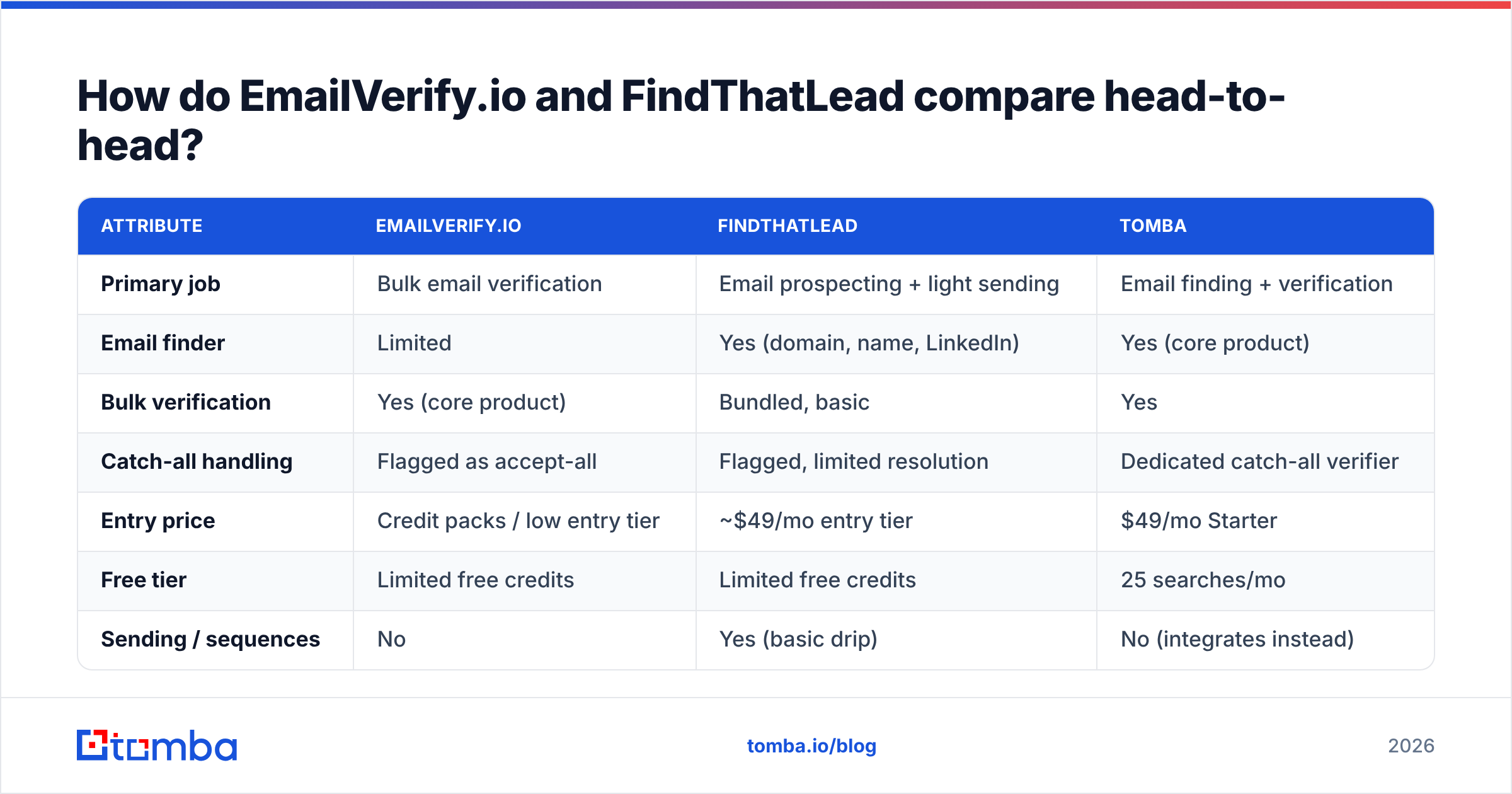
Here is the practical comparison. Treat published pricing as directional. Both vendors adjust tiers, so confirm current numbers on emailverify.io and findthatlead.com before you buy.
| Attribute | EmailVerify.io | FindThatLead | Tomba |
|---|---|---|---|
| Primary job | Bulk email verification | Email prospecting + light sending | Email finding + verification |
| Email finder | Limited | Yes (domain, name, LinkedIn) | Yes (core product) |
| Bulk verification | Yes (core product) | Bundled, basic | Yes |
| Catch-all handling | Flagged as accept-all | Flagged, limited resolution | Dedicated catch-all verifier |
| Entry price | Credit packs / low entry tier | ~$49/mo entry tier | $49/mo Starter |
| Free tier | Limited free credits | Limited free credits | 25 searches/mo |
| Sending / sequences | No | Yes (basic drip) | No (integrates instead) |
| API | Verification endpoints | Search + verify endpoints | Full finder, verifier, enrichment API |
| Best for | Cleaning purchased or aged lists | SMB teams building lists from scratch | Teams that want find + verify in one bill |

The table exposes the structural point. EmailVerify.io wins the column it was built for and does not compete elsewhere. FindThatLead spreads across finding, verifying, and sending. That is convenient, but bundled features are almost never as strong as the specialist equivalent.
Which tool is more accurate?#
Accuracy means two different things here. Conflating them is how teams end up disappointed. EmailVerify.io vs FindThatLead is not even scored on the same metric.
For EmailVerify.io, accuracy means classification precision. Given an address, does it correctly say deliverable, undeliverable, or risky? Good verifiers sit in the 95–99% agreement range against real send results on standard mailbox providers. Every verifier degrades on catch-all domains. Those servers accept mail for any address at the domain. No SMTP handshake can tell a real mailbox from a black hole, so honest tools flag it as "accept-all" and leave the call to you.
For FindThatLead, accuracy means hit rate and correctness. Of 1,000 target contacts, how many emails does it return? And how many of those belong to the right person? A finder can score well on one and badly on the other. Returning a guessed first.last@domain.com for everyone produces a high hit rate and a punishing bounce rate.

The practical test is cheap. Take 100 known-good contacts from your CRM, strip the emails, and run them through each tool. Measure found-rate, exact-match rate, and, after a real send, actual bounce rate. Vendor accuracy figures are marketing artifacts. Your own 100-row sample is evidence.
Also check how each tool treats risky addresses. A verifier that dumps catch-alls into "valid" makes its own accuracy look great and your bounce rate look terrible. Tomba splits this out with a dedicated catch-all verifier instead of forcing a binary answer. That is the honest way to handle an ambiguous signal.
What does each one actually cost?#
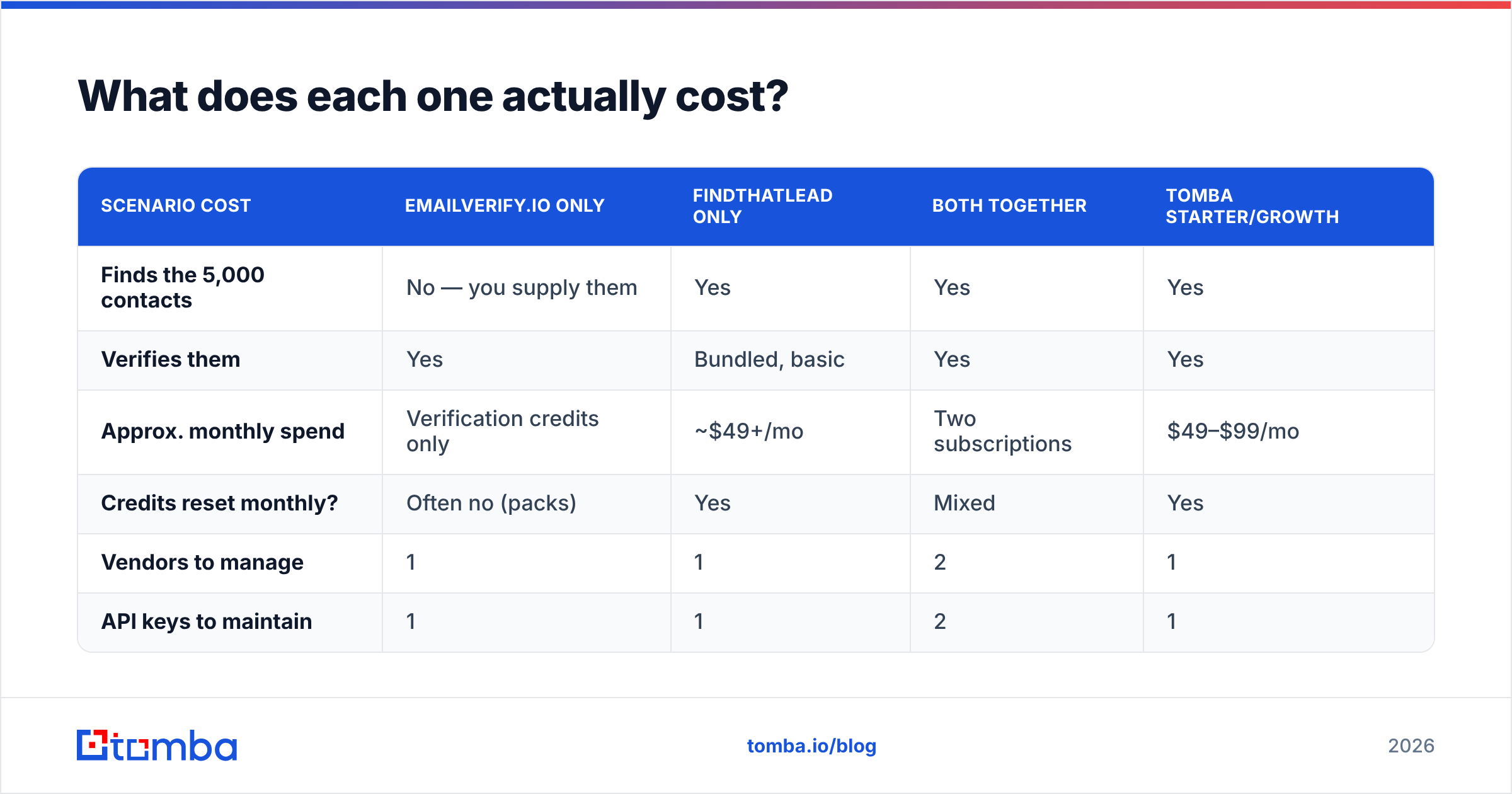
Cost in EmailVerify.io vs FindThatLead is apples-to-oranges unless you normalize on a workflow. So price a concrete scenario: a two-person SDR team that needs 5,000 new contacts per month, all verified before sending.
| Scenario cost | EmailVerify.io only | FindThatLead only | Both together | Tomba Starter/Growth |
|---|---|---|---|---|
| Finds the 5,000 contacts | No — you supply them | Yes | Yes | Yes |
| Verifies them | Yes | Bundled, basic | Yes | Yes |
| Approx. monthly spend | Verification credits only | ~$49+/mo | Two subscriptions | $49–$99/mo |
| Credits reset monthly? | Often no (packs) | Yes | Mixed | Yes |
| Vendors to manage | 1 | 1 | 2 | 1 |
| API keys to maintain | 1 | 1 | 2 | 1 |
The "both together" column is where budgets quietly leak. It is not only the second invoice. It is the second credit forecast, the second rate limit, the second failure point in your automation, and the cleanup work when the finder and the verifier disagree.
Tomba's pricing runs Free (25 searches/mo), Starter at $49/mo, Growth at $99/mo, Pro at $249/mo, and custom Enterprise. Finding and verification draw from the same account. That removes the two-vendor overhead for teams in this volume band.

Who should choose EmailVerify.io?#
Pick EmailVerify.io when your problem is a list you already own. In an EmailVerify.io vs FindThatLead decision, these four signals point at the verifier.
- You bought or inherited a database. Purchased lists decay fast. They often arrive with role accounts, spam traps, and dead domains. A verification pass before the first send is non-negotiable.
- You are recovering from a reputation hit. If a campaign bounced hard, a verifier plus a warmup plan is the recovery path. Check your standing with a sender reputation checker before you resume volume.
- Your CRM has years of accumulated contacts. Roughly 2–3% of B2B email addresses go stale per month through job changes alone. Annual list hygiene is a real ROI line item.
- You already have a finder you like. No reason to rip it out. Bolt verification onto the end.
Where EmailVerify.io does not help: an empty pipeline. It cannot create contacts, only judge them.
Who should choose FindThatLead?#
Pick FindThatLead when your problem is a list that does not exist yet. This is the other half of the EmailVerify.io vs FindThatLead split.
- You are a small team doing founder-led sales. The bundled search plus basic drip sending is genuinely convenient at low volume. One tool, one login, campaigns out the door.
- Your ICP maps cleanly to LinkedIn. FindThatLead's LinkedIn-driven workflows are its strongest angle, and reviews on G2 point at ease-of-use rather than raw data depth.
- You want light automation without a full sequencer. If Outreach or Salesloft is overkill, a bundled drip beats nothing.
Where FindThatLead struggles: enterprise-scale volume, API-first automation, and deep verification. If you send 20,000+ cold emails a month, the bundled verification layer will not carry the load alone. You will be shopping for a second tool anyway.
Can one platform do both jobs well?#
This is the real decision, and it is why a third option belongs in the conversation.
The two-tool stack — prospect in FindThatLead, clean in EmailVerify.io — works. It is also the most expensive way to solve the problem, and it adds a handoff. Every handoff between vendors is a CSV export, a column mismatch, and a re-import. It is also where 800 contacts silently become 740.
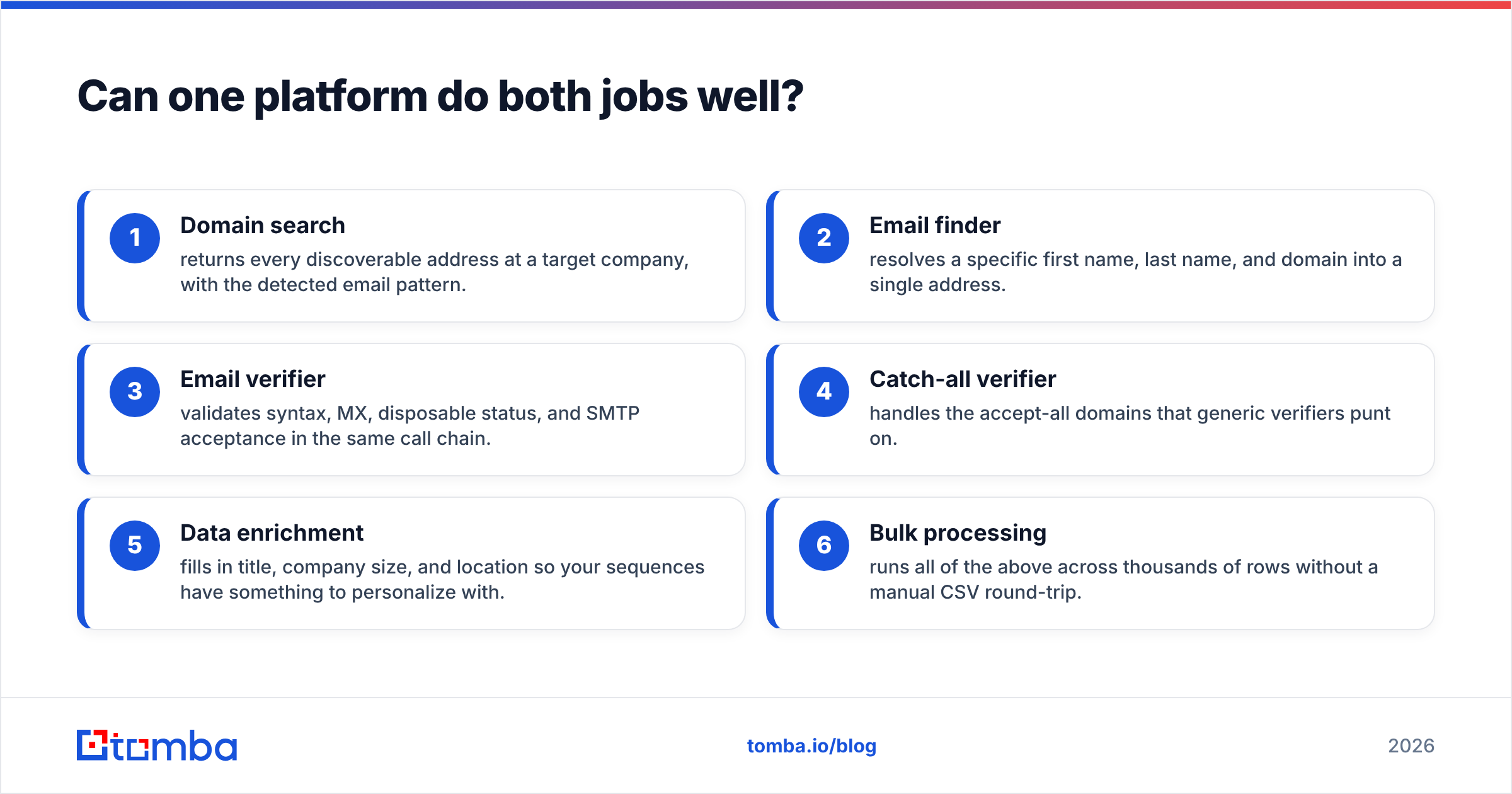
A consolidated approach collapses that. With Tomba, the same request that finds an address returns a confidence score and verification status, so there is no second pass to orchestrate:
- Domain search returns every discoverable address at a target company, with the detected email pattern.
- Email finder resolves a specific first name, last name, and domain into a single address.
- Email verifier validates syntax, MX, disposable status, and SMTP acceptance in the same call chain.
- Catch-all verifier handles the accept-all domains that generic verifiers punt on.
- Data enrichment fills in title, company size, and location so your sequences have something to personalize with.
- Bulk processing runs all of the above across thousands of rows without a manual CSV round-trip.
That is one credit pool, one API key, and one place to debug when something returns null at 2am.
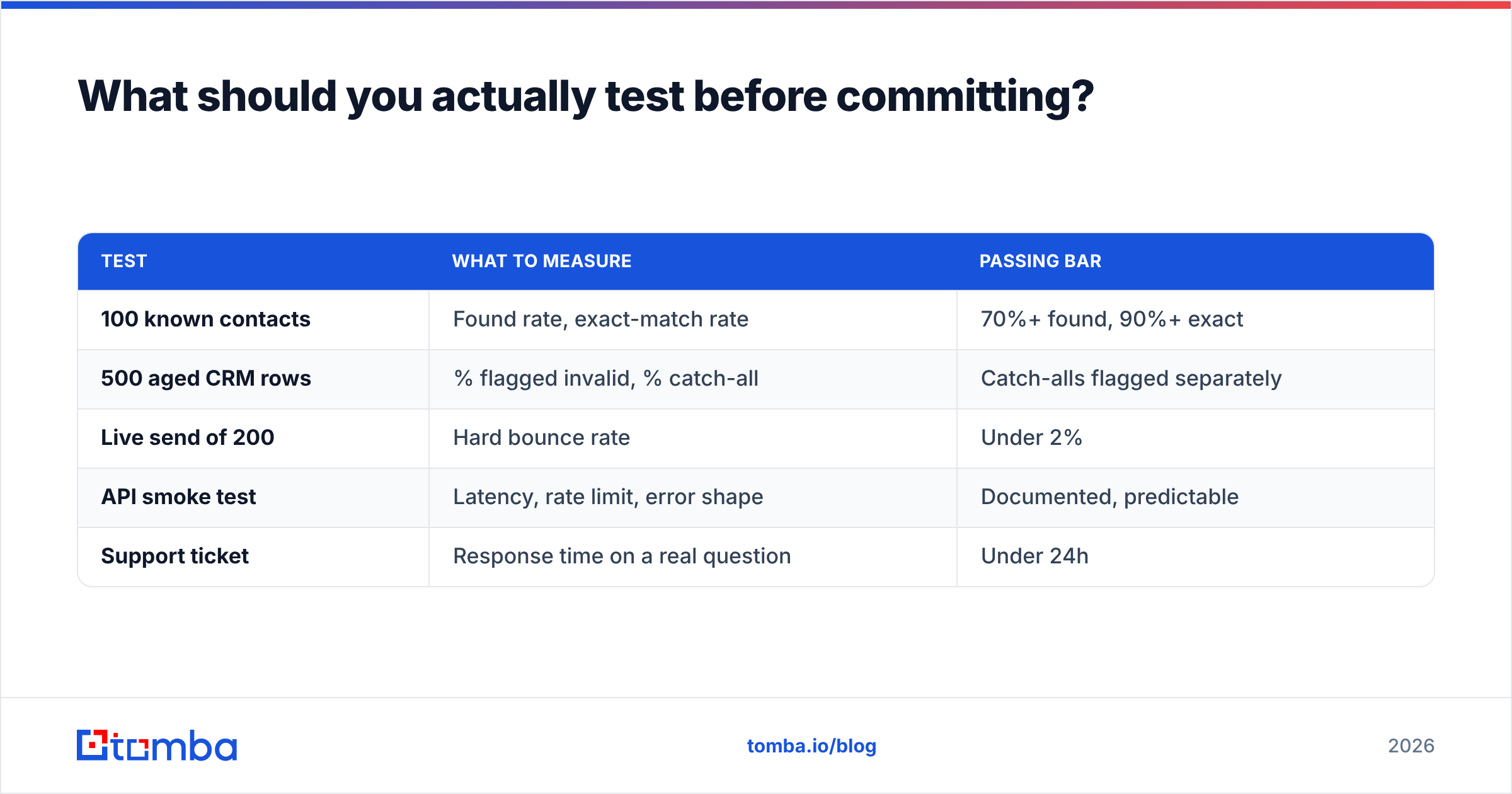
What should you actually test before committing?#
Run a 48-hour bake-off. It costs almost nothing and beats every comparison article, including this one.
| Test | What to measure | Passing bar |
|---|---|---|
| 100 known contacts | Found rate, exact-match rate | 70%+ found, 90%+ exact |
| 500 aged CRM rows | % flagged invalid, % catch-all | Catch-alls flagged separately |
| Live send of 200 | Hard bounce rate | Under 2% |
| API smoke test | Latency, rate limit, error shape | Documented, predictable |
| Support ticket | Response time on a real question | Under 24h |
Send the same 200 verified addresses from each tool through your real sending setup. Bounce rate on a live send is the only accuracy metric that is not a claim. Free tiers on all three tools cover this test comfortably. Tomba's free plan includes 25 searches per month, and both competitors offer trial credits.
The verdict#
The EmailVerify.io vs FindThatLead answer comes down to which problem you actually have. If you only have a list problem, EmailVerify.io is the sharper instrument. It does one job and does not pretend otherwise. If you only have a pipeline problem and you are a small team, FindThatLead is the friendlier start. The bundled sending saves a subscription at low volume.
But most outbound teams have both problems at once. That is where the two-tool math stops working. Paying two vendors to cover one workflow is a spend pattern you grow out of within a quarter.
Start with the Tomba Email Finder free tier — 25 searches a month, no card required — and run your 100-contact bake-off against whatever you use today. If the found-rate and bounce numbers hold up, you have consolidated two invoices into one at $49/mo. If they do not, you have spent an afternoon and learned exactly which vendor deserves your budget. Either outcome beats guessing.
Related guides#
Ready to find emails that actually work?
Join 150,000+ professionals who stopped guessing and started sending. Free credits on signup — no credit card required.
Get the Tomba newsletter
Practical outbound tactics and product updates — once every two weeks.
About the author