EmailVerify.io vs Generect (2026): Which One Should You Pick?
One tool cleans the list you already have. The other builds the list from scratch. Here is where EmailVerify.io and Generect actually differ on data, accuracy, API depth and price — and when you need neither.
The short version of EmailVerify.io vs Generect: one tool cleans lists, the other builds them. They are not rivals. They sit at opposite ends of the same funnel.
TL;DR
- EmailVerify.io vs Generect is not a true head-to-head. EmailVerify.io validates addresses you already have. Generect generates B2B leads and company data from scratch, through search and an API.
- Pick EmailVerify.io if your problem is bounce rate: you have a list, your ESP is complaining, and you need SMTP-level validation plus catch-all handling before the next send.
- Pick Generect if your problem is pipeline volume: you need net-new contacts filtered by role, headcount, tech or LinkedIn activity, delivered through an API into your sequencer.
- If you need both jobs done — find the address and prove it's safe to mail — a combined platform like Tomba (free tier, then $49/mo) usually beats stitching two vendors together on cost and on latency.
- Neither tool fixes bad targeting. A 99% deliverable list of the wrong people still returns 0.4% replies.
EmailVerify.io vs Generect: what does each tool do?#
They solve two different halves of the same funnel.
EmailVerify.io is a dedicated email validation service. You upload a CSV, or you hit the API with a single address. It runs syntax checks, DNS/MX lookups, disposable-domain detection and role-account flags (info@, sales@). Last comes an SMTP handshake to see whether the mailbox accepts mail. The output is a status — valid, invalid, risky, unknown, catch-all — plus a confidence signal. It does not know who your buyers are. It only tells you whether the mailbox exists.
Generect sits at the other end. It's a B2B lead platform built on LinkedIn-sourced people and company data. You get a UI and a developer API. You define a segment — job title, seniority, headcount, industry, geography, sometimes hiring signals — and it returns contact records with emails and enrichment fields. Agencies like it. So do teams that build their own prospecting tools, because the API is the product rather than an afterthought.
So the honest framing of "EmailVerify.io vs Generect" is simple: cleanup tool vs sourcing tool. Most teams end up running something in both categories. The real question is which one you buy first, and whether you can collapse both into one line item.

EmailVerify.io vs Generect: how do they compare head-to-head?#
Here's the practical breakdown. Treat pricing as directional. Both vendors adjust tiers and credit bundles, so check their own pages before you commit budget.
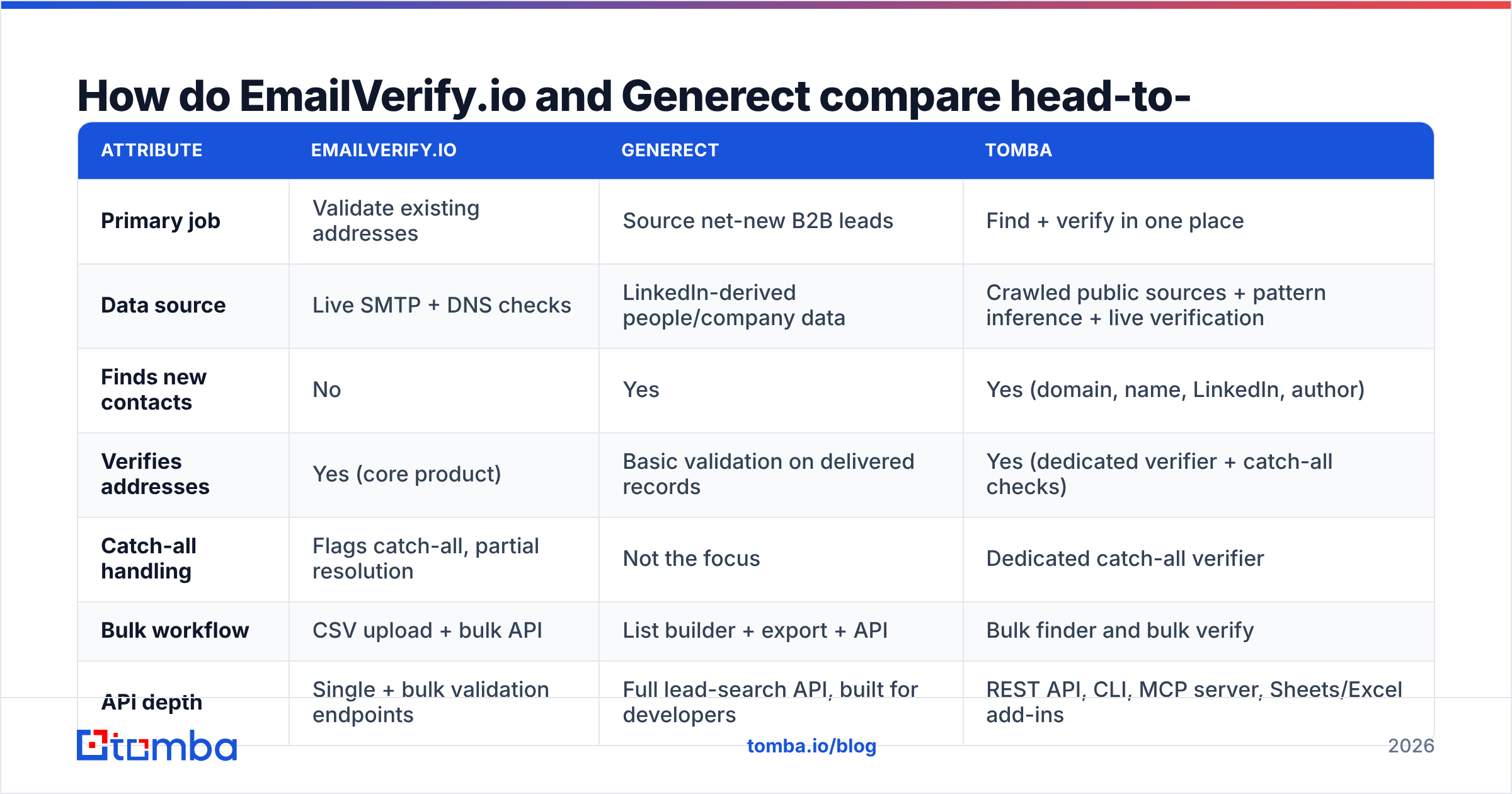
| Attribute | EmailVerify.io | Generect | Tomba |
|---|---|---|---|
| Primary job | Validate existing addresses | Source net-new B2B leads | Find + verify in one place |
| Data source | Live SMTP + DNS checks | LinkedIn-derived people/company data | Crawled public sources + pattern inference + live verification |
| Finds new contacts | No | Yes | Yes (domain, name, LinkedIn, author) |
| Verifies addresses | Yes (core product) | Basic validation on delivered records | Yes (dedicated verifier + catch-all checks) |
| Catch-all handling | Flags catch-all, partial resolution | Not the focus | Dedicated catch-all verifier |
| Bulk workflow | CSV upload + bulk API | List builder + export + API | Bulk finder and bulk verify |
| API depth | Single + bulk validation endpoints | Full lead-search API, built for developers | REST API, CLI, MCP server, Sheets/Excel add-ins |
| Free tier | Limited trial credits | Trial on request/demo-led | 25 searches/mo, no card |
| Entry paid tier | Pay-as-you-go credit packs | Subscription, sales-assisted for API volume | $49/mo Starter |
| Best for | Deliverability teams, ESP compliance | Agencies, data teams, custom tooling | SDR teams that need both jobs done |

Two things fall out of that table.
First, the overlap is thin. Generect will hand you an email. But "we returned an address" is not the same claim as "this mailbox accepted a probe 40 seconds ago." Any sourcing vendor's emails decay. People change jobs, domains migrate, aliases get retired. Second, EmailVerify.io has nothing to say about who to contact. Feed it garbage segmentation and it will confirm, very accurately, that your garbage is deliverable.
EmailVerify.io vs Generect: which one has better data accuracy?#
Wrong question. They measure different things, and the industry keeps mixing them up.
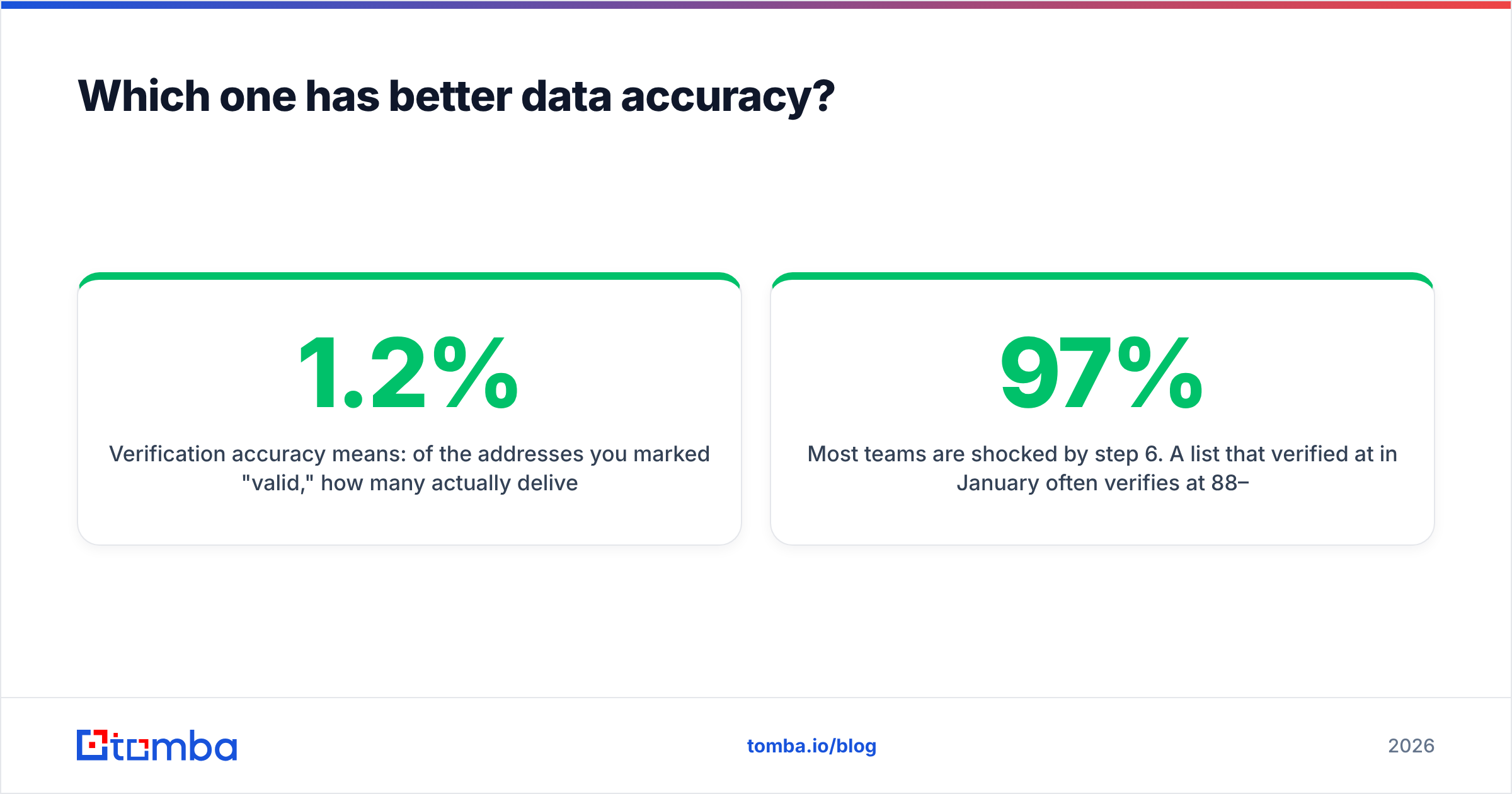
Verification accuracy means one thing: of the addresses you marked "valid," how many actually delivered? That's what EmailVerify.io optimizes. The honest benchmark is your own post-send bounce rate, not a vendor's marketing number. Say a verifier passes 10,000 addresses and you see a 1.2% hard bounce. That's roughly 98.8% precision on that slice — good. Above 3%, your sender reputation starts taking damage that no amount of warmup undoes quickly.
Sourcing accuracy means something else: of the contacts returned for "VP Marketing at 50–200 person SaaS companies in DACH," how many are still in that role, at that company, reachable at that address? That's Generect's problem. Two failure modes hide here: stale records (the person left six months ago) and inferred addresses (the pattern was guessed and never probed).

Run your own test in an afternoon. It is worth more than any vendor claim:
- Build one control segment. 300 contacts, one ICP, one geography. No mixing.
- Pull the same segment from each vendor. Export raw. Don't dedupe yet.
- Cross-verify with a third tool. Run both exports through a neutral email verifier. That way neither vendor grades its own homework.
- Send a low-volume, real sequence. 50 addresses per source, same copy, same sending domain.
- Score three numbers: hard bounce %, unique open %, reply %. Bounce measures the data. Reply measures the targeting.
- Recheck at day 30. Re-verify the same list. The decay delta tells you how fresh the source really is.
Most teams are shocked by step 6. A list that verified at 97% in January often verifies at 88–91% by April. Roughly 2–3% of B2B contacts change jobs every month. So static lists are a bad buy. Verify close to send time, not at purchase time.
EmailVerify.io vs Generect: what does each one cost?#
EmailVerify.io follows the standard verification pricing shape. Credit packs get cheaper per unit as volume grows, and pay-as-you-go covers spiky workloads. Verify 20,000 addresses a month and you'll usually pay somewhere in the tens of dollars. Verification is a commodity, and prices reflect it. The hidden cost is different: unknowns. Every verifier returns some share of "unknown" or "accept-all" results on hardened mail servers. You still pay credits for answers you can't act on. Ask for the unknown rate before you buy, and check how the vendor bills those.
Generect is priced like a data platform, not a utility. Subscriptions carry contact and credit allowances. Higher tiers add API access and higher rate limits, and real volume is sales-assisted. The value is the segmentation and the API, not the raw cost per record. Agencies running lead gen for ten clients find the math easy. A three-person startup pulling 500 contacts a month usually does not.
That's where the stacking cost shows up. Run both and you're paying:
- A sourcing subscription (contacts you may not fully consume)
- A verification credit pack (because you don't trust the sourced emails)
- Engineering time to glue the two APIs together
- Latency — two round trips before a lead is sequence-ready
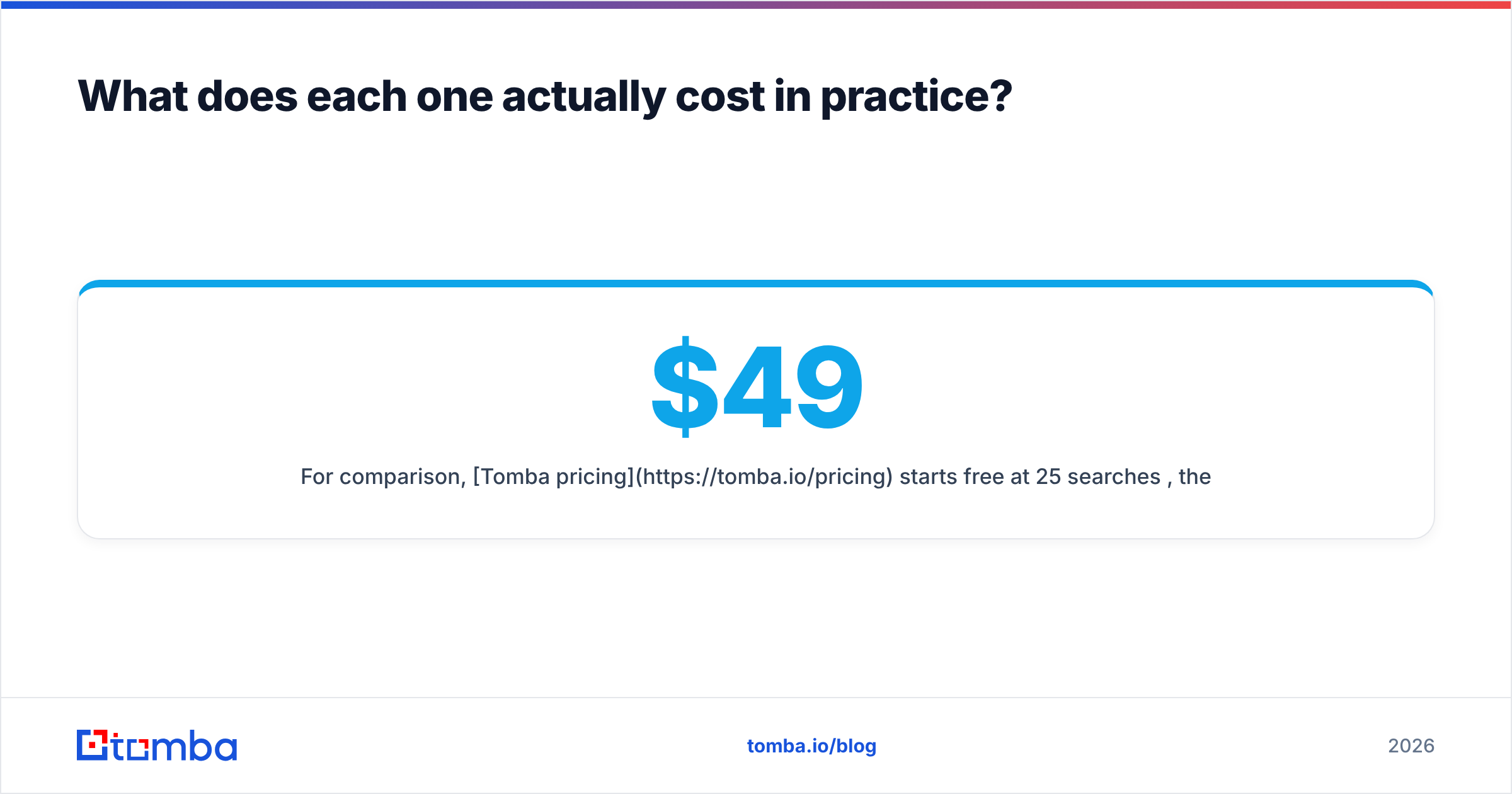
For comparison, Tomba pricing starts free at 25 searches/mo, then $49/mo Starter, $99/mo Growth, $249/mo Pro. Finding and verification share one credit pool and one API call chain. That consolidation is the real argument, not a per-credit price war.

Who should use EmailVerify.io?#
Buy it if your pain is measured in bounces, not in pipeline.
- Your ESP or sequencer sent a warning. Instantly, Smartlead, Mailchimp and HubSpot all throttle or suspend accounts on sustained bounce rates. A verifier is the fastest fix.
- You inherited a CRM. Old databases rot. Run 80,000 dormant records through validation before a re-engagement campaign. That is the job EmailVerify.io was built for.
- You buy data from multiple sources. Different vendors, different accuracy standards. A neutral validation layer normalizes them.
- You have a form-fill problem. Real-time API validation at signup blocks typos and throwaway addresses before they enter your database.
Skip it if you're not sourcing lists at all. If your outbound is 20 hand-researched accounts a month, a free email checker covers you.
Who should use Generect?#
Buy it if your pain is "we don't have enough qualified contacts," and you have the technical appetite to use an API well.
- You're an agency. Multiple ICPs, multiple clients, repeatable segment definitions — this is the sweet spot.
- You're building internal tooling. If your RevOps team wants leads flowing into a warehouse or a custom dashboard rather than a UI export, an API-first vendor beats a UI-first one.
- You need LinkedIn-shaped targeting. Filters like recent role changes, company growth signals, or specific headcount bands are hard to rebuild from public web crawls alone.
- Volume is genuinely high. Sales-assisted pricing rarely makes sense under a few thousand contacts a month.
Skip it if you already have a target account list. When you know the 200 companies you want, you don't need a discovery engine. You need a domain search that returns every reachable contact at those domains, which is a much cheaper problem.
EmailVerify.io vs Generect: where do both tools fall short?#
Every vendor in this space shares the same three structural limits. Name them before you sign anything.
Catch-all domains. Roughly a fifth of business domains accept all mail at the gateway, then bounce it internally. An SMTP probe can't tell real from fake there. Verifiers flag these as "risky" or "accept-all" and stop. That's an honest answer. It also leaves a big chunk of your list unusable, unless you have a dedicated catch-all verifier that adds pattern confidence and secondary signals on top of the SMTP result.
GDPR and compliance posture. Any EU contact data needs a documented lawful basis. Ask each vendor for its data-processing agreement, its opt-out handling, and where the data came from. "LinkedIn-derived" is not automatically a compliance problem. It is still a question your legal team will ask. Check independent reviews on G2's email verification category to see how customers describe support when compliance requests land.
Decay. Neither a verifier nor a sourcing platform can stop people from changing jobs. The only defense is verifying close to send time. If your workflow is "buy 50k contacts in Q1, mail them through Q3," you will burn a domain no matter which vendor you picked.
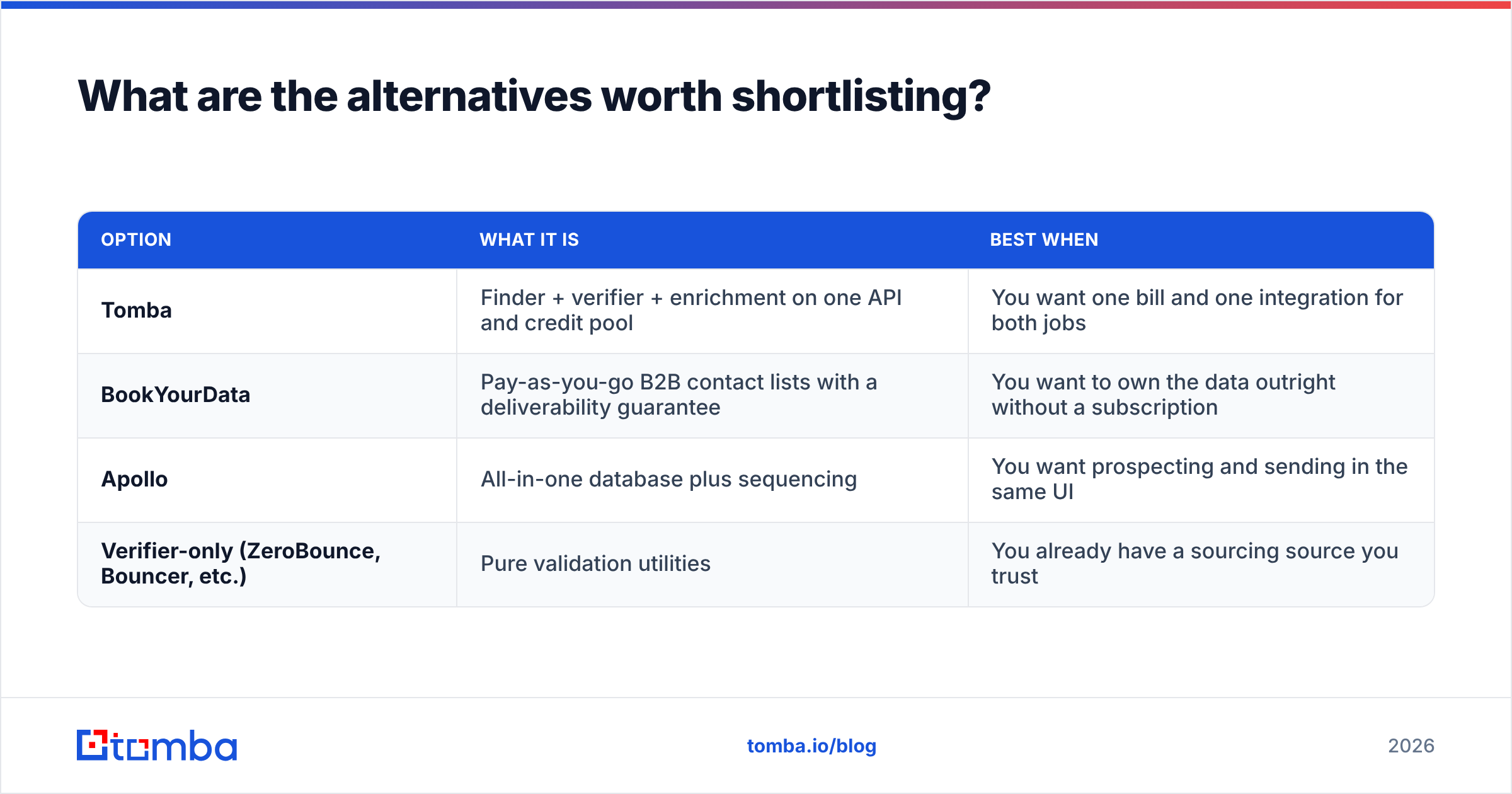
What are the alternatives worth shortlisting?#
Before you settle on the EmailVerify.io vs Generect two-vendor stack, three other shapes are worth pricing out.
| Option | What it is | Best when |
|---|---|---|
| Tomba | Finder + verifier + enrichment on one API and credit pool | You want one bill and one integration for both jobs |
| BookYourData | Pay-as-you-go B2B contact lists with a deliverability guarantee | You want to own the data outright without a subscription |
| Apollo | All-in-one database plus sequencing | You want prospecting and sending in the same UI |
| Verifier-only (ZeroBounce, Bouncer, etc.) | Pure validation utilities | You already have a sourcing source you trust |
BookYourData runs a different model. Instead of a monthly seat, you buy the contacts you need with a stated accuracy guarantee. That suits campaign-based buyers and agencies with lumpy volume. If your usage swings month to month, it often lands cheaper than a subscription you underuse.
Tomba's angle is consolidation. The email finder resolves an address from a domain, a name, or a LinkedIn profile. Verification runs on the same credits. So you don't pay one vendor to guess and a second vendor to check the guess. For list work in spreadsheets, the bulk email finder handles both directions at once. There's also a REST API, a CLI, and an MCP server if you'd rather script it than click it.
How should you build the stack in practice?#
Here's the sequence that survives contact with a real outbound program:
- Define the ICP before you buy anything. Segment definition drives 80% of reply rate. No tool fixes a vague ICP.
- Source in small batches. 500–1,000 contacts at a time, tied to one campaign. Big static buys decay before you mail them.
- Verify within 72 hours of sending. Not at purchase. Not last quarter. Re-verify anything older than 30 days.
- Suppress aggressively. Drop role accounts, known unsubscribes, competitors and current customers before the list reaches your sequencer.
- Cap sending volume per domain. Even a perfect list gets throttled if you jump from 20 to 500 sends a day. Ramp, then hold.
- Track bounce by source. Tag every contact with where it came from. After 60 days you'll know which vendor deserves renewal — from your data, not their case study.
Do this and the EmailVerify.io vs Generect debate resolves itself. Either you need a sourcing engine and can verify with anything cheap, or your sourcing is fine and list hygiene is the leak.
Frequently asked questions#
Is EmailVerify.io vs Generect even the right comparison? Only loosely. One validates addresses, the other finds them. Compare them on which job you need done first, not feature by feature.
Can Generect replace a dedicated verifier? Not fully. Sourcing platforms apply basic validation. They don't run the SMTP and catch-all depth a specialist does. If bounce rate is a live problem, keep a verification step.
Can EmailVerify.io replace a lead database? No. It has no discovery layer. It validates what you give it.
Is it cheaper to use one platform for both? Usually yes, at small and mid volume. At high volume with unusual segmentation needs, a best-of-breed sourcing vendor plus a cheap verifier can win. Model both at your real monthly volume.
What bounce rate should I target? Under 2% hard bounces. Above 3–5%, mailbox providers start treating your domain as a risk. That costs far more than verification credits.
Where to start#
If your bottleneck is finding contacts and proving they're safe to mail — one workflow, one bill — start with the Tomba Email Finder. The free tier gives you 25 searches a month with no card. That's enough to run the head-to-head test above against whatever you use now. Paid plans start at $49/mo, with finding, verification, catch-all checks and enrichment sharing the same credits and the same API. Run your own control segment, measure bounce and reply by source, and let the numbers settle EmailVerify.io vs Generect for you.
Related guides#
Ready to find emails that actually work?
Join 150,000+ professionals who stopped guessing and started sending. Free credits on signup — no credit card required.
Get the Tomba newsletter
Practical outbound tactics and product updates — once every two weeks.
About the author