EmailVerify.io vs GrowMeOrganic: Which Tool Wins in 2026?
One tool cleans lists, the other builds them. Here is an honest breakdown of EmailVerify.io vs GrowMeOrganic on accuracy, pricing, data coverage, and the workflow gaps nobody mentions in the demo.
TL;DR
- EmailVerify.io vs GrowMeOrganic is not a fair fight. One cleans lists. The other builds them.
- EmailVerify.io checks emails you already have. GrowMeOrganic finds new ones and sends the mail.
- Pick GrowMeOrganic if you have no list yet. It pulls contacts from LinkedIn and sends for you.
- Pick EmailVerify.io if your list is big and your bounce rate hurts.
- Running both is the cost trap. You pay to find a lead. Then you pay again to check it.
- Want both jobs in one credit pool? A tool like Tomba is often cheaper than two vendors.
EmailVerify.io vs GrowMeOrganic: what does each tool do?#
EmailVerify.io is a bulk email checker. You upload a list by CSV, paste, or API. It then runs a set of tests. It checks the syntax. It looks up MX records. It flags throwaway domains and role accounts. It also pings the mail server with an SMTP handshake.
Each row comes back with a status: valid, invalid, catch-all, or unknown. That is the whole product. It does not find anyone.
GrowMeOrganic is the other shape. It is an all-in-one B2B prospecting suite. A Chrome extension pulls contact data from LinkedIn, Sales Navigator, and Google Maps. It adds a B2B database on top. It also ships a drip campaign sender, with unlimited inboxes on most plans. It can check emails too, but that is a side feature.
So the honest framing of EmailVerify.io vs GrowMeOrganic is not "which is better." The real question is simpler. Which half of your pipeline is missing, and what does it cost to fill?
EmailVerify.io vs GrowMeOrganic: how do they differ?#
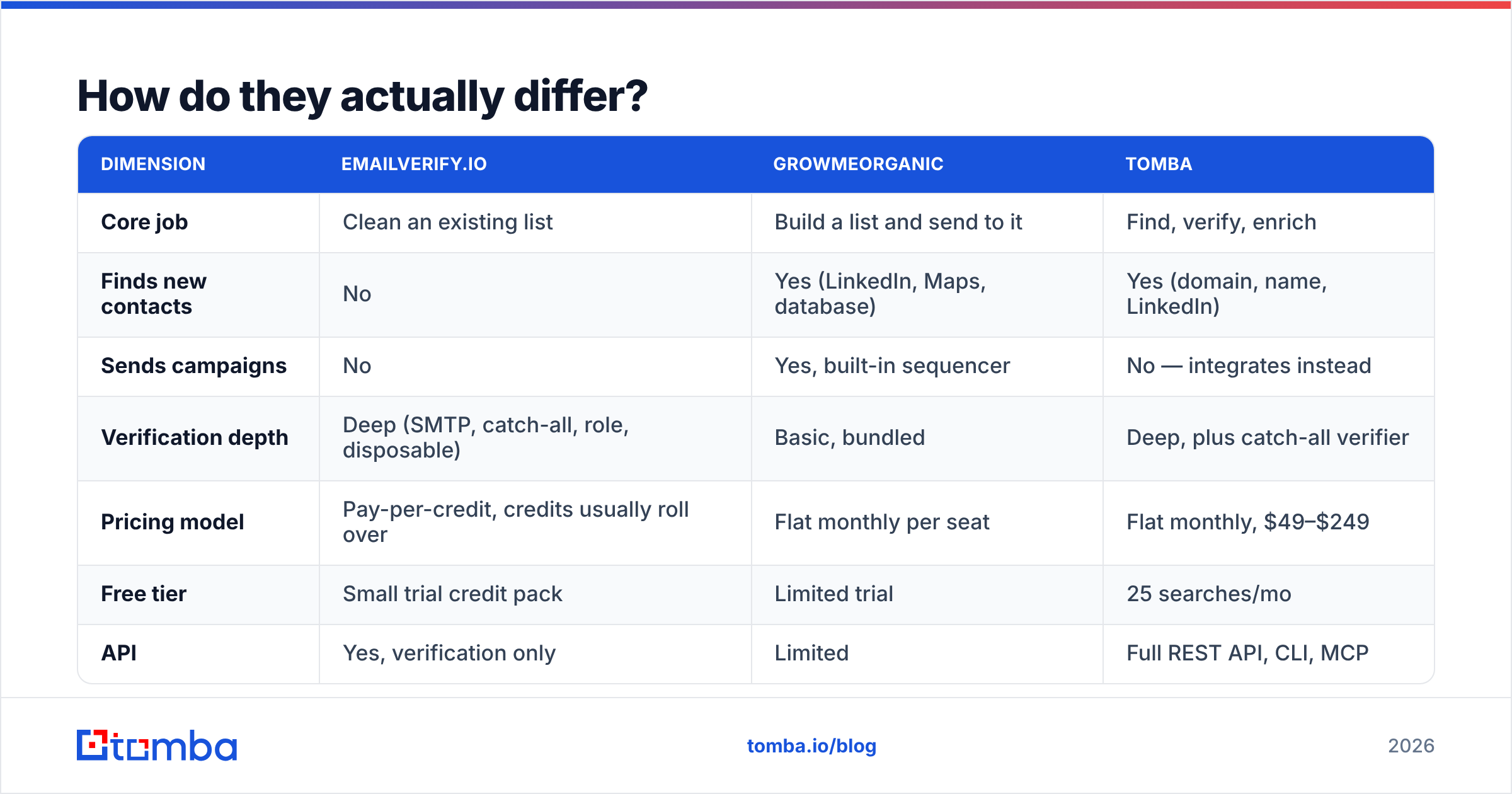
| Dimension | EmailVerify.io | GrowMeOrganic | Tomba |
|---|---|---|---|
| Core job | Clean an existing list | Build a list and send to it | Find, verify, enrich |
| Finds new contacts | No | Yes (LinkedIn, Maps, database) | Yes (domain, name, LinkedIn) |
| Sends campaigns | No | Yes, built-in sequencer | No — integrates instead |
| Verification depth | Deep (SMTP, catch-all, role, disposable) | Basic, bundled | Deep, plus catch-all verifier |
| Pricing model | Pay-per-credit, credits usually roll over | Flat monthly per seat | Flat monthly, $49–$249 |
| Free tier | Small trial credit pack | Limited trial | 25 searches/mo |
| API | Yes, verification only | Limited | Full REST API, CLI, MCP |
| Best for | Deliverability cleanup | Solo founders and small agencies | Teams that need accurate data at scale |
Read that table as a Venn diagram with almost no overlap. The two tools meet in one cell only: checking emails. For GrowMeOrganic, that check is a nice extra. For EmailVerify.io, it is the whole business.
Four questions decide the pick for you:
- Do you have a list already? If yes, a checker is the cheaper first buy. If no, you do not have that problem yet.
- Do you need a sender? GrowMeOrganic ships one. If you already pay for Instantly, Smartlead, or Lemlist, you pay twice.
- How many inboxes are at risk? Two inboxes can shrug off a bad send. Twenty cannot. One bad week can cost you months.
- Do you need this to run on its own? A clean API beats a UI-only tool as soon as you want nightly jobs.

Which one is more accurate?#
In the EmailVerify.io vs GrowMeOrganic debate, "accurate" means two things. Vendors enjoy the blur.
For EmailVerify.io, it means clean-up precision. Of the addresses it calls valid, how many accept mail? Most good checkers land in the 96–99% band on clean B2B data.
The gap between vendors is small on normal domains. It is wide on the hard ones. Think catch-all servers. Think Microsoft 365 tenants that ignore SMTP probes. Think greylisting. Think Google Workspace domains that say yes to every name.
Those hard cases are where a checker earns its fee. So ask each vendor one thing. What share of my list came back "unknown" or "catch-all"? Those rows are the ones you still judge by hand.
For GrowMeOrganic, "accurate" means find rate. Of the emails it hands you, how many are real, current, and read by a human? Scraped data ages fast. B2B records rot by about 25–30% a year from job changes alone. LinkedIn tools inherit whatever the profile owner last updated. A guessed address like first.last@domain passes a syntax test. On catch-all domains it can pass the SMTP test too, and still belong to no one.

So a valid address is not always the right address. This is the quiet failure that kills cold email. Your finder guesses. Your checker says the domain takes mail. You send. Nothing bounces, and nobody replies, because the inbox is a black hole. A catch-all verifier that reads both the pattern and the person closes that gap.
What does each one cost in 2026?#
Cost is where EmailVerify.io vs GrowMeOrganic split most clearly. Check both vendor pages before you buy. Prices move, and GrowMeOrganic has run lifetime deals that skew the math. The shapes below are what to expect.
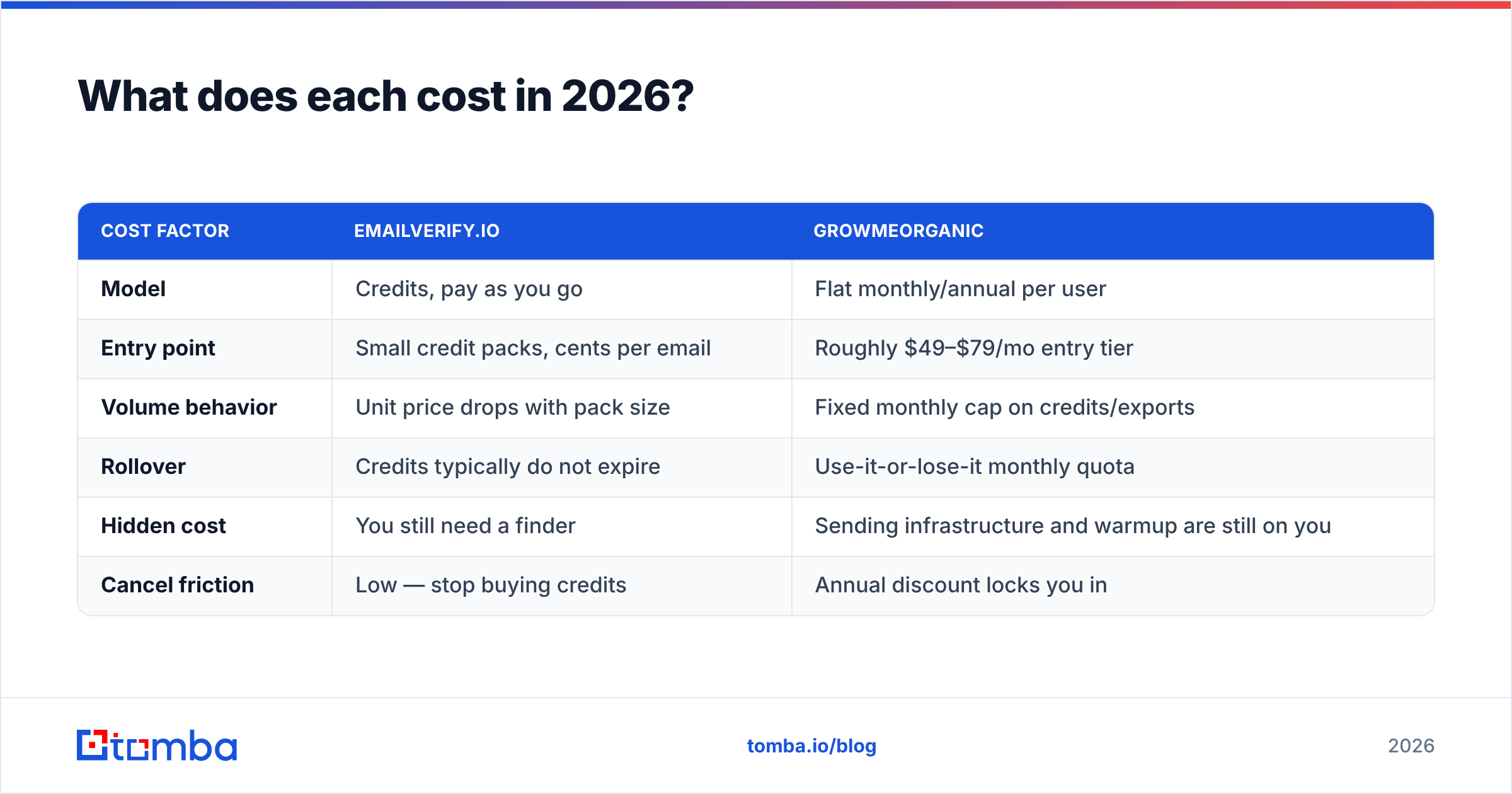
| Cost factor | EmailVerify.io | GrowMeOrganic |
|---|---|---|
| Model | Credits, pay as you go | Flat monthly/annual per user |
| Entry point | Small credit packs, cents per email | Roughly $49–$79/mo entry tier |
| Volume behavior | Unit price drops with pack size | Fixed monthly cap on credits/exports |
| Rollover | Credits typically do not expire | Use-it-or-lose-it monthly quota |
| Hidden cost | You still need a finder | Sending infrastructure and warmup are still on you |
| Cancel friction | Low — stop buying credits | Annual discount locks you in |
Model the blended cost, not the sticker price. Take a two-person SDR team in a normal month. They source 5,000 new contacts in GrowMeOrganic. Then they check 5,000 rows at a fraction of a cent each.
That check line looks tiny. At 50,000 rows it rivals the platform fee. And you still pay a third vendor for inboxes and warmup.
That stack is why one-vendor pricing wins above a few thousand contacts a month. Tomba pricing runs Free (25 searches), Starter $49/mo, Growth $99/mo, Pro $249/mo, and custom for Enterprise. Finding, checking, and enriching all draw on one pool, not three invoices.

Who should pick GrowMeOrganic?#
GrowMeOrganic fits when your bottleneck is contact volume. It also fits when your team is small. One tool doing four jobs at 80% can beat four tools at 95%.
Good fits:
- Solo founders who run their own outbound. One plan covers sourcing, sending, and basic checks. Fewer logins. One tool to learn.
- Small agencies chasing local business. The Google Maps scraper works well for gyms, dentists, and cafes. Those firms barely show up in B2B databases.
- LinkedIn-first teams. If your ICP lives in Sales Navigator filters, exporting from a search beats rebuilding it elsewhere.
- Tight budgets. The bundle undercuts Apollo plus a checker plus a sender.
Where it hurts: data quality in niche markets, export caps that bite mid-campaign, and inbox placement. Bundled senders share infrastructure with every other user on the platform. Google's bulk sender requirements are strict about auth and spam complaints. Read fresh reviews on G2's email verification category instead of vendor quotes.
Who should pick EmailVerify.io?#
Pick a standalone checker when your pain shows up as a bounce rate, not as a pipeline gap.
Signs you are in this camp:
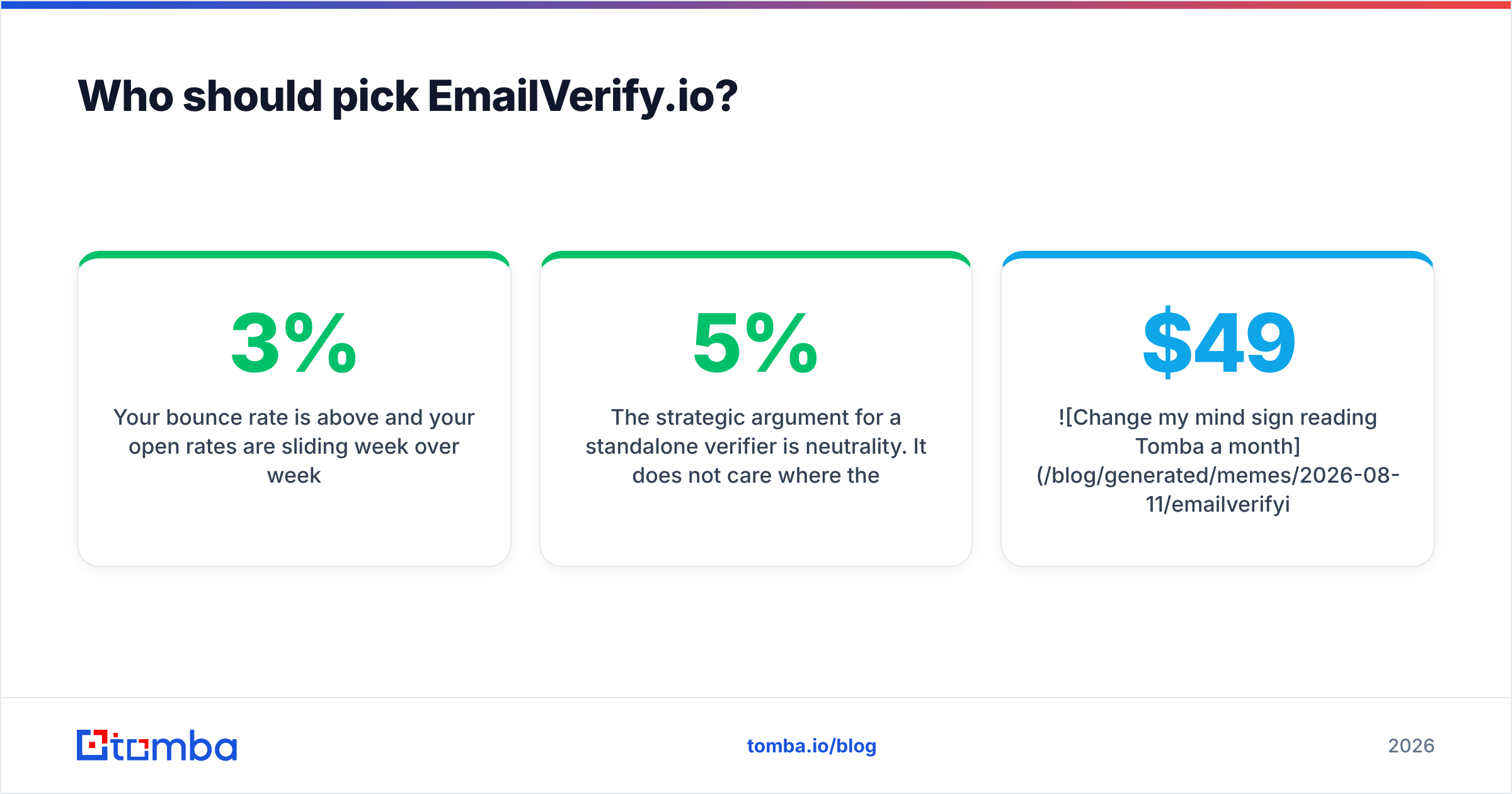
- Your bounce rate is over 3%. Your open rates keep sliding.
- You inherited a CRM with 40,000 old contacts. Nobody wants to touch it.
- You buy lists, or partners hand them over. You need a gate before you send.
- You run web forms and want a check before junk enters the database.
The case for a standalone tool is neutrality. It does not care where the address came from. So it will happily tell you that your main data vendor ships junk. A checker built inside a finder has less reason to say that out loud.
Want that second opinion without switching platforms? Run a sample through Tomba's email verifier. Compare the valid, invalid, and unknown splits on the same 1,000 rows. A gap above 5% is worth chasing.

Where does each one break down?#
Neither tool fails loudly. Both fail in ways you only spot a quarter later.
- The catch-all blind spot. About a fifth of B2B domains accept every address. A checker says "unknown." A finder often says "valid." Both leave you guessing. You need pattern smarts, not just a handshake.
- Job-change rot. Neither tool warns you that the VP you found in March left in June. Re-checking before each campaign is the only fix. It is a repeat cost nobody budgets for.
- The CSV shuttle. Export, upload, wait, download, re-import, dedupe. Every manual hop can drop columns or repeat rows. A proper bulk email finder flow removes most of it.
- Credit math. Some checkers bill you for unknowns. Some finders bill for empty searches. Read the fine print. Then run 500 rows and match the credits used against your guess.
- Sending is still your job. Clean data stops hard bounces. It does not set up SPF, DKIM, or DMARC. It does not warm your domain or fix a weak first line.
Is there a third option worth a look?#
Yes, though it only wins if you value one flow over best-in-class depth.
If you need both halves, one platform kills the shuttle. Tomba's domain search returns every email it can find at a company. You also get the detected pattern and a confidence score. Each address is checked inside the same request. The whole thing runs through a documented API, a CLI, and an MCP server. One credit pool. One vendor. One set of rate limits.
Fair caveats. Tomba does not send campaigns. If the built-in sender is why you want GrowMeOrganic, you still need Instantly or Smartlead. And at tens of millions of rows a month, a pure checker may still beat any bundled engine on price.
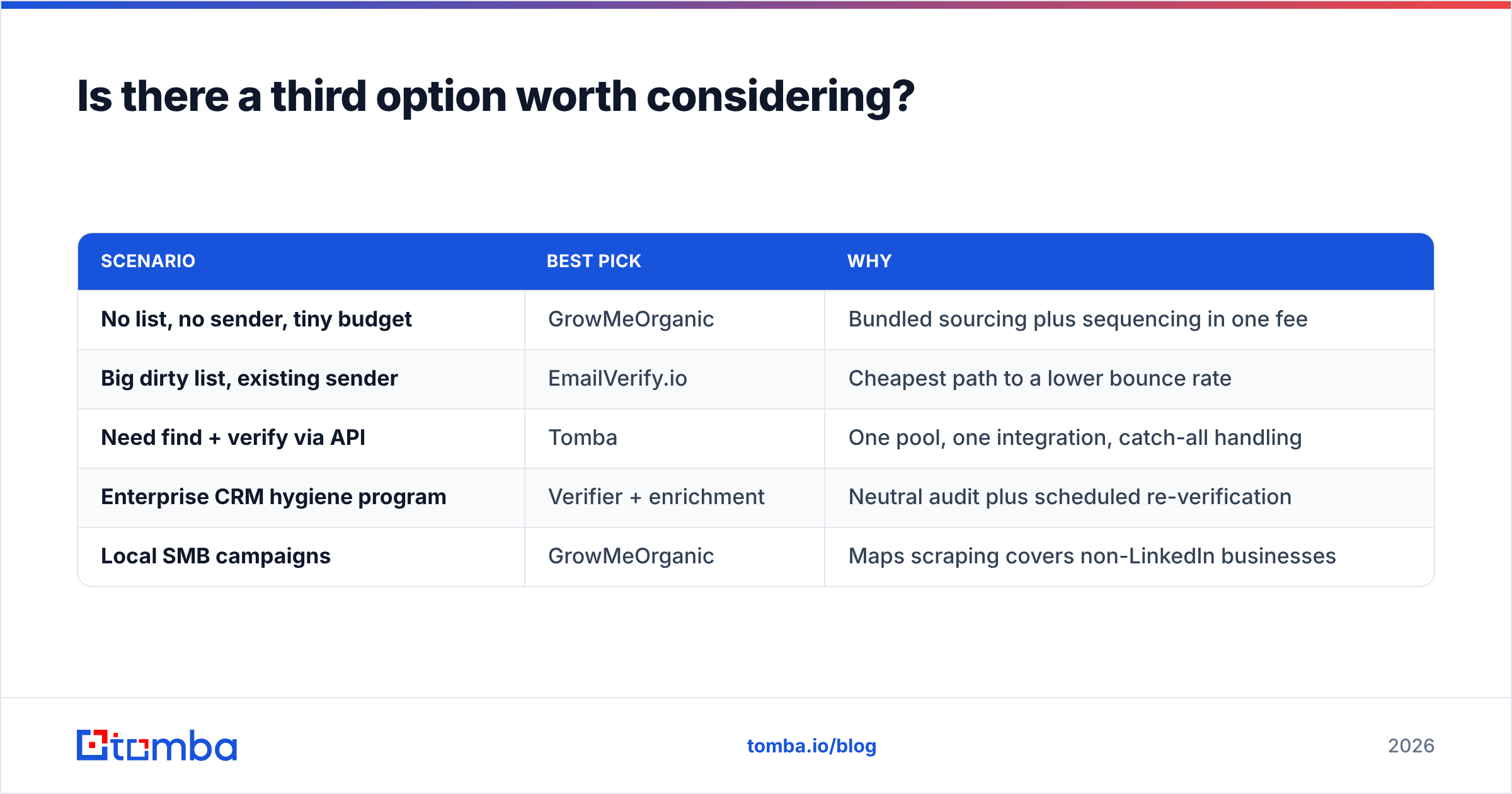
| Scenario | Best pick | Why |
|---|---|---|
| No list, no sender, tiny budget | GrowMeOrganic | Bundled sourcing plus sequencing in one fee |
| Big dirty list, existing sender | EmailVerify.io | Cheapest path to a lower bounce rate |
| Need find + verify via API | Tomba | One pool, one integration, catch-all handling |
| Enterprise CRM hygiene program | Verifier + enrichment | Neutral audit plus scheduled re-verification |
| Local SMB campaigns | GrowMeOrganic | Maps scraping covers non-LinkedIn businesses |
Many teams land on a hybrid. Use a prospecting suite where its data is strong. Run every list through a neutral checker before you send. Keep an API-first finder for the gaps: the execs, the tech buyers, the firms with no LinkedIn presence. That costs more than one plan. It costs far less than a burned domain.
What should you do next?#
Settle EmailVerify.io vs GrowMeOrganic with your own data, not with a vendor benchmark. Mine included.
Take 500 contacts from your real ICP. Push them through each tool. Then track four numbers: match rate, valid rate, hard-bounce rate after a real send, and reply rate. Bounce rate grades the checker. Reply rate tells you if the people were real. The test runs in a week for under $50.
Most teams find the same thing. The bottleneck is finding good addresses, not cleaning bad ones. If that is you, start with the Tomba Email Finder. The free tier gives 25 searches a month to test against your current tool. Starter is $49/mo. Every result arrives already checked, so there is no second tool and no second invoice.
Related guides#
Ready to find emails that actually work?
Join 150,000+ professionals who stopped guessing and started sending. Free credits on signup — no credit card required.
Get the Tomba newsletter
Practical outbound tactics and product updates — once every two weeks.
About the author