EmailVerify.io vs Hunter: Which Email Tool Wins in 2026?
EmailVerify.io cleans lists. Hunter builds them. Here is how the two compare on accuracy, catch-all handling, API depth and real monthly cost, plus when a single combined tool beats running both.
EmailVerify.io vs Hunter is not really a fair fight, because the two tools do different jobs. One cleans the lists you already own. The other finds new contacts. This guide shows which gap you have, and which tool closes it.
TL;DR
- EmailVerify.io vs Hunter is not one category. EmailVerify.io is a bulk verification service. Hunter is an email discovery platform that also verifies.
- Got a 40k-row CSV with a 12% bounce rate? EmailVerify.io is cheaper and faster. Got an empty CRM? Hunter wins.
- Hunter lists at about $49/mo (Starter) and $149/mo (Growth), plus a free tier of 25 searches and 50 verifications a month.
- EmailVerify.io sells credit packs and low-cost monthly plans, so its cost per check is usually lower.
- Neither tool solves catch-all domains. Both label them "accept-all" and hand the risk back to you.
- Need both jobs from one credit pool? Tomba covers finding, verifying, catch-all checks and enrichment from $49/mo.
EmailVerify.io vs Hunter: what does each tool do?#
They solve two different halves of the same pipeline. That is why a head-to-head comparison confuses so many buyers.
EmailVerify.io is a validation engine. You upload a list. It runs each address through a chain of checks. It returns a status: valid, invalid, risky, unknown, or accept-all. There is no discovery layer. It cannot tell you the email of the VP of Ops you just found on LinkedIn.
Hunter started as a domain-to-email index and grew from there. Type in stripe.com and it returns the addresses it has crawled or inferred. It also shows the company's dominant pattern (first.last@, finitial+last@, and so on). Verification is bundled, but it plays a supporting role.
So the honest framing of EmailVerify.io vs Hunter is simple: cleaner versus prospector. The better question is not which tool is best in the abstract. It is which gap you actually have this quarter.

How does email verification actually work?#
You cannot judge either vendor's accuracy claims until you know what a verification pass does. Every serious email verifier runs the same five stages. The tools differ in stages 4 and 5.
- Syntax check — Does the address parse under RFC rules? This catches typos like
john@@acme.com. It is free, and it clears 1-2% of a dirty list. - Domain and MX lookup — Does the domain resolve and publish mail records? No MX record means no mail can arrive, so the address is dead.
- Disposable and role detection — Flags
mailinator.comthrowaways and role accounts likeinfo@orsales@. They deliver fine, but they almost never reply. - SMTP handshake — The verifier asks the mail server whether the mailbox exists, without sending anything. Microsoft 365 and Google Workspace domains often answer vaguely, or throttle the request.
- Catch-all resolution — Some servers accept every address. A basic verifier shrugs and says "accept-all". A better engine uses patterns and past engagement to return a real probability.
Any vendor can nail the first three stages. Stage 4 depends on IP reputation and retry logic. Stage 5 is where you learn what you paid for.
EmailVerify.io vs Hunter: which one is more accurate?#
Both vendors claim 95-99% accuracy. Both claims hold up, because neither defines the word the same way.

The accuracy debate in EmailVerify.io vs Hunter comes down to denominators. For a verifier, accuracy means "did the status match reality". For a discovery tool, it means "of the emails returned, how many were deliverable". Hunter's confidence score counts how many public sources back a pattern. It is not a live mailbox check at the moment you export.
Run your own test instead. It takes an hour, and it is the only number that matters:
- Pull 500 addresses you already know the outcome for. A sent campaign with logged bounces is ideal.
- Split them into three buckets: known-good, known-bounced, and catch-all.
- Run the same file through both free tiers or trial credits.
- Score three things: false valids, false invalids, and the share returned as unknown or accept-all.
False valids are the expensive error. False invalids delete pipeline in silence.
The unknown rate is the metric buyers ignore and later regret. A tool that returns 22% "risky" hands a fifth of your list back unprocessed. It still charges you a credit for each row.
EmailVerify.io vs Hunter: features and price compared#
Prices below are published list rates at monthly billing. Both vendors change tiers now and then, so check their own pages before you buy.

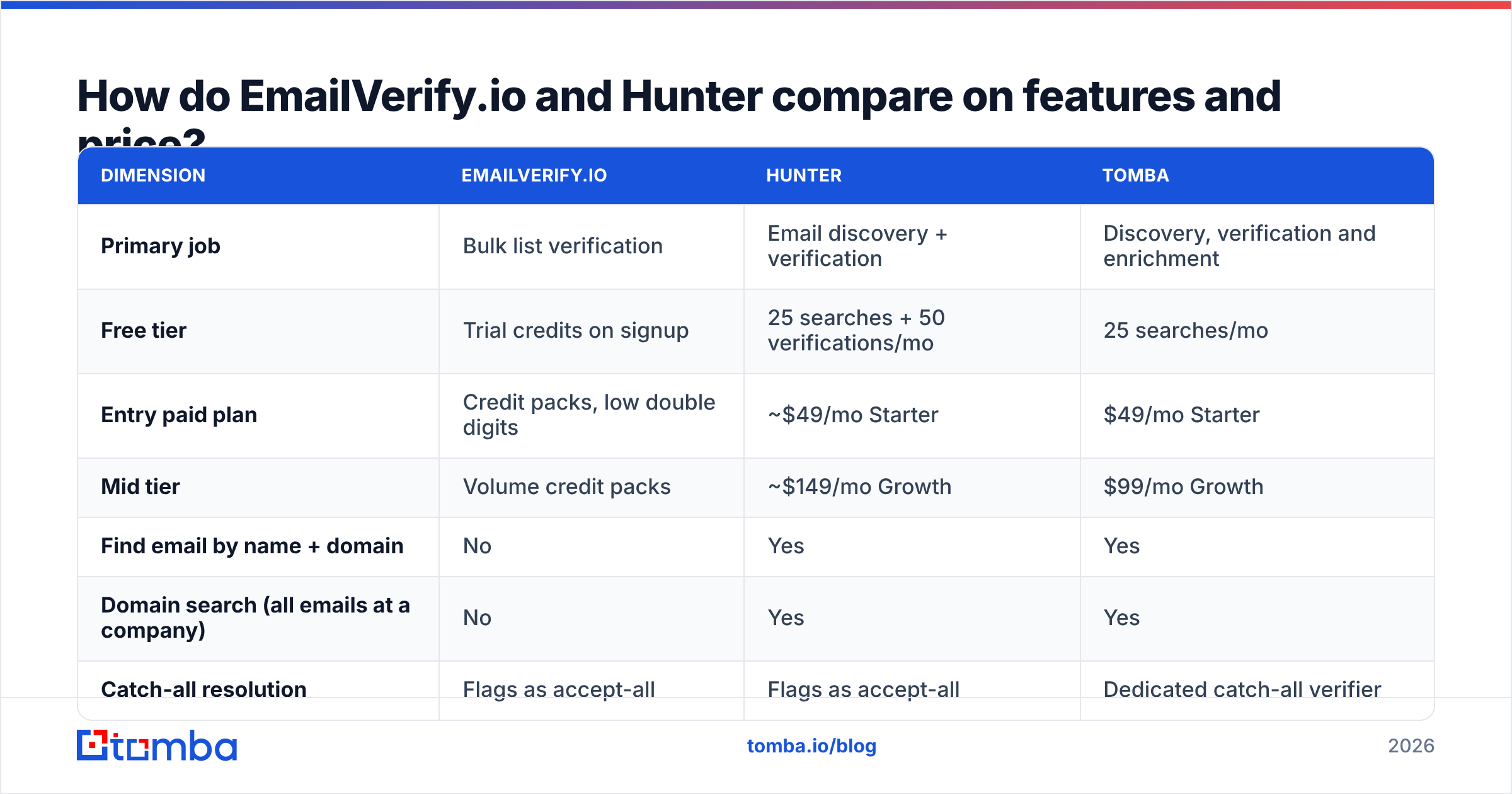
| Dimension | EmailVerify.io | Hunter | Tomba |
|---|---|---|---|
| Primary job | Bulk list verification | Email discovery + verification | Discovery, verification and enrichment |
| Free tier | Trial credits on signup | 25 searches + 50 verifications/mo | 25 searches/mo |
| Entry paid plan | Credit packs, low double digits | ~$49/mo Starter | $49/mo Starter |
| Mid tier | Volume credit packs | ~$149/mo Growth | $99/mo Growth |
| Find email by name + domain | No | Yes | Yes |
| Domain search (all emails at a company) | No | Yes | Yes |
| Catch-all resolution | Flags as accept-all | Flags as accept-all | Dedicated catch-all verifier |
| Phone numbers | No | No | Yes |
| Bulk CSV upload | Yes, core strength | Yes | Yes |
| API | Yes | Yes | Yes, plus CLI and MCP server |
| Spreadsheet add-ons | Limited | Sheets | Sheets, Excel, Airtable |
| Best for | Cleaning owned lists | Building lists from domains | Both, on one credit pool |
Two things jump out of that table.
First, EmailVerify.io is priced like infrastructure. Hunter is priced like seat-based software. Say you verify 100k addresses a quarter and never prospect. Paying Hunter's Growth rate for that capacity is poor value. Compare the Tomba pricing tiers on the same basis. What does one usable, deliverable contact cost you end to end?
Second, the feature gap runs one way. Hunter can do most of what EmailVerify.io does, though not as cheaply. EmailVerify.io cannot do what Hunter does at all.
Is Hunter better than EmailVerify.io for finding emails?#
Yes, and it is not close. EmailVerify.io does not compete in that category at all.
The comparison gets interesting when you put Hunter next to other discovery tools. Its index is deep on companies with a public web footprint: SaaS vendors, agencies, media, and anyone whose staff publish bylines. It is thin on smaller regional firms, trades, manufacturing, and companies that keep staff off the web.
That coverage shape has a direct cost. Hunter often returns a pattern-derived address with a confidence score rather than a proven one. first.last@acme.com is a good guess when 60% of a company's known addresses look like that. It is still a guess. Those guesses are the rows that come back as accept-all when you verify them elsewhere.
If your ICP is well-indexed mid-market tech, Hunter's hit rate feels excellent. If you sell into a long tail of small firms, budget for a second source. A domain search across the same target list is the cheapest way to measure that gap before you sign an annual contract.

What happens with catch-all domains?#
This is the biggest hidden cost in either tool. It decides whether your campaign lands or your domain burns.
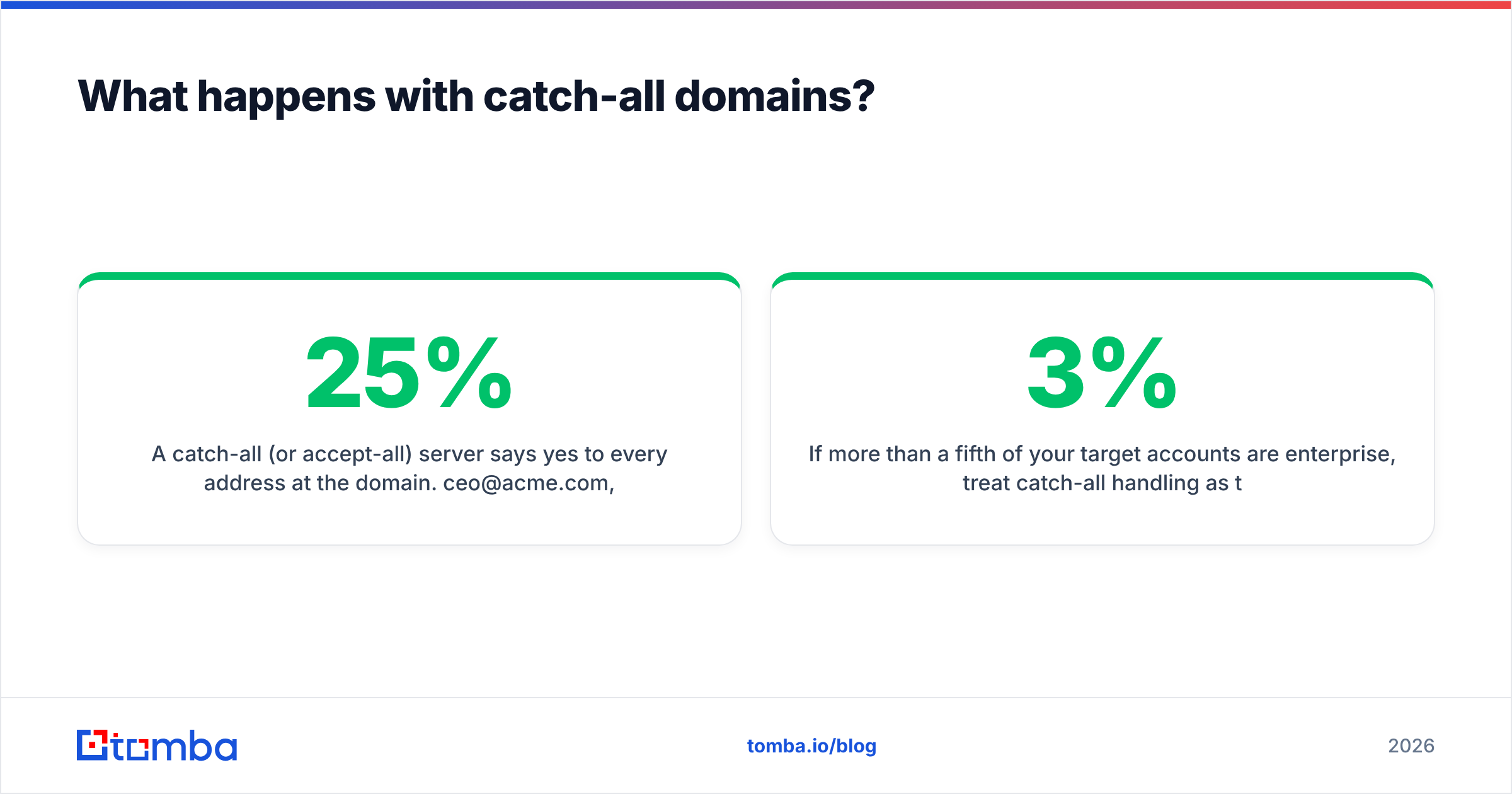
A catch-all server says yes to every address at the domain. ceo@acme.com and asdkjh@acme.com are both accepted at the SMTP layer. Roughly 15-25% of B2B domains work this way. Most of them are larger companies running Microsoft 365 with anti-harvesting settings turned up.
On EmailVerify.io vs Hunter, this one is a tie, and not a good one. Both detect the condition honestly and label it. Neither resolves it. That leaves you three options:
- Send anyway and gamble. A wrong guess still hard-bounces at the mailbox, or lands in a spam trap. Do that at volume and your sender reputation takes the hit.
- Suppress the whole segment. Safe. You also just deleted your enterprise pipeline, because the enterprises are the ones running catch-all.
- Resolve it properly. Patterns, engagement history and secondary signals turn "unknown" into a score you can act on. A dedicated catch-all verifier keeps those accounts in play.
If more than a fifth of your targets are enterprise, treat catch-all handling as the deciding feature. It is the difference between a 3% bounce rate and a 9% one. Google and Microsoft both start throttling well before 9%.
Where does each tool fit in your stack?#
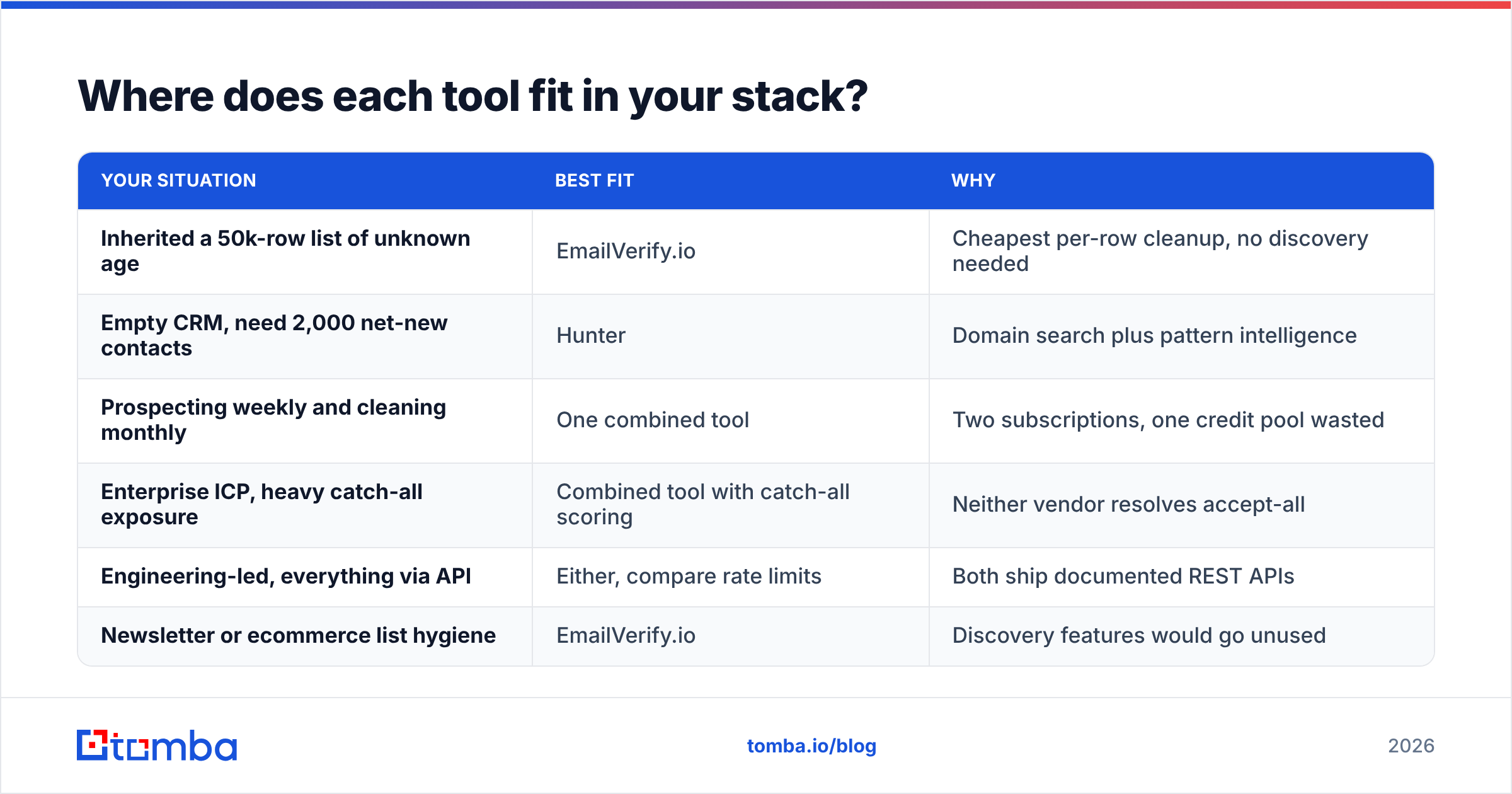
Match the tool to the bottleneck, not to the review score.
| Your situation | Best fit | Why |
|---|---|---|
| Inherited a 50k-row list of unknown age | EmailVerify.io | Cheapest per-row cleanup, no discovery needed |
| Empty CRM, need 2,000 net-new contacts | Hunter | Domain search plus pattern intelligence |
| Prospecting weekly and cleaning monthly | One combined tool | Two subscriptions, one credit pool wasted |
| Enterprise ICP, heavy catch-all exposure | Combined tool with catch-all scoring | Neither vendor resolves accept-all |
| Engineering-led, everything via API | Either, compare rate limits | Both ship documented REST APIs |
| Newsletter or ecommerce list hygiene | EmailVerify.io | Discovery features would go unused |
The third row catches most teams. Running a finder and a verifier as two subscriptions means two invoices and two credit balances that expire on their own clocks. It also means two sets of API keys and a manual CSV handoff. At $49 plus a credit pack you are near $80-100/mo before you find a single extra contact. Every export and import is one more place where data goes stale.
Is there a better option than either?#
EmailVerify.io vs Hunter is the wrong question if you do both jobs every week. Consolidating usually wins on cost and on data freshness. That is where Tomba fits. The reason is architectural, not promotional: when discovery and verification share one engine, every address is verified the moment it is found. Nothing waits days for a separate batch.
On a $49/mo Starter or $99/mo Growth plan you get find email addresses by name and domain, domain search across a company, bulk verification, catch-all resolution, phone lookup, and enrichment. All of it draws on the same credit balance. Sheets, Excel and Airtable add-ons remove the CSV shuffle. There is a CLI and an MCP server if you work in a terminal or with agents.
Hunter still has the edge on brand familiarity, a genuinely good Chrome extension, and a mature integration ecosystem your ops team may already depend on. EmailVerify.io still has the edge if verification is your only job at very high volume, where a pure-play price per credit is hard to beat. Cross-check current standings on G2's email verification category rather than trusting any vendor, including this one.
EmailVerify.io vs Hunter: which should you choose?#
Decide with three questions, in this order.
- Do you need to find emails, or only check them? Only check them, and only in bulk? Pick EmailVerify.io and stop reading. Need to find them? EmailVerify.io is out.
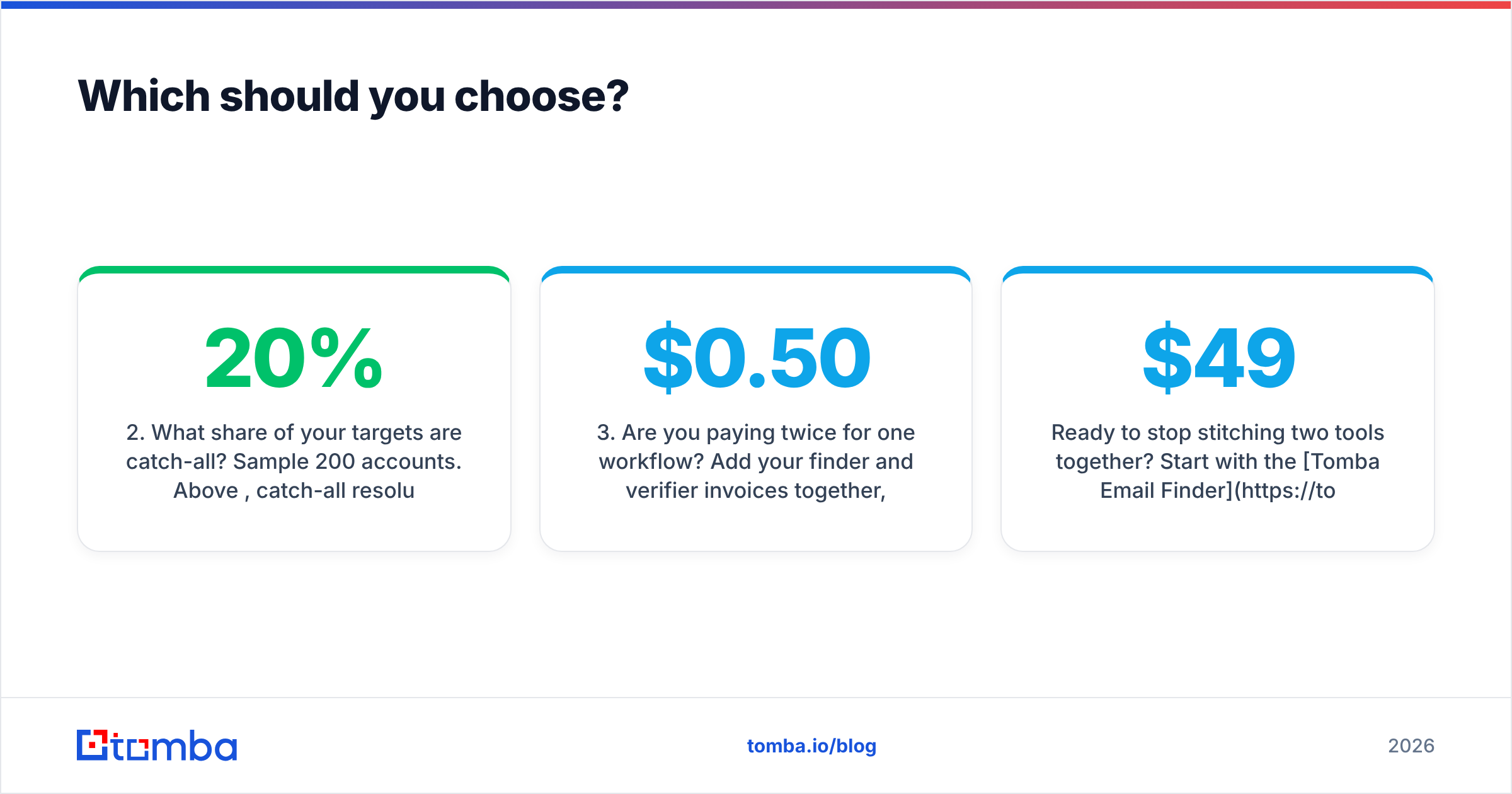
- What share of your targets are catch-all? Sample 200 accounts. Above 20%, catch-all resolution beats every other feature, and neither tool solves it natively.
- Are you paying twice for one workflow? Add your finder and verifier invoices together. Divide by the contacts that actually replied. Above roughly $0.50, consolidation pays for itself in a month.
The most common mistake is buying a verifier to fix a discovery problem. The list still underperforms, and the verifier gets the blame. Bad data does not get better after cleaning. It just gets smaller. Fix the source first.
Ready to stop stitching two tools together? Start with the Tomba Email Finder on the free tier: 25 searches a month, no card, verified at the point of discovery. Run your own 500-row test against whatever you use today. Compare the false-valid and accept-all rates side by side, and let the numbers decide. Starter is $49/mo and Growth is $99/mo, with the same credits covering finding, verifying, catch-all checks and enrichment.
Related guides#
Ready to find emails that actually work?
Join 150,000+ professionals who stopped guessing and started sending. Free credits on signup — no credit card required.
Get the Tomba newsletter
Practical outbound tactics and product updates — once every two weeks.
About the author