EmailVerifyIO vs ZoomInfo: Which B2B Email Tool Wins in 2026?
One tool cleans the list you already have. The other sells you the list — for five figures a year. Here is the honest, cost-per-usable-contact breakdown of EmailVerify.io vs ZoomInfo in 2026.
TL;DR
- EmailVerifyIO vs ZoomInfo is not really a matchup. EmailVerify.io is a bulk email validation engine. ZoomInfo is a B2B data and go-to-market platform. It is like comparing a water filter to a reservoir.
- ZoomInfo does not publish list pricing. Reported contracts sit in the five figures per year, on an annual deal with seat minimums. EmailVerify.io runs on pay-as-you-go credits that cost a fraction of a cent per email.
- Is your bounce rate 9% and Google throttling you? Buy a verifier. Do you have no contacts at all? Buy a data source. Pick the wrong one and the whole budget is wasted.
- Most small teams want the middle path: one tool that finds the contact and verifies it in the same pass, priced per credit instead of per seat.
- Cost per usable contact is the only metric that counts. A $0.004 check on a stale record still leaves you a stale record.
What is EmailVerify.io and what does it actually do?#
EmailVerify.io is a list-hygiene tool. You upload a CSV of addresses you already own — a webinar signup, a scraped list, an old CRM export. It returns a verdict on each one: deliverable, undeliverable, risky, unknown, catch-all, role-based, or disposable.
Under the hood it runs the same validation stack as every credible verifier:
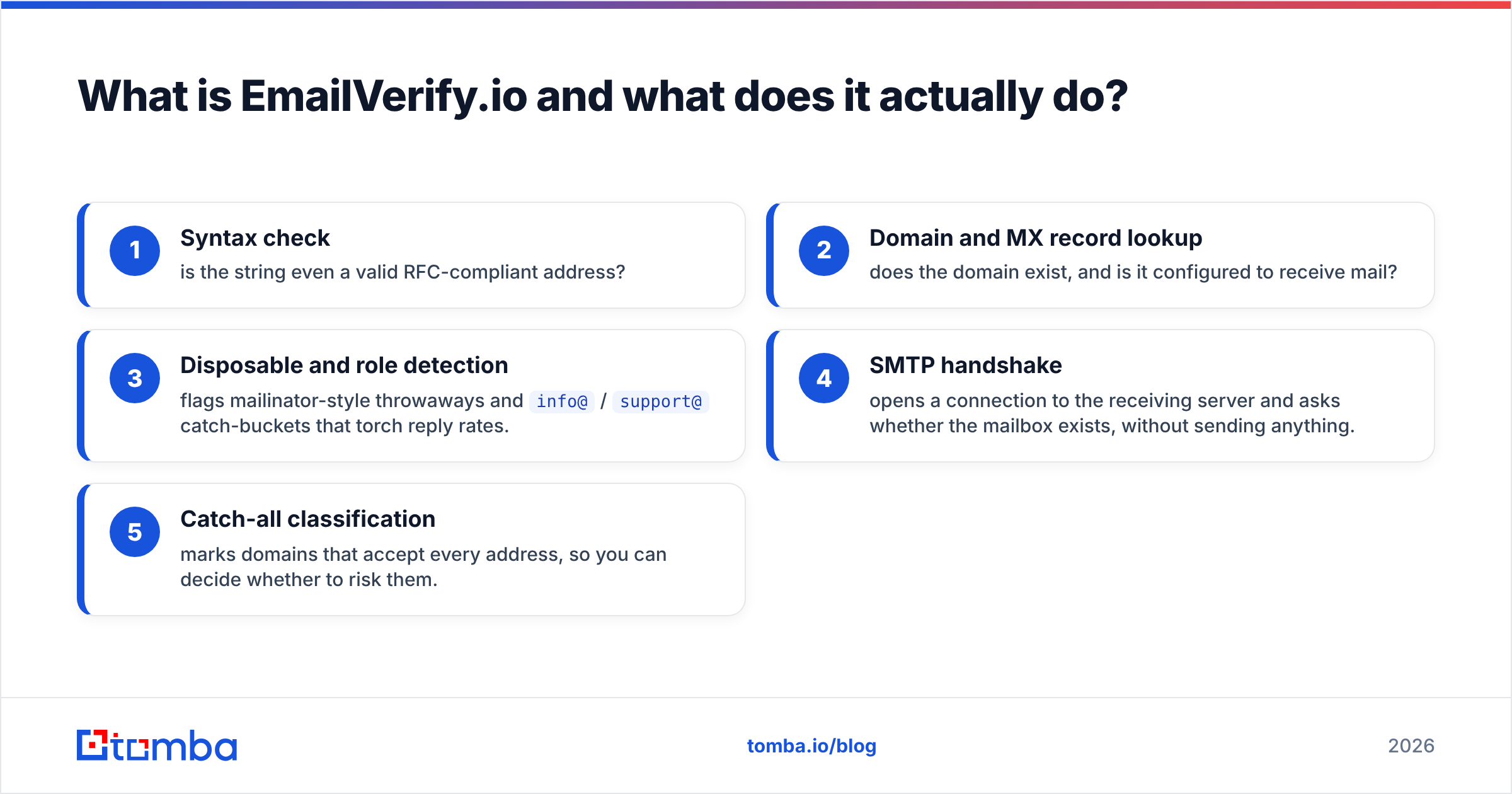
- Syntax check — is the string even a valid address?
- Domain and MX record lookup — does the domain exist, and can it receive mail?
- Disposable and role detection — flags throwaway addresses and
info@/support@inboxes that kill reply rates. - SMTP handshake — it opens a connection to the receiving server and asks whether the mailbox exists. Nothing is sent.
- Catch-all classification — marks domains that accept every address, so you can decide whether to risk them.
That is the whole product. It does not tell you who works at a company or what their title is. It will not flag a new funding round or a job change. There is no intent data, no org chart, no phone number, and no real CRM sync. It is a filter, and a filter needs something upstream feeding it water.
That gap matters more than any feature list, because it decides which tool can solve your problem at all. If you are shopping for email verification, EmailVerify.io belongs on the shortlist. If you are shopping for a source of pipeline, it does not belong in the conversation.

What is ZoomInfo and who is it built for?#
ZoomInfo sits at the other end of the stack. It is a contact and company database. It holds hundreds of millions of profiles, plus firmographics, technographics, org charts, direct dials, and buying-intent signals. The data comes from contributory networks, public web sources, and companies ZoomInfo has bought.
Its buyer is an enterprise revenue team. The pitch is not "clean my list." The pitch is "replace three vendors, feed Salesforce automatically, and show my reps which accounts are in-market this week." Around the data sit workflow products: Copilot for account prioritization, Engage for sequencing, Chorus for call analysis, and Websights for visitor identification.
That breadth is real. For a 40-rep outbound team, it can be worth the money. It also comes with the contract terms reviewers on G2 mention constantly: annual commitments, per-seat licensing, credit caps that reset, auto-renewal clauses, and a buying cycle measured in weeks.
A three-person startup that buys ZoomInfo for 2,000 contacts a month has bought a freight train to carry a suitcase.
EmailVerifyIO vs ZoomInfo: how do they compare head to head?#
Here is the honest side-by-side. A credit-based finder-plus-verifier sits in the third column, so you can see where the middle ground is.
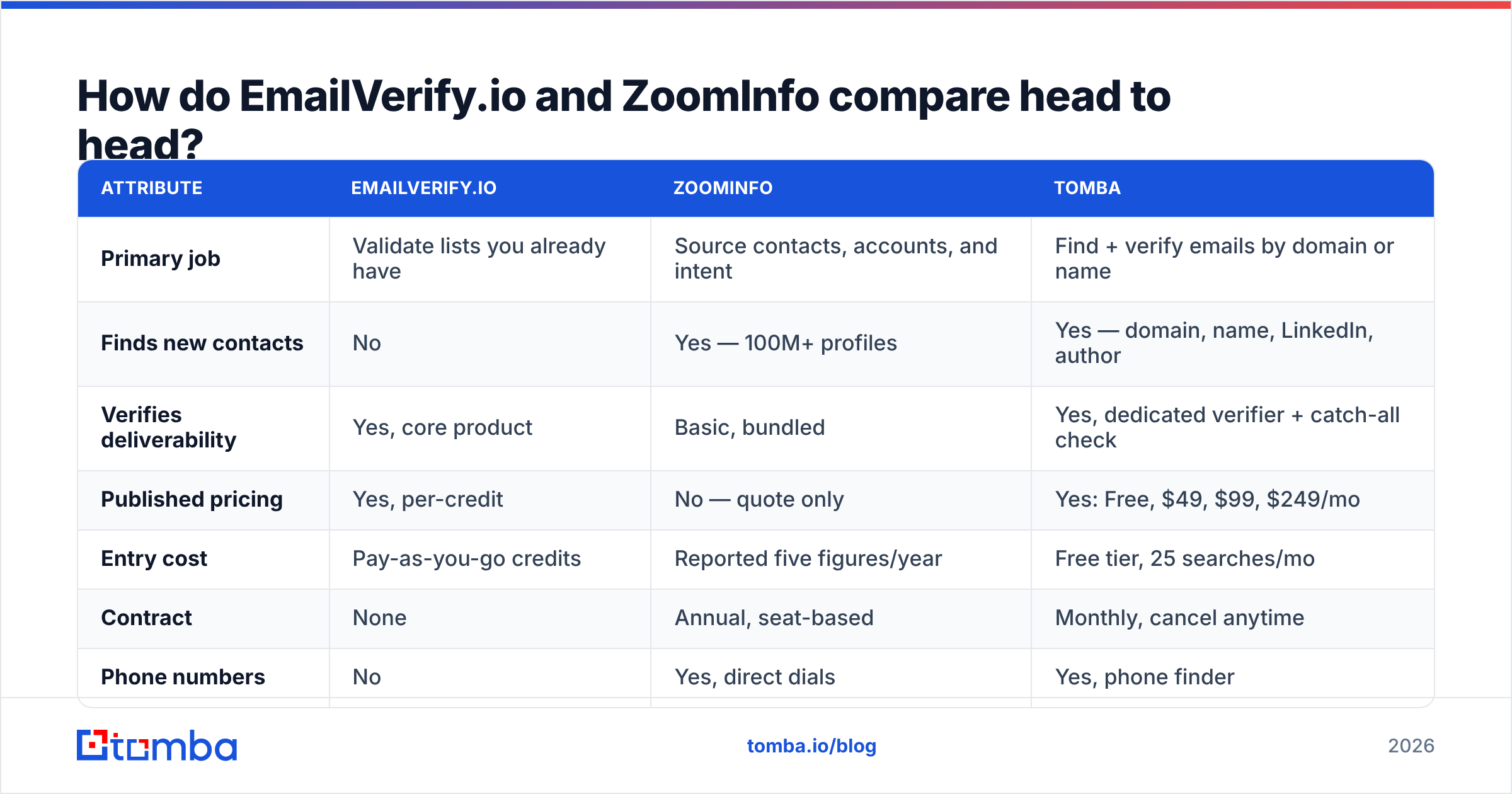
| Attribute | EmailVerify.io | ZoomInfo | Tomba |
|---|---|---|---|
| Primary job | Validate lists you already have | Source contacts, accounts, and intent | Find + verify emails by domain or name |
| Finds new contacts | No | Yes — 100M+ profiles | Yes — domain, name, LinkedIn, author |
| Verifies deliverability | Yes, core product | Basic, bundled | Yes, dedicated verifier + catch-all check |
| Published pricing | Yes, per-credit | No — quote only | Yes: Free, $49, $99, $249/mo |
| Entry cost | Pay-as-you-go credits | Reported five figures/year | Free tier, 25 searches/mo |
| Contract | None | Annual, seat-based | Monthly, cancel anytime |
| Phone numbers | No | Yes, direct dials | Yes, phone finder |
| Intent / technographics | No | Yes | No |
| API access | Yes | Yes, enterprise tier | Yes, on all paid plans |
| Time to first contact | Minutes (if you have a list) | Days to weeks (procurement) | Minutes |
| Best for | Cleaning inherited or scraped lists | 20+ rep enterprise GTM teams | SMB and mid-market outbound |
The row that decides most deals is "finds new contacts." Every other line is downstream of it. Teams pick EmailVerify.io, then learn they still have nowhere to get contacts. So they buy a second tool anyway. The combined bill often beats one tool that does both jobs.
Which one has better data accuracy?#
The comparison gets slippery here, because the two tools claim accuracy on different things.
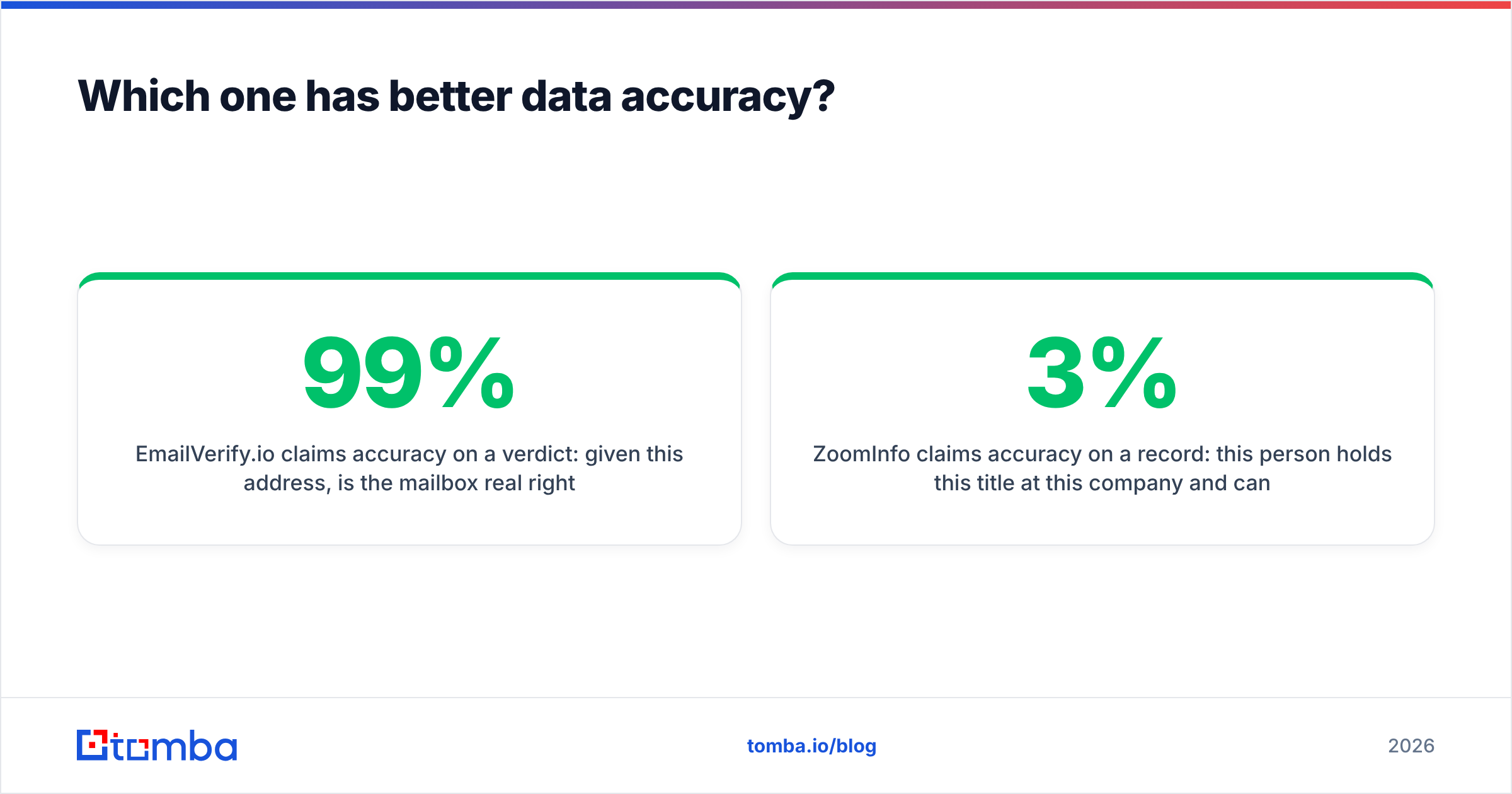
EmailVerify.io claims accuracy on a verdict: is this mailbox real right now? That is a testable, near-binary claim. Mature verifiers land in the 96–99% range on clean test sets.
The caveat every vendor buries is catch-all domains. About a fifth of B2B domains accept all mail at the server level, so an SMTP check tells you nothing there. Verifiers either mark them "risky" and hand the call back to you, or guess from patterns and source data. If a vendor quotes 99% accuracy but will not explain its catch-all handling, the number is marketing. A dedicated catch-all verifier exists because that bucket needs its own treatment.
ZoomInfo claims accuracy on a record: this person holds this title at this company, and you can reach them here. That claim decays with time, not with server settings. B2B contact data goes stale at roughly 2–3% per month as people switch jobs, get promoted, or get laid off. A database snapshot loses a real slice of its accuracy every quarter. ZoomInfo fights back with contributory data and constant refresh, and it is genuinely good at this. But nobody beats decay, which is why even ZoomInfo users should re-verify before a send.
The practical takeaway: these two accuracy claims are not substitutes. A ZoomInfo export still bounces if the record is four months old. An EmailVerify.io pass still leaves you with zero contacts if you started with zero. Sourcing accuracy and deliverability accuracy are separate failure modes. Either one alone can sink a campaign.

How does the pricing really compare?#
EmailVerify.io publishes per-credit pricing. Rates drop at volume, and a small free allowance lets you test the engine. At mid-volume rates, verifying 10,000 addresses costs tens of dollars. There is no seat cost and no contract. That is the entire appeal.
ZoomInfo does not publish pricing. Quotes are built from seat count, credit allowance, modules, and data scope. Buyers and analysts report entry packages in the five-figure annual range. Per-seat costs climb fast once Engage, Chorus, or intent data are added. Credits are capped per contract year, and overage is negotiated rather than metered.
The EmailVerifyIO vs ZoomInfo gap is widest here. Now put both against a per-credit finder-plus-verifier. Tomba pricing is public: a free tier at 25 searches per month, Starter at $49/mo, Growth at $99/mo, Pro at $249/mo, and custom Enterprise pricing. Say your team needs a few thousand verified contacts a month. That is roughly one to two percent of a typical ZoomInfo commitment, and it still does the sourcing EmailVerify.io cannot do at all.

Run the math on cost per usable contact instead of cost per record:
- EmailVerify.io alone: cheap per address. But the cost of getting the raw list is hidden elsewhere — scraping time, a second vendor, or an intern's afternoon.
- ZoomInfo alone: high fixed cost, low marginal cost once you are in. It breaks even only at real volume across several reps.
- Finder + verifier in one: predictable monthly cost, no seat tax, and no second invoice for hygiene.
For an enterprise-grade database option, BookYourData is worth a look. It sells verified B2B contacts on a pay-as-you-go basis with a bounce guarantee. That sits neatly between ZoomInfo's contract model and a pure verification tool. Different shape, same goal: usable contacts without a procurement cycle.
Who should choose EmailVerify.io?#
Pick EmailVerify.io when all of these are true:
- You already own the list. Inherited CRM data, a decade of webinar signups, or a bought file of unknown origin.
- Your bounce rate is the symptom. You see 5%+ hard bounces, and Gmail or Outlook has started throttling you.
- You do not need new contacts this quarter. Your pipeline problem is conversion, not coverage.
- You want zero commitment. Credits only — no contract, no onboarding call.
- Your volume is spiky. You verify 50,000 addresses in March and none in April. Pay-as-you-go fits that shape far better than an annual license.
If your list is genuinely dirty, verification is the best hour you will spend all month. Mailbox providers weigh bounce rate heavily in sender reputation, and one bad send can take weeks to undo. Cleaning first is not optional.
Who should choose ZoomInfo?#
Pick ZoomInfo when:
- You have 15+ reps who do outbound full time, so seat economics start working for you.
- You need intent and technographic signals, not just contact records. You run account-based plays where timing decides the deal.
- Salesforce or HubSpot is the system of record, and you need enrichment written back automatically at scale.
- You need direct dials at volume for a phone-heavy motion.
- You have budget and a buying process that can absorb an annual commitment without stalling the quarter.
ZoomInfo is not overpriced for what it is. It is overpriced for what most small teams use it for, which is looking up email addresses one at a time.
Is there a middle option between the two?#
Yes, and it is where most teams under 20 reps land: a tool that sources the contact and verifies it in the same request.
The workflow looks like this. You have a target list of 300 companies from a conference page, a funding announcement, or your ICP filter. You run a domain search to pull every discoverable address at each domain, plus the company's email pattern. You run the email finder for named prospects where you know the person but not the address. Every result comes back with a confidence score and a verification status, so there is no separate cleaning step and no second invoice.
That is genuinely different from both tools here. It is not a static database you rent by the seat, and it is not a filter that assumes you brought your own water. Coverage is narrower than ZoomInfo's, and you get no intent scores or call analysis. But for one job — verified addresses for these accounts, this week, without a contract — it wins on cost per usable contact by an order of magnitude.
The honest limit: if you cannot define your target accounts, no finder helps. Finders answer "how do I reach this company?" Databases answer "which companies should I reach?" Know which question you are asking before you sign anything.
What should you do before your next send, regardless of tool?#
Three things, in order:
- Verify within 30 days of sending. Data decay never stops. A list verified in January is not a verified list in June.
- Segment catch-alls separately. Send to them from a secondary domain, or leave them out of your main sequence until you have a second signal.
- Warm the domain before volume. No amount of verification saves a cold domain sending 500 emails on day one. Ramp slowly and watch your email deliverability metrics daily.
Skip any of the three and the tool comparison stops mattering. The best data in the world bounces off a domain nobody trusts.
The verdict#
EmailVerifyIO vs ZoomInfo comes down to one question: do you already have the contacts?
EmailVerify.io wins if you have contacts and need them clean. It is focused, cheap, and honest about its scope.
ZoomInfo wins if you have a real outbound org and a real budget. You get intent, org charts, and direct dials in one contract. It is expensive because it does far more than verification.
Neither wins for a small team that just needs verified addresses for accounts it already picked. Paying for a database you use 5% of is money set on fire. So is a verifier that still needs a separate sourcing vendor.
Start with Tomba Email Finder. The free tier gives you 25 searches a month with no card. Run 20 lookups against contacts you can check by hand, then compare hit rate and confidence scoring. Only then decide whether you need a full data platform. If the free tier covers your volume, you just saved five figures. If it does not, $49/mo covers most SMB outbound — and you will have real data on your own accounts before committing to anything larger.
Related guides#
Ready to find emails that actually work?
Join 150,000+ professionals who stopped guessing and started sending. Free credits on signup — no credit card required.
Get the Tomba newsletter
Practical outbound tactics and product updates — once every two weeks.
About the author