Emelia Pricing 2026: Plans, Hidden Costs, and Alternatives
A neutral look at Emelia pricing in 2026: what each tier actually includes, where sending slots and credits push the bill up, and when a cheaper stack beats the all-in-one.
TL;DR
- Emelia sells cold email and LinkedIn automation on a tiered subscription, with the entry plan landing in the mid-€30s/month and the main growth plan near €97/month at the time of writing — always confirm on emelia.io before you buy, because outreach vendors reprice often.
- The sticker price is not the bill. Sending slots, email-finder credits, LinkedIn seats, and the inboxes you buy elsewhere are what actually determine your monthly spend.
- Emelia's strongest pitch is unlimited-ish sending on higher tiers plus a clean UI — it is priced for teams that send a lot from many mailboxes, not for people who need deep data.
- If your bottleneck is finding and verifying contacts rather than sending them, an all-in-one sequencer is the wrong line item to grow. A dedicated finder plus a cheap sender is usually 30-50% less.
- Best-fit rule: Emelia for high-volume senders who want simple pricing; a specialist data tool like Tomba for anyone whose bounce rate — not send volume — is the constraint.
What is Emelia and what are you actually paying for?#
Emelia is a French cold-outreach platform that bundles email sequencing, LinkedIn automation, an email finder, and verification into one subscription. It competes with Lemlist, Instantly, Smartlead, and Saleshandy, and its positioning has always been "simpler and cheaper than Lemlist."
When you buy Emelia, you're buying four distinct things that vendors like to blur together:
- Sending infrastructure access — the sequencer that connects to your mailboxes, schedules sends, handles replies and unsubscribes. This is the core product.
- Sending slots (mailbox connections) — how many email accounts you can attach. On volume-based outbound, this number matters more than any feature list, because deliverability caps you at roughly 30-50 sends per mailbox per day.
- Credits for data — email finder lookups and verification, metered separately from sending.
- LinkedIn automation seats — usually priced per LinkedIn account, and usually the fastest-growing part of the bill for teams doing multichannel.
The pricing question is really: which of those four do you need, and are you overpaying for the three you don't?

What are Emelia's pricing tiers in 2026?#
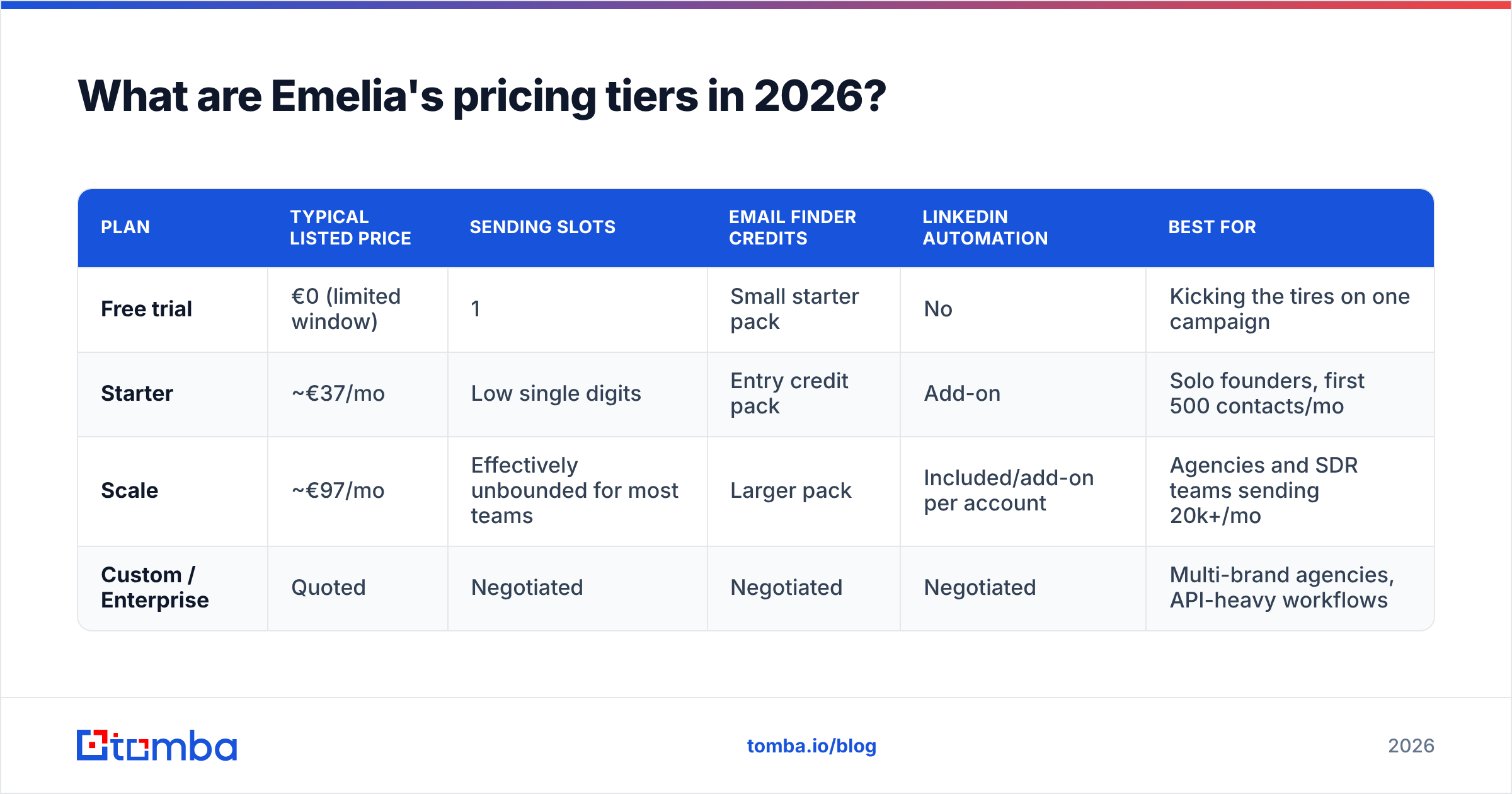
Emelia publishes a small, readable tier list — one of the genuinely good things about the product. Below is the structure as listed publicly at the time of writing. Treat the euro figures as directional and verify on the vendor page.
| Plan | Typical listed price | Sending slots | Email finder credits | LinkedIn automation | Best for |
|---|---|---|---|---|---|
| Free trial | €0 (limited window) | 1 | Small starter pack | No | Kicking the tires on one campaign |
| Starter | ~€37/mo | Low single digits | Entry credit pack | Add-on | Solo founders, first 500 contacts/mo |
| Scale | ~€97/mo | Effectively unbounded for most teams | Larger pack | Included/add-on per account | Agencies and SDR teams sending 20k+/mo |
| Custom / Enterprise | Quoted | Negotiated | Negotiated | Negotiated | Multi-brand agencies, API-heavy workflows |
Two things stand out versus the category.
The jump from Starter to Scale is steep in percentage terms but cheap in absolute terms. Going from ~€37 to ~€97 nearly triples your bill, but €97/month for effectively unlimited sending slots is aggressive pricing next to Lemlist or Outreach, where per-seat costs stack fast. If you run 20 mailboxes, Emelia's Scale plan is one of the lower-cost ways to do it.
Credits are the soft ceiling. Sending is generous; data is not. That's a deliberate and common design — infrastructure costs the vendor almost nothing, while every verified email costs real money. Which is exactly why the credit line is where most teams end up buying twice.
Where do the hidden costs in Emelia pricing show up?#
The subscription is not your outbound budget. Here's the honest accounting for a team running Emelia at a moderate scale:
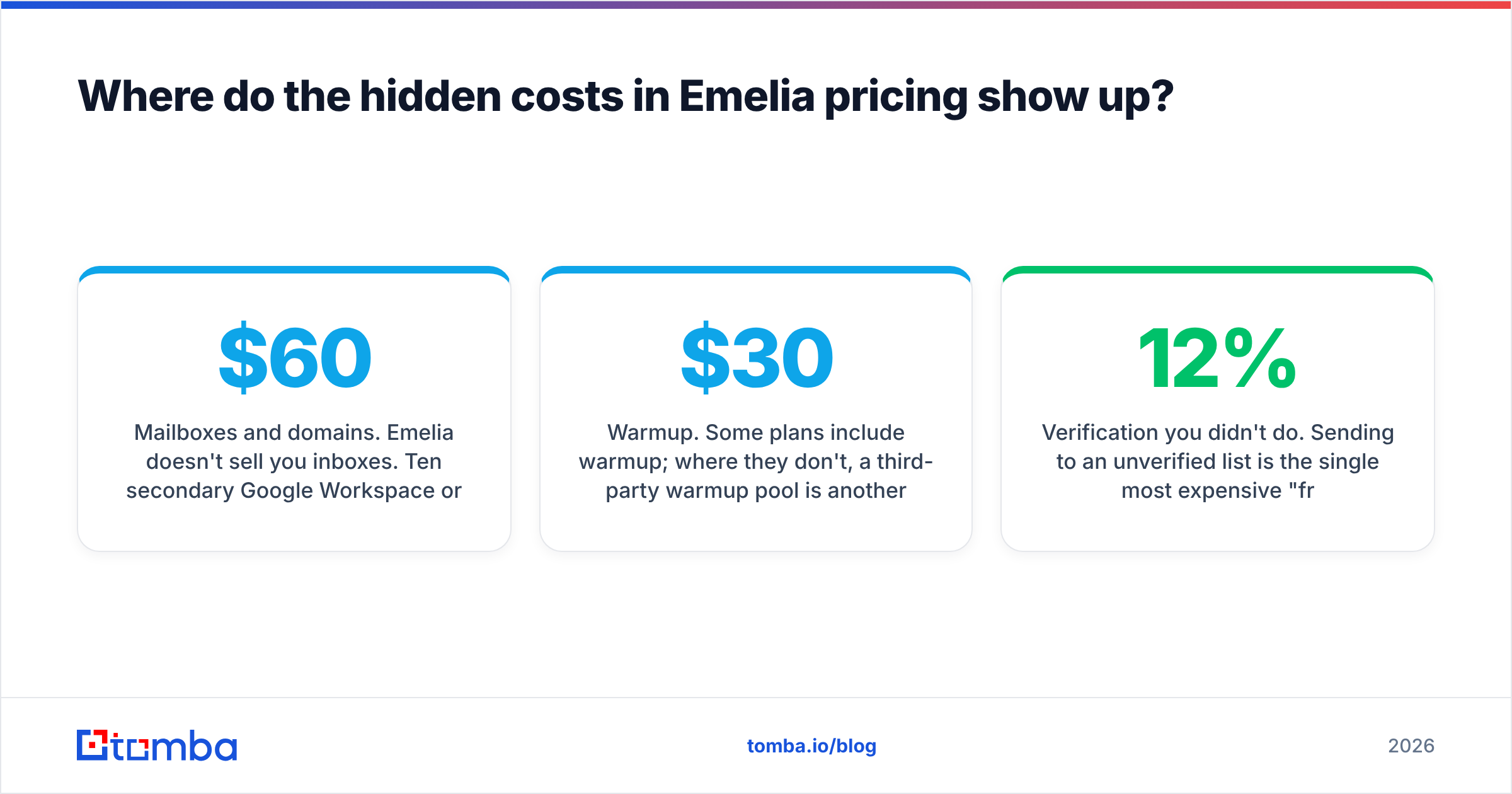
- Mailboxes and domains. Emelia doesn't sell you inboxes. Ten secondary Google Workspace or Microsoft 365 mailboxes across three domains runs roughly $60-120/month plus domain registration. That's often more than the software.
- Warmup. Some plans include warmup; where they don't, a third-party warmup pool is another $30-50/month. Check whether warmup counts against sending slots.
- Data credits, round two. Emelia's built-in finder is convenient but is not a full B2B database. Teams building lists at scale usually add a dedicated finder, which means paying for lookups twice.
- Verification you didn't do. Sending to an unverified list is the single most expensive "free" decision in outbound. A 12% bounce rate on 10,000 sends doesn't just waste 1,200 emails — it damages sender reputation across every mailbox on the domain, and recovery takes weeks.
- LinkedIn accounts. Multichannel pricing is typically per connected LinkedIn profile. Five reps means five line items.
Add those up and a "€97/month tool" is realistically a €250-350/month outbound stack. That's not a knock on Emelia — it's true of Instantly, Smartlead, and Lemlist too. It just means you should compare stacks, not sticker prices.
How does Emelia pricing compare to other cold email tools?#
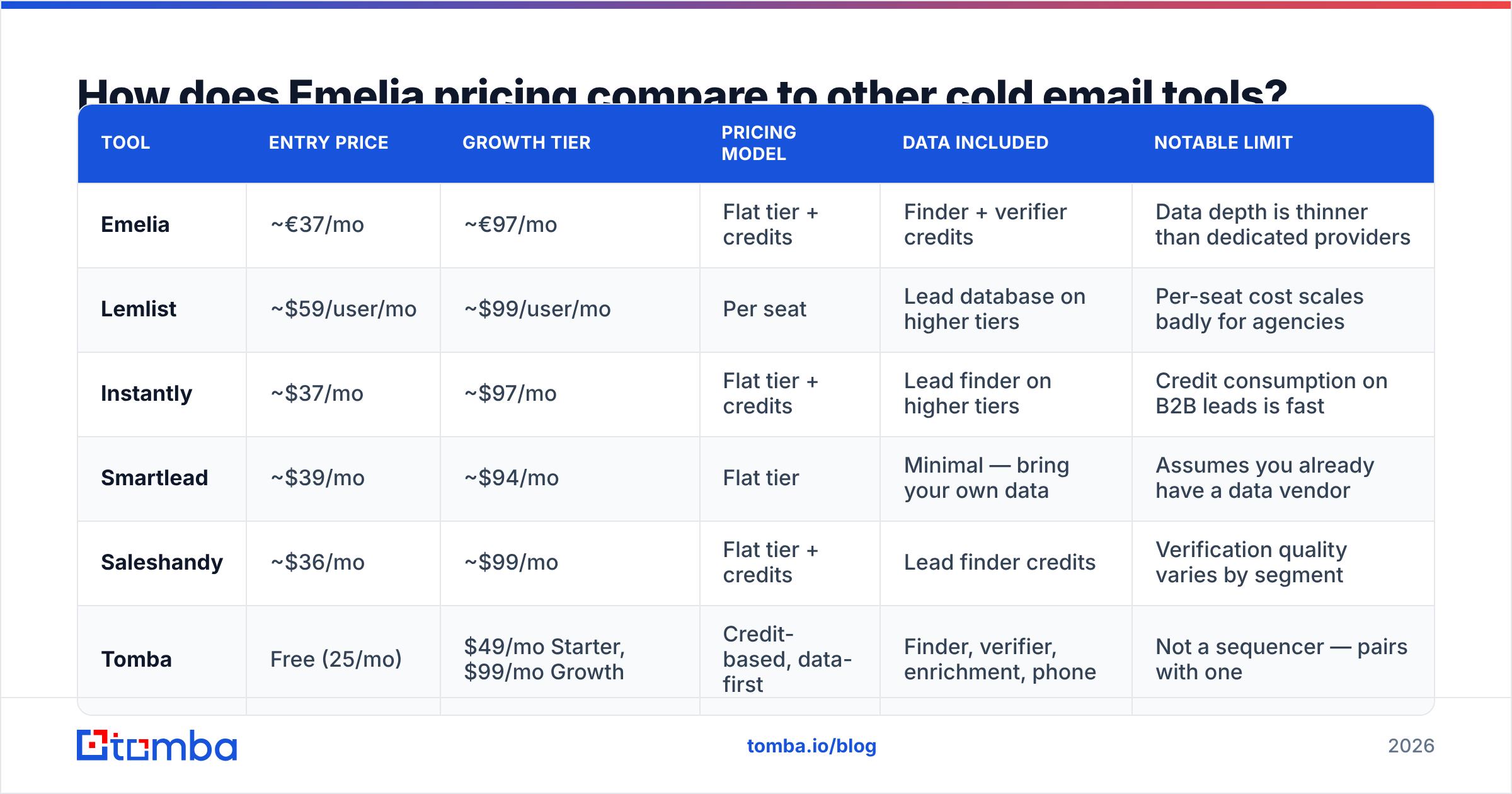
| Tool | Entry price | Growth tier | Pricing model | Data included | Notable limit |
|---|---|---|---|---|---|
| Emelia | ~€37/mo | ~€97/mo | Flat tier + credits | Finder + verifier credits | Data depth is thinner than dedicated providers |
| Lemlist | ~$59/user/mo | ~$99/user/mo | Per seat | Lead database on higher tiers | Per-seat cost scales badly for agencies |
| Instantly | ~$37/mo | ~$97/mo | Flat tier + credits | Lead finder on higher tiers | Credit consumption on B2B leads is fast |
| Smartlead | ~$39/mo | ~$94/mo | Flat tier | Minimal — bring your own data | Assumes you already have a data vendor |
| Saleshandy | ~$36/mo | ~$99/mo | Flat tier + credits | Lead finder credits | Verification quality varies by segment |
| Tomba | Free (25/mo) | $49/mo Starter, $99/mo Growth | Credit-based, data-first | Finder, verifier, enrichment, phone | Not a sequencer — pairs with one |
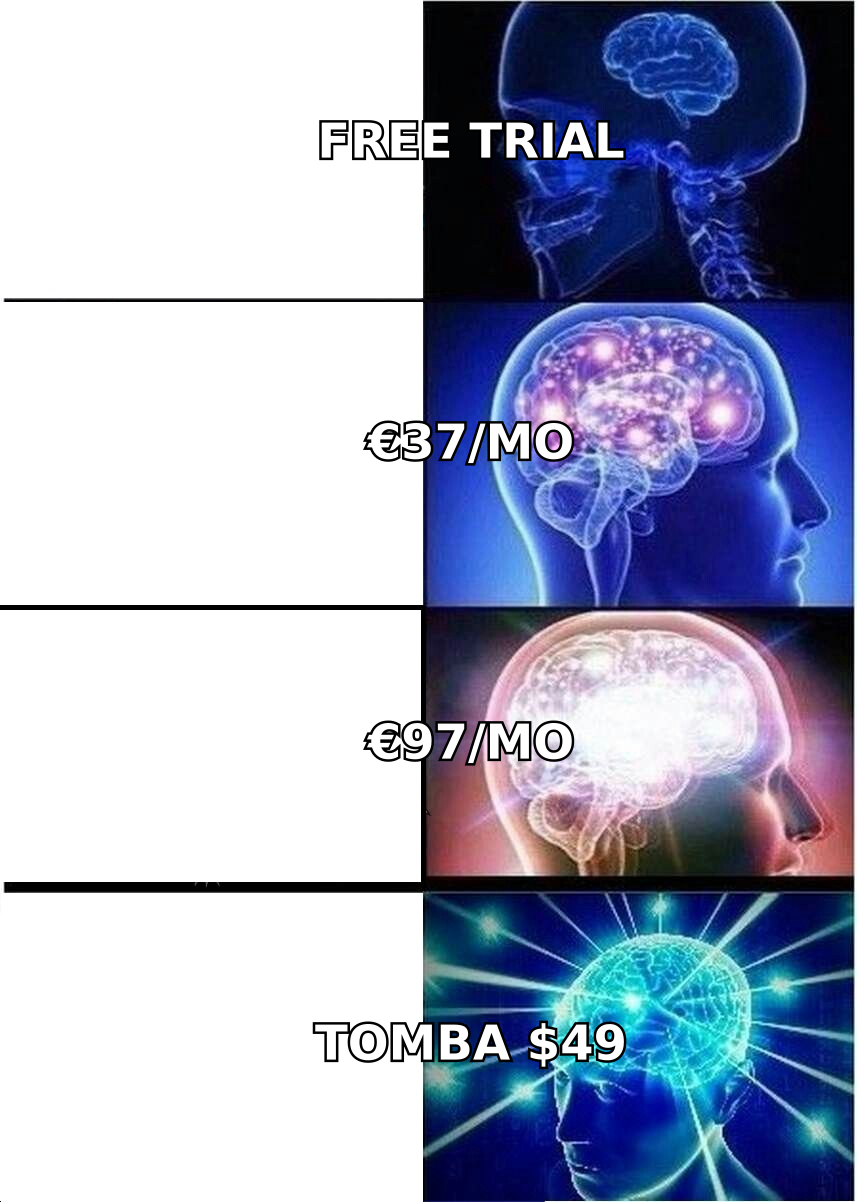
The pattern is obvious once you line them up: the sequencer market has converged on roughly €37 entry and €97 growth. Feature-for-feature, price is no longer the differentiator between Emelia, Instantly, Smartlead, and Saleshandy. Data quality and deliverability are.
That reframes the buying decision. You are not choosing between €37 and €97 — you're choosing where the data comes from, because that's the variable with an order-of-magnitude effect on reply rate.
Is Emelia's built-in email finder worth the credits?#
Depends entirely on your ICP.
Bundled finders inside sequencers are optimized for convenience, not coverage. They work well on large, well-indexed companies with predictable email patterns — a 500-person SaaS firm in the US where first.last@company.com is the norm. They degrade sharply on smaller companies, non-English domains, catch-all servers, and roles that aren't public-facing.
If you're seeing any of these, the bundled finder is costing you more than it saves:
- Bounce rate above 3% on lists sourced through the tool. Anything over 5% is actively burning domains.
- Coverage below 60% on your target account list — you're paying for lookups that return nothing usable.
- Catch-all domains marked "risky" and skipped. Catch-all servers accept everything at the SMTP layer, so naive verifiers punt. A proper catch-all verifier resolves a meaningful share of them instead of discarding the contact.
- No phone or enrichment fallback, so unreachable prospects just die in the list.
This is where an unbundled stack wins on cost. A dedicated email finder plus a sequencer that assumes you bring your own data (Smartlead, or Emelia on its lower tier) frequently costs less than an all-in-one on the growth tier, and lands with a fraction of the bounces.
Who should actually buy Emelia?#
Emelia makes sense if:
- You send high volume from many mailboxes and want predictable, non-per-seat pricing. The Scale tier is legitimately good value for 15+ sending slots.
- You want email and LinkedIn in one interface without stitching two tools together.
- Your team is small enough that per-seat pricing elsewhere would hurt, and you value UI simplicity over configurability.
- Your list-building happens elsewhere — a partner, an existing database, inbound — and you just need a reliable sender.
Look elsewhere if:
- Your reply rate problem is a data problem. No sequencer fixes a list with wrong addresses.
- You need deep firmographic filtering to build lists from scratch. Emelia is a sender with a finder attached, not a database platform.
- You need API-first workflows to enrich records inside your CRM or data warehouse. That's a job for a dedicated email finder API, not a sequencer.
- You operate in markets where email patterns are irregular — much of EMEA, LATAM, and APAC — and coverage from bundled finders drops off a cliff.
For a direct feature comparison, Tomba maintains an Emelia alternative breakdown, and third-party reviews on G2 and Capterra are useful for reading unfiltered complaints about credit consumption and support responsiveness.
How should you budget a realistic outbound stack?#
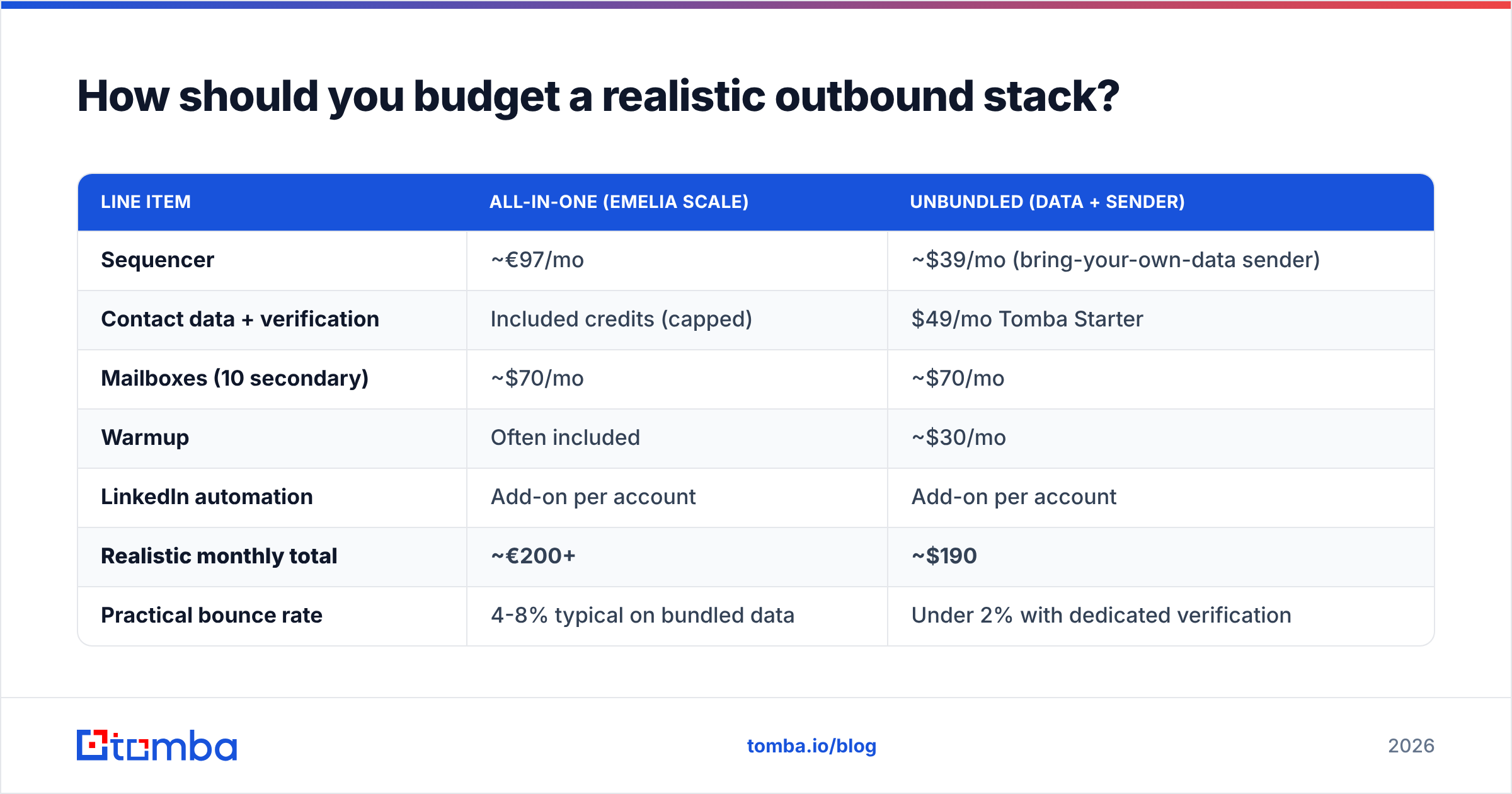
Here's a working monthly budget for a two-rep team sending 15,000 emails a month, comparing an all-in-one approach against an unbundled one.
| Line item | All-in-one (Emelia Scale) | Unbundled (data + sender) |
|---|---|---|
| Sequencer | ~€97/mo | ~$39/mo (bring-your-own-data sender) |
| Contact data + verification | Included credits (capped) | $49/mo Tomba Starter |
| Mailboxes (10 secondary) | ~$70/mo | ~$70/mo |
| Warmup | Often included | ~$30/mo |
| LinkedIn automation | Add-on per account | Add-on per account |
| Realistic monthly total | ~€200+ | ~$190 |
| Practical bounce rate | 4-8% typical on bundled data | Under 2% with dedicated verification |
The totals land close. The difference is what you get for them: the unbundled stack spends a larger share of the budget on the part that determines whether your emails reach a human. Reaching 14,700 real inboxes out of 15,000 sends beats reaching 13,800 — not because of the 900 emails, but because the domains stay healthy for the next quarter's campaigns.
What questions should you ask before you sign up?#
Run these against Emelia and every competitor on your shortlist:
- What happens when credits run out mid-month? Do campaigns pause, or do you get auto-charged overage? Overage billing is where "cheap" plans become expensive.
- Are unused credits rolled over? Most sequencers say no. Budget for the peak month, not the average.
- Is verification included with finder credits, or metered separately? Paying twice for one contact is common and easy to miss.
- Can you export your data? If contacts are locked in the platform, the switching cost is real regardless of price.
- What's the annual discount, and what's the refund policy? Annual commitments typically save 20-30%, but only take one if you've run a full month on monthly billing first.
- Does the plan cap contacts, sends, or both? These are different ceilings and vendors mix them freely.
Get those answers in writing during the trial. Support responsiveness during the trial is also the cheapest possible signal about support responsiveness after you pay.
Frequently asked questions about Emelia pricing#
Does Emelia have a free plan? Emelia offers a limited free trial rather than a permanent free tier. If you want an ongoing free allowance for contact lookups, dedicated data tools tend to offer one — Tomba includes 25 free searches per month, with details on the Tomba pricing page.
Is Emelia cheaper than Lemlist? Generally yes, particularly for teams with several users, because Emelia's growth tier isn't per-seat and Lemlist's is. The gap narrows if you only have one or two users.
Does Emelia charge per email sent? No. Sending is bundled into the tier; data lookups are the metered resource. Your real send ceiling is set by how many mailboxes you attach and how hard you can push each one without hurting deliverability.
Can I use Emelia with data from another provider? Yes, and many teams do exactly that — import a verified CSV or push contacts in via integration, and use Emelia purely as the sending layer. That's often the most cost-effective configuration.
The bottom line on Emelia pricing#
Emelia is fairly priced for what it is: a clean, high-volume sequencer with flat tiers and no per-seat penalty. At roughly €97/month for the growth plan, it undercuts Lemlist and matches Instantly and Smartlead. If sending volume is your constraint, it's a reasonable buy.
But nobody's outbound is failing because they couldn't send enough emails. It fails because the addresses were wrong, the domains got burned, and the reply rate never cleared 1%. That's a data problem, and no sequencer subscription solves it.
Before you upgrade a sending plan, fix the list. Run your target accounts through Tomba Email Finder to build verified contact lists with sourcing you can audit, catch-all resolution instead of "risky, skipped," and a free tier that lets you benchmark coverage against your current bundled finder before spending a euro. Start on the free 25 searches, compare the bounce rate against what your sequencer's built-in finder produces, and let the numbers pick the stack.
Related guides#
Ready to find emails that actually work?
Join 150,000+ professionals who stopped guessing and started sending. Free credits on signup — no credit card required.
Get the Tomba newsletter
Practical outbound tactics and product updates — once every two weeks.
About the author