Emelia Reviews 2026: Features, Pricing, Limits & Verdict
Emelia is a French cold email and LinkedIn automation tool with warmup and verification built in. Here's what it does well, where it stalls, and who should skip it.
TL;DR
- Emelia is a European cold email and LinkedIn automation platform — sequences, unlimited sending accounts on higher tiers, built-in warmup and a basic verifier, all under EU data rules.
- It competes on price and simplicity, not on depth. If you want native CRM two-way sync, deep analytics, or a large built-in B2B contact database, this is the wrong tool.
- Most positive Emelia reviews cite the interface, support responsiveness, and the fact that warmup isn't a paid add-on. Most negative ones cite thin reporting, a smaller integration catalog, and the lead data being an add-on rather than a core asset.
- Emelia does not replace a real data layer. You still need an accurate source of verified addresses before a sequence is worth sending.
- Best fit: small agencies and lean outbound teams in the EU who send moderate volume and care about GDPR posture. Worst fit: enterprise RevOps teams with Salesforce-first workflows.
What is Emelia, exactly?#
Emelia is a cold outreach platform built by a French team. You connect your sending mailboxes (Gmail, Outlook, or generic SMTP/IMAP), import a list of contacts, build a multi-step sequence with conditional follow-ups, and let it send on a schedule with human-like delays. On the higher tiers you can layer LinkedIn actions — profile visits, connection requests, messages — into the same sequence so a prospect gets email and LinkedIn touches in one flow.
Think of it as the sending engine and the traffic controller, not the map. It decides when each message goes out, from which mailbox, and what happens if someone replies. It does not tell you who to contact or guarantee that the address you loaded is real.
Three things distinguish it from the American incumbents:
1. Warmup is included, not upsold. Most platforms charge separately for a warmup pool or push you toward a partner tool. Emelia bundles it, which meaningfully changes the true monthly cost of a stack.
2. Unlimited sending accounts on upper tiers. Instead of paying per connected mailbox, you pay for contacts and features. If you run the modern "many domains, few sends each" playbook, per-mailbox pricing gets brutal fast — this model doesn't.
3. EU hosting and a GDPR-native posture. For teams selling into Europe, having data processed under GDPR by a company headquartered there removes a procurement conversation. Check the current terms on emelia.io before you make it a contractual claim.
What do Emelia reviews actually agree on?#
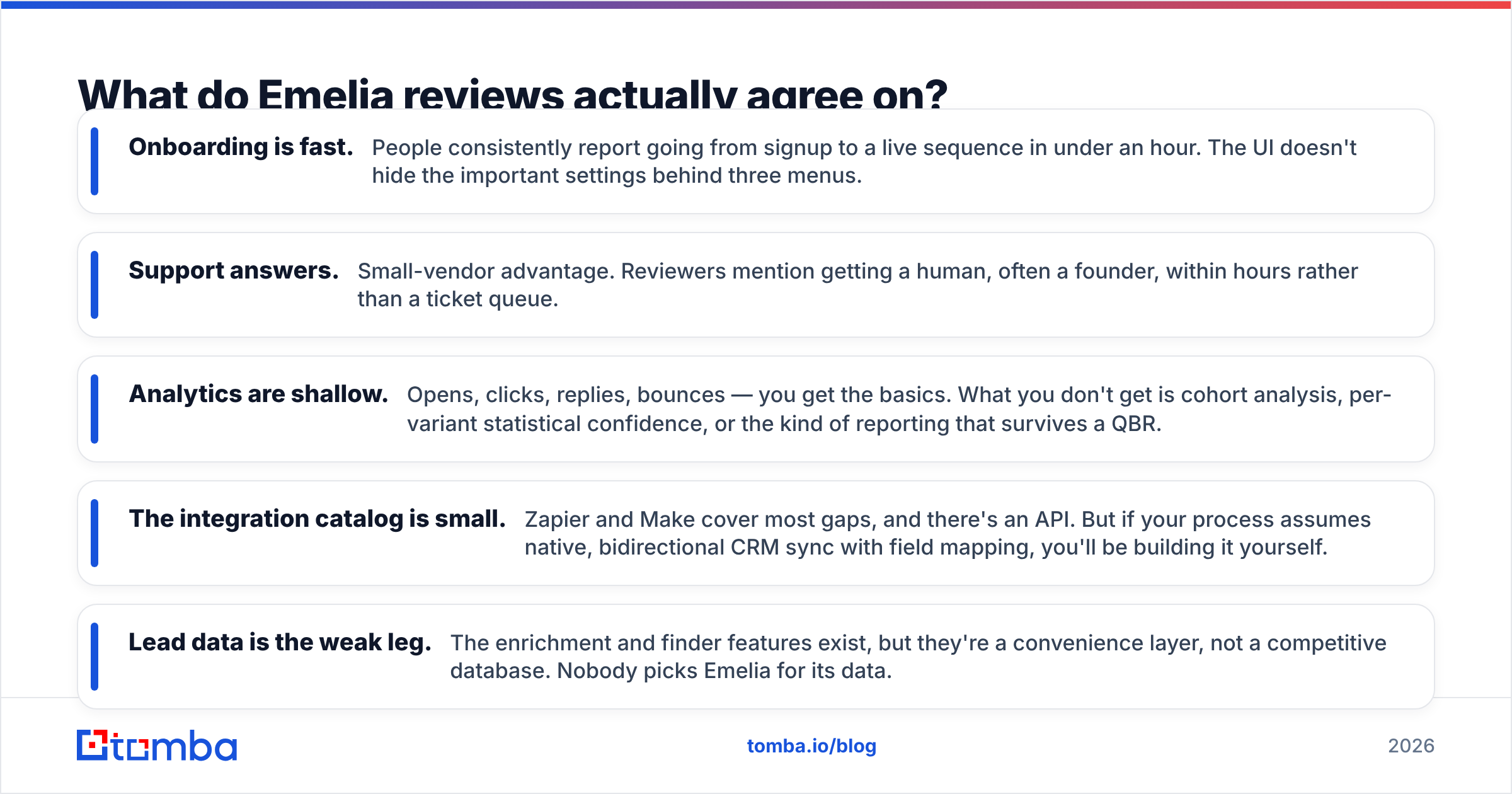
Read enough user feedback on G2 and Capterra and the same five themes surface regardless of who's writing:
- Onboarding is fast. People consistently report going from signup to a live sequence in under an hour. The UI doesn't hide the important settings behind three menus.
- Support answers. Small-vendor advantage. Reviewers mention getting a human, often a founder, within hours rather than a ticket queue.
- Analytics are shallow. Opens, clicks, replies, bounces — you get the basics. What you don't get is cohort analysis, per-variant statistical confidence, or the kind of reporting that survives a QBR.
- The integration catalog is small. Zapier and Make cover most gaps, and there's an API. But if your process assumes native, bidirectional CRM sync with field mapping, you'll be building it yourself.
- Lead data is the weak leg. The enrichment and finder features exist, but they're a convenience layer, not a competitive database. Nobody picks Emelia for its data.
That last point is the one that costs teams money, and it's worth sitting with.
Is Emelia good for email deliverability?#
Reasonably — with the caveat that no sending tool can save a bad list.
Emelia does the mechanical work correctly: randomized send intervals, daily volume ramps, rotation across connected mailboxes, automatic pause on reply, and unsubscribe handling. Warmup runs in the background against a peer network so new domains build sending history before you point them at real prospects. If you're comparing warmup ramp schedules across vendors, run the numbers with a warmup calculator rather than trusting a vendor default.
What it can't do is fix your inputs. Bounce rate is the single loudest negative signal to Google and Microsoft, and it's determined entirely by list quality before the first send. A sequence platform sending to 12% invalid addresses will burn a domain no matter how elegant its warmup is. That's why serious operators treat email verification as a pre-send gate, not a post-mortem metric — and why relying on a sequencer's bundled "verify" checkbox as your only quality control is the most common self-inflicted deliverability wound in outbound.
The practical rule: verify externally, then import. Catch-all domains deserve special handling — a catch-all verifier tells you whether an accept-all server is likely to route to a real inbox or a black hole, which is exactly the distinction a generic SMTP ping can't make.
How does Emelia compare to Lemlist, Instantly and Smartlead?#
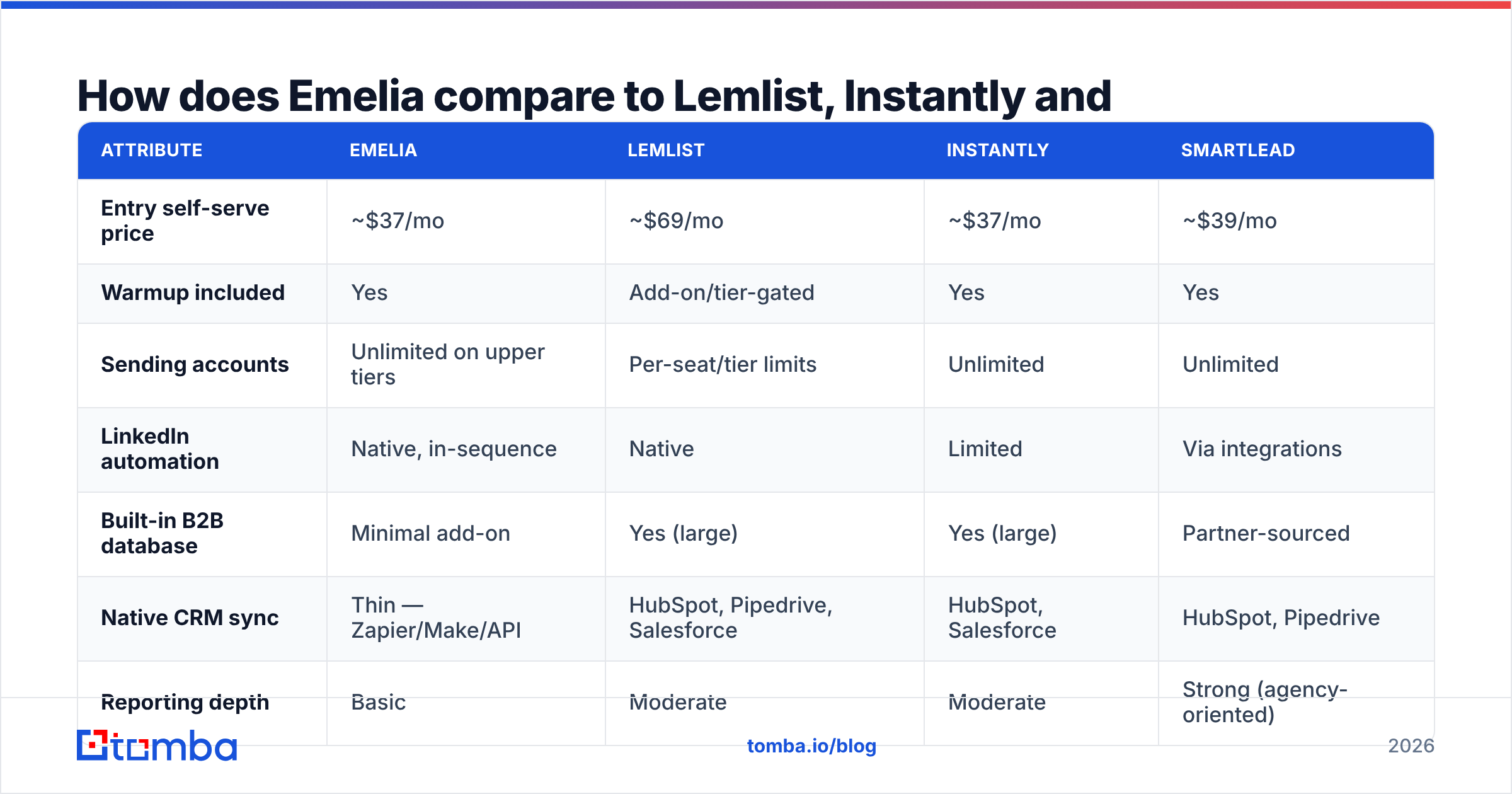
List prices move constantly, so treat the figures below as directional and confirm on each vendor's page before you buy. What matters more than the exact number is the shape of the pricing model.
| Attribute | Emelia | Lemlist | Instantly | Smartlead |
|---|---|---|---|---|
| Entry self-serve price | ~$37/mo | ~$69/mo | ~$37/mo | ~$39/mo |
| Warmup included | Yes | Add-on/tier-gated | Yes | Yes |
| Sending accounts | Unlimited on upper tiers | Per-seat/tier limits | Unlimited | Unlimited |
| LinkedIn automation | Native, in-sequence | Native | Limited | Via integrations |
| Built-in B2B database | Minimal add-on | Yes (large) | Yes (large) | Partner-sourced |
| Native CRM sync | Thin — Zapier/Make/API | HubSpot, Pipedrive, Salesforce | HubSpot, Salesforce | HubSpot, Pipedrive |
| Reporting depth | Basic | Moderate | Moderate | Strong (agency-oriented) |
| Data residency | EU | EU/US | US | US |
| Best for | EU SMBs, lean agencies | Multichannel with data included | High-volume senders | Agencies at scale |
The honest read: Emelia wins on price-per-capability for a small team that sends moderate volume and wants LinkedIn in the same sequence. It loses on data and reporting. Lemlist and Instantly bundle prospecting databases, which flatters their sticker price until you audit the accuracy of those records — bundled data is usually the least fresh part of any all-in-one.
If you want a like-for-like breakdown against Tomba's own stack, we keep a running Emelia alternative comparison that goes deeper on the data side.
Where does Emelia fall short?#
Four gaps show up repeatedly once teams pass the honeymoon phase.
Reporting hits a ceiling around 5,000 sends a month. You can see what happened. You'll struggle to explain why one variant outperformed another with statistical rigor, or to slice performance by industry, seniority, and sending domain simultaneously. Teams that need this end up exporting to a spreadsheet or a BI tool.
CRM workflows require glue. No native bidirectional sync with Salesforce means replies don't automatically become tasks, and lead status changes in the CRM don't automatically pause sequences. Zapier handles the happy path; edge cases become your problem. If your team runs revenue operations discipline with strict data hygiene rules, budget engineering time.
Deliverability diagnostics are thin. You'll see bounces. You won't get a clear breakdown of soft vs hard, per-provider inbox placement, or spam-folder detection at the level a dedicated deliverability suite provides. Run your own SPF checker and monitor sender reputation externally.
The data layer is not a data layer. This is the structural issue. Emelia's finder/enrichment features are fine for one-off lookups. They are not built to source thousands of verified, role-matched contacts a month with defensible accuracy. Teams that treat them as sufficient end up with lists that bounce, and then blame the sequencer.
What should you pair with Emelia?#
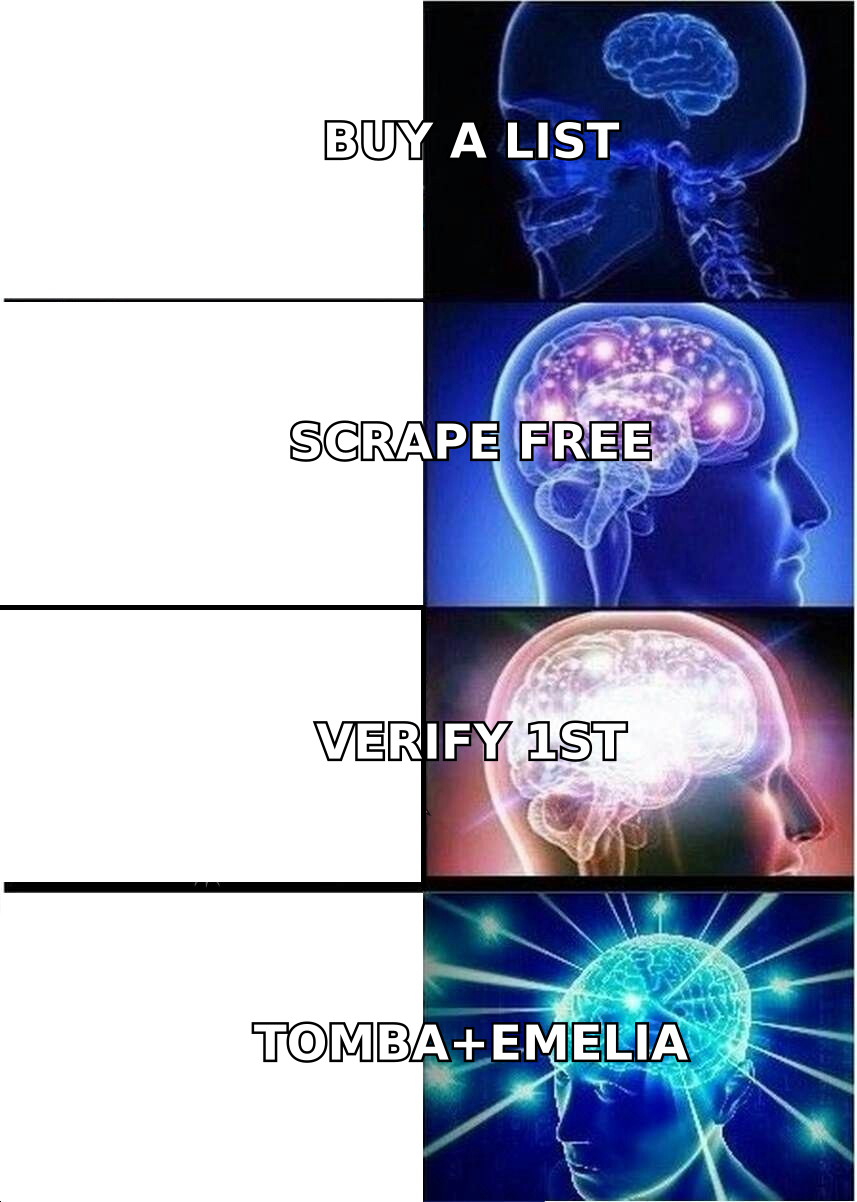
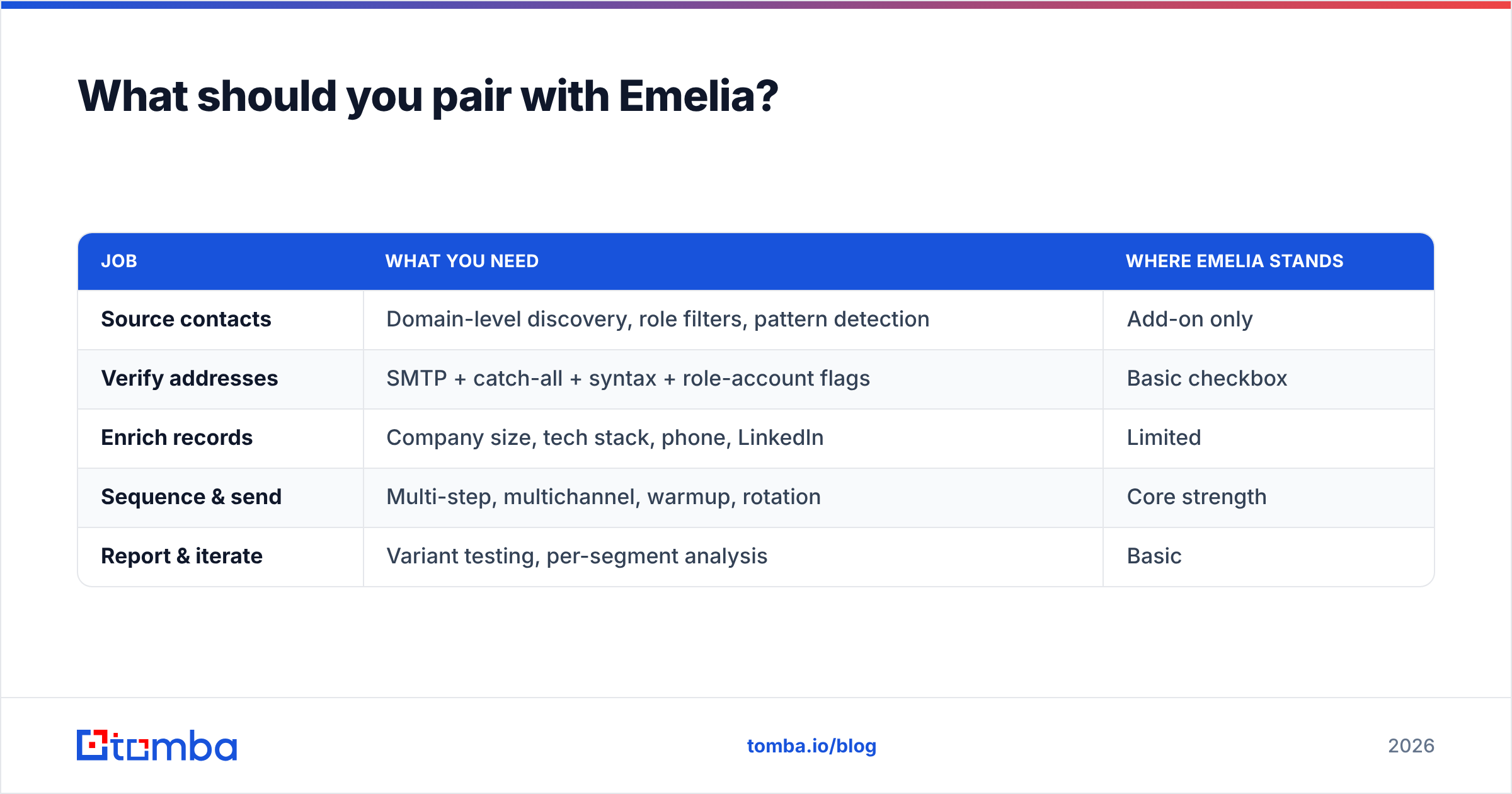
The stack that actually works separates three jobs: finding contacts, verifying them, and sending to them. Emelia is excellent at the third job and mediocre at the first two. Don't ask one tool to do all three well — that's how you end up with 40% of a workflow.
Here's how a functional split looks:
| Job | What you need | Where Emelia stands |
|---|---|---|
| Source contacts | Domain-level discovery, role filters, pattern detection | Add-on only |
| Verify addresses | SMTP + catch-all + syntax + role-account flags | Basic checkbox |
| Enrich records | Company size, tech stack, phone, LinkedIn | Limited |
| Sequence & send | Multi-step, multichannel, warmup, rotation | Core strength |
| Report & iterate | Variant testing, per-segment analysis | Basic |
For the top three rows, run a dedicated provider. Start with domain search to map who works at a target company and what the email pattern is, verify every result before export, then push the clean list into Emelia via CSV or API. Teams processing volume should look at bulk email finder workflows rather than one-off lookups — pushing 5,000 rows through a UI is not a process.
For prebuilt list purchases where you'd rather buy than build, vendors like BookYourData occupy a legitimate and different niche — verified static lists with a per-record guarantee. That's a valid complement to a finder-plus-sequencer stack, not a competitor to it.
Who should buy Emelia — and who shouldn't?#
Buy it if: you're a 2–15 person team or a boutique agency, you sell into Europe, you want LinkedIn and email in one sequence without paying two subscriptions, and your reporting needs stop at "which sequence booked meetings." The bundled warmup plus unlimited-mailbox model genuinely lowers total cost versus the American alternatives once you account for add-ons.
Skip it if: your CRM is Salesforce and your ops team enforces field-level sync, you need attribution reporting that a CFO will accept, you send above roughly 50,000 emails a month, or you were hoping the built-in database would replace a real prospecting tool. In those cases, either go up-market to a full sales engagement platform or accept that you'll be maintaining integration glue permanently.
Trial it properly: load 200 verified contacts — not 2,000 scraped ones — into a three-step sequence across two warmed domains, run it for three weeks, and measure reply rate and bounce rate separately. If bounces exceed 2%, the problem is your data, not Emelia. Fix that first, because switching sequencers will not change the number.
Frequently asked questions#
Is Emelia GDPR compliant? The company is EU-based and processes data under EU rules, which is a strong starting position. Compliance still depends on your legal basis for contacting people, your opt-out handling, and your record-keeping. The tool supports compliance; it doesn't grant it.
Does Emelia have a free plan? It runs a trial rather than a permanent free tier. Confirm current terms directly on their site — trial structures change often in this category.
Can Emelia find email addresses? It has a lookup feature, but coverage and accuracy are not why anyone chooses the platform. Pair it with a dedicated email finder if contact sourcing is a meaningful part of your workflow.
Is Emelia better than Lemlist? For price and LinkedIn-plus-email simplicity, often yes. For bundled data and reporting depth, no. The answer depends entirely on whether you already have a data source you trust.
How many mailboxes should I connect? Enough that no single mailbox exceeds roughly 30–50 cold sends per day. That usually means 3–5 mailboxes across 2–3 secondary domains for every 5,000 monthly sends.
The part Emelia can't do for you#
Emelia is a solid, fairly priced sending engine with a real advantage for European teams. It is not a data company, and it doesn't pretend to be. Every complaint about outbound performance that gets blamed on a sequencer — high bounces, low reply rates, domains getting flagged — traces back to the list, not the sender.
Fix the input. Use the Tomba Email Finder to build role-targeted contact lists from company domains, verify every address before it touches a sequence, and export clean records into Emelia. The free tier covers 25 searches a month so you can benchmark accuracy against whatever you're using now; paid plans start at $49/mo with full Tomba pricing published up front. Send fewer, better-targeted emails to addresses that actually exist — that single change moves reply rate more than any sequencing platform on the market.
Related guides#
Ready to find emails that actually work?
Join 150,000+ professionals who stopped guessing and started sending. Free credits on signup — no credit card required.
Get the Tomba newsletter
Practical outbound tactics and product updates — once every two weeks.
About the author