Eminer Alternatives: 9 Better Lead Data Tools for 2026
Eminer bundles prospecting, enrichment and outreach into one subscription — but that bundle is not the cheapest or the most accurate path for every team. Here are nine Eminer alternatives compared on data quality, pricing and API access.
TL;DR
- Most teams leave Eminer for one of three reasons: credit burn on unverified contacts, seat-based pricing that punishes small teams, or a thin API when they try to automate.
- If you mainly need accurate B2B emails and an API you can build on, Tomba is the cheapest serious replacement — Free tier at 25 searches/mo, Starter at $49/mo.
- If you need a full sequencer plus a database, Apollo.io is the closest all-in-one swap; if you need one-off verified lists without a subscription, BookYourData's pay-as-you-go model is a strong fit.
- Verification matters more than list size. A 100k-record export at 70% deliverability is worse than 20k records at 96%.
- Run a 200-contact bake-off before you sign anything. Same accounts, same job titles, three tools, one verifier as the judge.
What is Eminer, and why are people looking for alternatives?#
Eminer sits in the crowded "find leads, enrich them, email them" category — the same shelf as Apollo, Lusha, Seamless.AI and a dozen newer AI-flavoured entrants. The pitch is convenience: one login for prospect search, contact data, enrichment and outreach, so an SDR never leaves the tab.
That bundle works right up until one part of it underperforms. And in practice, the part that underperforms first is almost always the data. You can swap a sequencer in an afternoon. You cannot fix a contact database that returns catch-all guesses labelled as valid.
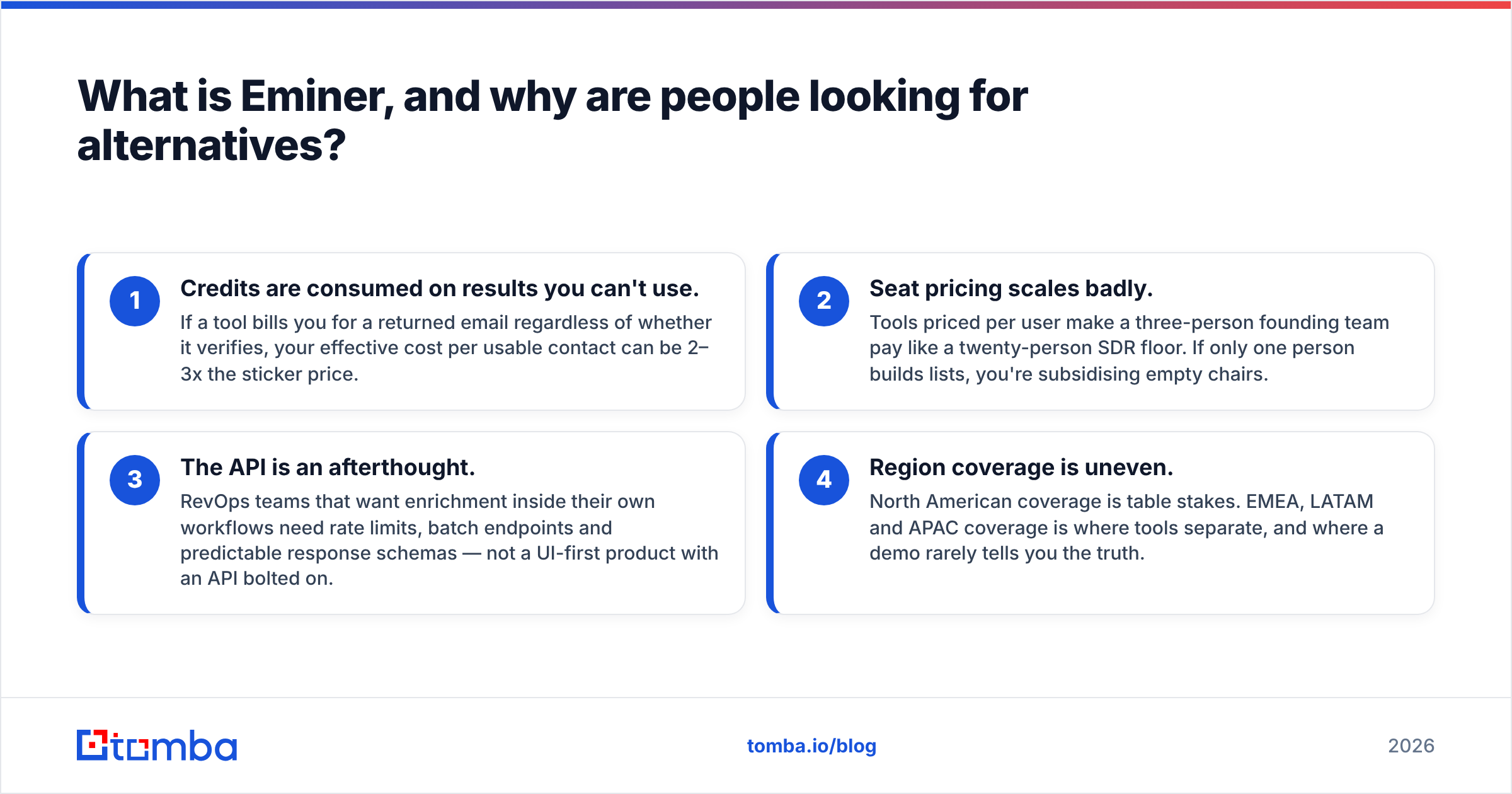
The four complaints that push teams to search for eminer alternatives are consistent across categories:
- Credits are consumed on results you can't use. If a tool bills you for a returned email regardless of whether it verifies, your effective cost per usable contact can be 2–3x the sticker price.
- Seat pricing scales badly. Tools priced per user make a three-person founding team pay like a twenty-person SDR floor. If only one person builds lists, you're subsidising empty chairs.
- The API is an afterthought. RevOps teams that want enrichment inside their own workflows need rate limits, batch endpoints and predictable response schemas — not a UI-first product with an API bolted on.
- Region coverage is uneven. North American coverage is table stakes. EMEA, LATAM and APAC coverage is where tools separate, and where a demo rarely tells you the truth.
Before you switch, confirm Eminer's current plan structure on its own site — pricing pages in this category change quarterly, and any number you read in a blog post (including this one) is a snapshot, not a contract.
What should you actually compare in an Eminer alternative?#
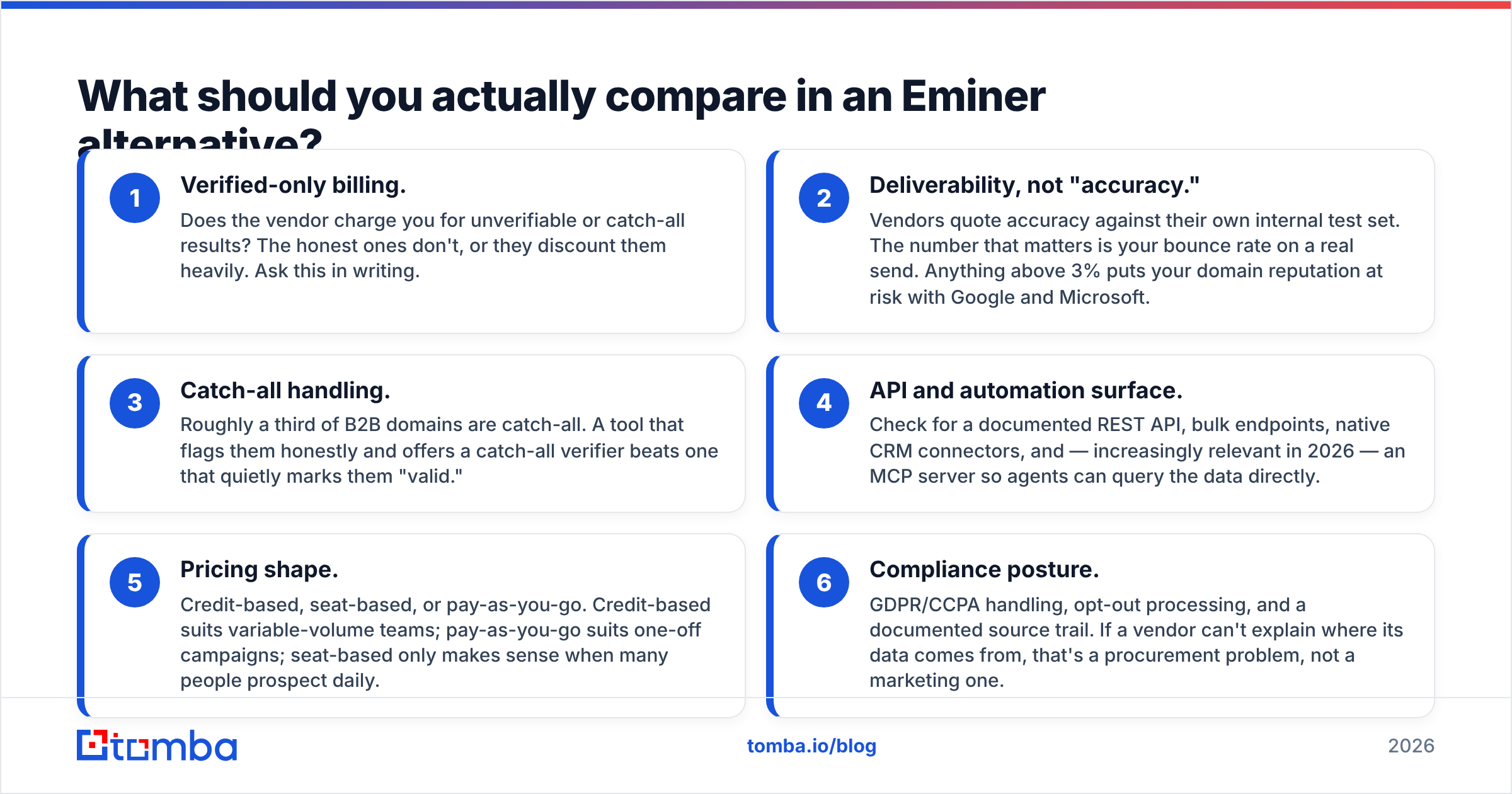
Ignore feature-count marketing. Six criteria decide whether a tool survives contact with a real outbound motion:
- Verified-only billing. Does the vendor charge you for unverifiable or catch-all results? The honest ones don't, or they discount them heavily. Ask this in writing.
- Deliverability, not "accuracy." Vendors quote accuracy against their own internal test set. The number that matters is your bounce rate on a real send. Anything above 3% puts your domain reputation at risk with Google and Microsoft.
- Catch-all handling. Roughly a third of B2B domains are catch-all. A tool that flags them honestly and offers a catch-all verifier beats one that quietly marks them "valid."
- API and automation surface. Check for a documented REST API, bulk endpoints, native CRM connectors, and — increasingly relevant in 2026 — an MCP server so agents can query the data directly.
- Pricing shape. Credit-based, seat-based, or pay-as-you-go. Credit-based suits variable-volume teams; pay-as-you-go suits one-off campaigns; seat-based only makes sense when many people prospect daily.
- Compliance posture. GDPR/CCPA handling, opt-out processing, and a documented source trail. If a vendor can't explain where its data comes from, that's a procurement problem, not a marketing one.
Score each candidate 1–5 on these six. The winner is rarely the one with the longest feature list.
Which Eminer alternatives are worth testing in 2026?#
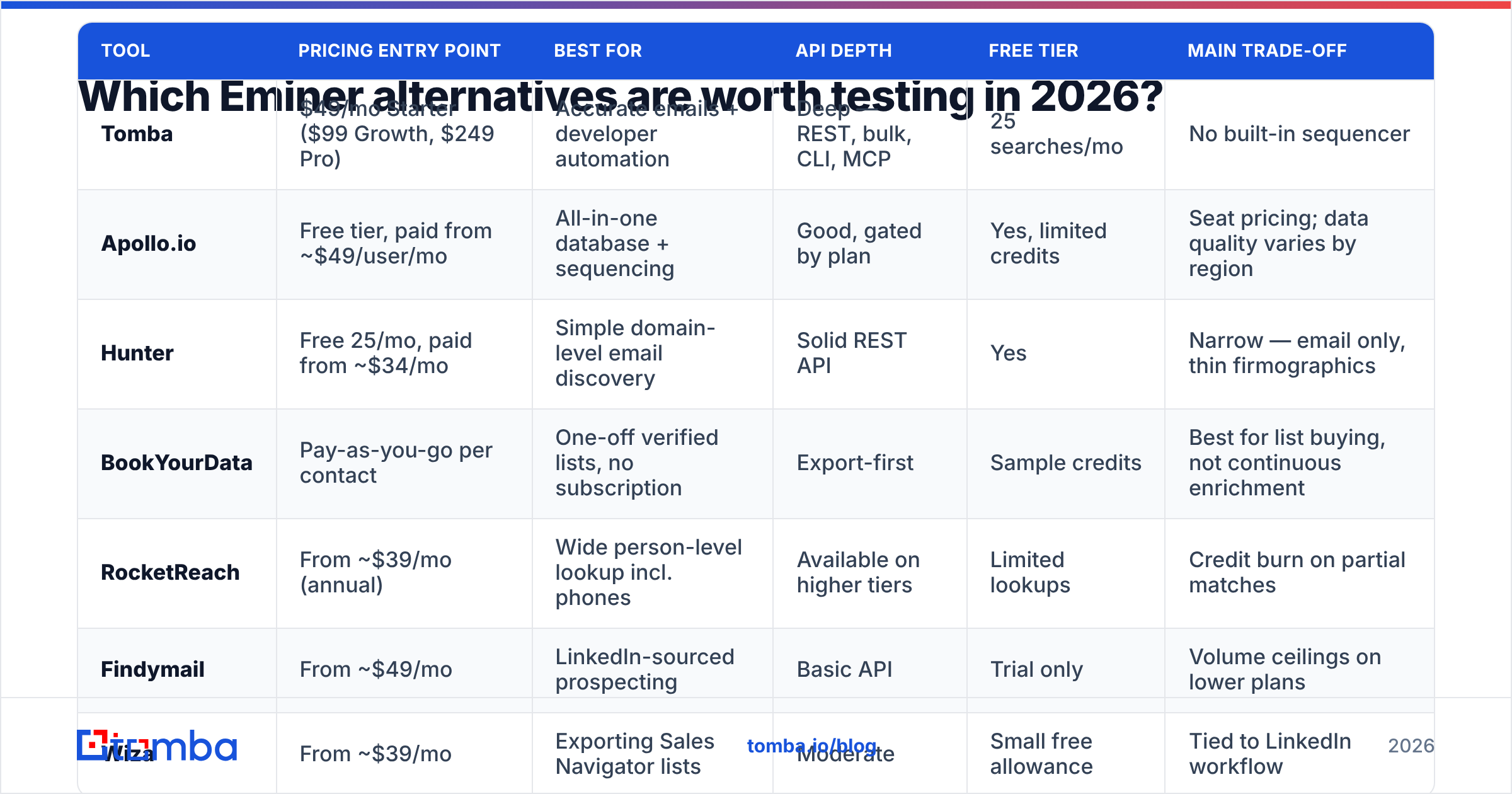
Here are the nine that consistently show up in real evaluations, with the trade-off that actually defines each one.
| Tool | Pricing entry point | Best for | API depth | Free tier | Main trade-off |
|---|---|---|---|---|---|
| Tomba | $49/mo Starter ($99 Growth, $249 Pro) | Accurate emails + developer automation | Deep — REST, bulk, CLI, MCP | 25 searches/mo | No built-in sequencer |
| Apollo.io | Free tier, paid from ~$49/user/mo | All-in-one database + sequencing | Good, gated by plan | Yes, limited credits | Seat pricing; data quality varies by region |
| Hunter | Free 25/mo, paid from ~$34/mo | Simple domain-level email discovery | Solid REST API | Yes | Narrow — email only, thin firmographics |
| BookYourData | Pay-as-you-go per contact | One-off verified lists, no subscription | Export-first | Sample credits | Best for list buying, not continuous enrichment |
| RocketReach | From ~$39/mo (annual) | Wide person-level lookup incl. phones | Available on higher tiers | Limited lookups | Credit burn on partial matches |
| Findymail | From ~$49/mo | LinkedIn-sourced prospecting | Basic API | Trial only | Volume ceilings on lower plans |
| Wiza | From ~$39/mo | Exporting Sales Navigator lists | Moderate | Small free allowance | Tied to LinkedIn workflow |
| Seamless.AI | Custom / annual contracts | Enterprise SDR floors wanting volume | Enterprise only | Trial | Annual commitments, aggressive upsell |
| Clearbit (HubSpot) | Bundled with HubSpot tiers | Inbound enrichment inside HubSpot | Strong, HubSpot-native | No standalone free tier | Locked to the HubSpot ecosystem |
Pricing above reflects publicly listed entry tiers in early 2026 and moves often — verify on each vendor's own page before budgeting. Compare against Tomba pricing for a like-for-like credit calculation.

A few notes the table can't hold:
Apollo.io (apollo.io) is the natural swap if what you liked about Eminer was the bundle. You get a large database, sequences, dialer and CRM sync in one place. The cost is seat pricing and uneven international coverage — European mid-market data in particular tends to need a second verification pass.
Hunter (hunter.io) is the minimalist. If your workflow is "give me the pattern and the emails for this domain," it does that cleanly. It won't give you deep firmographics or intent.
BookYourData (bookyourdata.com) solves a genuinely different problem: buying a clean, verified list once without committing to a monthly seat. For agencies running discrete campaigns per client, or for a founder testing three ICPs before picking one, that pay-as-you-go shape removes a real headache. It's a list-purchase motion rather than a continuous-enrichment motion — pick it when that's what you need.
Seamless.AI and Clearbit are both ecosystem plays. Seamless targets larger SDR organisations on annual contracts; Clearbit now lives inside HubSpot's data layer, which is excellent if you're a HubSpot shop and irrelevant if you're not. If you're evaluating either, read current user reviews on G2 rather than the vendor's own case studies — the gap between the two is instructive.
How accurate are these tools, really?#
Every vendor in this category claims something in the 95–98% range. Those numbers are measured differently by each vendor, on different test sets, with different definitions of "valid." Treat them as directional at best.

The only test that means anything is one you run:
- Pull 200 target contacts you can independently confirm — customers, partners, people whose email you already have in your CRM.
- Strip the emails. Keep name + company domain only.
- Run the same list through each candidate tool.
- Score two things separately: hit rate (how many emails returned) and match rate (how many matched the known-good address).
- Run every returned address through a neutral third-party email verifier — not the one bundled with the tool that produced them.
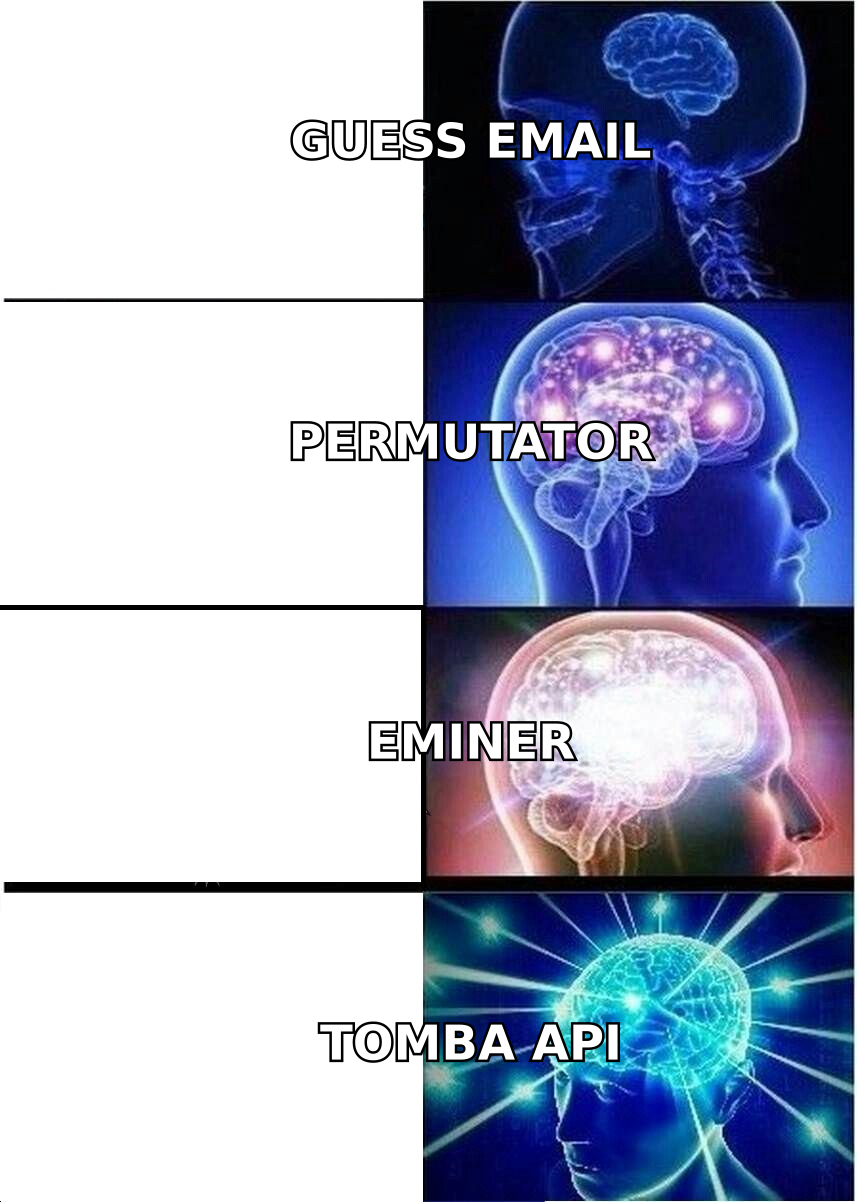
Tools that score high on hit rate but low on match rate are pattern-guessing. That's fine for a permutator, and unacceptable in something you pay per credit for. This is also where honest catch-all reporting shows up: a vendor that returns fewer results but labels ambiguity correctly saves you more money than one that returns everything and lets your ESP absorb the bounces.
For context on why bounce rate matters so much in 2026, review the current bulk-sender requirements — Google and Yahoo both enforce spam-complaint thresholds, and a bad list is the fastest way to trip them. HubSpot's deliverability documentation is a reasonable vendor-neutral primer, and the SMTP protocol overview on Wikipedia explains why verification can only ever be probabilistic on catch-all domains.

Is Tomba a good Eminer alternative?#
For the data half of Eminer's promise, yes — and that's the honest scope of the claim. Tomba doesn't ship a sequencer or a dialer. If you want everything in one login, Apollo is the closer match.
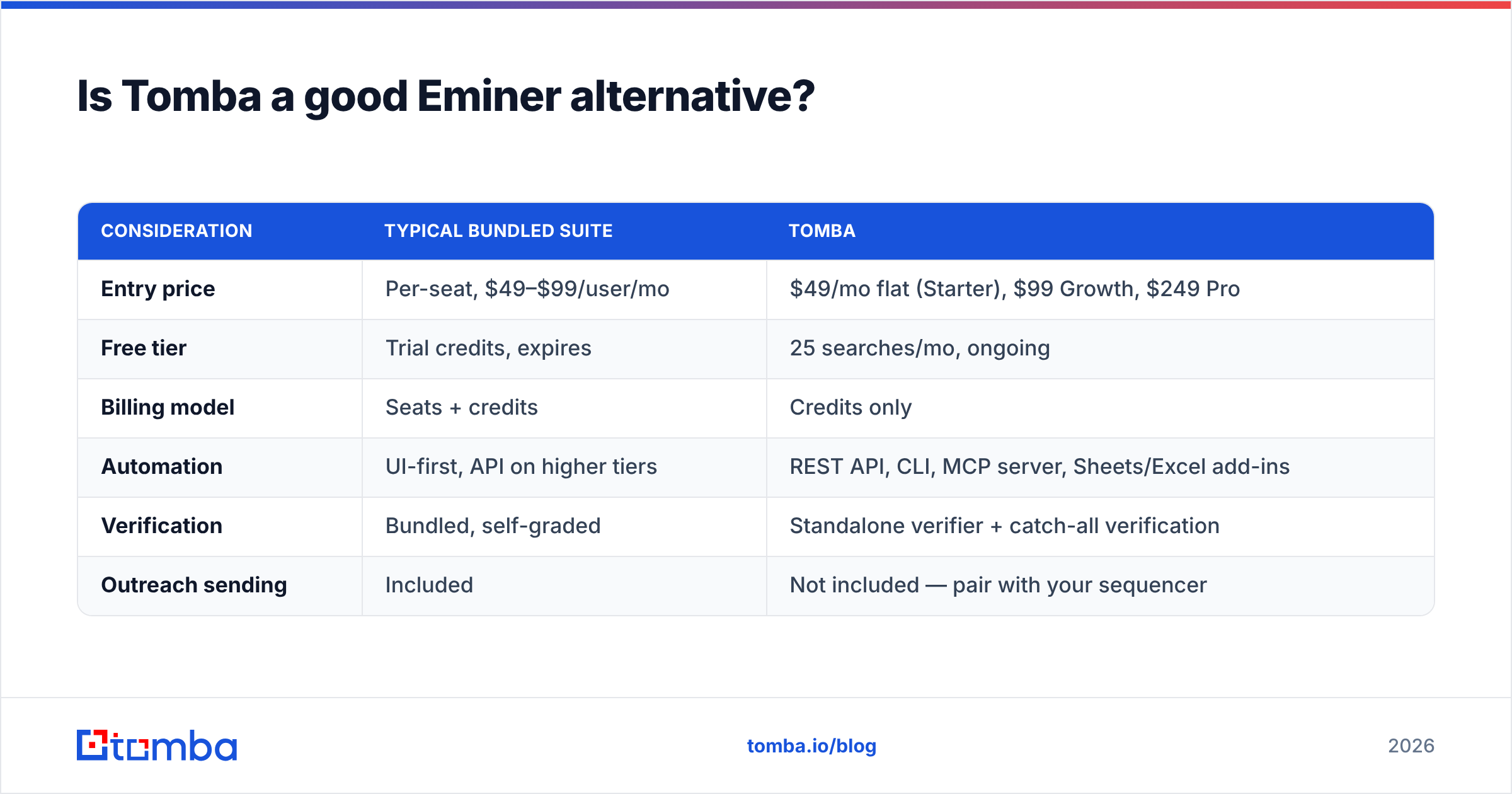
Where Tomba wins is cost per verified contact and automation depth:
| Consideration | Typical bundled suite | Tomba |
|---|---|---|
| Entry price | Per-seat, $49–$99/user/mo | $49/mo flat (Starter), $99 Growth, $249 Pro |
| Free tier | Trial credits, expires | 25 searches/mo, ongoing |
| Billing model | Seats + credits | Credits only |
| Automation | UI-first, API on higher tiers | REST API, CLI, MCP server, Sheets/Excel add-ins |
| Verification | Bundled, self-graded | Standalone verifier + catch-all verification |
| Outreach sending | Included | Not included — pair with your sequencer |
The practical stack most teams land on: Tomba for finding and verifying, a dedicated sequencer for sending, and your CRM as the source of truth. That separation is usually cheaper than a bundle and always easier to swap a component out of.
Useful entry points depending on your workflow: domain search for account-based list building, the bulk email finder for CSV enrichment, and the Tomba API if you're wiring enrichment into a product or an internal agent.
How do you switch without breaking your pipeline?#
Migrations fail when teams flip everything at once. Do it in five steps over two weeks:
- Export everything from Eminer first. Contacts, lists, tags, sequence stats. Do this before you cancel — export access often disappears with the subscription.
- Run the 200-contact bake-off described above. Don't skip it because a G2 chart looked convincing.
- Re-verify your existing database. Contact data decays roughly 25–30% a year as people change jobs. Half your bounce problem may be stale records, not a bad vendor.
- Rebuild integrations in parallel. Keep both tools live for one billing cycle. Point new enrichment at the new vendor while the old one still backs your active sequences.
- Measure on reply rate, not hit rate. Two weeks in, compare replies per 100 contacts sourced. That's the only metric that pays salaries.
One more thing: cancel deliberately. Annual contracts in this category frequently auto-renew with a 30-day notice window. Put the date in a calendar the day you sign anything.
Which alternative should you pick?#
Short version, by situation:
- Solo founder or small team, budget-sensitive, technical: Tomba. Free tier to test, $49/mo Starter, full API access without an enterprise conversation.
- You want the whole bundle in one login: Apollo.io, accepting seat pricing and a second verification pass on non-US data.
- You need one clean list, once, no subscription: BookYourData's pay-as-you-go model.
- You live inside Sales Navigator: Wiza or Findymail for the export workflow, with an independent verifier downstream.
- You're a HubSpot shop: Clearbit's native enrichment, since the integration cost is already paid.
- Large SDR floor with procurement and an annual budget: Seamless.AI or a negotiated enterprise agreement — but benchmark it against a credit-based tool before signing.
There's no universally correct answer here, only a correct answer for your ICP, your regions and your send volume. The bake-off tells you which one that is in about three hours of work.
Ready to test the data side?#
Start with the Tomba Email Finder. The free tier gives you 25 searches a month with no card, which is enough to run a real bake-off against whatever you're using now — same accounts, same titles, same verifier as the judge. If the match rate wins, Starter is $49/mo flat with no per-seat maths; if it doesn't, you've lost an afternoon and gained a benchmark. Either way you'll stop guessing which vendor's accuracy claim to believe.
Related guides#
Ready to find emails that actually work?
Join 150,000+ professionals who stopped guessing and started sending. Free credits on signup — no credit card required.
Get the Tomba newsletter
Practical outbound tactics and product updates — once every two weeks.
About the author