End of Quarter Sales Strategy: How to Close More Deals in 2026
The last 10 days of a quarter expose everything you did or didn't do in the first 80. Here's a practical playbook for closing the quarter without panic discounts or a last-minute scramble for contact data.
TL;DR
- The end of quarter is a reporting deadline, not a buying deadline. Your prospect's fiscal calendar rarely matches yours, so "our quarter ends Friday" is not a reason for them to sign.
- Discounting is the most expensive quarter-end tactic and the easiest one to reach for. A 20% concession on a $40,000 deal costs more than an entire month of prospecting tooling.
- The three tactics with the best cost-to-close ratio are multithreading into the economic buyer, removing procurement friction, and reviving closed-lost deals from two quarters ago.
- Most quarter-end scrambles fail on data, not effort. Reps burn the last week hunting for a CFO's email instead of talking to the CFO.
- Build the next quarter during the last two weeks of this one. Teams that enter a quarter with a verified, enriched list close earlier and discount less.
What actually happens at the end of a quarter?#
Two things happen at once, and confusing them is where most revenue teams lose money.
The first is real: deals that were genuinely close get the attention, executive sponsorship, and internal urgency they needed all along. A VP finally joins a call. Legal finally reads the MSA. Someone finally asks for the security questionnaire. That's not magic — it's a forcing function doing what forcing functions do.
The second is theatre: deals that were never close get discounted, re-forecast, and dragged into a "verbal commit" that evaporates in week two of the new quarter. Every sales org has a version of this. The board deck looks better on the last day of the quarter than it does eleven days later.
Think of it like a restaurant at 9:55 PM. The tables that were going to order dessert order dessert. The tables that just walked in aren't going to eat a three-course meal because the kitchen is closing. Rushing them doesn't create appetite — it creates a bad review.
The practical implication: your end of quarter plan should be two separate plans. One for accelerating deals that have real momentum, and one for protecting the quality of what carries into next quarter.
Why do end-of-quarter deals stall?#
Stalls at quarter-end are almost never about price, even when price is what the buyer says. Here's what's usually underneath.
- Single-threading. You have one champion and no relationship with the person who signs. Research summarized in Gartner's B2B sales guidance consistently puts the typical enterprise buying group in the 6–10 person range. If you know two of them, you are not running a deal — you are running a hope.
- No documented business case. Your champion cannot forward your pitch deck to a CFO and have it survive. If the value isn't expressed in the buyer's own numbers, it dies in the approval queue.
- Unmapped procurement. Security review, vendor onboarding, and legal redlines are serial processes with their own SLAs. A 15-day procurement cycle discovered on day 82 of the quarter is a next-quarter deal, full stop.
- Manufactured urgency the buyer can see through. "This discount expires Friday" from a rep who offered the same discount last quarter teaches buyers to wait. You've trained them.
- A pipeline that was never real. Opportunities created to hit an activity target, not because a buyer expressed a problem. No amount of quarter-end effort fixes stage-one fiction.

Which end-of-quarter tactics actually work?#
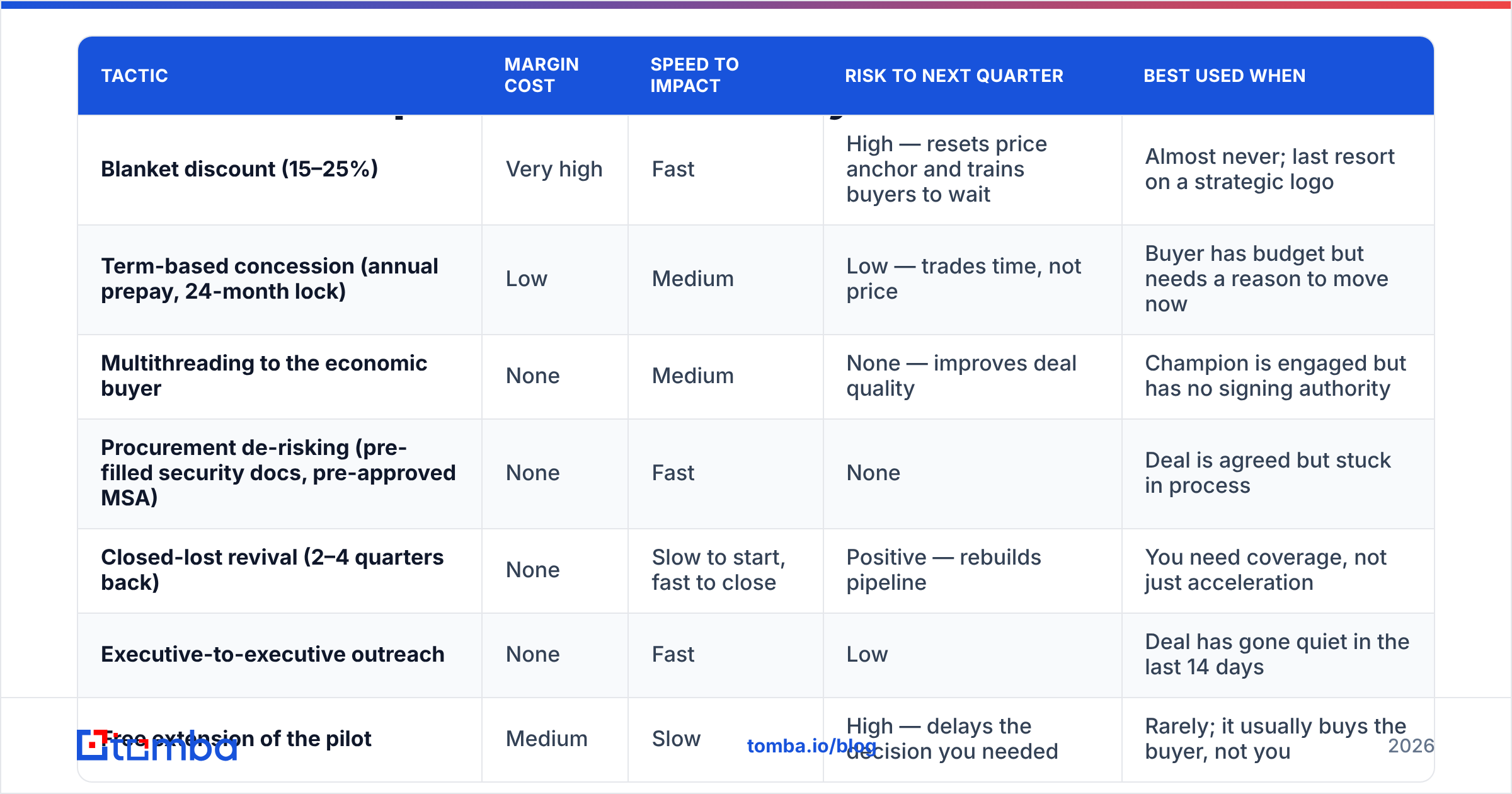
Not all quarter-end moves cost the same or return the same. Here's how the common plays compare on the dimensions that matter: what it costs you, how fast it moves, and what it does to the deal after signature.
| Tactic | Margin cost | Speed to impact | Risk to next quarter | Best used when |
|---|---|---|---|---|
| Blanket discount (15–25%) | Very high | Fast | High — resets price anchor and trains buyers to wait | Almost never; last resort on a strategic logo |
| Term-based concession (annual prepay, 24-month lock) | Low | Medium | Low — trades time, not price | Buyer has budget but needs a reason to move now |
| Multithreading to the economic buyer | None | Medium | None — improves deal quality | Champion is engaged but has no signing authority |
| Procurement de-risking (pre-filled security docs, pre-approved MSA) | None | Fast | None | Deal is agreed but stuck in process |
| Closed-lost revival (2–4 quarters back) | None | Slow to start, fast to close | Positive — rebuilds pipeline | You need coverage, not just acceleration |
| Executive-to-executive outreach | None | Fast | Low | Deal has gone quiet in the last 14 days |
| Free extension of the pilot | Medium | Slow | High — delays the decision you needed | Rarely; it usually buys the buyer, not you |
The pattern is hard to miss. The tactics that cost nothing — multithreading, removing procurement friction, going back to old losses — are the ones teams do last, because they require preparation. The tactic that costs the most requires none.
Is discounting at the end of the quarter worth it?#
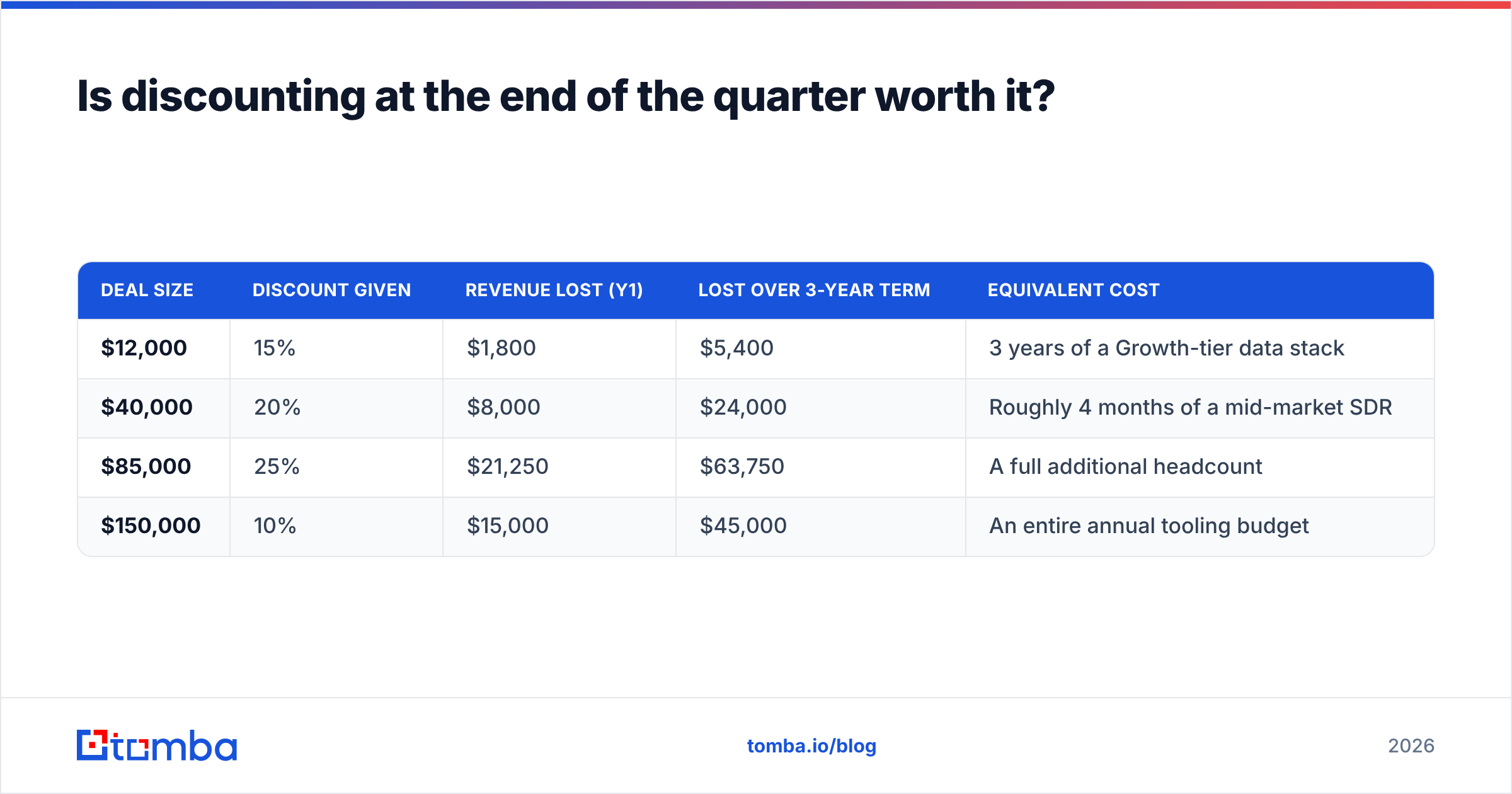
Run the arithmetic before you run the play. Most reps have never seen the number written down.
| Deal size | Discount given | Revenue lost (Y1) | Lost over 3-year term | Equivalent cost |
|---|---|---|---|---|
| $12,000 | 15% | $1,800 | $5,400 | 3 years of a Growth-tier data stack |
| $40,000 | 20% | $8,000 | $24,000 | Roughly 4 months of a mid-market SDR |
| $85,000 | 25% | $21,250 | $63,750 | A full additional headcount |
| $150,000 | 10% | $15,000 | $45,000 | An entire annual tooling budget |
The second-order cost is worse than the table shows. Discounts renew. A 20% concession granted in Q3 becomes the buyer's baseline expectation at renewal, and your CS team inherits a negotiation they didn't create. HubSpot's sales research library has documented this pattern repeatedly: discount-led closes correlate with weaker net revenue retention, not stronger.
If you must concede, concede something that isn't price. Extra seats capped at a threshold. A faster onboarding slot. A quarterly business review with your VP of Product. Payment terms. All of these feel like wins to a buyer and cost you a fraction of a percentage point of margin.
How do you run the last 30 days of a quarter?#
Treat the final month as three distinct blocks with different jobs.
Days 1–10: triage honestly. Go through every open opportunity and answer three questions in writing. Do I know the economic buyer's name? Do I know the procurement steps and their duration? Has the buyer articulated a cost of inaction in their own words? Any deal missing two of three is not a this-quarter deal. Re-forecast it now, while there's still time to replace it.
Days 11–20: multithread and de-risk. Every surviving deal gets at least one new contact engaged — ideally the person whose budget it is. This is where most teams discover their contact data is a mess. You need the CFO, the VP of IT, or the head of security, and your CRM has a generic info@ address and a person who left fourteen months ago. This is a data problem you solve with a domain search against the account, not a problem you solve with more LinkedIn connection requests.
Days 21–30: close what's real, build what's next. Split the day. Mornings on active deals. Afternoons on the list that carries you into the next quarter. The teams that end a quarter strong and start the next one strong are doing both simultaneously; the teams that crater in month one of the new quarter spent the last three weeks doing only the first half.
What role does data quality play in a quarter-end push?#
More than most managers account for. Here's the failure sequence, and it repeats everywhere.
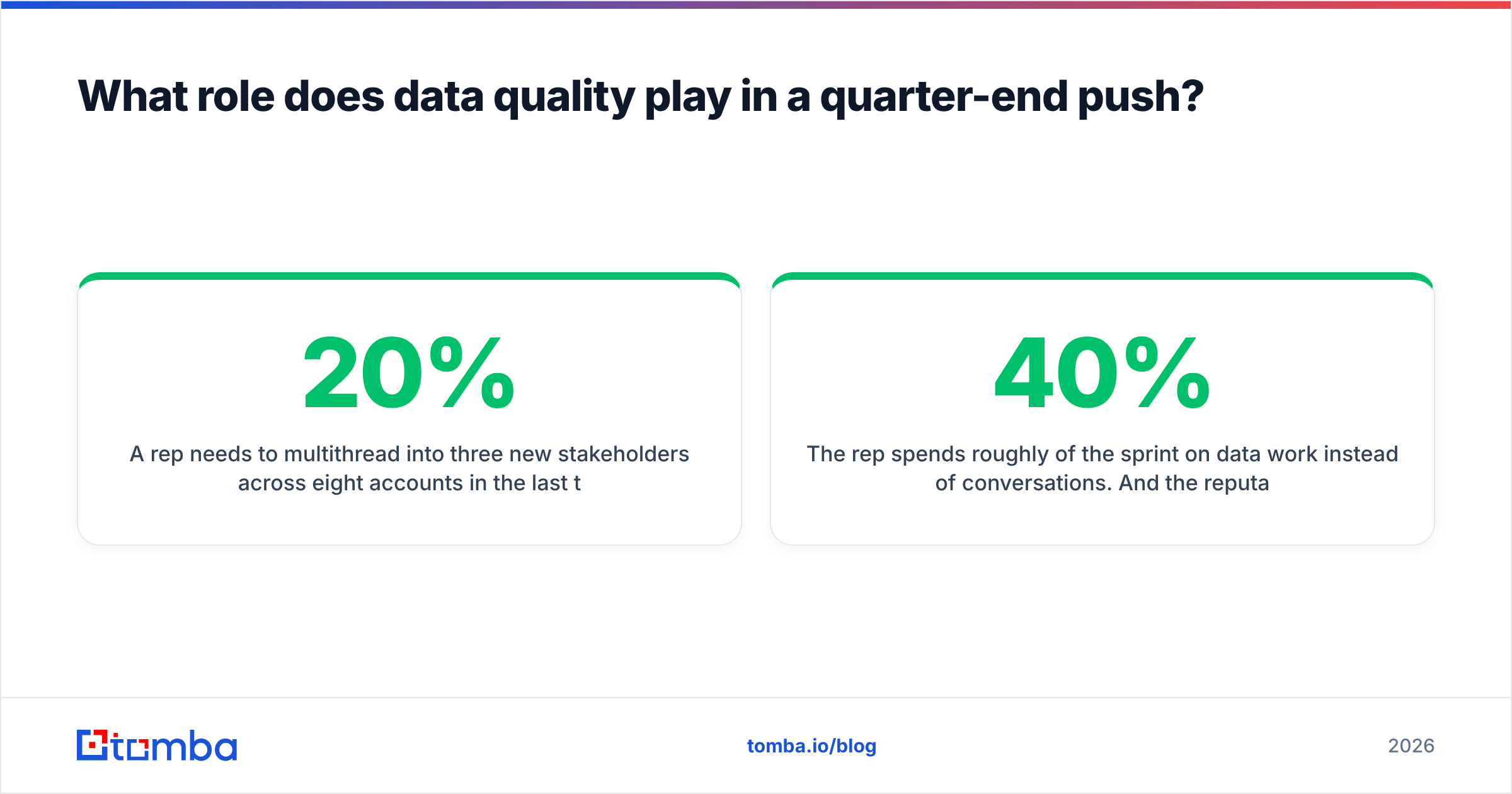
A rep needs to multithread into three new stakeholders across eight accounts in the last two weeks. That's 24 contacts. They pull names from LinkedIn, guess at email patterns, and send. Somewhere between 20% and 35% bounce, depending on how old the source data is. The bounces damage the sending domain's sender reputation, which quietly reduces inbox placement for every legitimate email the rep sends for the rest of the quarter — including replies to the deals they were trying to close.
The rep spends roughly 40% of the sprint on data work instead of conversations. And the reputation hit persists into the new quarter.
The fix is boring and it works: separate finding contacts from contacting them, and put verification between the two.
- Find by account, not by person. When you need "whoever runs security at Acme," a domain-level lookup returns the org chart slice you need. Guessing one name at a time is slower and less complete.
- Verify before you send, always. An email verifier pass on 24 addresses costs seconds and protects the deliverability you'll need in October, January, or whenever your next quarter starts.
- Enrich once, reuse all quarter. Title, seniority, and company data attached to the record means the next rep who touches the account doesn't repeat the work. Run data enrichment on the account list, not on individual records under time pressure.
- Handle catch-all domains explicitly. A large share of enterprise domains accept everything at the SMTP layer, which makes standard verification return "unknown." A catch-all verifier resolves the ambiguity instead of leaving you to gamble.
- Batch the work. Twenty-four contacts is a five-minute bulk email finder job. Done one at a time between calls, it's most of an afternoon.
If you're evaluating tooling for this, the sales intelligence category on G2 is a reasonable neutral starting point — vendor claims about match rates vary wildly, and buyer reviews at least reflect real list conditions.
Should you revive closed-lost deals at the end of the quarter?#
Yes, and it's the single most underused quarter-end play.
A deal lost 6–12 months ago has something a cold account doesn't: a documented problem, a known buying group, and a reason it didn't happen. Three of the most common loss reasons — no budget, wrong timing, chose a competitor — all decay. Budgets refresh. Timing changes. Competitors disappoint.
Build the list from your CRM, filtered on losses from two to four quarters back where the loss reason was timing or budget rather than product fit. Then check what changed. New funding round, new executive in the relevant seat, new job posting that signals the initiative restarted. When the original champion has moved on — which happens constantly — you need the replacement, and a reverse email lookup or a fresh domain pass gets you there faster than re-researching the account from scratch.
The message is not "checking in." It's specific: "You passed last March because the migration was mid-flight. I saw you shipped it in May. Worth a 15-minute revisit?" That email gets replies because it proves you were paying attention.
What should you do in the first week of the new quarter?#
The quarter you're about to start is largely determined by what's sitting in your pipeline on day one, and that's determined by what you did in the last two weeks of the quarter that just ended.
Three concrete moves:
Do a real loss review, not a blame review. For every deal that slipped, write down the earliest signal you ignored. Most slipped deals have a detectable warning at day 30, not day 85 — usually an unanswered request to meet a second stakeholder.
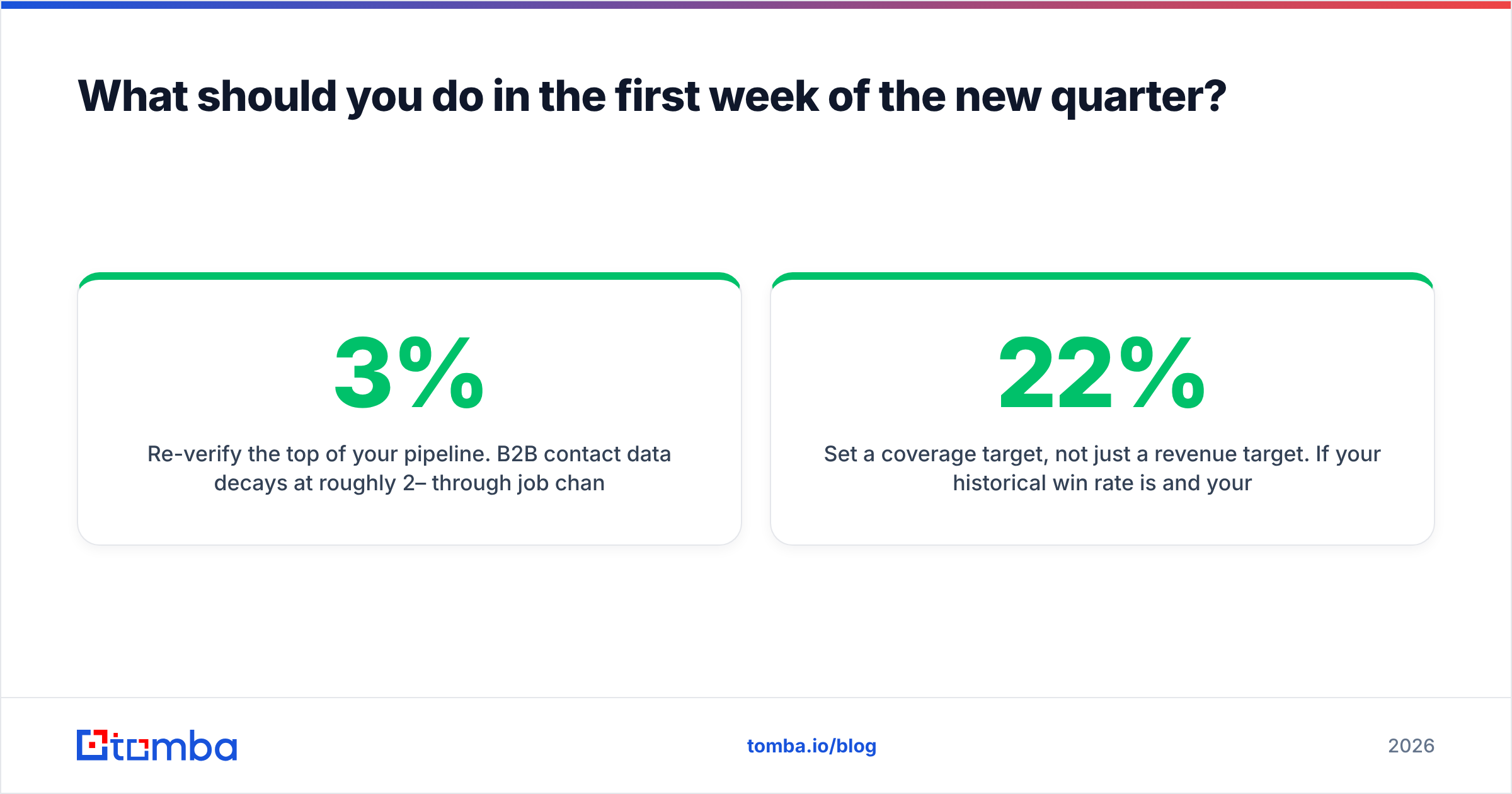
Re-verify the top of your pipeline. B2B contact data decays at roughly 2–3% per month through job changes alone. Over a full quarter that's meaningful. A verification pass on your active account list before you start dialing costs almost nothing and prevents an entire month of quiet bounces.
Set a coverage target, not just a revenue target. If your historical win rate is 22% and your quota is $500,000, you need $2.3M of qualified pipeline in the door — most of it before week four, not scrambled together in week eleven. Working backward from that number is what prevents the next end of quarter from turning into another discount cycle.
Close the next quarter earlier, not harder#
The teams that don't panic in the last ten days aren't more disciplined by temperament. They just did the boring work earlier: they knew who the economic buyer was by week three, they had procurement mapped by week six, and their contact list was verified before the first send instead of after the first wave of bounces.
That last part is the piece you can fix this week. If your quarter-end sprint keeps turning into a research project, put a real finder in front of it. The Tomba Email Finder resolves professional email addresses by name, domain, or company, with verification built into the same workflow — so a 24-contact multithreading push takes five minutes instead of an afternoon. The free tier includes 25 searches a month if you want to test it against an account you already know cold; paid plans start at $49/mo, and full Tomba pricing is public. Run your next quarter's list through it in week one, not week twelve.
Related guides#
Ready to find emails that actually work?
Join 150,000+ professionals who stopped guessing and started sending. Free credits on signup — no credit card required.
Get the Tomba newsletter
Practical outbound tactics and product updates — once every two weeks.
About the author