End of Quarter Sales Strategies: A 2026 Closing Playbook
Most end-of-quarter pushes are just discount fire sales with a countdown timer attached. Here is what the last 30 days should actually look like — triage rules, a week-by-week plan, and the plays that hold margin.
TL;DR
- Most end of quarter sales strategies are just discounting with a countdown timer bolted on. A 20% discount on a 70%-margin product means you need 40% more volume to break even on gross profit.
- The last 30 days are for triage, not prospecting. Sort every open deal into Close, Coach, or Cut — then spend 80% of your hours on the Coach pile.
- The single highest-leverage move in week 1 is a multi-threading sweep: get a second and third contact on every deal above your average contract value.
- Deals that slip are usually missing a signature path (procurement, legal, security review), not desire. Ask about the path in week 1, not week 4.
- The quarter you're closing is mostly already decided. The quarter after it is decided by whether you keep booking discovery calls in the final two weeks.
What actually happens in the last 30 days of a quarter?#
Two things happen at once, and they pull in opposite directions.
First, buyers get leverage. Every procurement team on earth knows your fiscal calendar. They know the pressure curve, they know reps get desperate around day 75, and they will sit on a signature specifically to see what falls out of your pocket. This isn't cynicism — it's a documented negotiation tactic taught in most enterprise purchasing playbooks.
Second, reps stop prospecting. Activity data across sales orgs shows outbound volume collapsing in the final three weeks of a quarter as everyone piles onto existing opportunities. That collapse is what creates the "quarter one is always slow" problem three months later. You didn't have a bad January; you had a bad December in which nobody built pipeline.
So the real job of an end-of-quarter plan isn't "close harder." It's to close the closeable, protect margin against buyers who know you're squeezed, and keep the top of the funnel breathing while you do it.
Why do most end of quarter sales strategies backfire?#
Because they optimize for a single number — bookings — and quietly pay for it out of three others: margin, retention, and next quarter's pipeline.
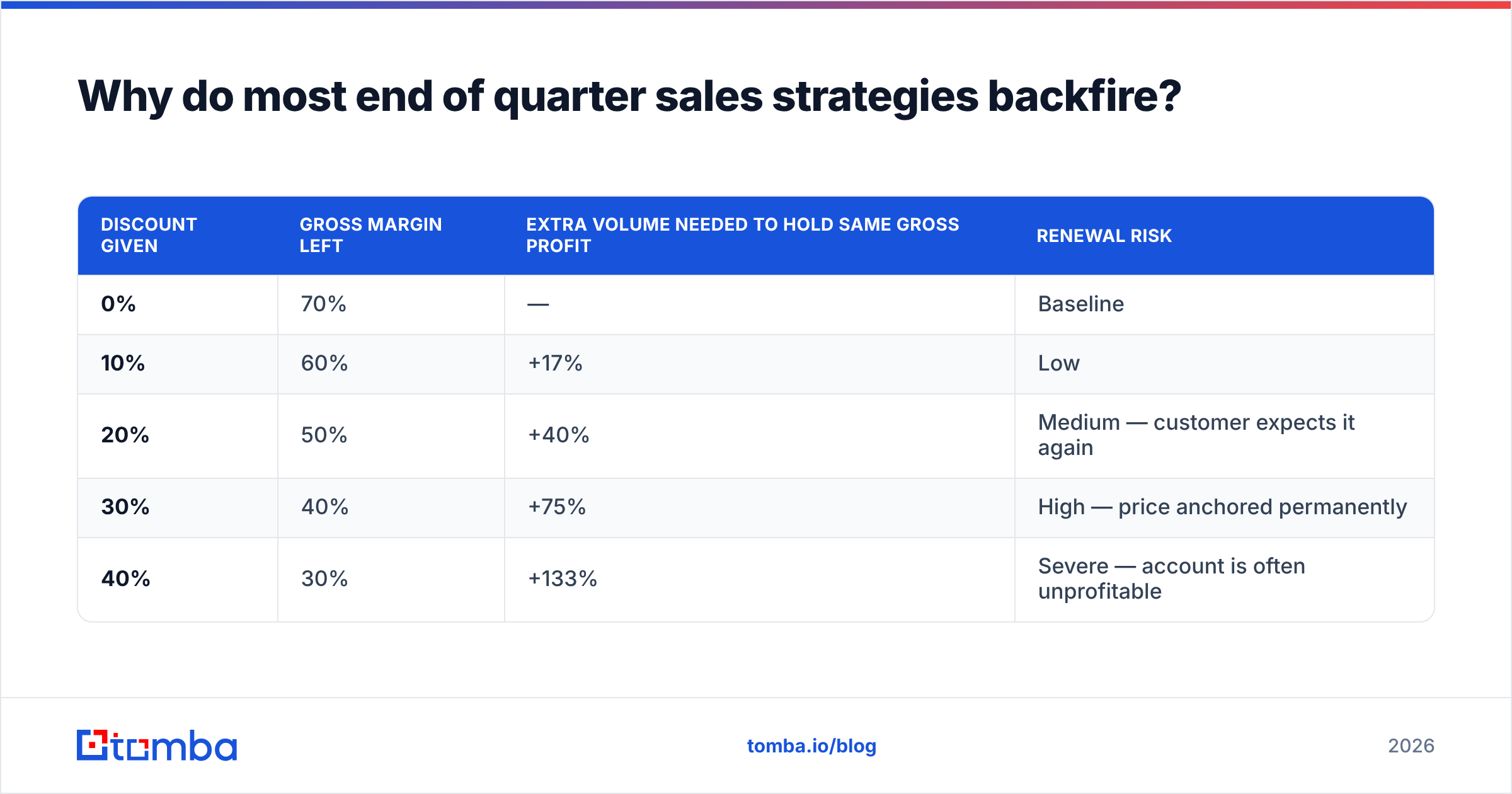
Run the arithmetic on the discount before you offer it. Assume a product with 70% gross margin:
| Discount given | Gross margin left | Extra volume needed to hold same gross profit | Renewal risk |
|---|---|---|---|
| 0% | 70% | — | Baseline |
| 10% | 60% | +17% | Low |
| 20% | 50% | +40% | Medium — customer expects it again |
| 30% | 40% | +75% | High — price anchored permanently |
| 40% | 30% | +133% | Severe — account is often unprofitable |
That last column is the one nobody models. A 30% "just to get it in this quarter" discount doesn't expire at renewal. It becomes the customer's reference price forever, and your CSM inherits the argument.
The second failure mode is sandbagging in reverse: reps pull deals forward that weren't ready, close them with a concession, and burn the deal that would have closed cleanly at full price six weeks later. You didn't create revenue. You borrowed it from next quarter at a bad interest rate.

The third failure mode is the day-85 blast: someone exports every stale contact in the CRM and fires a "last chance before pricing changes" sequence at 4,000 addresses that haven't been touched in a year. Bounce rates spike, the sending domain gets flagged, and Q1 outbound starts from a damaged reputation. If you're going to touch a dormant list at all, run it through an email verifier first — a list that's been sitting for twelve months typically decays 20–30% through job changes alone.
How should you triage your pipeline in week 1?#
Stop treating all open opportunities as equal. In the first Monday of your final month, sort every deal into three buckets and act differently on each.
- Close (10–15% of open deals) — Verbal yes, budget confirmed, signature path known, no unresolved technical objection. Action: get the paperwork moving today. Do not "check in." Send the agreement.
- Coach (25–35%) — Real champion, real need, but one blocker: pricing approval, a security questionnaire, a missing stakeholder, a competing initiative. Action: this is where every spare hour goes. One blocker, one named owner, one date.
- Cut (50%+) — No champion, no next meeting booked, no answer in 14 days, or an unqualified budget. Action: push the close date honestly and stop spending time. A clean "not this quarter" is worth more to your forecast than a hopeful maybe.
- Expand (variable) — Existing customers with a live expansion trigger: new headcount, a hit usage limit, a new team onboarded. Action: these close 3–5x faster than net-new and rarely need a discount.
- Resurrect (variable) — Closed-lost deals from 6–12 months ago where the blocker was timing or a champion who has since changed jobs. Action: one clean, specific re-open email. No "just circling back."
The triage exercise usually reveals the same uncomfortable truth: a forecast that looks like $2M of "commit and best case" is really $400K of Close, $700K of genuinely winnable Coach, and $900K of wishful thinking. Knowing that on day 60 is a gift. Finding out on day 89 is a disaster.
What are the end of quarter sales strategies that actually hold margin?#
Here are the plays that move numbers without shredding your price book, ranked roughly by leverage.
Multi-thread every deal above your ACV. Single-threaded deals die when one person goes on holiday. Before you do anything else, identify the CFO, the technical evaluator, and the executive sponsor on each Coach-bucket deal, and get an email into all three. Most reps skip this because they don't have the contact details — which is a data problem, not a courage problem. A domain search against the account's website surfaces the other stakeholders in the buying committee in a couple of minutes, complete with the company's email pattern.
Trade concessions instead of giving them. Never lower price for nothing. Trade it: a 12% discount for a 24-month term, a case study, a reference call, quarterly-to-annual prepay, or a two-week implementation slot. Every concession must have a counterparty obligation attached. This is the difference between a negotiation and a surrender.
Ask the signature question in week 1, not week 4. "Walk me through exactly what happens between your yes and a signed contract — who touches it, in what order, and how long does each step take?" Deals slip on procurement queues, security reviews, and legal redlines far more often than on desire. If a customer's legal review takes 15 business days, you needed to know that on day 45.
Use a real deadline, not a manufactured one. Buyers can smell a fake "this pricing expires Friday." What works is a genuine constraint: an implementation team with limited onboarding slots, a rate card that genuinely changes on January 1, a promotional term tied to a launch. If you don't have one, don't invent one — invent a reason to act, like a business case that quantifies the cost of waiting a quarter.
Run a closed-lost resurrection sweep. Pull every deal marked lost in the last 9 months for reasons of "timing," "budget," or "champion left." Roughly 10–20% of those accounts have changed circumstances. This is the cheapest pipeline you will ever generate. Where the original champion has moved on, you need current contacts for the replacement — a bulk email finder run against the account list turns a stale CRM export into a workable outreach list in one pass.
Protect two hours a day for net-new prospecting. Non-negotiable, calendar-blocked, no exceptions. The reps who finish Q4 strong and start Q1 strong are the ones who never stopped booking discovery calls. Everyone else spends January rebuilding from zero.
Get executive-to-executive on the top three deals. Your VP emailing their VP creates a different kind of urgency than a rep emailing a manager. Save this for the three deals that actually decide whether you hit the number — it doesn't scale, and it loses force if you use it everywhere.
Which end of quarter approach fits your deal size?#
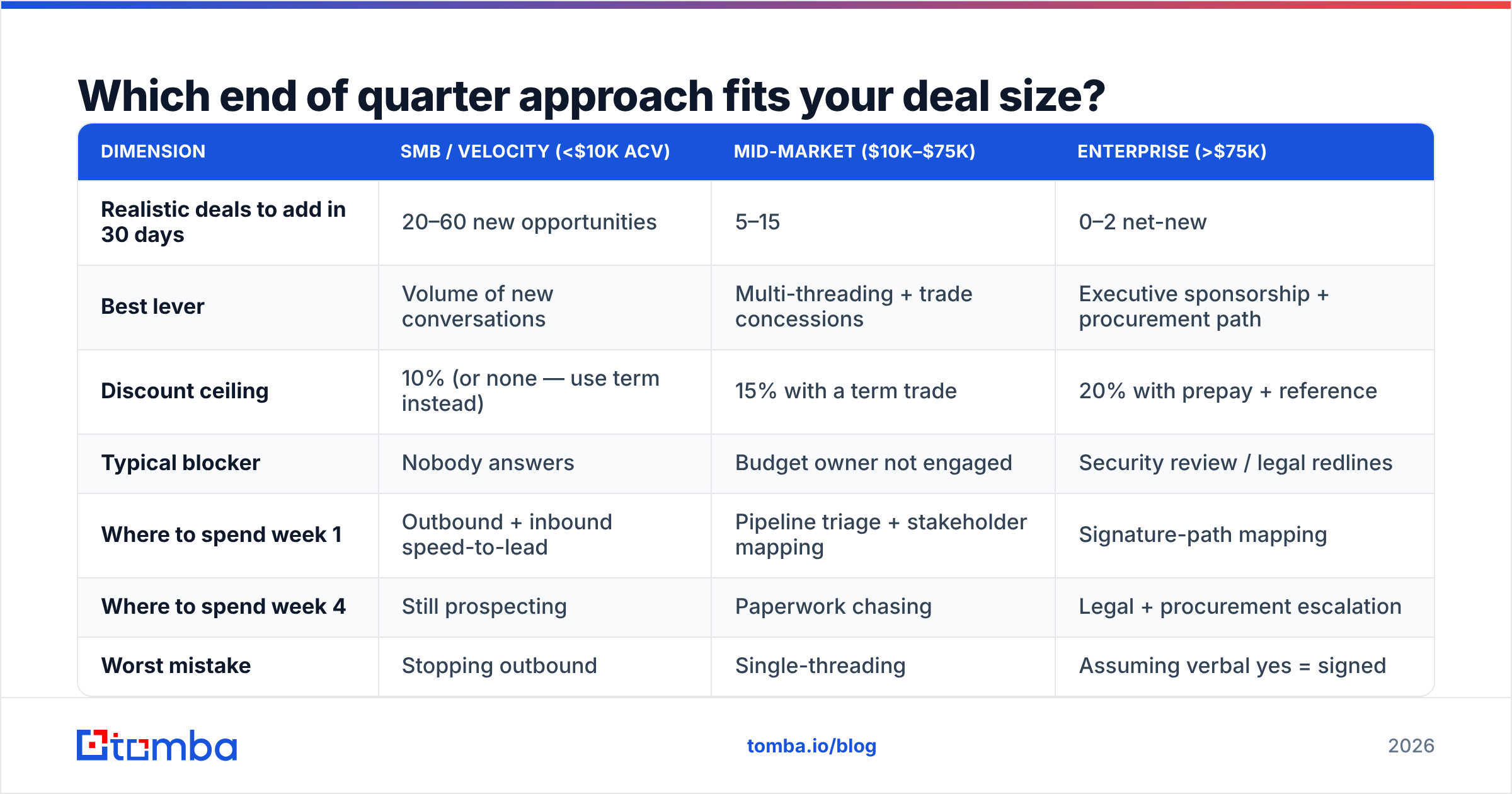
The right strategy depends heavily on your motion. A $400 self-serve deal and a $250K enterprise contract need completely different final-30-day behaviour.
| Dimension | SMB / velocity (<$10K ACV) | Mid-market ($10K–$75K) | Enterprise (>$75K) |
|---|---|---|---|
| Realistic deals to add in 30 days | 20–60 new opportunities | 5–15 | 0–2 net-new |
| Best lever | Volume of new conversations | Multi-threading + trade concessions | Executive sponsorship + procurement path |
| Discount ceiling | 10% (or none — use term instead) | 15% with a term trade | 20% with prepay + reference |
| Typical blocker | Nobody answers | Budget owner not engaged | Security review / legal redlines |
| Where to spend week 1 | Outbound + inbound speed-to-lead | Pipeline triage + stakeholder mapping | Signature-path mapping |
| Where to spend week 4 | Still prospecting | Paperwork chasing | Legal + procurement escalation |
| Worst mistake | Stopping outbound | Single-threading | Assuming verbal yes = signed |
The pattern across all three columns: the earlier in the 30 days you learn the truth about a deal, the more options you keep. Every day you delay a hard qualification question, you trade an option for a discount.
What does a week-by-week close plan look like?#
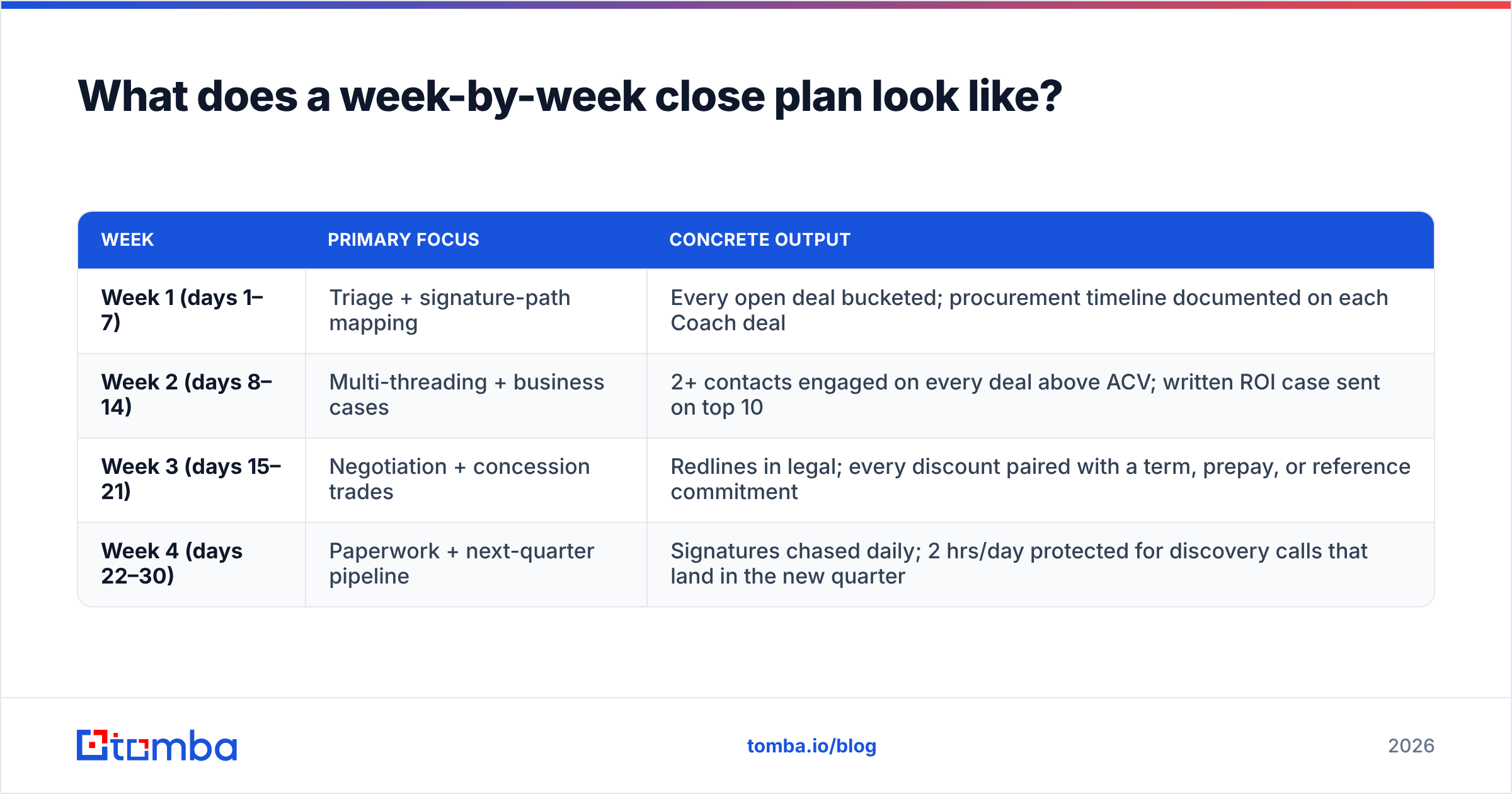
| Week | Primary focus | Concrete output |
|---|---|---|
| Week 1 (days 1–7) | Triage + signature-path mapping | Every open deal bucketed; procurement timeline documented on each Coach deal |
| Week 2 (days 8–14) | Multi-threading + business cases | 2+ contacts engaged on every deal above ACV; written ROI case sent on top 10 |
| Week 3 (days 15–21) | Negotiation + concession trades | Redlines in legal; every discount paired with a term, prepay, or reference commitment |
| Week 4 (days 22–30) | Paperwork + next-quarter pipeline | Signatures chased daily; 2 hrs/day protected for discovery calls that land in the new quarter |
Notice what isn't in week 4: renegotiation. If you're still discussing price in the final five days, you have already lost the leverage battle and you are about to pay for it. The buyer knows exactly how much you need it.

Is discounting ever the right call?#
Yes — under three conditions, and only three.
One: the deal is genuinely strategic. A logo that unlocks a segment, a reference in a vertical you're breaking into, or a design partner whose feedback shapes the roadmap. Price it as a marketing investment and say so internally, so nobody treats it as a precedent.
Two: the discount is traded, not given. Term length, prepayment, multi-year commitment, case study rights, reference calls. Each of these has a quantifiable value. If you can't name what you got back, you didn't negotiate.
Three: it's structural, not situational. A volume tier that any customer at that size would qualify for is a pricing policy. A one-off "because it's December 30th" is a leak, and it will show up in your next renewal cycle as an expectation.
If none of those three apply, the honest answer is usually to let the deal slip into next quarter at full price. Sales leaders who track this properly — and Gartner's sales research has been consistent on it for years — find that deals pulled forward with heavy concessions produce measurably worse net revenue retention over 24 months than deals allowed to close naturally.
How do you avoid starting next quarter empty?#
The quarter you're closing is largely already written. The one that follows is decided in the next four weeks, and this is where most teams fail.
Three habits protect it:
- Protect the prospecting block. Two hours a day, every day, including day 89. Track it as a metric with the same seriousness as bookings.
- Book meetings into the new quarter deliberately. A discovery call scheduled for the second week of the new quarter is worth more than a rushed demo on day 88 that goes nowhere.
- Rebuild the list, don't recycle it. Contact data decays roughly 2–3% per month through job changes and role moves. If your outbound list is the same one you used three months ago, a meaningful chunk of it is already dead. Refresh it before you send.
That last point is where tooling actually matters. HubSpot's sales research consistently shows prospecting as the task reps rate hardest and skip first — and bad data makes it harder still. Nothing kills a prospecting block faster than a rep spending 40 minutes hunting for one email address.
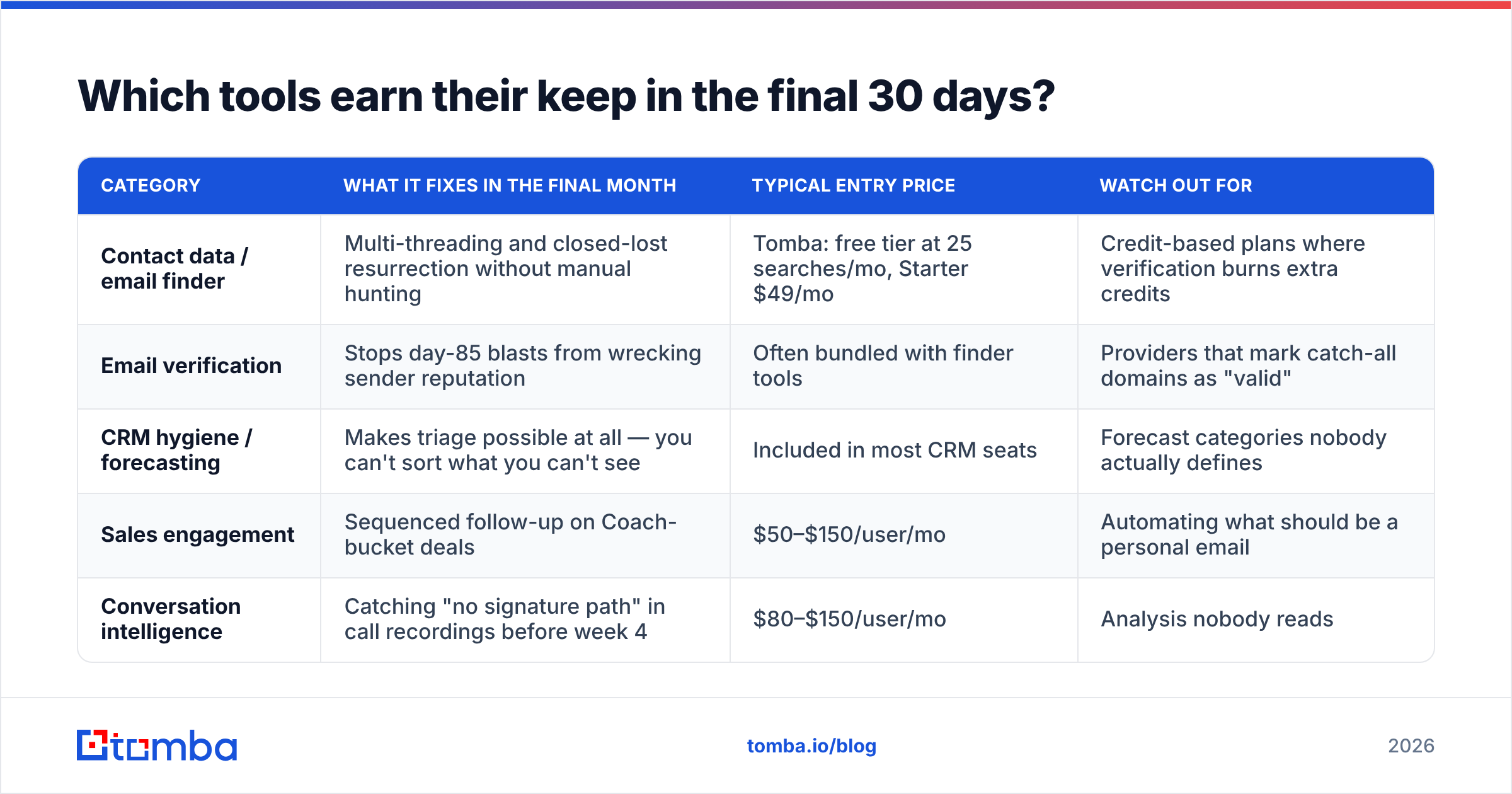
Which tools earn their keep in the final 30 days?#
You don't need new software in week 3 of a quarter. But if you're auditing the stack for next quarter, these are the categories that measurably shorten the last-30-days scramble.
| Category | What it fixes in the final month | Typical entry price | Watch out for |
|---|---|---|---|
| Contact data / email finder | Multi-threading and closed-lost resurrection without manual hunting | Tomba: free tier at 25 searches/mo, Starter $49/mo | Credit-based plans where verification burns extra credits |
| Email verification | Stops day-85 blasts from wrecking sender reputation | Often bundled with finder tools | Providers that mark catch-all domains as "valid" |
| CRM hygiene / forecasting | Makes triage possible at all — you can't sort what you can't see | Included in most CRM seats | Forecast categories nobody actually defines |
| Sales engagement | Sequenced follow-up on Coach-bucket deals | $50–$150/user/mo | Automating what should be a personal email |
| Conversation intelligence | Catching "no signature path" in call recordings before week 4 | $80–$150/user/mo | Analysis nobody reads |
If you're comparing options in any of these categories, G2's sales software categories are a reasonable neutral starting point — filter reviews by company size, because SMB and enterprise reviewers describe completely different products. And whatever you pick, check the pricing model against your actual usage pattern; a per-credit tool that looks cheap at 500 lookups a month gets expensive fast during a resurrection sweep. Tomba's pricing plans run Free (25 searches/mo), Starter $49/mo, Growth $99/mo, and Pro $249/mo, with Enterprise negotiated — worth mapping against your own peak-month volume rather than your average.
What's the one thing to change this quarter?#
Move the hard questions earlier. Almost every painful end-of-quarter moment — the deal that slipped, the discount you regret, the champion who went dark — traces back to a question you could have asked in week 1 and didn't.
Ask about the signature path on day 3. Multi-thread on day 5. Bucket the pipeline honestly before you've had time to get emotionally attached to the number. The reps who look calm on day 89 aren't better closers; they front-loaded the discomfort.
Building the contact list for your week-1 multi-threading sweep? The Tomba Email Finder locates verified professional email addresses by name and company domain, so you can get a second and third stakeholder into every open deal without spending your closing hours on research. Start on the free tier at 25 searches a month, or run a whole account list in bulk when you're resurrecting closed-lost opportunities.
Related guides#
Ready to find emails that actually work?
Join 150,000+ professionals who stopped guessing and started sending. Free credits on signup — no credit card required.
Get the Tomba newsletter
Practical outbound tactics and product updates — once every two weeks.
About the author