Endole vs Apollo.io in 2026: Which B2B Data Tool Wins?
Endole sells UK company filings and credit data. Apollo.io sells global contact records and sequencing. They barely overlap — here is which one actually fits your pipeline, and where both leave gaps.
Endole vs Apollo.io is an odd matchup. One tool reads UK company filings. The other holds global contact records. Here is where each one wins, and where both fall short.
TL;DR
- Endole vs Apollo.io is not a fair fight. Endole is a UK company-intelligence tool built on Companies House filings, financials, and credit scores. Apollo.io is a global contact database with a sequencer attached.
- Pick Endole if you sell to UK limited companies. It fits when turnover, filing history, director changes, or credit risk decide who you call.
- Pick Apollo.io if you need named contacts at scale across the US, EMEA, and APAC. It also sends the email for you.
- Neither one is a strong email-accuracy layer. Endole barely lists personal emails. Apollo's contact records go stale fast on mid-market and SMB accounts.
- The usual fix is a three-part stack. Company signal (Endole or Companies House), contact discovery, then a verification pass before you send.
What is Endole, and who is it built for?#
Endole is a UK business information platform. It pulls public filings from Companies House. On top of that it adds financial analysis, credit scoring, group structure maps, and director histories. You read it all through company profiles, reports, and a prospecting product called Endole Explorer.
The people who get value from it are usually not SDRs. They are:
- Credit and finance teams checking whether a prospect can pay for a 24-month contract.
- Corporate finance and M&A analysts screening UK companies by turnover band, SIC code, headcount, and growth rate.
- Account executives selling to UK SMEs and mid-market who want to know a company just filed accounts showing 40% growth.
- Compliance and KYB teams checking ownership and PSC (persons with significant control) data.
Endole's edge is depth on a narrow patch. If a company is registered in the UK, Endole knows its filing history, its charges, and its shareholders. It also knows roughly what the accounts say about its health. A US-built sales database cannot copy that easily.
The limit is just as clear. Endole is a company database, not a people database. You will find directors and officers, because those names are filed by law. You will not reliably find the Head of RevOps. You will very rarely find a verified work email below board level. That is the first half of the Endole vs Apollo.io split.
What is Apollo.io, and who is it built for?#
Apollo.io is a go-to-market platform. It ships a contact and company database, marketed in the hundreds of millions of contacts. You can filter by title, seniority, tech stack, headcount, and funding. It also bundles sequencing, a dialer, meeting scheduling, and CRM sync.
The buyer is an outbound sales team. You build a list, push it to a sequence, and send. It all happens in one tool. That is why Apollo took so much share from the old ZoomInfo plus Outreach setup. It is also why Apollo leads SMB and mid-market sales orgs on G2.
Apollo's strengths:
- Breadth. Global contact coverage, strong in the US and decent across Western Europe.
- Persona filtering. Title, function, and seniority filters beat anything a filings database can offer.
- All-in-one. Data, sequencing, and dialing on one bill.
- Intent and enrichment add-ons for teams that want more than firmographics.
The weak spots are the ones every big aggregated database has. Data decays on smaller companies. European coverage thins outside the major markets. Credit systems get costly at volume. Email accuracy swings by segment. If your ICP is a 15-person UK engineering firm, record quality drops sharply against Apollo's US enterprise coverage. In the Endole vs Apollo.io split, Apollo clearly owns the people layer.

Endole vs Apollo.io: how do they compare head-to-head?#
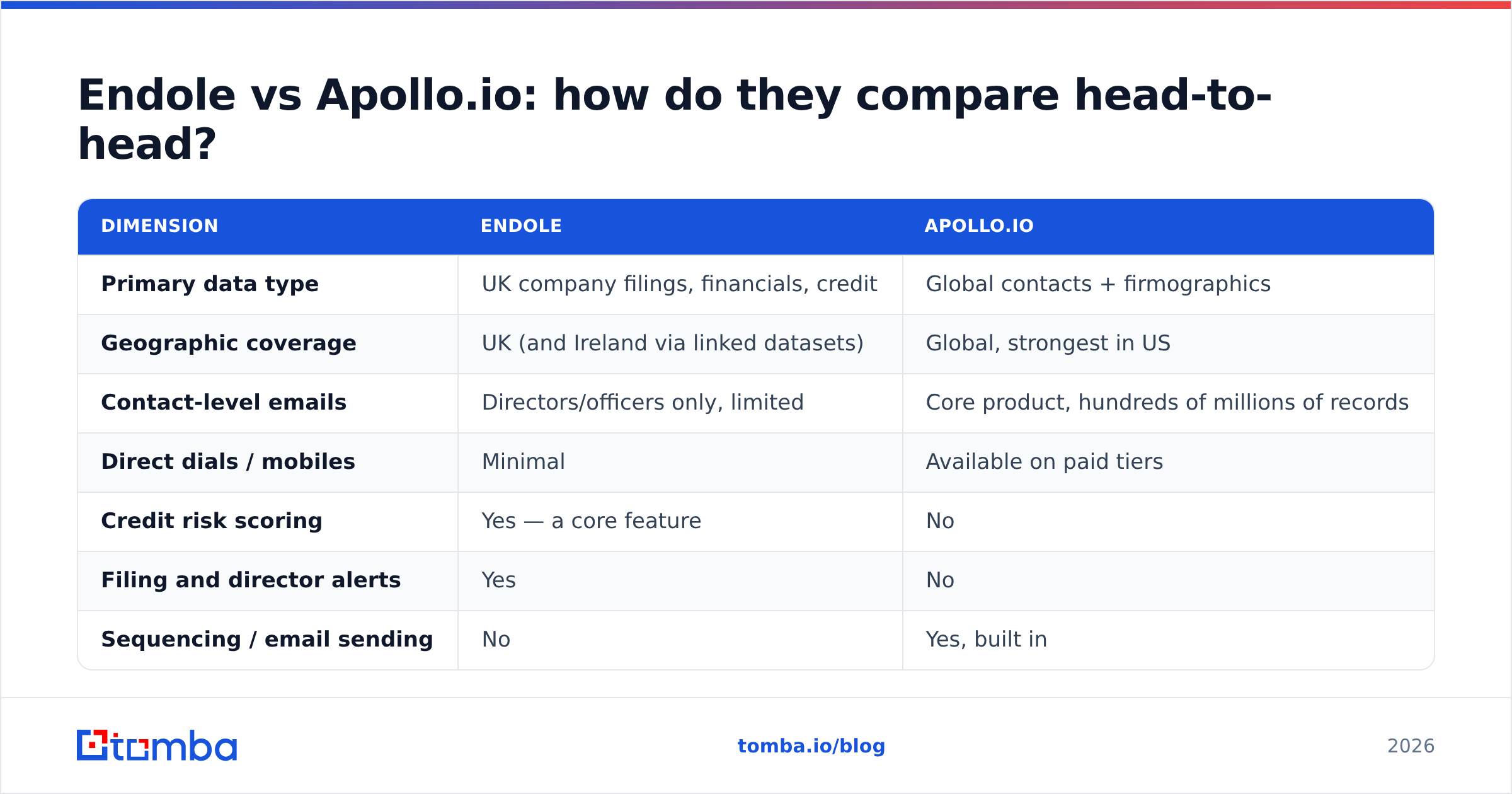
Here is Endole vs Apollo.io on the dimensions buyers actually ask about.
| Dimension | Endole | Apollo.io |
|---|---|---|
| Primary data type | UK company filings, financials, credit | Global contacts + firmographics |
| Geographic coverage | UK (and Ireland via linked datasets) | Global, strongest in US |
| Contact-level emails | Directors/officers only, limited | Core product, hundreds of millions of records |
| Direct dials / mobiles | Minimal | Available on paid tiers |
| Credit risk scoring | Yes — a core feature | No |
| Filing and director alerts | Yes | No |
| Sequencing / email sending | No | Yes, built in |
| CRM sync | Export-driven | Native HubSpot, Salesforce, Pipedrive |
| API access | Yes, business data API | Yes, on higher tiers |
| Typical buyer | Credit, finance, UK mid-market AEs | SDR teams, founder-led outbound |
| Pricing model | UK subscription tiers, quoted for Explorer | Free tier; paid seats from roughly $49/user/mo, listed pricing changes |
| Best-fit use case | UK qualification and risk screening | High-volume multi-market prospecting |
Read that table once and the verdict writes itself. These two tools solve different halves of the same problem. Endole tells you which UK companies are worth chasing. Apollo tells you who to email, anywhere. Teams that treat them as swaps end up unhappy with whichever one they bought.
Which one has better data coverage and accuracy?#
On coverage, Endole vs Apollo.io splits cleanly. The answer depends on what you measure.
On UK company facts, Endole wins outright. Its source is the public record. When a company files accounts, Endole shows it. There is no scraping guesswork and no "estimated revenue" model. You get filed figures. For turnover thresholds, group structures, and insolvency risk, Apollo has no real answer.
On contact records, Apollo wins by default. Endole barely competes there. But winning by default is not the same as being accurate. Aggregated contact databases are rebuilt from shared address books, public web data, and pattern guessing. Two things follow:
- Job-change decay. B2B contact data decays at roughly 2–3% per month. Over a year, a quarter or more of your list is wrong.
- Pattern-guessed emails. Many records are inferred from a company's known email format. They are never confirmed. They look real, they parse fine, and plenty of them bounce.
That second problem is what kills sending domains. A hard-bounce rate above 2–3% is the fastest way to burn sender reputation. No amount of good copy saves you after that. So experienced teams run a separate email verifier over any list pulled from a large database. The vendor does not matter. The database is a discovery layer. Verification is a different job.
For UK SMEs, the gap widens. Apollo's view of a 12-person Manchester consultancy is usually the founder plus maybe one more name. The address is often a guess. Endole will show you the full board, the accounts, and the filing dates. It will not show a working email for the operations lead you actually want.
How do pricing models actually differ?#
Endole vs Apollo.io also price in opposite ways.
Endole sells UK subscriptions in report-based and search-based tiers. Explorer, its prospecting and bulk-export product, is quoted on volume and seats. It is priced like a data service. You pay for depth in one defined market. No per-contact credit meter shapes how you prospect.
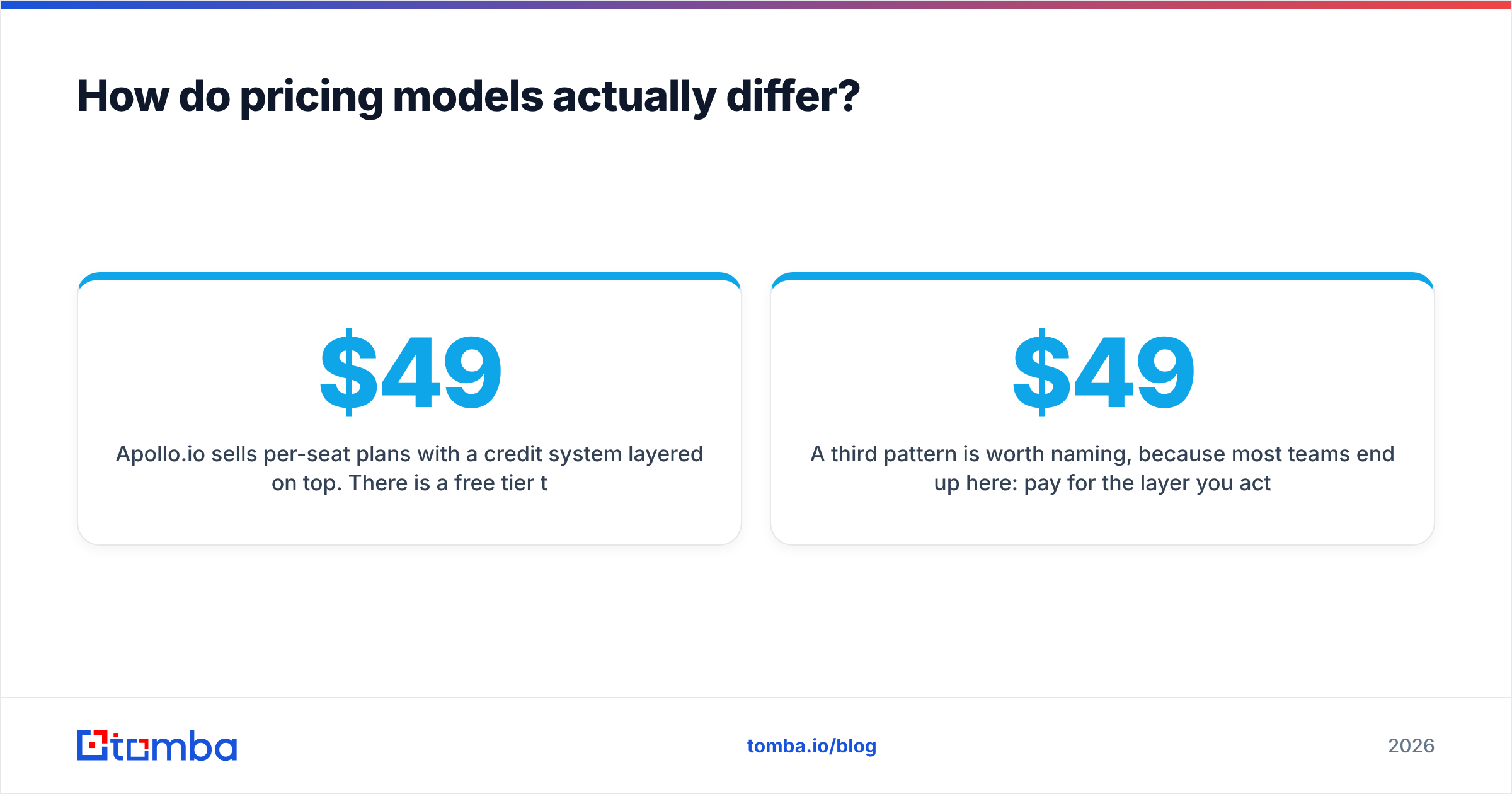
Apollo.io sells per-seat plans with a credit system on top. The free tier is genuinely usable for testing. Paid seats start around $49/user/month on annual billing at the time of writing. Professional and organization tiers cost more. Export credits, mobile-number credits, and enrichment credits are metered on their own. That metering is where teams get surprised. A five-seat team doing real volume usually pays well above the sticker price.
A third pattern is worth naming, because most teams end up there. Pay for the layer you actually use. Maybe your bottleneck is finding and confirming email addresses, not sequencing or credit scores. Then a focused tool costs less than either platform. Tomba pricing starts free at 25 searches per month. Starter is $49/mo, Growth is $99/mo, and Pro is $249/mo. Enterprise is quoted. You buy lookups and verifications, not seats.
The cost comparison looks like this:
- Endole-only stack: strong UK qualification, almost no contact discovery. You will build emails by hand or buy them elsewhere.
- Apollo-only stack: fast list building and sending, weak UK financial context, ongoing credit spend, and bounce risk you manage yourself.
- Signal + discovery + verification: three focused tools. Usually cheaper than one all-in-one at volume, and each one is easy to swap.
Which should you pick for your motion?#
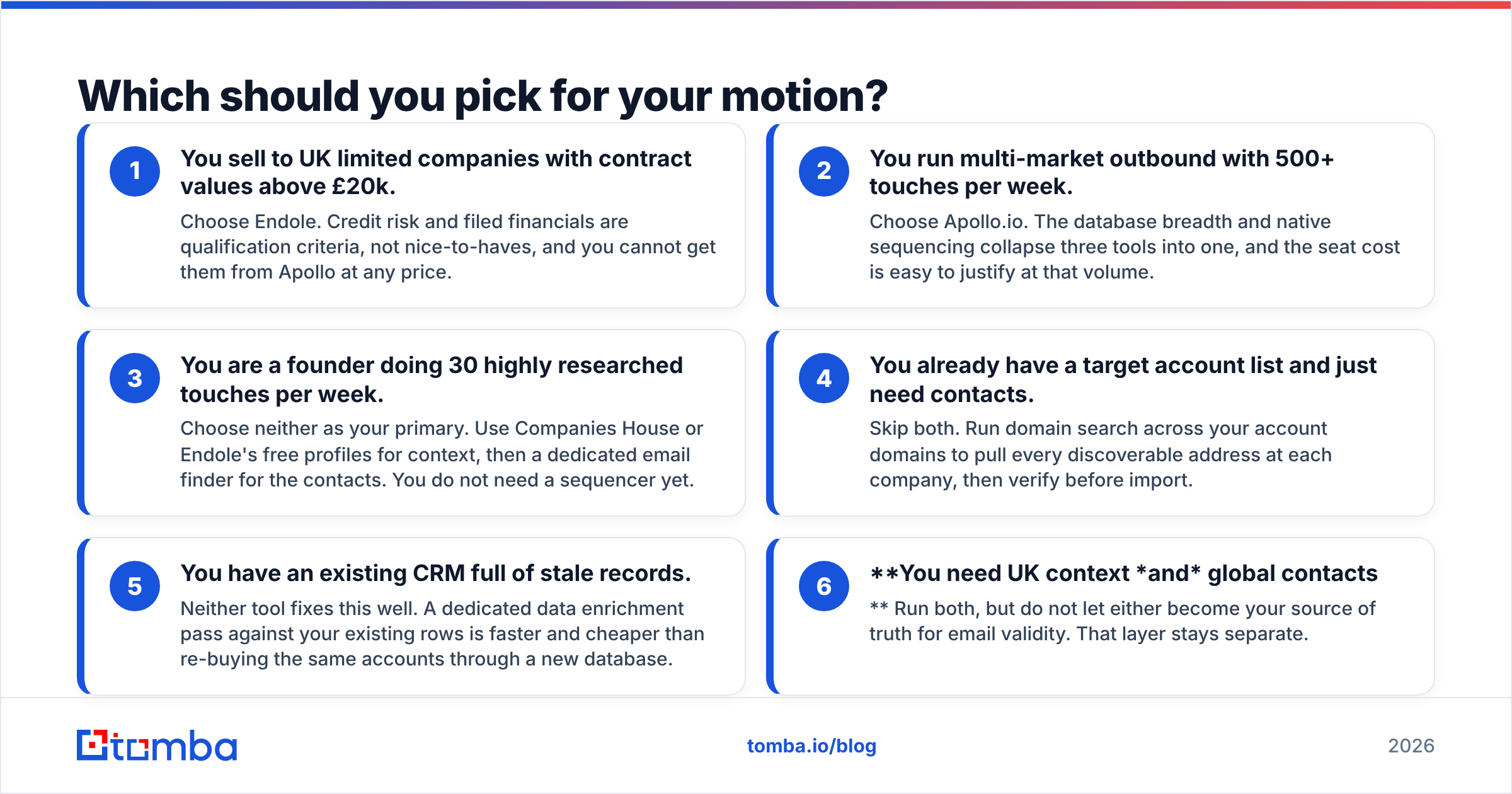
The Endole vs Apollo.io choice comes down to your motion, not the feature list. Match the tool to the real constraint in your pipeline.
- You sell to UK limited companies with deals above £20k. Choose Endole. Credit risk and filed financials are qualification criteria here, not extras. Apollo cannot give you them at any price.
- You run multi-market outbound with 500+ touches per week. Choose Apollo.io. The database breadth and built-in sequencing fold three tools into one. At that volume, the seat cost is easy to justify.
- You are a founder doing 30 researched touches per week. Choose neither as your main tool. Use Companies House or Endole's free profiles for context. Then use a dedicated email finder for the contacts. You do not need a sequencer yet.
Three more cases come up often:
- You already have a target account list and just need contacts. Skip both. Run domain search across your account domains. It pulls every discoverable address at each company. Verify before import.
- You have a CRM full of stale records. Neither tool fixes that well. A data enrichment pass over your existing rows is faster and cheaper than buying the same accounts again.
- You need UK context and global contacts. Run both. Just do not let either one be your source of truth for email validity. That layer stays separate.

Where do both tools leave gaps — and how do you fill them?#
Endole vs Apollo.io both leave the same three gaps.
Gap 1: verified deliverability. Endole does not try to solve it. Apollo bundles verification, but the vendor that sold you the record is also the one grading it. That is a clear conflict. Catch-all domains defeat most single-pass checks too. A catch-all verifier built for accept-all servers is the difference between a 1% and a 6% bounce rate on UK SME lists, where catch-all setups are common.
Gap 2: contacts below board level. Endole gives you directors. Apollo gives you titled contacts where its data happens to be fresh. Neither reliably finds the mid-level manager who owns the budget at a 60-person company. Domain-level discovery closes that faster. You pull every known address at a company, then match the person you want.
Gap 3: workflow friction. Endole exports to CSV. Apollo pushes to its own sequencer. If your stack is HubSpot plus a separate sending tool, both add manual steps. Check whether the vendor has a real native connector or just a Zapier recipe. The HubSpot integration pattern is what you want: enrich on record creation, no CSV round-trip.
Maybe you are evaluating Apollo and the credit model or the coverage frustrates you. The Apollo alternative comparison shows where a finder-plus-verifier stack costs less than the same number of Apollo seats.
What does a sensible combined stack look like?#
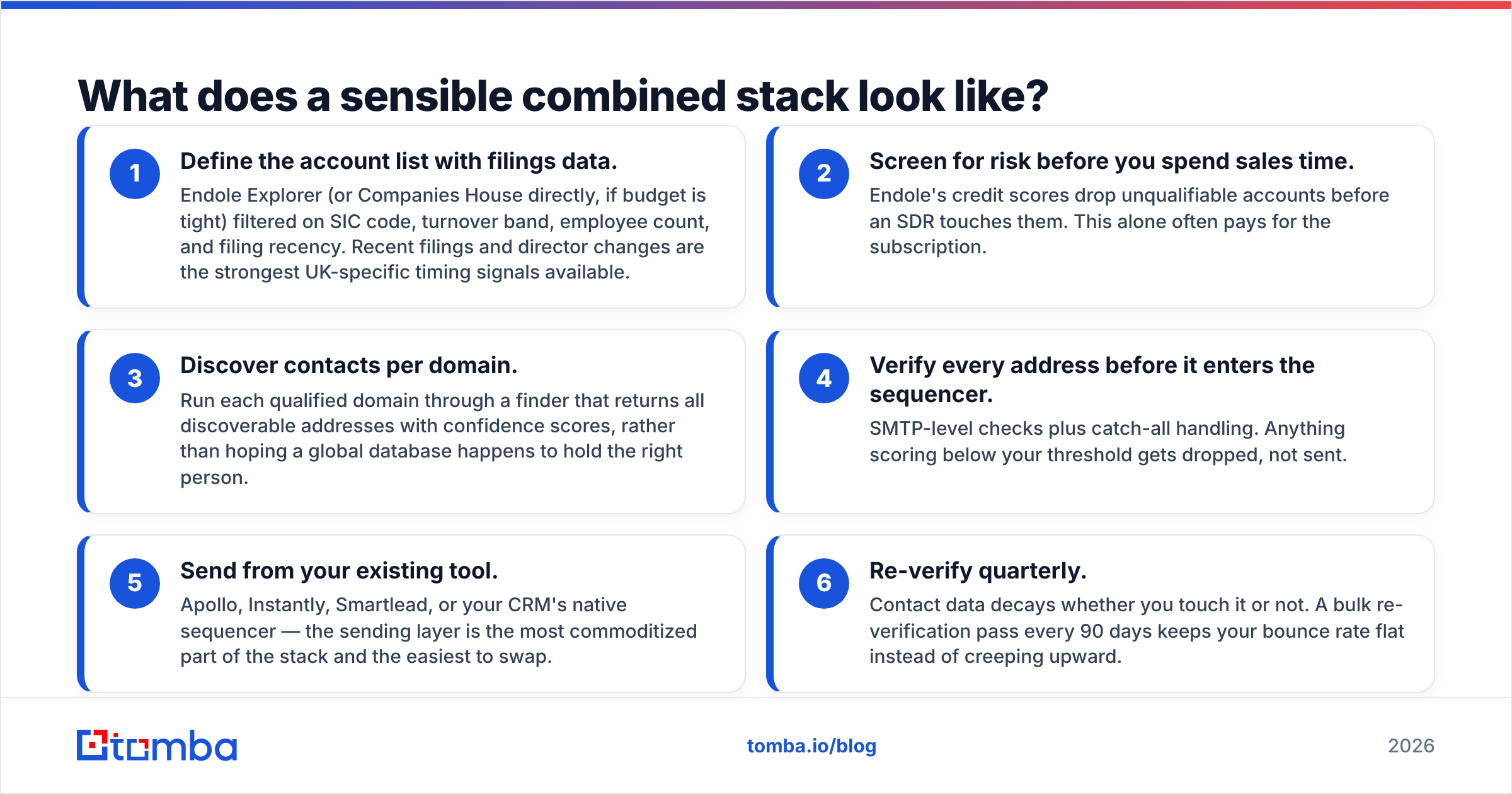
Most teams stop treating Endole vs Apollo.io as an either/or. Here is the setup that works for UK-focused outbound teams, in order:
- Define the account list with filings data. Use Endole Explorer, or Companies House directly if budget is tight. Filter on SIC code, turnover band, headcount, and filing recency. Recent filings and director changes are the strongest UK timing signals you can get.
- Screen for risk before you spend sales time. Endole's credit scores drop weak accounts before an SDR touches them. That alone often pays for the subscription.
- Discover contacts per domain. Run each qualified domain through a finder. It returns every discoverable address with a confidence score. That beats hoping a global database holds the right person.
The last three steps are about hygiene:
- Verify every address before it enters the sequencer. Use SMTP-level checks plus catch-all handling. Anything below your threshold gets dropped, not sent.
- Send from the tool you already have. Apollo, Instantly, Smartlead, or your CRM sequencer. The sending layer is the easiest part to swap.
- Re-verify every quarter. Contact data decays whether you touch it or not. A bulk re-check every 90 days keeps your bounce rate flat.
That structure has one real edge over an all-in-one. Each layer can be replaced on its own. If Apollo's pricing changes, you swap the sending layer and keep your account intelligence. If Endole stops matching your ICP as you move outside the UK, you swap the signal layer and keep your contact workflow.
Endole vs Apollo.io: so which one actually wins?#
Endole wins for UK qualification. Apollo.io wins for multi-market contact volume. Neither wins on email accuracy — and that is the layer that decides whether your campaigns land.
Do you sell only to UK limited companies, with deals that hinge on financial health? Endole is close to irreplaceable, and Apollo is a poor stand-in. Do you run global outbound at volume and want one bill? Apollo is the practical pick. Just budget for credits honestly and run your own verification pass.
Most people reading an Endole vs Apollo.io comparison want to solve a smaller problem. They have a list of target companies and need working emails for the right people. That is not a $99-per-seat platform problem. Start with the Tomba Email Finder. You get 25 free searches a month, no seat minimum, confidence-scored results, and verification in the same workflow. Add the heavy platform later, once you know which layer is really the bottleneck.
That is the honest Endole vs Apollo.io verdict.
Related guides#
Ready to find emails that actually work?
Join 150,000+ professionals who stopped guessing and started sending. Free credits on signup — no credit card required.
Get the Tomba newsletter
Practical outbound tactics and product updates — once every two weeks.
About the author