Endole vs Smarte 2026: Which B2B Data Platform Wins?
Endole maps UK company filings in forensic detail. Smarte chases global contacts and intent. They solve different halves of the same problem — here is which one your pipeline actually needs, and where both leave gaps.
Endole vs Smarte is a comparison of two tools that barely do the same job. Endole reads UK company filings. Smarte finds contacts around the world. Here is what each one covers, what it costs, and the gap both of them leave open.
TL;DR
- Endole is a UK company intelligence platform. It is built on Companies House filings, accounts, credit scores, directorships and group structures. Is your ICP "UK limited companies with £2m–£10m turnover and rising margins"? Then Endole is excellent.
- Smarte is a global GTM data platform. It covers contacts, job titles, tech stacks, intent signals and TAM analysis across North America, EMEA and APAC. It answers "who do I email," not "is this company solvent."
- They barely overlap. Endole wins on UK financial depth and account qualification. Smarte wins on international contact coverage and buying signals.
- Neither is a clean email-finding layer. Endole gives you company-level contact details, not verified personal work emails at scale. Smarte gives you contacts, but you still have to verify them before you send.
- The common stack in 2026 pairs one qualification source with a dedicated finder and verifier. That is where a tool like Tomba's email finder fits, at $49/mo rather than a five-figure annual contract.
Endole vs Smarte: what is each tool, exactly?#
People compare them because both sell "B2B data." That is about as useful as saying a scalpel and a chainsaw both cut things.
Endole (endole.co.uk) is a UK business intelligence provider. Its core asset is the full Companies House record set: statutory filings, filed accounts, charges, directors and shareholders. Endole cleans that data, links it, and adds derived metrics such as credit ratings, estimated turnover and group hierarchies.
The Endole Explorer product lets you build lists of UK companies. You can filter by SIC code, region, turnover band, employee count, growth rate and financial health. Credit reports sit alongside it.
The mental model: Endole is a companies register with a prospecting interface bolted on. It is authoritative about UK entities because the source is statutory. You are not reading scraped guesses. You are reading what the company legally filed.
Smarte (smarte.io) is a go-to-market data platform for outbound and demand-gen teams. It sells contact records: name, title, work email and direct dial. It also sells account firmographics, technographic signals about the software a company runs, and intent data on accounts researching your category.
Smarte markets TAM/SAM analysis and CRM enrichment workflows too. It leans hard on GDPR-compliant sourcing for EU records. That is a real differentiator against US-first databases, which often treat European compliance as an afterthought.
The mental model: Smarte is a contact database with a targeting engine on top. It is built for volume outbound, not for underwriting.
So Endole vs Smarte is less a duel than a question. Which half of your problem hurts more right now: which companies are worth talking to, or which humans do I contact?
Endole vs Smarte: how do they compare head-to-head?#
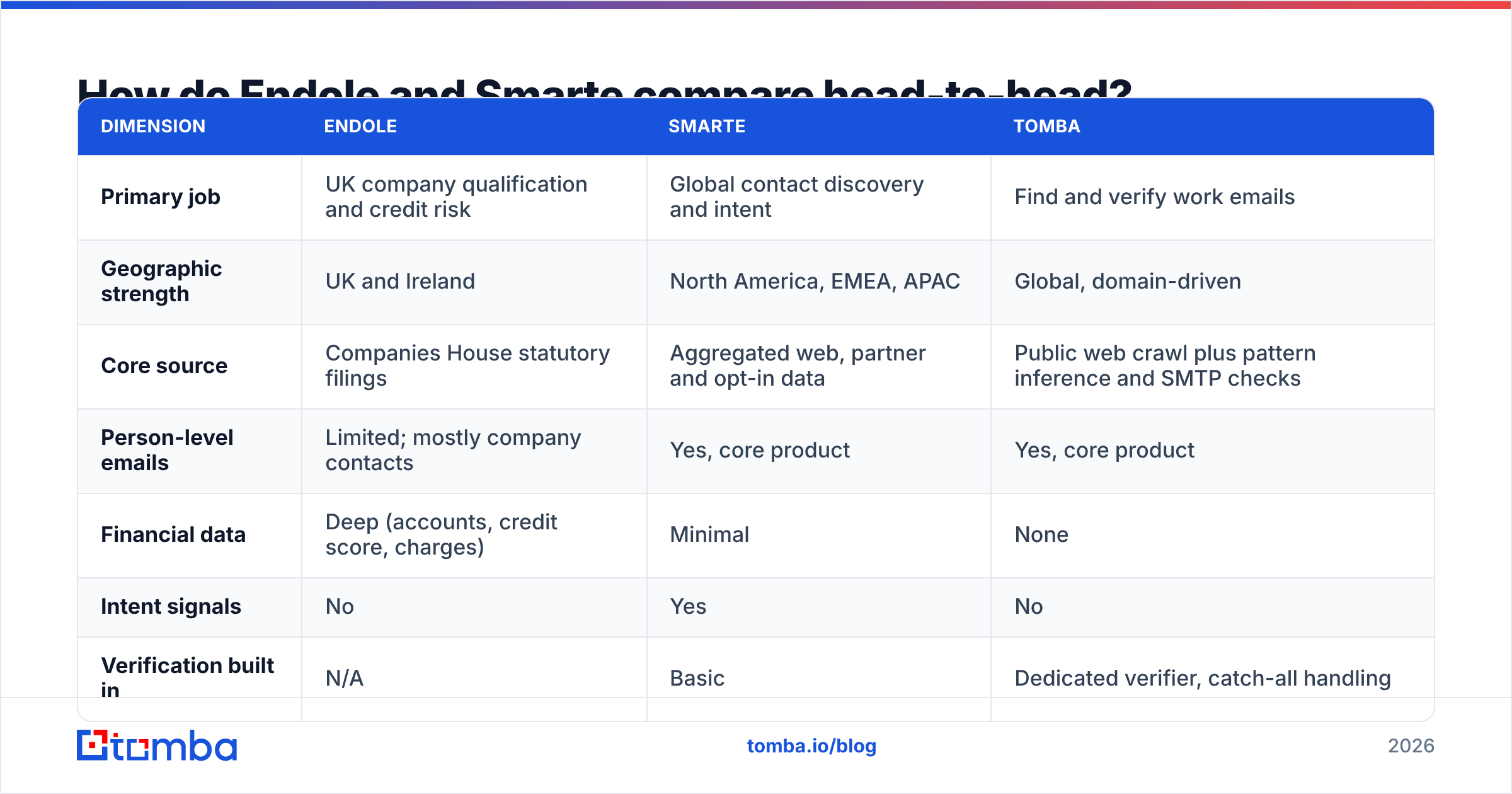
| Dimension | Endole | Smarte | Tomba |
|---|---|---|---|
| Primary job | UK company qualification and credit risk | Global contact discovery and intent | Find and verify work emails |
| Geographic strength | UK and Ireland | North America, EMEA, APAC | Global, domain-driven |
| Core source | Companies House statutory filings | Aggregated web, partner and opt-in data | Public web crawl plus pattern inference and SMTP checks |
| Person-level emails | Limited; mostly company contacts | Yes, core product | Yes, core product |
| Financial data | Deep (accounts, credit score, charges) | Minimal | None |
| Intent signals | No | Yes | No |
| Verification built in | N/A | Basic | Dedicated verifier, catch-all handling |
| Entry price | Low monthly subscription tiers | Quote-based, credit bundles | Free tier, then $49/mo |
| Best for | UK-focused sales, finance, credit teams | International outbound and ABM | Any team that needs deliverable addresses |
| API access | Yes, commercial tiers | Yes | Yes, on all paid plans |
The table makes the shape obvious. In an Endole vs Smarte matchup, the two sit at opposite ends of the funnel. Endole tells you a Manchester engineering firm posted 22% revenue growth and carries no outstanding charges. Smarte tells you their VP of Operations is called Priya, runs NetSuite, and has been reading procurement content for three weeks.

Endole vs Smarte: what data do you actually get?#
Break it down by what lands in your CRM after a search.
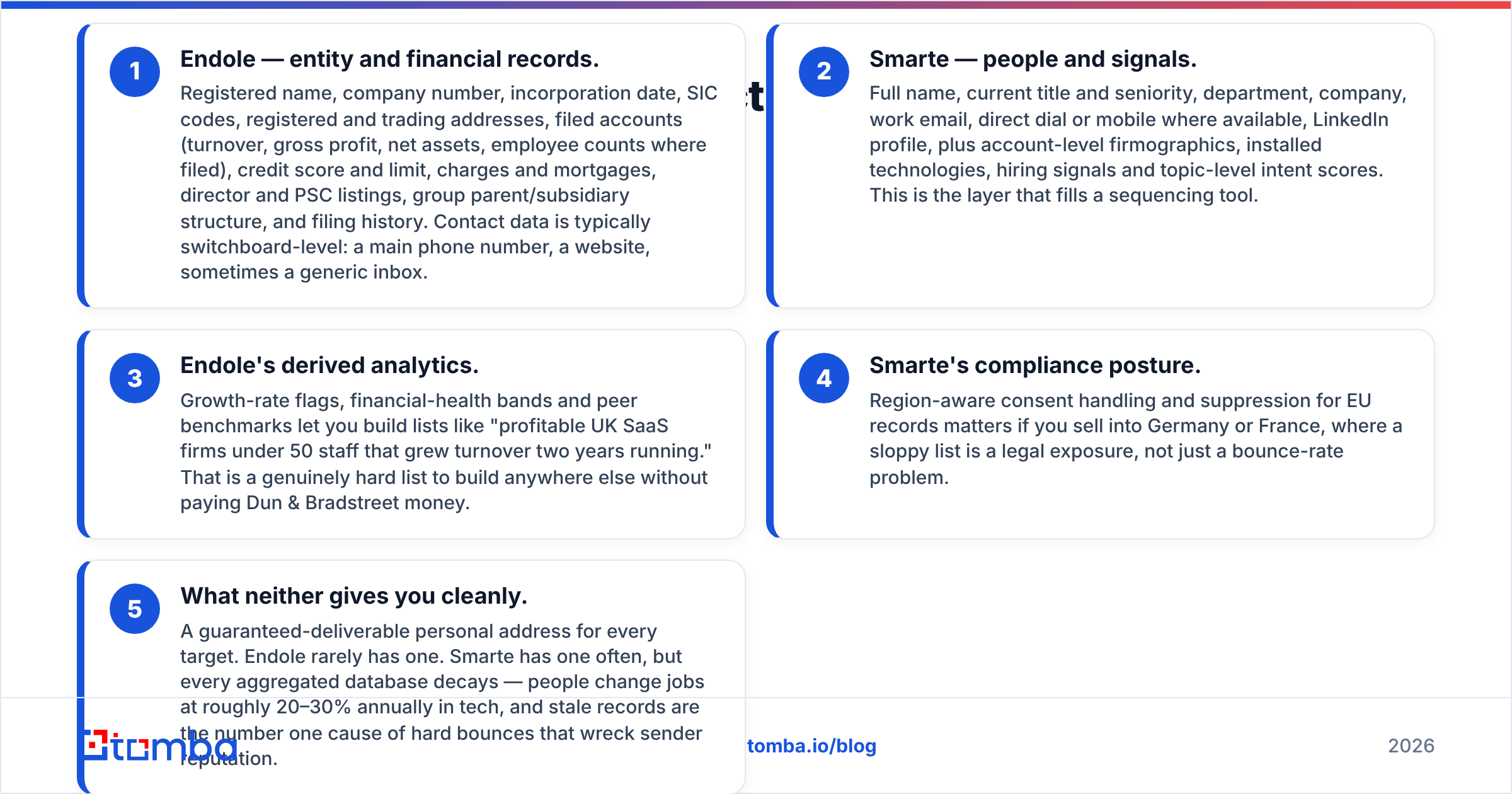
Endole — entity and financial records. You get the registered name, company number, incorporation date, SIC codes and addresses. You also get filed accounts: turnover, gross profit, net assets and employee counts where filed. On top of that sit the credit score and limit, charges and mortgages, director and PSC listings, group structure and filing history. Contact data is usually switchboard-level: a main phone number, a website, sometimes a generic inbox.
Smarte — people and signals. You get full name, current title, seniority, department, company, work email and often a direct dial or mobile. Records also carry the LinkedIn profile, account firmographics, installed technologies, hiring signals and topic-level intent scores. This is the layer that fills a sequencing tool.
Endole's derived analytics. Growth-rate flags, financial-health bands and peer benchmarks let you build sharp lists. One example: "profitable UK SaaS firms under 50 staff that grew turnover two years running." That list is genuinely hard to build anywhere else without paying Dun & Bradstreet money.
Smarte's compliance posture. It handles consent and suppression by region for EU records. That matters if you sell into Germany or France. There, a sloppy list is a legal exposure, not just a bounce-rate problem.
What neither gives you cleanly. Neither hands you a guaranteed-deliverable personal address for every target. Endole rarely has one at all. Smarte often does, but every aggregated database decays. People change jobs at roughly 20–30% a year in tech, and stale records are the top cause of hard bounces that wreck your sender reputation.
Endole vs Smarte for UK-only prospecting: which wins?#
Endole wins on qualification, and it is not close.
Say you sell accountancy services, asset finance, commercial insurance or recruitment. In those markets the buyer's balance sheet decides whether they can afford you. Endole's filings data is the difference between a targeted list and a spray.
You can screen out companies filing dormant accounts. You can exclude anyone with recent county court judgments. You can rank by net-asset growth before a single email leaves your outbox.
Smarte does not carry that depth. It knows a UK company exists and roughly how big it is. It does not know the company filed micro-entity accounts three months late.
There is a catch. Endole hands you a well-qualified list of 400 companies and then leaves you at the front door. You have company numbers, addresses, director names and a switchboard. Turning "Sarah Whitfield, Director, appointed 2019" into s.whitfield@company.co.uk is your problem. That is the exact gap a domain search closes: feed it the domain, get the live email pattern and the people behind it.
Endole vs Smarte for global outbound: which wins?#
Smarte wins, and again it is not close. Endole is not really competing there.
Suppose your ICP includes a US series-B company, a Singaporean logistics firm or a German manufacturer. Endole's coverage stops being relevant at that point. Companies House does not have jurisdiction over Delaware.
Smarte's pitch to outbound teams is that it collapses three purchases into one: contact data, technographics and intent. That helps if you run account-based outbound. When the trigger is "company X started evaluating category Y," having the signal and the contact in one query saves real work.
Smarte also draws the criticism every contact database absorbs, in line with how buyers rate these tools on G2. Coverage varies by region and seniority. Mobile numbers are patchier than advertised. Burning credits on unusable records stings.
None of that is a Smarte-specific failing. It is the physics of aggregated people data. It is also why serious teams verify before sending instead of trusting any provider's internal status flag.
Endole vs Smarte pricing: how do the costs compare?#
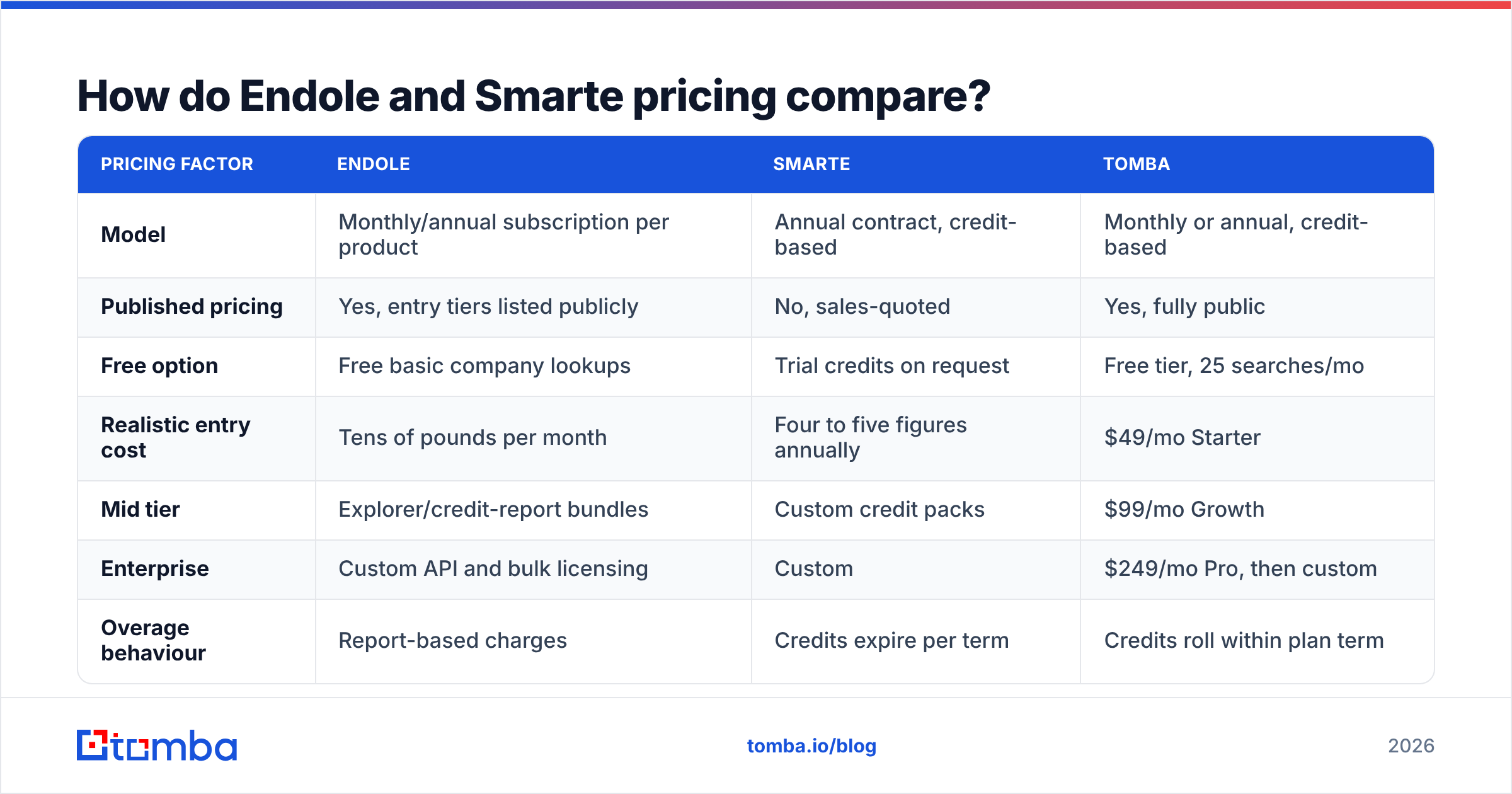
Pricing needs a caveat. Endole publishes subscription tiers that shift by product bundle, and Smarte is quote-led with credit bundles. Always confirm current numbers directly. The structure below is stable even when the figures move.
| Pricing factor | Endole | Smarte | Tomba |
|---|---|---|---|
| Model | Monthly/annual subscription per product | Annual contract, credit-based | Monthly or annual, credit-based |
| Published pricing | Yes, entry tiers listed publicly | No, sales-quoted | Yes, fully public |
| Free option | Free basic company lookups | Trial credits on request | Free tier, 25 searches/mo |
| Realistic entry cost | Tens of pounds per month | Four to five figures annually | $49/mo Starter |
| Mid tier | Explorer/credit-report bundles | Custom credit packs | $99/mo Growth |
| Enterprise | Custom API and bulk licensing | Custom | $249/mo Pro, then custom |
| Overage behaviour | Report-based charges | Credits expire per term | Credits roll within plan term |
The practical read: Endole is cheap to start and gets expensive once you pull volume credit reports. Smarte is a budgeted line item you commit to for a year.
Neither is priced like a utility you casually add to a workflow. That is why teams often pair one of them with a low-cost finder instead of buying a second full platform. You can see the full breakdown on Tomba pricing if you want the comparison numbers.
Maybe your requirement is simply "verified B2B contacts in bulk, priced per record." Then look at pay-as-you-go list vendors such as BookYourData. They sell downloadable, filtered contact lists with no annual platform commitment. Different buying model, same underlying need, and a cleaner fit for some teams.
Endole vs Smarte: the accuracy and compliance trade-offs#
Three things decide whether a data purchase pays back.
Source authority. Endole's advantage is structural. Statutory filings are the primary source, not a scrape of a scrape. When Endole says a company's net assets are £1.4m, that is what was filed. Smarte, like every contact aggregator, infers current truth from evidence of varying freshness. Neither is "wrong." They just carry different error profiles.
Decay. Filings update once a year, on a predictable schedule. People data decays all the time, with no warning. A Smarte record pulled in January can be dead by April and nothing tells you. So "how fresh is it" matters more than "how many records." Read any vendor's data sources disclosure before you sign.
Compliance. UK and EU outreach lives under GDPR and PECR. Legitimate interest can cover B2B outreach, but it demands documented sourcing, easy opt-out and suppression discipline. Smarte markets region-aware compliance handling. Endole's data comes from public registers, which sits on firmer ground for company-level use. It still does not license you to email individuals. Sort out your legal position before you grow your list.

Where a dedicated email finder fits in the Endole vs Smarte stack#
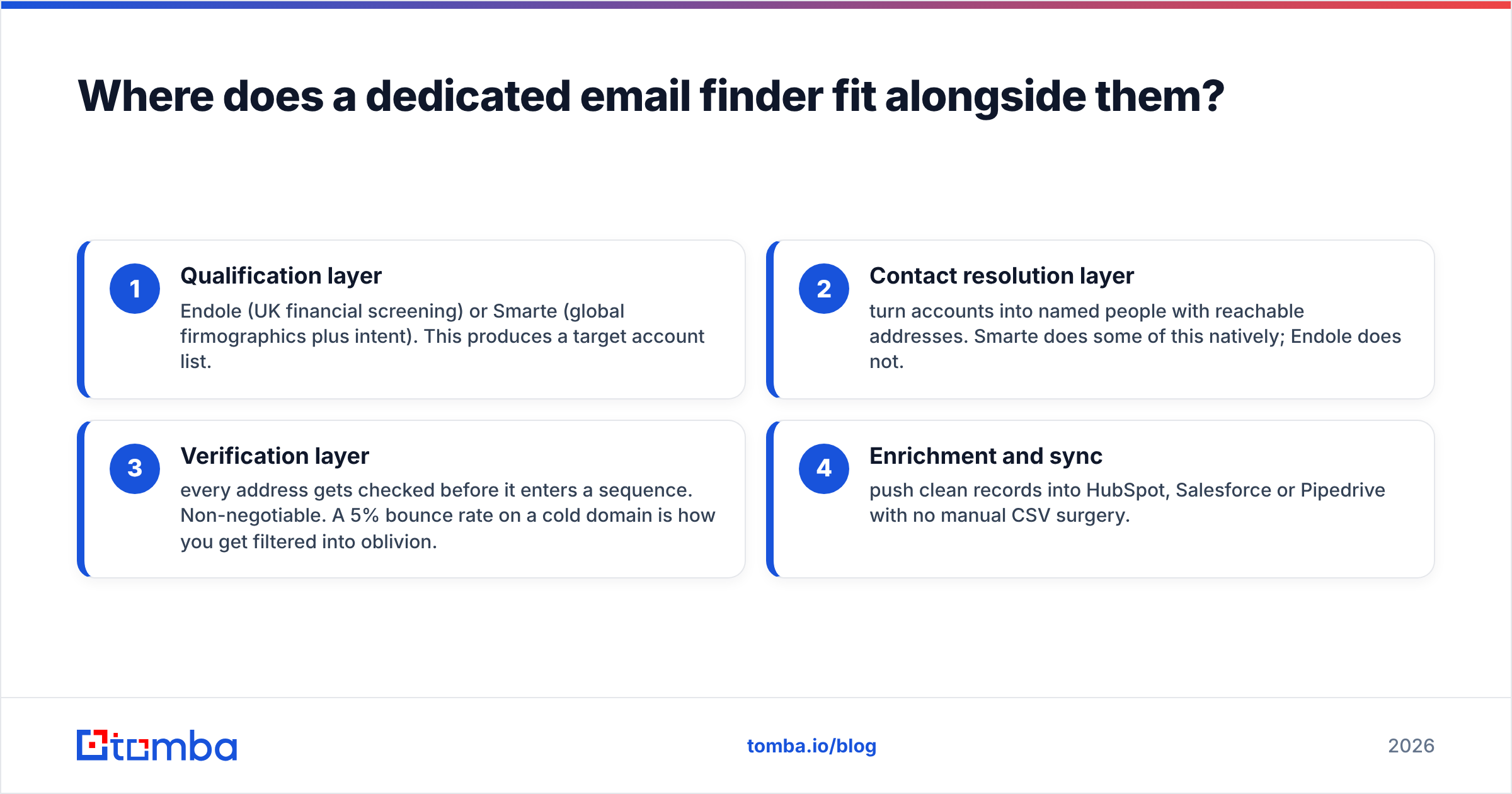
Here is the stack most working teams end up with, whichever platform they picked:
- Qualification layer — Endole for UK financial screening, or Smarte for global firmographics plus intent. This produces a target account list.
- Contact resolution layer — turn accounts into named people with reachable addresses. Smarte does some of this natively. Endole does not.
- Verification layer — check every address before it enters a sequence. This is non-negotiable. A 5% bounce rate on a cold domain gets you filtered into oblivion.
- Enrichment and sync — push clean records into HubSpot, Salesforce or Pipedrive with no manual CSV surgery.
Layers 2 and 3 are where a purpose-built tool earns its keep. Tomba's stack is deliberately narrow. Find the email, confirm it resolves, handle catch-all domains that most verifiers punt on, then hand it off.
The email verifier runs syntax, MX, disposable and SMTP checks. The catch-all handling matters more than it sounds. Many enterprise domains accept everything at the SMTP layer, so a naive verifier marks garbage as valid.
Already committed to Endole for UK screening? The workflow is simple. Export company domains, run a bulk domain search, verify, sync. You keep Endole's financial rigour and add the contact layer it was never built to provide. The same logic applies on the Smarte side: use it for targeting and intent, then verify externally before you send.
Endole vs Smarte: which one should you choose?#
Choose Endole if:
- Your market is UK limited companies and you need financial or credit qualification.
- You sell to finance, procurement or owner-managed businesses where solvency is the gate.
- You want a low, predictable monthly cost and public pricing.
- You are happy to source contact emails separately.
Choose Smarte if:
- You prospect internationally and need person-level records at volume.
- Intent signals and technographics really change your targeting, not just your slide deck.
- You have budget for an annual data contract and someone to own it.
- EU compliance handling is a hard requirement.
Choose neither, or add a third tool, if:
- Your real bottleneck is deliverable addresses, not target selection.
- You already have an account list from your CRM, a conference, or a scraped source.
- You want per-lookup economics instead of a platform commitment.
The honest summary: Endole vs Smarte is not a choice between substitutes. Buy one because you compared it to the other and you end up with a beautiful UK credit-screening tool and zero emails to send. Or a global contact firehose aimed at companies that cannot afford you.
Map your funnel first. Buy for the gap.
Ready to close the contact gap?#
Whichever qualification platform you land on, the last mile is the same. You need real, deliverable addresses for the people on your list.
Start with Tomba Email Finder. The free tier gives you 25 searches a month, so you can test accuracy against your own known-good contacts before you pay anything. Paid plans start at $49/mo with full API access. Run 50 of your Endole exports or Smarte records through it, check the bounce rate, and let the numbers decide.
Related guides#
Ready to find emails that actually work?
Join 150,000+ professionals who stopped guessing and started sending. Free credits on signup — no credit card required.
Get the Tomba newsletter
Practical outbound tactics and product updates — once every two weeks.
About the author