Enreach Alternatives: 7 Best Cloud Phone Systems for 2026
Enreach is solid European UCaaS, but partner-led pricing and long contracts push teams to shop around. Here are 7 Enreach alternatives compared on price, features, migration effort, and who each one actually fits.
TL;DR
- Enreach is a European cloud communications group (UCaaS, contact centre, Swyx, Enreach Contact) sold mostly through partners and quoted per deal — which is exactly why buyers start comparing.
- The strongest Enreach alternatives in 2026 are Ringover, CloudTalk, Aircall, Dialpad, JustCall, 3CX, and Zoom Phone. Each wins on a different axis: price, CRM depth, AI, or self-hosting.
- If you are outbound-heavy, pick on dialer quality and CRM sync. If you are support-heavy, pick on queueing, IVR, and reporting. They are not the same buy.
- Switching phone systems rarely fixes a bad connect rate. Wrong or stale mobile numbers do more damage than any dialer feature, so audit your data before you audit your vendor.
- Budget realistically: most alternatives land between $15 and $45 per user per month on list, plus number rental, outbound minutes, and porting time.
What is Enreach, and who actually uses it?#
Enreach is a European unified-communications group built by acquisition — Voiceworks, Centile, Swyx, Benemen, and a long list of regional telcos now sit under one brand. The portfolio covers cloud PBX, mobile-first calling, contact centre, and Microsoft Teams voice integration, sold in the Netherlands, Germany, the Nordics, the UK, France, Spain, and beyond. You can see the current product split on the official Enreach site.
The typical Enreach customer is a 20–500 seat European business that wants one vendor for telephony, mobile, and contact centre, ideally delivered by a local partner who handles setup and support. That model has real advantages: regional number coverage, GDPR-friendly hosting, mobile SIM integration that most US-born tools cannot match, and a human being to call when the trunk breaks.
It also has a predictable set of frictions, which is why "Enreach alternatives" is a search with volume behind it.
Why do teams look for Enreach alternatives?#
Five reasons come up repeatedly in buyer reviews on Capterra and in procurement conversations:
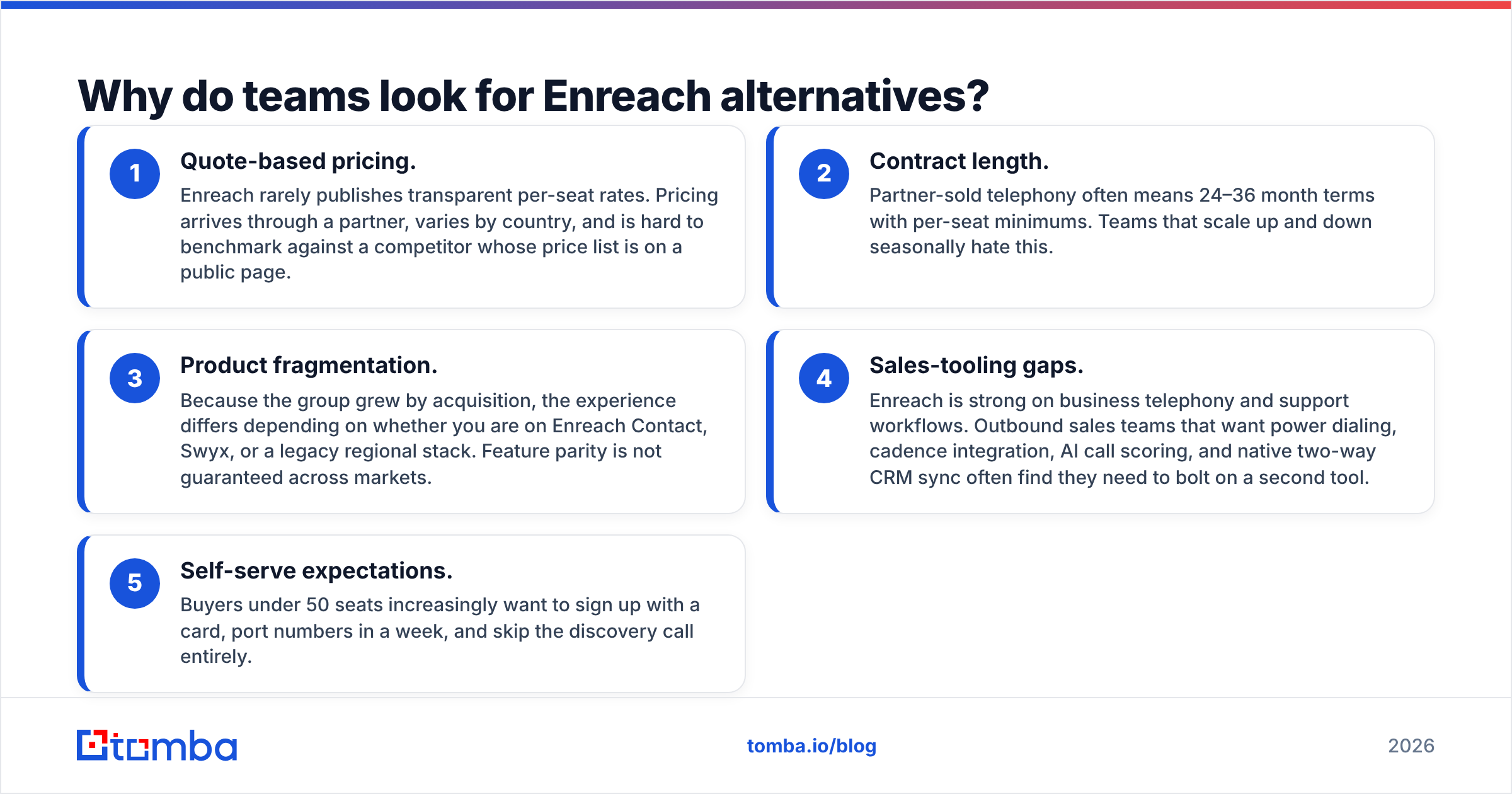
- Quote-based pricing. Enreach rarely publishes transparent per-seat rates. Pricing arrives through a partner, varies by country, and is hard to benchmark against a competitor whose price list is on a public page.
- Contract length. Partner-sold telephony often means 24–36 month terms with per-seat minimums. Teams that scale up and down seasonally hate this.
- Product fragmentation. Because the group grew by acquisition, the experience differs depending on whether you are on Enreach Contact, Swyx, or a legacy regional stack. Feature parity is not guaranteed across markets.
- Sales-tooling gaps. Enreach is strong on business telephony and support workflows. Outbound sales teams that want power dialing, cadence integration, AI call scoring, and native two-way CRM sync often find they need to bolt on a second tool.
- Self-serve expectations. Buyers under 50 seats increasingly want to sign up with a card, port numbers in a week, and skip the discovery call entirely.
None of that makes Enreach a bad product. It makes it a specific product, with a specific buyer. If you are not that buyer, the alternatives below will fit better.
How should you compare Enreach alternatives?#
Do not start from the feature grid. Start from these five dimensions, in this order:
- Primary motion — outbound or inbound? Outbound teams need power/parallel dialing, local presence, call recording with AI summaries, and a cadence tool. Inbound teams need skills-based routing, IVR depth, SLAs, and wallboards. Buying the wrong shape is the most expensive mistake on this list.
- Geographic coverage. Number availability and regulatory compliance vary wildly. Confirm your target countries have local DIDs, emergency-services registration, and legal recording consent flows before you sign.
- CRM depth, not CRM logos. Almost every vendor claims HubSpot and Salesforce support. What matters is bi-directional sync, call logging with correct object association, click-to-dial from list views, and whether the integration is native or Zapier-shaped.
- Real total cost. List price per seat is the smallest line. Add number rental, per-minute outbound, AI transcription add-ons, extra recording storage, and the professional-services fee for porting.
- Data quality feeding the dialer. A dialer only ever performs as well as the phone numbers you load into it. If 30% of your mobile numbers are wrong, no vendor on earth will save your connect rate.
That last point is the one most buyers skip, and it is the one that quietly determines whether the migration looks like a success six months later.
What are the 7 best Enreach alternatives in 2026?#
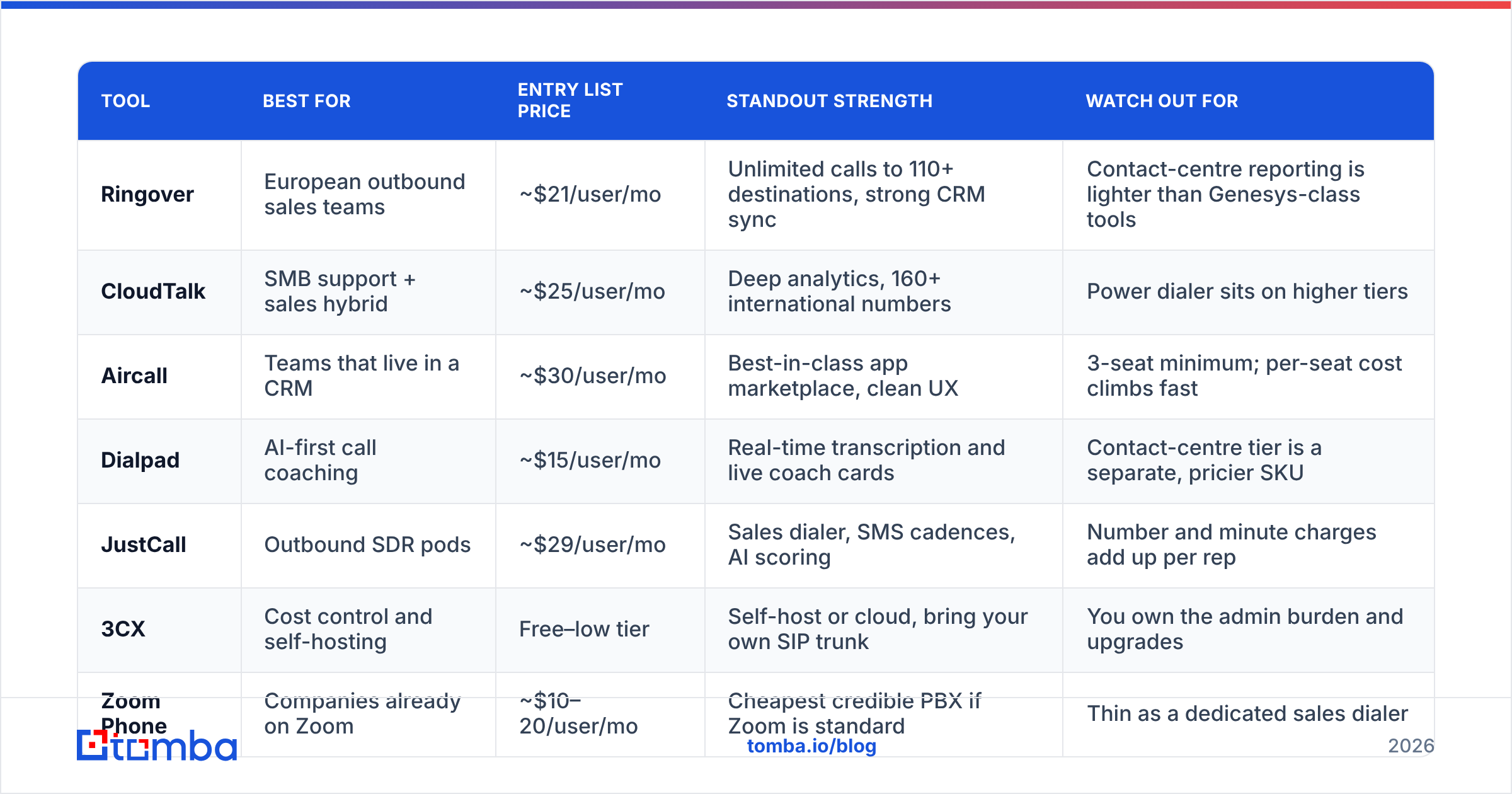
Prices below are published list rates at the time of writing, typically on annual billing and excluding number rental and outbound minutes. Always re-check the vendor's own pricing page before you build a business case.
| Tool | Best for | Entry list price | Standout strength | Watch out for |
|---|---|---|---|---|
| Ringover | European outbound sales teams | ~$21/user/mo | Unlimited calls to 110+ destinations, strong CRM sync | Contact-centre reporting is lighter than Genesys-class tools |
| CloudTalk | SMB support + sales hybrid | ~$25/user/mo | Deep analytics, 160+ international numbers | Power dialer sits on higher tiers |
| Aircall | Teams that live in a CRM | ~$30/user/mo | Best-in-class app marketplace, clean UX | 3-seat minimum; per-seat cost climbs fast |
| Dialpad | AI-first call coaching | ~$15/user/mo | Real-time transcription and live coach cards | Contact-centre tier is a separate, pricier SKU |
| JustCall | Outbound SDR pods | ~$29/user/mo | Sales dialer, SMS cadences, AI scoring | Number and minute charges add up per rep |
| 3CX | Cost control and self-hosting | Free–low tier | Self-host or cloud, bring your own SIP trunk | You own the admin burden and upgrades |
| Zoom Phone | Companies already on Zoom | ~$10–20/user/mo | Cheapest credible PBX if Zoom is standard | Thin as a dedicated sales dialer |
Ringover#
The most direct like-for-like replacement for Enreach in European markets. Ringover publishes pricing, offers unlimited calling to a long list of destinations on its mid tier, and has invested heavily in sales features — power dialer, call whispering, AI call summaries, and native HubSpot/Pipedrive/Salesforce integrations. It also markets itself explicitly against Enreach, which tells you where the deals overlap. Weakness: if you need enterprise-grade WFM and omnichannel routing, look higher up the market.
CloudTalk#
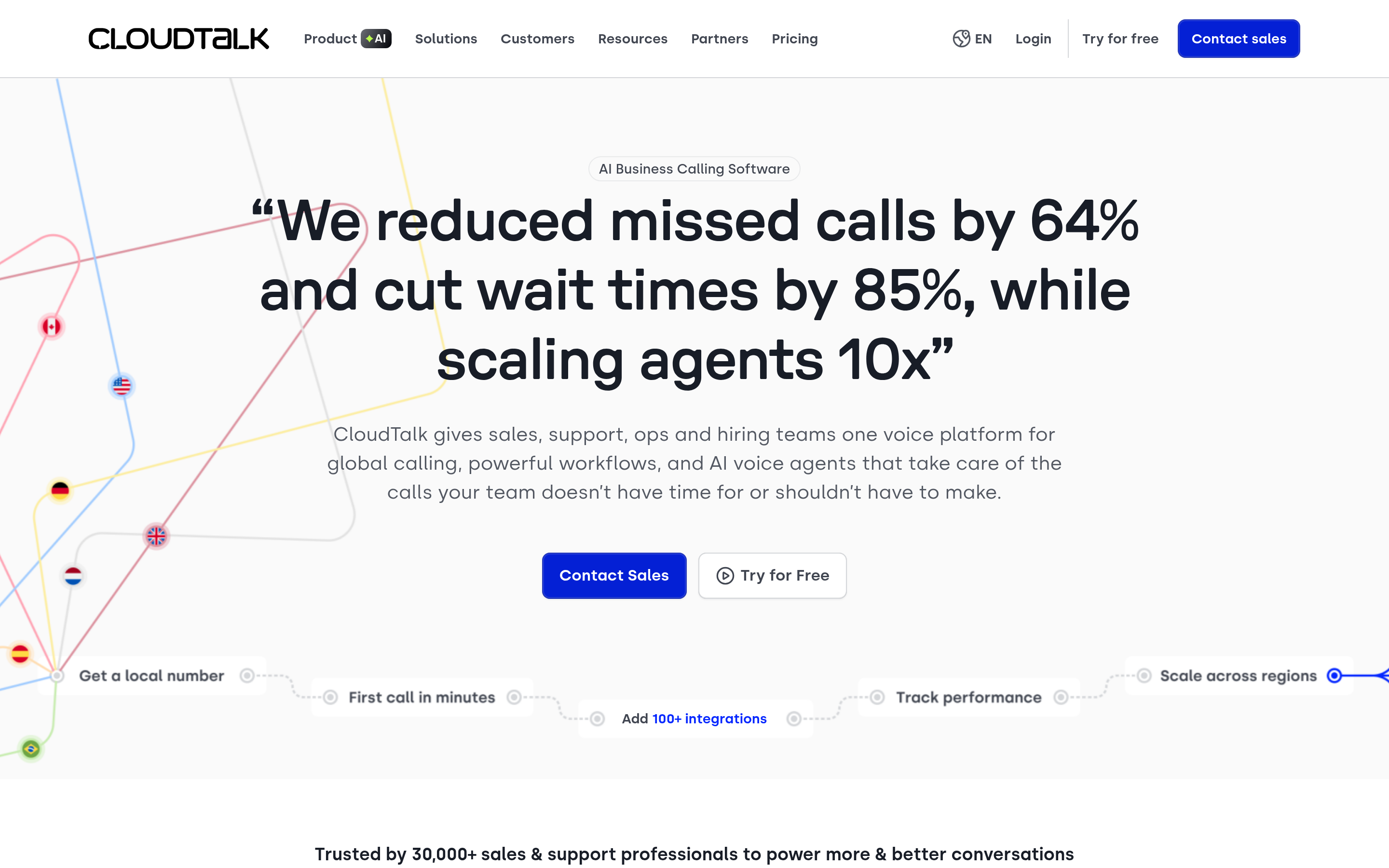
Strong middle ground. CloudTalk's analytics are genuinely better than the category average — agent-level reporting, call-flow designer, and sentiment tagging — and international number coverage is wide. It fits a 10–100 seat team running both inbound support and outbound follow-up from the same tool. The catch is packaging: the features that outbound teams want most, like the power dialer and advanced automations, sit on the upper plans.
Aircall#
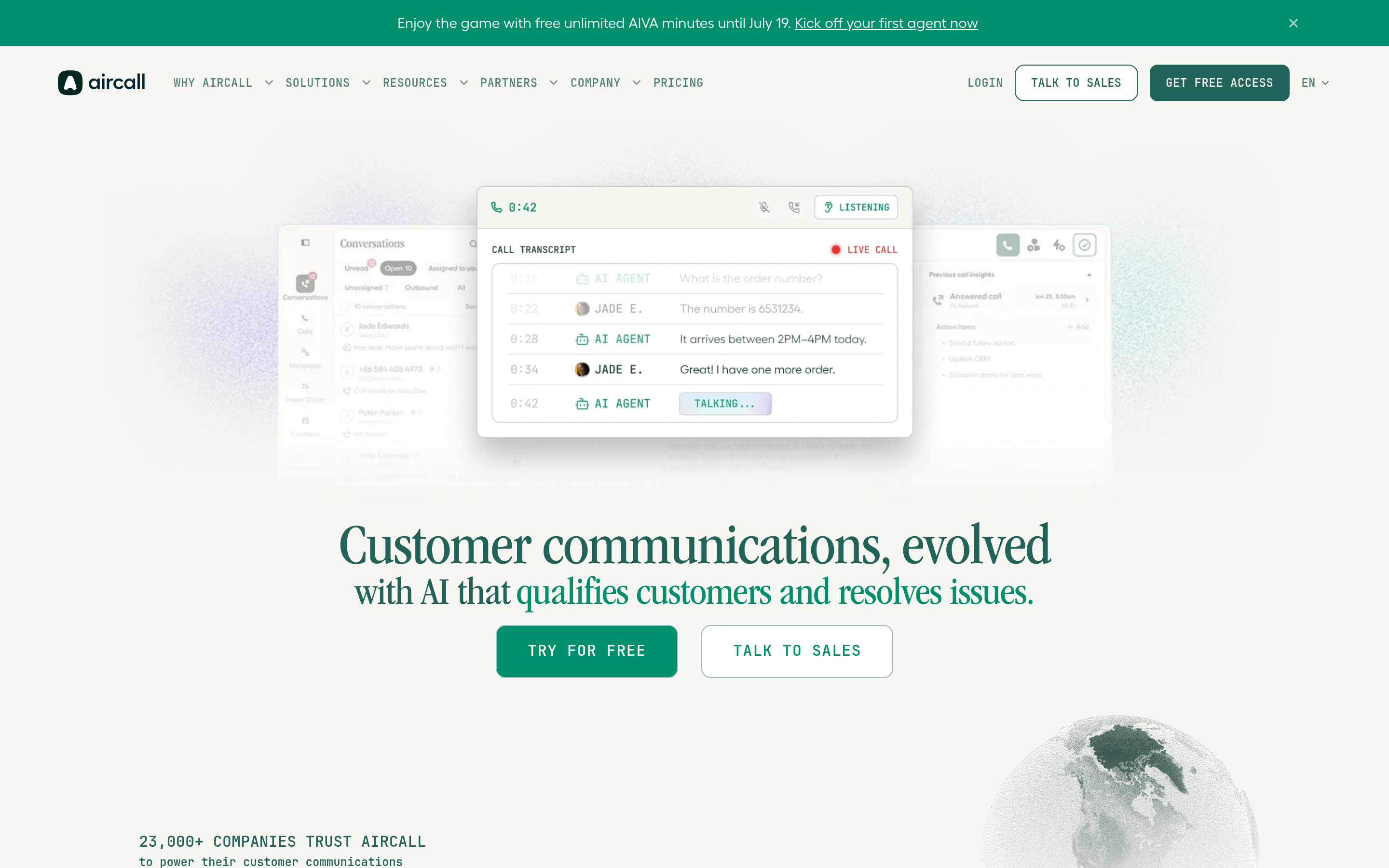
Aircall wins on integration ecosystem and usability. If your reps work inside HubSpot or Salesforce all day and you want calling to disappear into that workflow, Aircall is the smoothest option here. It is also the one most likely to blow your budget: a three-seat minimum, per-seat pricing above most rivals, and add-ons for AI features. Check current listings on G2 before assuming the entry tier covers what you need.
Dialpad#
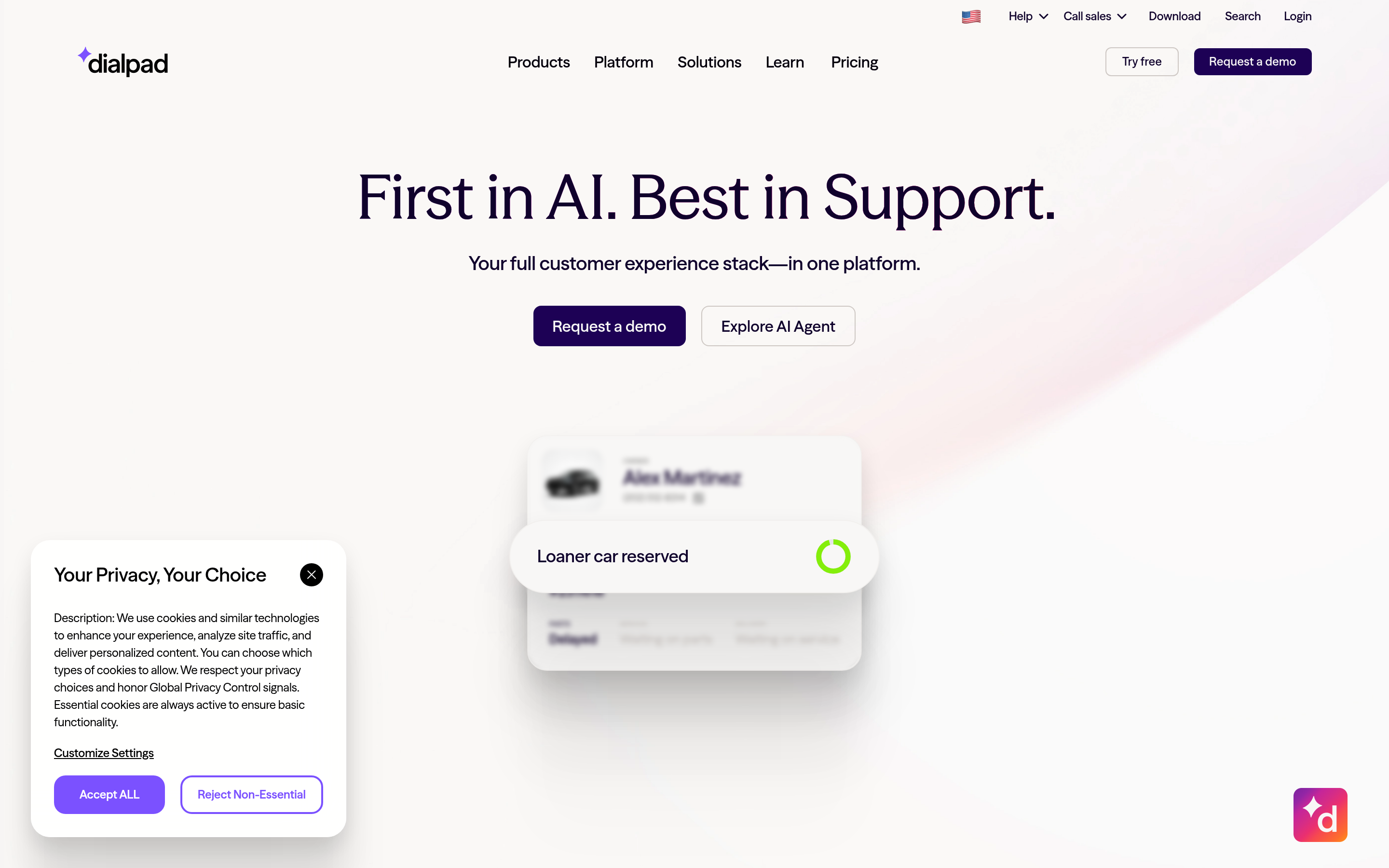
The AI-native pick. Live transcription, real-time objection-handling cards, automatic call summaries pushed to the CRM, and coaching analytics that managers actually open. For a sales org that wants to improve conversation quality rather than just place more calls, Dialpad is the strongest argument on this list. Note that Dialpad Connect (business phone) and Dialpad Support/Sell (contact centre) are separate products with separate pricing.
JustCall#

Built for SDR pods. Sales dialer, SMS and WhatsApp sequences, AI call scoring, and workflow automation in one subscription. It is the closest thing here to "dialer plus light sequencer," which suits teams that do not want a separate outreach platform. Costs scale with numbers and minutes, so model a full quarter of real call volume rather than the sticker price.
3CX#
The cost-control answer. Self-host it or run it in 3CX's cloud, bring your own SIP trunk, and you can run a serious phone system for a fraction of per-seat SaaS pricing. This is the right pick if you have internal IT capacity and predictable requirements. It is the wrong pick if you want AI summaries, native CRM object mapping, and zero admin overhead.
Zoom Phone#
If your company already standardised on Zoom, adding Phone is often the cheapest credible PBX migration available, with decent international coverage and simple admin. It is a business phone system, not a sales engagement platform — pair it with a dedicated cadence tool if outbound volume matters.
Which Enreach alternative fits your team?#
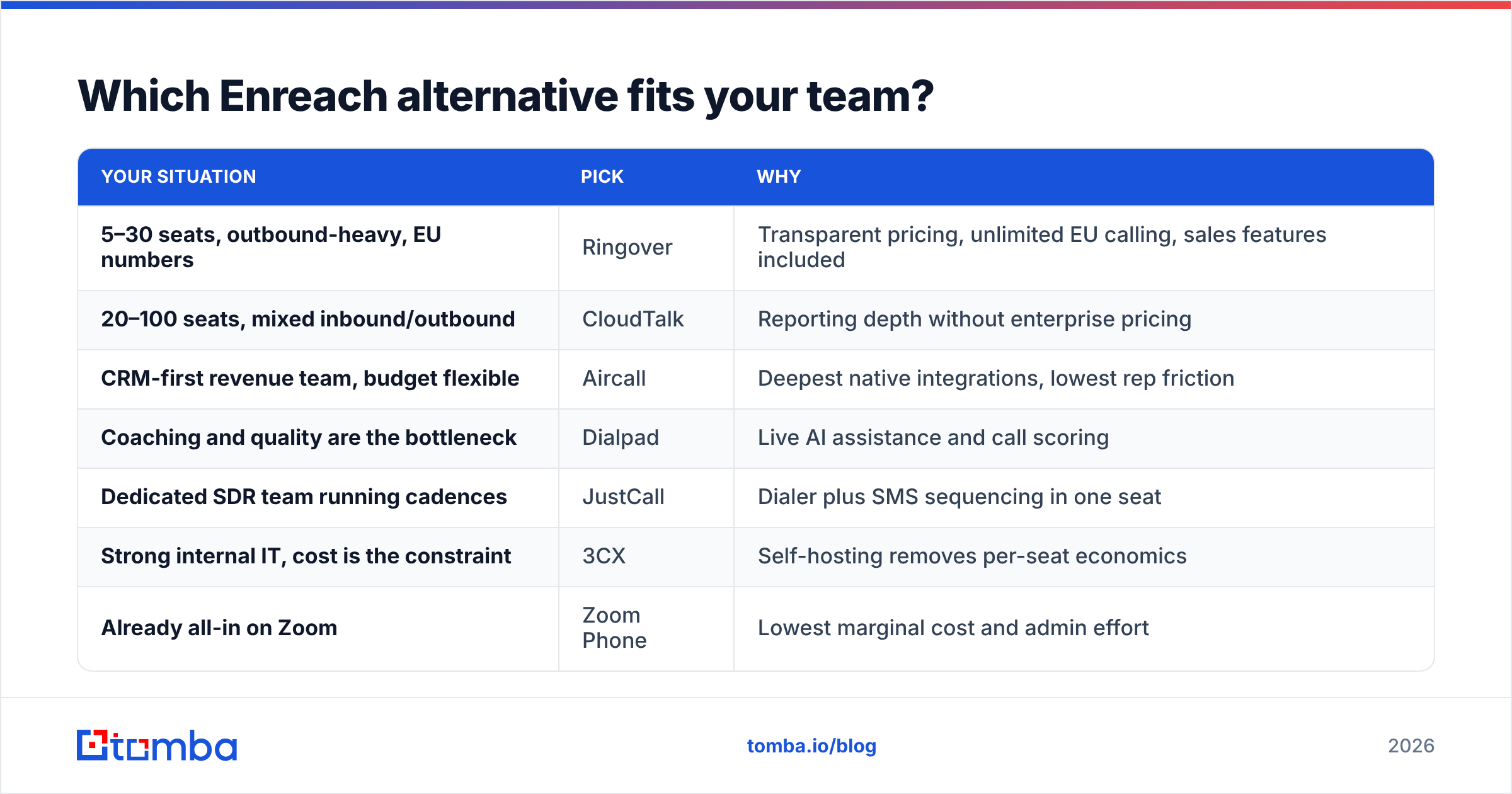
| Your situation | Pick | Why |
|---|---|---|
| 5–30 seats, outbound-heavy, EU numbers | Ringover | Transparent pricing, unlimited EU calling, sales features included |
| 20–100 seats, mixed inbound/outbound | CloudTalk | Reporting depth without enterprise pricing |
| CRM-first revenue team, budget flexible | Aircall | Deepest native integrations, lowest rep friction |
| Coaching and quality are the bottleneck | Dialpad | Live AI assistance and call scoring |
| Dedicated SDR team running cadences | JustCall | Dialer plus SMS sequencing in one seat |
| Strong internal IT, cost is the constraint | 3CX | Self-hosting removes per-seat economics |
| Already all-in on Zoom | Zoom Phone | Lowest marginal cost and admin effort |
Does switching phone systems actually fix your connect rate?#
Usually not. Connect rate is a function of three things, and only one of them is the dialer.
Think of it like a delivery van. A faster van does not help if the addresses on the parcels are wrong. Most teams that migrate from Enreach to a shinier dialer see a modest lift from local presence and faster dialing, then plateau — because the underlying phone list is the constraint.
Three data problems cause the bulk of it:
- Wrong numbers. Switchboards instead of direct dials, or personal mobiles that changed with the last job move. B2B contact data decays roughly 25–30% per year, and mobile numbers decay fastest.
- Unvalidated numbers. Landline versus mobile, disconnected lines, and invalid country formatting all burn dial attempts. Running numbers through a phone validator before they hit the dialer removes a meaningful chunk of wasted activity.
- Missing numbers entirely. Reps end up guessing or skipping accounts. A phone finder that returns direct-dial and mobile numbers from a name plus company closes that gap without manual LinkedIn spelunking.

The practical sequence: clean and enrich the list, validate the numbers, then load them into whichever dialer you chose. Running contact enrichment as a scheduled job — not a one-off cleanup — is what keeps the improvement from decaying back to baseline within two quarters.
What does migrating off Enreach actually involve?#
Plan for six to ten weeks end to end. The steps that consistently take longer than expected:
- Contract exit. Check notice periods and auto-renewal dates first. Many partner agreements require 60–90 days' written notice; miss it and you pay for a year of parallel service.
- Number porting. Country-dependent and the single biggest schedule risk. Some European geographic numbers port in days; others take weeks and require a signed letter of authority per range.
- Call-flow rebuild. IVR menus, opening hours, holiday routing, and queue overflow rules do not export. Document them from the current admin console before you cancel access.
- Integration re-mapping. Call logging fields, dispositions, and recording links have to be re-pointed at the new vendor. Budget an admin day per CRM.
- Rep enablement. One 45-minute session plus a one-page cheat sheet. Adoption dips for about ten days; plan quota expectations accordingly.
- Data refresh. Migration is the best possible moment to clean the contact database, because you are re-importing anyway. Do not carry three years of dead numbers into a new system.
One more warning: run both systems in parallel for at least a week on a small pilot group. Porting failures are recoverable; discovering them on go-live day with the whole sales floor idle is not.
Which alternative should you shortlist first?#
If you want one default answer: shortlist Ringover, CloudTalk, and Dialpad, then add Aircall if your CRM is the centre of gravity and 3CX if cost control outranks convenience. Get quotes with your real seat count, your real destination mix, and your real minute volume — not the sticker price. Ask every vendor for the porting timeline in writing, and ask what happens to your recordings if you leave.
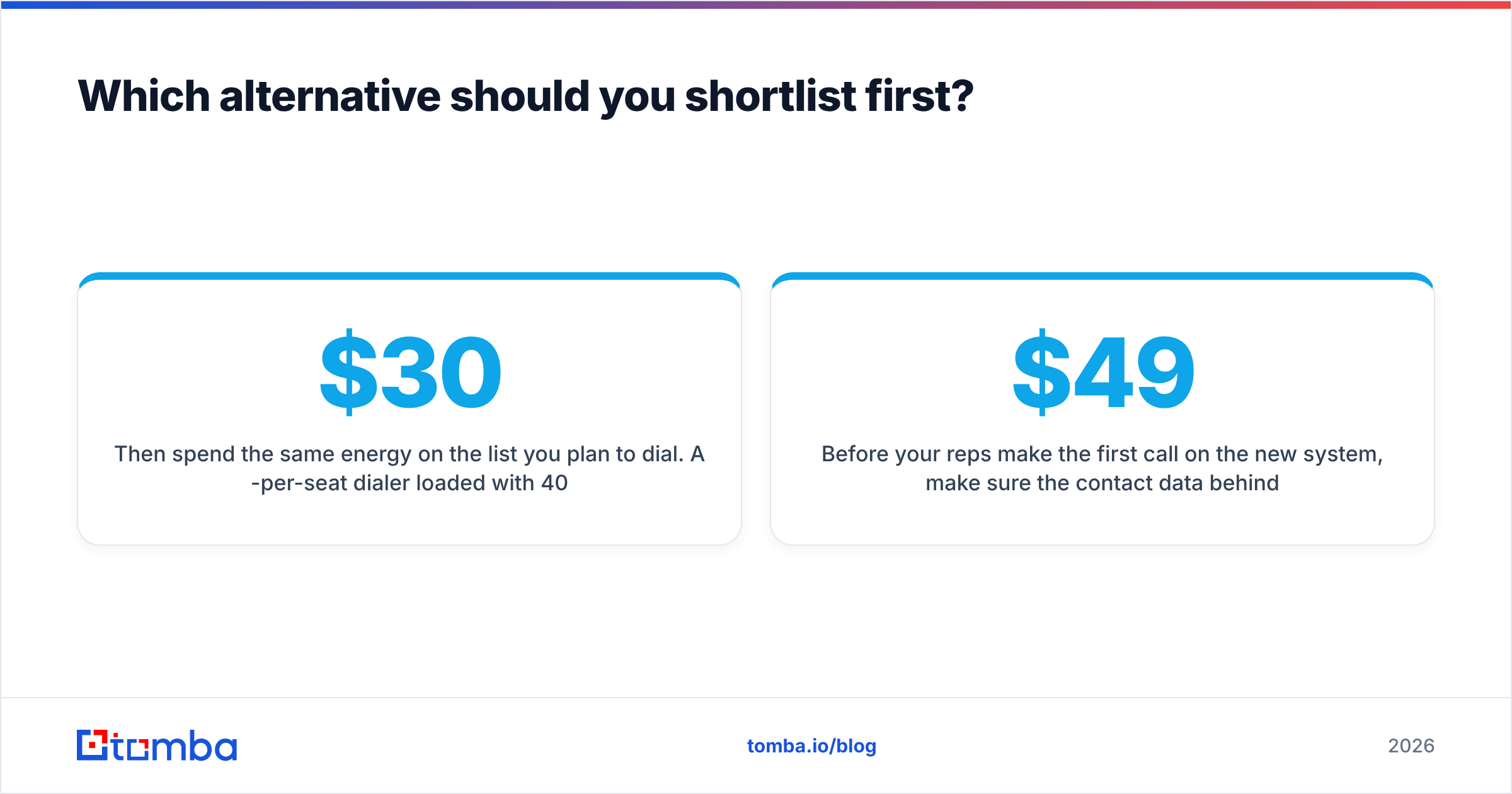
Then spend the same energy on the list you plan to dial. A $30-per-seat dialer loaded with 40% stale numbers performs worse than a $15 one loaded with verified direct dials. Vendor choice is a one-time decision; data quality is a recurring one, and it compounds.
Before your reps make the first call on the new system, make sure the contact data behind it holds up. Tomba's Email Finder gives you verified work emails by name and domain to pair with your dialer list, so multichannel follow-up actually lands — with 25 free searches per month to test it, and paid plans from $49/mo on Tomba pricing when you are ready to run it at team scale.
Related guides#
Ready to find emails that actually work?
Join 150,000+ professionals who stopped guessing and started sending. Free credits on signup — no credit card required.
Get the Tomba newsletter
Practical outbound tactics and product updates — once every two weeks.
About the author