9 Best Enrich Layer Alternatives in 2026 (Tested & Priced)
Enrich Layer (formerly Proxycurl) is a capable LinkedIn data API — until the credits run dry. Here are 9 alternatives compared on price, coverage, email accuracy, and API quality.

TL;DR
- Enrich Layer (the rebranded Proxycurl) is a LinkedIn-shaped data API: profile lookups, company lookups, reverse email search. It is good at what it does and priced per credit, which is exactly why teams start shopping around once volume climbs.
- If you mostly need work email addresses at scale via API, a dedicated email finder like Tomba is cheaper per usable record — plans run Free (25 searches/mo), $49/mo, $99/mo, $249/mo.
- If you need raw datasets (millions of profiles, not lookups), People Data Labs, Coresignal, and Bright Data are the serious options — and they price like infrastructure, not like SaaS.
- If you need a full GTM stack (database + sequences + CRM sync), Apollo or HubSpot's Breeze Intelligence (formerly Clearbit) replaces the API with a workflow.
- Nobody wins on every axis. Pick by the job: lookups, exports, datasets, or lists. The comparison table below sorts them by that split.
What is Enrich Layer, and what changed since Proxycurl?#
Enrich Layer is the current name for Proxycurl, the developer-first API that turns a LinkedIn URL, a name, or an email into a structured person or company record. The rebrand happened without a change in the core product: you still hit endpoints like Person Profile, Company Profile, Person Lookup, and Reverse Email Lookup, and you still pay in credits that vary by endpoint cost.
The value proposition is narrow and honest. Enrich Layer is not trying to be your CRM, your sequencer, or your intent platform. It's a data pipe. You send an identifier, you get back a JSON blob with job title, company, tenure, location, and (on the pricier endpoints) contact details. For engineers building lead-scoring services, ATS enrichment, or investor-research tools, that's often exactly the right shape.
The friction shows up in three places:
- Credit math is endpoint-dependent. A profile fetch and an email lookup do not cost the same. Budgeting requires you to model your call mix, not just your row count.
- Email coverage is a secondary product. Enrich Layer's strength is profile data. Email is available, but it isn't the core competency the way it is for a dedicated email finder.
- Compliance posture matters more every year. LinkedIn-derived data sits in a legally contested area, and procurement teams at larger companies increasingly ask where every field came from.
None of that makes Enrich Layer a bad tool. It makes it a specific tool. The question worth asking before you switch is which of the four jobs below you're actually buying.
Why do teams look for Enrich Layer alternatives?#
From support threads, G2 reviews, and conversations with RevOps teams, the switching triggers cluster tightly:
- Cost per usable record, not cost per call. You pay for every lookup, including the ones that return nothing useful. A 60% hit rate doubles your effective price. Teams rarely notice this until month three.
- Email is the actual deliverable. Most enrichment projects end with "send an email." If 80% of the value sits in one field, paying profile-API prices for it is inefficient.
- Bulk needs outgrow lookup APIs. Once you need 500k records for a model or a TAM map, per-call APIs are the wrong tool. Dataset vendors exist for this.
- Procurement and provenance. Legal wants a data-sourcing statement. Vendors that publish data sources and GDPR/CCPA handling clear that gate faster.
- Support and SLAs. Developer-first tools often ship excellent docs and thin support. At enterprise volume, that trade flips.
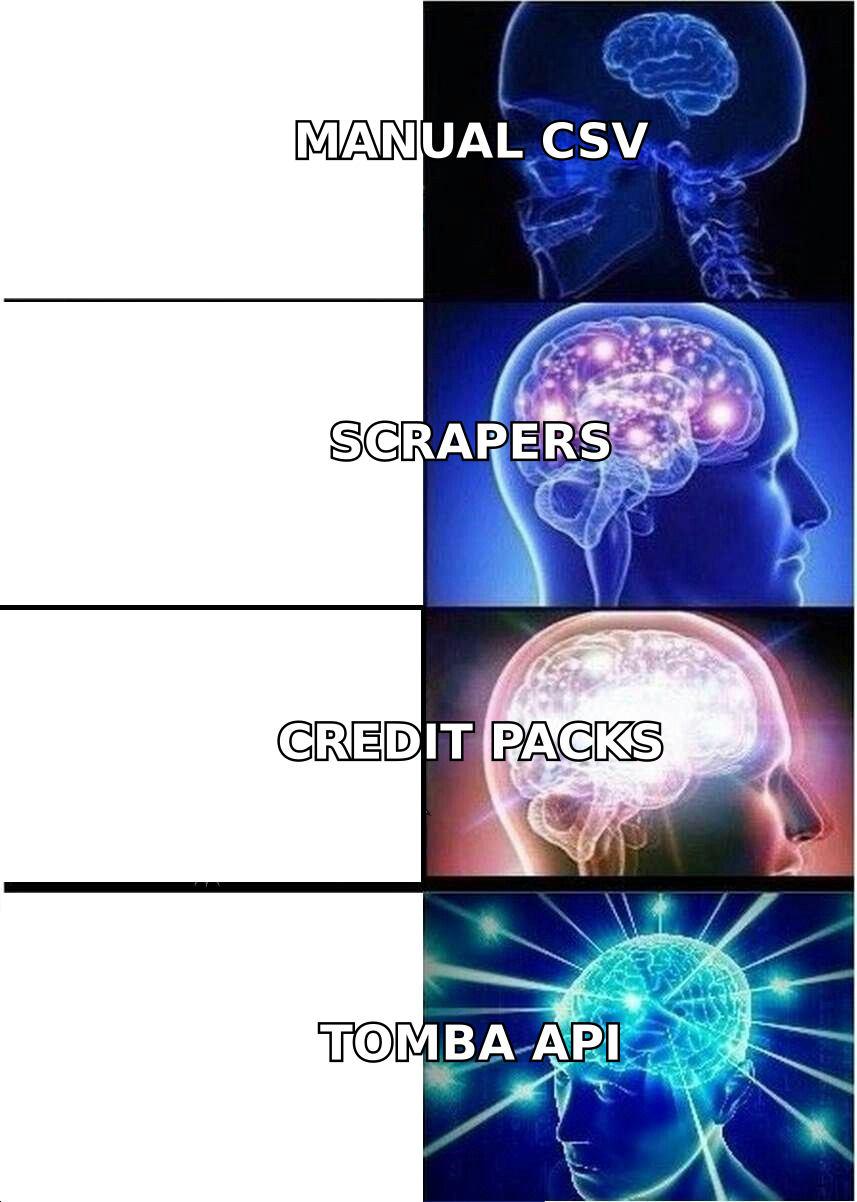
How do the top Enrich Layer alternatives compare?#
Here's the head-to-head. Prices are entry-level list prices at the time of writing and move often — verify on each vendor's page before you commit budget.
| Tool | Best for | Entry price | Free tier | Primary data | API-first? |
|---|---|---|---|---|---|
| Enrich Layer (baseline) | LinkedIn profile lookups | Credit packs, pay-as-you-go | Small trial credits | LinkedIn-shaped profiles | Yes |
| Tomba | Work email discovery + verification | $49/mo Starter | 25 searches/mo | Domain/company emails, phones | Yes |
| People Data Labs | Large person/company datasets | ~$99/mo self-serve | 100 credits/mo | Resume-graph person data | Yes |
| Coresignal | Firehose-scale raw data | Custom, enterprise-tier | No | Employee + company records | Yes |
| Bright Data | Custom scraping infrastructure | ~$500/mo tiers, PAYG datasets | Trial | Whatever you collect | Yes |
| Apollo.io | All-in-one prospect + sequence | ~$49/user/mo | Yes, limited | Contact DB + engagement | Partial |
| Breeze Intelligence (ex-Clearbit) | HubSpot-native firmographics | Credit bundles in HubSpot | No | Company + visitor data | Partial |
| ContactOut | Recruiter-style LinkedIn sourcing | ~$49/mo | Limited free | LinkedIn emails + phones | Partial |
| Wiza | Sales Nav list exports | ~$99/mo | 20 credits | LinkedIn list → CSV | Partial |
| BookYourData | Prepaid verified contact lists | Pay-as-you-go credits | Sample | Curated B2B list data | Partial |

Four groups fall out of that table, and they don't compete with each other so much as they compete for different budgets:
- Lookup APIs — Enrich Layer, Tomba, People Data Labs. You send identifiers, you get records. Cheap to start, priced per call.
- Dataset vendors — Coresignal, Bright Data. You buy files or streams. Expensive to start, cheap per record at scale.
- GTM platforms — Apollo, Breeze Intelligence. Data is bundled into a workflow you're already paying for.
- Extraction tools and lists — ContactOut, Wiza, BookYourData. Human-operated, list-shaped, minimal engineering required.
Picking the wrong group is the expensive mistake. Picking the wrong vendor inside the right group is usually a 20-30% cost difference.
Which alternative is best if you only need work emails?#
If the end of your pipeline is an outbound email, a dedicated finder beats a profile API on both price and hit rate — because the vendor's entire quality loop is aimed at that one field.
Tomba is the clean swap here. The Tomba API mirrors the shape developers expect from Enrich Layer: single-record lookup, domain search for every address at a company, and bulk endpoints for batch jobs. The difference is that verification is built into the same platform rather than bolted on. You find an address, you verify emails with SMTP-level checks, and you get a catch-all determination before you burn sender reputation on a guess.
What you get in practice:
- Domain search — hand it
stripe.comand get the pattern plus every discoverable mailbox, rather than looking people up one at a time. - Pattern inference — when a specific person isn't in the index, the confirmed company pattern plus a verification pass often still lands the address.
- Catch-all handling — the single biggest source of silent bounce risk, treated as a first-class result instead of an "unknown."
- Enrichment on the side — data enrichment fills company size, industry, and social profiles when you need context beyond the address.
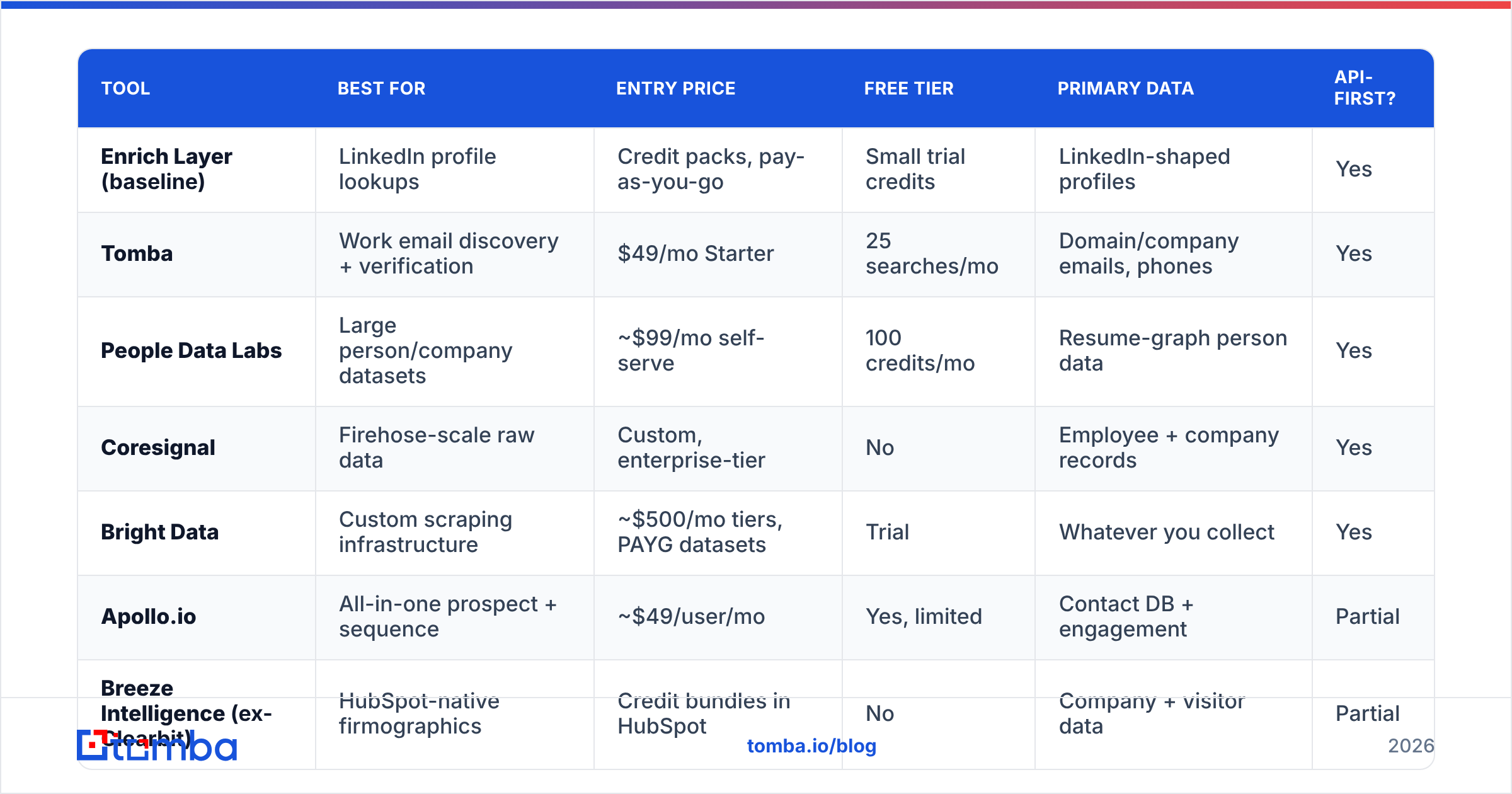
- Predictable pricing — Free (25 searches/mo), Starter $49/mo, Growth $99/mo, Pro $249/mo, with Enterprise custom. Full Tomba pricing is public, so you can model cost before signing.
Where Tomba is not the answer: if you need deep employment history, skills arrays, or education records for a matching algorithm, an email finder will underserve you. That's Enrich Layer's or People Data Labs' turf, and you should stay there.
How much does accuracy actually vary between providers?#
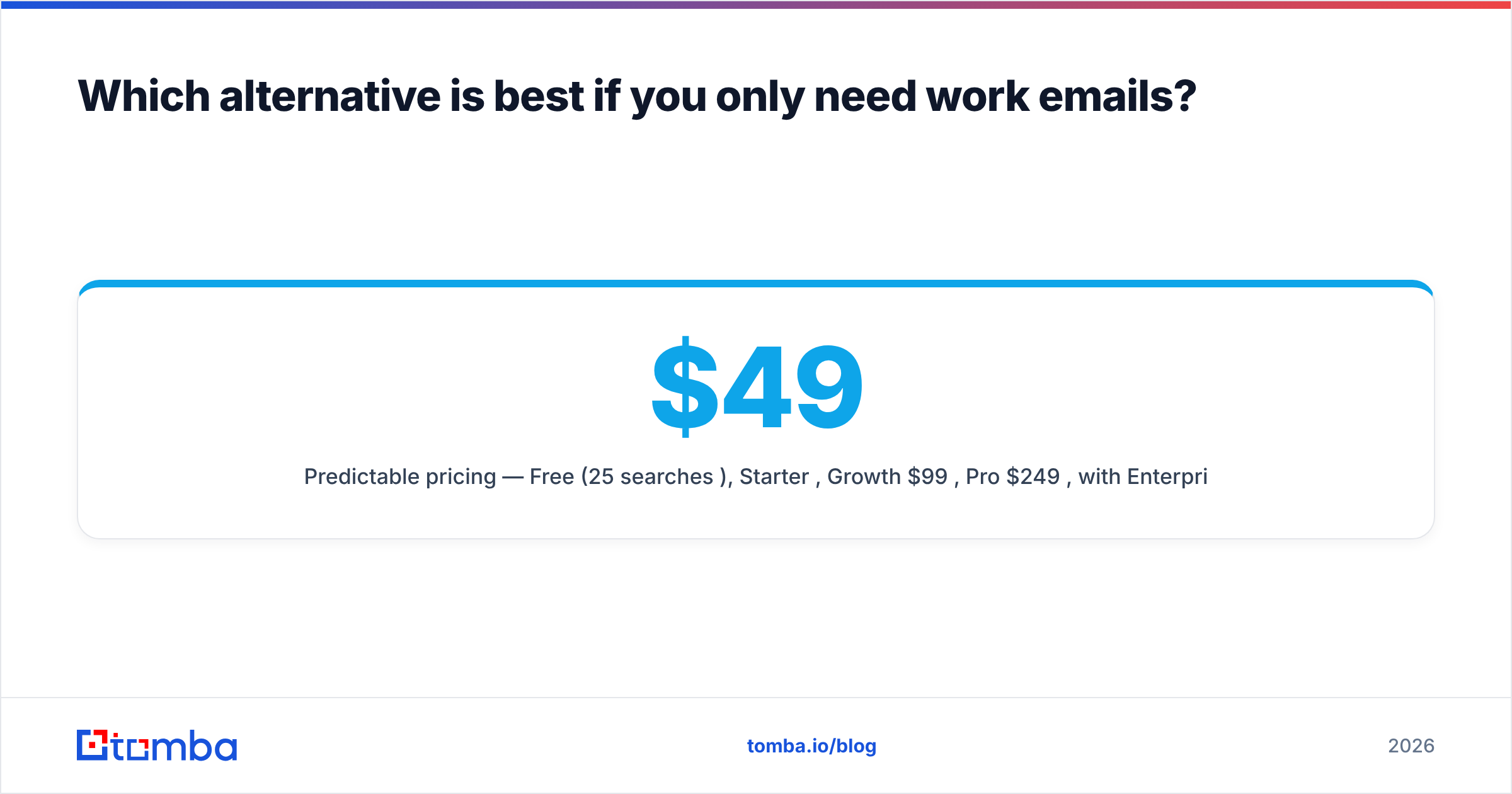
More than vendors admit, and less than skeptics assume. Independent tests consistently land in the same band: 70-95% for confirmed-deliverable rates on standard B2B domains, with sharp drop-offs for small companies, non-English markets, and catch-all domains.

Three rules for reading anyone's accuracy claim, including ours:
- "Accuracy" and "coverage" are different numbers. A tool that returns an address 40% of the time with 99% accuracy is worse than one that returns 80% of the time at 92%. Always compute usable-records-per-100-inputs.
- Test on your own ICP. A vendor tuned for US SaaS will underperform on German manufacturing or Japanese enterprise. Run 200 of your real target accounts through every trial before you decide.
- Verify with a third party. Never grade a finder using its own verifier. Export the results and run them through a neutral checker, then compare bounce rates in your actual sending tool.

When should you buy datasets instead of API lookups?#
Switch to a dataset vendor when your unit of work stops being "a person" and becomes "a market."
People Data Labs sells person and company records with strong identity resolution and a self-serve tier that starts around $99/mo. It's the natural upgrade if you're building a product feature on top of enrichment rather than doing outbound. The data is broad but not LinkedIn-live: expect staleness on recent job changes.
Coresignal is the firehose. Employee counts, headcount trends, job postings, firmographics — delivered as flat files or an API, priced for teams with a data engineer. If you're modeling hiring signals or building an investment thesis, this beats any per-call API on cost per record.
Bright Data isn't a dataset company so much as the infrastructure underneath one. You define the collection, they handle the proxies and scale. Maximum flexibility, maximum operational burden, and you own the compliance question end to end.
The trade is stark: lookup APIs cost more per record but require zero pipeline. Dataset vendors are cheap per record and demand real engineering. If nobody on your team owns a warehouse, stay in the API group.
Are all-in-one GTM platforms a real replacement?#
They're a replacement for the workflow, not the API.
Apollo.io bundles a large contact database with sequencing, dialing, and CRM sync starting around $49/user/mo. For a five-rep sales team, this is often cheaper and faster than assembling an API plus a sequencer, and the data quality is decent-to-good on US mid-market. The catch is that Apollo's API and export limits are gated by seat and plan — it isn't built for someone else's product to consume. If you tried to swap Enrich Layer for Apollo inside an application, you'd hit rate limits and terms-of-service friction quickly. Teams evaluating this route often shortlist an Apollo alternative specifically because of those export ceilings.
Breeze Intelligence (HubSpot's rebuilt Clearbit) is the strongest option when your source of truth is already HubSpot. Enrichment happens inside the CRM, credits are bought in the same contract, and the firmographic quality on established companies is high. It's weak on individual email discovery and it's meaningless if you're not a HubSpot shop.
What about LinkedIn extraction tools and prepaid lists?#
Three options that skip the engineering entirely:
ContactOut runs as a browser extension over LinkedIn and surfaces personal and work emails plus phone numbers. Recruiters love it because personal-email coverage is genuinely strong. It's seat-based, human-in-the-loop, and not designed for automated pipelines.
Wiza turns a Sales Navigator search into a verified CSV. If your motion is "build a list on Monday, send on Tuesday," it removes a whole step. Credits are consumed on export, and quality tracks whatever Sales Nav returned.
BookYourData takes a different and often underrated route: prepaid, pay-as-you-go access to curated, pre-verified B2B contact lists with a published accuracy guarantee and no subscription lock-in. For teams that need a clean 5,000-contact list this quarter and don't want to build or maintain anything, it's a legitimately efficient purchase — you know the cost before you start, and there's no credit-burn surprise. It's a list product rather than a live API, so pair it with periodic re-verification if the data sits in your CRM for months.
How should you choose between these Enrich Layer alternatives?#
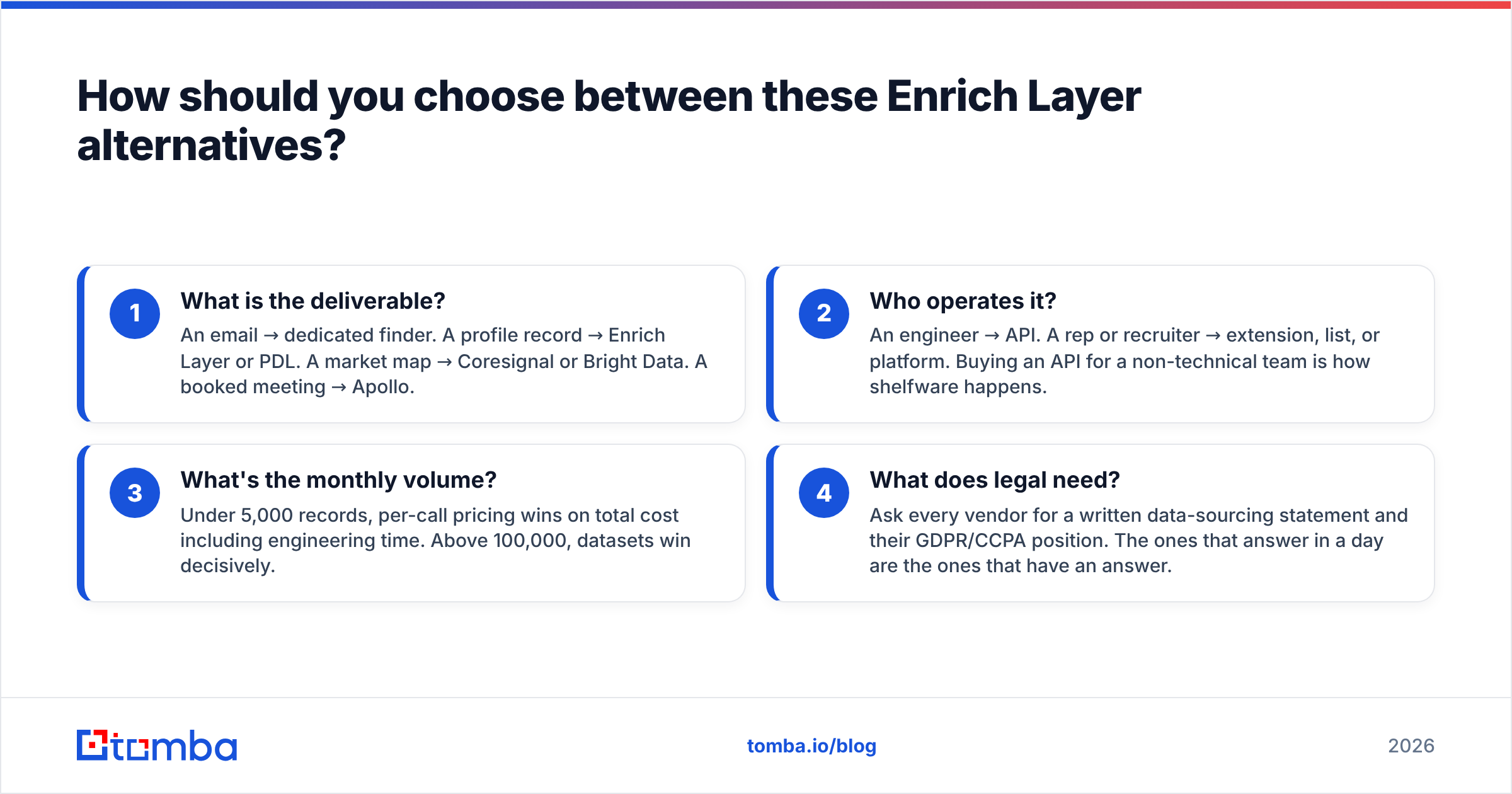
Answer four questions in order:
- What is the deliverable? An email → dedicated finder. A profile record → Enrich Layer or PDL. A market map → Coresignal or Bright Data. A booked meeting → Apollo.
- Who operates it? An engineer → API. A rep or recruiter → extension, list, or platform. Buying an API for a non-technical team is how shelfware happens.
- What's the monthly volume? Under 5,000 records, per-call pricing wins on total cost including engineering time. Above 100,000, datasets win decisively.
- What does legal need? Ask every vendor for a written data-sourcing statement and their GDPR/CCPA position. The ones that answer in a day are the ones that have an answer.
Then run the same 200-record test set through your top two. Score usable records per 100 inputs, not raw match rate, and check bounce rates in your sending platform after a week. That single test settles more arguments than any comparison post — this one included.
Where does that leave Enrich Layer?#
Keep it if LinkedIn-shaped profile data is your product's core input and credits are predictable at your call mix. It's a well-built API with clear docs, and switching away from a working integration has a real cost.
Replace it if the email field is where the value lives, if your hit rate is quietly doubling your effective price, or if your volume has outgrown per-call economics. In the first case, a purpose-built finder is the cheaper answer. In the third, a dataset vendor is.
Ready to test the email-first path? Start with the Tomba Email Finder — the free tier gives you 25 searches a month with no card, enough to run a real head-to-head against your current Enrich Layer output. Feed it the same 200 accounts, compare usable addresses per 100 inputs, and let the numbers pick your stack. If it wins, Starter is $49/mo and the API drops into the same slot your current integration occupies.
Related guides#
Ready to find emails that actually work?
Join 150,000+ professionals who stopped guessing and started sending. Free credits on signup — no credit card required.
Get the Tomba newsletter
Practical outbound tactics and product updates — once every two weeks.
About the author