Enrichley vs Seamless.AI: Which B2B Data Tool Wins in 2026?
Enrichley leans on waterfall enrichment; Seamless.AI sells a real-time contact search engine. We compare coverage, accuracy, credit math, and contract terms — then name the cheaper option most teams actually need.
Enrichley vs Seamless.AI is a choice between two different jobs. One fills the gaps in lists you already own. The other builds new lists from scratch. Here is how the two compare on data quality, real pricing, and contract terms — and when a narrower tool does the job for less.
TL;DR
- Enrichley is a waterfall-style enrichment layer. You feed it partial records, it queries multiple downstream data vendors, and it returns the first hit that passes validation. Its strength is fill rate on lists you already own.
- Seamless.AI is a real-time contact search engine with a Chrome extension and a large self-reported contact index. Its strength is net-new prospecting volume for SDR teams that live in the browser.
- Pricing transparency is the biggest practical difference. Enrichley is credit-priced and self-serve. Seamless.AI routes most buyers through a sales call and an annual contract, and its public plan pages tend to show limits rather than a full price card.
Two more things to weigh before you compare price cards:
- Neither tool is cheap for email-only workflows. If all you need is a verified work email from a name and domain, a focused finder like Tomba runs $49/mo for the Starter plan, with a free tier to test first.
- Run a 200-row bake-off before you sign anything. Same list, same day, all three tools, then bounce-test the output. Vendor accuracy numbers are marketing. Your own ICP list is the only benchmark that counts.
What are Enrichley and Seamless.AI?#
They solve adjacent problems, and the confusion between them costs teams money.
Enrichley sits in the enrichment category. You arrive with data — a CSV of company domains, a CRM export with 40% blank email fields, a list of LinkedIn URLs — and it fills the gaps. Waterfall enrichment means it does not rely on one source. It queries provider A, checks whether the result passes a validity test, and if not, cascades to provider B, C, and D. You pay only for the successful hit. That is why waterfall tools tend to beat single-source vendors on fill rate.
Seamless.AI sits in sales intelligence. You arrive with an ICP definition — "VP of Marketing at 200-1000 employee SaaS companies in the US" — and it returns contact records to work. Its pitch is real-time search. Rather than serving a static database snapshot, it claims to assemble and validate contact details at query time. In practice you use it through the web app plus a Chrome extension that overlays LinkedIn and company sites. Check the current feature set on seamless.ai before you evaluate, since the product has shifted toward AI-generated messaging and buyer-intent features.
The one-line distinction: Enrichley improves lists you have. Seamless.AI creates lists you don't.

Enrichley vs Seamless.AI: how do they differ under the hood?#
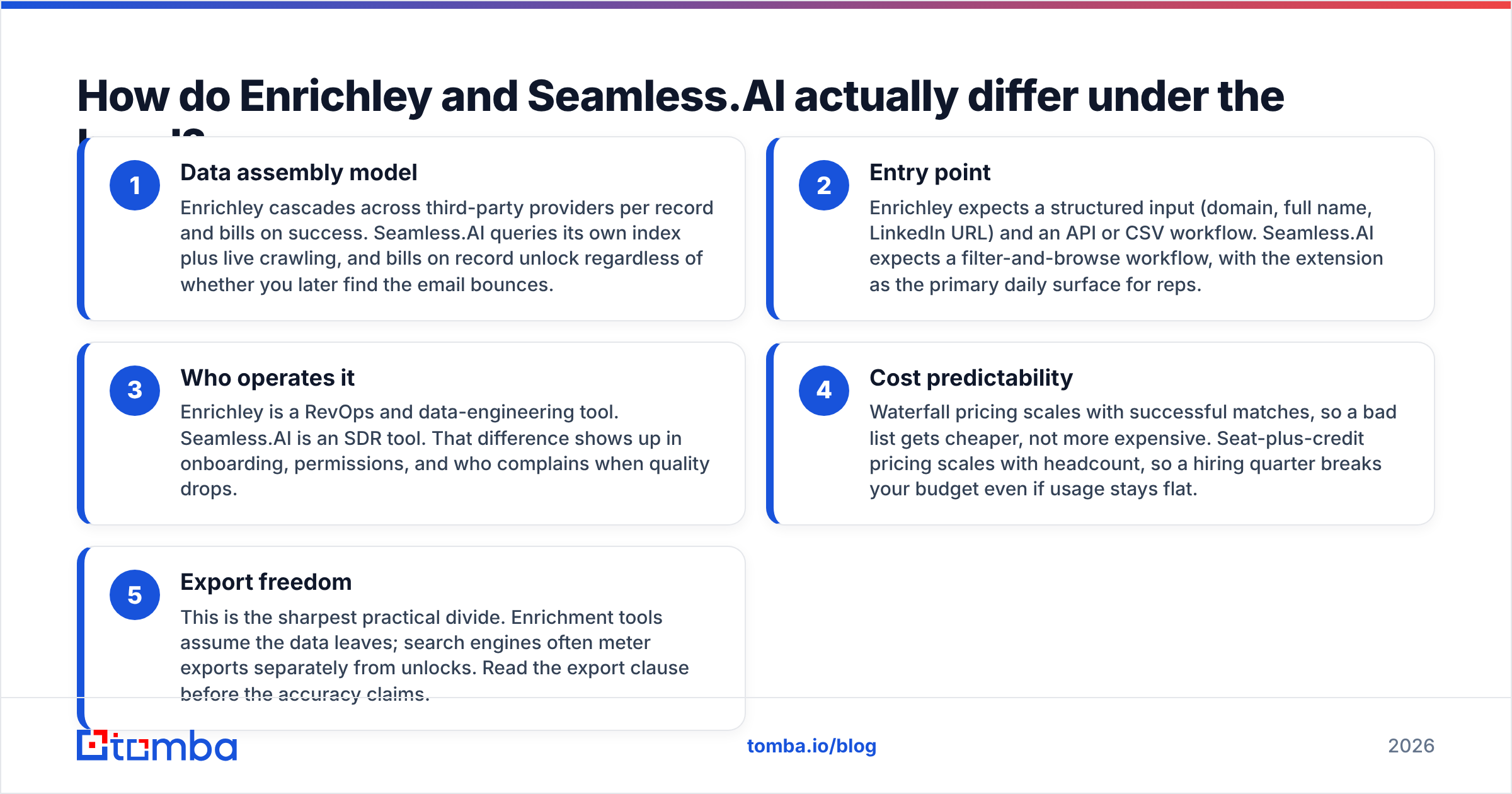
Five structural differences decide which one fits your motion. Three of them are about how the data arrives:
- Data assembly model — Enrichley cascades across third-party providers per record and bills on success. Seamless.AI queries its own index plus live crawling, and bills on record unlock. It bills that way whether or not the email later bounces.
- Entry point — Enrichley expects a structured input (domain, full name, LinkedIn URL) and an API or CSV workflow. Seamless.AI expects a filter-and-browse workflow, with the extension as the daily surface for reps.
- Who operates it — Enrichley is a RevOps and data-engineering tool. Seamless.AI is an SDR tool. That difference shows up in onboarding, permissions, and who complains when quality drops.
The other two are about money and control:
- Cost predictability — Waterfall pricing scales with successful matches, so a bad list gets cheaper, not more expensive. Seat-plus-credit pricing scales with headcount, so a hiring quarter breaks your budget even if usage stays flat.
- Export freedom — This is the sharpest practical divide. Enrichment tools assume the data leaves. Search engines often meter exports separately from unlocks. Read the export clause before the accuracy claims.
Which one gives you better data accuracy?#
Honest answer: it depends on your segment, and both vendors' headline numbers are self-reported.
Waterfall enrichment structurally wins on coverage because it has more shots on goal. If provider A has no record for a 30-person logistics company in Poland, provider C might. Single-index search engines are better on freshness in high-volume segments like US tech, because their crawlers hit those profiles constantly. The tradeoff is predictable: coverage in the long tail versus recency in the head.
The trap with Seamless.AI is that credits burn on unlock, not on verified delivery. If a record is stale, you already paid. Reviewers on G2's sales intelligence category raise this often — strong volume, uneven hit quality by vertical, and credit use that outpaces expectation. That is not a scandal. It is the economics of unlock-based billing.

Whatever you buy, treat the vendor's output as unverified until you prove otherwise. Push every result through an independent email verifier before it reaches a sequencer. A 4% bounce rate is the difference between a warm inbox and a domain you have to retire, and no enrichment vendor absorbs that cost for you.
If your list is full of catch-all domains, add a catch-all verifier step. Standard SMTP checks return "unknown" on those, and most tools quietly count unknowns as valid. The broader principle: data quality is a pipeline property, not a vendor property. You get accuracy from source diversity plus independent verification, never from one supplier's dashboard number.
How do Enrichley and Seamless.AI compare on features and pricing?#
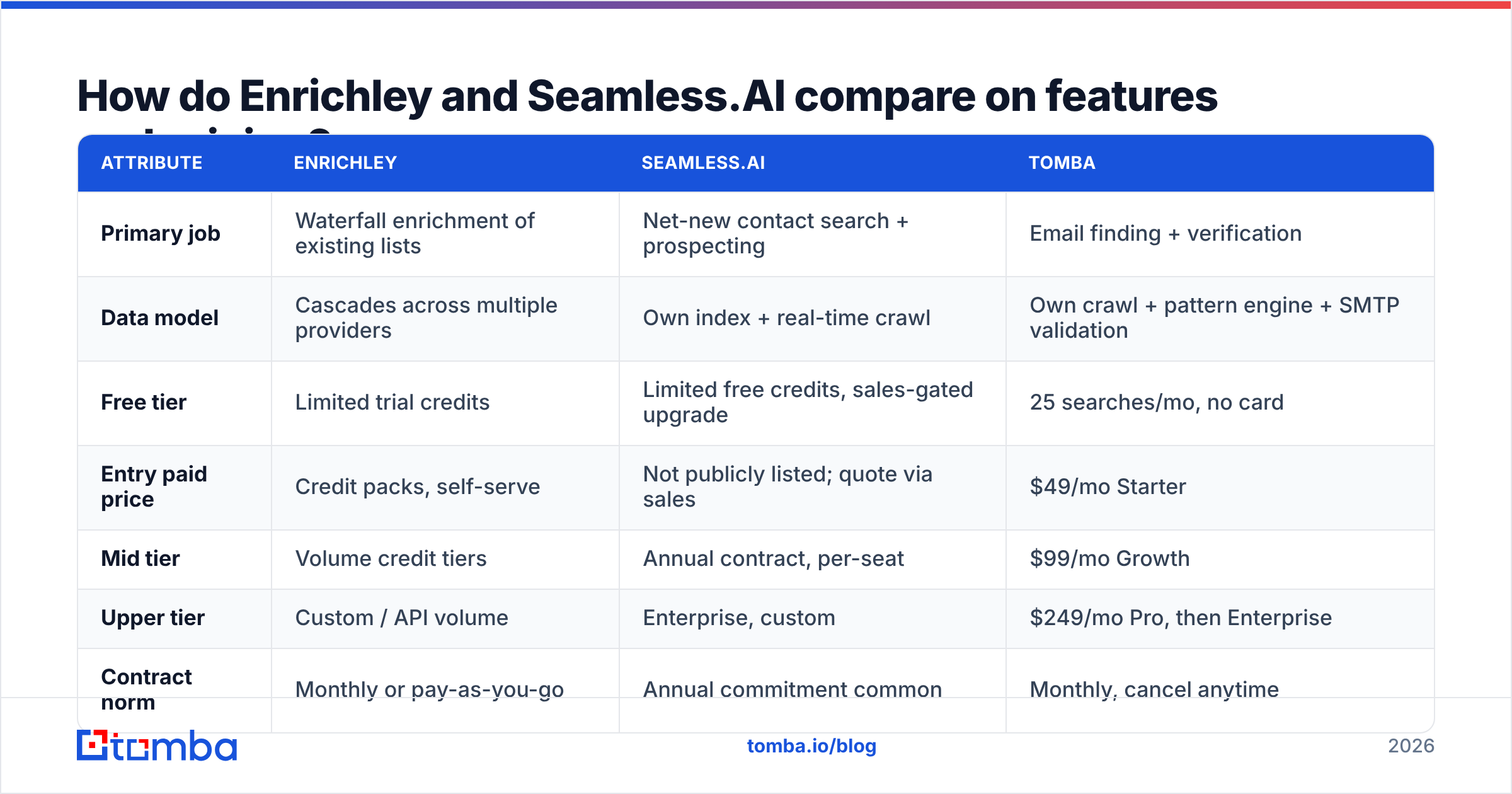
Public pricing for both moves, and Seamless.AI gates most numbers behind a demo. Treat the table below as a structural comparison, then confirm current figures with each vendor.
| Attribute | Enrichley | Seamless.AI | Tomba |
|---|---|---|---|
| Primary job | Waterfall enrichment of existing lists | Net-new contact search + prospecting | Email finding + verification |
| Data model | Cascades across multiple providers | Own index + real-time crawl | Own crawl + pattern engine + SMTP validation |
| Free tier | Limited trial credits | Limited free credits, sales-gated upgrade | 25 searches/mo, no card |
| Entry paid price | Credit packs, self-serve | Not publicly listed; quote via sales | $49/mo Starter |
| Mid tier | Volume credit tiers | Annual contract, per-seat | $99/mo Growth |
| Upper tier | Custom / API volume | Enterprise, custom | $249/mo Pro, then Enterprise |
| Contract norm | Monthly or pay-as-you-go | Annual commitment common | Monthly, cancel anytime |
| Chrome extension | Limited | Yes — core workflow | Yes |
| Native API | Yes | Yes, higher tiers | Yes, all paid tiers |
| Built-in verification | Provider-dependent | Basic | Dedicated verifier + catch-all handling |
| Phone numbers | Via providers | Yes, mobile-heavy pitch | Yes |
| Best for | RevOps filling CRM gaps | SDR teams needing volume | Teams that need clean emails at a fixed cost |

Two line items deserve more attention than the rest.
Contract length. Monthly credit packs let you fail cheaply. Annual seat contracts do not. If you are still validating an outbound motion, the ability to cancel in month two is worth more than a 15% annual discount.
Credit definition. "Credit" means different things across these products. A search that returns nothing may or may not cost you. An enrichment that returns a phone but no email may bill as a full record. Ask both vendors the same question in writing: what exactly triggers a credit deduction, and what is refunded? The answers will differ more than the headline prices do.
What does Seamless.AI really cost?#
Seamless.AI's list price is not the number most teams end up paying, in either direction.
The public entry point is a free tier with a small credit allocation, designed to get you into the extension. Beyond that, pricing is quoted. Reported deal sizes vary widely by seat count and negotiated credit volume, and multi-seat annual contracts are standard. Two things consistently surprise buyers:
- Per-seat cost compounds. Ten reps on a per-seat sales intelligence tool is a very different budget line than one RevOps analyst running enrichment jobs over the same records.
- Credits and seats are separate levers. Buying more seats does not raise your credit pool in proportion, so fast-growing teams often renegotiate mid-term from a weak position.
None of this makes Seamless.AI a bad product. It makes it an enterprise-shaped purchase. If your team is three people testing outbound, that shape is wrong no matter how good the data is. It is also the most common reason buyers go looking for a Seamless.AI alternative six months in.

Where does each tool genuinely win?#
Skip the "it depends" and pick by workflow:
- Choose Enrichley if your bottleneck is a CRM full of half-complete records, you have a RevOps owner who can run batch jobs, and you want per-success billing that punishes bad input lists cheaply.
- Choose Seamless.AI if you run a browser-native SDR floor, need net-new names daily, care about mobile numbers as much as emails, and have budget for an annual multi-seat commitment.
- Choose neither if your actual requirement is "given a name and a company domain, get me a deliverable work email." That is a narrower job, and narrow tools do it cheaper and better.
That third case is more common than vendors like to admit. Plenty of teams buy a full sales intelligence platform, use 8% of the surface area, and discover their real workflow is domain-in, verified-emails-out.
Is there a cheaper option for email-first outbound?#
Yes — and the tradeoff is worth naming honestly rather than pretending one tool wins everything.
If your outbound depends on verified work emails rather than a filterable universe of contacts, a focused finder is the better economic fit. Tomba's email finder works from a name plus domain. Its domain search returns every discoverable address on a company domain with role and confidence signals. Verification runs in the same pipeline, not as a separate vendor. Pricing is public and flat: free tier at 25 searches/mo, Starter at $49/mo, Growth at $99/mo, Pro at $249/mo. Full Tomba pricing sits on one page, with no demo call to see a number.
What Tomba does not do: it is not a filter-by-intent prospecting universe, and it does not replace a full sales intelligence platform for enterprise ABM. If you need buying-signal data and firmographic filtering across millions of accounts, Seamless.AI or a dedicated intent vendor is the honest recommendation. If you need clean addresses at predictable cost, the narrower tool wins.
For teams that already have a list and just need it enriched at volume, the bulk email finder handles CSV in, verified CSV out. The Tomba API covers the same job programmatically on every paid tier, not gated behind an enterprise upgrade.
How should you run a fair head-to-head test?#
Do this before any contract, not after. It takes an afternoon. Start by building the list and running it:
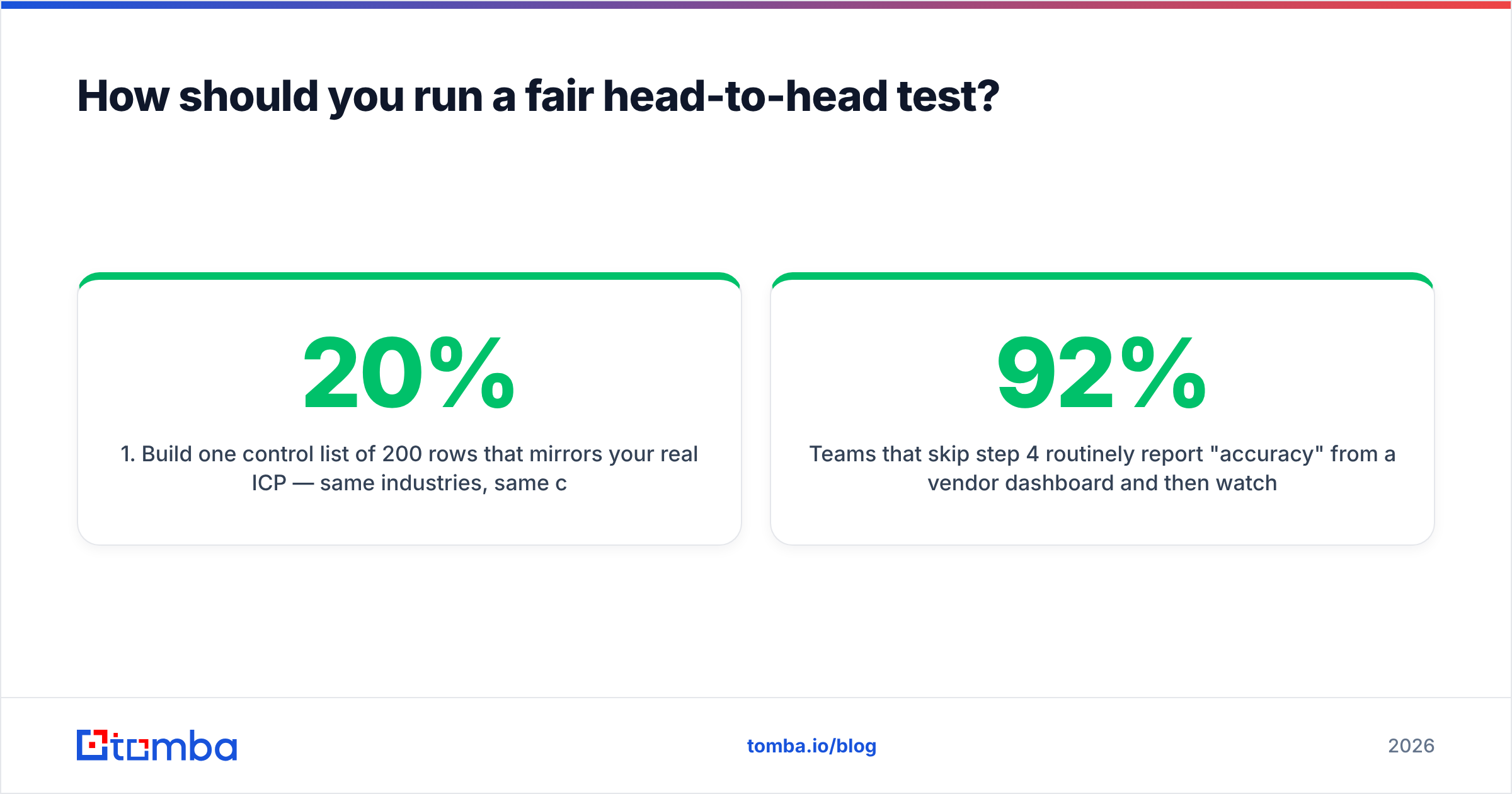
- Build one control list of 200 rows that mirrors your real ICP — same industries, same company sizes, same geographies. Include 20% deliberately hard rows: non-US domains, sub-50-employee companies, hyphenated names.
- Run the identical list through every tool on the same day. Freshness varies week to week, and staggered tests produce meaningless comparisons.
- Record two numbers per tool: hit rate and cost per hit. Hit rate alone favors expensive tools. Cost per hit is the number your CFO will ask about.
Then check what the data does in the real world:
- Verify every returned address with a neutral third party, not the vendor's own checker. A vendor grading its own output is not evidence. A free email checker works for spot checks. Use a bulk verifier for the full set.
- Send a real 100-contact campaign per tool and log bounce rate. Deliverability is the only metric that maps to revenue.
- Price the annual cost at 3x your current volume. Every one of these tools is affordable at pilot scale. The question is what happens when it works.
Teams that skip step 4 routinely report 92% "accuracy" from a vendor dashboard, then watch a 7% hard bounce rate torch their sender reputation in week three.
Enrichley vs Seamless.AI: which should you pick?#
If you have lists and need them filled: Enrichley. Waterfall architecture is the right design for gap-filling, and per-success billing aligns vendor incentive with your outcome.
If you have reps and need volume: Seamless.AI, provided you go in knowing it is an annual, per-seat, sales-negotiated purchase and you budget for credit overage. Negotiate the credit pool harder than the seat price.
If you have domains and need verified emails: neither, and that is not a dodge. Buying a sales intelligence platform to extract emails is like buying a truck to move one box. It works, and you overpaid by a factor of five.
Start with the narrow tool, prove the motion works, and upgrade to a platform when you can name the specific feature you are missing. That order costs less and teaches you more.
Ready to test the email layer without a sales call? Start with the Tomba Email Finder free tier — 25 searches a month, no card, and every result runs through verification before it reaches you. Run it against the same 200-row list you send to Enrichley and Seamless.AI, compare cost per verified contact, and let the bounce rate decide.
Related guides#
Ready to find emails that actually work?
Join 150,000+ professionals who stopped guessing and started sending. Free credits on signup — no credit card required.
Get the Tomba newsletter
Practical outbound tactics and product updates — once every two weeks.
About the author