Enrow vs GrowMeOrganic (2026): Which Tool Should You Pick?
Enrow is a verification-first engine. GrowMeOrganic is a LinkedIn-first prospecting suite. They solve different halves of the same problem — here's which half you actually have, and what each one costs to fix it.
TL;DR
- Enrow is a verification-first tool. Its whole reason to exist is deciding whether an address is safe to send to — including catch-all domains, which is where most verifiers quietly give up.
- GrowMeOrganic is a prospecting suite. LinkedIn scraping, contact database, email finding, and drip campaigns bundled into one seat-based subscription with a lifetime-deal history.
- They are not really competitors. Comparing them head-to-head is like comparing a scale to a grocery store. Most teams that shortlist both actually need one of each — or one tool that covers both jobs.
- Cost gets ugly fast if you stack a prospecting suite plus a standalone verifier plus a sending tool. Three subscriptions to move one lead from "name on LinkedIn" to "email in inbox."
- The consolidation play: a single find-and-verify API. Tomba starts at $49/mo (25 free searches to test first), returns a confidence score with every email, and includes a dedicated catch-all verifier instead of charging for it separately.
What are Enrow and GrowMeOrganic, exactly?#
Start here, because half the confusion in the Enrow vs GrowMeOrganic comparison comes from assuming they do the same thing.
Enrow is a French email verification and finding service built around one promise: tell you whether an email will bounce before you send to it. Its selling point is handling the hard cases — catch-all servers, which accept every address at the SMTP handshake and then silently discard the invalid ones. Most verifiers return "unknown" or "risky" on those domains and hand the risk back to you. Enrow's positioning is that it resolves a meaningful share of them into a real verdict.
GrowMeOrganic is a different animal. It's an all-in-one prospecting platform: a Chrome extension that pulls contacts off LinkedIn and Sales Navigator, a B2B contact database, an email finder, and a built-in cold email sequencer. It grew popular through lifetime deals on marketplaces like AppSumo, which is why you'll still see it in "cheap Apollo alternative" threads.
So one tool answers "is this address real?" and the other answers "who should I email, and how do I send it?" Different questions, different budgets, different failure modes.

How do Enrow and GrowMeOrganic compare head-to-head?#
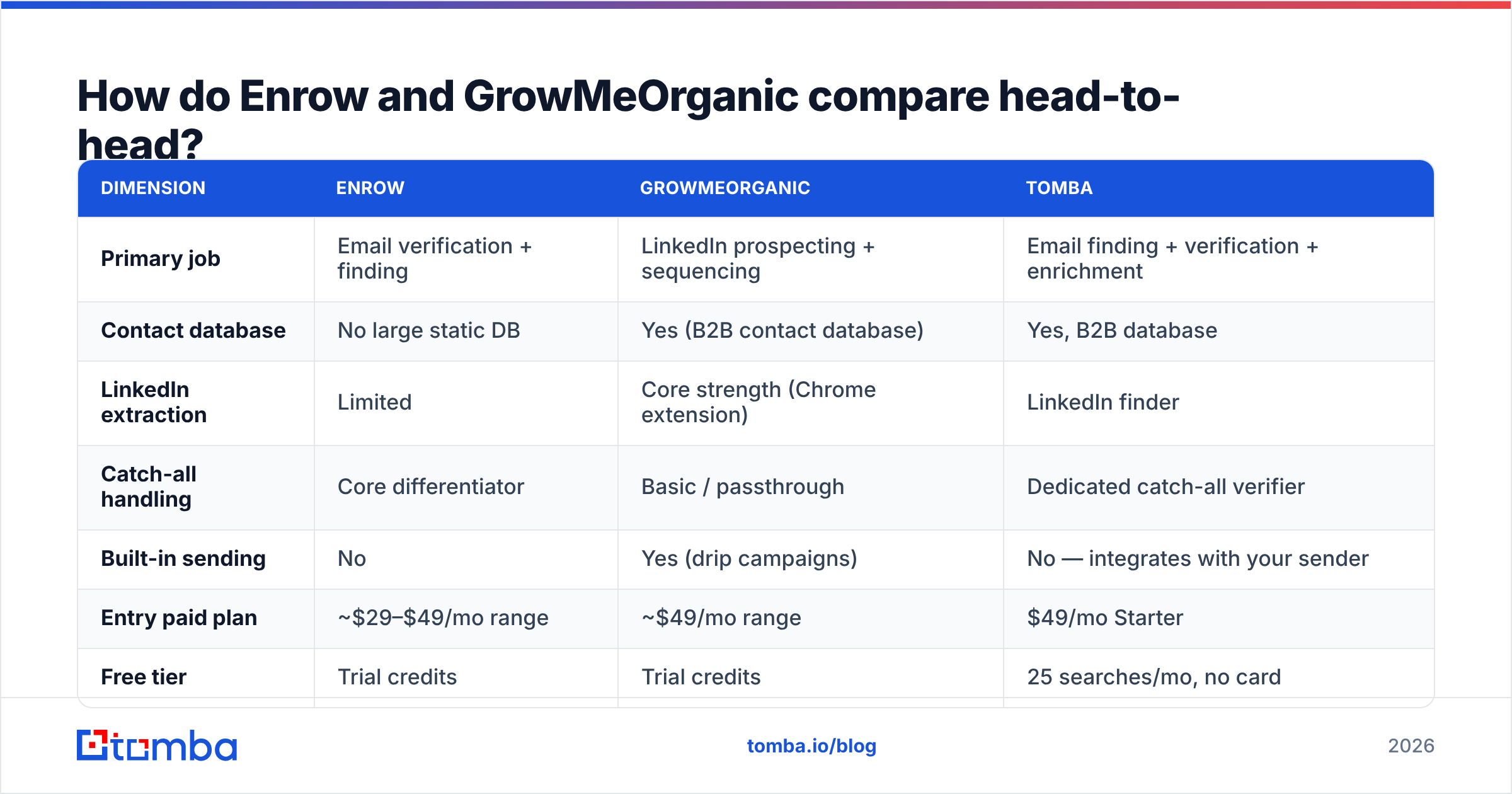
Here's the honest side-by-side. Pricing moves constantly on both platforms, so treat the figures as an order-of-magnitude guide and confirm on the vendor pages before you commit.
| Dimension | Enrow | GrowMeOrganic | Tomba |
|---|---|---|---|
| Primary job | Email verification + finding | LinkedIn prospecting + sequencing | Email finding + verification + enrichment |
| Contact database | No large static DB | Yes (B2B contact database) | Yes, B2B database |
| LinkedIn extraction | Limited | Core strength (Chrome extension) | LinkedIn finder |
| Catch-all handling | Core differentiator | Basic / passthrough | Dedicated catch-all verifier |
| Built-in sending | No | Yes (drip campaigns) | No — integrates with your sender |
| Entry paid plan | ~$29–$49/mo range | ~$49/mo range | $49/mo Starter |
| Free tier | Trial credits | Trial credits | 25 searches/mo, no card |
| Public API | Yes | Yes | Yes — Tomba API, CLI, MCP |
| Best fit | Cleaning lists you already own | Building lists from scratch | Both, in one credit pool |
The pattern jumps out immediately: Enrow is deep and narrow, GrowMeOrganic is broad and shallow. If you buy Enrow, you still need a source of contacts. If you buy GrowMeOrganic, you still need something to check the addresses it produces before your domain reputation takes the hit.
Which one actually finds more valid emails?#
This is the question people mean when they search Enrow vs GrowMeOrganic, and the answer depends on what you feed it.
On a list of known names and domains — say 5,000 rows exported from a conference attendee list — Enrow will generally return a higher share of confidently-valid addresses, because pattern resolution and SMTP-level validation are its entire product. GrowMeOrganic's finder is a feature inside a larger suite; it's fine, not specialized.
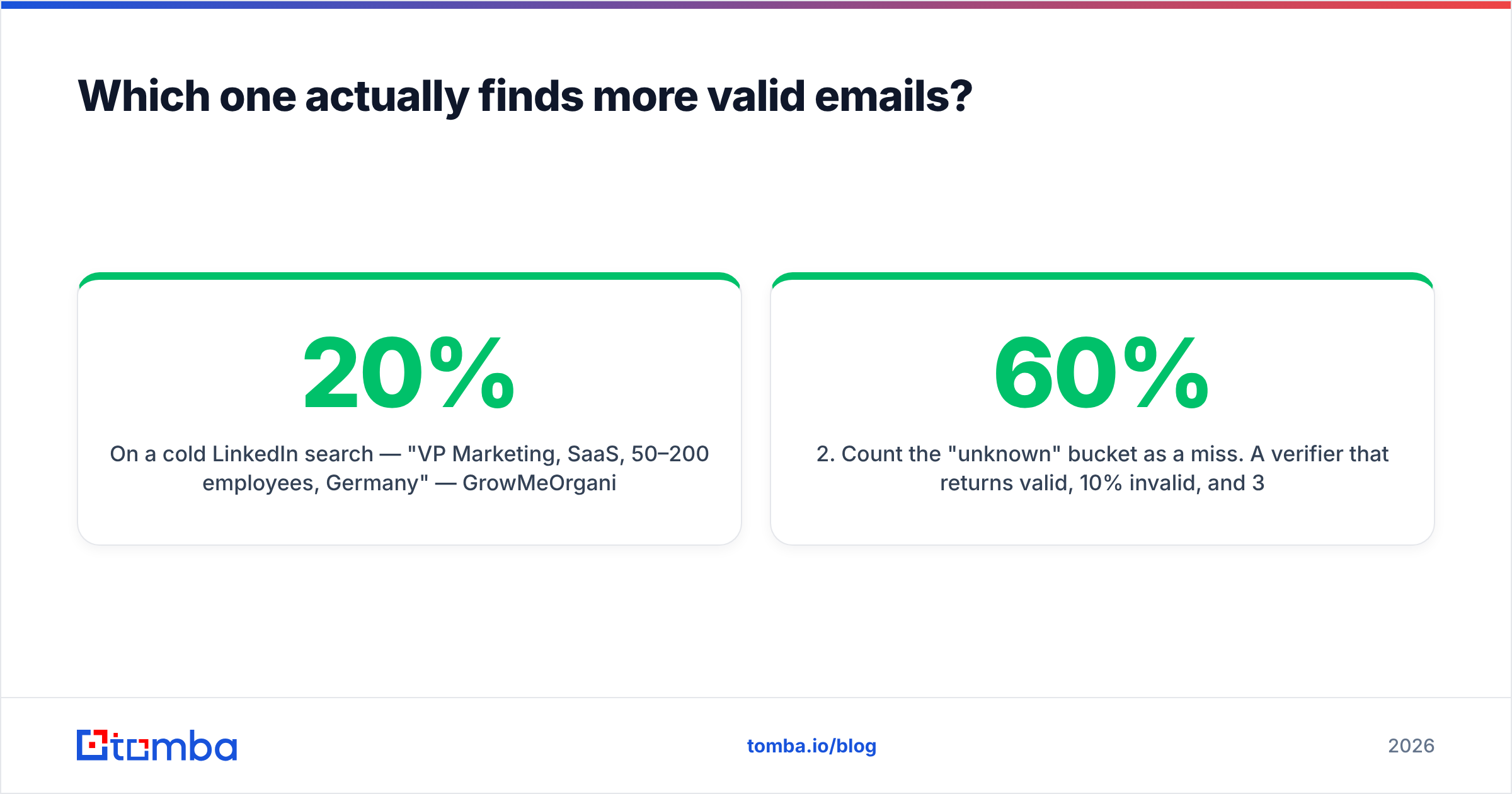
On a cold LinkedIn search — "VP Marketing, SaaS, 50–200 employees, Germany" — GrowMeOrganic wins on raw volume, because it can scrape the profiles first. Enrow has no equivalent sourcing layer. But volume is not the same as deliverable volume: a large export where 20% of rows bounce is worse than a smaller export where 3% do, because bounce rate is what your mailbox provider grades you on.

The metric that matters isn't "hit rate," it's valid-and-deliverable rate: found ÷ attempted, minus everything that bounces. Vendors quote the first number. Your sender reputation is graded on the second.
Two rules for testing this yourself before you sign anything:
- Use your own list, not the vendor's demo. Take 200 contacts you can independently confirm — customers, past leads, people who've replied to you. Run them through each tool blind.
- Count the "unknown" bucket as a miss. A verifier that returns 60% valid, 10% invalid, and 30% unknown has not done 60% of the job. It's done 60% and handed you a 30% coin flip.
How do they handle catch-all domains?#
Catch-all is where this comparison gets interesting, because it's the one axis where Enrow has a genuine, defensible edge over most of the market — including over GrowMeOrganic.
A catch-all (or "accept-all") server is configured to say yes to every address at the door. ceo@company.com, zzzz@company.com — both accepted. The SMTP conversation tells you nothing. Roughly a fifth to a quarter of business domains are configured this way, and the share skews higher among enterprises, which are exactly the accounts most B2B teams care about.
Your options when a domain is catch-all:
- Skip it. Safe, but you just deleted a chunk of your ICP.
- Send anyway. You'll get some replies and some bounces, and the bounces cost you deliverability.
- Resolve it with secondary signals — pattern confidence across the domain, cross-source corroboration, engagement history. This is the expensive path, and it's what Enrow is built around.
GrowMeOrganic doesn't market a specialized catch-all resolution layer. If catch-all coverage is your bottleneck, that's a real point for Enrow.
It's also worth knowing that this isn't a two-horse race. Tomba ships a catch-all finder and a separate catch-all verifier inside the same subscription rather than as a premium add-on, and providers like BookYourData take a different but legitimate route — selling pre-verified contact records with bounce guarantees attached, which sidesteps the catch-all problem at the source rather than solving it at send time. Different architecture, same goal.
What does each one really cost in 2026?#
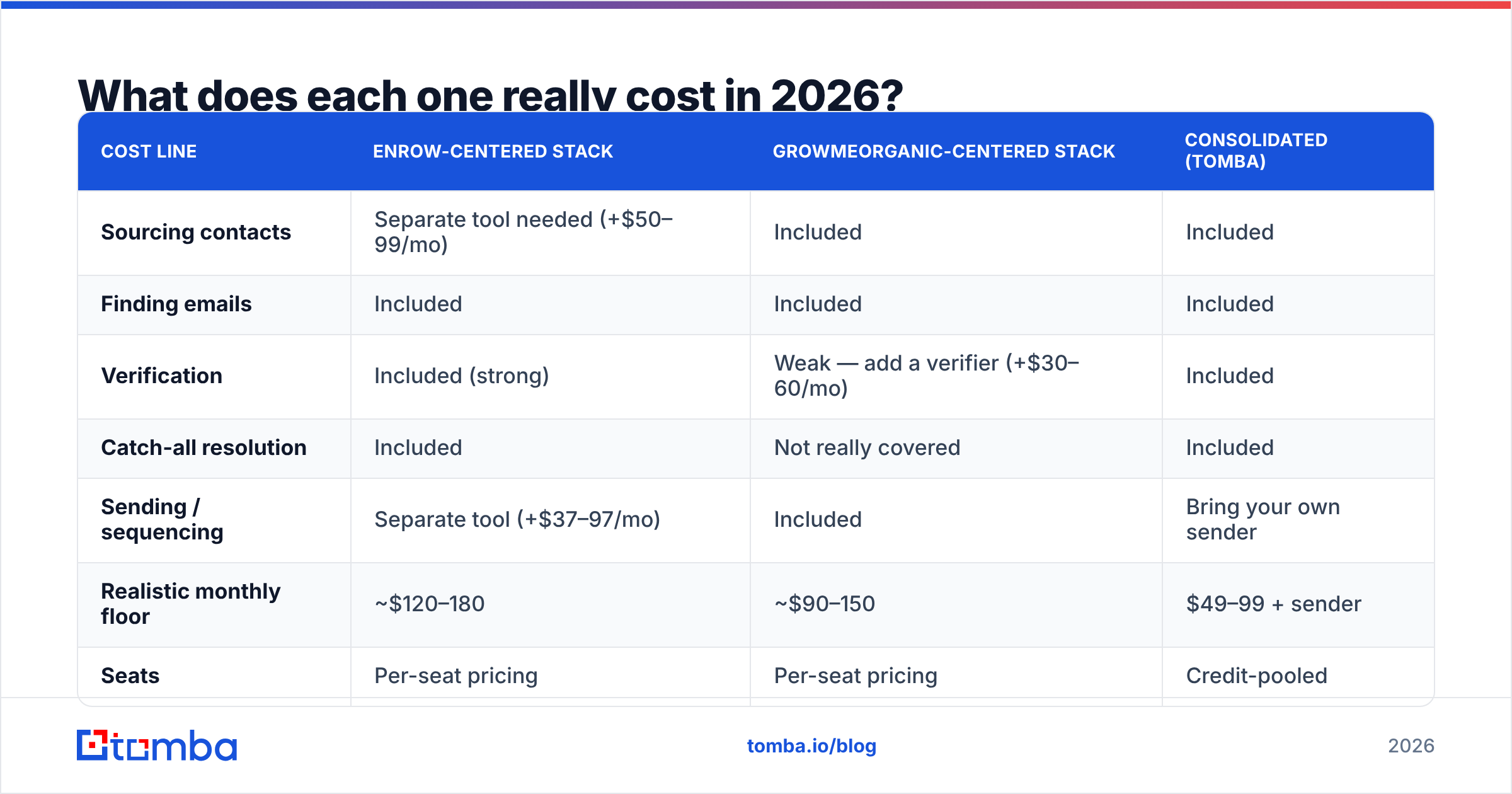
Sticker price is the least interesting part of any tool comparison. Here's what the total bill actually looks like for a small outbound team running roughly 3,000 new contacts a month.
| Cost line | Enrow-centered stack | GrowMeOrganic-centered stack | Consolidated (Tomba) |
|---|---|---|---|
| Sourcing contacts | Separate tool needed (+$50–99/mo) | Included | Included |
| Finding emails | Included | Included | Included |
| Verification | Included (strong) | Weak — add a verifier (+$30–60/mo) | Included |
| Catch-all resolution | Included | Not really covered | Included |
| Sending / sequencing | Separate tool (+$37–97/mo) | Included | Bring your own sender |
| Realistic monthly floor | ~$120–180 | ~$90–150 | $49–99 + sender |
| Seats | Per-seat pricing | Per-seat pricing | Credit-pooled |
Two things to watch on any of these platforms:
- Credit burn on failures. Ask directly: do you get charged for a search that returns nothing? Policies vary, and it changes effective cost per usable contact by a lot.
- Per-seat multiplication. A $49 tool for one rep is a $245 tool for a five-person team. Credit-pooled pricing behaves very differently at team scale — see Tomba pricing for the comparison.
Read the review counts and recency on G2 for both tools before you decide. Lifetime-deal-era reviews and 2026 reviews often describe two different products.
Who should choose Enrow?#
Pick Enrow if you can honestly say most of these:
- You already have a contact source. A CRM, a scraper, an SDR team, a partner list — the names come from somewhere else and you just need them cleaned.
- Your bounce rate is the problem. You're above 3% and it's starting to show in your inbox placement.
- Enterprise domains dominate your ICP. More catch-all servers means more value from a specialized resolver.
- You don't need sequencing. You already run Instantly, Smartlead, Lemlist, or your own sending infrastructure.
Enrow is a scalpel. If your problem is precisely the thing it cuts, it's an easy yes.
Who should choose GrowMeOrganic?#
Pick GrowMeOrganic if:
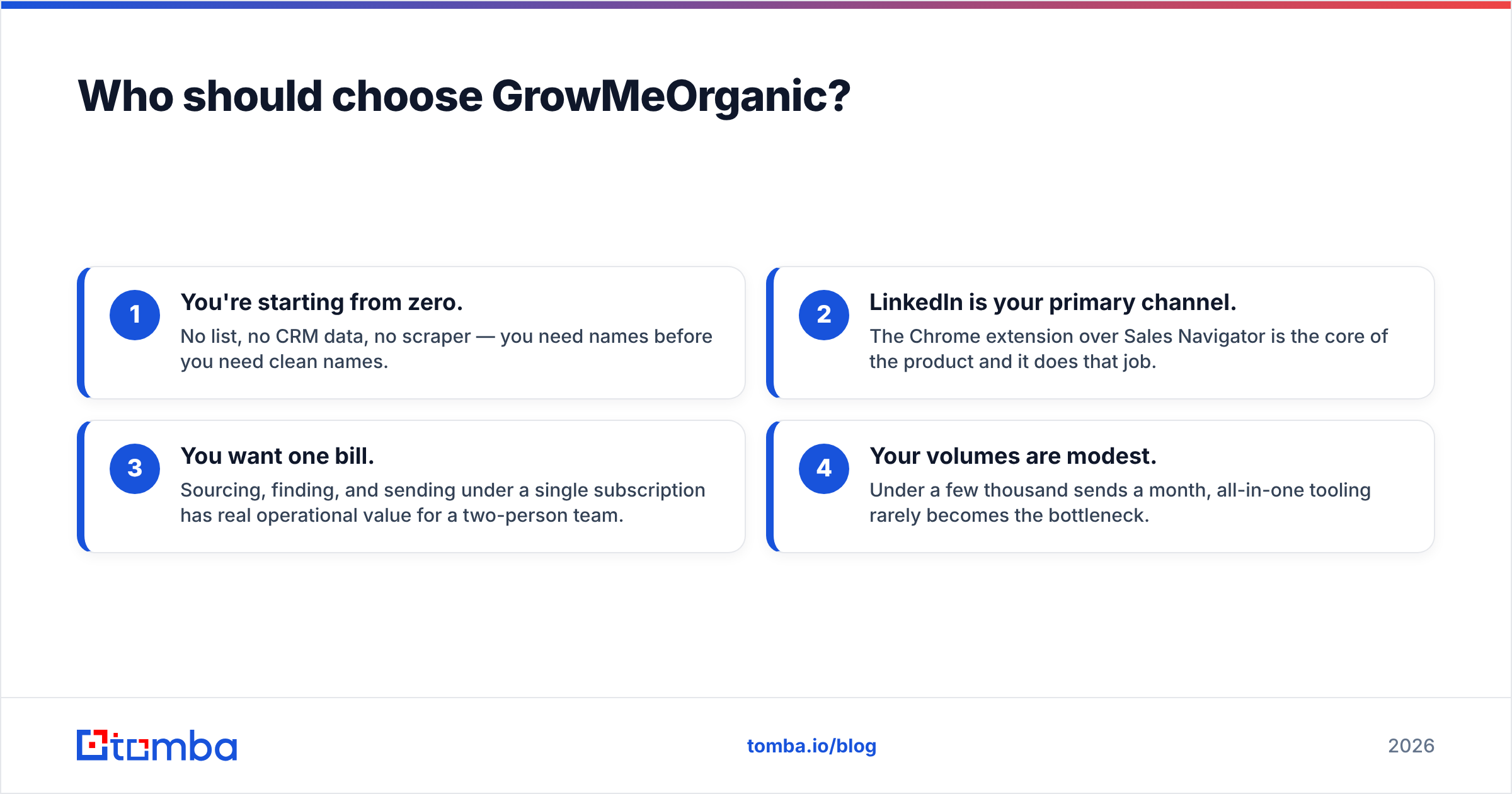
- You're starting from zero. No list, no CRM data, no scraper — you need names before you need clean names.
- LinkedIn is your primary channel. The Chrome extension over Sales Navigator is the core of the product and it does that job.
- You want one bill. Sourcing, finding, and sending under a single subscription has real operational value for a two-person team.
- Your volumes are modest. Under a few thousand sends a month, all-in-one tooling rarely becomes the bottleneck.
Just budget separately for verification. Sending unverified scraped addresses through a shared sending infrastructure is the fastest way to burn a domain.
Where does Tomba fit in the Enrow vs GrowMeOrganic decision?#
Honestly? It fits the case where you looked at both and realized you need the middle.
Tomba's core is the email finder — give it a name and a domain, or just a domain, and get verified professional addresses back. Around it sit the pieces you'd otherwise buy separately: an email verifier, domain search for mapping a whole company's contacts, catch-all verification, phone finding, and data enrichment.
What it deliberately doesn't do is send your email. That's a design choice, not a gap — sequencing tools are a competitive, well-served category, and bundling a mediocre one would only make the data layer worse.

The practical differences that show up in day-to-day use:
- Every result carries a confidence score, not just a green checkmark. You decide your own risk threshold per campaign instead of trusting a binary.
- Sources are visible. Where the data comes from is documented, which matters for GDPR and CCPA review.
- It meets you where you work. Chrome extension, Google Sheets add-on, Excel, a CLI, an MCP server, and native HubSpot and Salesforce integrations.
- Real free tier. 25 searches a month, no card, no sales call — enough to run the 200-contact blind test described above against Enrow and GrowMeOrganic side by side.
What's the verdict?#
There isn't a single winner, because these two tools answer different questions — and any article that declares one is selling you something.
Choose Enrow when your list already exists and your bounce rate is the fire. Its catch-all work is genuinely differentiated.
Choose GrowMeOrganic when you have no list at all, LinkedIn is your channel, and you want sourcing plus sending on one invoice. Add a verifier to the budget.
Choose a consolidated find-and-verify layer when you're doing both jobs at volume and don't want to pay two subscriptions, reconcile two credit systems, and export CSVs between them every Monday. That's where per-contact economics start to matter more than feature checklists.
The test that settles it takes an afternoon: 200 contacts you can independently verify, all three tools, count valid-and-deliverable results, divide by cost. Vendor benchmarks are marketing. Your list is evidence.
Ready to run that test? Start with the Tomba Email Finder — 25 free searches a month, no credit card, confidence score on every result. Feed it the same 200 rows you're about to hand Enrow and GrowMeOrganic, then compare the numbers yourself. If Tomba doesn't win on your data, you'll at least have a real benchmark instead of a vendor slide.
Related guides#
Ready to find emails that actually work?
Join 150,000+ professionals who stopped guessing and started sending. Free credits on signup — no credit card required.
Get the Tomba newsletter
Practical outbound tactics and product updates — once every two weeks.
About the author