Enrow vs Lead411 (2026): Which Email Data Tool Wins?
Enrow verifies and finds emails; Lead411 sells a contact database with intent data and direct dials. They solve different problems — here's the honest breakdown of pricing, accuracy, and which one your outbound actually needs in 2026.
TL;DR
- Enrow and Lead411 are not really competitors. Enrow is an email finding and verification engine that cleans and completes lists you already have; Lead411 is a subscription contact database with direct dials and buyer intent data.
- Pick Enrow if your bottleneck is bounce rate and catch-all domains. Pick Lead411 if your bottleneck is "we have no one to email" and you want intent signals plus phone numbers in one seat-based subscription.
- Lead411 is priced per seat with a large annual commitment; Enrow is credit-based and cheaper to start but does nothing for list sourcing beyond what you feed it.
- Most teams that buy one end up buying the other six months later. A credit-based platform that does finding, verification, catch-all resolution, and enrichment — like Tomba at $49/mo — usually collapses both line items.
- Whatever you choose, verify before you send. Every provider's data decays 2–3% per month, and no database refresh cycle is fast enough to save your domain reputation on its own.
What is Enrow and what problem does it actually solve?#
Enrow is a European email finding and verification service built around one specific pain: catch-all domains. A catch-all server accepts mail for any address at the domain, which means traditional SMTP verification returns "unknown" and most tools shrug. Enrow's pitch is that it resolves a meaningful share of those unknowns into a hard valid/invalid answer, and it publishes accuracy guarantees rather than vague "industry-leading" claims.
The workflow is narrow by design. You upload a CSV or hit the API with a first name, last name, and domain. Enrow returns an email and a status. There is no prospecting UI, no saved-search feed of new hires, no phone numbers, no intent data. It sits behind your list-building step, not in front of it.
That narrowness is the product's strength and its ceiling. If you already have a scraper, a LinkedIn export, or a partner list of 40,000 companies, Enrow turns raw rows into deliverable rows. If you have nothing, it gives you nothing.

Two things to understand about accuracy claims in this category before you compare anyone:
- "Accuracy" usually means precision, not coverage. A tool can hit 99% accuracy by refusing to answer on anything hard. Always ask for the hit rate alongside it.
- Catch-all resolution is probabilistic. Nobody has a deterministic answer on a domain that accepts everything. Vendors infer from pattern history, engagement data, and secondary signals. That is legitimate — but it means results vary wildly by industry and region.
What is Lead411 and who is it built for?#
Lead411 is a B2B contact and company database that has been around since 2001. It sells access to millions of contact records with verified emails, direct-dial mobile numbers, technographics, and — its main differentiator — Bombora-powered buyer intent data and "growth intent" triggers like recent funding rounds, hiring spikes, and executive changes.
The buyer is an SDR team or a small-to-mid-market sales org that wants one login for the whole prospecting motion: build a list by title and industry, see who is showing intent this week, grab the mobile number, push to HubSpot or Salesforce, sequence.
Lead411's positioning against the giants — ZoomInfo, Apollo, Cognism — has historically been "unlimited-ish exports without the six-figure contract." That is a real advantage over ZoomInfo. It is a weaker advantage against modern credit-based tools, and the seat-based model means costs scale with headcount rather than usage.

Where Lead411 gets criticized on review sites like G2 is fairly consistent: direct-dial accuracy varies by vertical, non-US coverage is thinner than the US dataset, and the export limits described as "unlimited" have fair-use ceilings that surprise heavy users. None of that makes it a bad product — it makes it a product with a specific sweet spot: US-centric mid-market outbound.
Enrow vs Lead411: how do they compare head-to-head?#
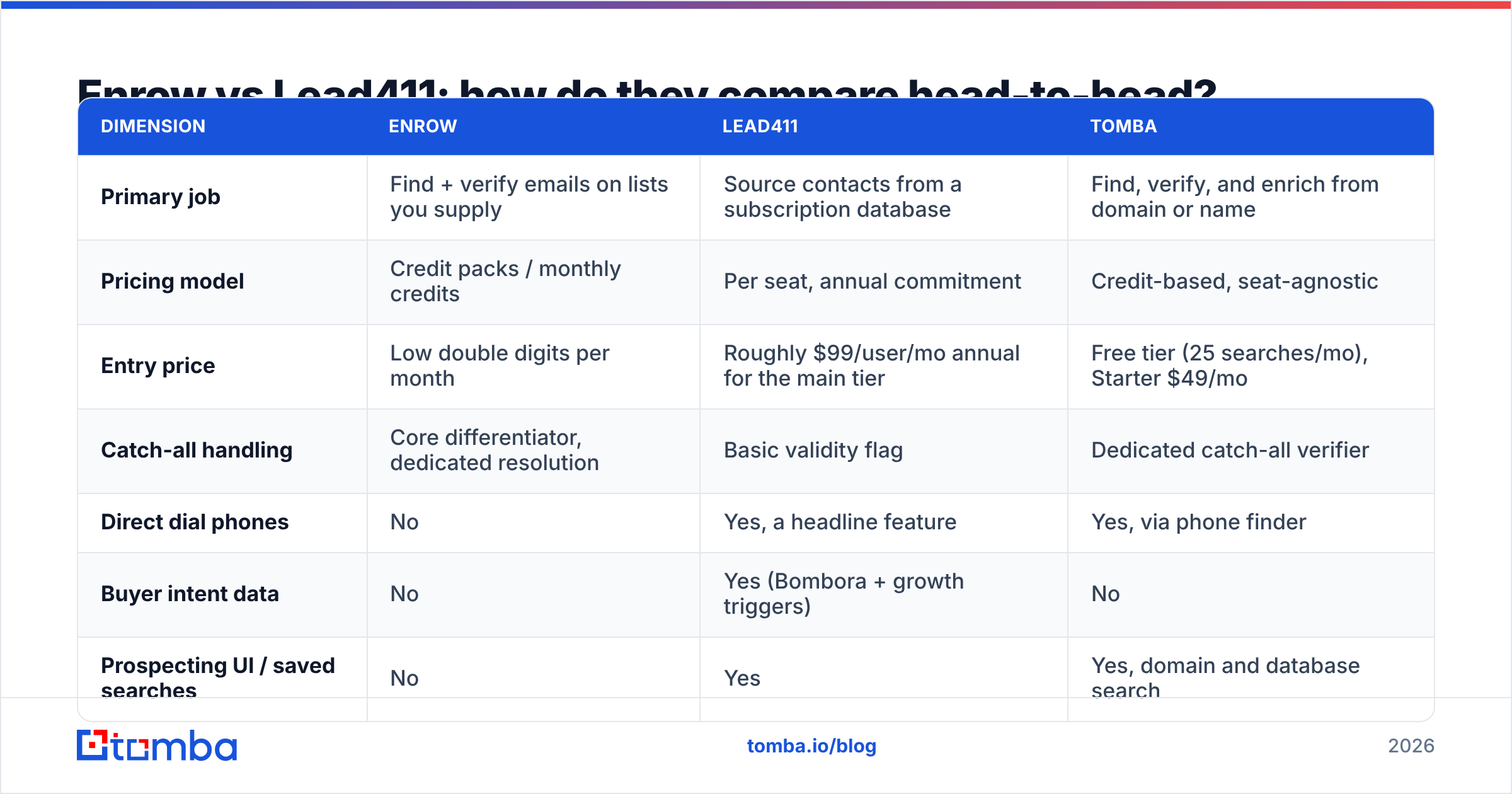
Here is the honest side-by-side. Prices are list prices observed at the time of writing and both vendors negotiate — verify on their own pages before you budget.
| Dimension | Enrow | Lead411 | Tomba |
|---|---|---|---|
| Primary job | Find + verify emails on lists you supply | Source contacts from a subscription database | Find, verify, and enrich from domain or name |
| Pricing model | Credit packs / monthly credits | Per seat, annual commitment | Credit-based, seat-agnostic |
| Entry price | Low double digits per month | Roughly $99/user/mo annual for the main tier | Free tier (25 searches/mo), Starter $49/mo |
| Catch-all handling | Core differentiator, dedicated resolution | Basic validity flag | Dedicated catch-all verifier |
| Direct dial phones | No | Yes, a headline feature | Yes, via phone finder |
| Buyer intent data | No | Yes (Bombora + growth triggers) | No |
| Prospecting UI / saved searches | No | Yes | Yes, domain and database search |
| API access | Yes | Yes, on higher tiers | Yes on all paid plans |
| Bulk processing | Yes, CSV + API | Export-limited | Yes, bulk email finder |
| Best for | Cleaning a list you already own | Building a US-centric list from scratch | Doing both without two subscriptions |

Read that table as a fork, not a scoreboard. If your row-level question is "is this address real?", Lead411 is the wrong purchase. If your question is "who at these 5,000 companies should I be talking to, and are any of them in-market right now?", Enrow cannot answer it at any price.
Which one is more accurate in practice?#
Neither vendor's marketing number will match what you see. Here is how to run a comparison that actually predicts your bounce rate.
- Build a 500-row control set from your own closed-won and closed-lost CRM records — real people, real domains, known-good addresses. Split it across at least three industries and two regions.
- Strip the emails and feed just name + domain to each tool. You now have ground truth to score against.
- Score three metrics separately: hit rate (percentage of rows returned), precision (percentage of returned rows that match ground truth), and catch-all share (percentage that came back as unresolved).
- Send a 200-address seed campaign through a warmed inbox and record actual hard bounces. This is the only number that matters to your domain reputation.
- Price per usable contact, not per credit. A $0.02 credit with a 45% hit rate costs more per usable contact than a $0.05 credit at 85%.
- Re-run the test 60 days later on the same list. Decay rate is a real cost line, and it separates vendors that refresh from vendors that hoard.
That fourth step is where most "accuracy" arguments die. A provider that returns a valid-looking address for a person who left the company in March is technically accurate and commercially useless. This is why the sequencing matters: source, then verify, then send — and re-verify anything older than 90 days with an email verifier before it enters a sequence.
What does each one actually cost at scale?#
The pricing models are structurally different, which makes headline comparisons misleading.
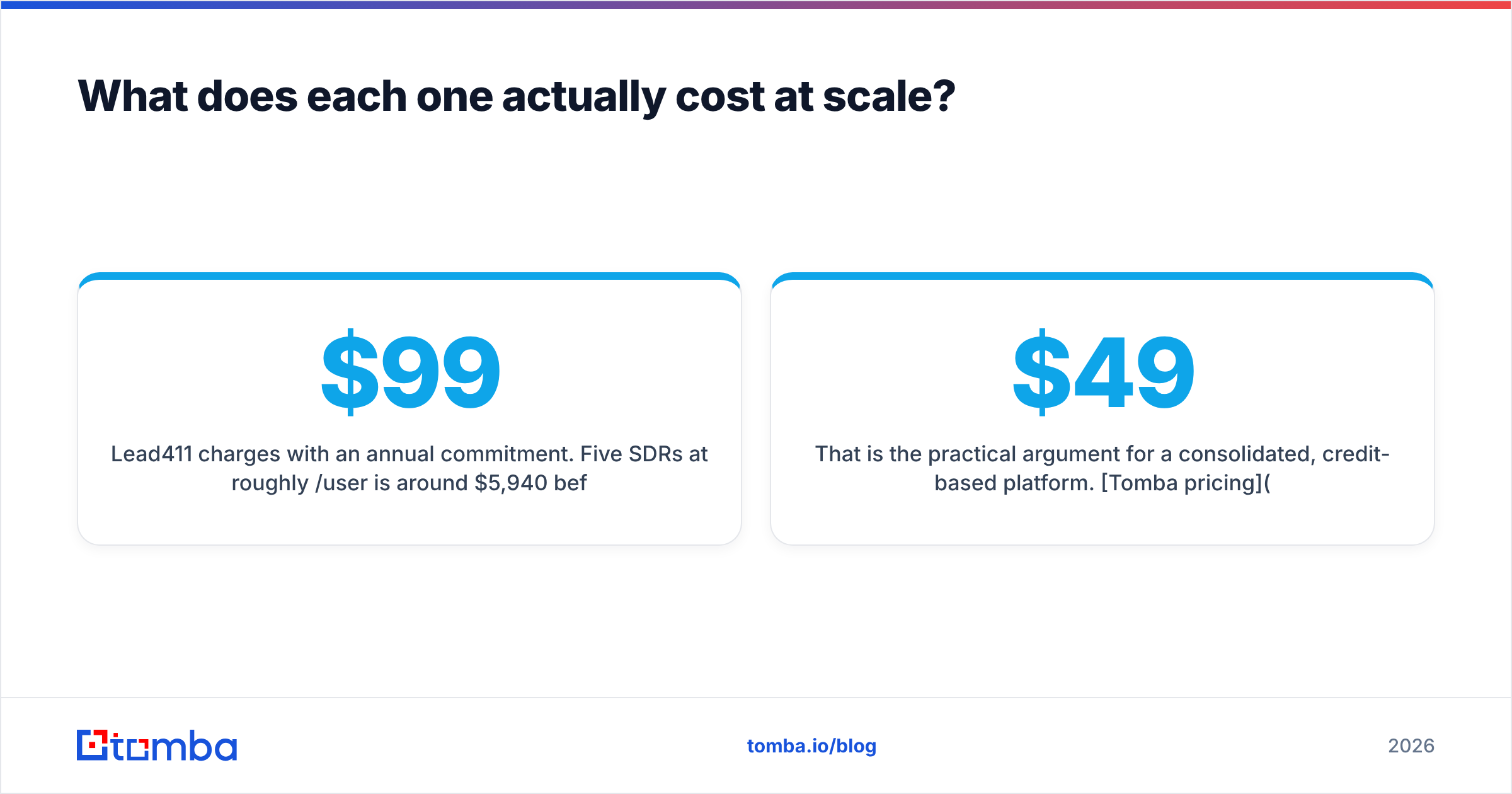
Lead411 charges per seat with an annual commitment. Five SDRs at roughly $99/user/month is around $5,940/year before add-ons like extra export volume or API access on higher tiers. The cost is predictable and does not spike with usage — but it also does not shrink when your team runs a quiet quarter, and every new rep adds a full seat.
Enrow charges for credits. A team burning 20,000 verifications a month pays for 20,000 verifications. Seasonal outbound teams love this. But credits only cover the verification step; you still pay separately for whatever produced the names in the first place — a scraper, a LinkedIn Sales Navigator seat, a data vendor.
The hidden third line item is what most teams miss. If you buy Lead411 for sourcing, you will still want independent verification before you send, because sending straight from any database export to a cold inbox is how domains get burned. If you buy Enrow for verification, you still need a source. Either path tends to end in two invoices.
That is the practical argument for a consolidated, credit-based platform. Tomba pricing runs Free (25 searches/mo), Starter $49/mo, Growth $99/mo, Pro $249/mo, and Enterprise custom — and the same credit pool covers domain search, email finding, verification, catch-all checks, and enrichment. For a five-person team, Growth at $99/mo replaces the seat math entirely, because credits are consumed by work done rather than by badges assigned.

Is there a scenario where you genuinely need both?#
Yes — and it is more common than vendors admit.
Scenario A: enterprise ABM with a fixed account list. You already know your 800 target accounts. You do not need a database; you need contacts inside those accounts and confidence that the addresses land. Enrow-style verification plus a domain search beats a full database subscription, and costs a fraction of it.
Scenario B: high-velocity SMB outbound in the US. You need volume, fresh titles, mobile numbers, and intent triggers to prioritize. Lead411 earns its seat price here — but budget for verification on top, because database freshness and inbox deliverability are not the same problem.
Scenario C: international or long-tail markets. Both tools weaken outside the US and Western Europe. Lead411's non-US coverage is thinner; Enrow depends entirely on the quality of the names you feed it. Here, pattern-based finding against the company domain plus aggressive verification tends to outperform any static database, because you are deriving addresses from live infrastructure rather than reading a cached record.
Scenario D: you are a developer or RevOps engineer. You want the whole thing behind an endpoint with no UI in the loop. Check API rate limits, credit refund policy on unverifiable rows, and whether bulk jobs are async. The Tomba API and Enrow both expose this cleanly; Lead411's API sits on higher tiers and is oriented toward CRM sync rather than high-volume enrichment.
What should you check before you sign anything?#
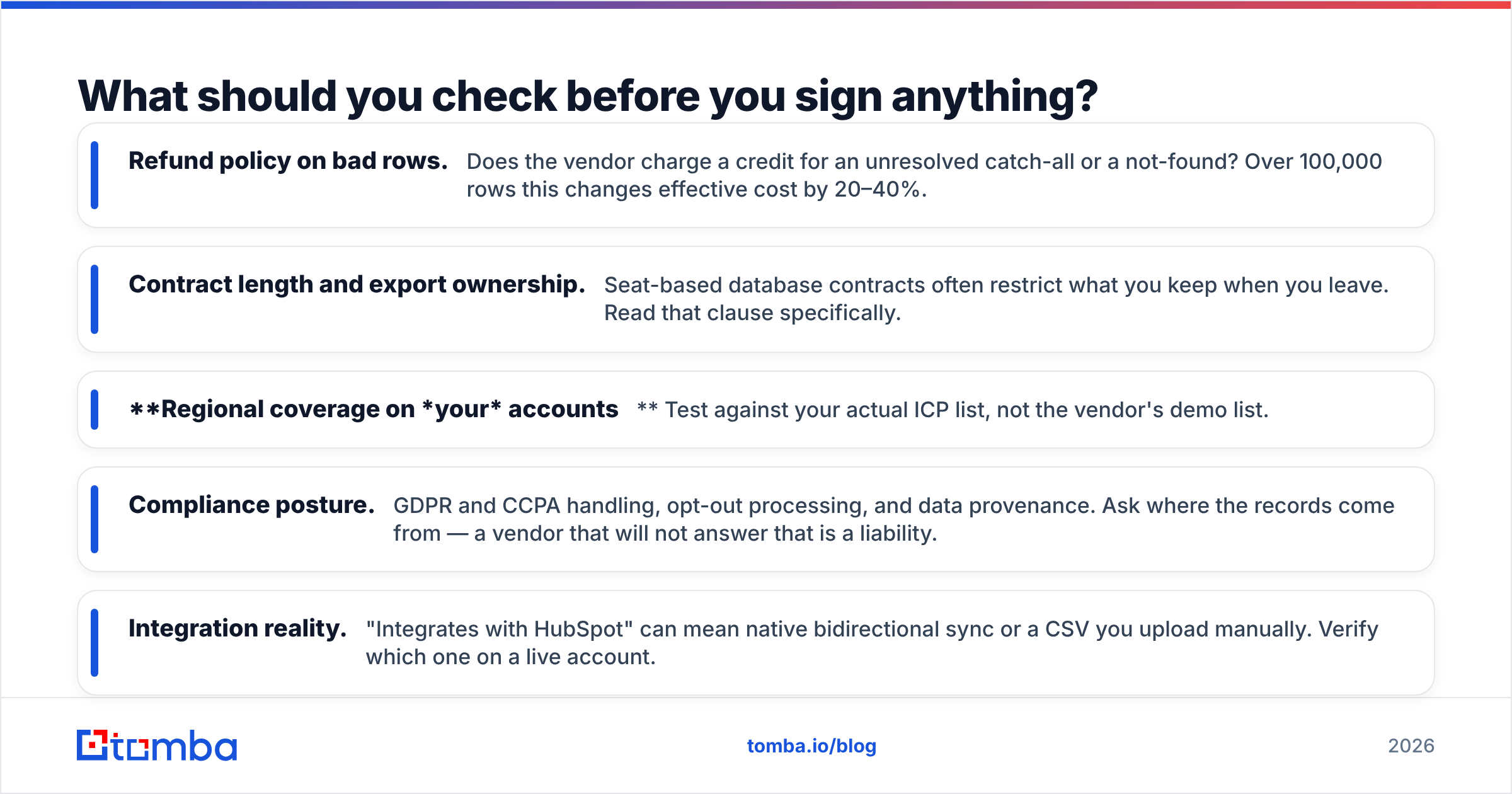
Run these five checks in a trial, not after a contract.
- Refund policy on bad rows. Does the vendor charge a credit for an unresolved catch-all or a not-found? Over 100,000 rows this changes effective cost by 20–40%.
- Contract length and export ownership. Seat-based database contracts often restrict what you keep when you leave. Read that clause specifically.
- Regional coverage on your accounts. Test against your actual ICP list, not the vendor's demo list.
- Compliance posture. GDPR and CCPA handling, opt-out processing, and data provenance. Ask where the records come from — a vendor that will not answer that is a liability.
- Integration reality. "Integrates with HubSpot" can mean native bidirectional sync or a CSV you upload manually. Verify which one on a live account.
The verdict: Enrow or Lead411?#
Choose Lead411 if you are a US-focused sales team of 3–20 reps that needs to build lists from nothing, wants direct dials, and will genuinely use intent data to prioritize. The seat price is defensible when reps are actively sourcing every day.
Choose Enrow if you have a reliable source of names already and your only measurable problem is bounce rate — especially on catch-all-heavy domains. It is a sharp tool for a specific cut.
Choose neither if you are paying two invoices for what one credit pool can do. Most teams comparing "enrow vs lead411" are actually asking a broader question: what is the cheapest reliable path from a company name to a deliverable inbox? That path is domain search, pattern-based finding, verification, catch-all resolution, and enrichment — five steps that should share one balance.
That is exactly how the Tomba Email Finder is built. Start on the free tier with 25 searches a month, run your own 500-row control set against whatever you use today, and compare price per usable contact rather than price per credit. If the numbers favor a specialist, buy the specialist — but run the test before you sign an annual seat contract you will be stuck with until 2027.
Related guides#
Ready to find emails that actually work?
Join 150,000+ professionals who stopped guessing and started sending. Free credits on signup — no credit card required.
Get the Tomba newsletter
Practical outbound tactics and product updates — once every two weeks.
About the author