Enrow vs LeadGenius: Which B2B Data Tool Wins in 2026?
Enrow verifies emails at scale. LeadGenius builds custom datasets with humans in the loop. They solve different problems — here's the honest breakdown of cost, accuracy, and which one your pipeline actually needs.
TL;DR
- They are not the same category. Enrow is a self-serve email verification engine built for cold-email senders. LeadGenius is a managed B2B data service that builds custom datasets with human researchers in the loop.
- Pick Enrow if you already have lists and your problem is bounces, catch-all domains, and deliverability.
- Pick LeadGenius if your ICP can't be filtered out of a standard database — niche attributes, headcount signals, store counts, hard-to-scrape fields — and you have budget plus a multi-month timeline.
- Pricing transparency is the biggest gap. Enrow sells credits you can buy with a card. LeadGenius is quote-only, annual, and priced like enterprise services.
- Most teams need a third thing: a find-and-verify layer that does discovery and validation in one place. That's where a tool like Tomba's email finder sits, at $49/mo instead of a procurement cycle.
What is Enrow and what does it actually do?#
Enrow is an email verification tool aimed squarely at cold outbound. Its pitch is narrow and honest: you upload a list of email addresses, and it tells you which ones will land, which will bounce, and — the part everyone cares about — what to do with catch-all domains that most verifiers punt on with a shrug and a "risky" label.
That catch-all problem is the reason Enrow exists. Roughly a quarter to a third of B2B domains are configured to accept mail at any address, which means a standard SMTP handshake returns "yes" for ceo@company.com and asdfgh@company.com alike. Verifiers that only do SMTP pings mark those as unknown, and you're left guessing. Enrow's positioning is that it resolves a large share of those unknowns into a real valid/invalid verdict.
What Enrow does not do is build your list. It's a filter, not a faucet. You bring emails; it grades them.
What is LeadGenius and who is it for?#
LeadGenius is a different animal entirely. It's a managed B2B data provider — part software, part human research team. Instead of querying a static database, you describe the accounts and contacts you need, including attributes no off-the-shelf database tracks, and LeadGenius delivers a custom dataset mapped to your CRM schema.
Typical LeadGenius use cases look like this:
- Non-standard firmographics — "SaaS companies that just hired their first RevOps lead" or "retailers with 40–120 physical locations in the EU."
- Signal-based targeting — hiring patterns, tech installs, expansion news, funding events, tracked continuously rather than pulled once.
- Data hygiene at scale — refreshing and de-duplicating an existing CRM of hundreds of thousands of records.
- Global coverage gaps — APAC and LATAM contact data that US-centric databases handle poorly.
- Enterprise compliance requirements — documented sourcing, DPAs, and procurement-friendly contracts.
The trade-off is obvious: humans in the loop means quality and flexibility, but also lead time and cost. You don't sign up for LeadGenius on a Tuesday afternoon and start sending on Wednesday.

Enrow vs LeadGenius: how do they compare head to head?#
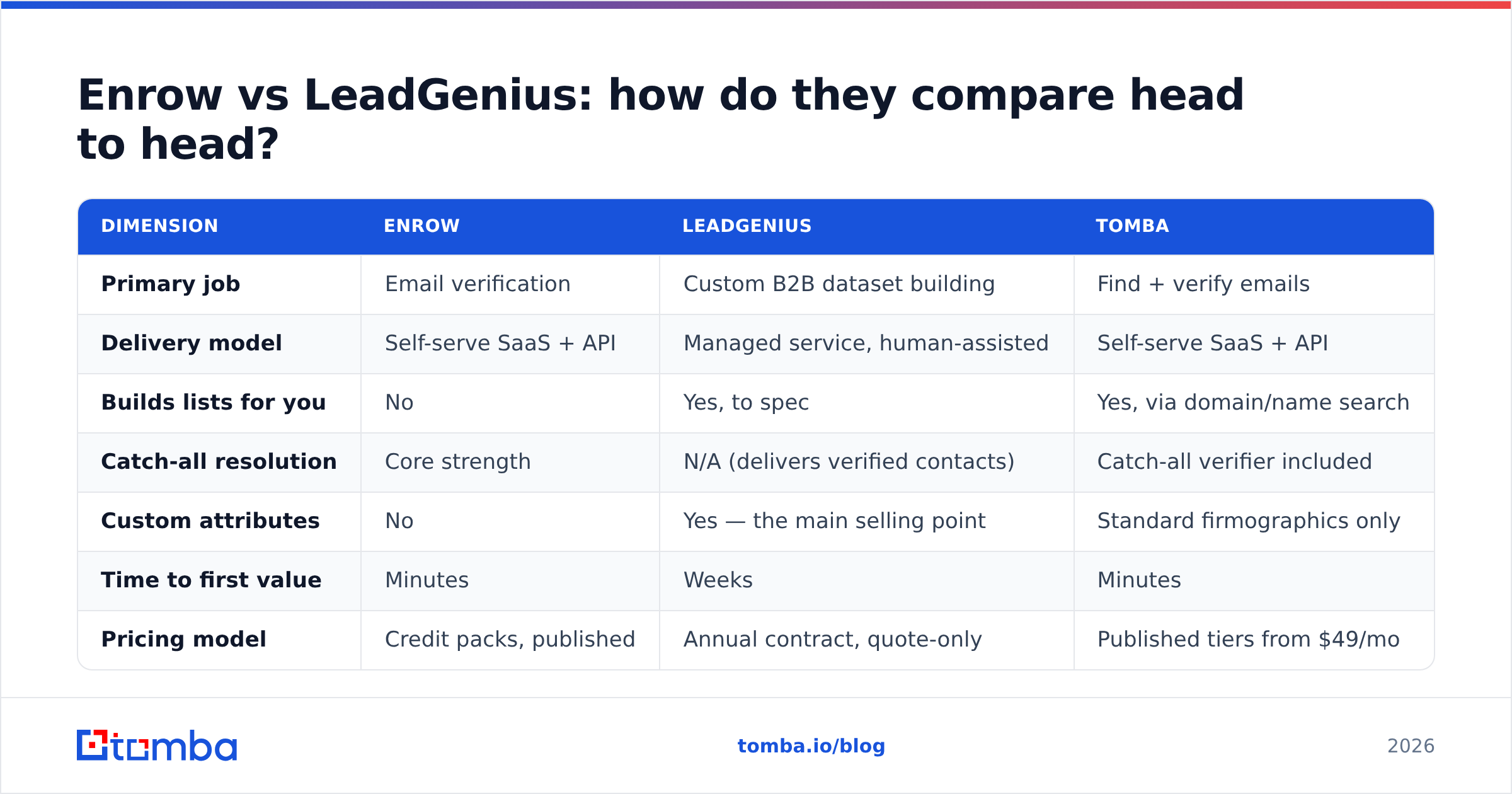
| Dimension | Enrow | LeadGenius | Tomba |
|---|---|---|---|
| Primary job | Email verification | Custom B2B dataset building | Find + verify emails |
| Delivery model | Self-serve SaaS + API | Managed service, human-assisted | Self-serve SaaS + API |
| Builds lists for you | No | Yes, to spec | Yes, via domain/name search |
| Catch-all resolution | Core strength | N/A (delivers verified contacts) | Catch-all verifier included |
| Custom attributes | No | Yes — the main selling point | Standard firmographics only |
| Time to first value | Minutes | Weeks | Minutes |
| Pricing model | Credit packs, published | Annual contract, quote-only | Published tiers from $49/mo |
| Free tier | Trial credits | No | 25 searches/mo |
| Typical buyer | Growth/outbound lead | VP RevOps, enterprise demand gen | SDR teams, founders, developers |
| Contract friction | Card payment | Procurement, legal, SOW | Card payment |
Read that table twice before you shortlist either one. Half the "Enrow vs LeadGenius" searches come from people who haven't yet decided whether their real problem is list quality or list existence. Those are different purchases.
Is Enrow better than LeadGenius for cold email?#
For pure cold email operations, yes — Enrow is the more relevant tool, and it's not close.
Cold email lives or dies on bounce rate. Google and Microsoft both tightened bulk-sender enforcement, and the practical threshold most senders now aim for is under 2% bounces, with under 1% being the safe zone. A verifier that returns 30% "unknown" on your list forces a bad choice: send anyway and risk the domain, or discard a third of your addressable market.
Enrow's value is collapsing that unknown bucket. If it converts 25% unknowns into 20% valid and 5% invalid, you get back a fifth of your list without touching your sender reputation.
LeadGenius doesn't compete here. It delivers contacts that are already validated, but you're paying service rates for data you may only need once. Using LeadGenius to clean an existing list is like hiring a contractor to change a lightbulb — it'll work, and it'll cost you.
Where LeadGenius wins outright is when the list you want doesn't exist yet. No amount of verification fixes an empty spreadsheet.
What does each one cost in practice?#
Cost is the cleanest dividing line between these two.
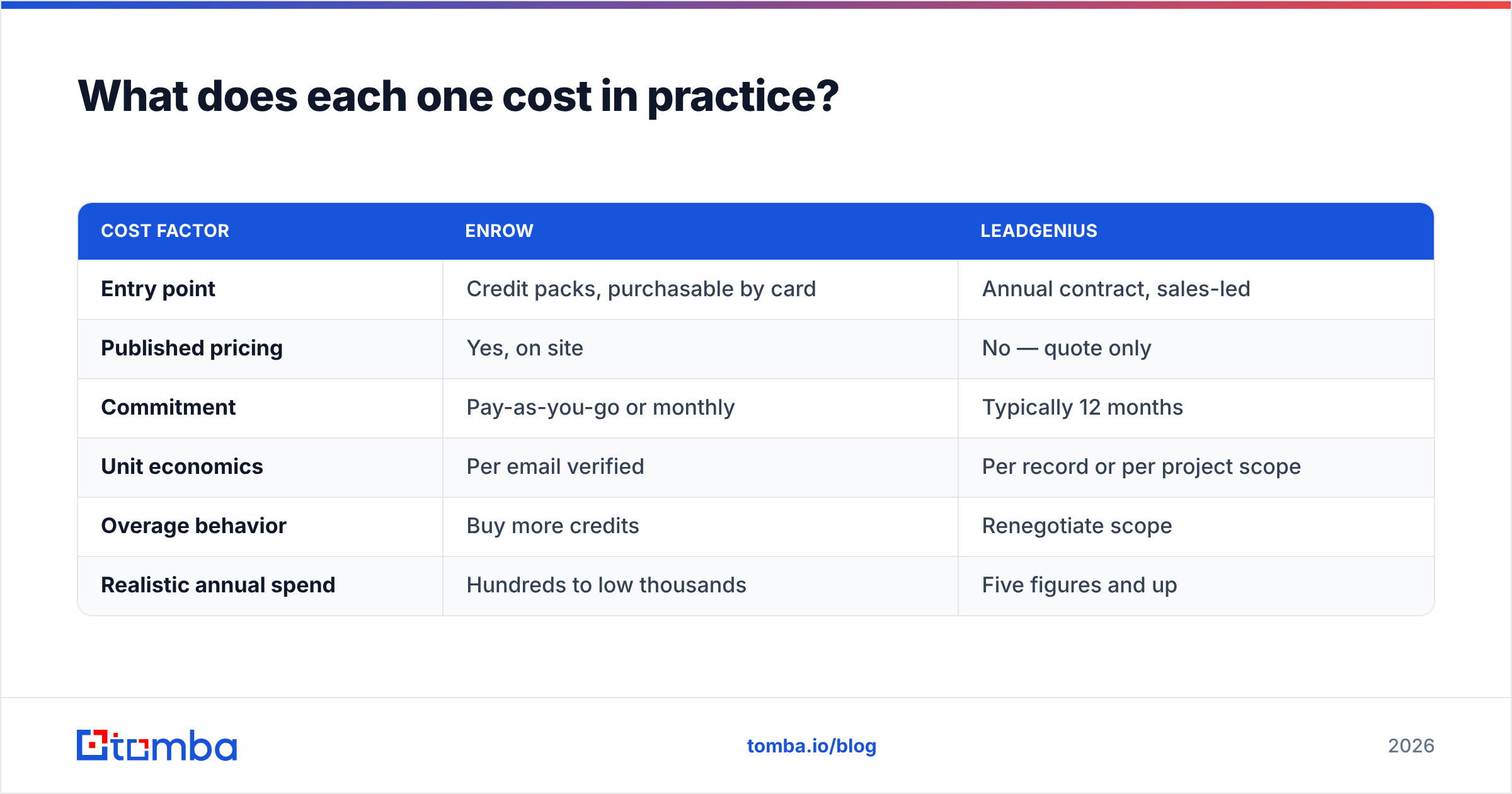
| Cost factor | Enrow | LeadGenius |
|---|---|---|
| Entry point | Credit packs, purchasable by card | Annual contract, sales-led |
| Published pricing | Yes, on site | No — quote only |
| Commitment | Pay-as-you-go or monthly | Typically 12 months |
| Unit economics | Per email verified | Per record or per project scope |
| Overage behavior | Buy more credits | Renegotiate scope |
| Realistic annual spend | Hundreds to low thousands | Five figures and up |
Two practical notes. First, credit-based verification pricing looks cheap per unit and adds up fast at volume — model your monthly send volume before comparing sticker prices. Second, quote-only vendors like LeadGenius are not automatically overpriced; they're priced for a different job. If custom research saves your team 200 hours of manual list building, the math can work. It just won't work for a two-person startup verifying 5,000 emails a month.
For reference on the middle ground, Tomba pricing publishes everything: a free tier at 25 searches per month, Starter at $49/mo, Growth at $99/mo, Pro at $249/mo, and custom Enterprise. You can budget it without a discovery call, which matters more than most vendors admit.
Which one is more accurate?#
This question needs splitting, because "accuracy" means two different things for these products.
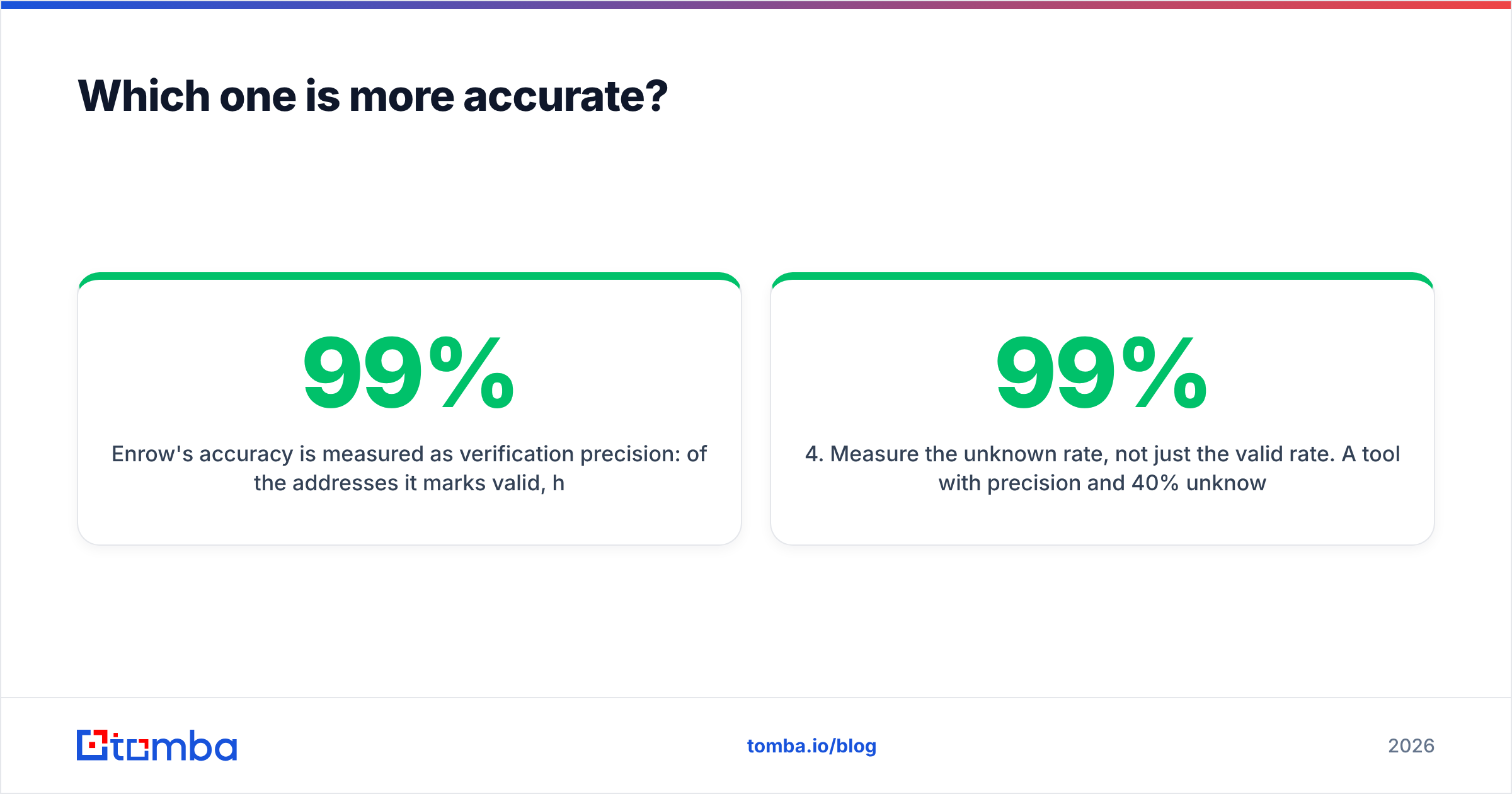
Enrow's accuracy is measured as verification precision: of the addresses it marks valid, how many actually deliver? Good verifiers land in the 95–99% range on standard domains. The differentiator is catch-all handling, where accuracy claims across the whole category get soft. Every vendor publishes flattering numbers from their own test set.
LeadGenius's accuracy is measured as data correctness: is this person still at this company, is the title right, is the custom attribute you asked for true? Human verification generally outperforms scraped-and-inferred data on freshness, which is exactly what you're paying the premium for.
How to test either one without taking marketing copy on faith:
- Build a known-truth sample. Take 300–500 contacts where you already know the outcome — past customers, opted-in newsletter subscribers, colleagues at partner companies.
- Include deliberate poison. Add 20–30 addresses you know are dead. Any tool that marks them valid is guessing.
- Segment by domain type. Score catch-all, Google Workspace, Microsoft 365, and regional providers separately. Aggregate numbers hide catastrophic weakness in one segment.
- Measure the unknown rate, not just the valid rate. A tool with 99% precision and 40% unknowns is worse in practice than one with 96% precision and 6% unknowns.
- Send a real test batch. Nothing beats 500 live sends through the same inbox setup and comparing actual hard bounces against predicted ones.
Run that on any verifier — Enrow, ZeroBounce, Bouncer, or Tomba's email verifier — and you'll get a truth you can defend in a QBR instead of a screenshot from a vendor's landing page. Peer-review sites like G2 are useful for spotting support and billing complaints, but they're weak evidence on data accuracy, since almost no reviewer runs a controlled test.

When should you choose LeadGenius over a database tool?#
Choose LeadGenius when all three of these are true:
- Your ICP filter doesn't exist in any standard database. If you can express your target list as "industry + headcount + title," you don't need custom research — a self-serve B2B database will do it for a fraction of the price.
- The data needs continuous refresh, not a one-time pull. Signal-based targeting decays in weeks. If you need someone watching for changes, that's a service, not a query.
- You have budget authority and a timeline. Managed data means kickoff calls, spec iterations, sample reviews, and delivery cycles.
Choose a self-serve tool instead when you're testing an ICP, when speed matters more than perfection, or when your total contact need is under about 50,000 records a year. At that scale, the service premium rarely pays back.
Note also that "managed data provider" is a crowded space with meaningfully different models — some, like BookYourData, sell verified prebuilt B2B lists with self-serve checkout and per-contact pricing, which is a genuinely different value proposition from LeadGenius's bespoke research and worth pricing out alongside it.
What's the workflow most teams actually end up with?#
Here's the uncomfortable truth about the Enrow vs LeadGenius comparison: most teams that run it end up buying neither, or buying one plus something else.
The common stack looks like this:
- Discovery layer — find contacts at target accounts by domain, name, or role. This is where domain search and email finding live.
- Verification layer — validate before sending, with explicit catch-all handling.
- Enrichment layer — fill in phone numbers, LinkedIn URLs, firmographics for routing and scoring.
- Sending layer — sequencer, warmup, inbox rotation.
- CRM sync — everything lands in HubSpot, Salesforce, or Pipedrive without a CSV round-trip.
Enrow covers step 2 well and nothing else. LeadGenius covers steps 1 and 3 as a service, expensively, and nothing else. Neither is a full stack, which means you're buying at least two vendors either way.
Consolidating steps 1–3 is why platforms like Tomba exist in this comparison at all. One API key handles domain search, email finding, verification, catch-all checks, and data enrichment, plus bulk email finder jobs for list-scale work. Fewer vendors means fewer credit systems to reconcile and fewer places for a lead to get lost between tools.
Enrow vs LeadGenius: which should you pick?#
Short version, by situation:
| Your situation | Best pick |
|---|---|
| High-volume cold email, bounce rate is the pain | Enrow |
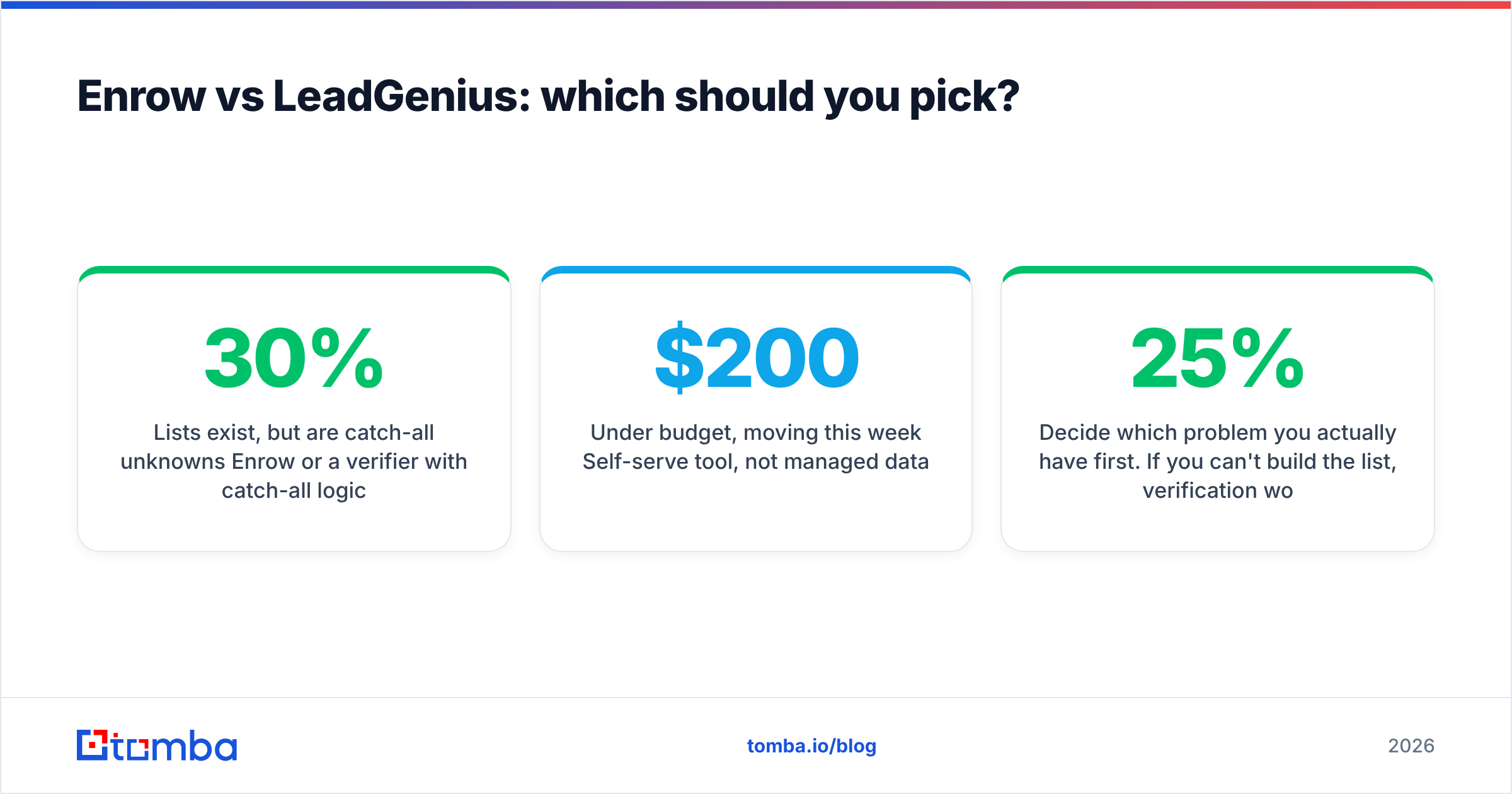
| Lists exist, but 30% are catch-all unknowns | Enrow or a verifier with catch-all logic |
| ICP requires attributes no database tracks | LeadGenius |
| Enterprise CRM hygiene project, 200k+ records | LeadGenius |
| Need to find and verify contacts, self-serve | Tomba or similar find+verify platform |
| Under $200/mo budget, moving this week | Self-serve tool, not managed data |
| Developer building this into a product | API-first tool with published pricing |
The honest framing: Enrow and LeadGenius aren't really competitors. They show up in the same searches because both get labeled "B2B data tools," but one is a scalpel for deliverability and the other is a research department you rent. Comparing them is comparing a spell-checker to a ghostwriter.
Decide which problem you actually have first. If you can't build the list, verification won't save you. If you can build the list but 25% of it bounces, no amount of custom research will fix a broken sending setup.
Ready to find and verify in one place?#
If your real bottleneck is getting accurate, sendable contact data without an enterprise contract or a second vendor for verification, start with the Tomba Email Finder. Search by domain, name, or company, get catch-all-aware verification on the same platform, and export straight to your CRM or pull it through the API. The free tier gives you 25 searches a month to test against your own known-truth list — run the accuracy test described above before you spend a dollar, on Tomba or anyone else.
Related guides#
Ready to find emails that actually work?
Join 150,000+ professionals who stopped guessing and started sending. Free credits on signup — no credit card required.
Get the Tomba newsletter
Practical outbound tactics and product updates — once every two weeks.
About the author