Enrow vs ZoomInfo: Which B2B Email Data Tool Wins in 2026?
One is a lightweight email verification engine billed in credits. The other is a five-figure enterprise GTM database with annual contracts. Here is the honest breakdown of where each one earns its money — and where it does not.
TL;DR
- Enrow and ZoomInfo solve different problems. Enrow is a credit-based email finding and verification engine built around catch-all accuracy. ZoomInfo is an enterprise GTM database with intent data, org charts, and phone coverage — sold on annual contracts.
- Price gap is the headline: Enrow's public plans sit in the tens of dollars per month; ZoomInfo deals commonly land in the $15,000–$40,000+ per year range with multi-seat minimums.
- If your only pain is "my bounce rate is too high," ZoomInfo is dramatic overkill. If your pain is "I need intent signals, org charts, and CRM-native workflows for a 30-rep team," Enrow won't cover it.
- Neither is the cheapest way to get verified email coverage at mid-market volume. A dedicated finder + verifier stack (Tomba starts at $49/mo) usually beats both on cost-per-valid-email.
- The real decision isn't features. It's contract structure: credits you can stop buying vs. an annual commitment with auto-renewal language.
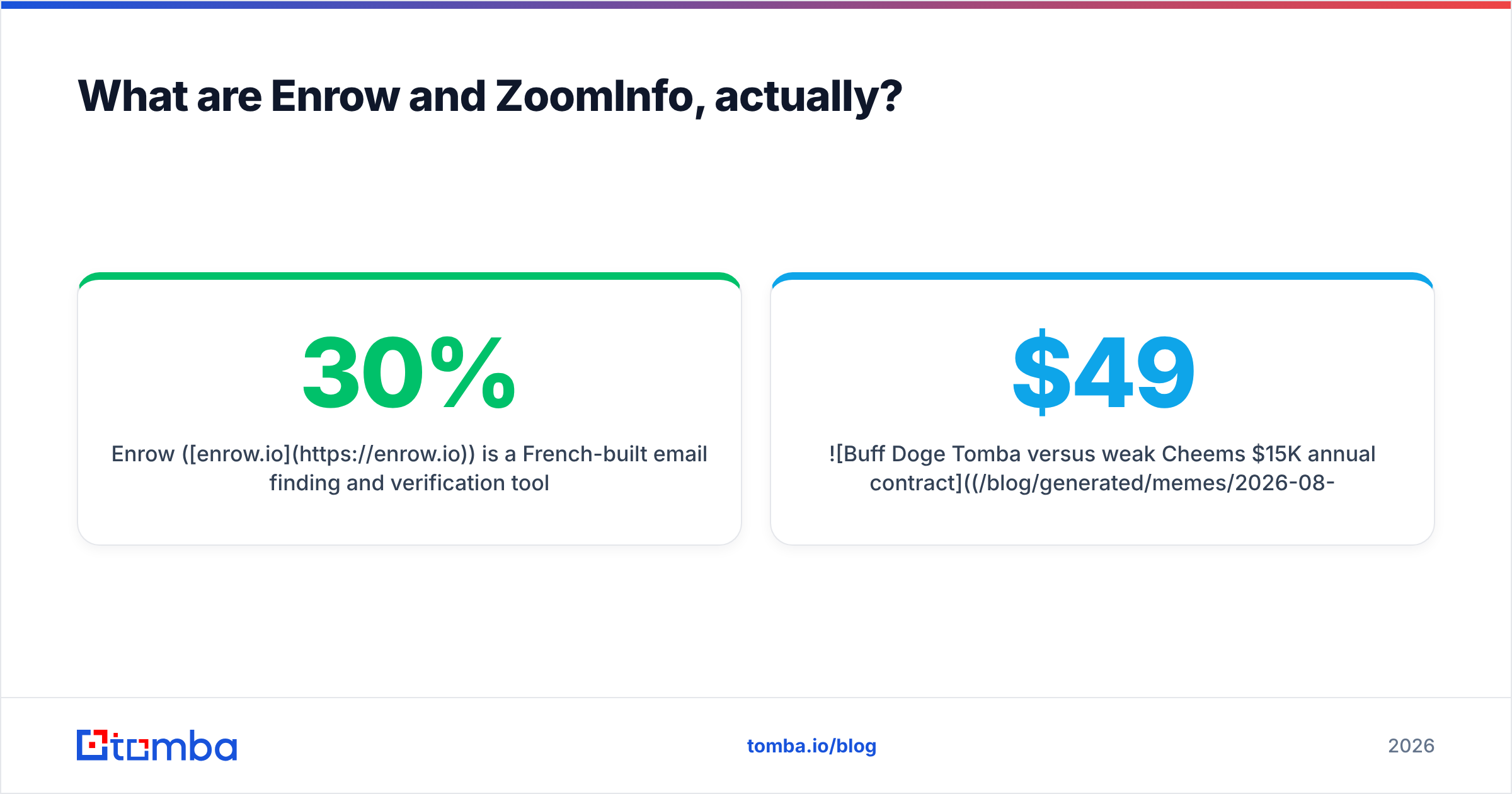
What are Enrow and ZoomInfo, actually?#
They get compared because both put email addresses in your sequencer. That's where the similarity ends.
Enrow (enrow.io) is a French-built email finding and verification tool that made its name on one specific problem: catch-all domains. Roughly 20–30% of B2B domains accept every address at the SMTP layer, which makes traditional verification return "unknown" and leaves reps guessing. Enrow's pitch is that its verification engine resolves a large share of those unknowns into a real valid/invalid verdict. It's credit-based, self-serve, and API-first. No org charts, no intent data, no dialer.
ZoomInfo (zoominfo.com) is the incumbent B2B data platform — contact records, firmographics, technographics, buyer intent via its Bidstream and website-visitor products, conversation intelligence, and a full GTM suite marketed as Copilot. It sells to revenue teams, not to individual founders. Contracts are annual, priced per seat plus credit blocks, and negotiated through a rep.
So the honest framing of enrow vs zoominfo is: a scalpel versus a hospital. Asking which is "better" without naming your use case produces a useless answer.

How do Enrow and ZoomInfo compare on price?#
This is where most evaluations end, so let's take it seriously.
Enrow publishes pricing on its site and bills in credits. Entry plans start in the low tens of dollars per month for a few thousand verification credits, scaling by volume. You can stop paying next month. Failed lookups typically don't consume credits — the industry-standard "only pay for results" model that most modern finders now use.
ZoomInfo does not publish pricing. Every public data point comes from buyers: reported deals cluster around $15,000/year at the low end for a small team, climbing well past $40,000 once you add intent, Copilot, or extra seats. Credit blocks are metered separately from seats, and export limits are a common source of mid-year friction. Check current buyer reviews on G2 before you assume a number — the pricing conversation there is more useful than any vendor page.
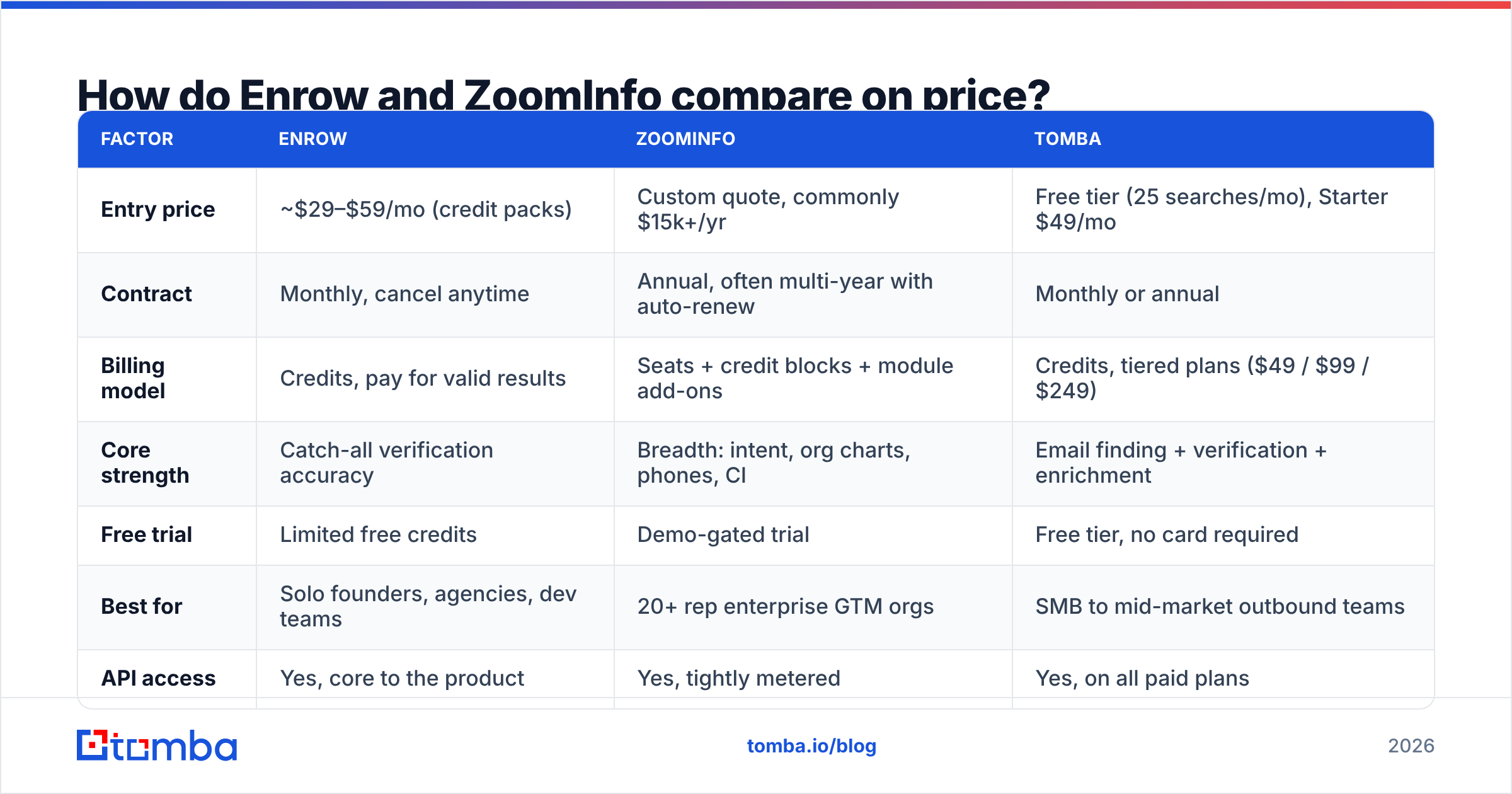
| Factor | Enrow | ZoomInfo | Tomba |
|---|---|---|---|
| Entry price | ~$29–$59/mo (credit packs) | Custom quote, commonly $15k+/yr | Free tier (25 searches/mo), Starter $49/mo |
| Contract | Monthly, cancel anytime | Annual, often multi-year with auto-renew | Monthly or annual |
| Billing model | Credits, pay for valid results | Seats + credit blocks + module add-ons | Credits, tiered plans ($49 / $99 / $249) |
| Core strength | Catch-all verification accuracy | Breadth: intent, org charts, phones, CI | Email finding + verification + enrichment |
| Free trial | Limited free credits | Demo-gated trial | Free tier, no card required |
| Best for | Solo founders, agencies, dev teams | 20+ rep enterprise GTM orgs | SMB to mid-market outbound teams |
| API access | Yes, core to the product | Yes, tightly metered | Yes, on all paid plans |
The gap isn't 3x. At small-team volume it's often 20–50x. That doesn't make ZoomInfo a bad product — it makes it a bad fit for a five-person team that just wants clean emails.
Which one has better email accuracy?#
Accuracy claims in this category are mostly marketing until you test them on your own list. But the mechanisms differ enough to reason about.
Enrow's advantage is architectural. Because it does one thing, its verification pipeline can spend more compute per address — multi-step SMTP probing, pattern inference, and heuristics tuned specifically for catch-all domains. On a list dominated by catch-alls (common in Europe, common in enterprise), that matters. Enrow's published bounce guarantees sit in the low single digits.
ZoomInfo's advantage is coverage. It has one of the largest verified contact graphs in B2B, refreshed by a contributory network and human research. Where Enrow has to derive an address from a name and domain, ZoomInfo often already has it — with a title, a direct dial, and a reporting line attached.
The weakness cuts both ways:
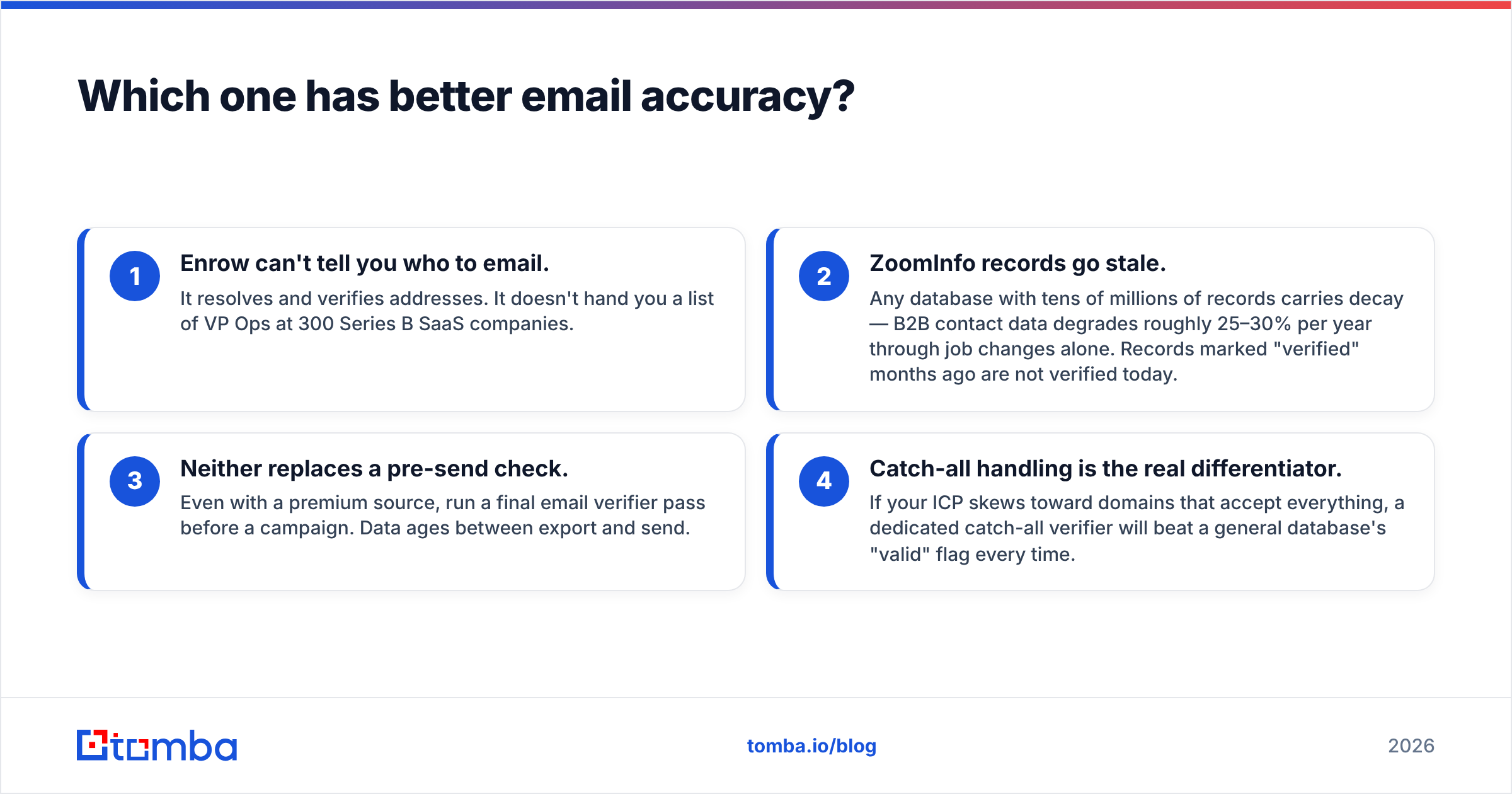
- Enrow can't tell you who to email. It resolves and verifies addresses. It doesn't hand you a list of VP Ops at 300 Series B SaaS companies.
- ZoomInfo records go stale. Any database with tens of millions of records carries decay — B2B contact data degrades roughly 25–30% per year through job changes alone. Records marked "verified" months ago are not verified today.
- Neither replaces a pre-send check. Even with a premium source, run a final email verifier pass before a campaign. Data ages between export and send.
- Catch-all handling is the real differentiator. If your ICP skews toward domains that accept everything, a dedicated catch-all verifier will beat a general database's "valid" flag every time.

The practical takeaway: accuracy is a pipeline property, not a vendor property. Source from wherever coverage is best, then verify at the last possible moment.
What does ZoomInfo give you that Enrow simply cannot?#
If you're evaluating honestly, this list is the argument for the price tag:
- Intent data. ZoomInfo tracks topic-level surges across a bidstream network. Enrow has nothing comparable.
- Org charts and reporting lines. Useful for multi-threading enterprise deals. Enrow doesn't model company hierarchy.
- Direct dials and mobile numbers at scale. ZoomInfo's phone coverage is a genuine moat in North America.
- Native CRM workflows. Deep Salesforce and HubSpot sync, list-building inside the CRM, enrichment on record creation.
- Website visitor identification. De-anonymizing traffic is a separate purchase for most stacks.
- Conversation intelligence and a sequencer bundled into the GTM suite.
If three or more of those are load-bearing for your revenue motion, Enrow isn't a substitute and the comparison ends here. Go buy ZoomInfo — but negotiate hard, and read the renewal clause. The most consistent complaint in buyer reviews isn't data quality. It's the contract: auto-renewal windows, credit overage charges, and difficulty downgrading mid-term.
What does Enrow give you that ZoomInfo cannot?#
- Speed to value. Sign up, paste a domain, get results. No demo, no procurement, no security review.
- Cost predictability at small volume. Buy 5,000 credits, use 5,000 credits, stop.
- API simplicity. Enrow's endpoints are straightforward to wire into a scraper or an internal enrichment job. ZoomInfo's API is metered and gated by contract tier.
- No seat tax. You're not paying $1,200+ per user for someone who runs 40 lookups a month.
- Catch-all resolution as a first-class feature, not a footnote in a data dictionary.
For agencies running outbound on behalf of clients, lean growth teams, and developers building enrichment into a product, that profile wins on every axis that matters.

Is there a better middle option between the two?#
Yes, and it's the reason this comparison usually ends with a third name on the shortlist.
Most teams evaluating enrow vs zoominfo are actually trying to answer: how do I get accurate B2B emails without signing an annual contract, while still getting more than raw verification? That's a real gap. Enrow is deliberately narrow. ZoomInfo is deliberately enterprise. The middle — finding, verifying, enriching, and exporting at SMB and mid-market volume — is where a dedicated stack fits.
That's the slot Tomba occupies. The email finder resolves addresses from a name and domain or a full domain search across a company. Verification, catch-all handling, data enrichment, and B2B phone numbers run in the same workspace rather than across three vendors. Pricing is public and monthly: free tier at 25 searches, Starter at $49/mo, Growth at $99/mo, Pro at $249/mo. Full Tomba pricing is on one page — no quote call.

Worth naming other credible options depending on your angle: BookYourData is a strong pick if you'd rather buy a targeted, pre-verified list outright than run lookups yourself — its pay-as-you-go list building with a bounce guarantee is a genuinely different buying model, and for one-off campaign lists it's often the cleanest path. Apollo bundles data with a sequencer if you want a single tool for both. Each of these is a legitimate answer to a specific version of the question.
How should you decide?#
Run this checklist against your actual situation rather than against a feature matrix.
- Count your seats. Under 10 reps, enterprise per-seat pricing rarely clears the ROI bar. Over 25, the bundled workflows start paying for themselves.
- Audit your catch-all rate. Export 500 target domains and check how many are catch-all. Above 25%, weight verification depth heavily — that's Enrow's home turf, and the reason a dedicated verification layer earns its keep regardless of which database you use.
- Name the signal you're missing. If it's intent, org structure, or direct dials, no verification tool solves it. If it's "my emails bounce," no enterprise database solves it either — that's a verification problem, and you can fix it for under $100/month.
- Model cost per valid email, not cost per month. Take your realistic monthly volume, apply each tool's hit rate and pricing, and divide. The rankings shift fast once you do this honestly.
- Read the exit terms before the feature list. Annual contracts with auto-renewal are the single most common regret in this category. Monthly credits carry none of that risk.
- Test on your own ICP. Every vendor's benchmark is run on a list that flatters it. Take 200 of your real prospects, run them through each trial, and check bounces in your own sequencer.
That last step is non-negotiable. Aggregate accuracy numbers tell you almost nothing about performance on your segment, geography, and company-size band.
What's the verdict?#
Choose ZoomInfo if you're an enterprise revenue org that needs intent data, org charts, direct dials, and CRM-native workflows across 20+ seats — and you have the budget and procurement process to match. It's the most complete GTM data platform on the market, and the price reflects that.
Choose Enrow if you already know who you want to reach, your problem is resolving and verifying their addresses (especially on catch-all domains), and you want to pay by the credit with no contract.
Choose a combined finder-and-verifier stack if you're between those poles — which describes most teams doing outbound. You need coverage broad enough to build lists, verification tight enough to protect email deliverability, and pricing that doesn't require a procurement cycle.
One structural note that applies no matter what you pick: never treat "verified at export" as "valid at send." Contact data decays continuously. Whatever your source, run a verification pass immediately before each campaign. That single habit does more for your bounce rate than switching vendors ever will.
Ready to test the middle option? Start with the Tomba Email Finder — the free tier gives you 25 searches a month with no card required, so you can run your own 200-prospect benchmark against Enrow and ZoomInfo before you commit a dollar. If the numbers hold up on your list, Starter is $49/mo. If they don't, you've lost nothing but an afternoon — which is a better deal than any annual contract will offer you.
Related guides#
Ready to find emails that actually work?
Join 150,000+ professionals who stopped guessing and started sending. Free credits on signup — no credit card required.
Get the Tomba newsletter
Practical outbound tactics and product updates — once every two weeks.
About the author