Enterprise Sales Playbook: How to Build One That Closes in 2026
Most enterprise sales playbooks are 60-page PDFs nobody opens. Here's how to build one reps actually use — with buying committee maps, MEDDPICC gates, and the data layer that keeps it alive.
TL;DR
- An enterprise sales playbook is not a document — it's a decision system: who to target, who to reach inside the account, what to say at each stage, and what proof lets a deal advance.
- The average enterprise deal now involves 6–10 buyers (Gartner), so the single most valuable page in your playbook is the buying committee map, not the pitch script.
- Playbooks fail for three reasons: they're too long, they're not tied to CRM stage gates, and the contact data behind them rots at roughly 25–30% per year.
- MEDDPICC (or a trimmed version of it) works as an exit criteria layer — not as a form reps fill in after the fact.
- Budget one afternoon a quarter for playbook maintenance. A playbook that isn't re-tested against closed-won/closed-lost data is just folklore.
What is an enterprise sales playbook?#
An enterprise sales playbook is the written, testable answer to one question: what do we do, in order, to win a deal over $50K with a company that has a procurement department?
Think of it like a restaurant's line prep sheets. Nobody hands a new cook a 200-page culinary theory book at 5pm on a Friday. They hand them a laminated card: this station, these six dishes, this plating, this timing. The theory lives elsewhere. The card is what gets used during service.
That distinction matters because most "playbooks" are the theory book. They open with a mission statement, spend four pages on brand positioning, and bury the one thing a rep needs — the discovery question that separates a real deal from a tire-kicker — on page 41.
A working enterprise playbook has seven parts:
- ICP definition with disqualifiers. Not just who you sell to — who you actively walk away from. Firmographics, tech stack signals, headcount bands, and the two or three conditions that mean "no" regardless of budget.
- Buying committee map. Titles, typical concerns, and who blocks. In enterprise, the person who takes your first call is almost never the person who signs.
- Stage definitions with exit criteria. Each stage has a verifiable event that must happen before the deal moves. "Prospect seems interested" is not an event.
- Discovery framework. A short question set per persona, plus the pain-to-metric translation that turns "our reporting is slow" into "$340K of analyst time per year."
- Multithreading motion. The specific sequence for getting from one contact to four inside the same account.
- Objection and competitive handling. Named competitors, named objections, and the two-sentence response — not a paragraph.
- Proof assets mapped to stage. Which case study, which ROI model, which security doc, at which moment.
Everything else is appendix.
Why do most enterprise sales playbooks fail?#
Three failure modes, in order of how often they show up.
Length. A 60-page playbook has a read rate near zero after week one of onboarding. The reps who need it most — the ones in month three, mid-deal, at 4:45pm — will not scroll. If your playbook can't be navigated in 30 seconds to the exact answer needed, it doesn't exist.
Disconnection from the CRM. If your playbook says stage 3 requires a documented business case and your CRM lets anyone drag a deal to stage 4 without one, the playbook is advisory. Advisory documents lose to deadline pressure every time. Stage gates need to be enforced in the CRM, not suggested in a PDF.
Data rot. This is the one nobody budgets for. B2B contact data decays continuously — people change jobs, companies get acquired, domains consolidate. A playbook that says "map five stakeholders per account" is useless if three of the five contact records bounce. Your multithreading motion is only as good as your ability to actually reach the people on the map.
There's a fourth, quieter failure: writing the playbook from what your best rep says they do, rather than from what the data shows they do. Top performers are unreliable narrators of their own process. They'll credit the demo when the actual differentiator was that they got the CFO on a call in week two. Pull the activity data before you write the narrative.
Who is actually in an enterprise buying committee?#
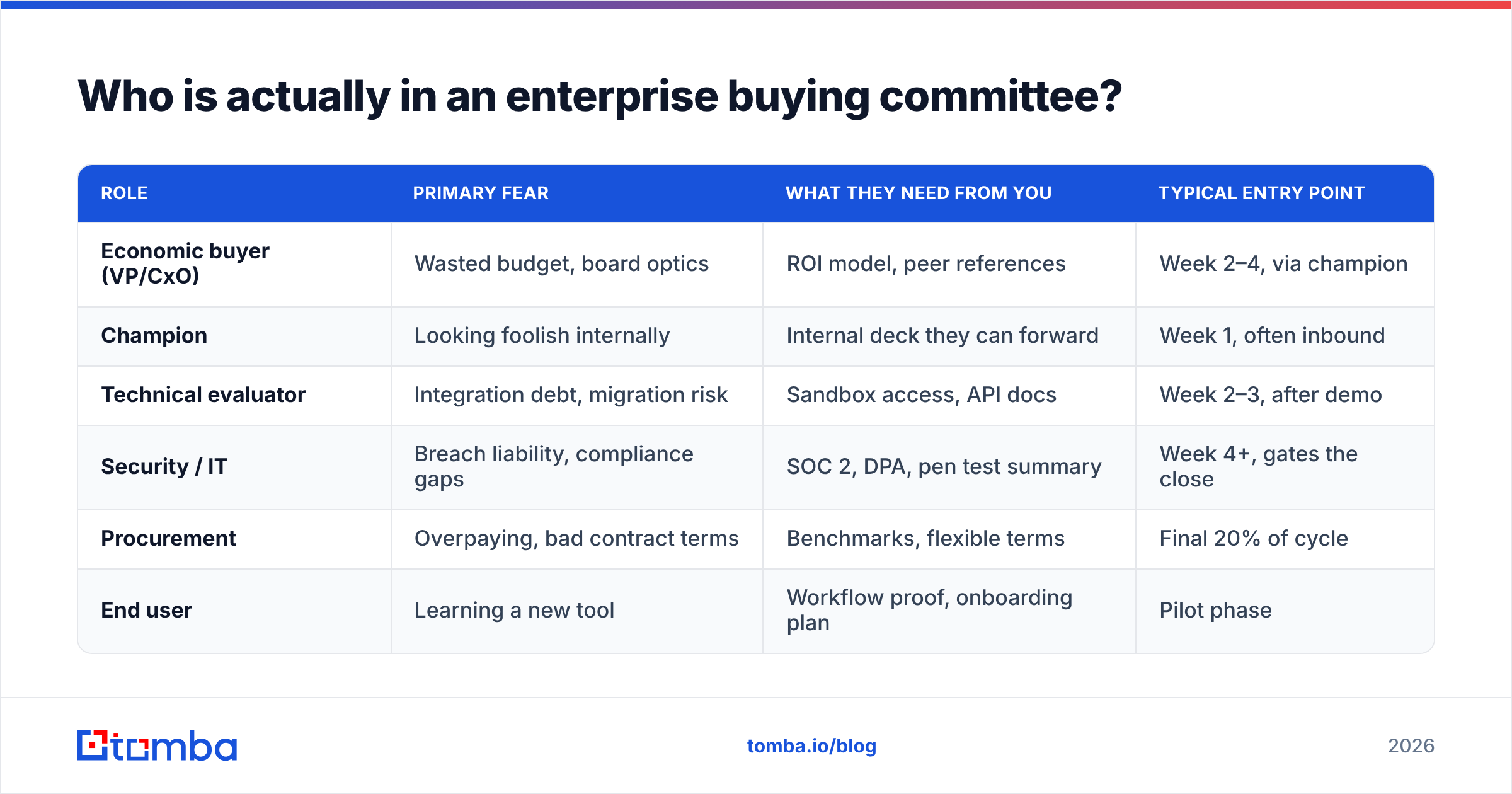
This is the section that earns the playbook its keep. Gartner's research puts the typical B2B buying group at 6 to 10 decision makers, each arriving with four or five independently gathered pieces of information. Your rep is not selling to a person. They're supplying ammunition to an internal debate they will never fully witness.
Map roles by what they're afraid of, not by title alone:
| Role | Primary fear | What they need from you | Typical entry point |
|---|---|---|---|
| Economic buyer (VP/CxO) | Wasted budget, board optics | ROI model, peer references | Week 2–4, via champion |
| Champion | Looking foolish internally | Internal deck they can forward | Week 1, often inbound |
| Technical evaluator | Integration debt, migration risk | Sandbox access, API docs | Week 2–3, after demo |
| Security / IT | Breach liability, compliance gaps | SOC 2, DPA, pen test summary | Week 4+, gates the close |
| Procurement | Overpaying, bad contract terms | Benchmarks, flexible terms | Final 20% of cycle |
| End user | Learning a new tool | Workflow proof, onboarding plan | Pilot phase |
The playbook should tell a rep exactly which of these six is missing from the deal at each stage — and what to do about it. A deal in stage 4 with no security contact identified is not a stage 4 deal. It's a stage 2 deal with optimistic labeling.
Multithreading is where contact data quality becomes a revenue variable rather than an ops detail. If a rep has to guess at an email format to reach the VP of Engineering, they will send fewer of those emails. Making stakeholder contact retrieval a two-second action — via a domain search across the target company, or a LinkedIn finder when you have the profile but not the address — changes behavior more than any coaching session about "the importance of multithreading."
How should you structure stages and exit criteria?#
Stages should map to what the buyer has done, not what the seller has done. "Demo completed" is a seller action. "Buyer has shared the demo recording with two colleagues" is a buyer action, and it's a far better predictor.
Here's a workable six-stage structure with buyer-verified exits:
| Stage | Buyer-verified exit criteria | Typical duration | Forecast weight |
|---|---|---|---|
| 1. Qualified | Pain confirmed + budget owner named | 1–2 weeks | 10% |
| 2. Discovery | Metric quantified, champion identified | 2–3 weeks | 20% |
| 3. Solution fit | Technical evaluator engaged, 2+ stakeholders | 3–4 weeks | 40% |
| 4. Business case | Economic buyer has seen ROI model | 2–4 weeks | 60% |
| 5. Validation | Security/legal review started | 3–6 weeks | 80% |
| 6. Negotiation | Redlines exchanged, close date agreed | 1–3 weeks | 90% |
Two rules make this stick. First, the forecast weight is not a rep judgment — it's derived from the stage, and the stage is derived from the criteria. Second, deals can move backward. A stage 5 deal where the champion leaves the company drops to stage 2. Playbooks that only permit forward motion produce forecasts that collapse at quarter end.
Is MEDDPICC still the right qualification framework in 2026?#
Mostly yes, with one adjustment: use it as a gate checklist, not as a data-entry chore.
MEDDPICC — Metrics, Economic buyer, Decision criteria, Decision process, Paper process, Identify pain, Champion, Competition — holds up because it maps cleanly onto the enterprise reality of committee buying and procurement friction. The failure isn't the framework, it's the implementation: teams turn it into eight CRM fields that reps fill in on Thursday afternoon before the pipeline review, which produces documentation of a deal rather than progress on one.
The fix is to attach each letter to a stage gate:
- Metrics + Identify pain → required to exit stage 2. If the rep can't state the customer's number, there's no business case to build later.
- Economic buyer + Champion → required to exit stage 3. Two named humans, with verified contact details, both of whom have replied to something.
- Decision criteria + Competition → required to exit stage 4. If you don't know the scorecard, you're competing blind.
- Decision process + Paper process → required to exit stage 5. This is where deals slip a quarter — legal review takes six weeks and nobody asked.
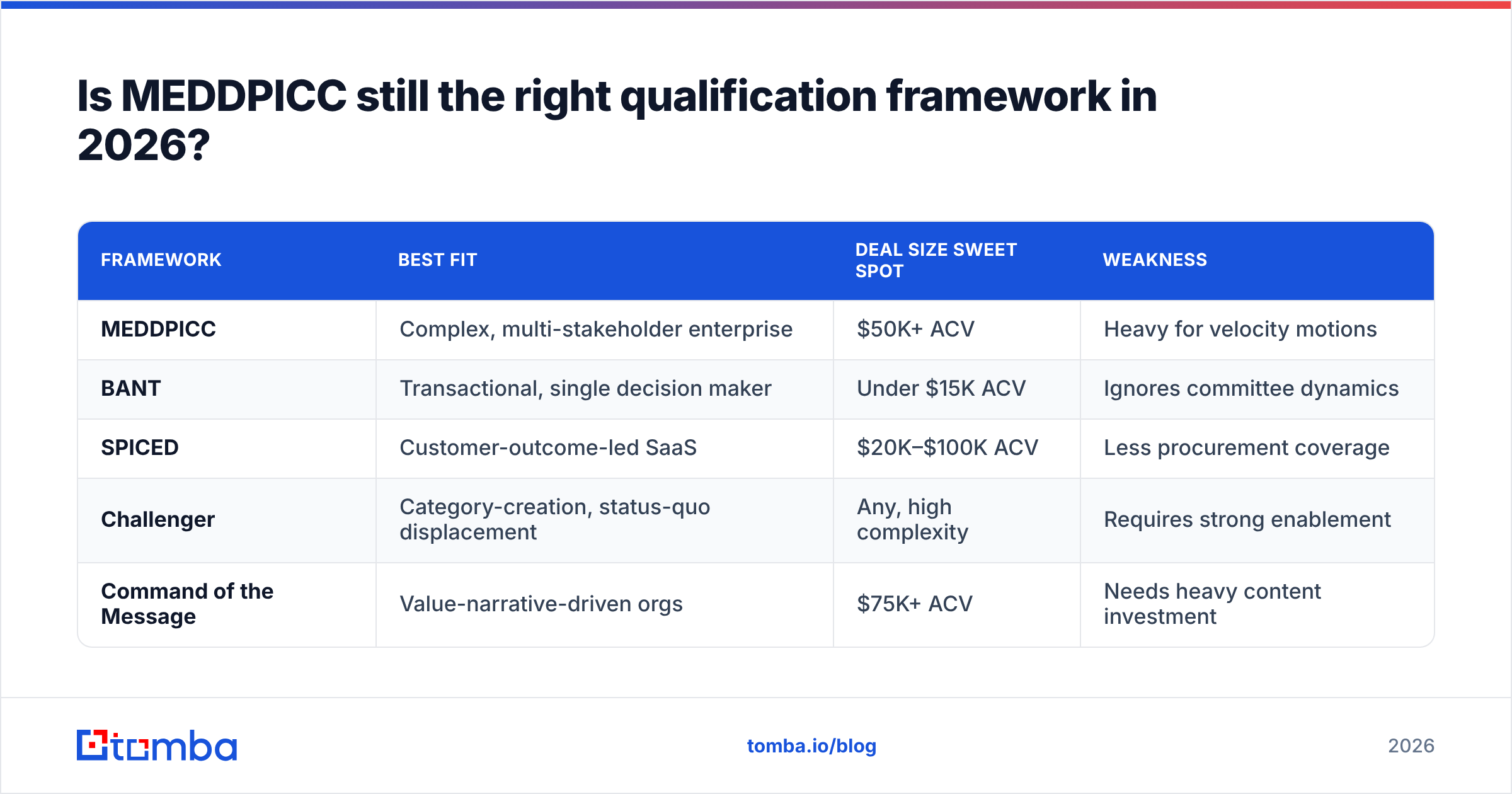
Compare the common frameworks honestly, because MEDDPICC isn't right for everyone:
| Framework | Best fit | Deal size sweet spot | Weakness |
|---|---|---|---|
| MEDDPICC | Complex, multi-stakeholder enterprise | $50K+ ACV | Heavy for velocity motions |
| BANT | Transactional, single decision maker | Under $15K ACV | Ignores committee dynamics |
| SPICED | Customer-outcome-led SaaS | $20K–$100K ACV | Less procurement coverage |
| Challenger | Category-creation, status-quo displacement | Any, high complexity | Requires strong enablement |
| Command of the Message | Value-narrative-driven orgs | $75K+ ACV | Needs heavy content investment |
Pick one. Running two frameworks simultaneously produces reps who run neither.
What does the data layer of a playbook look like?#
Every playbook assumes a data layer and almost none of them document it. That's the gap where good process quietly dies.
Concretely, your playbook depends on four data operations happening reliably:
- Account identification. Firmographic filtering against your ICP definition, plus intent or technographic signals where you have them.
- Contact discovery inside the account. Finding all six committee roles, not just the one who filled out a form. This is where an email finder and phone finder earn their keep — the map is worthless without addresses.
- Verification before send. Bouncing a VP of Security is not a neutral event; it degrades your sending domain and burns the account. Run addresses through an email verifier before any sequence touches an enterprise account.
- Ongoing enrichment. Job changes at target accounts are among the strongest buying signals in B2B. Contact enrichment on a quarterly cadence catches champions who moved to a new company — which is a warm re-entry, not a lost contact.
For teams building this into their stack rather than doing it by hand, the Tomba API handles discovery and verification programmatically, and it slots into the CRM sync so reps never leave their workflow. Tomba pricing starts with a free tier at 25 searches/month for testing the motion, then $49/mo Starter, $99/mo Growth, and $249/mo Pro as usage scales — which is worth knowing before you design a process that assumes unlimited lookups.
A note on peers here: BookYourData takes a different and legitimate approach, selling pre-built verified B2B lists with a pay-as-you-go model, which suits teams that want a list handed over rather than a discovery API to build against. If your playbook calls for a static target account list refreshed twice a year, that model is a clean fit. If it calls for continuous, in-workflow lookups during live deals, an API-first tool fits better. Neither is wrong — they solve different halves of the same problem.
How do you roll out a playbook so reps actually use it?#
Rollout is where 80% of playbook value is won or lost. A few things that consistently work:
Ship a one-pager first. Before the full document exists, publish a single page: ICP, three disqualifiers, six committee roles, six stage gates. Get that adopted. Expand only where reps ask for more.
Embed it, don't attach it. The playbook should surface inside the CRM at the relevant stage — a checklist on the opportunity record, not a link in the onboarding folder. If a rep has to switch tabs to consult it, they won't.
Make deal reviews playbook-shaped. Run every pipeline review against the exit criteria. Three weeks of "show me the buyer-verified evidence for stage 4" does more for adoption than any training deck.
Assign an owner. RevOps or sales enablement, named, with a quarterly review on the calendar. Unowned playbooks drift within two quarters.
Instrument it. Track win rate by stage-gate compliance. If deals that pass all stage 3 criteria close at 47% and deals that skip them close at 19%, you have your argument. If there's no difference, your criteria are wrong and you should say so out loud.
For benchmarking your process against peers, G2's sales enablement category and HubSpot's sales research are both reasonable free reference points — useful for sanity-checking cycle lengths and stage conversion rates before you set internal targets.
What should you measure to know the playbook is working?#
Four metrics, reviewed monthly:
- Stage-to-stage conversion, especially stage 3 → 4. That's where committee expansion either happens or doesn't.
- Average stakeholders engaged per closed-won deal vs. closed-lost. If won deals average 4.2 contacts and lost deals average 1.8, multithreading is your highest-leverage coaching topic.
- Cycle length by segment. A playbook that works for mid-market may add three weeks to enterprise deals or vice versa.
- Win rate by stage-gate compliance. The single number that proves or disproves the whole exercise.
If you can't produce these four numbers from your CRM today, fix that before writing another page of playbook. Process without measurement is preference.
Where to start this week#
Pick one closed-won deal from the last quarter and one closed-lost deal of similar size. Reconstruct both: who was contacted, when, in what order, and what evidence existed at each stage. The delta between those two timelines is the first draft of your playbook — grounded in your actual market, not in a template someone published in 2019.
Then fix the data layer, because every step above depends on reaching the right six people at the right account. Start with Tomba Email Finder — find verified professional addresses by domain, name, or company so your buying committee map turns into actual conversations. The free tier gives you 25 searches a month, which is enough to test the multithreading motion on a handful of live deals before you commit to anything.
Related guides#
Ready to find emails that actually work?
Join 150,000+ professionals who stopped guessing and started sending. Free credits on signup — no credit card required.
Get the Tomba newsletter
Practical outbound tactics and product updates — once every two weeks.
About the author