Enterprise Sales SaaS: The Complete 2026 Playbook and Stack
Enterprise SaaS deals take 6-18 months, involve 11 stakeholders, and die quietly in procurement. Here is the full 2026 playbook: cycle math, stack costs, and the data layer that actually feeds it.
TL;DR
- Enterprise sales SaaS means deals above roughly $50K ACV with 6-18 month cycles, 6-11 buying-committee members, security review, and procurement — not a bigger version of mid-market.
- The stack costs $2,400-$18,000 per rep per year across data, engagement, intelligence, and CRM. Data quality is the cheapest line item and the one that breaks everything else when it's wrong.
- Win rates in enterprise hover around 15-25%. The single biggest lever is multi-threading: reaching 4+ contacts inside the account, not perfecting one email to one VP.
- MEDDICC/MEDDPICC still outperforms BANT at this deal size because it forces you to name the Economic Buyer and the Paper Process before forecasting.
- Most "enterprise" pipeline dies in procurement and security review, not in discovery. Build for that from day one.
What is enterprise sales in SaaS, actually?#
Enterprise sales SaaS is the motion for selling software to organizations large enough that no single person can say yes. That's the whole definition. Everything else — longer cycles, security questionnaires, custom MSAs, pilot phases — falls out of that one constraint.
Think of it like getting a mortgage versus buying a coffee. The coffee is a self-serve SaaS signup: one decision, one person, thirty seconds. The mortgage involves an underwriter, a lawyer, an appraiser, and a compliance check, and any one of them can stall it for a month. Enterprise SaaS is the mortgage.
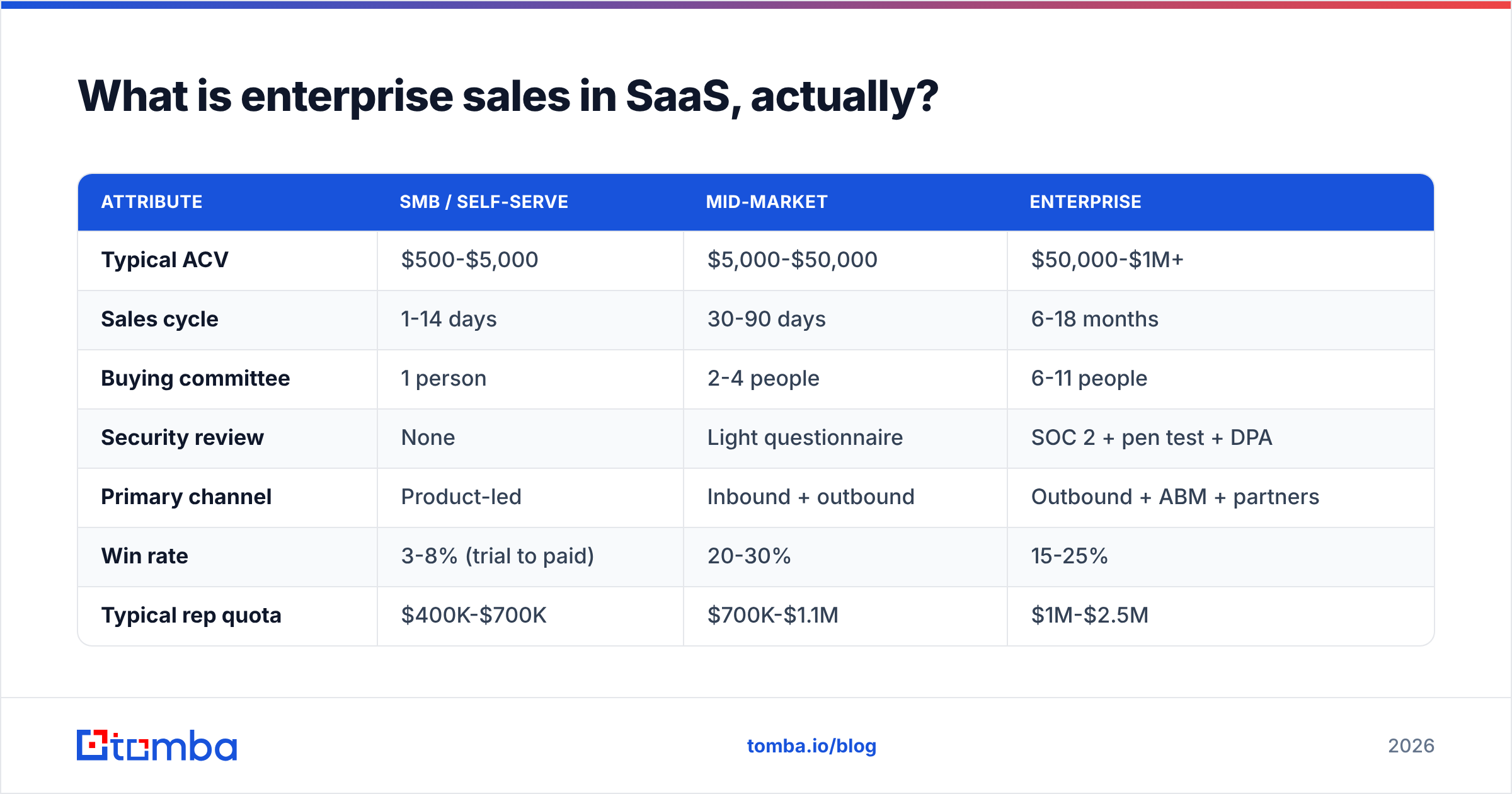
Here's how the tiers actually break down in 2026:
| Attribute | SMB / Self-serve | Mid-market | Enterprise |
|---|---|---|---|
| Typical ACV | $500-$5,000 | $5,000-$50,000 | $50,000-$1M+ |
| Sales cycle | 1-14 days | 30-90 days | 6-18 months |
| Buying committee | 1 person | 2-4 people | 6-11 people |
| Security review | None | Light questionnaire | SOC 2 + pen test + DPA |
| Primary channel | Product-led | Inbound + outbound | Outbound + ABM + partners |
| Win rate | 3-8% (trial to paid) | 20-30% | 15-25% |
| Typical rep quota | $400K-$700K | $700K-$1.1M | $1M-$2.5M |
| Rep ramp time | 1-2 months | 3-4 months | 6-9 months |
The row that matters most is ramp time. A rep who takes nine months to produce and carries an 18-month cycle will not close their first self-sourced deal until month 15. If your runway or your patience is shorter than that, you are not running an enterprise motion — you are running a mid-market motion with enterprise logos on the deck.
Why do enterprise SaaS deals actually die?#
Not where you think. Deals rarely die in discovery, where reps spend most of their energy. They die in the three places nobody rehearses:
- No Economic Buyer identified. You have a champion who loves the product and no access to the person who controls the budget line. The deal forecasts at 80% for two quarters and then evaporates in a reorg.
- Security and legal review. SOC 2 Type II, a 300-row security questionnaire, a DPA negotiation, and an MSA redline. Each adds 3-8 weeks. If you don't have a trust center and a completed CAIQ, add another month.
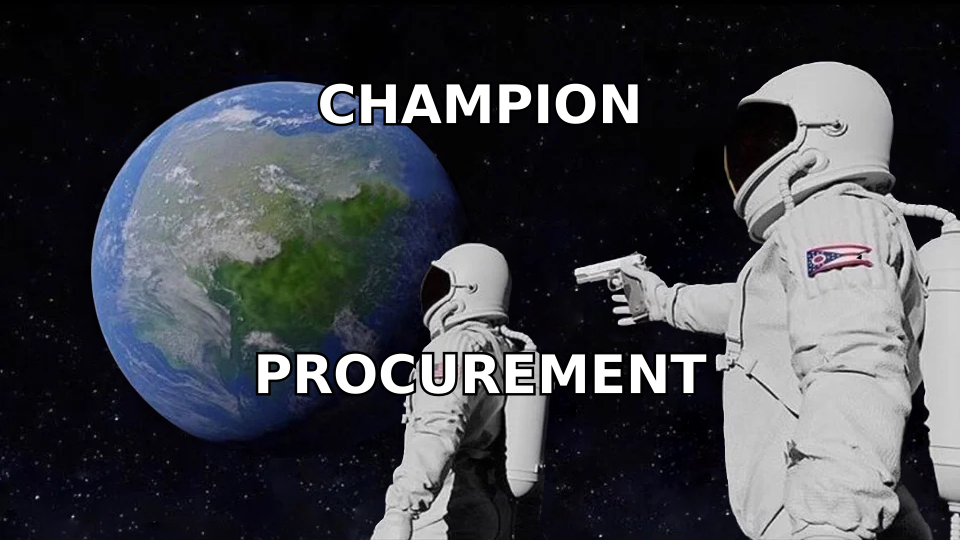
- Procurement's job is to reduce your price. Not to evaluate you. By the time you reach procurement, the technical decision is made — they're extracting discount. Reps who haven't held a line on pricing all cycle get shredded here.
- Single-threading. Your champion leaves. In 2026, average tenure in a B2B software buying role sits under two years, so on an 18-month cycle there's a meaningful chance your one contact is gone before signature.
- No compelling event. "This looks great, let's revisit next fiscal year" is the most common enterprise loss, and it's recorded as "no decision" rather than a competitive loss — which is why win-rate dashboards flatter you.
Fix the list above and you fix most of your win rate. Nothing in it is about pitch quality.
What does the enterprise sales SaaS stack cost in 2026?#
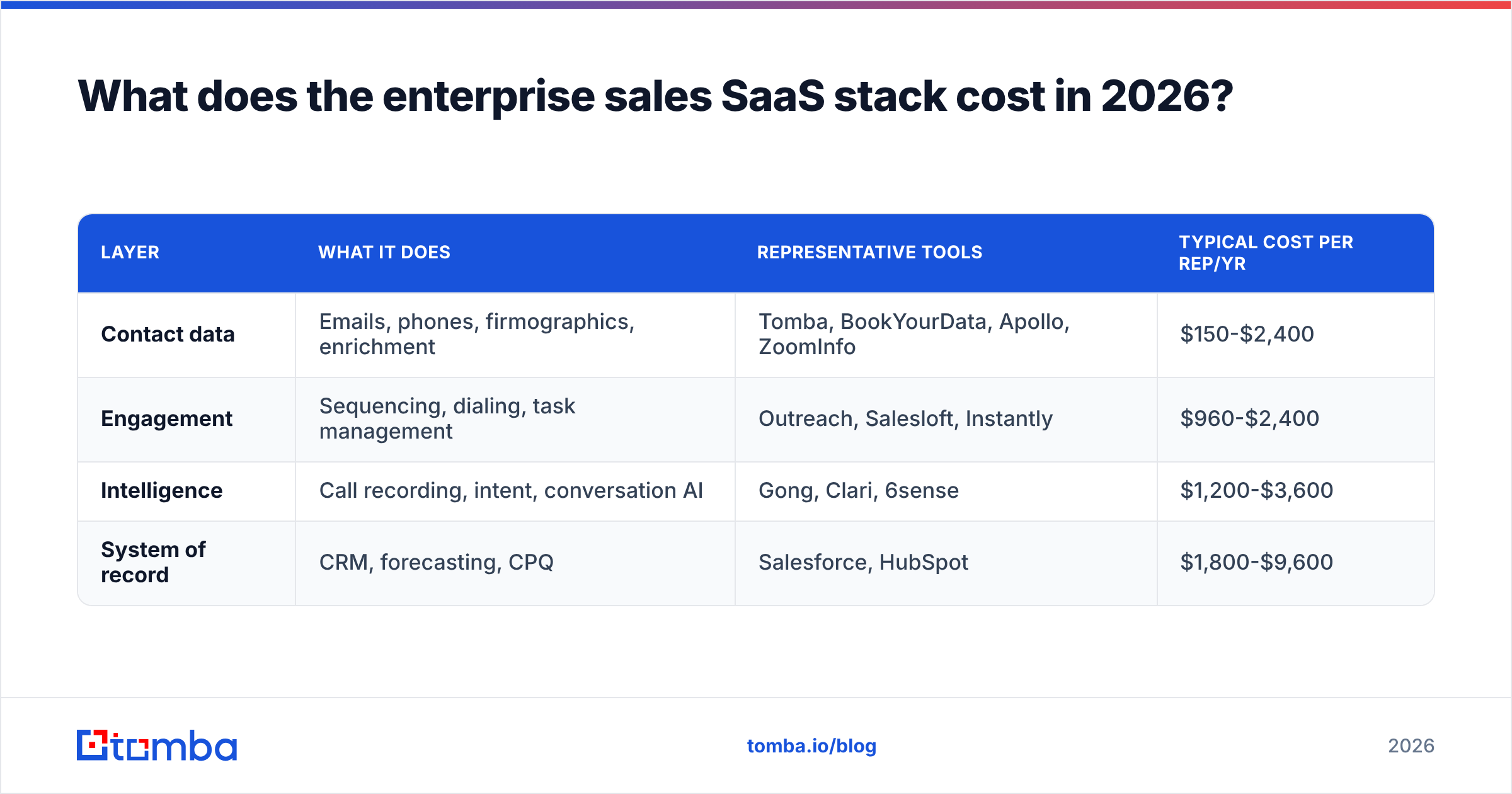
There are four layers, and teams consistently overspend on the top two while underspending on the bottom one.
| Layer | What it does | Representative tools | Typical cost per rep/yr |
|---|---|---|---|
| Contact data | Emails, phones, firmographics, enrichment | Tomba, BookYourData, Apollo, ZoomInfo | $150-$2,400 |
| Engagement | Sequencing, dialing, task management | Outreach, Salesloft, Instantly | $960-$2,400 |
| Intelligence | Call recording, intent, conversation AI | Gong, Clari, 6sense | $1,200-$3,600 |
| System of record | CRM, forecasting, CPQ | Salesforce, HubSpot | $1,800-$9,600 |
A fully loaded enterprise rep therefore sits somewhere between $4,100 and $18,000 per year in tooling before salary. At a $1.5M quota that's under 1.2% of the number even at the high end, so cost isn't the argument — overlap is. Most teams pay for firmographic data three times: once in the CRM enrichment plugin, once in the intent platform, and once in the prospecting tool.
The practical audit: list every tool that writes a contact record into your CRM. If more than one does, you have a deduplication problem masquerading as a data budget.
Where the data layer breaks#
Enterprise personas are the hardest contacts to source correctly. A VP of Infrastructure at a 12,000-person company doesn't publish an email anywhere, uses a nonstandard format, and often sits behind a catch-all domain that most verifiers return as "unknown." That last one is where most enterprise lists quietly rot: reps see "risky," skip the contact, and the account never gets multi-threaded.
Three habits fix most of it:
- Verify at send time, not at list-build time. A list built in January is roughly 25-30% decayed by December given normal job movement.
- Handle catch-alls explicitly. Use a catch-all verifier rather than dropping every unknown, or you'll systematically delete your largest accounts — big companies are disproportionately catch-all.
- Source by pattern, not by guess. Domain search returns the company's actual email format plus known contacts, which beats permutation guessing for accounts where a bounce costs you domain reputation.

Which qualification framework works for enterprise SaaS?#
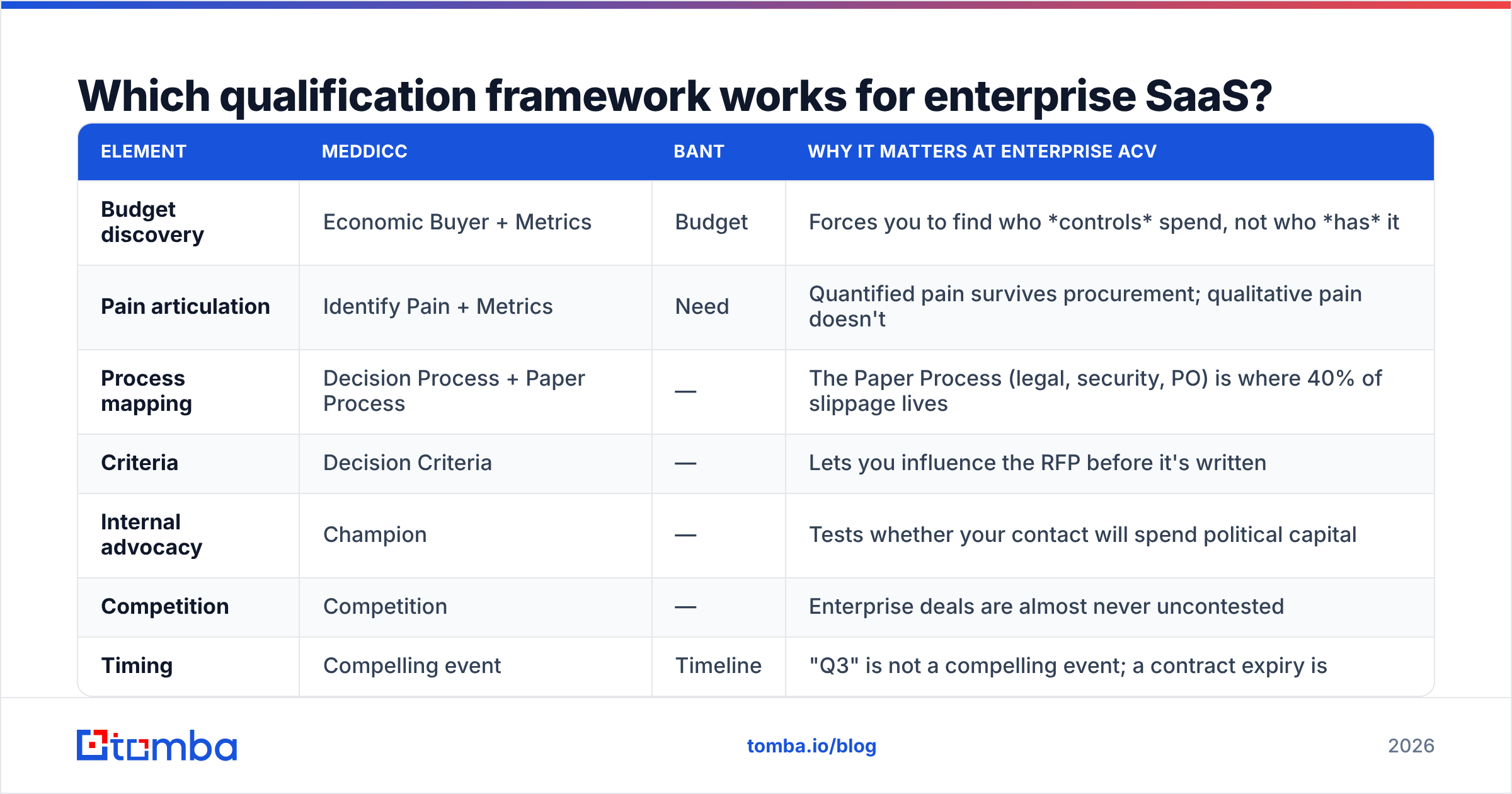
MEDDICC, with BANT as a lightweight filter at the top of funnel only. The reason is structural: BANT asks four questions a single person can answer, and enterprise has no single person.
| Element | MEDDICC | BANT | Why it matters at enterprise ACV |
|---|---|---|---|
| Budget discovery | Economic Buyer + Metrics | Budget | Forces you to find who controls spend, not who has it |
| Pain articulation | Identify Pain + Metrics | Need | Quantified pain survives procurement; qualitative pain doesn't |
| Process mapping | Decision Process + Paper Process | — | The Paper Process (legal, security, PO) is where 40% of slippage lives |
| Criteria | Decision Criteria | — | Lets you influence the RFP before it's written |
| Internal advocacy | Champion | — | Tests whether your contact will spend political capital |
| Competition | Competition | — | Enterprise deals are almost never uncontested |
| Timing | Compelling event | Timeline | "Q3" is not a compelling event; a contract expiry is |
The Paper Process addition (the second P in MEDDPICC) is the single highest-ROI change most teams can make to their qualification. Ask on the second call: "Walk me through what happens after we agree commercially — who touches the contract, and how long did the last vendor take?" Reps who ask this forecast within 15% accuracy. Reps who don't miss quarters by a full deal.
How do you build enterprise pipeline that isn't fake?#
Enterprise pipeline generation is account-first, contact-second. That's the inverse of mid-market outbound, where you buy 10,000 contacts and sequence them.
The account-first sequence:
- Define the ICP by fit signal, not size. "Companies over 1,000 employees" is not an ICP. "Companies over 1,000 employees running Snowflake with a posted req for a Data Governance Lead" is. The second list is 40 accounts, and every one is real.
- Build the buying committee map before you send anything. For each account, name 5-8 roles: economic buyer, technical evaluator, end-user champion, security reviewer, procurement contact. Use data enrichment to fill titles and reporting lines, then source contacts against that map.
- Multi-thread from message one. Send to four people in the same week with genuinely different angles — the VP gets the business outcome, the director gets the workflow problem, the IC gets the tool comparison. Not the same email with a different first name.
- Layer channels. Email plus LinkedIn plus phone outperforms any single channel by a wide margin at enterprise. LinkedIn outreach works best as the warm-up before the call, not as the ask.
- Track account engagement, not contact engagement. One reply from any of six contacts means the account is warm. Most sequencers report per-contact and hide this.
- Give it 90 days before judging. Enterprise outbound at 40-account scale produces 2-4 meetings a month, not 20. That's the correct number.
The failure mode here is importing mid-market metrics. If your VP measures the enterprise team on emails sent, you'll get 10,000 emails to 10,000 accounts and zero multi-threading. Measure accounts penetrated at depth ≥3 contacts instead.
How long is the enterprise sales cycle, and can you compress it?#
Median is 6-9 months for a $50K-$150K ACV deal and 12-18 months above $250K, based on aggregate benchmarks from vendor reviews on G2 and public SaaS metrics reporting. You can compress it, but only in specific places:
Compressible:
- Security review — pre-build a trust center, publish SOC 2, pre-fill the CAIQ. Saves 3-6 weeks.
- Pilot/POC scoping — define success criteria in writing before the pilot starts. Saves 4-8 weeks of "let's extend the trial."
- Legal — publish a standard MSA and a pre-negotiated DPA. Saves 2-4 weeks.
Not compressible:
- Budget cycles. If their fiscal year starts in February and the budget is allocated, no amount of urgency creates money in October.
- Committee consensus. Six people need to meet, and they meet on their calendar.
- Executive turnover. Nothing to do but multi-thread against it.
The honest framing: you don't shorten enterprise cycles, you start them earlier and stop wasting the middle. A deal that spends four months in "evaluation" with no scheduled next step isn't slow — it's dead and unlabeled.
What should a 2026 enterprise SaaS team actually measure?#
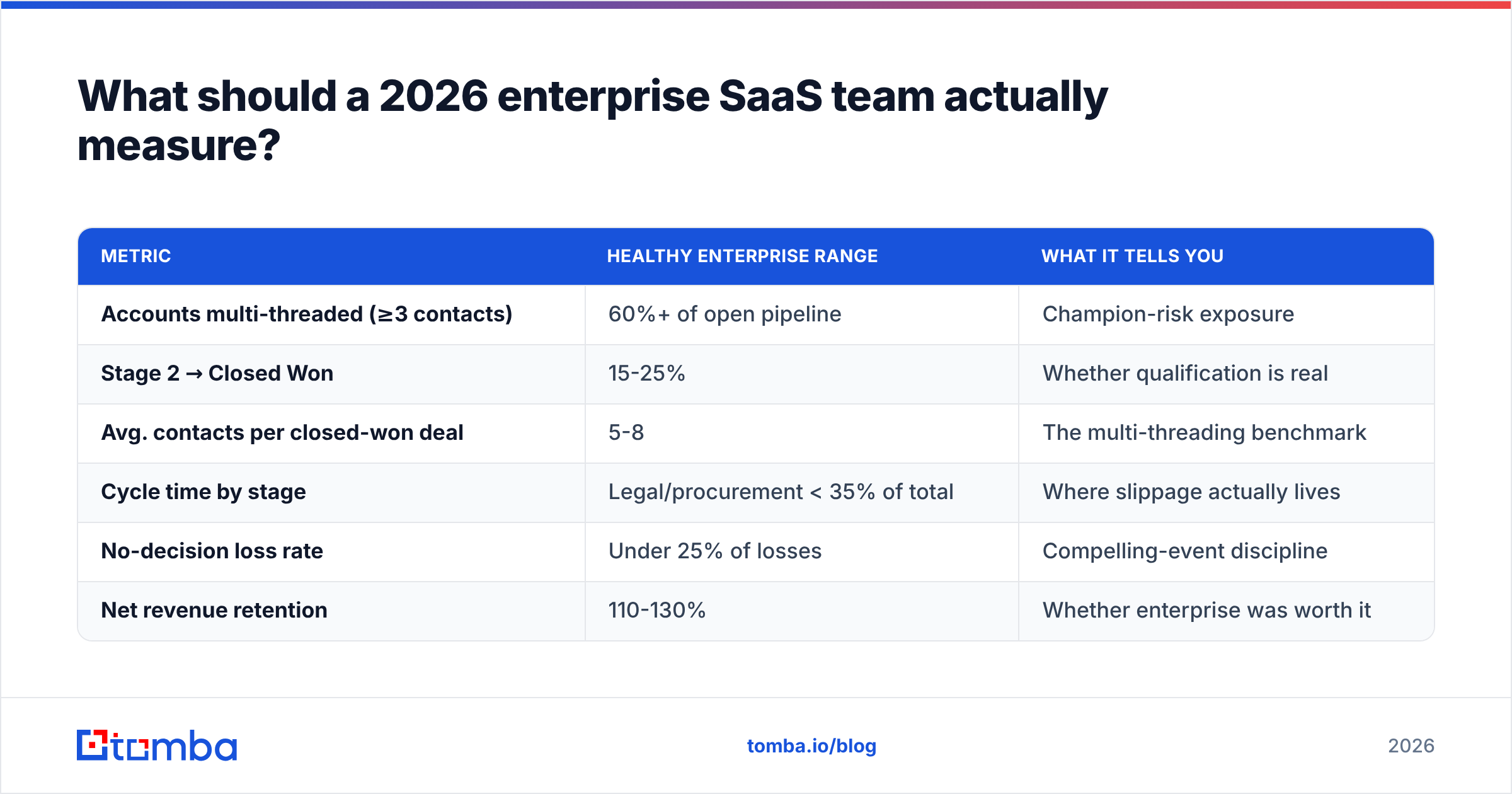
Six numbers. Everything else is noise for the board deck.
| Metric | Healthy enterprise range | What it tells you |
|---|---|---|
| Accounts multi-threaded (≥3 contacts) | 60%+ of open pipeline | Champion-risk exposure |
| Stage 2 → Closed Won | 15-25% | Whether qualification is real |
| Avg. contacts per closed-won deal | 5-8 | The multi-threading benchmark |
| Cycle time by stage | Legal/procurement < 35% of total | Where slippage actually lives |
| No-decision loss rate | Under 25% of losses | Compelling-event discipline |
| Net revenue retention | 110-130% | Whether enterprise was worth it |
Net revenue retention is the one that decides whether enterprise SaaS is the right motion for your company at all. Enterprise costs 3-5x more to acquire than mid-market. If those accounts don't expand, the CAC payback never closes and you've built an expensive logo collection. Gartner's research on B2B buying consistently lands on the same point: the buying group, not the buyer, determines the outcome — and expansion follows the same rule.
What's changed for enterprise SaaS in 2026?#
Four things worth adjusting for:
- AI-assisted buying research. Committees arrive at the first call having already read your docs, your G2 reviews, and three competitor comparisons generated by an assistant. Discovery calls that start with "so tell me about your business" now read as unprepared. Come with a hypothesis.
- Security review moved earlier. It used to sit at the end. Now security reviewers are pulled into the second or third meeting at many enterprises, which is good — earlier failure is cheaper failure.
- Consolidation pressure. Procurement teams are actively cutting vendor counts. "We replace three tools" is a stronger 2026 pitch than "we're 20% better at one thing."
- Deliverability tightened. Google and Microsoft's bulk sender requirements mean enterprise outbound now needs authenticated domains and clean lists as a hard prerequisite. Check your SPF record and keep bounce rates under 2% or your best-researched sequence never lands. HubSpot's own reporting on sending practices reflects the same shift.
None of these change the fundamentals. They change the cost of getting the basics wrong.
Build the account map before you build the sequence#
The pattern across every enterprise team that works: they know exactly who sits on the buying committee at each of their 40-80 target accounts, and they can reach all of them. Not one person. All of them.
That starts with accurate contact data at the account level — the VP, the two directors under them, the security reviewer, and the procurement lead. Tomba's email finder sources contacts by domain and role so you can fill a committee map instead of chasing one name, with domain search returning a company's actual email pattern and bulk verification keeping the list clean before it hits your sequencer. The free tier gives you 25 searches a month to test it against your real target accounts; Tomba pricing starts at $49/mo for Starter and $99/mo for Growth when you're ready to map accounts at scale.
Map the committee first. The sequence is the easy part.
Related guides#
Ready to find emails that actually work?
Join 150,000+ professionals who stopped guessing and started sending. Free credits on signup — no credit card required.
Get the Tomba newsletter
Practical outbound tactics and product updates — once every two weeks.
About the author