Enterprise Solution Sales in 2026: The Complete Playbook
Enterprise deals are not big SMB deals. They involve 6-11 stakeholders, 9-18 month cycles, and a procurement gate that kills feature pitches. Here is the process, stack, and math that actually closes them.
TL;DR
- Enterprise solution sales is not "SMB selling with a bigger number on the contract." The unit of work is a buying committee of 6-11 people, not a single champion, and the cycle runs 9-18 months.
- The deals you lose are rarely lost to a competitor. Gartner's research consistently shows the most common outcome in complex B2B purchases is no decision — the committee stalls out.
- Methodology matters less than qualification discipline. MEDDICC, Challenger, and SPIN all work; running none of them consistently does not.
- Your pipeline math changes shape: fewer accounts, deeper research, multi-threaded contact coverage. One verified email per account is a losing configuration.
- Contact data is the quiet bottleneck. If you cannot reach the CFO, the security reviewer, and the end-user lead, you are running a single-threaded deal that dies when your champion changes jobs.
What is enterprise solution sales?#
Enterprise solution sales is the practice of selling a configured, multi-component solution to a large organization where the purchase is decided by a committee, validated by procurement and security, and justified against a business case rather than a feature list.
Think of it like renovating a hospital wing versus selling someone a nice chair. The chair sale is a preference — one person likes it, they buy it. The hospital wing involves the facilities director, the compliance officer, the finance controller, the surgeons who will actually use the space, and a procurement team whose entire job is to make the price go down. Nobody has unilateral authority. Everybody has veto power.
That asymmetry is the whole discipline. The classic definition of solution selling — diagnose the pain, then prescribe a configured remedy — is still directionally right, but it was written for a world where one VP could sign. In 2026, the diagnosis has to be run across an entire committee, and each member is diagnosing a different pain.
Three things define an enterprise motion:
- Deal size above $50K ACV. Below that, the buying process usually stays inside one budget holder's discretion and the enterprise apparatus never activates.
- Formal procurement involvement. Security questionnaires, SOC 2 review, MSA redlines, vendor onboarding portals, sometimes an RFP.
- A multi-quarter cycle. Budget calendars, not buyer urgency, dictate close dates.
If your deals do not have all three, you are running mid-market sales and should not adopt the overhead of an enterprise process.
How is enterprise solution sales different from transactional selling?#
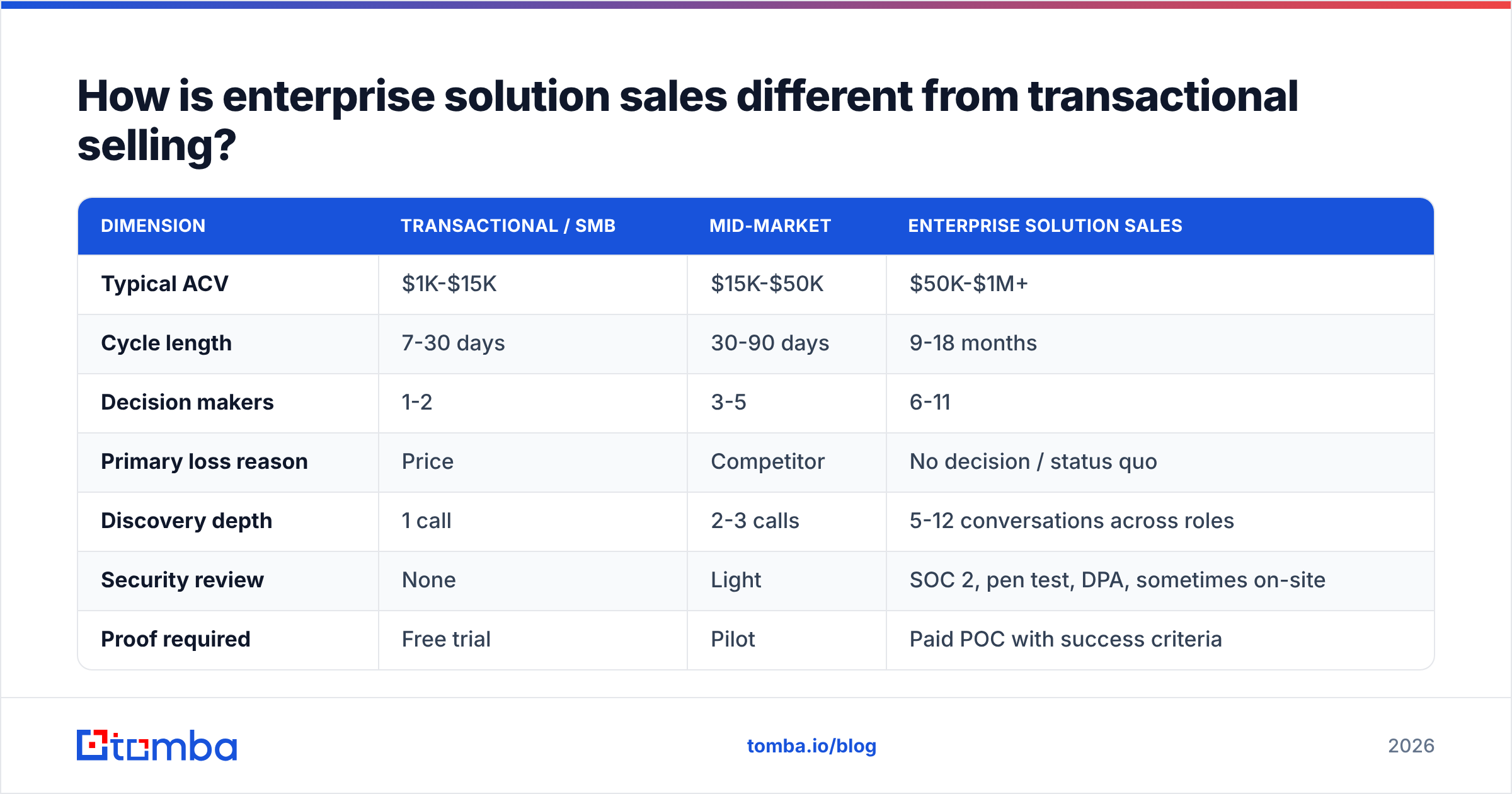
The differences are structural, not stylistic. Running a transactional playbook at enterprise scale produces the same failure every time: a great demo, a champion who loves you, and a deal that evaporates in legal review.
| Dimension | Transactional / SMB | Mid-market | Enterprise solution sales |
|---|---|---|---|
| Typical ACV | $1K-$15K | $15K-$50K | $50K-$1M+ |
| Cycle length | 7-30 days | 30-90 days | 9-18 months |
| Decision makers | 1-2 | 3-5 | 6-11 |
| Primary loss reason | Price | Competitor | No decision / status quo |
| Discovery depth | 1 call | 2-3 calls | 5-12 conversations across roles |
| Security review | None | Light | SOC 2, pen test, DPA, sometimes on-site |
| Proof required | Free trial | Pilot | Paid POC with success criteria |
| Contacts needed per account | 1-2 | 3-5 | 8-15 |
| Rep quota model | Volume | Blended | 3-6 deals per year |
| Post-sale | Self-serve | CSM pool | Named CSM + implementation team |
Read the last three rows again. An enterprise rep closing four deals a year cannot afford a 20% data accuracy rate on their contact list — every bad email is a percentage point off their annual number. That is a very different economic situation from an SDR burning through 3,000 records a month.
Who actually sits in an enterprise buying committee?#
This is where most reps under-model the deal. You are not selling to a persona. You are selling to a group of people with conflicting incentives who have to agree in a room you are not in.
- The Economic Buyer. Controls the budget line. Cares about payback period, risk of doing nothing, and whether this fits the current fiscal plan. Usually a VP or C-level, usually invisible until late.
- The Champion. Feels the pain daily and gains status if the project succeeds. Your job is to arm them with an internal business case, not to be their friend.
- The Technical Evaluator. Security, IT, or engineering. Cannot say yes, can absolutely say no. Their questions are binary and documented.
- The End-User Lead. Will be blamed if adoption fails. Usually left out of the sales process and then given veto power at the worst moment.
- Procurement. Compensated on savings. Their leverage is time — they slow the deal until you discount. Not an enemy, just a different game.
- The Blocker. Owns the incumbent tool, built the internal workaround, or simply does not want the change. Every enterprise deal has one. Find them early or meet them at the finish line.
The practical implication: a deal with one contact is not a deal, it is a hope. Multi-threading — having live relationships with at least four committee members — is the single highest-correlation behavior with enterprise close rates. It also happens to be a contact-data problem before it is a selling problem, which is why the prospecting stack section below matters more than it looks.
What does the enterprise solution sales process look like stage by stage?#
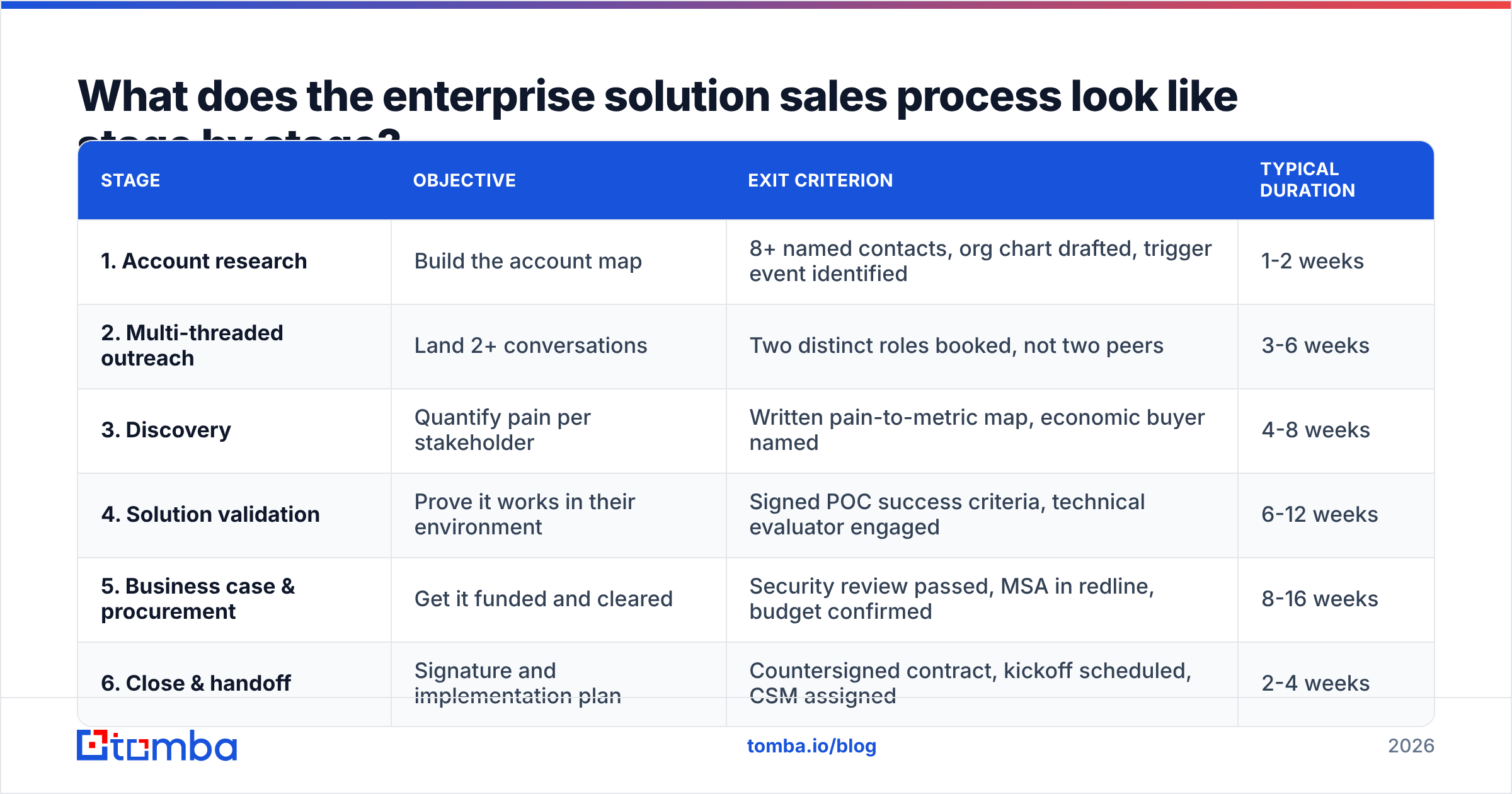
A workable enterprise pipeline has six stages, and each one has an exit criterion that is verifiable by someone other than the rep. "Prospect seems interested" is not an exit criterion.
| Stage | Objective | Exit criterion | Typical duration |
|---|---|---|---|
| 1. Account research | Build the account map | 8+ named contacts, org chart drafted, trigger event identified | 1-2 weeks |
| 2. Multi-threaded outreach | Land 2+ conversations | Two distinct roles booked, not two peers | 3-6 weeks |
| 3. Discovery | Quantify pain per stakeholder | Written pain-to-metric map, economic buyer named | 4-8 weeks |
| 4. Solution validation | Prove it works in their environment | Signed POC success criteria, technical evaluator engaged | 6-12 weeks |
| 5. Business case & procurement | Get it funded and cleared | Security review passed, MSA in redline, budget confirmed | 8-16 weeks |
| 6. Close & handoff | Signature and implementation plan | Countersigned contract, kickoff scheduled, CSM assigned | 2-4 weeks |
The stage that kills most forecasts is stage 5. Reps mark a deal "verbal yes" and forecast it for the quarter, then discover the security questionnaire has 240 questions and legal has a six-week queue. Build procurement lead time into your close date from stage 3 onward, and ask directly: "Walk me through what happens between our handshake and a signature. Who touches it?"
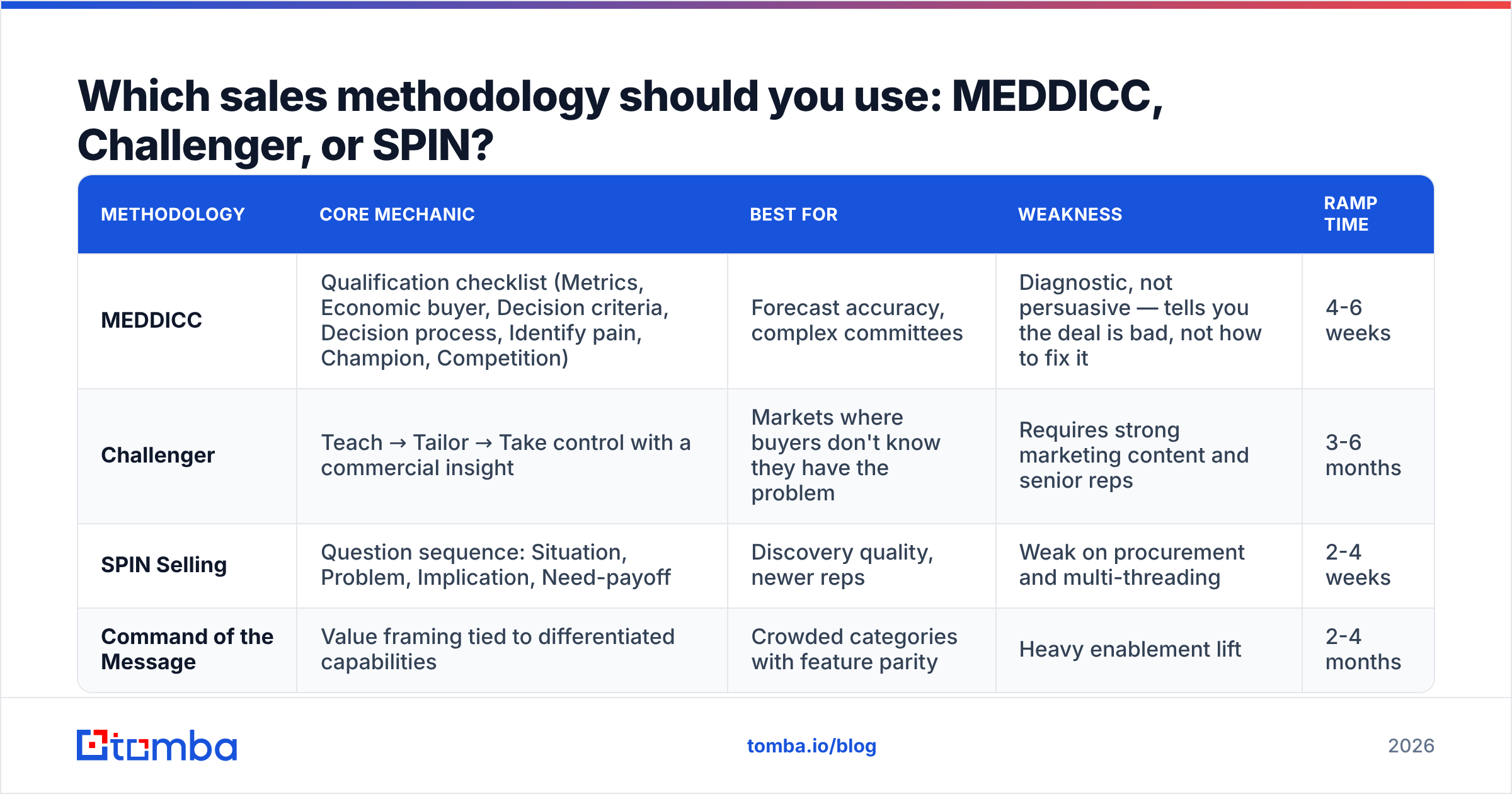
Which sales methodology should you use: MEDDICC, Challenger, or SPIN?#
All three work. What does not work is switching every quarter because a new VP arrived. Pick one, instrument your CRM around it, and coach to it.
| Methodology | Core mechanic | Best for | Weakness | Ramp time |
|---|---|---|---|---|
| MEDDICC | Qualification checklist (Metrics, Economic buyer, Decision criteria, Decision process, Identify pain, Champion, Competition) | Forecast accuracy, complex committees | Diagnostic, not persuasive — tells you the deal is bad, not how to fix it | 4-6 weeks |
| Challenger | Teach → Tailor → Take control with a commercial insight | Markets where buyers don't know they have the problem | Requires strong marketing content and senior reps | 3-6 months |
| SPIN Selling | Question sequence: Situation, Problem, Implication, Need-payoff | Discovery quality, newer reps | Weak on procurement and multi-threading | 2-4 weeks |
| Command of the Message | Value framing tied to differentiated capabilities | Crowded categories with feature parity | Heavy enablement lift | 2-4 months |
The pragmatic answer for most teams: run MEDDICC as your CRM schema and SPIN as your call structure. MEDDICC tells your forecast the truth; SPIN gets the information MEDDICC needs. Layer Challenger-style insight into your outbound messaging where you actually have proprietary data to teach with. HubSpot's sales research library is a reasonable free source for benchmark numbers if you need external proof points for a business case.
One caution: methodology fields in a CRM are only as honest as the manager reviewing them. A pipeline where 100% of deals have a "confirmed economic buyer" is a pipeline where nobody checked.
How do you build the account list and contact data for enterprise deals?#
Here is the part nobody puts in the playbook, because it is unglamorous: enterprise selling is bottlenecked by contact coverage, not by charisma.
Your target list is small — 50 to 200 named accounts per rep, not 5,000. But the depth per account is severe. You need the VP of Ops, her two directors, the security lead, the finance partner, and the person who actually runs the incumbent tool. That is 8-15 verified contacts per account, refreshed continuously because enterprise org charts change every quarter.
Three failure modes are common:
- Buying a static list. You pay for 10,000 records, 30% are stale within six months, and your bounce rate torches your sending domain right when you need it.
- Relying on one contact per account. Your champion leaves, and a nine-month deal resets to zero.
- Scraping without verification. Guessed patterns like
first.last@company.comare right often enough to feel productive and wrong often enough to damage deliverability.
The workable pattern is a build-and-verify loop. Start from the account domain, pull the org's known email patterns, then verify before anything enters your sequencer.
- Use domain search to enumerate the contacts publicly associated with a target company's domain, which gives you the raw org map to work from.
- Resolve specific named stakeholders you found on LinkedIn or in an earnings call transcript with the email finder.
- Run every address through an email verifier before it touches your sequencer. On enterprise domains, catch-all configurations are common, so a tool that distinguishes catch-all from invalid matters more than raw volume.
- Fill in firmographic and technographic context with data enrichment so your outreach references the buyer's actual stack rather than a generic pain statement.
For phone-first motions — and enterprise still rewards them, because a 40-person committee generates a lot of "who is this again?" — pair email coverage with a phone finder so your multi-threading is not single-channel. If your team is running this at volume across a named account list, Tomba pricing starts with a free tier at 25 searches per month, then $49/mo Starter, $99/mo Growth, and $249/mo Pro. For a rep carrying a $1.2M quota across 80 accounts, that is a rounding error against one recovered deal.
Compare that math honestly against the alternatives. Full-suite platforms like ZoomInfo or Apollo bundle data with sequencing and intent signals, which is genuinely useful if you want one vendor. They also price at a multiple that only makes sense if you actually use the sequencing layer. Peer providers such as BookYourData take a pay-as-you-go approach that suits teams with lumpy, campaign-driven data needs rather than continuous refresh. There is no universally correct answer here — check current user reports on G2 for your specific segment, because accuracy varies dramatically by region and industry vertical.
What metrics actually matter in enterprise solution sales?#
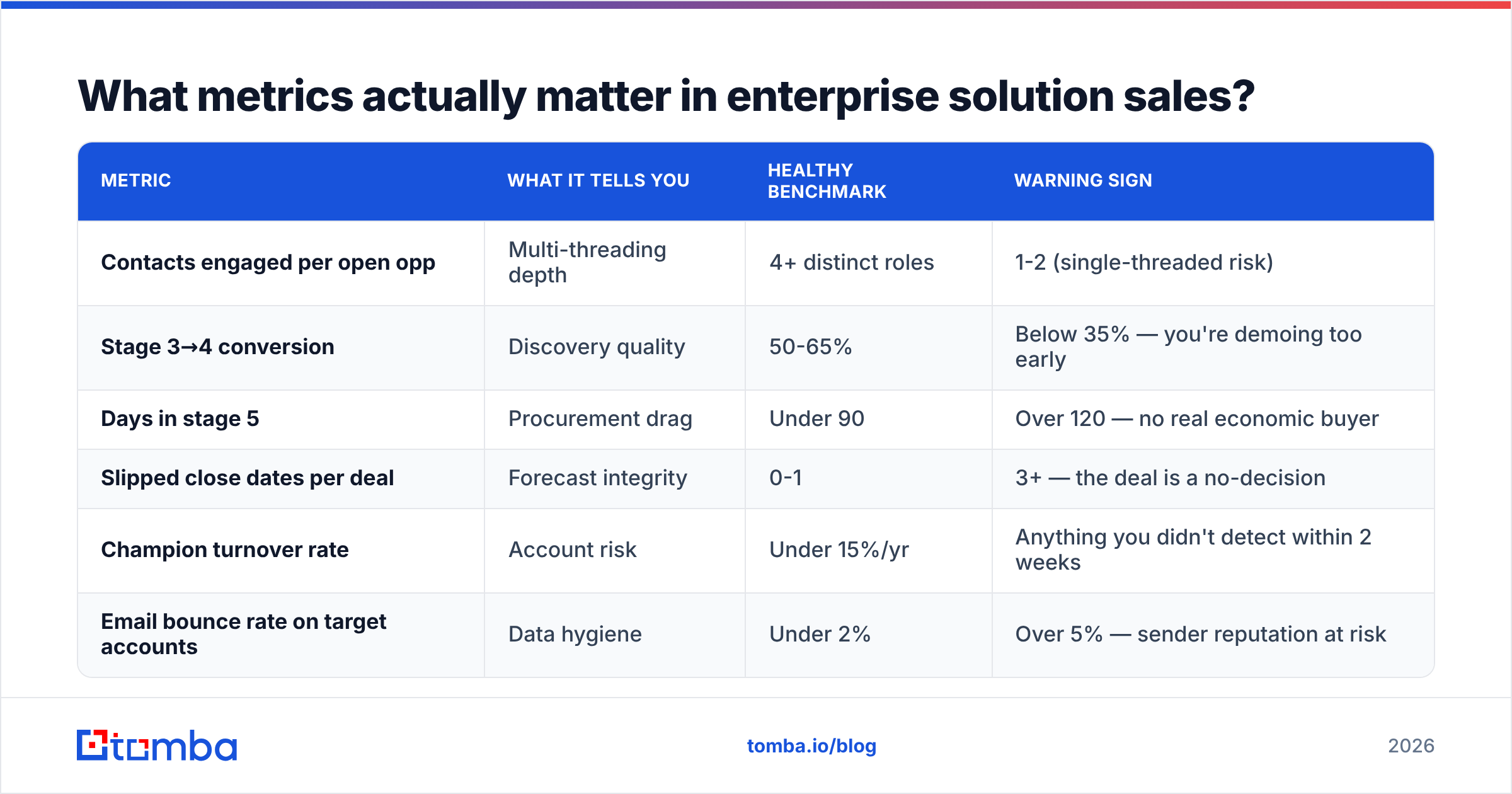
Activity metrics that work in SMB — calls made, emails sent — are nearly meaningless when a rep closes four deals a year. You need leading indicators that describe deal health, not rep busyness.
| Metric | What it tells you | Healthy benchmark | Warning sign |
|---|---|---|---|
| Contacts engaged per open opp | Multi-threading depth | 4+ distinct roles | 1-2 (single-threaded risk) |
| Stage 3→4 conversion | Discovery quality | 50-65% | Below 35% — you're demoing too early |
| Days in stage 5 | Procurement drag | Under 90 | Over 120 — no real economic buyer |
| Slipped close dates per deal | Forecast integrity | 0-1 | 3+ — the deal is a no-decision |
| Champion turnover rate | Account risk | Under 15%/yr | Anything you didn't detect within 2 weeks |
| Email bounce rate on target accounts | Data hygiene | Under 2% | Over 5% — sender reputation at risk |
That last row is the one enterprise teams skip. Poor list hygiene degrades email deliverability across the whole domain, which means your carefully researched message to a CFO lands in quarantine and you never find out. Verify before you send, every time.
What kills enterprise deals most often?#
Ranked by how often it actually happens, not by how dramatic it sounds:
- No compelling event. The pain is real, the budget exists, and nothing forces a decision this fiscal year. Manufacture urgency by tying to a dated event — a contract renewal, a compliance deadline, a reorg — or accept a longer cycle honestly.
- Single-threading. One champion, no backup. Fatal about a third of the time, and always at the worst moment.
- Selling features into a business-case decision. The committee is not evaluating your product. They are evaluating whether this project beats the other seven projects competing for the same capital.
- Ignoring procurement until the end. Ask about the process in month two, not month eight.
- Discounting to accelerate. It signals your original price was fiction and teaches procurement to wait you out next renewal.
Gartner's work on B2B buying behavior is worth reading directly — their sales research documents how much of the buying journey now happens without a rep present, which reframes what your outreach is even for. It is not to walk the buyer through a funnel. It is to be useful in the gaps between their own internal research.
How do you start an enterprise motion from scratch?#
If you are moving upmarket from mid-market, sequence it like this:
- Month 1: Define ICP by firmographics that predict deal size, not by whoever answered your emails. Build a 100-account target list.
- Month 2: Map the buying committee for your top 20 accounts. Eight-plus verified contacts each. This is the research investment that makes everything downstream cheaper.
- Month 3: Instrument the CRM with MEDDICC fields and enforce exit criteria in pipeline reviews. Expect your pipeline to shrink by 40% when you apply real qualification. That is the system working.
- Month 4-6: Run outreach multi-threaded from day one. Two roles minimum per account, distinct messaging per role.
- Month 7+: Review no-decision losses specifically. They are your richest source of process fixes, and most teams never analyze them because they are not competitive losses.
Expect 12-18 months before the model produces predictable revenue. Enterprise sales is a long-duration asset. Teams that abandon it at month eight burn the investment right before it starts compounding.
Where should you start today?#
The cheapest improvement available to most enterprise teams is not a new methodology or a new sequencer. It is fixing the contact layer so that multi-threading is actually possible.
If your reps are single-threaded because they only have one email per account, start there. Use the Tomba Email Finder to build out full committee coverage on your top 20 target accounts — every director, every technical evaluator, every finance partner — then verify each address before it enters a sequence. The free tier gives you 25 searches to test the accuracy on accounts you already know, which is the only benchmark that means anything. Run it against ten contacts whose emails you can confirm, count the hits, and decide from data rather than from a vendor's marketing page.
Enterprise deals are won by the rep who knows more people in the building. Everything else is downstream of that.
Related guides#
Ready to find emails that actually work?
Join 150,000+ professionals who stopped guessing and started sending. Free credits on signup — no credit card required.
Get the Tomba newsletter
Practical outbound tactics and product updates — once every two weeks.
About the author